S T U D Y P R O T O C O L
Open Access
Implementing goals of care conversations
with veterans in VA long-term care setting:
a mixed methods protocol
Anne E. Sales
1,2*, Mary Ersek
3,4, Orna K. Intrator
5,6, Cari Levy
7,8, Joan G. Carpenter
3, Robert Hogikyan
1,2,
Helen C. Kales
1,2, Zach Landis-Lewis
1, Tobie Olsan
5,6, Susan C. Miller
9, Marcos Montagnini
1,2,
Vyjeyanthi S. Periyakoil
10,11and Sheri Reder
12Abstract
Background:The program“Implementing Goals of Care Conversations with Veterans in VA LTC Settings”is proposed in partnership with the US Veterans Health Administration (VA) National Center for Ethics in Health Care and the Geriatrics and Extended Care Program Offices, together with the VA Office of Nursing Services. The three projects in this program are designed to support a new system-wide mandate requiring providers to conduct and systematically record conversations with veterans about their preferences for care, particularly life-sustaining treatments. These treatments include cardiac resuscitation, mechanical ventilation, and other forms of life support. However, veteran preferences for care go beyond whether or not they receive life-sustaining treatments to include issues such as whether or not they want to be hospitalized if they are acutely ill, and what kinds of comfort care they would like to receive.
Methods:Three projects, all focused on improving the provision of veteran-centered care, are proposed. The projects will be conducted in Community Living Centers (VA-owned nursing homes) and VA Home-Based Primary Care programs in five regional networks in the Veterans Health Administration. In all the projects, we will use data from context and barrier and facilitator assessments to design feedback reports for staff to help them understand how well they are meeting the requirement to have conversations with veterans about their preferences and to document them appropriately. We will also use learning collaboratives—meetings in which staff teams come together and problem-solve issues they encounter in how to get veterans’ preferences expressed and documented, and acted on—to support action planning to improve performance.
Discussion: We will use data over time to track implementation success, measured as the proportions of veterans in Community Living Centers (CLCs) and Home-Based Primary Care (HBPC) who have a documented goals of care conversation soon after admission. We will work with our operational partners to spread approaches that work throughout the Veterans Health Administration.
Keywords: Long-term care, Goals of care conversations, Implementation science, Feedback interventions,
Learning collaboratives
* Correspondence:[email protected] 1
Center for Clinical Management Research, VA Ann Arbor Healthcare System, Ann Arbor, MI, USA
2University of Michigan Medical School, 300 N. Ingalls Street, Room 1161-I, Ann Arbor, MI 48109-5423, USA
Full list of author information is available at the end of the article
Background
Goals of care (GoC) conversations are critical in long-term care settings. Older people in these settings are vulnerable, frail, and often face critical decisions about future care, particularly life-sustaining treatments (LSTs). Many have experienced serious health problems that could trigger the need for LSTs, or are likely to ex-perience such within the next year. Conversations about LST preferences are frequently held with veterans and their families, and documentation of care preferences in an advance directive is routine in most Veterans Health Administration (VA) settings. While admission to a long-term care service or setting is an appropriate trig-ger for GoC conversations, practices vary across VA Community Living Centers (CLCs) and VA Home-Based Primary Care (HBPC) programs about how and when these conversations should be held after admission.
The VA National Center for Ethics in Health Care has updated Handbook 1004.03, “Life Sustaining Treatment Decisions: Eliciting, Documenting, and Honoring Patients’ Values, Goals, and Preferences”. Through this update, licensed prescribing practitioners throughout all care delivery settings in the VA will be required to hold GoC conversations with veterans and their families, document the findings in a standard template installed in a consist-ent, prominent place within the VA electronic health record, and develop care plans consistent with the goals expressed by the veterans and their families. While the focus of the conversation is on LST decisions faced by veterans with life-limiting events (such as end-stage heart failure or terminal cancer), the intent is to elicit, document, and respect veterans’ preferences for care, which is important for all veteran populations.
The evidence for the VA LST initiative and similar programs is mixed [1], but a recent narrative review describes improved outcomes for patients who have en-gaged with their clinicians in GoC discussions [2]. Out-comes that may be improved by timely GoC include better quality of life for patients, less aggressive medical care near the end of life, and earlier referral to hospice. Family members report better adjustment to bereave-ment [2]. Studies have also shown that these improved outcomes can be achieved without increasing anxiety, depression, and hopelessness for patients, and can lead to a reduction in distress for surrogates who make deci-sions about end-of-life care for family members [2]. Our primary rationale for engaging in this program of imple-mentation support is the fact that the GOC conversation program has been initiated by VA’s national program office, with which we are partnering.
The new requirements for timing and documentation of GoC conversations provide a unique opportunity for CLC and HBPC staff to improve current practices by ensuring that these conversations take place and are
documented using the new standardized template speci-fied in the updated handbook. Implementation of com-plex interventions such as GoC conversations, which require significant and sustained behavior change on the part of clinical team members, veterans, and their fam-ilies, is a process that takes time and focused attention to ensure it is sustained and becomes the norm, a “ cul-ture change”. A shared decision-making framework can support this effort by providing veterans and their fam-ilies or caregivers with information and tools to more fully participate in the process. Our team for the Quality Enhancement Research Initiative (QUERI) program, which includes an Implementation and Data Core, will test the design and delivery of implementation strategies to optimize integration of the LST across several VA regional networks and facilities. Our overall goal is to support veteran-centered implementation of GoC con-versations across the long-term care services and sup-ports continuum in the VA. This program will engage a diverse group of investigators and VA operational part-ners, including the National Center for Ethics in Health Care, Geriatrics and Extended Care program offices, and the Office of Nursing Services.
We will accomplish our overall impact goal through the following specific aims:
1. Assess variation in practice measures related to implementation of GoC conversations in CLCs and HBPC programs over time nationally
2. Design, implement, and test tools to improve performance in five geographically diverse VA regional networks, specifically:
(a) Feedback reports to provide information on progress towards key processes and outcomes (b)Learning collaboratives to support action
planning to address performance gaps 3. Use measures derived from two widely used
implementation research frameworks, the Consolidated Framework for Implementation Research and the Theoretical Domains Framework to assess barriers and facilitators to implementing GoC conversations
4. Use audit with feedback interventions, coupled with action planning through learning collaboratives to conduct rapid tests of different designs within these strategies to overcome barriers to implementing GoC conversations in CLCs and HBPC
Methods/Design
Overview of the three program projects
be supported by our Implementation and Data Core (IDC) in deploying our common implementation strategy, audit with feedback coupled with action plans developed through learning collaboratives. The proposed IDC will collect and report process and outcome measures using routinely col-lected administrative and clinical data combined with data collected as part of the implementation processes. We note that in all projects, and throughout the Program, as we discuss eliciting GoC from veterans, we will also in-volve family members or other surrogates as necessary, depending on an individual veteran’s cognitive status and ability to participate.
Our work is planned as quality improvement (QI). The VA has developed policies which permit operational QI projects to be published under oversight from local, regional, or national program offices (http://www.va.gov/ vhapublications/searchresults.cfm?ST=Adv&RPP=20& SQ=www.va.gov/vhapublications&RS=741). In this case, our program has been deemed QI by the VA Ann Arbor Healthcare System Research and Development Committee, and is being conducted under the auspices both of national program offices (the VA National Center for Ethics in Health Care and Geriatrics and Extended Care) and local programs (local and regional Geriatrics and Extended Care committees).
The first of the three projects, Implementing Goals of Care Conversations in CLCs, is intended to be com-pleted in the first year of the 5-year program. The goal is to work closely with CLCs in one regional network to implement the guidance in the updated Handbook, fo-cusing on supporting the implementation of eliciting goals related to life-sustaining treatment and preferences regarding the setting of care.
The second project, Partnership to Enhance Resident Outcomes: Collaborative Care Plans for CLC Residents with Dementia, will be conducted during years 2 through 5. It also extends the Handbook guidance and builds on GoC conversations and documentation of veteran preferences to develop personalized care plans for veterans with dementia living in CLCs in two re-gional networks. Project 2 focuses on deepening the care team’s use of goals, preferences, and values elicited during the GoC conversations by expanding discussions to encompass choices about therapeutic approaches for pain and other symptoms; use of medications and non-pharmacologic strategies for behavior management; and honoring lifestyle preferences (for example, waking, meals, sleeping times, and dietary choices) that affect quality of life.
The third project,Implementing Goals of Care Conver-sations in HBPC, will be conducted during years 2 through 5 of the program. Similar to the first project, the overall goal is to support implementation of the up-dated Handbook guidance in HBPC programs in two
additional regional networks. As in the first project, we will support staff in completing and documenting GoC conversations during the first or second HBPC visit.
Further information about the first and third projects are given in Additional file 1. Project 2 will be described in a separate manuscript. We will form a Steering Commit-tee comprised of our operational partners, a family mem-ber of a veteran who died in a VA CLC, leadership from our Program, and others as recommended by the Quality Enhancement Research Initiative (QUERI) Program, which is our primary funding body.
Implementation and Data Core
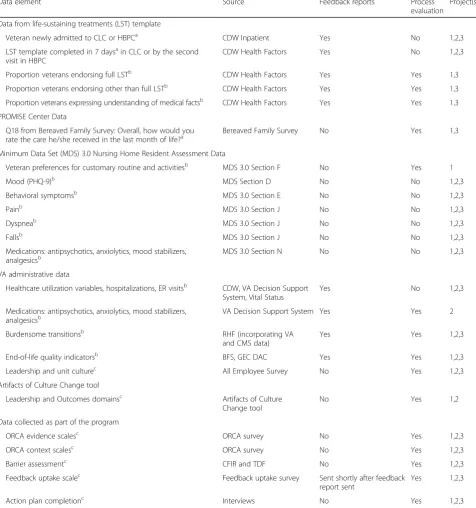
The Implementation and Data Core (IDC) will work in concert with the full project team to support our aims. The data component of the Core will compile, analyze, and report both routinely collected administrative and clinical data (described in Table 1) from several sources within VA, as well as data collected specifically for this project. The IDC will employ strategies to support inte-gration of best practices and minimize variation in prac-tices across sites. In all cases, a key underlying principle is to keep the implementation burden on staff to a mini-mum, by supporting project efforts through the IDC to the greatest extent possible.
Common implementation strategies
We have specifically selected a coupled strategy of audit with feedback and learning collaboratives to generate action planning in order to optimize the effect of both strategies. Both strategies have been used extensively and been found to be associated with mixed effectiveness in promoting desired provider behavior change [3–8]. Each has been studied, although with differing levels of rigor. Although there is considerable information about some aspects of each strategy, and despite the fact that learning collaboratives can provide action planning, required for optimal feedback uptake, they have not been studied as a coupled intervention [9]. Further detail on our implemen-tation strategies is provided in Additional file 2.
Implementation activities
Guiding frameworks
adopted by many VA and non-VA groups in the USA and other countries. It has primarily been applied through semi-structured individual and focus group interview guides to elicit barriers and facilitators in five domains: Intervention Characteristics; Outer Setting; Inner Setting;
Characteristics of Individuals; and Process. Survey in-struments based on the CFIR have been developed and are currently under review.
The TDF is also a widely used framework in imple-mentation research that was initially developed from
Table 1Program outcomes and measures
Data element Source Feedback reports Process
evaluation
Project(s)
Data from life-sustaining treatments (LST) template
Veteran newly admitted to CLC or HBPCa CDW Inpatient Yes No 1,2,3
LST template completed in 7 daysain CLC or by the second visit in HBPC
CDW Health Factors Yes No 1,2,3
Proportion veterans endorsing full LSTb CDW Health Factors Yes Yes 1,3
Proportion veterans endorsing other than full LSTb CDW Health Factors Yes Yes 1,3
Proportion veterans expressing understanding of medical factsb CDW Health Factors Yes Yes 1,3
PROMISE Center Data
Q18 from Bereaved Family Survey: Overall, how would you
rate the care he/she received in the last month of life?a Bereaved Family Survey No Yes 1,3
Minimum Data Set (MDS) 3.0 Nursing Home Resident Assessment Data
Veteran preferences for customary routine and activitiesb MDS 3.0 Section F No Yes 1
Mood (PHQ-9)b MDS Section D No No 1,2,3
Behavioral symptomsb MDS 3.0 Section E No No 1,2,3
Painb MDS 3.0 Section J No No 1,2,3
Dyspneab MDS 3.0 Section J No No 1,2,3
Fallsb MDS 3.0 Section J No No 1,2,3
Medications: antipsychotics, anxiolytics, mood stabilizers, analgesicsb
MDS 3.0 Section N No No 1,2,3
VA administrative data
Healthcare utilization variables, hospitalizations, ER visitsb CDW, VA Decision Support System, Vital Status
Yes No 1,2,3
Medications: antipsychotics, anxiolytics, mood stabilizers, analgesicsb
VA Decision Support System Yes Yes 2
Burdensome transitionsb RHF (incorporating VA and CMS data)
Yes Yes 1,2,3
End-of-life quality indicatorsb BFS, GEC DAC Yes Yes 1,2,3
Leadership and unit culturec All Employee Survey No Yes 1,2,3
Artifacts of Culture Change tool
Leadership and Outcomes domainsc Artifacts of Culture Change tool
No Yes 1,2
Data collected as part of the program
ORCA evidence scalesc ORCA survey No Yes 1,2,3
ORCA context scalesc ORCA survey No Yes 1,2,3
Barrier assessmentc CFIR and TDF No Yes 1,2,3
Feedback uptake scalec Feedback uptake survey Sent shortly after feedback report sent
Yes 1,2,3
Action plan completionc Interviews No Yes 1,2,3
Key (how variables are used in analysis): a
Primary outcome b
Secondary outcome c
health behavior change theories focused primarily on the individual level [11]. It has since been used in many im-plementation studies [12], and several interview guides have been developed. Like the CFIR, it has primarily been used qualitatively, administered through semi-structured interviews; however, a survey instrument has been devel-oped [13] based on the most current version of the TDF [14]. This updated version has 14 TDF domains: Know-ledge; Skills; Social/Professional Role and Identity; Beliefs about Capabilities; Optimism; Beliefs about Conse-quences; Reinforcement; Intentions; Goals; Memory, At-tention and Decision Processes; Environmental Context and Resources; Social Influences; Emotions; and Behav-ioral Regulation. Ongoing research is developing the abil-ity to link identified barriers toimplementation strategies
and behavior change techniques [15, 16]. These are im-portant tools for implementing change at both the individ-ual and organizational/policy levels.
Implementation strategies are described [17–19] as theoretical and/or empirically tested approaches that promote implementation of evidence-based practices. These strategies, a total of 73 described in this body of work, range from “Access new funding” to “Work with educational institutions” [19]. They function at multiple levels, from strategies focused on individuals to those focused on policy and organizational change. In many cases, these strategies are “umbrella” ap-proaches, within which there is still a need to design and specify content to create implementation inter-ventions. This idea was described in a paper pub-lished in 2006, which was derived from early QUERI efforts to change behavior related to a number of clinical areas [20]. Linkages between CFIR constructs identified as barriers or facilitators and implementa-tion strategies are being developed.
Behavior change techniqueshave been collated and de-scribed extensively in work coming from a multidiscip-linary group in the UK that developed the TDF. In this body of work, 93 different behavior change techniques are clustered hierarchically in a Behavior Change Tech-niques Taxonomy [16]. These techTech-niques can be linked to constructs within TDF domains, which will allow us to design elements into the feedback and learning col-laborative strategies. We regard the behavior change techniques as“atomic”units that can provide highly spe-cific components to implementation interventions, and can be used to design elements within broader strategies. Using both the“umbrellas”of feedback and learning col-laborative implementation strategies and the “atomic” units of individual behavior change techniques, we will test different design elements within these two strategies. We will also be able to tailor these strategies to local contexts through the data we gather from the context and barrier/facilitator assessments.
Assessing context and barriers and facilitators to implementing GoC conversations
We will use the Organizational Readiness to Change As-sessment (ORCA) survey instrument [21] together with interviews and focus groups conducted using the CFIR [10] and the TDF [11] to obtain a multi-faceted view of the context of each unit in which we will be working (CLC unit, HBPC team). As we progress through the program, we will develop an expanding database of in-formation about local context in CLCs and HBPC teams throughout the participating VA regional networks. We will use this information to tailor our interventions to accommodate variations in individual settings for max-imal effectiveness.
The ORCA survey consists of three domains: Evi-dence, Context, and Facilitation. We will use the evi-dence and context domains, as these are relevant to an initial assessment. These two domains consist of 34 items, and the survey can be administered either in per-son using a pen and paper version or online. The ORCA is a validated [21] tool for assessing organizational readi-ness to change, an important factor in effective imple-mentation [22]. In particular, organizational readiness to change is a construct in the CFIR, with important impli-cations for intervention design. The IDC will collect all ORCA data, linked by role of the respondent and units/ teams with which we are working.
For each project, we will use the data from unit-specific context and barrier/facilitator assessments to de-sign tailored versions of our common implementation strategy described below. By doing this, we will build a database of information to support this kind of tailored implementation intervention design. For example, if we learn that providers are highly motivated to meet facility benchmarks for documented GoC conversations, we will add some form of comparison or benchmark to the feed-back report to ensure that they have a comparison. Tailoring learning collaboratives might include providing scripts to support initiating GoC conversations if per-ceived self-efficacy in conducting them is low.
In addition to the use of contextual data for tailoring interventions, we will be able to develop variables for use as covariates in analyses of the effect of implementa-tion intervenimplementa-tions in specific settings. This latter use will allow us to compare processes, such as length of time to GoC completion after admission, and outcomes, such as repeat hospitalizations.
Contextualized experimentation using our implementation strategies
and many use learning collaboratives. The fact that little is known about optimal design of these strategies affects the optimization of quality improvement, an activity that hospitals and healthcare systems across the globe use with regularity and on which they expend considerable resources in time, human energy, and money. Under-standing how best to design and deploy these resources and tools is a critical business issue for all healthcare sys-tems, while at the same time is of interest to researchers.
We are interested in supporting behavior change at the level of individual practitioner, initially, in having GoC conversations with new residents of CLCs or vet-erans newly admitted to HBPC programs. Providing feedback reports to these providers and the interdiscip-linary teams working with them is expected to increase motivation to close performance gaps. Taking the further step of translating the elicited goals and preferences into care plans and from there into specific care activities will require behavior change on the part of the entire care team, including patients and families as feasible.
Learning collaboratives are one approach to team building, sharing among teams from different units so that shared learning can occur, and action plans can be developed to support closing performance gaps that appear in ongoing and changing feedback reports. As Weiner et al. notes, feedback reports require careful de-sign to promote desired behavior change, as do learning collaboratives [23, 24]. We will use information from on-going interviews and focus groups with staff in CLCs and HBPC teams to understand how different design elements work, and we will use individual behavior change techniques [16] intentionally designed into both feedback interventions and learning collaboratives as im-plementation strategies [19] to understand the effect of different design elements.
There are important questions about both audit with feedback interventions and learning collaboratives which we plan to address including:
What is the optimal length of a feedback report designed to be delivered to individuals or groups working in healthcare settings? Does optimal length vary by role—whether feedback recipients are managers or frontline providers?
What is the optimal format of feedback reports? What is the best way to deliver feedback for a
given context?
What information and tools are needed to support effective action plans by teams of providers? What are the most effective strategies for planning
and operationalizing learning collaboratives to improve performance?
How best to support action planning that includes goal setting?
How best to use action plans developed through a learning collaborative to improve quality of care?
We plan to address these questions through brief, rapid quality improvement approaches that take advan-tage of the settings in which we will be working. In each project, we will conduct at least one experiment focused on either feedback reports or on learning collaboratives, which will be conducted as part of the work of that pro-ject. For example, we may vary mode of delivery of feed-back reports across sites to assess the effectiveness of delivery through direct email vs. delivery through a supervisor. As a result of these QI experiments, we will generate useful knowledge about optimal approaches to using these strategies in combination. We will use the first and third projects, which focus on core implemen-tation of the LST Handbook guidance, as the primary vehicles for this experimentation.
The data component of the Implementation and Data Core
The data component will use resources developed and maintained by VA’s Geriatrics and Extended Care Data and Analyses Center (GEC DAC), as well as those gener-ated through the projects. The GEC DAC provides an infrastructure for acquisition and analysis of data from multiple VA sources to inform decision-making regard-ing the delivery, quality, and cost of geriatric and ex-tended care programs, and is an integral data resource to the national VA Geriatric and Extended Care Offices for shaping policy and operations. Dr. Intrator’s work on the Residential History File [25] is foundational to the work we propose. The residential history file links Medi-care and resident assessment data with VA administra-tive data to track care over time and in particular care provided in nursing homes. Through the GEC DAC, a VA/Medicare residential history file has been created that integrates data from VA’s utilization and costs data-bases with Medicare and Medicaid utilization and costs data to enable tracking of a person’s healthcare utilization over a variety of institutional and community-based healthcare settings, including, for example, HBPC. Im-portantly, the residential history file allows tracking of hospice use paid for by VA or Medicare, identifying whether it is provided in institutions and in the commu-nity. We will use the residential history file and other GEC DAC resources as sources of important variables. We show the full list of data sources and their planned use in this study in Table 1.
Data resource descriptions
(i.e., acute care, intensive care, or CLC) unit. The BFS is currently being piloted in several HBPC programs in three VA regional networks. The BFS is a valid tool that is endorsed by the National Quality Forum [26–29]. The VA has adopted one item (rating of overall care in the last 30 days of life) as a national performance measure. The facility-level BFS performance measure score reflects the percentage of respondents that rate care as“excellent.”
The MDS 3.0 is a comprehensive, standardized, fed-erally-mandated assessment tool that must be com-pleted for every nursing home resident, including those in VA CLCs at admission, discharge, and at regular intervals [30, 31]. The instrument measures many clinical outcomes that are critical in determin-ing the needs, quality of care, and outcomes of nurs-ing home residents. The MDS Version 3.0 has been extensively evaluated and the tool and its related indi-ces that measure specific factors (e.g., mood) were found to be valid and reliable [30, 32].
Burdensome transitions are a concept developed by Gozalo et al. [33], to measure the degree to which nursing home residents experience care transitions near the end of life, with particular attention to tran-sitions to acute care settings. The Residential History File provides comprehensive linked data to capture burdensome transitions as well as other quality indi-cators for end-of-life care. For the quality indiindi-cators of end-of-life care, we will adapt the indicators of poor end-of-life care identified by Earle and col-leagues [34] and used by Gonsalves [35]. Indicators of poor end-of-life care include a hospice stay of less than 3 days, and one or more of the following in the last 30 days of life: ICU (intensive care unit) admis-sion; two or more hospital admissions; hospital stay of 14 days or more; two or more emergency room visits; and non-hospice care transitions in the last 3 days of life.
The Artifacts of Culture Change (ACC) tool was de-veloped by the Centers for Medicare and Medicaid Services (CMS) to measure the extent to which facil-ities have implemented 79 elements that reflect person-centered care [36]. The items are organized by six domains: Care Practices, Environment, Family and Community, Leadership, Workplace Practice, and Out-comes. Points assigned to each artifact in a domain are summed, yielding domain scores. Since FY 2007, the VA GEC office has required CLCs to submit data from the ACC (adapted for the VA) twice a year. Sullivan et al. [37] examined the association between ACC scores and a composite measure of quality (measured by the MDS 3.0) in 107 CLCs, and found significant associa-tions, lending support for the positive influence of the culture change model on resident outcomes.
Analytic approaches to evaluation
We will use a primary strategy of interrupted time series/seg-mented regression analysis [38, 39] with matched compari-sons to evaluate the impact of our implementation strategies. Matched comparison will be identified among CLC units for CLC evaluations and HBPC programs for HBPC evaluations. Veterans will be identified in CLC units based on the VA’ DSS WARD file which is derived from nurse staffing assign-ment to CLC units as related to particular Veterans in the CLC. Veterans cared for within an HBPC team will be iden-tified from a combination of the HBPC Masterfile and DSS outpatient records of HBPC visits.
Since interventions will not be randomly assigned to CLC units or HBPC teams, we will need to control for selection bias, We will use propensity matching tech-niques to identify 1-3 matching CLC units or HBPC teams, with replacement from all CLCs and HBPC teams nationally. To estimate propensity scores we will develop a logistic regression model at the CLC unit level model-ing the likelihood of a CLC unit to be included in our intervention. We will control for concurrent summary information at the unit level of location (urban/rural), associated VAMC (on-site with acute hospital, on-site without acute hospital, off-site), mix of short-stay, long-stay and hospice residents, number of beds and case-mix acuity measures aggregated from MDS assessments. To control for potential underlying trends in CLC unit context we will also test a subset of the covariates mea-sured up to six prior quarters. The GEC DAC already develops many of these descriptive CLC indicators on a quarterly basis and will post them to the CLC Dash-board that is under development. We will use k-nearest neighbor with caliper propensity score matching with re-placement to choose the three closest controls whose logit propensity score falls within one-fifth of the stand-ard deviation of the mean logit propensity score for each CLC unit in the interventions group [40]. The same methods will be applied to aggregation of data over Vet-erans by HBPC team. The HBPC teams will be matched by rural or urban location, number of providers, average number of Veterans enrolled in the team and average length-of-stay in HBPC during the last year. All analyses will be conducted in Stata.
We will construct data files in which we assess trends in documentation and other outcomes by unit, CLC, HBPC team and program, facility, and regional network, at regu-lar intervals. Ideally, this will occur every 2 weeks to per-mit segmented regression analysis using data beginning in the third year of implementation for summative evalu-ation. An important note is that the trended data will be used in both the feedback reports and in summative evaluation. Power for segmented regression analysis does not rely on the number of individuals contributing to each time point (either at the level of individual veteran or at the level of unit/team), but instead is dependent on the number of time points, both before and after the intervtion begins [41]. We will construct this metric for the en-tire VA to permit comparison among participating facilities and others not participating in this program.
The primary outcome does not require adjustment because the requirement for documentation is the same regardless of individual veteran factors. However, we will use multivariable, hierarchical regression at key time points in each intervention to assess the impact of im-plementation and organizational factors. The unit of analysis will be both at the individual level (e.g., receipt of a palliative care consult, co-morbidities, physical and cognitive functioning) and at the unit or facility level (ORCA scales, barrier assessment, feedback uptake scores), which we list as covariates in Table 1.
Discussion
Limitations and challenges
We acknowledge that while the proposed projects cover many CLCs and HBPC programs, they are not fully rep-resentative of the full range of regional networks and facilities across the VA, and in some important areas that have a dense veteran population. One challenge already encountered is the fact that the updated Hand-book will not be released to the field until after October 1, 2016, a year after the planned start of the project. We have initiated planned implementation activities with the four demonstration sites that have already installed and are using the LST template, and will continue with the projects described in this manuscript as soon as the LST initiative is released.
Summary
This program will support implementation of a complex intervention to support veteran preferences for end-of-life care and relating to end-of-life-sustaining treatments. It is embedded in a large, national healthcare system provid-ing care to over 6 million veterans in the USA, and will offer new insights into program implementation in large, complex systems in contexts that are not often studied in implementation science, namely post-acute and long-term care, and home-based care. The work conducted in
this project is part of the VA’s quality improvement ef-fort, and as such demonstrates VA’s capacity as a learn-ing healthcare system.
Additional files
Additional file 1:Individual project descriptions for: implementing goals
of care conversations with veterans in VA long-term care setting: a mixed methods protocol. (DOCX 35 kb)
Additional file 2:Detailed implementation strategies for implementing
goals of care conversations with veterans in VA LTC settings: a mixed methods protocol. (DOCX 22 kb)
Additional file 3:Issues to consider when QUERI-funded projects are
considered quality improvement (5/15/15). (PDF 211 kb)
Abbreviations
ACC:Artifacts of Culture Change; CFIR: Consolidated Framework for Implementation Research; CLC: Community Living Center; formerly“Nursing Home Care Unit”; units or facilities owned and operated by the VA; GEC: Geriatrics and Extended Care; GEC DAC: Geriatrics and Extended Care Data and Analyses Center; GoC: Goals of care; HBPC: Home-Based Primary Care; ICU: Intensive care unit; LST: Life-sustaining treatment; MDS: Minimum Data Set; comprehensive, standardized, federally mandated assessment tool that must be completed for every nursing home patient at admission and at regular intervals; ORCA: Organizational Readiness Change Assessment; PHQ-9: Patient Health Questionnaire: a widely used standardized questionnaire to assess the presence of depression; PROMISE: Performance Reporting and Outcomes Measurement to Improve the Standard of care at End-of-life; QI: Quality improvement; TDF: Theoretical Domains Framework; VA: Veterans Health Administration; part of the Department of Veterans Affairs
Acknowledgements
All views expressed are those of the authors, and do not reflect the views of the Department of Veterans Affairs.
Availability of data and materials
Because this work is being done as quality improvement, data will only be available from the authors on request and after approval by the authorizing officials.
Authors’contributions
All authors are investigators on this funded program, and all contributed to revising the approved proposal after funding to meet journal specifications. The original proposal was 25 pages in length, over three times the word count limit. As a result, much of the text has been moved into additional files. AES took the lead in revising the proposal into its current submitted form. AES, ME, OKI, and CL are co-principal investigators. All other authors are co-investigators. All authors read and critically revised the final version of the manuscript and additional files.
Competing interests
The authors declare that they have no competing interests.
Consent for publication Not applicable.
Ethics approval and consent to participate
Author details
1Center for Clinical Management Research, VA Ann Arbor Healthcare System, Ann Arbor, MI, USA.2University of Michigan Medical School, 300 N. Ingalls Street, Room 1161-I, Ann Arbor, MI 48109-5423, USA.3Corporal Michael J. Crescenz VAMC, Philadelphia, PA, USA.4School of Nursing, University of Pennsylvania, Philadelphia, PA, USA.5Canandaigua VAMC, Canandaigua, NY, USA.6University of Rochester Medical Center, Rochester, NY, USA.7Eastern Colorado Health Care System, Denver, CO, USA.8School of Medicine, University of Colorado Anschutz Campus, Denver, CO, USA.9Brown University School of Public Health, Providence, RI, USA.10VA Palo Alto Health Care System, Palo Alto, CA, USA.11Stanford University School of Medicine, Stanford University, Palo Alto, CA, USA.12Puget Sound Health Care System, Seattle, WA, USA.
Received: 7 September 2016 Accepted: 20 September 2016
References
1. Halpern SD. Toward evidence-based end-of-life care. N Engl J Med. 2015; 373(21):2001–3.
2. Bernacki RE, Block SD. Communication about serious illness care goals: A review and synthesis of best practices. JAMA Intern Med. 2014;174(12): 1994–2003.
3. Ivers N, Jamtvedt G, Flottorp S, Young JM, Odgaard-Jensen J, French SD, O'Brien MA, Johansen M, Grimshaw J, Oxman AD. Audit and feedback: effects on professional practice and healthcare outcomes. Cochrane Database Syst Rev. 2012;6:CD000259.
4. Nembhard IM. Learning and improving in quality improvement collaboratives: Which collaborative features do participants value most?: Quality and patient safety. Health Serv Res. 2009;44(2P1):359–78. 5. Schouten LMT, Hulscher MEJL, Van Everdingen JJE, Huijsman R, Grol RPTM.
Evidence for the impact of quality improvement collaboratives: Systematic review. BMJ. 2008;336(7659):1491–4.
6. Schouten LMT, Grol RPTM, Hulscher MEJL: Factors influencing success in quality-improvement collaboratives: Development and psychometric testing of an instrument. Implementation Science 2010, 5(1). http://
implementationscience.biomedcentral.com.proxy.lib.umich.edu/articles/10. 1186/1748-5908-5-84
7. Brehaut JC, Colquhoun HL, Eva KW, Carroll K, Sales A, Michie S, Ivers N, Grimshaw JM. Practice Feedback Interventions: 15 Suggestions for Optimizing Effectiveness. Ann Intern Med. 2016;164(6):435–41. 8. Ivers NM, Sales A, Colquhoun H, Michie S, Foy R, Francis JJ, Grimshaw JM:
No more 'business as usual' with audit and feedback interventions: Towards an agenda for a reinvigorated intervention. Implementation Science 2014, 9(14). http://implementationscience.biomedcentral.com.proxy.lib.umich.edu/ articles/10.1186/1748-5908-9-14
9. Gardner B, Whittington C, McAteer J, Eccles MP, Michie S. Using theory to synthesise evidence from behaviour change interventions: The example of audit and feedback. Soc Sci Med. 2010;70(10):1618–25.
10. Damschroder LJ, Aron DC, Keith RE, Kirsh SR, Alexander JA, Lowery JC. Fostering implementation of health services research findings into practice: a consolidated framework for advancing implementation science. Implement Sci. 2009;4:50. http://implementationscience.biomedcentral.com. proxy.lib.umich.edu/articles/10.1186/1748-5908-4-50.
11. Michie S, Johnston M, Abraham C, Lawton R, Parker D, Walker A. Making psychological theory useful for implementing evidence based practice: A consensus approach. Qual Saf Health Care. 2005;14(1):26–33.
12. Francis JJ, O'Connor D, Curran J. Theories of behaviour change synthesised into a set of theoretical groupings: introducing a thematic series on the theoretical domains framework. Implement Sci. 2012;7:35. http:// implementationscience.biomedcentral.com.proxy.lib.umich.edu/articles/10. 1186/1748-5908-7-35.
13. Huijg JM, Gebhardt WA, Crone MR, Dusseldorp E, Presseau J. Discriminant content validity of a theoretical domains framework questionnaire for use in implementation research. Implement Sci. 2014;9:11. http://
implementationscience.biomedcentral.com.proxy.lib.umich.edu/articles/10. 1186/1748-5908-9-11.
14. Cane J, O'Connor D, Michie S: Validation of the theoretical domains framework for use in behaviour change and implementation research. Implementation Science 2012, :37. http://implementationscience. biomedcentral.com.proxy.lib.umich.edu/articles/10.1186/1748-5908-7-37
15. Waltz TJ, Powell BJ, Chinman MJ, Smith JL, Matthieu MM, Proctor EK, Damschroder LJ, Kirchner JE: Expert recommendations for implementing change (ERIC): Protocol for a mixed methods study. Implementation Science 2014, 9(1). http://implementationscience.biomedcentral.com.proxy. lib.umich.edu/articles/10.1186/1748-5908-7-37
16. Michie S, Richardson M, Johnston M, Abraham C, Francis J, Hardeman W, Eccles MP, Cane J, Wood CE. The behavior change technique taxonomy (v1) of 93 hierarchically clustered techniques: building an international consensus for the reporting of behavior change interventions. Ann Behav Med. 2013;46(1):81–95.
17. Proctor EK, Powell BJ, McMillen JC: Implementation strategies: Recommendations for specifying and reporting. Implementation Science 2013, 8(1). http://implementationscience.biomedcentral.com.proxy.lib.umich. edu/articles/10.1186/1748-5908-8-139
18. Powell BJ, Proctor EK, Glass JE. A Systematic Review of Strategies for Implementing Empirically Supported Mental Health Interventions. Res Soc Work Pract. 2014;24(2):192–212.
19. Powell BJ, Waltz TJ, Chinman MJ, Damschroder LJ, Smith JL, Matthieu MM, Proctor EK, Kirchner JAE: A refined compilation of implementation strategies: Results from the Expert Recommendations for Implementing Change (ERIC) project. Implementation Science 2015, 10(1). http:// implementationscience.biomedcentral.com.proxy.lib.umich.edu/articles/10. 1186/s13012-015-0209-1
20. Sales A, Smith J, Curran G, Kochevar L. Models, strategies, and tools. Theory in implementing evidence-based findings into health care practice.see comment. J Gen Intern Med. 2006;21 Suppl 2:S43–9.
21. Helfrich CD, Li YF, Sharp ND, Sales AE. Organizational readiness to change assessment (ORCA): development of an instrument based on the Promoting Action on Research in Health Services (PARIHS) framework. Implement Sci. 2009;4:38. http://implementationscience.biomedcentral.com.proxy.lib.umich. edu/articles/10.1186/1748-5908-4-38.
22. Weiner BJ: A theory of organizational readiness for change. Implementation Science 2009, 4(1). http://implementationscience.biomedcentral.com.proxy. lib.umich.edu/articles/10.1186/1748-5908-4-67
23. Baker R, Camosso-Stefinovic J, Gillies C, Shaw EJ, Cheater F, Flottorp S, Robertson N, Wensing M, Fiander M, Eccles MP, Godycki-Cwirko M, van Lieshout J, Jäger C. Tailored interventions to address determinants of practice. Cochrane Database Syst Rev. 2015;4:CD005470.
24. Weiner BJ, Lewis MA, Clauser SB, Stitzenberg KB. In search of synergy: Strategies for combining interventions at multiple levels. J Natl Cancer Inst Monogr. 2012;44:34–41.
25. Intrator O, Hiris J, Berg K, Miller SC, Mor V. The residential history file: studying nursing home residents' long-term care histories(*). Health Serv Res. 2011;46(1 Pt 1):120–37.
26. Casarett D, Shreve S, Luhrs C, Lorenz K, Smith D, De Sousa M, Richardson D. Measuring families' perceptions of care across a health care system: preliminary experience with the Family Assessment of Treatment at End of Life Short form (FATE-S). J Pain Symptom Manage. 2010;40(6):801–9.
27. Finlay E, Shreve S, Casarett D. Nationwide veterans affairs quality measure for cancer: the family assessment of treatment at end of life. J Clin Oncol. 2008;26(23):3838–44.
28. Casarett D, Pickard A, Bailey FA, Ritchie CS, Furman CD, Rosenfeld K, Shreve S, Shea J. A nationwide VA palliative care quality measure: The family assessment of treatment at the end of life. J Palliat Med. 2008;11(1):68–75. 29. Thorpe JM, Smith D, Kuzla N, Scott L, Ersek M. Does Mode of Survey
Administration Matter? Using Measurement Invariance to Validate the Mail and Telephone Versions of the Bereaved Family Survey. J Pain Symptom Manage. 2016;51(3):546–56.
30. Saliba D, DiFilippo S, Edelen MO, Kroenke K, Buchanan J, Streim J. Testing the PHQ-9 interview and observational versions (PHQ-9 OV) for MDS 3.0. J Am Med Dir Assoc. 2012;13(7):618–25.
31. Saliba D, Jones M, Streim J, Ouslander J, Berlowitz D, Buchanan J. Overview of Significant Changes in the Minimum Data Set for Nursing Homes Version 3.0. J Am Med Dir Assoc. 2012;13(7):595–601.
32. Saliba D, Buchanan J, Edelen MO, Streim J, Ouslander J, Berlowitz D, Chodosh J. MDS 3.0: brief interview for mental status. J Am Med Dir Assoc. 2012;13(7):611–7.
34. Mack JW, Cronin A, Keating NL, Taback N, Huskamp HA, Malin JL, Earle CC, Weeks JC. Associations between end-of-life discussion characteristics and care received near death: A prospective cohort study. J Clin Oncol. 2012; 30(35):4387–95.
35. Gonsalves WI, Tashi T, Krishnamurthy J, Davies T, Ortman S, Thota R, Aldoss I, Ganta A, Kalaiah M, Didwaniya N, Eberle C, Ganti AK, Silberstein PT, Subbiah S. Effect of palliative care services on the aggressiveness of end-of-life care in the veteran's affairs cancer population. J Palliat Med. 2011;14(11): 1231–5.
36. Rahman AN, Schnelle JF. The nursing home culture-change movement: Recent past, present, and future directions for research. Gerontologist. 2008; 48(2):142–8.
37. Sullivan JL, Shwartz M, Burgess JF, Peköz EA, Christiansen CL, Gerena-Melia M, Berlowitz D. Person-centered care practices and quality in department of veterans affairs nursing homes: Is there a relationship? Med Care. 2013;51(2): 165–71.
38. Sales AE, Schalm C. Data for improvement and clinical excellence: protocol for an audit with feedback intervention in long-term care. Implement Sci. 2010;5:74. http://implementationscience.biomedcentral.com.proxy.lib.umich. edu/articles/10.1186/1748-5908-5-74.
39. Sales AE, Schalm C, Baylon MA, Fraser KD: Data for improvement and clinical excellence: Report of an interrupted time series trial of feedback in long-term care. Implementation Science 2014, :161. http://
implementationscience.biomedcentral.com.proxy.lib.umich.edu/articles/10. 1186/s13012-014-0161-5
40. Austin PC, Mamdani MM, Stukel TA, Anderson GM, Tu JV. The use of the propensity score for estimating treatment effects: administrative versus clinical data. Stat Med. 2005;24(10):1563–78.
41. Wagner AK, Soumerai SB, Zhang F, Ross-Degnan D. Segmented regression analysis of interrupted time series studies in medication use research. J Clin Pharm Ther. 2002;27(4):299–309.
• We accept pre-submission inquiries
• Our selector tool helps you to find the most relevant journal • We provide round the clock customer support
• Convenient online submission • Thorough peer review
• Inclusion in PubMed and all major indexing services • Maximum visibility for your research
Submit your manuscript at www.biomedcentral.com/submit