DOI:10.21276/ijprhs.2017.05.01
Farheenet al CODEN (USA)-IJPRUR, e-ISSN: 2348-6465
Review Article
A Review on a Process: Microencapsulation
Talat Farheen
1,*, Azmat Shaikh
1, Sadhana Shahi
2Y.B. Chavan College of Pharmacy, Department of Pharmaceutics, Aurangabad-431001, Maharashtra, India. Government College of Pharmacy, Department of Pharmaceutics, Aurangabad-431005, Maharashtra, India
A R T I C L E I N F O A B S T R A C T
________
1. INTRODUCTION
Microencapsulation, as a process, is application of relatively thin coatings to small particles of solids or droplets of liquids and dispersions. It is a process of surrounding, capsulating or enclosing a substance inside a small capsule. Extremely tiny droplets or particles of liquid, dispersion or solid material, are packed within a second material or coating polymer film for shielding the active material from surrounding environment. The size of microcapsule ranges from one micron to seven millimeter. Microencapsulation provides the means of converting liquids to solids, altering colloidal surface properties, providing environmental protection and controlling the release characteristics or availability of
International Journal of Pharma Research and Health Sciences
Available online at
www.pharmahealthsciences.net
Received: 23 Aug 2017 Accepted: 01 Oct 2017
The review of microencapsulation include preparation, modification in preparative
techniques, properties and uses of microcapsules in various fields like industrial,
engineering, pharmaceutical, biotechnology, and research applications. The article covers
encapsulation material, advantages and difficulties associated with microcapsules,
mechanism of release through capsule wall, techniques of preparation, some of the
modifications in preparation techniques, uses of microcapsules.
Key Words: Microencapsulation, microcapsules, core material, coating material,
coacervation, Wruster coater
Corresponding author * Talat Farheen
1824 coated materials. Several of these properties can be attained
by macro-packaging techniques, however, the uniqueness of microencapsulation is the smallness of the coated particles and there subsequent use and adaptation to a wide variety of dosage forms and product application. The materials to be coated are referred to as core, internal phase, active ingredient, fill, payload or nucleus, whereas the coatings of microcapsules are termed as wall, shell, external phase, membrane or coating. Microcapsules may have one or multiple coatings arranged in strata of varying thicknesses around core material. All the three states of material i.e. solid, liquid and gas, may be encapsulated and affect shape and size of resultant capsules.1
Microencapsulation also includes bio-encapsulation which is more restricted to the entrapment of a biologically active substance (DNA, entire cell or group of cells) generally to improve its performance and to enhance its shelf life. Because of the smallness of the particles, drug moieties can be widely distributed throughout the GIT, thus potentially improving drug sorption.2
Need of Microencapsulation
To achieve sustained or prolonged drug release.
To mask unpleasant taste and odor of drugs to improve patient compliance.
Environment sensitive drugs can be stabilized by this technique. Bakan and Anderson reported that microencapsulated vitamin A palmitate had enhanced stability.3
Microencapsulation can be used for converting liquid drugs into free flowing powders.
Drug-drug and drug-excipient incompatibility can be prevented by microencapsulation.
Vaporization of volatile drugs such as methyl salicylate and peppermint oil can be prevented.
Alteration in site of absorption can also be achieved by microencapsulation.
Reduction in toxicity and GI irritation caused by various drugs can be possible.
Toxic chemicals such as insecticides may be microencapsulated to reduce possibility of sensitization of factorial person.
Release Mechanisms
The coated drug is release from microcapsules by following mechanisms
1. Degradation controlled monolithic system:
In this system drug is dissolved in matrix and is distributed uniformly. The drug is strongly attached to matrix and is released on degradation of matrix. Thus diffusion of drug is slow as compared with matrix degradation.
2. Diffusion controlled monolithic system:
These systems are characterized by release of active agent by diffusion prior to or concurrent with the degradation of polymer matrix. Thus the rate of diffusion of drug is higher or equal to the rate of degradation of polymer. Rate of
release also depend upon whether the polymer degrades by homogeneous or heterogeneous mechanism.
3. Diffusion controlled reservoir system:
The active agent is encapsulated by a rate controlling membrane through which the agent diffuses and the membrane erodes only after its delivery is completed. In these systems delivery of drugs remain unaffected by the degradation of matrix.
4. Erosion:
Erosion of the coating due to pH and enzymatic hydrolysis causes drug release with certain coating materials like glyceryl mono stearate, bees wax and stearyl alcohol.4
Major Elements of Microcapsule System Core material
The “core material” is defined as the specific material to be
coated, can be liquid or solid in nature. The composition of the core material can be varied, as the liquid core can include dispersed or dissolved material and the solid core can be a mixture of active constituents, stabilizers, diluents, excipients and release rate retardants or accelerators. The ability to vary the core material composition provides definite flexibility and utilization of these characteristics often allows effectual design and development of the desired microcapsule properties.
Coating material
The selection of the appropriate coating material is responsible for the resultant physical and chemical properties of the microcapsules. The coating materials should be capable of forming film that is cohesive with the core material, be chemically compatible and non-reactive with the core material provide the desired coating properties such as strength, flexibility, impermeability, optical properties and stability.3
Process Selection
The factors to be considered during process selection are:
Whether the core is solid or liquid,
The solubility characteristics of the core,
The reactivity of the core with the wall material and solvent,
The size of desired capsule,
The method of attaching the capsule to the desired substrate,
The method of core release,
And the process and product economics.5
2. TECHNIQUES TO MANUFACTURE MICROCAPSULES
A. Physical methods: 1. Air suspension 2. Coacervation
3. Coacervation phase separation 4. Centrifugal extrusion
B. Chemical methods:1. Solvent evaporation 2. Polymerization: a) Interfacial polymerization b) In-situ polymerization
c)Matrix polymerization
Air suspension
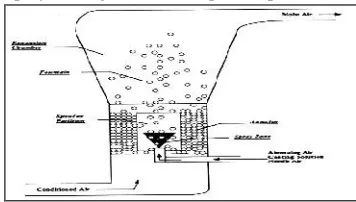
Also known as Wruster process, consist of the dispersing of solid, particulate core materials in a supporting air stream and the spray coating of the air suspended particles.
Fig 1:Wruster coater
Air-suspension coating of particles by solutions or melts gives better control and flexibility. The particles are coated while suspended in an upward-moving air stream. They are supported by a perforated plate having different patterns of holes inside and outside a cylindrical insert. Just sufficient air is permitted to rise through the outer annular space to fluidize the settling particles. Most of the rising air flows inside the cylinder, causing the particles to rise rapidly. At the top, as the air stream diverges and slows, they settle back onto the outer bed and move downward to repeat the cycle. The particles pass through the inner cylinder many times in a few minutes.
Process variables that affect the encapsulation:
Density, surface area, melting point, solubility, volatility, crystallinity and flowability of the core material.
Coating material concentration.
Coating material application rate.
Volumes of air required to support and fluidize the core material.
Amount of coating material required.
Inlet and outlet operating temperature.
The process has the capability of applying coating in the form of solvent solutions, aqueous solutions, emulsions, dispersions or hot melts. In regard to particle size, the air suspension technique is applicable to both micro-encapsulation and macro-micro-encapsulation coating processes.4
Coacervation
The core material will be added to the solution. The core material selected should not react or dissolve in water (maximum solubility 2%). The core material is dispersed in the solution. The particle size will be defined by dispersion parameter, as stirring speed, stirrer shape, surface tension and viscosity. Size of the particles ranges from 2 -1200μm.
Coacervation starts with a change of the pH value of the dispersion, e.g. by adding H2SO4, HCl or organic acids. The result is a reduction of the solubility of the dispersed phases (shell material). The shell material (coacervate) starts to
precipitate from the solution. The shell material forms a continuous coating around the core droplets.
A. Cooling and hardening phase
• The shell material is cooled down to harden and forms the
final capsule.
• Hardening agents like formaldehyde can be added to the process.
• The microcapsules are now stable in the suspension and
ready to be dried. B. Drying phase
• The suspension is dried in a spray dryer or in a fluidized
bed drier.
• Spray Drying is a suitable method for heat sensitive
Products.
• The atomized particles assume a spherical shape. The rapid flow of the coating material keeps the core material below 100°C, even if the temperature in the drying chamber is much greater.
• Microencapsulation makes the spray drying process easier
for sticky products like fruit pulp or juice, with a high content of invert sugar.
Coacervation phase separation
The process consists of three steps carried out under continuous agitation:
1.Formation of three immiscible chemical phases–A liquid manufacturing vehicle phase,A core material phase, andA coating material phase.
To form the three phases, the core material dispersed in a solution of the coating polymer, the solvent for the polymer being the liquid manufacturing vehicle phase. The coating material phase, an immiscible polymer in a liquid state, is formed by utilizing one of the methods of the methods of phase separation-coacervation, i.e., by
a)Changing the temperature of the polymer solution; or b)By adding a salt, non-solvent, or incompatible polymer to the polymer solution; or
c)By inducing a polymer-polymer interaction. 2.Deposition of the coating–
It consists of depositing the liquid polymer coating upon the core material. This is accomplished by controlled, physical mixing of the material in the manufacturing vehicle deposition. If the liquid polymer coating around the core material occurs if the polymer is adsorbed at the interface formed between the core material and the liquid vehicle phase, and this adsorption phenomenon is a prerequisite to effective coating. The continued deposition of the coating material is promoted by a reduction in the total free interfacial energy of the system, brought about by the decrease of the coating material surface area.6
3.Rigidization of the coating–
1826 E.g. Coacervation microencapsulation of talc particles with
poly (methyl methacrylate) by pressure-induced phase separation of CO2- expanded ethanol solutions.6
Genc L et al. has prepared microcapsules of Ketorolac tromethamine by means of a coacervation-phase separation technique induced by the addition of non-solvent.7
Multi-orifice centrifugal extrusion
Liquids are encapsulated using a rotating extrusion head containing concentric nozzles. In this process, a jet of core liquid is surrounded by a sheath of wall solution or melt. As the jet moves through the air it breaks, owing to Rayleigh instability, into droplets of core, each coated with the wall solution. While the droplets are in flight, a molten wall may be hardened or a solvent may be evaporated from the wall solution. Since most of the droplets are within ± 10% of the mean diameter, they land in a narrow ring around the spray nozzle. Hence, if needed, the capsules can be hardened after formation by catching them in a ring-shaped hardening bath. This process is excellent for forming particles of 400– 2,000μm diameter. Since the drops are formed by the
breakup of a liquid jet, the process is only suitable for liquid or slurry. A high production rate can be achieved, i.e., up to 22.5 kg of microcapsules can be produced per nozzle per hour per head. Heads containing 16 nozzles are available. The process utilizes centrifugal forces to core material particles through an enveloping microencapsulation membrane, thereby affecting microencapsulation.8
Process variables include; rotational speed of cylinder, flow rate of the core and coating material, the concentration and viscosity of the coating material, viscosity and surface tension of core material.4
Pan coating
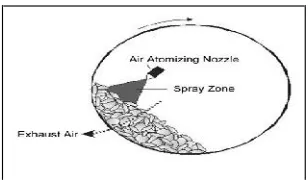
The pan coating process, widely used in the pharmaceutical industry, is among the oldest industrial procedures for forming small, coated particles or tablets. The particles are tumbled in a pan or other device while the coating material is applied slowly. With respect to microencapsulation, solid particles greater than 600 microns in size are generally considered essential for effective coating, and the process has been extensively employed for the preparation of controlled - release beads. Medicaments are usually coated onto various spherical substrates such as nonpareil sugar seeds, and then coated with protective layers of various polymers.9
Generally the coating is applied as a solution, or as an atomized spray, to the desired solid core material in the coating pans. To remove the coating solvent, warm air is passed over the coated materials as the coatings are being applied in the coating pans. In some cases, final solvent removal is accomplished in a drying oven.
Fig 2: Representation of a typical pan coating Spray drying
Spray drying serves as a microencapsulation technique when an active material is dissolved or suspended in a melt or polymer solution and becomes trapped in the dried particle. The main advantages is the ability to handle labile materials because of the short contact time in the dryer, in addition, the operation is economical.
Spray drying and spray congealing processes are similar in that both involve dispersing the core material in a liquefied coating substance and spraying or introducing the core -coating mixture into some environmental condition, whereby, relatively rapid solidification and formation of the coating is affected. The principal difference between the two methods is the means by which coating solidification is accomplished. Coating solidification in the case of spray drying is effected by rapid evaporation of a solvent in which the coating material is dissolved. Coating solidification in spray congealing methods is accomplished by thermally congealing a molten coating material or by solidifying a dissolved coating by introducing the coating - core material mixture into a non-solvent. Removal of the non-solvent or solvent from the coated product is then accomplished by sorption, extraction, or evaporation techniques.
Microencapsulation by spray drying is conducted by dispersing a core material in a coating solution, in which the coating substance is dissolved and in which the core material is insoluble, and then by atomizing the mixture into air stream. The air, usually heated, supplies the latent heat of vaporization required to remove the solvent from the coating material, thus forming the microencapsulated product. The equipment components of a standard spray dryer include an air heater, atomizer, main spray chamber, blower or fan, cyclone and product collector.
Air flow: The initial contact between spray droplets and
drying air controls evaporation rates and product temperatures in the dryer. There are three modes of contact: a) Co-current Drying - air and particles move through the drying chamber in the same direction. Product temperatures on discharge from the dryer are lower than the exhaust air temperature, and hence this is an ideal mode for drying heat sensitive products. When operating with rotary atomizer, the air disperser creates a high degree of air rotation, giving uniform temperatures throughout the drying chamber. b) Counter-current Drying - air and particles move through the drying chamber in opposite directions. This mode is suitable for products which require a degree of heat treatment during drying. The temperature of the powder leaving the dryer is usually higher than the exhaust air temperature.
c) Mixed-flow - particle movement through the drying chamber experiences both co-current and counter-current phases. This mode is suitable for heat stable products where coarse powder requirements necessitate the use of nozzle atomizers, spraying upwards into an incoming airflow, or for heat sensitive products where the atomizer sprays droplets downwards towards an integrated fluid bed and the air inlet and outlet are located at the top of the drying chamber.4
Solvent evaporation
This technique has been used by various companies to produce microcapsules. The processes are carried out in a liquid manufacturing vehicle. The microcapsule coating is dissolved in a volatile solvent, which is immiscible with the liquid manufacturing vehicle phase. A core material to be microencapsulated is dissolved or dispersed in the coating polymer solution. With agitation, the core coating material mixture is dispersed in the liquid manufacturing vehicle phase to obtain the appropriate size microcapsule. The mixture is then heated (if necessary) to evaporate the solvent for the polymer. The case in which the core material is dispersed in the polymer solution, polymer shrinks around the core, and in which core material is dissolved in the coating polymer solution, a matrix - type microcapsule is formed. Once all the solvent for the polymer is evaporated, the liquid vehicle temperature is reduced to ambient temperature (if required) with continued agitation. At this stage, the microcapsules can be used in suspension form, coated on to substrates or isolated as powders. The solvent evaporation technique to produce microcapsules is applicable to a wide variety of liquid and solid core materials. The core materials may be either water - soluble or water - insoluble materials. A variety of film - forming polymers can be used as coatings.11
Polymerization
1) Interfacial polymerization
In Interfacial polymerization, the two reactants in a poly-condensation meet at an interface and react rapidly. The basis of this method is the classical Schotten Baumann reaction between an acid chloride and a compound
containing an active hydrogen atom, such as an amine or alcohol, polyesters, polyurea, polyurethane. Under the right conditions, thin flexible walls form rapidly at the interface. A solution of the pesticide and a diacid chloride are emulsified in water and an aqueous solution containing an amine and a poly-functional isocyanate is added. Base is present to neutralize the acid formed during the reaction. Condensed polymer walls form instantaneously at the interface of the emulsion droplets.
2) In-situ polymerization
In a few microencapsulation processes, the direct polymerization of a single monomer is carried out on the particle surface. In one process, e.g. Cellulose fibers are encapsulated in polyethylene while immersed in dry toluene.
Usual deposition rates are about 0.5μm/min. Coating
thickness ranges 0.2-75μm. The coating is uniform, even
over sharp projections. 3) Matrix polymerization
In a number of processes, a core material is imbedded in a polymeric matrix during formation of the particles. A simple method of this type is spray-drying, in which the particle is formed by evaporation of the solvent from the matrix material. However, the solidification of the matrix also can be caused by a chemical change.
3. RECENT ADVANCES IN
MICROENCAPSULATION PROCESSES
1.Fluidized bed spray coating 2.Deagglomerating jet spray coating 3.Melt prilling in fluidized bed
4.Using ultrasonic atomizer based on interfacial solvent exchange
5.Miscellaneous12
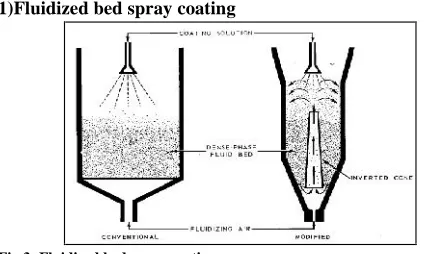
1)Fluidized bed spray coating
Fig 3: Fluidized bed spray coating
Microencapsulation of core particles that can be fluidized by a gas may be accomplished by spraying a coating agent (wall) onto the surface of the particles. The wall may be formed by congealing of a molten material, by chemical reaction on the surface or by evaporation of a solvent from a coating solution. The solvent is removed with the gas leaving the bed. Coating thickness may be easily controlled by the amount of wall material applied.
1828 particulate form and coated at temperatures below their
freezing point. Fluidized-bed encapsulation has yielded such products as: slow release fertilizer, coated iron particles, seeds, salts, and clays.5
2) De-agglomerating jet spray coating
Numerous modifications of the conventional fluidized-bed microencapsulation concept have been developed to satisfy the needs of particular problems. A de-agglomerating jet unit was created to coat core particles of small size which tend to agglomerate in a conventional fluidized bed, by application of a high velocity gas jet and a conical conduit in a fluidized bed to de-agglomerate the partially coated particles before additional coating material is applied from the coating spray nozzle. This method may be employed to encapsulate solid particles down in the 10-g size range. It does not lend itself to liquid cores nor to solid core particles larger than about 300 g. Products including pharmaceuticals, resin catalysts, inorganic salts, and pigmented plastics.5
3) Melt prilling in fluidized bed
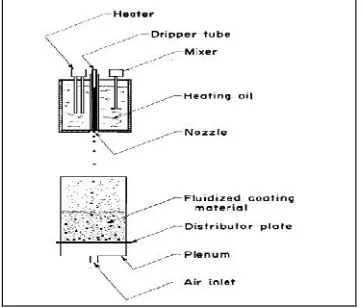
In this process the wall material must be in solid particle form so that it can be fluidized by a gas. The core material is heated and is in liquid form for atomization from a nozzle to yield droplets of the desired size. The droplets of core material fall into the fluidized bed and are simultaneously cooled and coated with the wall material particles. The heat liberated from the core droplets is transferred to the wall material particles causing them to melt, adhere to the core surface, and flow together to form a coherent capsule wall structure. A mixture of capsules and bed material is removed from the fluidizing column and the capsules are separated by screening. The excess bed material is returned to the system. The process has been made continuous by providing continuous capsule removal and bed material make-up.
Fig 4: Melt prilling in fluidized bed
Both liquid and solid core capsules can be made; however, the core material must be able to withstand the temperature required to provide the energy for fusing the wall material particles together. Applications of this process have yielded slow-release glycerin capsules, and biologically active encapsulated products.5
4) Using ultrasonic atomizer based on interfacial solvent exchange
In this method, reservoir-type microcapsules were generated using a dual micro-dispenser system that involves two ink-jet nozzles. Series of drops of polymer solution and aqueous drug solution are separately produced using ink-jet nozzles, and then they are induced to collide in the air. Following the collision, the two liquid phases are separated as a core and a membrane within the merged micro-drops due to the surface tension difference of the two liquids. Recently, it was found that a coaxial ultrasonic atomizer can also be utilized to generate reservoir-type microcapsules under the similar principle, yet, in a simple, mild, and highly efficient manner. This method is successfully used for microencapsulation of therapeutic proteins.13
5) Miscellaneous
a) Meltable dispersion: In this method the wall material in a molten state and the core material are dispersed in a medium (in which both are insoluble) at a temperature high enough to maintain the wall material in liquid form. By means of agitation and use of wetting agents the wall material is caused to envelop the core particles and solidifies on cooling to complete capsule formation.
b) Diffusional exchange: In this process, previously formed capsule with a porous coating is immersed in a preferred liquid so that the original core contents are diffused out of the capsule and the liquid diffused in. The resulting encapsulated liquid is then over-coated or subjected to a treatment that imparts the desired degree of wall impermeability.
Factors Influencing Encapsulation Efficiency
The encapsulation efficiency of the microparticle or microcapsule or microsphere will be affected by different parameters:
•High solubility of the polymer in organic solvent.
•Low solubility of organic solvent in water.
•Low concentration of polymer.
•High DP/CP ratio.
Low solvent removal rate results in slow solidification of microparticles and low encapsulation efficiency.
•Low solubility of the polymer in organic solvent.
•Solubility of organic solvent in water.
•High concentration of polymer.
High solvent removal rate gives fast solidification of microparticles and high encapsulation efficiency.
4. APPLICATIONS OF
MICROENCAPSULATION
Some of the applications of microencapsulation can be described as given below:
1. Prolonged release dosage forms. The microencapsulated drug can be administered, as microencapsulation is perhaps most useful for the preparation of tablets, capsules or parenteral dosage forms.
selectively absorbed in the intestine rather than the stomach.
3. It can be used to mask the taste of bitter drugs.
4. From the mechanical point of view, microencapsulation has been used to aid in the addition of oily medicines to tableted dosage forms. This has been used to overcome problems inherent in producing tablets from otherwise tacky granulations. This was accomplished through improved flow properties. For example, the non-flowable multicomponent solid mixture of niacin, riboflavin, and thiamine hydrochloride and iron phosphate may be encapsulated and made directly into tablets.
5. It has been used to protect drugs from environmental hazards such as humidity, light, oxygen or heat. Microencapsulation does not yet provide a perfect barrier for materials, which degrade in the presence of oxygen, moisture or heat, however a great degree of protection against these elements can be provided. For example, vitamin A and K have been shown to be protected from moisture and oxygen through microencapsulation.
6. The separations of incompatible substances, for example, pharmaceutical eutectics have been achieved by encapsulation. This is a case where direct contact of materials brings about liquid formation. The stability enhancement of incompatible aspirin-chlorpheniramine maleate mixture was accomplished by microencapsulating both of them before mixing. 7. Microencapsulation can be used to decrease the
volatility. An encapsulated volatile substance can be stored for longer times without substantial evaporation. 8. Microencapsulation has also been used to decrease
potential danger of handling of toxic or noxious substances. The toxicity occurred due to handling of fumigants, herbicides, insecticides and pesticides have been advantageously decreased after microencapsulation.
9. The hygroscopic properties of many core materials may be reduced by microencapsulation.
10. Many drugs have been microencapsulated to reduce gastric irritation.
11. Microencapsulation method has also been proposed to prepare intrauterine contraceptive device.
12. In the fabrication of multilayered tablet formulations for controlled release of medicament contained in medial layers of tableted particles.
5. CONCLUSION
Microencapsulation means packaging an active ingredient inside a capsule ranging in size from one micron to several millimeters. The capsule protects the active ingredient from its surrounding environment until an appropriate time. Then, the material escapes through the capsule wall by various means, including rupture, dissolution, melting or diffusion.
Microencapsulation is both an art and a science. There are various ways to do it, and each new application provides a fresh challenge. There are also some modifications in microencapsulation process depending upon the demand of product.
6. REFERENCES
1. Leon L, Herbert AL, Joseph LK. Theory and practice of industrial pharmacy, Varghese publishing house, 3rd edition, 1990: 412-429.
2. James S. Encyclopedia of Pharmaceutical Technology, 3rd edition: 1325-1333.
3. Shekhar K, Madhu MN, Pradeep B, David B. A review on microencapsulation, International Journal of Pharmaceutical Sciences Review and Research 2010; 5: 58-62.
4. Bansode SS, Banarjee SK, Gaikwad DD, Jadhav SL,Thorat RM. Microencapsulation: A review. International J of Pharmaceutical Sciences Review and Research 2010; 1: 38-43.
5. Herman N. Microencapsulation techniques Applications and Problems, Journal of the society of Cosmetic Chemists, 1969; 21: 85-98.
6. Weil G, Knoch A,Laicher A. Simple coacervation of hydroxyl propyl methylcellulose phthalate: Microencapsulation of ibuprofen, International J of Pharm 1995; 124: 97-105.
7. Genç L, Demirel M, Güler E,Hegazy N. Microencapsulation of ketorolac tromethamine by means of a coacervation-phase separation technique induced by the addition of non-solvent, Journal of Microencapsulation 1998; 15: 45-53.
8. George RS, John TG, Donald EJ. Controlled Release of Quinidine Sulfate Microcapsules, ACS Symposium Series 1976; 33.
9. KasturagiY, Sugiura YC, Lee K, Otsugi,Kurihara, Selective inhibition of bitter taste of various drugs by lipoprotein, Pharmaceutical Research 1995; 12: 658-662.
10. Boza YD, Barbin ARP,Scamparini. Survival of Beijerinckia sp. microencapsulated in carbohydrates by spray-drying, Journal of Microencapsulation 2004; 21: 15-24.
11. Ming L, Olivier R,Denis P. Microencapsulation by solvent evaporation: State of the art for process engineering approaches, 2008.
12. Anil KN,Harjinder S. Recent advances in microencapsulation of probiotics for industrial applications and targeted delivery, Trends in Food Science & Technology 2007; 18: 240-251.
1830 14. Nihant N, Grandfils C, Jerome R. Microencapsulation
by coacervation of poly (lactide-co-glycolide): Effect of the processing parameters on coacervation and encapsulation, Journal of Controlled Release 1995; 35: 117-125.
Conflict of Interest: None