Methodology for Developing Digital Maturity Model of
Higher Education Institutions
Valentina Đurek
1*, Nina Begičević Ređep
2, Nikola Kadoić
2 1 City of Zabok, ZIVTOV trg 10, Zabok 49210, Croatia.* Corresponding author. Tel.: +385989037807; email: [email protected] Manuscript submitted January 14, 2019; accepted April 5, 2019.
doi: 10.17706/jcp.14.4.247-256
Abstract: Achieving any of the three primary missions of higher education institutions (HEIs) (teaching,
scientific production and contribution to the society) is today almost impossible without information and communication technologies (ICT). Because of this, analyzing the maturity of ICT use at HEIs becomes useful and necessary for two main reasons: (1) HEIs can determine how digital mature they are based on how ready they are for different ICT challenges, and (2) HEIs can determine what ICT areas and fields they need to improve. There are many frameworks for measuring the digital maturity, but none for HEIs. In this paper, the methodology for developing a digital maturity model for HEIs (DMMHEI) is presented. DMMHEI consists of two parts: (1) a framework that covers areas and elements which influence digital maturity and (2) a two-component instrument used to assess the HEI’s digital maturity. The methodology for creating such a model is based on paradigm called design science research (DSR). Once created, the methodology can be applied in different higher education systems in different countries to create DMMHEIs that are adjusted to different contexts.
Key words: Digital maturity, digital maturity model, maturity framework, maturity instrument.
1.
Introduction
The research presented in this paper was completed as part of a project titled “Development of a methodological framework for strategic decision-making in higher education – a case of open and distance learning (ODL) implementation – Higher Decision”. The primary goal of the project is to develop a complete methodology for strategic decision-making and the monitoring of its implementation in higher education (HE). Two basic components of this project are defined: (1) Development of methodological framework for strategic decision making and monitoring of its implementation and (2) Application, adjustment and evaluation of our methodology on the example of decision implementation on e-learning and distance learning [1].
This paper proposes a methodology to assess digital maturity models for higher education institutions (DMMHEI). The developed methodology can be applied in different higher education systems and can be adjusted to suit the strategic planning and decision-making needs and specific characteristics of a particular system. DMMHEI consists of two basic parts:
• The Digital Maturity Framework for HEI (DMFHEI),
• The Instrument for the Assessment of Digital Maturity of HEI (IADMHEI).
The framework contains areas and elements which are recognized as indicators of HEI digital maturity.
The instrument serves to assess the level of an HEI’s digital maturity. The instrument’s capacity to measure the current digital maturity level (DML) of a certain aspect of HEI can allow stakeholders to clearly identify points of strength and improvement and to determine what to do to achieve greater maturity at individual levels. By using the IADMHEI, stakeholders can assess their level of maturity and by applying the DMFHEI, they can plan and implement the use of digital technologies. The research is based on mixed methods strategy, the combination of qualitative and quantitative methods. The epistemological approach is pragmatic for this study because it allows a combination of different methods of research and data collection, as well as other approaches. The research follows the steps of the design science research (DSR) methodology through three research cycles: the relevance cycle, the rigorous cycle and the design cycle [2]. The relevance cycle includes students, professors, administrators, and all stakeholders connected with an HEI. The relevance cycle also includes areas and elements that are relevant to the digital maturity of the HEI. During the relevance cycle, methods are developed to determine the relevance of areas and elements and ways of assessing the maturity of the HEI are designed. The rigorous cycle includes various sources of knowledge that affect the development of artefacts. The rigor of this research is rooted in the methods used in the field of strategic planning and decision-making in HEI. The models of maturity, digital maturity, and maturity model development are based on systematic literature analysis and expert knowledge gained through focus groups, Q-sorting, application of inter-rater reliability and the analytical network process (ANP) method. The rigorous cycle will contribute to science as it will add to the systematization of existing frameworks for digital maturity and maturity models. It will also increase knowledge in the field of digital maturity through the development of the DMMHEI. The design cycle is used to evaluate and harmonize the initial set of artefacts obtained through the relevance cycle and rigorous cycle. DSR presents new knowledge and explains how artefacts of this research, in the form of constructs, techniques and methods, models, upgraded technologies, comprise valid scientific contributions. DSR research is conducted through five steps (Fig. 1): 1. Identification of the problem; 2. proposition of the artefact; 3. development of the artefact; 4. evaluation and 5. conclusion of research results [2].
Fig. 1. Steps of the design science research methodology.
This paper is divided into the several sections. Section 2 introduces the identification of the problem. Proposition of the artefact is presented in Section 3. In Section 4, the development of the artefact is presented. In Section 5, the demonstration of proposed methodology is presented. In Section 6, the evaluation of the artefact is presented.
2.
Identification of Problem
literature in the field of digital maturity was carried out that took into account the arguments of the scientific relevance of the proposed research. The analysis was conducted using the databases EBSCO, SCOPUS and Science Direct. Databases were searched for maturity concepts, maturity models, and digital maturity combined with the words "higher education institution" and “framework”. A qualitative analysis of the relevant literature found that there were no developed frameworks for the digital maturity of HEI and nor any developed instruments for its evaluation. This motivated further research and development of the DMMHEI [3], [5]. Maturity Modeling (MM) is a framework that describes the levels of excellence within which the activities are performed for a specific area [6]. It is necessary to develop a concept of institutional maturity level due to the need to create a simple benchmark to differentiate the different stages of maturity for the organizations, businesses, or institutions observed. There are different ways to determine the maturity level that depend on the context of the application. However, it is common that the level of maturity reflects the current state of organization. The model of maturity is a framework that details the activities that are taking place in each of the existing levels of maturity. The development of all models of maturity starts with an assessment of the levels of maturity of the individual parts of the institution. Thus, the progress of an institution can be seen through several basic steps (the levels of maturity) that represent the progress already made or that needs to be achieved in order to reach a digitally mature state. The concept of digital maturity for educational institutions is important because of the growing influence of ICT in education. The European Commission points to the importance of digital maturity and provides support for digital maturity through policies and programs currently being implemented [7]-[9]. Digital maturity can be achieved by the digital transformation of the institution, by planning the application of ICT in business, and by learning and teaching.
3.
Proposal of the Artefact
The artefact proposed in this paper is the DMMHEI, which consists of two parts: (1) areas and elements relevant to the digital maturity of the HEI (framework), and (2) the method of collecting data on DML for each element and for aggregating collected data and determining the total DML (instrument). This section presents methods which must be implemented in both parts of the DMMHEI design.
3.1.
Digital Maturity Framework for HEI (DMFHEI)
The artefact is designed using the following methods:
1)Literature analysis and focus group method: These methods will be used to determine the initial area and elements list in DMFHEI. The focus group method is a qualitative form of research involving a group discussion about a given topic. The primary goal of the focus group will be to encourage a deep discussion to explore the values or attitudes of respondents on a particular issue or topic. The information gathered through this method is the construction and / or testing of the model that best illustrates the research problem [10].
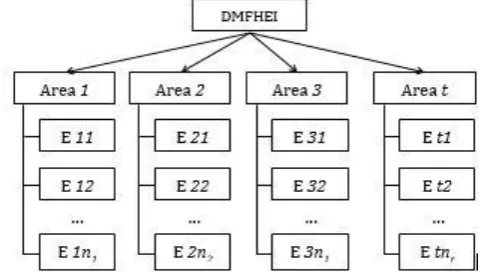
2 presents a general structure of DMFHEI (adopted from [3]). The elements that influence DML are grouped into areas, from which the final DML can be obtained.
Fig. 2. Structure of digital maturity framework for higher education institutions – DMFHEI.
3.2.
Instrument for Assessing the Digital Maturity for HEI (IADMHEI)
IADMHEI presents a dynamic part of DMMHEI. It is a mechanism which calculates a two-component measure of DML for certain HEIs from the data input from each HEI that describes the states of each HEI per each element in the DMFHEI. The first component will represent a result of the application of the ANP. This component is quantitative. The second component will represent a result of the application of the decision expert (DEX) method and this component is qualitative. The reasons why IADMHEI will be a two-component measure, and why two methods will be applied, are the following: (1) some aspects of the IADMHEI are qualitative, and some aspects are quantitative; (2) those aspects complement each other; (3) the two methods ANP and DEX (which support both aspects of DML), have different aggregation mechanisms; (4) applying two methods will act as a sort of control, or at least a comparison mechanism, in determining the DML of HEI. To create the IADMHEI, several methods have been suggested:
1)Method(s) for structuring the decision-making problem: The decision-making trial and evaluation laboratory (DEMATEL), will be used to determine the link between areas and elements and will help structure the decision-making problem to develop the network structure. The DEMATEL method will help design and analyze the structural models while incorporating feedback between elements [15]. 2)Method for multi-criteria decision-making – ANP [16]-[19]: This method will be used to determine
weight-based coefficients of elements obtained through expert group decision-making in order to obtain the weight of areas needed to determine the final DML of the HEI. The ANP was developed by Thomas Saaty in 1996. The structure of the ANP allows a network to define a problem. The ANP is different from the AHP because it does not represent a linear hierarchy, but instead models influences between network elements. The network dependence of the elements contributes to better modeling of real problems, since most real-world problems are nonlinear and backlinks allow more precise prioritization of elements and better quality solution of the problem [20], [21]. One of the ANP implementation areas is higher education, which is characterized by the existence of dependence among other criteria based on which strategic and tactical decisions are made. By introducing the influence between the criteria, we get more precise weighing of criteria and local/global alternative priorities. Consequently, we can conclude that the ANP method is recommended for strategic and tactical decision-making in HEI [22], [23].
rubrics when assessing the maturity of an institution.
4)The composite index: The composite index is used in the research of social phenomena when multiple variables must be considered in order to obtain a complex assessment or to understand different dimensions of a phenomenon [26] to rank higher education by DML [3].
5)The DEX method: This method is a qualitative multi-criteria decision making method [27] that will be used to calculate the qualitative measure of total maturity. The DEX method uses qualitative variables instead of numeric variables, which is appropriate for less formalized decision-making problems [28].
4.
Development of the Artefact
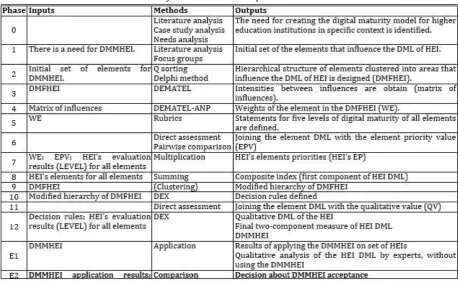
In the earlier DSR step, methods for developing two parts of the DMMHEI were proposed. In this step, the implementation of these proposals will be discussed. Below are the steps that must be taken to implement the proposed methods in order to develop the artefact:
1)The literature analysis and focus groups are the starting points in developing the initial set of elements that influence the DML of HEIs. According to the differences in higher education systems across different countries, it is expected that these initial sets of elements will differ. However, the general procedure of how to reach the set of elements will be the same in all countries.
2)In the next phase, the Q-sorting method and the Delphi method will be used to determine the final list of elements that influence the DML of HEIs in a certain country. Additionally, in this phase, the hierarchical structure of elements that are clustered into areas will be determined (concretization of the Fig. 2).
3)Next the influences (dependencies) and their intensities must be defined using the DEMATEL.
4)After the influences and their intensities have been defined, it is possible to apply the DEMATEL-ANP approach (as described in [29]). This phase will include ICT and HE experts. This phase will result in the weights of the elements (WE).
5)In the next phase, the rubrics will be applied. For each element, the five statements that describe the five basic elements of DMLs must be defined. This phase will include ICT and HE experts.
6)For each element of the DML, an element priority value (EPV) will be assigned. This can be done in two ways, directly or by using the pairwise comparisons procedure as explained in [3]. This phase will also include ICT and HE experts.
7)After completing these earlier steps, it will be possible to calculate HEI’s element priority (HEI’s EP) by multiplying the weight of the element (WE) the element priority value (EPV). This is joined to the element DML that is correlated to the HEI (LEVEL) analyzed.
8)Summing all the HEI’s element priorities give a quantitative composite index value, the first component of the total DML of the HEI.
9)To reach the qualitative value of the total DML of the HEI, the method DEX must be applied. However, there are issues with applying the DEX if there is a high number of elements at some level in the hierarchy. If that would be the case after the phase 2 of this procedure, then additional clustering must be made. If a certain area in the DMFHEI contains 10 elements, they have to be grouped into two or three subdomains before the next phase.
10) When the hierarchy is ready for DEX to be applied, the decision rules must be defined. Decision-making rules represent the basic mechanism of conclusion and decision-making in the DEX method [30]. Here, expertise in the HEI and ICT will be required.
high, and very high). The idea is that in the process of evaluating the alternatives on the element level, both qualitative and quantitative information will be obtained, i.e. the statements will be joined to both, element priorities (EPVs) and qualitative values (QVs).
12) Now, it is possible to obtain the final qualitative value of DML, i.e. qualitative value and the second component of total DML of the HEI. There are five levels of maturity: digitally unaware HEIs, digital beginner HEIs, digitally competent HEIs, digitally advanced HEIs and digitally mature HEIs.
To conclude, the DMFHEI is a result of the second phase of the artefact development and IADMHEI is a result of the last phase of the artefact development. Finally, when the DMMHEI is applied, additional quantitative/qualitative analysis of the results is possible (comparing with other HEIs, determining the element with low maturity levels and creating the activities in order to increase the element maturity level).
5.
Demonstration of the Artefact
After the DMMHEI is developed, it can be demonstrated with several HEIs. However, since this paper only proposes the methodology for creating the DMMHEI, the demonstration is not complete. In this section, we demonstrate the current results of the development of the artefact, as well as demo examples of how certain parts of the proposed artefact are planned can be applied:
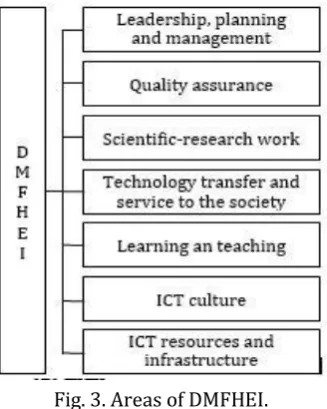
So far, the first two phases of the DMMHEI development have been implemented. Following the qualitative analysis of the existing frameworks, the two focus groups and Q-sorting methods will be implemented and the DMFEI area and elements will be obtained. The DMFHEI consists of 7 areas (presented at the Fig. 3) and 43 elements. Details can be found in [5]. DMFEI area and elements will be obtained. The DMFHEI consists of 7 areas (presented at the Fig. 3) and 43 elements. Details can be found in [5].
Fig. 3. Areas of DMFHEI.
Since the phases 4, 5 and 6 require the participation of experts in the fields of HEI and ICT, calculating the two-component DML measure can only be theoretically demonstrated. Table 1, demonstrates how to calculate the DML of certain HEI according to the phases 3-8 from the DMMHEI development (only demonstration for one area, “Leadership, Planning and Management,” is presented).
Table 1. Calculating Quantitative DML on Element and Area Level (Composite Index)
Table 2. Calculating Qualitative DML on Area Level
6.
Evaluation of the Artefact
After a DMMHEI is created, it must be evaluated. The evaluation can be conducted after each phase in the artefact development. The Delphi method used in the forecasting of technical and technological development will be used in the evaluation phase [12]. The Delphi method will be used to match the expert to the area and elements of DMFHEI. Self-evaluation, the comparison of estimates and estimator consistency calculations using inter-rater reliability will also be performed. Inter-rater reliability is a measure used to assess the degree of agreement between different experts or assessors in decision-making. It is useful because evaluators do not necessarily need to interpret the answers in the same way. They may not agree on some of the responses or skills that should be assessed [31]. In the evaluation process, experts with dual expertise, HEI management and ICT, must participate.
The most important evaluation of the DMMHEI is of the developed artefact. This evaluation includes an assessment of the application of the DMMHEI on a set of HEIs and a comparison of the results with real states. It is important to carefully analyse the tool in order to determine if the DMMHEI matches reality. A general structure of applying the final evaluation step is presented on Fig. 4.
If the comparison results show disproportionate difference between the DMMHEI results and qualitative assessment results in many cases (HEIs), then further analysis of this difference must be completed. After the comparison results show acceptable results, the DMMHEI can be accepted as final. As stated earlier, there is no one unique DMMHEI for all contexts, which means that some DMMHEI can be only evaluated in the context for which it is designed.
7.
Conclusion
In this paper, a methodology for creating the digital maturity model of higher education institutions is proposed. The model covers both the framework (i.e. elements that influence on digital maturity) and the instrument (i.e. procedures of how to evaluate HEIs to determine the digital maturity level of HEIs). The model can be very helpful in the strategic management of HEIs.
Stakeholders can use this methodology to create recommendations about how to increase the level of digital maturity of institutions and how to rank the institutions based on their digital maturity.
The last phase of DSR process also includes the dissemination of the artefact. When DMMHEI for a certain context is designed, it is recommended that it should be disseminated with the public.
On the end of the paper, we bring the phases for creating DMMHEI with the evaluation summarized in the table form (Table 3).
Acknowledgment
The Croatian Science Foundation supported this work under project IP-2014-09-7854.
References
[1] Divjak, B. (2017). Webpage od the project Development of a methodological framework for strategic decision-making in higher education – A case of open and distance learning (ODL) implementation.
Development of A Methodological Framework for Strategic Decision-Making in Higher Education – A Case
of Open and Distance Learning (ODL) Implementation. Retrieved from http://higherdecision.foi.hr/
[2] Hevner, A. R., March, S. T., Park, J., & Ram, S. (2004). Design science in information system research.Des.
Sci. IS Res. MIS Q., 28(1), 75-105.
[3] Valentina, N. Đ., Kadoić, N., & Begičević, R. (2018). Assessing the digital maturity level of higher education institutions.Proceedings of 41st International Convention on Information and Communication
Technology, Electronics and Microelectronics MIPRO 2018(pp. 747-752).
[4] Ređep, N., B., Balaban, I., Žugec, B., Čalopa, M., K., & Divjak, B. (2017). Framework for digitally mature schools.European Distance and e-Learning Network,360-371.
[5] Đurek, V., Ređep, N. B., & Divjak, B. (2017). Digital maturity framework for higher education institutions. Proceedings of Central European Conference on Information and Intelligent Systems 2017
(pp. 99-106).
[6] Software Engineering Institute. (2002). Capability maturity model ® integration (CMMI continuous representation improving processes for better products. Pittsburgh.
[7] Balaban, I., Redjep, N. B., & Calopa, M. K. (2018). The analysis of digital maturity of schools in Croatia.
Int. J. Emerg. Technol. Learn., 13(06),4-15.
Framework for Digitally-Competent Educational Organisations. Joint Research Centre, European Union. [9] SCALE CCR. (2012). Up-scaling Creative Classrooms in Europe. Retrieved from
http://is.jrc.ec.europa.eu/pages/EAP/SCALECCR.html
[10]Hines, T. (2000). An evaluation of two qualitative methods (focus group interviews and cognitive maps) for conducting research into entrepreneurial decision making. Qual. Mark. Res. An Int. J., 3(1), 7-16. [11]Watts, S., & Stenner, P. (2005). Doing Q methodology: Theory, method and interpretation. Qual. Res.
Psychol., 2, 67-91.
[12]Clayton, M. J. (1997). Delphi: A technique to harness expert opinion for critical decision-making tasks in education. educational psychology: An international journal of experimental educational psychology.
Educ. Psychol. An Int. J. Exp. Educ. Psychol., 17(4), 373-386.
[13]Nunnally, J., & Bernstein, I. (1994). Psychometric Theory (3rd ed.). New York: McGraw-Hill.
[14]Lawshe, C. H. (1975). No title quantitative approach to content validity. Pers. Psychol., 28(4), 563-575.
[15]Shih-Hsi, Y. (2012). Application of DEMATEL, ISM, and ANP for key success factor (KSF) complexity analysis in R&D alliance. Sci. Res. Essays, 7(19), 1872-1890.
[16]Divjak, B., & Ređep, N. B. (2015). Strategic decision making cycle in higher eeducation: Case study in e-learing. Int. Conf. e-Learning 2015 Strateg., 19-26.
[17]Kadoić, N., Ređep, N. B., & Divjak, B. (2017). A new method for strategic decision-making in higher education. Cent. Eur. J. Oper. Res., Special Issue of Croatian Operational Research Society and Collaborators.
[18]Kadoić, N., Ređep, N. B., & Divjak, B. (2017). Structuring e-learning multi-criteria decision making problems. Proceedings of 40th Jubilee International Convention, MIPRO 2017 (pp. 811-817).
[19]Begicevic, N., Divjak, B., & Hunjak, T. (2007). Comparison between AHP and ANP: Case study of strategic planning of e-learning implementation. Development, 1(1), 1-10.
[20]Saaty, T. L. (1999). Fundamentals of the analytic network process. Japan, Kobe Int. Symp. Anal.
Hierarchy Process.
[21]Saaty, T. L. (2008). Decision making with the analytic hierarchy process. Int. J. Serv. Sci., 1(1), 83-98. [22]Begičević, N. (2008). Višekriterijski Modeli Odlučivanja u Strateškom Plniranju Uvođenja E-učenja.
University of Zagreb, Faculty of Organization and Informatics, 2008.
[23]Divjak, B. (2016). Challenges of strategic decision-making within higher education and evaluation of the strategic decisions. Proceedings of Central European Conference on Information and Intelligent
Systems (pp. 41-46).
[24]Knight, L. A. (2006). Using rubrics to assess information literacy. Ref. Serv. Rev., 34(1), 43-55.
[25]Oakleaf, M. (2009). Using rubrics to assess information literacy: An examination of methodology and interrater reliability. J. Am. Soc. Inf. Sci. Technol., 60(5), 969-983.
[26]Asif, M. & Cory, S. (2014). A composite index for measuring performance in higher education institutions. Int. J. Qual. Sci., 31(9), 983-1001.
[27]Taškova, K., Stojanova, D., Bohanec, M., & Eroski, S. D. (2007). A qualitative decision-support model for evaluating researchers. Inform., 31(4), 479-486.
[28]Bohanec, M., Žnidaršič, M., Rajkovič, V., Bratko, I., & Zupan, B. (2013). DEX methodology: Three decades of qualitative multi-attribute modeling. Informatica, 37, 49-54.
[29]Kadoić, N., Divjak, B., & Ređep, N. B. (2018). Integrating the DEMATEL with the analytic network process for effective decision-making. Proceedings of SOR 2017 Conference Cent. Eur. J. Oper. Res., no. S.I (pp. 1-30).
[31]Kilem, L. G. (2014). Handbook of Inter-Rater Reliability (4th ed.). Gaithersburg, MD: Advance Analytics, LLC.
Valentina Đurek was born in Zabok, Krapina-zagorje county, Croatia. She has
professional experience in education, having worked as a teacher of information science in primary and secondary schools for 15 years. Today, she is the deputy mayor of the City of Zabok. She is a doctoral student at the University of Zagreb in the Faculty of Organization and Informatics in Varaždin. Her research includes digital maturity of higher education institutions. She has published several research papers at conferences.
Nina Begičević Ređep was born in Varaždin, Croatia. She is an associate professor in the
Faculty of Organization and Informatics in Varaždin, University of Zagreb and a vice-dean for research and international cooperation. Her areas of interest include business decision-making and decision theory, multi-criteria decision-making, strategic planning and decision-making, and e-learning. She is author of more than fifty scientific and professional papers and has participated in many workshops and seminars as part of her training. She has worked on scientific and professional projects and has participated in the work of several international projects (Horizon, FP7, TEMPUS, etc.). She is a reviewer for Applied Soft Computing Journals, Project Management, International Journal of Analytic Hierarchy Process, Central European Journal of
Operational Research and Journal of Information and Organizational Sciences, etc. She is a member of
program committees of several international scientific conferences.
Nikola Kadoić works at the Faculty of Organization and Informatics in Varaždin. He is a