Research Paper
EFFECT OF THE PESTICIDE LAMBDA CYHALOTHRIN ON THE GPT
CONTENT IN THE FISH
Labeo rohita
UNDER SHORT TERM AND LONG
TERM EXPOSURE PERIOD
Dhanya, P.Y. and S. Sushama1
Department of Zoology, Bharathiyar University, Coimbatore.
51 Siddeswari Road, Dhaka 1217, 1Department of Zoology, N.S.S.College, Ottapalam
India.
Abstract
Enzymes control the metabolism and vital activities of tissues. Any change in the normal balance of enzyme due to adverse actions directly or indirectly make the organism under stress. To overcome this organism shows many protective actions. Due to this reason enzyme analysis is becoming increasingly important for the determination of toxic effects of chemical pollutants in the field of environmental toxicology. The increase in GPT activity suggests that proteins are channelled into the metabolic pathway. Enzyme activities used as sensitive indicator of stress in fish exposed to diverse group of water pollutants. The present study indicated that the pyrethroid insecticide lambda cyhalothrin is toxic to fish Labeo rohita.
Key words: Lambda cyhalothrin, Labeo rohita.
INTRODUCTION
Water pollution is a serious issue and the discharge of polluting chemicals into
water in many ways could pose a threat to fish in fish ponds as well as in open water
located around such areas. This is because fish live in very intimate contact with their
environment. Agricultural runoff or the water from the fields that drains into rivers is
another major pollutant as it contains pesticides and fertilizers. Pesticides when used
Journal of Global Biosciences
ISSN 2320-1355
exceedingly efficient and very specific in terms of nature of reaction catalysed and the
substrate utilized. Transaminases like GOT and GPT are usually present in various
tissues and injuries to the cells of these tissues may result in the release of enzymes into
plasma. Chambers et al., (1979) has reported that this may be also related to possible
failure of the tissues to initiate the required compensatory reactions under conditions of
a prolonged stress. Soman,(1987) also reported similar reduction in GOT and GPT
activity in Lebaycid-1000 exposed fish, Colisa fasciata and suggested that it could be due
to damage caused to tissue leading to the leakage of enzymes. GPT levels were found to
be increased after pesticide exposure. The increase in GPT activity suggests that
proteins are channelled into the metabolic pathway. Enzyme activities used as sensitive
indicator of stress in fish exposed to diverse group of water pollutants. In the present
study, the significant increase in GPT activity during lambda cyhalothrin exposed water
might have resulted from the organ damage and physiological disturbances. Due to
stress in organism the normal metabolic pathway get disturbed.
MATERIALS AND METHODS
Enzymes
Estimation of Glutamate Pyruvate Transaminase (GPT) Principle
SGPT catalyzes the transfer of amino group between L-Alanine and ketoglutarate to form pyruvate and Glutamate. The pyruvate formed reacts with NADH in the presence of Lactate Dehydrogenase to form NAD. The rate of oxidation of NADH to NAD is measured as a decrease in absorbance, which is proportional to the SGPT activity in the sample.
L- Alanine + œ ketoglutarate → Pyruvate+Glutamate
RESULTS
Short term exposure
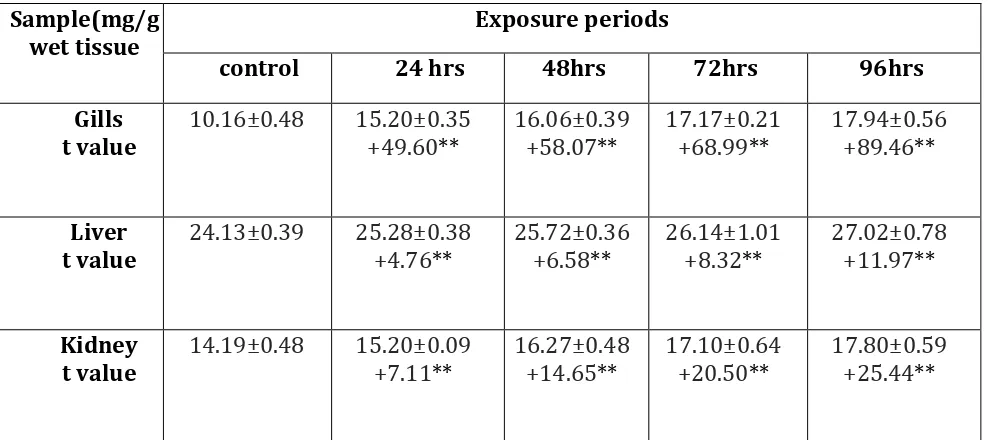
The amount of GPT in gill tissue is 15.20 for 24 hours, 16.08 for 48 hours, 17.17
for 72 hours and 17.94 for 96 hours respectively. The control value is 10.16. Liver tissue
observed a drastic change after the exposure to pesticides and showed an increase in
GPT content and it is 25.28 for 24 hours, 25.72 for 48 hours, 26.14 for 72 hours and
27.02 u/ml after 96 hours of exposure. The control value is 24.13. Kidney recorded GPT
values in increased order and the values are 15.20, 16.21, 17.10, 17.80 for 24, 48, 72, 96
hours respectively. The control value is 14.19.The values are expressed as IU/L. The
values are significant at P<0.01 level.
Table. 1. Effect of the pesticide lambda cyhalothrin on the GPT content in the fish
Labeo rohita under short term exposure period
Sample(mg/g
wet tissue Exposure periods
control 24 hrs 48hrs 72hrs 96hrs
Gills
t value 10.16±0.48 15.20±0.35 +49.60** 16.06±0.39 +58.07** 17.17±0.21 +68.99** 17.94±0.56 +89.46**
Liver t value
24.13±0.39 25.28±0.38
+4.76**
25.72±0.36 +6.58**
26.14±1.01 +8.32**
27.02±0.78 +11.97**
Kidney
t value 14.19±0.48 15.20±0.09 +7.11** 16.27±0.48 +14.65** 17.10±0.64 +20.50** 17.80±0.59 +25.44**
Graph. 1. Effect of the pesticide lambda cyhalothrin on the GPT content in the
fish Labeo rohita under short term exposure period
Long term exposure
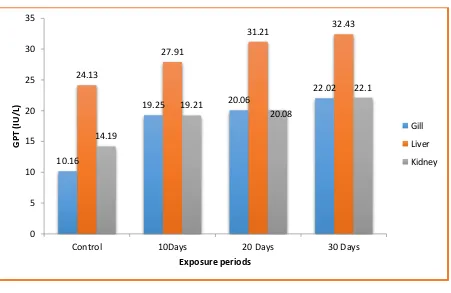
The GPT content in the gill of fish after the long term exposure shows
considerable increase and it is 19.25 for 10 days, 20.06 for 20 days and 27.02 after 30
days of exposure.The control value of gill tissue is 10.16. The control value of liver
tissue is 24.13 and long term exposure content in 10 days is 27.91, 31.21 for 20 days
and 32.43 after 30 days. The GPT content in kidney shows control value 14.19 and
19.21, 20.08, 22.10 for 10, 20 and 30 days of long term exposure periods. The values are
expressed as IU/L. The values are significant at P<0.01 level.
10.16
15.2 16.06
17.17 17.94 24.13 25.28 25.72
26.14 27.02
14.19 15.2
16.27 17.1 17.8
0 5 10 15 20 25 30
Control 24 Hrs 48 Hrs 72 Hrs 96 Hrs
G
P
T
(IU
/L
)
Exposure Periods
Gill
Liver
Table. 2. Effect of the pesticide lambda cyhalothrin on the GPT content in the
fish Labeo rohita under long term exposure period
Sample mg/g
wet tissue Exposure periods
control 10days 20 days 30 days
Gills
t value 10.16±0.48 19.25 ±0.33 +89.46** 20.06±0.48 +97.44** 22.02±0.76 +116.73**
Liver
t value 24.13±0.39 27.91±0.78 +15.66** 31.21±0.46 +29.34** 32.43±0.82 +34.39**
Kidney
t value 14.19±0.48 19.21±0.48 +35.37** 20.08±0.43 +42.50** 22.10±0.87 +55.74**
**-Significant at one per cent level;*-significant at five per cent level
Graph. 2. Effect of the pesticide lambda cyhalothrin on the GPT content in the
fish Labeo rohita under long term exposure period
10.16
19.25 20.06
22.02 24.13
27.91
31.21 32.43
14.19
19.21
20.08
22.1
0 5 10 15 20 25 30 35
Control 10Days 20 Days 30 Days
GPT (IU/L)
Exposure periods
Gill
Liver
DISCUSSION
The increase in Glutamic pyruvic transminase (GPT) activity may be due to decrease in
metabolic activity, disruption of enzyme system by blocking active sites and tissue
damage. Radha Krishnan Nair and Jasmine, (2010) reported the increased activity of
GOT and GPT in the intestine tissues of the fish, Catla catla on exposed to Triazophos.
Glutamic pyruvic transminase (GPT) enzyme activities in different tissues of
Sarotherodon mossambicus (Peters) exposed to a carbamate pesticide casrbaryl,
reported by Murugesan et al. (1991) and showed adaptive elevation in the activity
levels of GOT and GPI enzymes in many tissues. Even a minor cellular damage leads to
fluctuated enzymatic activity. Jeney et al. (1991) reported an increased level of these
two enzymes [serum glutamic-oxaloacetic transaminase (GOT), serum glutamate
pyruvate transaminase (GPT)] in the serum of fish exposed to toxicant (ammonia). Jee
(2005) found an increase in levels of serum glutamic oxaloacetic acid transaminase,
glutamicpyruvic acid transaminase, glucose and alkaline phosphatase and a decrease in
the concentration of plasma total protein, albumin, cholesterol and lysozyme in Korean
rock fish Sebastes schlegeli Hilgendorf exposed to cypermethrin. It might be due to
leakage of these enzymes from the damaged tissues into the serum under fenthion
stress. Many authors suggested that liver is rich in GOT and GPT, and damage to it could
result in liberation of large quantities of these enzymes into the blood. An increase in
these enzymes after exposure to pollutants is a sensitive indicator of cellular damage
(Van-Dar et al., 2003; Palanivelu et al., 2005).In the present investigation stress exerted
by exposure of fish to insecticide altered activity of enzyme constituents. This indicates
REFERENCE
Chambers, J.E., Heitz, J.R., McCankle, F.M. and Tarbrough, J.D. 1979. Enzyme
activities following chronic exposure to crude oil in a stimulated ecosystem in
American oyster and brown shrimp. Environ. Res. (20) pp-133-139.
Jee, L.H., Masroor F, Kang, J. 2005. Response of cypermethrin-induced stress in
haematological Parameters of korean rockfish, Sebastes schlegli. Hilgendorf.
Aquaculture Research; 36, pp. 898-905.
Jeney G, Nemcsok J, Jeney ZS, Olah, J. 1991. Acute effect of sublethal ammonia
concentrations on common carp (Cyprinus carpio L.). II. Effect of ammonia on
blood plasma transminases (GOT, GPT),GDH enzyme activity and ATP value.
Aquaculture, 104: 149-156.
Radhakrishnan Nair, C. and Jasmine, E.2010. Toxic effect of Triazophos on
transaminase activity in Poll Res, 29(1): 73-76.
Murugesan, R., Palaniswamy, T.N., Panneer, S. 1999. Glutamic oxaloacetic
transaminase (GOT) and glutamix pyruvic transaminase (GPT) enzyme activities
in different tissues of Sarotherodon mossambicus (Peters) exposed to a
carbamate pesticides, carbaryl. Pesticide Science. 55: 1217 - 1221.
Palanivelu, P., Vijayavel, K., Ezhilarasibalasubramanian, S., Balasubramanian, M.P.
2005. Influence of insecticidal derivatives (Cartap Hydrochloride) from the
marine polychaete on certain enzymes of the freshwater fish Oreochromis
mossambicus. J. Environ. Biol. 26: 191-196.