Professor
Department of Mechanical Engineering J D College of Engineering & Management, Nagpur
Abstract
This paper gives the general introduction to the arrangement, design and some basic concept of multi plate wet type clutch. Fluid plays an important role in this type of clutch so some of their properties are discussed. Some losses due to design parameters are also discussed. To meet the requirements of low fuel consumption, good driving performance and manufacturing feasibility. This paper will provide a design overview of the transmission architecture, main characteristics, key subsystems and control strategies. This gives better understanding about working principle of clutch, material used for making the clutch plates. Effect of design consideration can be further studied during its application in various conditions. In the CAD model actual clutch has also been explained. The design approach is in the way of improving the efficiency of transmission system. Lastly there is the solution given to the analysed error. Advantages, disadvantages and various practical applications are also discussed.
Keywords: CAD model, Housing, Wheel Clutch
________________________________________________________________________________________________________
I.
INTRODUCTION
Background: A.
The wet clutch is one of the part of transmission system in which with its design aspects efficiency will be improved. The function of clutch is to engage and disengage the engine with rest of the transmission system. The main functional components of this type of clutch are friction plates, fluid used and transmission gear. Due to engagement and disengagement the friction occurs in between the two mating parts so that they are also designed carefully. More focus on design of the friction plates and the selection of material. As fluid plays an important role in wet clutches so the movements of the internal parts are smooth. The design will produce the maximum efficient output in such a way that it does not affect the primary purpose of wet clutches which is its torque carrying capacity.
A Friction Clutch: B.
The vast majority of clutches ultimately rely on frictional forces for their operation. The purpose of friction clutches is to connect a moving member to another that is moving at a different speed or stationary, often to synchronize the speeds, and/or to transmit power.
Materials: C.
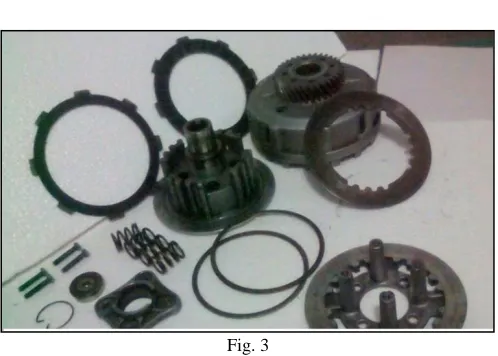
Fig. 1
Fig. 2
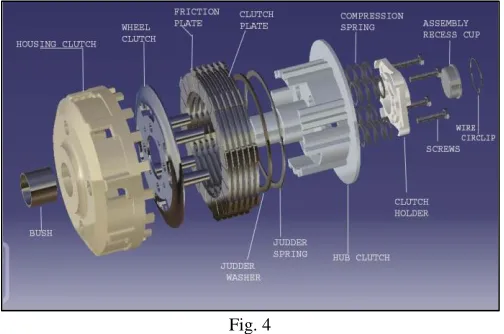
Components of Multi Plate Clutch: D.
Housing Wheel clutch friction plate clutch plate
Compression spring Clutch holder
Hub
Fig. 4
III.
INCREASE IN POWER CONSUMPTION ARE DUE TO SOME OF THE FOLLOWING REASONS
Manufacturing: A.
Modern clutch development focuses its attention on the simplification of the overall assembly and/or manufacturing method. For example drive straps are now commonly employed to transfer torque as well as lift the pressure plate upon disengagement of vehicle drive. With regard to the manufacture of diaphragm springs, heat treatment is crucial.
Clutch Temperature: B.
The interface temperature in the clutch is known to have a significant effect on friction. surface active additives in the transmission fluid that are present at the sliding interfaces in the clutch and which govern friction
The clutch temperature is governed by power input (sliding velocity and transmitted torque) and heat dissipation.
Fluid Formulation: C.
A transmission fluid consists of one or more base oils and a number of additives. A wet clutch transmission fluid must provide adequate friction performance and at the same time have good shear and oxidation stability, anti-wear performance and corrosion resistance. Performance requirements for transmission fluids are generally set by OEMs and include friction characteristics, friction durability, oxidation stability and wear.
Friction Materials: D.
The friction material used has significant influence on the friction characteristics of a clutch. Friction materials commonly used include paper, sintered bronze, steel, carbon fibre, cork, asbestos and aramid fibres. Key material parameters include friction intensity, quality and stability, durability, heat resistance, heat adsorption and compatibility with oils and their additives. Paper based friction materials, consisting of raw paper (cotton linters or cellulose fibers) in combination with a thermosetting resin have been used since the late fifties. These offer low cost and good performance under low load conditions and remain by far the most commonly used friction material in wet clutch applications. Sintered bronze and sintered brass friction materials are used where service conditions prevent the use of discs faced with paper, synthetic or organic linings. Sintered bronze friction materials are known to be sensitive to operating conditions but are able to cope with high temperatures and also decrease the clutch temperature due to their good thermal conductivity. More recently, the use of carbon fiber as a friction material has increased.
IV.
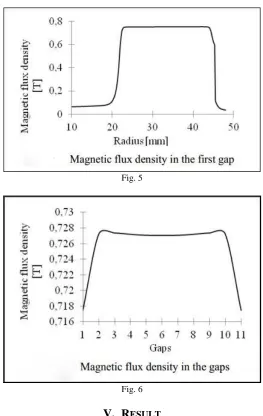
DESIGN ISSUESFig. 5
Fig. 6
V.
RESULT
The main output of the study was to evaluate the problem of breaking of the friction plate. The results show that there’s a problem with properties of the materials viz. specimens after the concluded heat. The result also showed that at every aspect of temperature there was a constant change in mechanical properties of the specimen viz. Hardness etc. The hardness property of the material was checked under Rockwell Hardness Testing Machine which at the end showed positive sign, which was the ultimate result or outcome of this study.
VI.
CONCLUSION
From the various obtained result the study work can be concluded that the mechanical properties vary depending upon the various heat absorbing process. Hence depending upon properties and application required we should go for suitable fluid or oil for gear box. We have measure the hardness of the material in the Rockwell hardness testing machine with help of rockwell hardness test with the help of intender.
VII.
FUTURE WORK / SCOPE
The friction characteristics of the multi plate clutch are well understood at normal operating temperatures. so, at low temperatures there are several effects which were not explained completely in this paper.
REFERENCES
[1] http://www.kobelco.co.jp/english/ktr/pdf/ktr_27/058-062.pdf
[2] http://publications.lib.chalmers.se/records/fulltext/179621/179621.pdf
[3]
http://www.google.co.in/url?sa=t&rct=j&q=&esrc=s&source=web&cd=5&ved=0CCgQFjAEahUKEwj-5-u-
jLPHAhXSCI4KHVfaA18&url=http%3A%2F%2Fmkweb.uni-pannon.hu%2Fhjic%2Findex.php%2Fhjic%2Farticle%2Fdownload%2F380%2F349&ei=bGPTVf6BMdKRuATXtI_4BQ&usg=AFQjCNEBTpAgKLmNa U1gp8mE-aLMTKc6AQ&sig2=EsJd7UsRAAXDj29vAeUkiQ&bvm=bv.99804247,d.c2E
[4] http://epubl.ltu.se/1402-1544/2005/28/LTU-DT-0528-SE.pdf