e- ISSN: 2278-067X, p-ISSN: 2278-800X, www.ijerd.com Volume 15, Issue 1 (January 2019), PP.09-15
Evaluation of strength and road performance of drainage
stabilized macadam base prepared from polyurethane glue and
cement stabilized macadam milling
Lizhi Wang
1, Zhirong Jia
2, and Luxin Fu
3 1School of Transportation and Vehicle Engineering2
School of Civil and Architecture Engineering
3School of Transportation and Vehicle Engineering
Shandong University of Technology, Zibo, CHINA Corresponding Author: ZhirongJia.
ABSTRACT: In order to provide practical reference for the practical application of Permeable polyurethane stabilized recycled gravel aggregate (PPSRA), which is made of polyurethane glue and cement stabilized gravel milled material, its strength and road use. The effects of performance were studied. Firstly, the unconfined compressive test and the flexural test were used to analyze the effect of porosity, glue dosage and glue component ratio on its strength. Then, the water stability and water permeability of PPSRA were tested by water immersion Marshall test and permeability test. The road is evaluated by performance. The results show that the strength increases with the increase of the amount of glue; when the distribution ratio of A and B is 1:2.5, the strength of PPSRA peaks, and the strength of PPSRA increases with the increase of porosity. The compressive modulus of PPSRA is 800-1300 MPa, the residual stability is 85%-90%, and the permeability coefficient is 0.8-1.0 cm˙s-1.
KEY WORDS: drainage polyurethane stabilized recycled gravel material; cement stabilized macadam milling material; glue dosage; strength; road performance
--- --- Date of Submission: 21-02-2019 Date of acceptance: 10-03-2019 --- ---
I.
INTRODUCTION
content has no effect on its dynamic stability. However, it will reduce its water stability and low temperature bending strain. Through experiments, it can be concluded that when the RCA content is 60%, all the detection indexes can meet the specification requirements; Wang Huoming(2014) and others pass the "non-standard Kentaba scattering test" and "leak test" on the polyurethane gravel. The experimental study on the amount of glue used in permeable pavement was carried out. According to its strength characteristics, permanent deformation and water stability, the application of polyurethane glue in pavement construction was analyzed. The test proved that the porous polyurethane gravel mixture can reach a better road. With performance.
In order to strengthen the recycling of waste pavement base materials and the research of new road materials, this paper uses cement stabilized macadam milling and polyurethane glue as test materials to test the PPSRA strength and road performance. As a new type of road construction material, polyurethane glue has little research on the application of cement stabilized macadam milling materials at home and abroad. In view of this, this paper uses the similar material research results to study the strength characteristics of different particle size PPSRA and the road performance of water permeability and water stability(2017), which provides reference for the practical application of PPSRA.
II.
PPSRA TEST RAW MATERIALS
The polyurethane glue is made up of the component A and the component B. The component A is a transparent color glue, the component B is a reddish brown curing agent and a mixture of fillers. The component A absorbs moisture in the air and is damp, which causes the glue to harden. Foaming, component B is prone to oxidation in air. Therefore, when the distribution ratio of the A and B groups is carried out, the time should be controlled within half an hour. Through the test analysis of the polyurethane glue in the proportion of different A and B components, it is determined that the ratio of the composition of the glue to the component B is 1:2-1:3. Three kinds of composition ratios of A and B were selected during the test, which were 1:2, 1:2.5, 1:3.
The cement stabilized gravel milling material adopts a secondary road cement stabilized gravel milling planing material, and its basic performance is shown in Table 1.
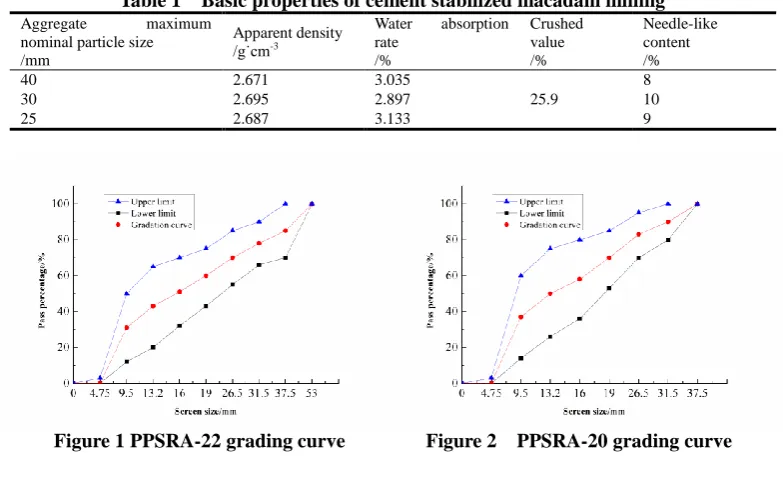
Table 1 Basic properties of cement stabilized macadam milling
Aggregate maximum
nominal particle size /mm
Apparent density /g˙cm-3
Water absorption rate
/%
Crushed value /%
Needle-like content /%
40 2.671 3.035
25.9
8
30 2.695 2.897 10
25 2.687 3.133 9
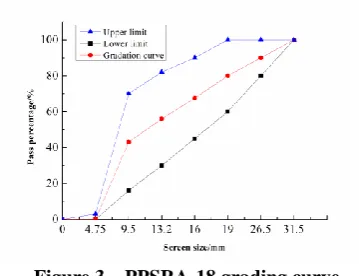
Figure 3 PPSRA-18 grading curve
Since the voids of the polyurethane mixture mixed with the fine aggregate are filled with the fine aggregate of the glue, the water permeability is greatly reduced, and the addition of the fine aggregate also causes a large amount of glue to be wrapped on the surface of the fine aggregate, which increases the glue Dosage. Therefore, in the case of meeting the specifications, the fine aggregate having a particle size range of 0-4.75 mm is removed when the aggregate is selected, and the cement stabilized gravel milling material having a particle size range of 4.75 mm to 31.5 mm is used. The three types of porosity cement stabilized macadam milling materials used in the test correspond to the water-permeable polyurethane stabilized macadam base layer is PPSRA-22, PPSRA-20, PPSRA-18, and the gradation curve is shown in Figure 1-Figure 3.
III.
TEST METHOD AND TEST PIECE PREPARATION
3.1 Unconfined compression test and flexural testThe compressive and flexural strength characteristics of PPSRA were modified on the basis of the compression and flexural test of ordinary asphalt mixture. The different porosity, the amount of glue and the unconfined compressive strength of the test specimen were measured. And flexural strength.
3.2 drainage test
In order to determine the drainage performance variation with PPSRA porosity, hydrostatic molding method cylindrical specimens, specimen size of 100×100 mm. The permeability coefficient of the test piece was tested by a water permeable tester. Three parallel test pieces were formed in each set of tests, and the average value was taken as the test result.
3.3 Immersion Marshall test
Currently, the water stability test method for PPSRA or blank, so this reference to Highway Engineering asphalt and asphalt testing procedures (JTG E20-2011), with large compaction test the porosity of the three kinds of large molded optimum mix Marshall test specimens, the water stability of PPSRA mixture was tested by immersion Marshall test residual stability.
3.4 Preparation of test pieces
At present, there is no relevant test procedure for the drainage of polyurethane stabilized recycled gravel materials at home and abroad. Therefore, this paper refers to the open-grade asphalt stabilized macadam mixture in the Technical Specifications for Highway Asphalt Pavement Construction (JTG F40-2004). The grading curve requires the determination of the grading range. The test pieces were formed in accordance with the Testing Procedures for Asphalt and Asphalt Mixtures for Highway Engineering (JTG E20-2011). Due to the large fluidity of the polyurethane glue, a thin layer of glue is easily formed on the surface of the aggregate, and the surface of the aggregate cannot be covered when the amount of glue is small, resulting in poor adhesion between the aggregates. Excessive amount of glue may lead to the test. A glue seal is formed on the bottom of the piece. Therefore, the optimum polyurethane glue dosage range is 3%-5% through the Schellenberg Leakage Test and the Kentberg Fly Test. During the test, the gradation of each aggregate particle size was taken as 3 glues at intervals of 1%. According to the laboratory test, the ratio of the glue components was 1:2.5.
IV.
ANALYSIS OF STRENGTH CHARACTERISTICS RESULTS
4.1 Effect of porosity on strength
(a) Two sets of test pieces (b) Single test piece Figure 4 test specimen
The void ratio, compressive strength and flexural strength of the three kinds of glue test pieces were measured for 24 hours. The effect of porosity on the compressive and flexural strength of PPSRA is shown in Figure 5.
(a) Compressive strength (b) Flexural strength Figure 5 intensity versus porosity curve
It can be seen from Fig. 5 that the compressive and flexural strength of PPSRA decreases with the increase of porosity. According to the linear regression analysis, the correlation coefficient r between the two is 0.93, indicating that there is strong linearity between the two. Correlation. The increase in porosity leads to a decrease in the compactness of the test piece, which affects the overall stability and bearing area of the test piece, resulting in a decrease in the compressive and flexural strength of the test piece.
4.2 Effect of glue dosage on strength
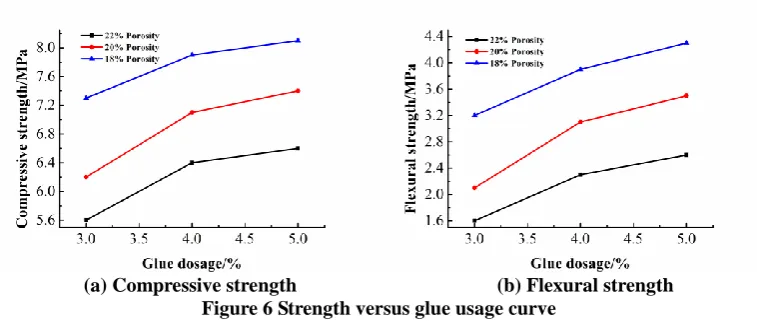
(a) Compressive strength (b) Flexural strength Figure 6 Strength versus glue usage curve
with 3%, 4% and 5% of the glue was carried out. The test results are shown in Figure 6.
It can be seen from Fig. 6 that the strength of PPSRA and the amount of glue have a certain regularity. First of all, in the range of the amount of glue, the compressive strength and flexural strength increase rapidly with the increase of the amount of glue, and then the growth rate tends to be stable. This shows that before the optimum amount of glue is reached, the adhesion between the glue and the aggregate exerts a structural strength on the PPSRA, which can strengthen the strength of the PPSRA, but as the amount of glue increases, the thickness of the glue film changes. In addition, in addition to the structural glue that binds, some of the free glue is added to the mixture, which causes a large amount of voids in the mixture to be filled with glue, and the increase in free glue does not significantly enhance the strength of the mixture. Therefore, 4% of the amount of glue is tested in the road performance analysis.
4.3 Effect of porosity on compression modulus
The compressive strength characteristics of PPSRA were modified according to the compression test of ordinary asphalt mixture. The test piece was compacted according to the “Testing Procedure for Highway Engineering Asphalt and Asphalt Mixture” (JTG E20-2011). After the unconfined compressive strength of the three best nominal particle size PPSRA ratios was determined, the cylindrical specimens were loaded step by step according to the test method, and the specimens were rebounded at 0.5 times the maximum compressive load. The deformation is calculated from the deformation modulus, and the test results are shown in Table 2.
Table 2 Results of compressive rebound modulus test
Types of PPSRA Compressive modulus /MPa average value /MPa
PPSRA-22 873 795 812 826.7
PPSRA-20 921 859 967 915.7
PPSRA-18 1260 1050 1575 1295.0
It can be seen from the test results that the compressive elastic modulus of the three largest nominal particle sizes PPSRA is 800-1300 MPa, the smaller the maximum nominal particle size of the aggregate is, the larger the compressive rebound modulus is, and the compressive rebound modulus is higher than that of ordinary asphalt. The concrete is low. When designing the road base layer, the rebound modulus of the base layer has a wide range of values. Therefore, when applying PPSRA to actual engineering, it is necessary to select according to the requirements in the roadbed design specification.
V.
PPSRA ROAD PERFORMANCE TEST
5.1 Water stabilityIn order to detect the water stability of PPSRA, the water stability of PPSRA mixture was tested by water immersion Marshall test to determine its water stability. The test results are shown in Table 3.
Table 3 Water stability test results
Types of PPSRA Residual stability /% average value /%
PPSRA-22 85.7 82.9 89.3 86.0
PPSRA-20 88.5 90.2 87.9 88.9
PPSRA-18 93.3 90.5 89.3 91.1
Types of PPSRA Permeability coefficient/cm˙s-1 average value/cm˙s-1
PPSRA-22 0.897 0.825 0.807 0.843
PPSRA-20 0.831 1.036 0.756 0.874
PPSRA-18 0.916 0.883 1.081 0.941
It can be seen from Table 4 that the permeability coefficient of the three kinds of porosity PPSRA is 0.8-1.0 cm˙s-1, which is in accordance with the Technical Specifications for Highway Asphalt Pavement Construction (JTG F40-2004). The permeability coefficient for the drainage subgrade is not less than 0.35. cm˙s-1. The water permeability of PPSRA mainly depends on the porosity. According to the Marshall test results, the porosity of the three kinds of porosity PPSRA is not much different. Therefore, the permeability coefficient of the three kinds of porosity PPSRA is similar in the drainage test, and both can meet the roadbed. Water permeability requirements.
VI.
CONCLUSION
In this paper, with reference to the asphalt mixture test procedure, the indoor test is used to determine the optimum ratio of PPSRA to B: 1:2.5. Through the unconfined compression test and the flexural test, the effect of porosity and glue dosage on strength is determined. Regularity, water stability and drainage of PPSRA were tested by water immersion Marshall test and penetration test, and the following conclusions were drawn.
(1) From the results of unconfined compression test and flexural test, the compressive strength and flexural strength of PPSRA in the range of glue dosage increase rapidly with the increase of glue dosage, and then the growth rate tends to be flat. The strength of the piece will tend to be stable when the amount of glue reaches a certain ratio; in the test, the compressive modulus of the PPSRA is 800-1300 MPa, and the compressive modulus of the PPSRA is slightly smaller than that of the ordinary asphalt mixture. The aggregate used is cement stabilized gravel milled concrete, which will have a great impact on its compressive strength. Further research is needed on the application of natural aggregate and polyurethane glue to the pavement base; from the relationship between porosity and strength The compressive and flexural strength of PPSRA decreases with increasing porosity, and there is a strong linear correlation between the two. This indicates that the compactness of the specimen has a decisive influence on the strength.
(2) According to the road performance test results, the residual stability of the three kinds of porosity PPSRA is greater than 85%, meeting the technical requirements of >75%, meeting the water stability requirements of the pavement base; from the drainage test, PPSRA The permeability coefficient is 0.8-1.0 cm˙s-1, which is much larger than the 0.35 cm˙s-1 specified in the specification, so PPSRA has good drainage.
REFERENCES
[1]. Jiqing Zhu,Shaopeng Wu,Jinjun Zhong,Dongming Wang. Investigation of asphalt mixture containing demolition waste obtained from earthquake-damaged buildings[J]. Construction and Building Materials,2012,29.
[2]. A.R. Pasandín,I. Pérez. Overview of bituminous mixtures made with recycled concrete aggregates[J]. Construction and Building Materials,2015,74.
[3]. Li Lihui, Dong Xibin. Mixing ratio design of drainage asphalt stabilized macadam base[J]. Journal of China & Foreign Highway, 2008,28(2): 47-49.
[4]. Laboratory Evaluation of Foamed Asphalt Stabilized Base Materials, Geotechnical Special Publication, n 225 GSP, p 1592-1601, 2012
[5]. Fresh, Mechanical, and Durability Characteristics of Self-Consolidating Concrete Incorporating Recycled Asphalt Pavements, Journal of Materials in Civil Engineering, v 26, n 4, p 668-675, 2014
[6]. Utilization of coal ash from fluidized'bed combustion boilers as road base material, Resources, Conservation and Recycling, v 14, n 2, p 69-77, Aug 1995
[7]. Analysis of Road Base Uniformity via the Deviation of Modulus of Asphalt Mixtures, Journal Wuhan University of Technology, Materials Science Edition, v 22, n 2, p 367-370, June 2007
[8]. Xu Zhoucong, Wang Huoming, Li Rukai, Chen Fei. Control for Construction Technology and Quality of Permeable Pavement of Polyurethane Macadam Mixture[J]. Technology of Highway and Transport, 2015(06):5-8+17.
[9]. Bao Sheng. Experiments on the total stress - strain curve of Porous Polyurethane Mixture[A]. Organizing Committee of Building Technology and Management. Proceedings of the March 2015 Building Technology and Management Academic Exchange Conference[C].
Materials,2015(04):43-45+48.
[11]. Zhao Boxun. Experimental study on polyurethane pavement permeable pavement[A]. China Western Regional Highway Society 2013 Science and Technology Proceedings[C]. China Highway Society,2013:5.
[12]. Xu Kaiquan. Study on Regeneration Technology of Cement Stabilized Macadam Foam Asphalt[D]. Xi’an: Chang'an University, 2017.
[13]. Yueqin Hou,Xiaoping Ji,Xiuli Su,Wengang Zhang,Lingqin Liu. Laboratory investigations of activated recycled concrete aggregate for asphalt treated base[J]. Construction and Building Materials,2014,65.
[14]. Wang Huoming, Li Rukai, Wang Xiu, Ling Tianqing, Zhou Gang. Strength and Road Performance for Porous Polyurethane Mixture[J]. China Journal of Highway and Transpor, 2014, 27(10): 24-31
[15]. Zhiqing Zhang,Kejin Wang,Huan Liu,Zongcai Deng. Key performance properties of asphalt mixtures with recycled concrete aggregate from low strength concrete[J]. Construction and Building Materials,2016,126.
[16]. Li Rukai, Wang Xiaoming, Wang Huoming, Zhou Gang. Research on Adhesive Dosage of Porous Polyurethane Gravel Pavement[J]. Highway Engineering,2015,40(02):105-108+127.
[17]. Wang Xiang. Design and Performance Evaluation of Polyurethane Elastic Concrete Mixture Ratio Based on Orthogonal Analysis[J]. Shanghai Highways,2017(03):77-81+5.
[18]. Xue Zilong. Study on Performance of Open Graded Cement Stabilized Aggregate for Pavement Base[D]. Hunan University,2015.