Computer-Based Boiler Efficiency Improvement,
Studying the Most Effective Parameters: A Case
Study
Asmaa S. Hamouda
Department of Environmental Sciences and Industrial Development
Faculty of Postgraduate Studies for Advanced Sciences, Beni-Suef University, Beni-Suef, Egypt
Abstract
This paper is concerned with how energy saving in steam boiler system. The simple mathematical model of a steam boiler has been developed for calculating boiler efficiency by using java web application. The Model shows the influence of the most effective parameters on the boiler performance and its applications in two types of boilers (water and fire tube boilers). The findings showed, in the case of a water tube boiler when natural gas fuel used, every 10% in the excess air causing decreasing boiler efficiency by 0.37%. Also every 10% (20◦C) increase in temperature of flue gases causing decreasing in boiler efficiency by 1 %, and every 10% (7-8)◦C increase in feed water temperature causing increasing in boiler efficiency by 1%,, In case of fire tube boiler when liquid fuel (solar) used, every 10% increase in the excess air causing decreasing in boiler efficiency by 5%, every 10 %( 20◦C) increase in temperature of flue gases causing decreasing in boiler efficiency by 1-2%, The model gave acceptable agreement with experimental data measured, in addition, the model has economic and environmental effect.
Keywords: Boiler Efficiency, Parameters, Java Web Application, Steam Boilers
________________________________________________________________________________________________________
I. INTRODUCTION
Boilers are the key part in any power station as it is the place where the fuel is used for producing the needed amount of heat in the form of steam. Facing enormous demand for electricity and growing need for more and safer power generating has motivated investigation into the dynamic analysis of power plants to design more reliable control systems with saving cost, keeping better system performance which means an increase in power generation efficiency and also decrease in the maintenance costs, also remembering the value of steam boiler system, so maintaining it properly to save cost in future.
studying the effective parameter that affects on boiler performance, making us taking right decision at the right time to control steam boiler efficiency, with traditional methods; operators often are not able to detect the critical condition to achieve high performance, as steam boiler considered hazard system because it works at high pressure and temperature, so we use mathematical model to help us to control the performance of steam boiler with safety method. Many models found in the market very effective but it is very high-priced, in our energy saving study, we developed a simple mathematical model with Java web application language with high accuracy to calculate boiler efficiency and combustion products then we used this model for studying the effect of excess air, the temperature of flue gases and the temperature of feed water on the two types of the steam boiler using a different type of fuels.
loss of 1% and an increase in the efficiency of the boiler by 0.55% when coal is used as fuel In the case of furnace oil, the reduction in the total loss was 0.5% with an increase in boiler efficiency of about 0.3%. Likewise, in the case of bagasse, the reduction in total loss was 1.5% with an increase in 1.2% of boiler efficiency, and 10.5% decrease in flue gas temperature, there is the reduction of total loss of 2.12% and 1.31% increase in boiler efficiency when coal was used as fuel. In the case of furnace oil, the reduction in the total loss was 1.5% with an increase in boiler efficiency of about 0.85%. Likewise, in the case of bagasse, the reduction in total loss was 2.86% with an increase in 2.2% of boiler efficiency. recently a new modification in conventional mathematical formulation of efficiency is presented by Ahamed Rehan in 2018 [7], based on time-varying efficiency using time-varying operational variables of boiler, in this model, he discussed the influence of variations in air to fuel ratio and fuel flow rate upon efficiency the study showed that time-varying efficiency covers a deeper aspect of the dynamic relation between efficiency and other input of boiler especially air to fuel ratio and fuel flow rate.
From the previous we found that, Feed water and the Flue gas temperatures, and percentage of excess air are the important parameters that improve the efficiency of the boiler, that clarifies the value of measuring them accurately in the steam boiler system, therefore by applying our suggested simple mathematical model specialized for steam boiler we could measure the critical limits which get high efficiency of steam boiler and explaining them on the graphs. We used for calculating the boiler efficiency two methods (direct and indirect method) which help us knowing percentages of losses in the boiler.
Our target is defining the critical limits for these parameters having effects on any steam boiler performance.
II. EXPERIMENTAL STUDY
The data used from water tube boiler using natural gas fuel and fire tube boiler using liquid fuel (solar) from a Salt production company.
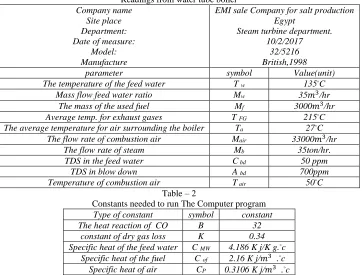
Table (1) shows specifications of the water tube boiler and the readings that were taken as the maximum load within the boiler. Table (2) presents some constants being used to run the developed computer program.
Table – 1
Readings from water tube boiler Company name
Site place Department: Date of measure:
Model: Manufacture
EMI sale Company for salt production Egypt
Steam turbine department. 10/2/2017
32/5216 British,1998
parameter symbol Value(unit)
The temperature of the feed water T w 135◦C
Mass flow feed water ratio Mw 35𝑚3/hr
The mass of the used fuel Mf 3000𝑚3/hr
Average temp. for exhaust gases T FG 215◦C
The average temperature for air surrounding the boiler Ta 27◦C
The flow rate of combustion air Mair 33000𝑚3/hr
The flow rate of steam Mb 35ton/hr.
TDS in the feed water C bd 50 ppm
TDS in blow down A bd 700ppm
Temperature of combustion air T air 50◦C
Table – 2
Constants needed to run The Computer program
Type of constant symbol constant
The heat reaction of CO B 32
constant of dry gas loss K 0.34
Specific heat of the feed water C MW 4.186 K j/K g.◦c
Specific heat of the fuel C of 2.16 K j/𝑚3 .◦c
Specific heat of air CP 0.3106 K j/𝑚3 .◦c
Table (3) shows the specifications of the fire tube boiler and the readings that were taken as the maximum load within the boiler. Table (4) presents some constants being used to run the developed computer program.
Table – 3
Readings from (Fire tube boiler) Company name
Site place Department: Date of measure:
Model: Manufacture
Emisal Company for salt production shakshok, EL-fayom Magnesium department.
18/2/2017 Dennis Baldwin and sons
British,2003
parameter symbol Value(unit)
Mass flow feed water ratio Mw 300Kg/hr.
The mass of the used fuel Mf 216Kg/hr.
Average temp. for exhaust gases T FG 171◦C
The average temperature for air surrounding the boiler Ta 27◦C
The flow rate of combustion air Mair 2769.1𝑚3/hr
The flow rate of steam Mb 3000Kg/hr.
TDS in the feed water C bd 100 ppm
TDS in blow down A bd 3500ppm
Temperature of combustion air T air 20◦C
Table – 4
Constants needed to run the computer program Type of constant symbol Constant
The heat reaction of CO B 48
constant of dry gas loss K 0.56 Specific heat of water C MW 4.186 K j/K g.◦c
Specific heat of the fuel C mf 0.47 K j/𝑚3 .◦c
Specific heat of air Cp 0.3106 K j/𝑚3 .◦c
III. RESULTS AND DISCUSSION:
Effect of Excess Air on the Water Tube Boiler Efficiency
The excess air has a direct effect on the losses of dry flue gas (L dg %) Consequently on the combustion efficiency and the boiler efficiency.
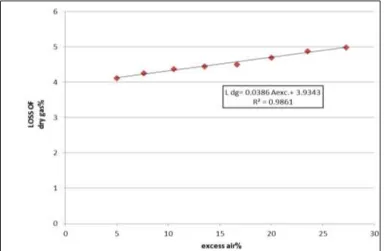
The program was used to calculate the boiler efficiency for different values of excess air between zero and 200% with a 5% step. The result of calculations is plotted by using ''EXCEL'' program, which also used to calculate the regression equation for the curve.
Fig.1 shows the effect of changing the values of excess air on the losses of dry flue gases.
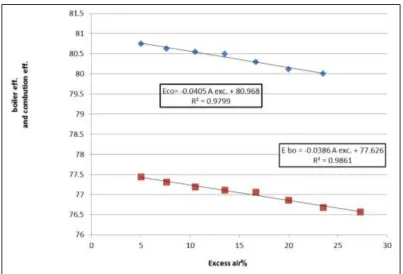
Fig.2 shows the effect of excess air on the combustion efficiency and boiler efficiency. From which it is clear that the increase of excess air increases the dry flue gases losses. To discuss this result:-
The relation between the excess air and loss in dry gases can be expressed by the following regression equation: L dg =0.0386 A exc. +3.9343 ... Eq. [1]
Where:
L dg : loss of dry flue gases, % A exc. : Excess air, %
From the last equation, it is clear that the increase of the excess air by 10% causing an increase in L dg by 0.347%. Fig.2 shows the relation between excess air and combustion efficiency & boiler efficiency percentage. This relation will have the following forms:
Fig. 2: The relation between excess air% with boiler &combustion efficiency.
Eco = - 0.0405 A exc. +80.968 ... Eq. [2] E bo = - 0.0386 A exc. +77.626 ... Eq. [3] Where:
Eco: combustion efficiency, % E bo: boiler efficiency, %
Excess air has a significant effect on the dry flue gases loss as the doubling of this coefficient from 20%to 40% increases this loss by 16.40%.this, in turn, decrease both of combustion and boiler efficiency as seen in fig.2 this last relation does not take into account the effect of the excess air increase on the inverse of flue gases temperature as the heat transfer coefficient inside the boiler chamber significantly decreases. It means that an increase in excess air coefficient will have a double worse effect on boiler efficiency.
Effect of the Temperature of Flue Gases
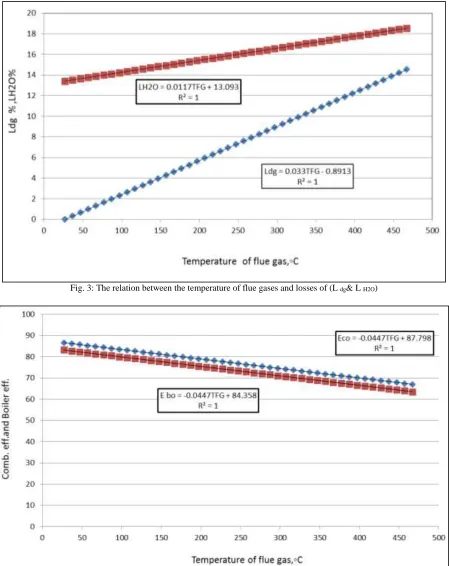
Fig. 3: The relation between the temperature of flue gases and losses of (L dg& L H2O)
Fig. 4: Relation between temperature of flue gases with combustion and boiler efficiencies
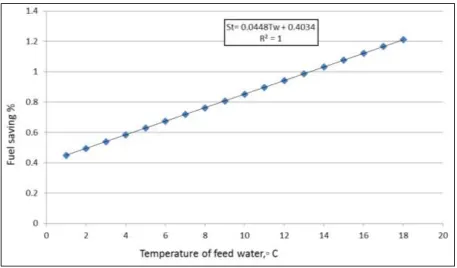
Fig. 5: The relation between preheated feed water and fuel saving
IV. CONCLUSION
The findings of this research show, for water tube boiler, every 10% in the excess air causing decreasing in boiler efficiency by 0.37%. Also every 10% (20◦C ) increase in temperature of flue gases causing decreasing in boiler efficiency by 1% ,and every 10% (7-8)◦C increase in feed water temperature causing increasing in boiler efficiency by 1%, for fire tube boiler, every 10% in excess air causing decreasing in boiler efficiency by 0.5%. Also, every 10% (20◦C) increase in temperature of flue gases causing decreasing in boiler efficiency by 1.2%, and every 10% (7-8) ◦C increase in feed water temperature causing increasing in boiler efficiency by 1%, the model shows a good agreement with efficiency calculated from experimental data.
REFERENCES
[1] Arun. S. Gopinath#1, N.S.B., Prediction of Excess Air Requirement Using ANN for the Improvement of Boiler Efficiency. International Journal of Students’
Research in Technology & Management, 2014. Vol 2 (04): p. pg 149-152.
[2] Che, D., Y. Liu, and C. Gao, Evaluation of retrofitting a conventional natural gas-fired boiler into a condensing boiler. Energy Conversion and Management,
2004. 45(20): p. 3251-3266.
[3] Nabil M. Muhaisen, R.A.H., Calculating the Efficiency of Steam Boilers Based on Its Most Effecting Factors: A Case Study, 2012.
[4] VI Kouprianov, V.T., Optimization of excess air for the improvement of environmental performance of a 150 MW boiler fired with Thai lignite. Energy,
2003. 74(3-4): p. 445-453.
[5] MA Rosen, R.T., Improving steam power plant efficiency through exergy analysis: effects of altering excess combustion air and stack-gas temperature -, -
inderscienceonline.com. International journal of exergy, 2008.
[6] Bhaskaran.A1, H., Influence of Flue Gas and Feed WaterTemperatures on Boiler Efficiency – An Analysis. International Journal of Innovative Research in
Science, Engineering, and Technology, January 2016. Vol. 5, (Issue 1).
[7] Ahmed Rehan, M.A.H., Moustafa Elshafei and Iyad T. Alzaharnah, Modeling time variations of boiler efficiency. Journal of Energy Resources Technology