www.ijres.org Volume 5 Issue 10 ǁ October. 2017 ǁ PP. 01-09
Differential Evolution Algorithm Based On Information
Extraction Strategy
*
Dapian Zhang
1,Liming Zheng
21,2Dept. of Electronic Engineering, Jinan University,Guangzhou,China) Corresponding Author : *Dapian Zhang
ABSTRACT:
In order to reduce the blindness in choosing the evolutionary directions in the evolutionary process, this paper proposes an information extraction strategy (IES), which can be incorporated into the mutation operator of the differential evolution (DE) algorithm. By efficiently utilizing the useful information extracted from the current population, IES improves the performance of DE algorithm. Numerical experiments show that the proposed strategy significantly enhances the performance of classic DE algorithm as well as several advanced DE variants. Moreover, IES outperforms the ranking based mutation scheme.Keywords:
differential evolution algorithm, mutation operator,evolutionary direction, information extraction strategy
---Date of Submission:24-09-2017 Date of acceptance: 04-10-2017
---I. INTRODUCTION
In order to solve complex computational problems, many scholars have turned their attention to the evolution of species in nature. By deeply observing and studying the connection between optimization problems and biological evolution, some scholars have begun to try to solve the complex computational problems by simulating the evolutionary processes of species in nature. The evolutionary algorithm inherits the advantages of self-organization and self-adaptation in biological evolution. It provides a general framework for solving complex system optimization problems. It does not depend on the specific field of the problem and has strong robustness to the optimization problem, So scholars in many disciplines have studied and improved the evolutionary algorithm. Differential evolution (DE) [1,2] Since 1995, Storn and Price [3] since the first proposed, because of its simple principle, less controlled parameters, easy to understand and achieve the current evolution of a hot spot
As a kind of heuristic search algorithm, Evolutionary Algorithms (EAs) is more and more concerned by researchers and scholars at home and abroad because of its lack of cumbersome mathematical formula deduction and rapid computing power based on computer simulation. Many disciplines in the field of scholars on the differential evolution algorithm to start a lot of work to explore its performance.
In this paper, an information extraction strategy is proposed to guide the evolution direction according to the ranking information of fitness and the extraction of effective information between individuals. The extraction of valid information between individuals is achieved by a combination of mathematical weights. Because IES strategy is versatile and is not limited by the type of evolutionary algorithm, it can be easily applied to different mutation operators.
The main contributions of this paper are as follows:
1) After introducing the IES strategy, the differential mutation operator can improve the performance of the algorithm by using the extraction information from multiple existing individuals to more effectively provide direction guidance in the evolutionary search process.
2) IES strategy has a strong operational because the structure is simple
3) As an independent strategy, IES strategy can be easily integrated into different differential evolutionary improvement algorithms.
II. STANDARD DIFFERENTIAL EVOLUTION ALGORITHM
The standard differential evolution algorithm consists of three steps: mutation, crossover, selection. The differential evolution algorithm has three control parameters, namely, population size NP, size scaling factor F and crossover rate Cr, where the individual in the population is generally a D-dimensional vector [3]. In the initial population need to ensure that the individual is randomly scattered throughout the search space. In the G-generation of the evolutionary search process, the i-th individual in the population is generally represented by a vector of D-dimensional. Where i = 1, 2, ..., NP.
A.Mutation
The individual variance of the differential evolution algorithm is realized by the difference strategy, such as the classical DE / rand / 1: randomly select the three different individuals in the population, the weight difference between the two individuals after the weight of the superposition to the base vector, As shown in equation (1). DE/rand/1:
vi=xr1+F∙(xr2-xr3) (1) Other commonly used tactical forms include: DE/rand/2:
vi=xr1+F∙(xr2-xr3)+F∙(xr4-xr5) (2) DE/best/1:
vi=xbest+F∙(xr1-xr2) (3) DE/best/2:
vi=xbest+F∙(xr1-xr2) +F∙(xr3-xr4) (4) DE/current-to-best/1:
vi=xi+F∙(xbest-xi)+F∙(xr1-xr2) (5)
The subscripts r1, r2, r3, r4 and r5 ∈ {1, 2, ..., NP} are different from each other. The vector xbest
represents the individuals with the best fitness value in the current population. The first vector of the difference vector is called the direction vector. Parents Xi, G Generate variants by mutation strategiesVi,G.
B. Cross
Variant individualsVi,G with the parentXi,Gexchange part of the elements to form a new test individuals
Ui,G=[ui,1,G,ui,2,G,…,ui,D,G]T. The common way of crossing is binomial cross: vi,j,G, if rand(0,1) ≤ Cr or j=jrand
ui,j,G=
xi,j,G, others
Where rand (0,1) represents a random number between (0,1); jrand∈{1, 2, ..., D} represents a randomly selected
integer to ensure that the test individual gets at least from the mutated individual A component.
C. Choose
Ui,G, iff(Ui,G)≤f(Xi,G)
Xi,G+1=
Xi,G, others
Choose to decide which vectors to survive to the next generation, and when the mutated cross produces the test subjects better than the parent, they survive to the next generation. (Note: This article considers minimizing the problem)
The termination condition is generally set to the maximum number of fitness function evaluations (referred to as Max_FEs).
III. DIFFERENTIAL EVOLUTION ALGORITHM BASED ON INFORMATION
EXTRACTION STRATEGY
According to the theory of natural evolution, the greater the probability that the better individuals of the offspring produce the better, so first, the individuals of the whole population are sorted according to the fitness values, and the more excellent the individual rank value rank i is, the ranki is the individual i The sort value. Then, based on Equation 6, make sure that the outstanding individual provides more effective information. So that the interaction information of the two random individuals is extracted and the improved individual corresponding to the individual i is generated. Finally, the improved individual XIES is used to replace the directional vector in the traditional mutation operator. Thus, a new information extraction strategy (IES) is proposed.
(6)
The introduction of the IES strategy in the differential mutation operator requires only XIES to replace all the directional vectors in the original differential mutation operator.
DE/rand/1 with IES:
vi=xr1+F∙(xIES-xr2) (7) DE/rand/2 with IES:
vi=xr1+F∙(xIES1-xr2)+F∙(xIES2-xr3) (8)
2 1
1 2
1 2 1 2
x *x *x
( ) ( )
i r r r r
IES
r r r r
rank rank
rank rank rank rank
DE/best/1 with IES
vi=xbest+F∙(xIES-xr2) (9) DE/best/2 with IES
vi=xbest+F∙(xIES1-xr2)+F∙(xIES2-xr3) (10)
IES strategy only affects the difference variation, so it can be easily substituted into any traditional differential evolution algorithm or other differential evolutionary improvement algorithm.
IV. EXPERIMENTAL RESULTS AND ANALYSIS
4.1 Test function, performance evaluation index and algorithm parameter setting
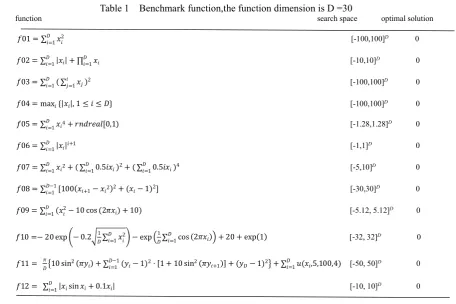
Test function: This paper selects 12 commonly used benchmarking functions [14] for simulation, and these functions are defined in Table 1.
Performance evaluation index: The algorithm performance is measured by the solution error value E = f (x) - f (x *), where x * represents the global optimal solution of the test function, x represents the algorithm in the Max_FEs = 105 function evaluation After obtaining the optimal solution.
In this paper, four popular DE algorithms are used to experiment, including two basic DE algorithms DE / rand / 1 / bin [3] and DE / best / 1 / bin [3]. In this paper, And two advanced DE algorithms jDE [4] and SHADE [10]. For the sake of fairness, the original algorithm and the improved algorithm use the same parameter settings, summarized as follows:
DE/rand/1/bin [3], IES_DE/rand/1/bin: F = 0.7, CR = 0.5, NP = 150 DE/best/1/bin [3], IES_DE/best/1/bin: F = 0.7, CR = 0.5, NP = 150 jDE [4], IES_jDE: γ1= 0.1, γ2 = 0.1, Fl = 0.1, Fu = 0.9, NP = 150
SHADE [10], IES_SHADE: MF = {0.7}, MCR = {0.5}, H = NP, NP = 150
Each pair of algorithms runs independently on each benchmark function for 50 times, and the mean and variance of the final solution error E are compared. The optimal solution is marked with blackbody. In addition, in order to obtain a statistical conclusion, experiments were performed using a pair of Vickersson rank sum of 5% significance levels to compare the differences of the different algorithm solutions. The symbols "-", "=" and "+" are used to represent the performance of the original algorithm, which is significantly inferior to that of the improved algorithm.
4.2 Explanation of the validity of the IES strategy
This section examines the ability of IES strategies to generate better individuals. First, for an intuitive explanation, we consider a one-dimensional simple function f (x) = (x-2) 2, x [0, 4]. Assuming that there are two individuals A (0.5) and B (3) in the population, the corresponding fitness function values are f (A) = 2.25 and f (B) = 1, the sort value of individual A is 2, B is 1 The According to the IES strategy (formula (6)), the newly generated individual C = 1/3 * 9/4 + 2/3 * 1 = 17/12, f (C) = 49/144. The fitness value of the new individual C is better than that of the two selected individuals. It can be seen that the IES strategy has the ability to generate more potential individuals. To more fully reflect the ability of IES on different functions, we will test it on 12 basis functions. The average frequency F and the ratio P = F / Max_FEs for 50 runs are shown in Table 2. It can be observed from Table 2 that IES has a relatively high (> 50%) ratio on the vast majority of functions, including f01-f08, f10 and f11, and a certain proportion of the functions f09 and f12 Good individual.
4.3 IES strategy in the basic DE algorithm performance
In this section, the proposed IES strategy is applied to the classic DE algorithm DE / rand / 1 / bin and DE / best / 1 / bin to observe the performance changes brought about by it.
Table 3 shows the mean and variance of the error values obtained on the 12 benchmark functions and the statistical results of the Wilkesson rank sum check before and after the improved algorithm. It can be seen from this table that the IES strategy significantly improves the performance of the basic DE algorithm. The two improved DE algorithms have a smaller error value than the original algorithm on all test cases and are statistically significant.
4.4 IES strategy in the advanced DE algorithm performance
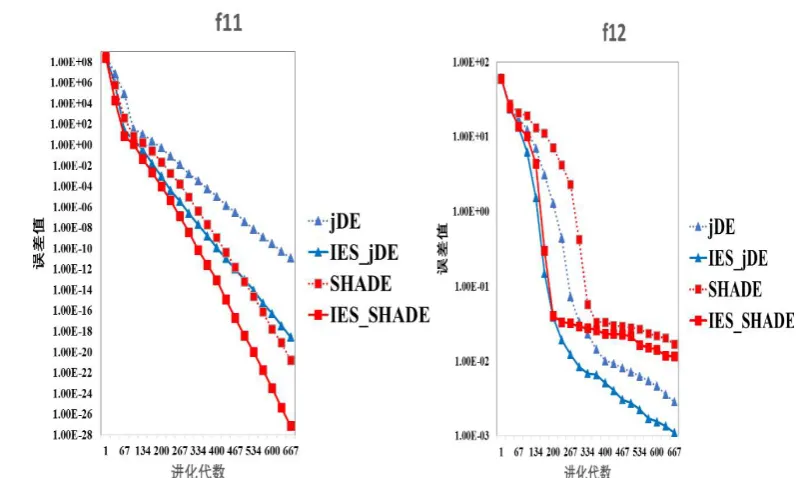
Only on the function f09 performance as IES_SHADE. Figure 1 shows the convergence of these four algorithms over all 12 reference functions. It can be seen from Fig. 1 that the improved algorithm based on IES strategy achieves faster convergence rate and better final solution in most functions than the original algorithm.
4.5 Comparison of Performance Comparison between IES Strategy and Adaptation Value Sorting Variations
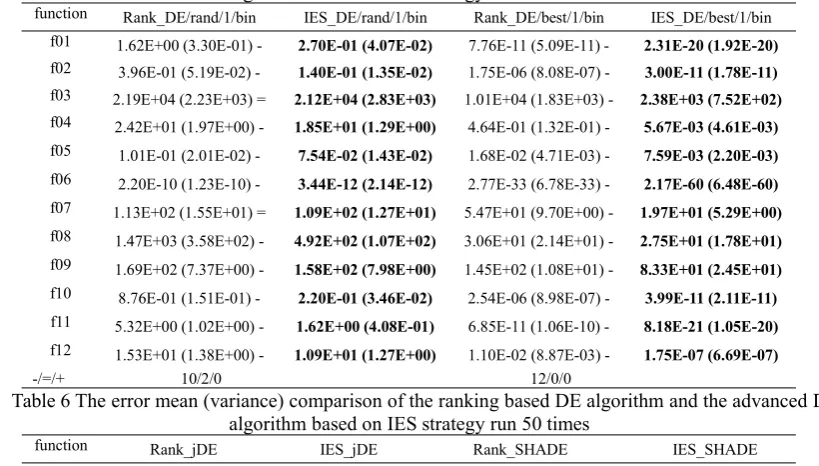
In order to further demonstrate the superiority of the proposed strategy, this section compares it with the Rank_DE [8] algorithm based on the fitness ranking. To ensure fairness of the experiment, Rank_DEs and IES_DEs use the same parameter settings, as shown in Section 4.1. The experimental results of all the algorithms are shown in Tables 5 and 6.
From Table 5 and 6 it can be observed that the performance of IES_DEs is significantly better than Rank_DEs. In the total of 48 comparisons, the number of IES_DEs was better than, equal to and equal to Rank_DEs were 39, 6, and 3 times, respectively. Compared to Rank_DEs, the reason why IES_DEs is more proficient is that the IES strategy can synthesize the population information more efficiently through the weight combination of the population, while the Rank strategy uses only the information of a single individual.
Table 1 Benchmark function,the function dimension is D =30
function search space optimal solution
th h [-100,100]D 0
t h h [-10,10]D 0
th h h [-100,100]D 0
th max h ᦙ [-100,100]D 0
th h h 㤱㌠㐴㤱‹浔㰍〰t h [-1.28,1.28]D 0
to h h [-1,1]D 0
tᝋ h htth htth h [-5,10]D 0
th thh〰htt
ht t h [-30,30]D 0
th h t ht cos ht [-5.12, 5.12]D 0
ht t t exp t tt h h t exp h hcos t exp h [-32, 32]D 0
hh ht sin thh t h h ht sin
h t h h h htt h [-50, 50]D 0
h h sin tth [-10, 10]D 0
Table 2 The average frequency (F) and the proportion (P) of individual generated by the IES strategy is superior to the selected parent
function F P function F P
f01 9.99E+04 99.90% f07 9.55E+04 95.54% f02 8.67E+04 86.72% f08 9.96E+04 99.60%
f03 9.97E+04 99.71% f09 7.74E+03 7.74%
f04 9.35E+04 93.49% f10 9.86E+04 98.57% f05 6.74E+04 67.38% f11 9.89E+04 98.92% f06 9.91E+04 99.06% f12 1.17E+04 11.72%
Table 3 The error mean (variance) comparison of the basic DE algorithm and the basic DE algorithm based on IES strategy run 50 times
f03 2.34E+04 (2.37E+03) - 2.12E+04 (2.83E+03) 1.29E+04 (2.34E+03) - 2.38E+03 (7.52E+02) f04 3.06E+01 (2.09E+00) - 1.85E+01 (1.29E+00) 1.19E+00 (3.01E-01) - 5.67E-03 (4.61E-03) f05 1.45E-01 (2.57E-02) - 7.54E-02 (1.43E-02) 2.13E-02 (5.41E-03) - 7.59E-03 (2.20E-03) f06 1.32E-08 (7.68E-09) - 3.44E-12 (2.14E-12) 1.57E-27 (7.99E-27) - 2.17E-60 (6.48E-60) f07 1.33E+02 (1.82E+01) - 1.09E+02 (1.27E+01) 6.20E+01 (1.12E+01) - 1.97E+01 (5.29E+00) f08 8.59E+03 (2.14E+03) - 4.92E+02 (1.07E+02) 3.65E+01 (2.62E+01) - 2.75E+01 (1.78E+01) f09 1.74E+02 (8.40E+00) - 1.58E+02 (7.98E+00) 1.47E+02 (9.18E+00) - 8.33E+01 (2.45E+01) f10 2.94E+00 (1.37E-01) - 2.20E-01 (3.46E-02) 3.14E-05 (1.06E-05) - 3.99E-11 (2.11E-11) f11 1.51E+01 (2.37E+00) - 1.62E+00 (4.08E-01) 1.99E-08 (3.21E-08) - 8.18E-21 (1.05E-20) f12 1.64E+01 (1.11E+00) - 1.09E+01 (1.27E+00) 8.63E-02 (3.64E-01) - 1.75E-07 (6.69E-07)
-/=/+ 12/0/0 12/0/0
Table 4 The error mean (variance) comparison of the advanced DE algorithm and the advanced DE algorithm based on IES strategy run 50 times
function jDE IES_jDE SHADE IES_SHADE
f01 2.50E-10 (1.18E-10) - 1.38E-17 (1.01E-17) 2.43E-21 (1.72E-21) - 4.53E-27 (4.04E-27) f02 8.53E-07 (3.52E-07) - 6.13E-11 (2.58E-11) 2.25E-10 (1.88E-10) - 1.45E-13 (8.45E-14) f03 5.99E+01 (3.03E+01)
- 3.57E-01 (2.12E-01) 6.89E-02 (8.38E-02) - 3.26E-03 (3.94E-03) f04 2.51E-01 (3.37E-01)+ 5.21E-01 (3.54E-01) 5.63E-05 (4.19E-05) - 1.29E-06 (8.78E-07) f05 1.62E-02 (2.99E-03) - 7.94E-03 (1.92E-03) 4.30E-03 (1.17E-03) - 2.84E-03 (8.72E-04) f06 2.08E-41 (3.93E-41) - 9.99E-52 (4.61E-51) 2.55E-56 (9.25E-56) - 7.72E-61 (1.54E-61) f07 1.06E+01 (6.06E+00)
- 1.14E-02 (1.21E-02) 2.60E-03 (1.16E-02) - 4.19E-04 (1.84E-03) f08 2.56E+01 (2.30E+01)
- 2.30E+01 (8.22E+00) 1.82E+01 (4.07E-01) - 1.36E+01 (6.37E-01) f09 7.55E+00 (1.07E-01) - 1.07E-01 (2.73E-01) 2.32E+01 (2.60E+00)+ 2.91E+01 (3.43E+00) f10 3.76E-06 (7.94E-10) - 7.94E-10 (3.44E-10) 1.02E-11 (3.65E-12) - 1.15E-14 (3.25E-15) f11 1.41E-11 (8.58E-12) - 4.28E-19 (5.01E-19) 2.44E-21 (3.45E-21) - 1.01E-27 (9.51E-28) f12 2.85E-03 (5.48E-04) - 1.08E-03 (3.32E-04) 1.71E-02 (1.36E-03) - 1.15E-02 (1.21E-03)
-/=/+ 11/0/1 11/0/1
Table 5 The error mean (variance) comparison of the ranking based DE algorithm and the basic DE algorithm based on IES strategy run 50 times
function Rank_DE/rand/1/bin IES_DE/rand/1/bin Rank_DE/best/1/bin IES_DE/best/1/bin f01 1.62E+00 (3.30E-01) - 2.70E-01 (4.07E-02) 7.76E-11 (5.09E-11) - 2.31E-20 (1.92E-20) f02 3.96E-01 (5.19E-02) - 1.40E-01 (1.35E-02) 1.75E-06 (8.08E-07) - 3.00E-11 (1.78E-11) f03 2.19E+04 (2.23E+03) = 2.12E+04 (2.83E+03) 1.01E+04 (1.83E+03) - 2.38E+03 (7.52E+02) f04 2.42E+01 (1.97E+00) - 1.85E+01 (1.29E+00) 4.64E-01 (1.32E-01) - 5.67E-03 (4.61E-03) f05 1.01E-01 (2.01E-02) - 7.54E-02 (1.43E-02) 1.68E-02 (4.71E-03) - 7.59E-03 (2.20E-03) f06 2.20E-10 (1.23E-10) - 3.44E-12 (2.14E-12) 2.77E-33 (6.78E-33) - 2.17E-60 (6.48E-60) f07 1.13E+02 (1.55E+01) = 1.09E+02 (1.27E+01) 5.47E+01 (9.70E+00) - 1.97E+01 (5.29E+00) f08 1.47E+03 (3.58E+02) - 4.92E+02 (1.07E+02) 3.06E+01 (2.14E+01) - 2.75E+01 (1.78E+01) f09 1.69E+02 (7.37E+00) - 1.58E+02 (7.98E+00) 1.45E+02 (1.08E+01) - 8.33E+01 (2.45E+01) f10 8.76E-01 (1.51E-01) - 2.20E-01 (3.46E-02) 2.54E-06 (8.98E-07) - 3.99E-11 (2.11E-11) f11 5.32E+00 (1.02E+00) - 1.62E+00 (4.08E-01) 6.85E-11 (1.06E-10) - 8.18E-21 (1.05E-20) f12 1.53E+01 (1.38E+00) - 1.09E+01 (1.27E+00) 1.10E-02 (8.87E-03) - 1.75E-07 (6.69E-07)
-/=/+ 10/2/0 12/0/0
Table 6 The error mean (variance) comparison of the ranking based DE algorithm and the advanced DE algorithm based on IES strategy run 50 times
function Rank_jDE IES_jDE Rank_SHADE IES_SHADE
f02 2.38E-10 (1.01E-10) - 6.13E-11 (2.58E-11) 3.78E-11 (2.18E-11) - 1.45E-13 (8.45E-14) f03 9.73E-01 (1.32E+00)
- 3.57E-01 (2.12E-01) 6.87E-03 (1.63E-02) = 3.26E-03 (3.94E-03) f04 3.40E-01 (2.92E-01)
+ 5.21E-01 (3.54E-01) 1.48E-05 (8.05E-06) - 1.29E-06 (8.78E-07) f05 9.96E-03 (2.42E-03) - 7.94E-03 (1.92E-03) 3.82E-03 (1.39E-03) - 2.84E-03 (8.72E-04) f06 1.03E-49 (7.22E-49) - 9.99E-52 (4.61E-51) 7.58E-61 (2.95E-61)= 7.72E-61 (1.54E-61) f07 6.22E-02 (1.03E-01) - 1.14E-02 (1.21E-02) 6.89E-04 (2.44E-03) = 4.19E-04 (1.84E-03) f08 2.42E+01 (1.15E+01)
= 2.30E+01 (8.22E+00) 1.50E+01 (4.61E-01) - 1.36E+01 (6.37E-01) f09 7.07E-01 (8.85E-01) - 1.07E-01 (2.73E-01) 2.13E+01 (2.78E+00)+ 2.91E+01 (3.43E+00) f10 2.14E-09 (9.28E-10) - 7.94E-10 (3.44E-10) 1.41E-12 (8.99E-13) - 1.15E-14 (3.25E-15) f11 3.80E-18 (2.78E-18) - 4.28E-19 (5.01E-19) 5.21E-23 (6.51E-23) - 1.01E-27 (9.51E-28) f12 6.86E-04 (2.86E-04)
+ 1.08E-03 (3.32E-04) 1.49E-02 (1.61E-03) - 1.15E-02 (1.21E-03)
Fig. 1The convergence figure of the advanced DE algorithm and the improved algorithm based on IES Strategy on 12 benchmark functions
V. C
ONCLUSIONThis paper proposes a strategy (IES) for interpersonal information extraction, which can provide effective direction information for DE mutation operator. The IES strategy is based on the combination of weights between two randomly selected individuals, taking into account the individual ranking values based on the fitness values and the interaction information based on the individual. As a general framework, IES strategy can easily be integrated into DE. A large number of experiments show that, in both traditional DE and advanced DE, the introduction of simple structure IES strategy can bring superior algorithm performance to the original algorithm. The next step will be to further explore the role of population comprehensive information in the evolution of DE. In addition, the applicability of the IES strategy to other population-based evolutionary algorithms will be studied.
REFERENCES
[1]. Das S, Mullick S S, Suganthan P N. Recentadvances in differential evolution–an updated survey[J]. Swarm and Evolutionary Computation, 2016, 27: 1-30.
[2]. Das S, Suganthan P N. Differential evolution: A survey of the state-of-the-art[J].IEEE transactions on evolutionary computation, 2011, 15(1): 4-31.
[3]. Storn R, Price K. Differential evolution-a simple and efficient adaptive scheme for global optimization over continuous spaces[M]. Berkeley: ICSI, 1995.
[4]. Brest J, Greiner S, Boskovic B, et al. Self-adapting control parameters in differential evolution: A comparative study on numerical benchmark problems[J]. IEEE transactions on evolutionary computation, 2006, 10(6): 646-657.
[5]. Qin A K, Huang V L, Suganthan P N. Differential evolution algorithm with strategy adaptation for global numerical optimization[J]. IEEE transactions on Evolutionary Computation, 2009, 13(2): 398-417.
[6]. Zhang J, Sanderson A C. JADE: adaptive differential evolution with optional external archive[J].IEEE Transactions on evolutionary computation, 2009, 13(5): 945-958.
[7]. Epitropakis M G, Tasoulis D K, Pavlidis N G, et al. Enhancing differential evolution utilizing proximity-based mutation operators[J].IEEE Transactions on Evolutionary Computation, 2011, 15(1): 99-119.
[8]. Gong W, Cai Z. Differential evolution with ranking-based mutation operators[J].IEEE Transactions on Cybernetics, 2013, 43(6): 2066-2081.
[9]. Wang Y, Cai Z, Zhang Q. Differential evolution with composite trial vector generation strategies and control parameters[J].IEEE Transactions on Evolutionary Computation,2011, 15(1): 55-66.
[10]. Tanabe R, Fukunaga A. Success-history based parameter adaptation for differential evolution[C]//Evolutionary Computation (CEC), 2013 IEEE Congress on. IEEE, 2013: 71-78.
optimisation[J].Applied Soft Computing,2015, 27: 99-126.
[12]. Tang L, Dong Y, Liu J. Differential evolution with an individual-dependent mechanism[J]. IEEE Transactions on Evolutionary Computation,2015, 19(4): 560-574.
[13]. Wu G, Mallipeddi R, Suganthan P N, et al. Differentialevolution with multi-population based ensemble of mutation strategies[J].Information Sciences,2016, 329: 329-345.
[14]. Gong W, Zhou A, Cai Z. A multioperator search strategy based on cheapsurrogate models for evolutionary optimization [J].IEEE transactions on Evolutionary Computation, 2015, 19(5): 746-758.