Vol. 09, Issue 5 (May. 2019), ||S (XV) || PP 72-76
“Cross-Platform Educational Mobile Application Using
React-Native”
1
Faisal A. Amdani,
2Dr. S. A. Bhura,
PG Scholar, Department of Computer Science & Engineering, BabasahebNaik College of Engineering, Pusad,Maharashtra, India.
Assistant Professor, Department of Computer Science& Engineering, BabasahebNaik College of Engineering, Pusad, Maharashtra, India.
Abstract:
Cross Creating a versatile application regularly requires the engineers to make one for Android and one for iOS, the two driving working frameworks for cell phones. The two applications may have a similar design and rationale yet a few parts of the (UI) will vary and the applications themselves should be created in two distinct dialects. This procedure is horrifying since it is tedious to make two applications and it requires two distinct arrangements of learning. There have been endeavors to make systems, administrations or structures so as to tackle this issue however these crossovers have not had the option to give a local sentiment of the subsequent applications. This proposal has assessed the recently discharged system React Native and Ionic that can make the two iOS and Android applications. The subsequent applications can share code and comprises of the UI parts which are interesting for every stage.Keywords:
Cross-Platform Mobile application development, React-Native,Ionic,Android development, iOS development, Cross-Platform.I.
Introduction:
Mobile application improvement as of late is developing exponentially. Today every single individual in this world has an advanced cell in his pocket. Cell phone's join a scope of capacities, for example, media players, camera and GPS with cutting edge figuring capacities and contact screens are getting a charge out of consistently expanding notoriety. Cell phone's assistance us to accomplish a scope of undertakings through something known as applications or Apps to short. As per Gartner [3], Google's Android, Apple's iOS and RIM's Blackberry all have at any rate a 10 percent piece of the pie.
Since the arrival of the main advanced cell, the utilization and request of versatile applications has expanded quickly. Numerous organizations have been built up by giving an assistance through an application yet a few organizations need an application so as to demonstrate that they are contemporary or on the grounds that their rivals have one. This has prompted an immense measure of uses being made yet there is one noteworthy issue, the application should be bolstered by both Android and iOS. Despite the fact that the application itself is the equivalent, the engineers still need to create two applications which requires superfluous time and aptitudes
II.
Literature Review
The measure of scholastic reports about React Native is nonexistent regardless of the structure was discharged almost a year back. Since it is another structure, it is justifiable that there will be a deficiency of books with respect to the subject and it is for the most part through the documentation and blog entries where one can get instructional exercises and learning about React_Native. In any case, despite the fact that there are no past work about React Native itself, there are a great deal of articles related as far as likenesses of assessing a half breed system and how to play out the assessment.
In addition, there are different methods for looking at systems and Sommer contrasted various structures and local by utilizing the FURPS model[4]. Sommer assessed the application made by the system and the structure itself on five characteristics; Functionality, Usability, Reliability, Performance, and Supportability. Each trait were given a rating from 1 to 5 and brought about the system getting a normal score. Despite the fact that this is a successful method for assessing a system on more than exclusively execution, the qualities are given by Sommer himself which may bring about a one-sided outcome.[5]
III.
Proposed System:
The Proposed system having following features: Creating a cross-platform mobile application for an educational purpose. It will work on both iOS and Android platform.
The goal of this is to target the students.
It will contain the various technical and non-technical blogs.
As nowadays everyone have the smart phone in their pocket so our primary aim is to provide career related information in their hands.
The app contains information on technical and non-technical subjects which would guide them in making career in variety of sectors.
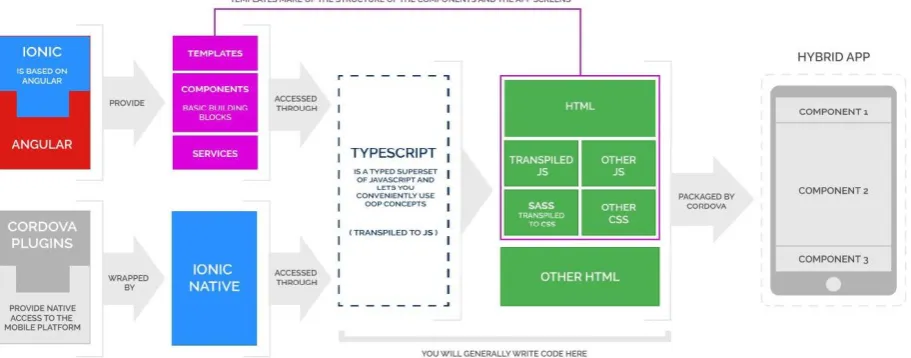
We chose Ionic framework because:
■ It is the framework of angularJs which is supported and maintained by google. ■ It is a very stable framework with excellent online support.
■ It is leader in hybrid application development. ■ It drastically reduces development cost.
■ It uses Object-Oriented principles for UI development.
Figure 3. Working Structure Of Ionic Framework
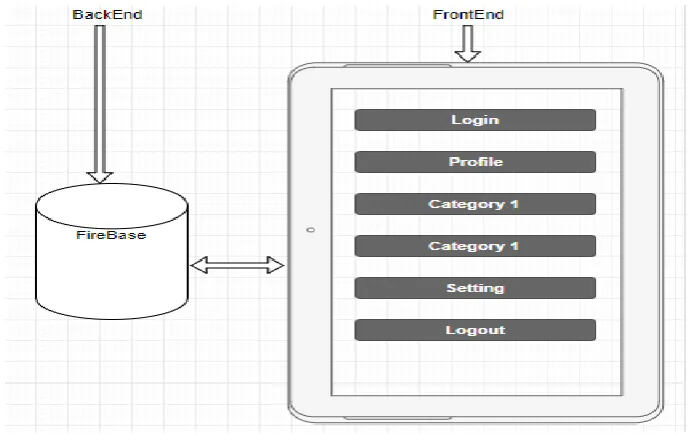
We chose Firebase for our backend because: ■ It supported by Google.
■ It is one of world leaders in Json based servers and cloud data store.
■ It uses a no sql database which significantly reduces the large development and deployment costs involved with traditional RDBMS.
IV.
Implementation Results:
Login Page Signup Page Home Page
Profile (Personal Section) Here User can update his personal details
Profile (Interests) Here User can update his Interests details
Profile (Academics) : Here User can update his academics details
when the application is to be made for multiple platforms and time and cost are the primary factors. As can be seen, with the help of ionic and AngularJS framework, we were able to build a fully functional application for cross platform deployment i.e. Android, iOS and Windows Phone. Using Ionic Framework and Firebase we have successfully created and deployed an app on playstore.
References:
[1]. Cider: Native Execution of iOS Apps on Android, Jeremy Andrus, Alexander Vant Hof, NaserAlDuaij, Christof-fer Dall, Nicolas Viennot, and Jason Nieh, IEEE Micro, 2008,Vol.1.
[2]. Andreas Arnesson. “Codename one and PhoneGap, a performance comparison”.MA thesis.Blekinge Institute of Technology, Department of Software Engineering, June 2015.
[3]. L. Zhang et al. “Accurate online power estimation and automatic battery behaviorbased power model generation for smartphones”. In: Hardware/Software CodesignandSystemSynthesis (CODES+ISSS), 2010 IEEE/ACM/IFIP International Conference on. Oct.2010, pp. 105–114.
[4]. Robert B. Grady and Deborah L. Caswell. Software Metrics: Establishing a Company-wideProgram. Prentice-Hall, Inc., 1987. ISBN: 0-13-821844-7.
[5]. Andreas Sommer. Comparison and evaluation of cross-platform frameworks for thedevelopment of mobile business applications.TechnischeUniversitätMünchen. 2012.
[6]. Seung-Ho Lim. “Experimental Comparison of Hybrid and Native Applications for MobileSystems”. In: International Journal of Multimedia and Ubiquitous Engineering 10.3(2015), pp. 1–12.