Perception and Experience of Distance Learning for Women: Case of the Higher
Education for Sisters in Africa (HESA) Program in West Africa
Jane Wakahiu, PhD
Rosemary Shaver, M.Ed
African Sisters Education Collaborative (ASEC)
Abstract
Online distance education is transforming higher education in the U.S. Technological innovation is effecting higher education in many ways, arguably most important, it is making education more accessible, globally. Online distance education can provide opportunities for marginalized populations, and people living in developing countries, to access higher education. This study focuses on the case of 17 women religious in West Africa, who are enrolled in the Higher Education for Sisters in Africa (HESA) program, a project funded with support from the Conrad N. Hilton Foundation. The students are living in Ghana and Nigeria, and studying online at a university in the U.S. The students were surveyed after completing one semester, or twelve credits, online to evaluate programmatic methods and to gauge their perceptions and experiences. The study addresses the contexts in which West African students are living – the challenges of Internet connectivity, scarcity of university seats, and condition of women. Findings and analysis of regional contexts indicate that online distance education is an increasingly viable, and needed, means of providing higher education to individuals in West Africa, especially women. HESA students’ status as adult learners was also determined ideal for the rigor and self-directed nature of online learning.
Keywords:
Higher education, Distance learning, Women religious, Africa, Online learningStudies on distance learning in higher education reveal an increase in the usage of information and communication technologies (ICTs) for course delivery. Distance learning and ICTs are intersecting, and the market is growing for online distance learning in higher education (Barlett, 2009; Allen & Seaman, 2010). Furthermore, higher enrollment in online courses is beginning to demystify online distance education. In the United States of America, there is significant enrollment growth in online higher education courses. Demand for e-learning options is also on the rise. Barlett (2009) found 65% of U.S. higher education institutions reported an increase in the demand for distance learning options; while 73% reported an increase in demand for existing online courses. Several colleges and universities are taking steps to meet the demand for e-learning options by building online infrastructures. Students are responding positively, and in August 2010, more than 6.1 million students were enrolled in at least one online class, a 17% increase in online course enrollment(Allen & Seaman, 2010).
Online education is becoming attractive to students who might not have the opportunity to attend college in the traditional method (Sun, et al., 2008). A non-traditional college student is a student over the age of 24 and typically holds work and family responsibilities and/ or has other life circumstances that can interfere with his/her meeting educational objectives (U.S. Department of Education, 1996).Using the case of Higher Education for Sisters in Africa (HESA), a program that offers higher education opportunities via partnerships between colleges and universities in the U.S. and Africa, this study will investigate the perceptions and experiences of women living in West Africa enrolled in an online distance-learning program.
Literature Review and Context
There is an urgency to develop the infrastructure for higher education in Sub-Saharan Africa. Population is growing in Sub-Saharan Africa. The region has among the highest shares of children in the world, 16.2% (UNDP, 2012 p. 57). This study highlights students in Ghana and Nigeria, two countries in West Africa. Nigeria’s population is young, with a median age of 17.3 years and an astounding 30.5 % of the population under age 5 (UNDP, 2014a). The growth rate of Nigeria, Africa’s most populous country, stands at 1.93%. Coupled with a fertility rate of 4.73 children born/women, the population of school-aged children is expected to increase (UNDP, 2012, p. 57). Similarly, Ghana is a young and growing country, with a median age of 20.9 years (UNDP, 2014a). Children under the age of 15 make up 42% of the population and the annual growth rate is about 2.2 % (UNESCO, 2012a). Due to population growth in Nigeria and Ghana, there is a need to establish higher education access for the growing number of college-aged students, who already compete for a limited number of university seats. Amid growing population rates and an expanding youth base, West Sub-Saharan Africa, is racked with poverty and socioeconomic crisis. Nigeria, which ranks as a low human development country (i.e. ranking 152 out of 187 globally) is faced with issues including poverty and religious/ethnic tensions (CIA, 2014; UNDP, 2014b). Over 62 % of Nigerians live in extreme poverty and the unemployment rate exceeds 20 percent. Additionally, Nigeria faces issues of government corruption and the growing threat of the terrorist group Boko Haram, the actions of which have resulted left 3.3 internally displaced persons (CIA, 2014b). Ghana, on the other hand, is considered a medium human development country (i.e. 138 of 187). Although poverty and unemployment remain, Ghana’s economy strengthened in the 1990s and 2000s. In 2010, it was categorized as a lower middle income country (CIA, 2014a; UNDP, 2014a).
Regional Context: Education Access, ICTs & Gender in West Sub-Saharan Africa
Taken together, growing populations and the need for educated leaders to help solve social, economic, and political concerns in Ghana and Nigeria, create a platform to endorse expanded educational opportunities. To further this point, and to address access to higher education for women through online distance education, it is necessary to analyze access to education and to Internet and communications technology (ICT) in Africa, as well as to speak to the situation of women in Ghana and Nigeria.
Educational Access
Since 2005, the number of accredited universities (i.e. federal, state, and private) increased from 51 to 128; however, it is not enough to meet demands in one of Africa’s youngest, and most populous nations (Clark & Ausukuya, 2013). Higher education in Ghana is similarly structured. In Ghana, only 375,000 Ghanaian students take the Basic Education Certificate Examination (BECE) at the end of ninth grade to qualify for senior secondary/high school, and only 150,000 can be admitted to 500 public and 200 private national secondary schools. After senior secondary school, students must take the West African Senior Secondary Certificate Examination (WASSCE). Based on exam results, only 53% of grades are credited passes, which qualify an applicant for postsecondary school. Ghana’s 140 accredited tertiary institutions enrolled 300,000 undergraduate, graduate, certificate and diploma programs (Affortey & Raheem, 2015).
Internet Communication Technology (ICT) Access
ICTs are penetrating Africa at increased rates. Infrastructure improvements are pointed at increasing access to two key structures: Internet and electricity. First, the percentage of the world population designated as Internet users is growing. In the first decade of the 21st century, Internet users in UNDP designated low development countries grew an astounding 4,000% (UNDP, 2010, p. 67). Globally, 35.5% of the world populations are Internet users. Growth of Internet usage in Africa is substantial, and increased usage is broadly affecting society and culture on the continent, especially as technologies reach into rural areas. Average annual growth of Internet users in Africa is 27%, the highest among regions studied by the UNDP (UNHDP, 2014a, p. 130). Second, access to electricity is a key piece of the equation. In sub-Saharan Africa, electricity is not universal. Particularly, in Ghana, 63% of the population has access to electricity, both commercially and self-generated; in Nigeria, 50.3% (UNHD, 2014a, p. 214). Sparse access to electricity is reflective of many regions of the developing world. The global community is recognizing the need for improvement of ICT capacity, promising infrastructure improvements in the twenty-first century. Just one example, the United Nations designated 2015 the International Year of Light and Light-based Technologies. This global initiative recognizes with access to electricity comes access to educational tools, Internet and new industries (Gottlieb, 2015; UNESCO, 2014).
Gender Barriers
Globally, women can expect to receive fewer years of education than men. At the low end of the spectrum, women in Mozambique, Niger, and Guinea, receive a mean of only 0.8 years of schooling. On the other hand, women in the U.S. receive a mean of 13.0 years of schooling. Several nations that constitute Sub-Saharan Africa rank among the lowest for women’s educational attainment. Western Sub-Saharan Africa is in deficit with regard to educational attainment and access for women. Access to education for women is a global concern. Fifty-seven percent of 72 million primary school age children out of school are girls, and 64 % of 774 million illiterate adults worldwide are women (Aja-Okorie, 3013, p. 273). Inherently, fewer women enrolled in primary and secondary school and fewer literate women, correlates to a lower proportion of women enrolled in higher education. As stated, women in Ghana and Nigeria can expect to receive fewer years of schooling than men. Access to tertiary education is also limited to women and marginalized populations. Access to education in Ghana and Nigeria is greater among urban populations and students of higher socioeconomic status (UNESCO, 2012a, 2012b). UNESCO lists early marriage, large family size, lower status accorded to the girl-child in the family, peer pressure, and poverty, among the sociocultural and economic barriers in Ghana and Nigeria that impact the out-of-school population (UNESCO, 2012a, 2012b). These factors, especially early marriage and large family size, effect female students and prevent them from ever obtaining credentials to qualify for higher education entry. Women also are in deficit in terms of access to ICTs. Limits to educational access plays in to women’s access and knowledge of ICTs. This is especially the case as ICTs enter primary and secondary school curriculum, as is the case in Ghana. Additionally, in rural areas, time demands factor in to time available for women to pursue education and to use the Internet; greater poverty rates also play a role. In some regions, women in rural areas spent twice as much time as men gathering fuel and water (UNDP, 2012, p. 118). This leaves little time for accessing or learning to access the Internet. Access to education and ICT is important for women in Africa. A larger population of education women can have tremendous impact on culture, economy, and life quality. The UNHDP highlighted this point, arguing that communication technologies “increase the voices of the vulnerable” (UNHDP, 2014a, p. 130). The same can be said of educational access. Education gives women a voice in their communities and in national and international dialogues. More women in powerful roles inspire young girls to continue their education and to contribute a unique voice to societal challenges.
Online Distance Education: Trends, Viability in Africa
Access to ICT in western Sub-Saharan Africa has the capacity to increase access to education, especially to women, through online learning. Statistics on tertiary education in Ghana and Nigeria reveal that students are willing to explore alternatives outside of their countries if they are not accepted to fill one of the precious few universities seats in-country at public universities. For example, of African countries, after Morocco Nigeria sends the most students out-of-country to pursue higher education. According to the UNESCO Institute of Statistics, in 2010, 39,000 Nigerians pursued their education in other countries – 16,486 in the United Kingdom; 6,510 in the USA; 5,443 in Malaysia; 1,649 in Ghana; and 1,302 in Canada. Online distance programs can also offer an avenue for students in West Sub-Saharan Africa and other regions where tertiary education is scare.
Global Trends in Online Learning
Online Learning in Africa
Online distance learning is gaining ground as a viable access point to higher education in Africa, although it is not without challenges. African Virtual University (AVU), a pilot study started in 1997 by the World Bank is now a nonprofit institution that offers various degree and certificate programs, including Business Administration and computer science, to students in Sub-Saharan Africa. AVU is based on Nairobi, Kenya, and started with 57 learning centers in 27 African countries (Simmons et al., 2011). Institutions including the University of Ghana have AVU centers to enhance their own distance learning programs (Kumi-Yeboah, 2010, p. 20). Several authors cite the potential of online distance learning to increase access in African countries where the issue of inadequate supply and demand for higher education seats is common (Agbatogun, 2013; Ayoo, 2009; Central Intelligence Agency, 2014a, 2014b). Online distance learning has become relevant in developing countries globally; as apparent in the literature (Wainaina, Sanou, Boateng, & Opoku-Mensah, 2014; Raspopovic, et al., 2014; Ramos et al., 2011). Ramos, Tajú, & Canuto(2011) highlighted the success of distance learning in Cape Verde and Mozambique. The literature suggests that online learning in developing countries is becoming more viable in the second decade of the twenty-first century.
Purpose
The purpose of this study is to examine the perceptions and experiences of women religious in West Africa enrolled in a degree programvia online distance learning; as well as the effectiveness of e-learning in this context.In this study, e-learning refers to a web-based system that makes information or knowledge available to users or learners and ignores border restrictions or geographic regions (Sun et al., 2008). The study will describe the experiences of 17 women religious taking online distance learning classes at a U.S. college through the Higher Education for Sisters in Africa (HESA) program while they are living in Ghana and Nigeria.
Research
The focus of this study is the preceptions and experiences of women studying via online distance learning in West Africa as part of the HESA program. Particularly, study will respond to the following questions: (a) What were your experiences in online distance learning? (b) How effective were faculty and student preparations during orientation to undertake online classes? (c) What challenges are associated in distance education? And how were they overcome? (d) What communication tools were used to help resolve online distance learning challenges? In addition to exploring the perceptions and experiences of the women studying in West Africa, this study will examine the experiences of women in East Africa in comparison. To provide context, the study will also address access to education and Internet in West Africa, and literature related to online distance higher education; as well as “Best Practices” for the program.
Program Decription
The orientation, which is three-weeks, provides basic research skills, basic technology training in the Microsoft Office suite, information on library services in the partner universities, and other academic requirements as well as training in the use of the online interface platform. Faculty at partnering institutions in the U.S. and Africa teach the orientation course via WebEx and continue to support students via Skype and Google Hangouts. Second, each cohort is required to participate in annual onsite two-day “reflective learning workshops.” During the workshops, sisters discuss the goals and desired outcomes they expressed and orientation, and reflect upon them relative to their stage in the program; as well as share experiences, assess their academic status, and build relationships. Students in this study have not partcipated in reflective leraning, as they have not completed a full year in the program. Finally, HESA is designed to address the higher education needs of Catholic sisters in Africa. Patall, Awad, & Cestone (2012)argue that design, implementation, and evaluation, is essential for the success of an online distance learning program. HESA was designed considering all of these challenges, including Internet access in Africa. Furthermore, adminsitators enage in continuous evalution and monitoring of the program design and implementation, relevative to courses, student experience, and partherships. Wakahiu and Kangethe (2014) conducted a similar case study involving a cohort of 18 women taking online classes at a U.S. university through a partnership with a university in East Africa. The students were women religious in Kenya, Uganda, and Zambia, also studying through HESA.
Methodology
A mixed method approach was used to explore the experiences of the 17 HESA students enrolled in online distance learning courses at a U.S. university. The study was conducted in West Africa, specifically in Ghana and Nigeria, where the 17 women religious in the HESA program live and work. Participants completed a survey through Survey Monkey and researchers analyzed data via Survey Monkey tools. Using Excel spreadsheet qualitative data was corroborate using participants respoines. Researcher applied Adult Learning Theory(Knwokles, 1980) to examine participants perceptions and experiences of online distance learning at an American University. Participants were adult learners who had not engaged in academic rigor for an averange of 10 years or more. To situate and understand participants experiences, we read stories in the scripts provided through the Survey Monke, participants were first generation college students given that except one parrents had no college education.
Theoretical Framework
An important factor that can contend with the notion of adult learners as ideal candidates for distance learning is technology; or the online portion of online distance learning. For adult learners who are native technology users, online distance learning might present challenges, which will be noted in the discussion.
Findings and Discussions
The study consisted of 17 women religious living in Ghana and Nigeria. These women were enrolled in the HESA Online classes at an Ameircan Unviersity and had completed 12 credits online and were continuing with online classes.All were nontraditional students with majority (52.9%) having a median of 37 years and 11.8% had more than 46 years. Figure 1, shows participants age group.
Figure1: Participants’ age Group by Percent
Majority (65%) had been in the congregation for over ten years prior to enrolling in the HESA program. During that time they served in schools, pastoral or social service ministries. Figure 2 illustrates18% had been in the congregation for over 20 years prior to having an opportunity for higher education to attain university degrees.
Figure 2: Years in the Congregation prior to entering HESA program
Careers and Ministries
More students (65%) listed teaching as their primary career; another 17% cited pastoral work, 12% catering to communities; and 6%, congregational leadership. Often sisters carry out humanitarian projects to serve underserved persons. Participants reported their primary occupation as illustrated in Figure3. During the online portion of the programs, the sisters continue in their ministries and with their community obligations; matching the characteristics of typical adult learners (U.S. Department of Education, 1996; Moore, et al. 2012 p. 151).
0.0%
11.8%
17.6%
52.9%
5.9%
11.8%
0.0% 10.0% 20.0% 30.0% 40.0% 50.0% 60.0%
20-25 26-30 31-34 35-40 41-45 46 and
Above
Participants age by percent
1-10
35%
11-20
47%
20-30
18%
Figure 3: Participants’ Primary Career by Percent
First Generation Students
Reports on parental education reveal participants’ were in first generation in their families to attend college. Seventy five percent (75%) reported their parents had no college degree as illustrated in figure 4.Wakahiu&Kangethe (2014) found the majority of HESA students in East Africa were first generation college students.
Figure 4: Percent Parents’ Level of Education
Diverse Congregations
According to a 2012 survey by the African Sisters Education Collaborative (ASEC) there are 120 congregations with over9,000 women religious in both Ghana and Nigeria. Participants represented 14 congregations. Figure5; illustrates participants reports on the number of sisters in their congregations. Providing higher education to these women religious will have significant impacts on them and on their ministries; thereby transforming the societies in which they live and work.
Teaching 65% Congr.
Leadership 6% Pastoral
17%
Catering 12%
Participants' primary career by percent
0.0% 5.0% 10.0% 15.0% 20.0% 25.0% 30.0% 35.0% 40.0% 45.0%
23.5% 41.2%
11.8% 23.5%
Figure 5: Percentage of Sisters in the Participants’ Congregations
Participants described their congregation as pontifical or diocesan congregation founded in the diocese.Table 1, demonstrates the breakdown.
Table 1
Percent Count
International pontifical rite 47.1 8
Indigenous/diocesan serving in Africa 52.9 9
Total 100 17
Education and Financial Earnings
Studies reveal that there is relationship between education and earning. With each additional year of education, average earnings rise by 11%, and with each additional year of a girl’s education, her eventual wages rise by 10-20% (UNESCO, 2008).Acquisition of higher education has a high return on investment and results in higher earnings. Participants reported their current monthly earnings; the majority (82%) report to earn less than $300 US dollars per month and only 5.9% earn over $500 US dollar. Such earnings may not ensure sustainability of the programs run by these women religious.
Figure 6: Percentage of Participants’ Monthly Earnings
Below 100 100- 150
151-200 201-250 300 and Above
29.4% 17.6%
11.8% 5.9%
35.3%
35.3% 47.1%
11.8%
0% 5.9%
0%
Monthly salary earned in the area of profession
Need for Higher Education
Participants reported that acquiring higher education was timely. Majority (90%) affirmed that attainment of higher education is equal to higher earnings as illustrated in table, 3. Sixteen (16) of 17 respondents agreed that acquiring a degree would improve their salaries. One sister commented, “Once my academic experience is upgraded, my salary scale will be upgraded also.” Others noted that the employment structures in Ghana and Nigeria rewarded those with higher degrees.
Table 3: Participants’ Opinions Salary with Additional Education
Acquisition of degree will improve your salary
Percent Count
Yes 94.1 16
No 5.9 1
Total100 17
Participants also reported the majority of the women religious in their congregation were in dire need for higher education. Table 2, shows the percentage of women religious with no higher education credentials as reported by HESA participants.
Table 2: Participants Report on Number of Sisters with no Degree
Number of Sisters in congregations with no college/university degree
Range Percent Count
Over 100 64.7 11
150-199 29.4 5
More than 200 5.9 1
Total 100 17
Online Distance Learning: Student Perception & Experience
Online distance learning is becoming increasingly viable for Africa. Research indicates that online options are becoming viable through universities in Africa(Asunka, 2008; Ramos et al., 2011; Simpson, 2008)and via transnational online distance learning (Bannier, 2015; UNESCO & InfoDev, 2015). Online and distance learning is especially relevant for adult working students(Cercone, 2008; Knowles, 1978, 1980).Several studies(Bernard et al., 2004; Donavant, 2009; Katz, 2000b) indicate online learning fulfills the requirements for learning in a modern society. Research indicates that it is important for students studying online to be motivated and self-directed(Cercone, 2008; Moore & Kearsley, 2012). Some studies of African students indicate desire to pursue online courses based on perceptions of one or several online courses (Wakahiu & Kangethe, 2014; Asunka, 2008). For example, a study in Ghana surveyed 26 students who volunteered to enroll in an online course at a Ghanaian University; the students were of a traditional age. Although it is important to distinguish that the students were of traditional age, it is telling that 66% reported that the will take an online course again if given the opportunity(Asunka, 2008).Although online distance education is becoming increasingly available, questions of quality have been posed. A survey by eLearning Africa found that the obstacles to eLearning in rural areas (i.e. lack of electricity and poor connectivity) are different than obstacles in urban areas (i.e. poor connectivity and lack or supporting infrastructure) (Wainaina, Sanou, Boateng, & Opoku-Mensah, 2014, p.64). Other scholars focused on challenges related to the viability of online learning in Africa, and in developing counties (Ayoo, 2009; Wainaina et al., 2014; Wright, 2014). Many challenges – inadequate ICT infrastructure, Internet connectivity, electricity, and quality – are recurrent across the literature.
Student Experience
This highlights the concerns related to online learning for adult learners (Moore & Kearsley, 2012). HESA orientation is designed to meet this challenge by providing training in basic technology. Nine (9) students who expressed positive experiences in the program also described challenges. Among the cited challenges, the most common were pressures and challenges associated with inadequate time. Often challenges related to time (Fodzar and Kumar, 2007; Lieblein, 2001) were linked to subsequent challenges faced by the students, who are working full-time and studying in developing countries where electricity and Internet are not universal. Encompassing these challenges, one student wrote that it was very challenging to cope with “time, workplace and network.” The one student who did not include any positive expressions about her experience focused on inadequate time related to work; she wrote, “It is very stressful for some of us who are full time workers.”Challenges associated with work and other responsibilities are common among nontraditional students (Cercone, 2008). Despite the challenges, a few students observed greater ease from the first to second semester as they became more accustom to the program. One student commented, “I must confess that the second semester has been so wonderful, am already getting use to the system even thou [sic] I still face some challenges.”
Student Perceptions of Support
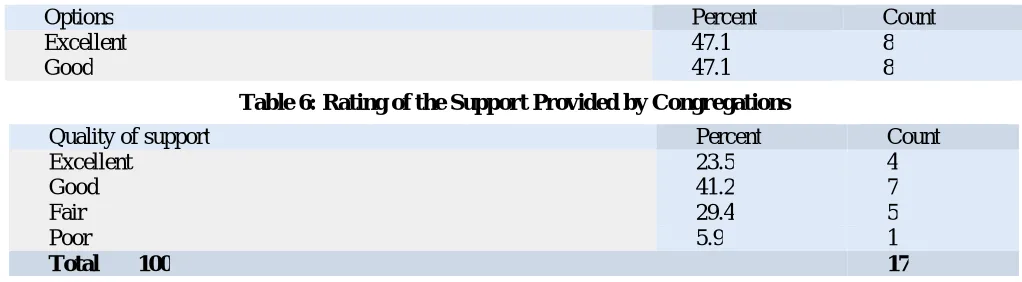
Students’ success in online learning requires support, commitment and self-discipline to complete assignments. Studies reveal that support networks and structures are central to student success in online distance education. Tinto (1993) found that student success is dependent upon access to student support services. As education is offered online, it is necessary to re-imagine traditional support structures (Simpson, 2008; Coates, 2005; Berge & Huang, 2004). Amongst students who drop out of eLearning programs, several factors are often cited, including: lack of time; technological challenges; motivation problems; lack of support from students, administrators, and/or instructors; poorly designed course; and personal learning preference(Berge & Huang, 2004; Gutierrez, 2013). Support, in various forms (e.g. technological, academic, personal) is central to the discussion. In an effort to examine the quality of support provided to the students, we prompted – “How would you rate the support provided to you during online learning?” Support system was vital because it was the first time they engaged in online learning. Participants rated support provided from the four entities: a) faculty from the American College, b) African University, c) Congregation and, d) HESA administrators. Fozdar, Kumar, & Kannan(2006) also highlighted to relevance of instructor engagement and communication to student success in online distance learning courses.
Participants rated support provided by their congregations as follows:
Table 4: Rating Support provided by American University
Options Percent Count
Excellent 82.4 14
Good 17.6 3
Much of our conception of support weighs upon the instructor. One student illustrated with an example, “The lecturers have been wonderful with their courses, very understanding and accommodating, most especially it was not an easy task for beginners like me when I started.”Gutierrez (2013) encourages instructors to engage with students and to create spaces for them to engage with others.
Table 5: Rating support provided by African University
Options Percent Count
Excellent 47.1 8
Good 47.1 8
Table 6: Rating of the Support Provided by Congregations
Quality of support Percent Count
Excellent 23.5 4
Good 41.2 7
Fair 29.4 5
Poor 5.9 1
Table 7: Rating Support from HESA Administration
Options Percent Count
Excellent 88.2 15
Good 11.8 2
Students described HESA administrators as encouraging and acknowledged their work in support of their studies, as well as praised the materials (e.g. laptops, books) provided for their coursework.
Relevance of Instructional Materials
Access and provision of instructional materials is essential to ascertain student success in HESA. In Africa, tuition and other costs is often carried by students and their parents. Limited and crowded libraries, as well as computer labs, can be inhibitive for students to acquire desired educational resources (Clark& Ausukuya, 2013; Ayoo, 2009). Participants were provided with a variety of instructional and learning tools to succeed in their pursuit of knowledge. These materials included laptops, books, handouts and access to the Internet via use of modems. We asked participants to rate materials provided for their learning.
Table 8: Rating Support via Instructional Materials
Rating Percent Count
Excellent 94.1 16
Good 5.9 1
Opinion of Distance Learning as a Teaching-Learning Model
Online learning is relatively new phenomenon, specifically for women religious. Allen and Seaman (2010) posit that more than 6.1 million students in the U.S. are enrolled in at least one online class and continued growth is reported with online platforms such as Coursera.In addition, online learning offers new educational avenues for women in Africa (Wright, 2014) and Sun, et al (2008) argues that it is becoming attractive to students who might not have the opportunity to attend college. Wakahiu and Kangethe (2014) propose that online learning model will facilitate in breaking educational barriers for women religious in Africa to acquire higher education. In this study, we sought to “examine the perceptions and satisfaction of their online learning experience in the HESA program.”Students agreed that their experience in the program has been excellence (24.5%) and (76.5%) rated as good.
Table 9: Participants Rating Online Learning Experience
Rating Scale Percent Count
Very high 52.9 9
Moderately high 11.8 2
Moderate 35.3 6
Total 100 17
Self-Appraisal on Educational Abilities
Perception of an individual’s academic ability is essential to their success. We examined participants’ perceptions of their educational abilities in relation to their peers at the universities whether in the USA or Africa. The students report their self-perception, indicating that they are above average students. Positive self-perception is central to academic success (Patall, Awad, & Cestone, 2012).Measurements included factors such as academic ability, computer skills, leadership ability, and physical health, public speaking both social and intellectual confidence. These factors are relevant to ascertain individual success in any academic environment. With respect to academic ability more than half (88%) considered themselves having moderate to somewhat moderate abilities, about 6% were on the lower side and one student perceived herself having exceptional ability. Table 9-17 details the participants’ ratings in their scholastic abilities.
Table 10.Self-Rating of Academic Ability
Percent Count
Somewhat moderately 5.8 1
Moderate 29.5 5
Somewhat high 58.5 10
Exceptionally high 5.8 1
Table 11: Self-Rating in Computer Skills
Percent Count
Somewhat moderately 5.8 1
Moderate 52.9 9
Somewhat high 29.4 5
Exceptionally high 5.8 1
Table 12: Self-Rating of Leadership Ability
Percent Count
Somewhat moderately 17.7 3
Moderate 41 7
Somewhat high 29.4 5
Exceptionally high 11.8 2
Table 13: Self-Rating of Physical Health
Table 14: Self-Rating in Public Speaking Ability
Percent Count
Somewhat moderate 5.8 1
Moderate 35.3 6
Somewhat high 47.1 8
Exceptionally high 11.8 2
Table 15: Self-Rating of Self-Confidence (Intellectual)
Percent Count
Low level 5.8 1
Moderate 35.3 6
Somewhat high 41.2 7
Exceptionally high 17.7 3
Percent Count
Low level 5.8 1
Moderate 23.5 4
Somewhat high 41.1 7
Table 16: Self-Rating of Self-Confidence (Social)
Percent Count
Moderate 47.1 8
Somewhat high 29.4 5
Exceptionally high 23.5 4
Table 17: Self-Rating on Ability to Communicate in English
Percent Count
Moderate 41.2 7
Somewhat high 41.2 7
Exceptionally high 11.8 2
Table 18: Ability to Navigate Complex Academic Situation
Percent Count
Low level 5.8 1
Somewhat moderate 5.8 1
Moderate 53 9
Somewhat high 29.4 5
Obstacles and Challenges
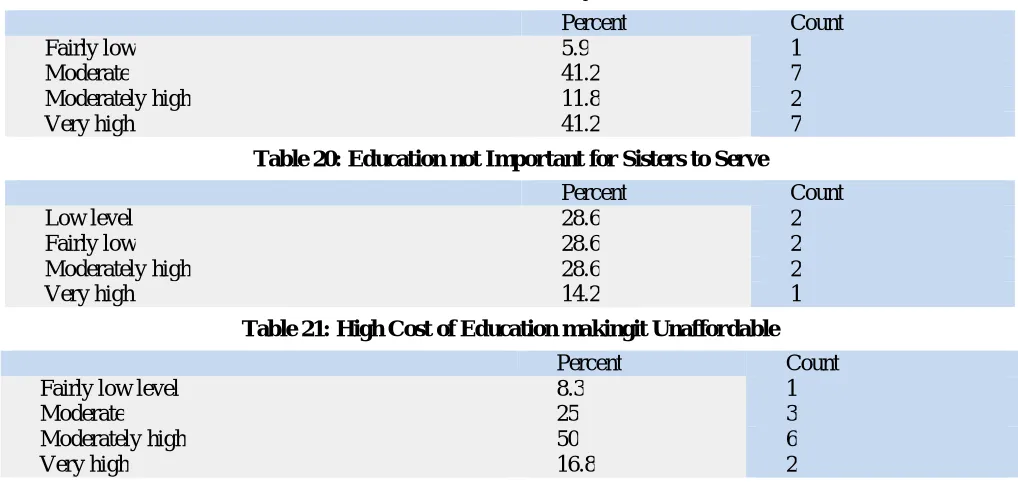
Given that participants are nontraditional students, we examined the salient obstacles that had kept them away from acquiring credentials given the relevance of education for their ministries and for adaptation of the changing global landscape. Tables 18-22 provide participants perceptions of the obstacles for college education.
Table 19: Poverty
Percent Count
Fairly low 5.9 1
Moderate 41.2 7
Moderately high 11.8 2
Very high 41.2 7
Table 20: Education not Important for Sisters to Serve
Percent Count
Low level 28.6 2
Fairly low 28.6 2
Moderately high 28.6 2
Very high 14.2 1
Table 21: High Cost of Education makingit Unaffordable
Percent Count
Fairly low level 8.3 1
Moderate 25 3
Moderately high 50 6
Very high 16.8 2
Table 22: Sisters Lack High School Credentials Required to Enter College
Percent Count
Moderately 86 6
Table 23: Some Sisters do not like Rigor Required in Higher Education
Percent Count
Fairly low level 40 2
Moderate 40 2
Moderately high 20 1
Importance of Women Religious in West Africa Acquiring University Degrees
Catholic Sisters in Africa continue to impact the society through their services in education; health care, social and pastoral ministries in Africa. Significantly increasing their higher education attainment will result in change and impacts of the underserved communities they serve. Intentionally educating sisters is important because costs for higher education are inhibitive not only to women religious but also to majority of the people they serve (Clark & Ausukuya, 2013; Ayoo, 2009; Affortey & Raheem, 2015). Given that participants worked in their ministries for over ten years with no university degree, we examined their perception on the value of higher education for women religious in West Africa. The sisters were asked to – “Give reasons why you think it is important to provide opportunity for sisters to study via online learning and onsite at universities in Africa?” Broadly, the sisters felt it was important to help the sisters acquire knowledge and an education, which will help them effectively serve their ministries. Consensus held that the program is important because it provides affordable education. Several (4) sisters stated that the program’s online structure is advantageous to congregations with limited personnel and/or resources. One sister wrote, “It is important because is not easy to send many sisters school because of lack of personals in their work places and … financial problems.” These findings correlate with studies; more women in African are breaking barriers in search for their own education and that of their families(Aja-Okorie, 2013; UNHP, 2005; Wakahiu &Kangethe, 2014).
Strategies to Strengthen HESA Program
HESA program is unique because it focuses on the empowerment of women religious in Africa. Further it fills in a gap to provide education to women who for years have longed to have an opportunity. Using cohort model is considered imperative as a support system for students to succeed. In this view, gathering program participants’ opinions was essential to learn of their successes and challenge. Eight (8) participants stated that congregations should reduce the workload for sisters studying online. In fact, four (4) sisters urged that congregations and superiors be educated about the program to better understand the demands of studying online. One sister wrote, “Education should be given to Superior generals to really know and understand the importance and demanding nature of online distance learning.” Other students focused on challenges related to studying online. Many (5) stated that each course should include a hardcopy textbook or that prints of readings should be made available, and others (3 of 16) stated that an alternative network should be made available. Finally, a student suggested at least “one physical contact between of one of the organizers of the program and the students within a country per year.”Participants held the opinion that acquisition of higher education will impact their ministries. To substantiate the claim, we investigated their “future plans on acquiring your degree.”Participants expressed a desire to serve God and humanity with the knowledge acquired their degree program. Several participants plan to use their degree to serve and share knowledge with others. One sister expressed desire to share the knowledge she learned “with the poor, especially in rural areas.” Academic and professional goals were stated frequently.Six (6) respondents plan to advance academic goals and to acquire a Master’s degree, while 8 plan to advance their professional goals. Describing her future plans, one sister encompassed these goals, writing: “I will like to be a full time class teacher, where I will pass my knowledge onto others. After some time, I will like to get a Master degree so as to be a professional in my field.” Some sisters (3) referenced goals for academic and professional advancement together.
Conclusion
However, it was different in HESA project in West Africa, no students dropped out of the project. Success is attributed to cohort system model where students are monitored and support as well as provided a two-day reflective learning to talk of their challenges and success, as a result problems are identified in advance and addressed in a timely manner. Results in this study revealed various benefits and challenges to studying online through the HESA program – including flexibility, convenience and cost-effectiveness in terms of time to attend college in person. Similar findingswere evident by schoalrs Fisher and Baird (2005) and Wojiciechowski& Palmer (2005) in their studies on online distance learning. HESA was designed to meet the challenges of studying online in a developing country. For example, prior to students engaging in coursework, the students participated in an orientation course that included computer literacy and navigation skills. Several participants had no prior ICT literacyand/ or research competencies. Fodzar and Kumar (2007) posits that computer literacy is often a challange for majority of students. Other challenges that had to be overcomed included greater electronic connection capabilities and concerns over student isolation.
Upon reviewing the literature and student response; we can draw several conclusions. These consclusions are also supported by Wakahiu & Kangethe (2013).
1. Age is difiant of educational pursuit. 2. Technologyis changing Africa.
3. Technology is expanding educational accesss.
4. Transnational online distance education is penetrating Africa as access to ICTs expand. 5. Women are overcoming challenges tp pursue education.
6. Support (i.e. from peers, faculty, administators) is central to student success in online distance education programs.
7. Fincial and technoligcal resource support is important for maraganized students to access education via onlien distance learning.
8. Sisters in Africa can access education through transational onlien distance education.
References
Affortey, B., & Raheem, S. (2015). The Educational System of Ghana.U.S. Embassy Ghana. Retrieved from http://ghana.usembassy.gov/education-of-ghana.html
Agbatogun, A. O. (2013). Interactive digital technologies’ use in Southwest Nigerian universities. Education Technology Research Development, 61, 333–357.
Aja-Okorie, U. (2013). Women Education In Nigeria: Problems And Implications For Family Role And Stability. European Scientific Journal, 9(28), 272–282.
Allen, T. H. (2006). Raising the question number 1. Is the rush to provide on-line instructions setting our students up for failure? Communication Education, 55(1), 122-126.
Allen, I. E., & Seaman, J. (2010). Class differences: Online education in the United States, 2010. Education. Retrieved from
http://scholar.google.com/scholar?hl=en&btnG=Search&q=intitle:Class+Differences:+Online+Education +in+the+United+States#0
Amenyedzi, F. W. K., Lartey, M. N., & Dzomeku, B. M. (2011). The Use of Computers and Internet as Supplementary Source of Educational Material : A Case Study of the Senior High Schools in the Tema
Metropolis in Ghana. Contemporary Educational Technology, 2, 151–162.
Arbaugh, J. B., & Duray, R. (2002). Technological and Structural Characteristics, Student Learning and Satisfaction with Web-Based Courses: An Exploratory Study of Two On-Line MBA Programs. Management Learning. doi:10.1177/1350507602333003
Asunka, S. (2008). Online learning in higher education in Sub-Saharan Africa: Ghanaian University students’ experiences and perceptions. International Review of Research in Open and Distance Learning, 9(3). Ayoo, P. O. (2009). Reflections on the Digital Divide and its Implications for the Internationalization of Higher
Education in a Developing Region: The Case of East Africa. Higher Education Policy, (22), 303–318. Bannier, B. J. (2016).Global Trends in Transnational Education. International Journal of Information and
Education Technology, 6(1), 80–84.
Bernard, R. M., Abrami, P. C., Lou, Y., Borokhovski, E., Wade, A., Wozney, L., … Huang, B. (2004). How Does Distance Education Compare With Classroom Instruction? A Meta-Analysis of the Empirical Literature. Review of Educational Research.doi:10.3102/00346543074003379
Central Intelligence Agency. (2014a). CIA World Factbook - Ghana. Retrieved from https://www.cia.gov/library/publications/the-world-factbook/geos/gh.html Central Intelligence Agency. (2014b). CIA World Factbook - Nigeria.
Cercone, K. (2008). Characteristics of Adult Learners with Implications for Online Learning Design. AACE Journal, 16, 137–159. doi:Article
Clark, N., & Ausukuya, C. (2013). Education in Nigeria. World Education News & Reviews. Retrieved from http://wenr.wes.org/2013/07/an-overview-of-education-in-nigeria/
Corley, K. 2003. Semantic learning as change enabler: Relating organizational identity and organizational learning. In M. Easterby-Smith & M. Lyles (Eds.), The Blackwell handbook of organizational learning and knowledge management: 621-636. Oxford: Blackwell.
Cranton, P. (2002). Teaching for transformation. In J.M. Ross-Gordon (Ed.), New directions for adult and continuing education: 93. Contemporary viewpoints on teaching adults effectively (pp. 63-71). San Francisco, CA: Jossey-Bass.
Donavant, B. W. (2009). The New, Modern Practice of Adult Education: Online Instruction in a Continuing Professional Education Setting. Adult Education Quarterly.doi:10.1177/0741713609331546
Fisher, M. Baird, D.E. (2005). Online learning design that fosters student support, self-regulation, and retention.Campus-Wide Information System, 22(2), 88-107. Retrieved
https://pantherfile.uwm.edu/simonec/public/Motivation%20retention%20articles/Articles/ Fisher_OnlineLearningDesign.pdf
Fodzar, B. I. Kumar, L. S. (2007).Mobile learning and student retention. The International Review of Research in Open and Distance Learning, 8(2)
Fozdar, B. I., Kumar, L. S., & Kannan, S. (2006). A survey of a study on the reasons responsible for student dropout from the bachelor of science programme at Indira Gandhi National Open University. International Review of Research in Open and Distance Learning, 7(3).
Gottlieb, D. (2015, January 21). The road ahead in the quest for access. eLeadning Africa: Perspectives on ICT, Education and Development in Africa. Retrieved from
http://www.elearning-africa.com/eLA_Newsportal/connectivity-Africa-Internet-smartphones/
Gutierrez, K. (2013). 25 Ways to Reduce Dropout Rates in eLearning Courses. Retrieved April 20, 2015, from http://info.shiftelearning.com/blog/bid/272086/25-Ways-to-Reduce-Dropout-Rates-in-eLearning-Courses-Part-I
Katz, Y. J. (2000). The Comparative Suitability Of Three ICT Distance Learning Methodologies For College Level Instruction.Educational Media International.doi:10.1080/095239800361482
Katz, Y. J. (2000b). The Comparative Suitability of Three ICT Distance Learning Methodologies for College Level Instruction.Educational Media International.doi:10.1080/095239800361482
Knowles, M. S. (1978). Andragogy: Adult Learning Theory in Perspective. Community College Review, 5, 9–20. doi:10.1177/009155217800500302
Knowles, M. S. (1980). The modern practice of adult education: From pedagogy to andragogy. Chicago: Follett. Kumi-Yeboah, A. (2010).A Look at the Trend of Distance and Adult Education in Ghana. International Forum of
Teaching and Studies, 6(1), 19–27.
Lewin, T. (2012). Universities Reshaping Education On the Web. New York Times, p. 12. Retrieved from http://www.immagic.com/eLibrary/ARCHIVES/GENERAL/GENPRESS/N120717L.pdf\nhttp://www.ny
times.com/2012/07/17/education/consortium-of-colleges-takes-online-education-to-new-level.html?pagewanted=all
Lieblein, E. (2001).Critical factors for successful delivery of online programs. Internet and Higher Education, 3(3), 161-174.
Mezirow, J. (2000). Learning to think like an adult: Core concepts of transformation theory. In J. Mezirow& Associates (Eds.), Learning as transformation: Critical perspectives on a theory in progress (pp. 3-34). San Francisco, CA: Jossey-Bass.
Patall, E. A., Awad, G. H., & Cestone, C. M. (2012). Academic Potential Beliefs and Feelings: Conceptual Development and Relations with Academic Outcomes. Self and Identity, 1–23.
doi:10.1080/15298868.2012.738705
Ramos, F., Tajú, G., & Canuto, L. (2011). Promoting distance education in higher education in Cape Verde and Mozambique. Distance Education. doi:10.1080/01587919.2011.584845
Simmons, L. L., Mbarika, I., Mbarika, V. W., Thomas, C. A., Tsuma, C., Wade, T. L., & Wilkerson, D. (2011). TeleEducation Initiatives for Sub-Saharan Africa: The Case of The African Virtual University in Kenya. Journal of STEM Education, 12(6), 78–90.
Simpson, O. (2004). The impact on retention of interventions to support distance-learning students.Open Learning, 19 (1), 79-95.
Simpson, O. (2008). Motivating learners in open and distance learning: do we need a new theory of learner support? Open Learning: The Journal of Open and Distance Learning, 23(3), 159–170.
doi:10.1080/02680510802419979
Sun, P. C., Tsai, R. J., Finger, G., Chen, Y. Y., &Yeh, D. (2008). What drives a successful e-Learning? An empirical investigation of the critical factors influencing learner satisfaction. Computers and Education, 50, 1183–1202. doi:10.1016/j.compedu.2006.11.007
UNESCO. (2012a). UNESCO Global Initiative on Out-of-School Children: Ghana Country Study, (April 2012). Retrieved from http://www.uis.unesco.org/Education/Documents/OOSCI Reports/ghana-oosci-report-2012.pdf
UNESCO. (2012b). UNESCO Global Initiative on Out-of-School Children: Nigeria Country Study. Retrieved from http://www.uis.unesco.org/Education/Documents/OOSCI Reports/nigeria-oosci-report-2012.pdf UNESCO. (2014). Why Light Matters. 2015 International Year of Light and Light-Based Technologies. Retrieved
from http://www.light2015.org/Home/WhyLightMatters.html
UNESCO, & InfoDev. (2015). Educational Technology Debate: Exploring ICT and Learning in Developing Countries. Retrieved January 23, 2015, from http://edutechdebate.org
United Nations Development Programme. (2010). Human Development Report 2010 the Real Wealth of Nations :
Pathways to Human Development. Human Development (Vol. 21).doi:10.2307/2137795
United Nations Development Programme. (2012). Africa Human Development Report 2012 towards a Food Secure Future. Retrieved from http://mirror.undp.org/angola/LinkRtf/Afhdr_2012.pdf
United Nations Development Programme. (2013). Human Development Report 2013 the Rise of the South: Human Progress in a Diverse World. doi: ISBN: 978-92-1-126340-4
United Nations Development Programme. (2014a). Human Development Report 2014 Sustaining Human Progress: Reducing Vulnerabilities and Building Resilience. New York.
United Nations Development Programme. (2014b). Human Development Report 2014 Sustaining Human Progress: Reducing Vulnerabilities and Building Resilience - Nigeria Summary. Retrieved from http://hdr.undp.org/sites/all/themes/hdr_theme/country-notes/NGA.pdf
United Nations Human Development Programme. (2005). Human Development Report 2005: International Cooperation at a Crossroads.
Wainaina, B., Sanou, B., Boateng, P., & Opoku-Mensah, A. (2014). The eLearning Africa Report 2014.
Wakahiu, J. P., &Kangethe, S. P. (2014). Efficacy of Online Distance Learning: Lessons from the Higher Education for Sisters in Africa Program. European Journal of Research and Reflection in Educational Sciences, 2(1), 25. Retrieved from
http://www.idpublications.org/wp-content/uploads/2014/03/EFFICACY-OF-ONLINE-DISTANCE- LEARNING-LESSONS-FROM-THE-HIGHER-EDUCATION-FOR-SISTERS-IN-AFRICA-PROGRAM.pdf
Wojciechowski, A., & Palmer, L. B. (2005). Individual student characteristics: Can any be predictors of success in online classes? Online Journal of Distance Learning Administration, 8 (2). Retrieved November 23, 2005, from http://www.westga.edu/%7Edistance/ojdla/summer82/wojciechowski82.htm