DESIGN WITH INTEGRATED ACTIVE CONTROL OF GRID
CONNECTED THREE PHASE INVERTER FOR MULTIPLE RES
USING DSP
Vilas S. Bugade1, Dr. Pradeep K. Katti2
Nomenclature:
VS = Solar Energy Source Voltage VW = Wind Energy Source Voltage VB = Battery Voltage
VG = Grid Voltage PD = Power Demand PS = Solar Power PW = Wind Power PB = Battery Power PG = Grid Power
1. INTRODUCTION
The growing environmental concern in various benefit of high distribution generation has resulted in significant increasing of Distributed Generation (DG) in many distribution systems worldwide. The electrical grade is an aggregate of multiple Network and multiple power generation suppliers with multiple operators employing varying levels of communication. Smart grid Technologies will enable power system to operate with larger amounts of renewable energy sources that can solve many problems such as limitation in the traditional infrastructure.
DG is expected to increase has more and more renewable energy sources are integrated to the power system with the realization of smart grid. Demand side management is one of the important function in a smart grid that allows consumer to make informed decisions regarding their energy consumption and helps the energy provider reduce the peak load demand and reshape the load profile. Voltage control is one of the imperative issues in the smart grid control and operation procedure. Using this smart grid Technologies the distribution voltage scheme will operate intelligently and cover the effect of high penetration of distributed generation.
To upkeep renewable assimilation and to encourage the routine of renewable sources of energy, prosumeresinterfaces are precisenoticeable in the smart grid. Smart inverter deviceapproachesare also looking in the consequencebeside with all constituents such as smart meter and sensors. The huge scale renewable integration with existing grid and the increase in distributed generation gives rise to control issues of how to synchronize the distributed system without causing disturbance to the grid operations. They used feedback linearization method considering the nonlinear state-model of three-phase grid connected PVinverters.An improved repetitive control scheme is implemented with finite
1
Research Scholar, Department of Electrical Engineering, Dr BabasahebAmbedkarTechnological University, Lonere, Raigad, Maharashtra, India – 402103
2
Professor, Department of Electrical Engineering, Dr BabasahebAmbedkar Technological University, Lonere, Raigad, Maharashtra, India – 402103
Abstract - The renewable energy sources (RES) with modern veracity are acquainting for grid integration as a fragment of smart grid. In this paper, a new technology for multiple renewable energy sources (RES) like solar PV, Wind energy, battery (fuel cell) with advanced feature of grid integration are presented for monitoring and control of power system parameters. The system behavior is controlled by using digital signal processing (DSP) as a according to grid requirement and hence promotes the optimized infiltrations of renewable to the grid. To know the status of power for each stage of output an algorithm and flowchart are detailed and then the each source of power is demarcated for their respective power output for aptness of DSP programming. The DSP programming software output are tested for each source generation energy capability and reported same. For evolution of multiple RES with grid integration these sources of power generation are clubbed together for single output for scrutinyperformance of them while fulfillment of demand side loads. Experimental results of the DSP-based power quality indices are compared with the results obtained from programming and test set-up in terms of computational time as well as accuracy.
Keywords - RES, Distributed Generation, DSP
impulseresponse(FIR)filtertomatchtheresonantfrequency [1]. Theyalso applied the controllerstratagem to progress anupright voltage ride through capable system. To solve these issues various control strategies were established by different researchers [2], presented the method of feedback linearization technique to control the active and reactive power output of a PV connected inverter for unbalanced grid voltage condition. The research on developed a reference generator with peak current limitations, to control the active and reactive power output of grid connected inverter for unbalancevoltagesagconditionincaseofgridfault [3].
The power quality (PQ) has gained significant importance due to a drastic change in the domestic and industrial loads. The high penetration of renewable energy sources has further worsened the quality of supply. The use of smart meters can measure not only the energy and tariff, but also power quality, power factor and communicates with the distribution substation. This sort of advanced technology is developed based on digital signal processor (DSP) platforms. The PQIs, defined in the IEEE Std. 1459 [4], are valuable tools in assessment of the PQ, as they describe the power consumption and distribution. The discrete Fourier transform (DFT) is used to estimation the fundamental and individual harmonic components for computation of the traditional PQIs. The IEC Std. 61000-4-7 [5] also recommends the DFT as a basic signal-processing tool for estimation of magnitudes and phase angles of the fundamental and harmonic components. Therefore, the PQ monitors generally use the DFT or FFT to obtain the harmonic contents and PQIs of a signal [6], [7]. Also, it is computationally fast and suitable for PQ assessment as evident from the works reported in [8]–[10]. Hence, this paper focuses on the implementation of the EWT on a DSP platform for estimation of single-phase PQIs for sinusoidal and non-sinusoidal waveforms.
The smart grid is a power system that enables real-time communication and control between the consumer and utility allowing suppliers to optimize energy usage based on environmental price preference and system technical issues. To make maximum use of renewable energy sources the existing grid switching technique is insufficient and load is often interrupted. Integrating these methods with DSP and electronic circuit the lag time between the switching of power sources is reduced nearly to zero.
2. METHODOLOGY
Traditionally the load was supplied with only conventional power source. This conventional method use non- renewable energy sources. But as the population increase there has been a drastic change rate of consumption of electricity. The stress on non-renewable sources has increased. To meet those demands renewable sources are used like Solar PV, windEnergy etc. which are non-polluting and free in nature.
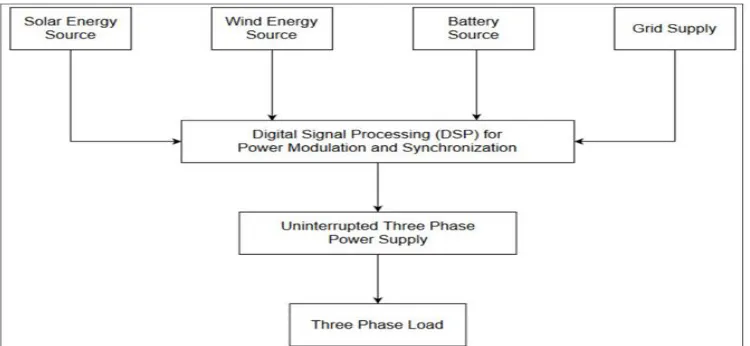
Technologies have been developed to harness this energy and demand is fulfilled. These sources were individually used to supply the load. Each source has its own set up to harness energy convert it into electricity and supply to the load. But drawback of such method is that they are not reliable and load get often interrupted which cause varieties of problems. To overcome such problems this technical is designed with DSP programming which uses power sources (Grid, Battery, Solar PV Cells and Wind) to generate uninterrupted three phase output. Algorithm is developed to switch between the sources to provide an uninterrupted power source to the load which helps in cost saving thus reducing stress on conventional power sources.
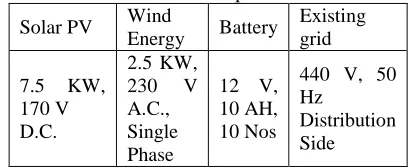
The analysis of optimal power for multiple sources of energy is a recently developed technique for use in distributed generation (DG) [11]. Here, a comprehensive concept for the design and development of distribution and control devices is introduced. In this process, the demand side (various loads) is distributed in the form uninterrupted power sinks and hardware is designed and developed to fulfil these loads using a 10 KW systems. As sources of energy, this system uses RESs (solar PV, wind energy), batteries and diesel generators on a three-phase existing grid. The respective capacities of these sources and the grid are given in Table I.
Table I – Grid and Source Capacities
Solar PV Wind
Energy Battery
Existing grid
7.5 KW, 170 V D.C.
2.5 KW, 230 V A.C., Single Phase
12 V, 10 AH, 10 Nos
440 V, 50 Hz
Distribution Side
DSP based algorithm is developed to switch between Power supplies according to load variations without interrupting the power supply. An accurate decision can be made using this program. DSP accepts and compares the values of current, voltage and power factor according to algorithm to determine the optimal power source for the load. The input from each Renewable Energy Sources (RES) is taken and compared with the grid supply and battery. According to the priority of the sources the choice is made, which will fulfill the load demand. If the load is not fulfilled by single source then the load is shared by two or more sources. This insures a steady supply for the load.
The main component of the digital signal processor (DSP) is a 32-bit CPU with a floating-point math accelerator, a 60 MHZ operating frequency (16.67 ns cycle time), fast interrupt response and processing and a unified memory programming model. The CPU is code efficient ( C / C ++ and assembly), and all optimal power flow tasks are conceded to it, including determination of directed paths for power flow and the synchronisation of electrical parameters such as voltage, frequency and waveform at the point of common coupling(PCC). For analysis, control and synthesis, three variables—x, y and h— are used. For satisfactory operation of system the reliable algorithm is proposed as follows.
3. ALGORITHM
Step 1 : Initiate Solar and Wind Power Source. Step 2 : Check initiated power source working or not.
Step 3 : If power source working then follow next steps else go to Step 9. Step 4 : Calculate live power generation from power system.
Step 5 : If load demand is fulfilling by total power generation then follow next steps else go to Step 9.
Step 6 : If total power generation is more than load demand then follow next steps else supply the load through power modulation and synchronization circuit.
Step 7 : Check battery charging status.
Step 8 : If battery is not fully charged then charge the battery else export the remaining power to Grid and end of program. Step 9 : Initiate Battery Source.
Step 10 : Check if load demand fulfilling by RES and battery power or not.
Step 11 : If yes then supply the load through power modulation and synchronization circuit and terminate the program flow else follow next step.
Step 12 : Initiate Grid Power Supply. Step 13 : Check grid supply active or not.
Step 14 : If grid is active then supply the load through power modulation and synchronization circuit else Isolate load from System.
Step 15 : End of Program.
This algorithm is for multiple sources of RES including storage devices, which satisfy the demand on priority without interruption of supply as per flowchart Appendix 1.
4. DSP PROGRAMING LOGIC
a) If VS > VRATED then Indicate “Solar Power Plant Working” and calculate power generation Ps else Indicate “Solar Power Plant not working”.
b) If VW> VRATED then Indicate “Wind Power Plant Working” and calculate power generation Pw else Indicate “Wind Power Plant not working”.
c) If VB> VRATED then Indicate “Battery is ready to supply” and calculate power generation PB else Indicate “Battery is discharged”.
d) If VG> VRATED then Indicate “Grid is Working” calculate power generation Pg else Indicate “Grid is not working”. e) Calculate Power demand Pd.
f) If PS>= PD then Indicate “Load is fulfilled by Solar Power Plant” else follow next steps g) If PS> PD then PD – PS = Charge the Battery
h) If PS + PW>= PD then Indicate “Load is fulfilled by RES” else follow next steps i) If PS + PW> PD then PD – Ps + PW = Charge the Battery
5. TESTING RESULT
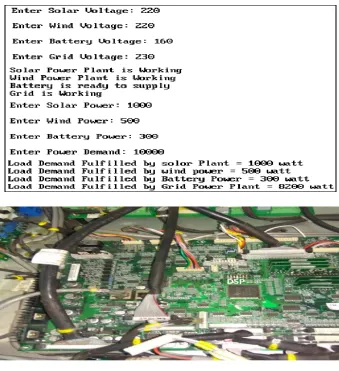
DSP as a programmable device, the created program in it gives an optimal power strategy which is adopted for operation of multiple RES with existing grid as per the constraints of parameters of Table 1. The real time analyses were performed for scrutiny of adequate results of DSP in relationships of critical occurrence of parameters of RES and existing grid. This gives a source wise analysis for Solar PV, Wind Energy, Battery and grid including integrating parameters at PCC.During testing the rigorous values were taken into consideration, one of its represented as below.
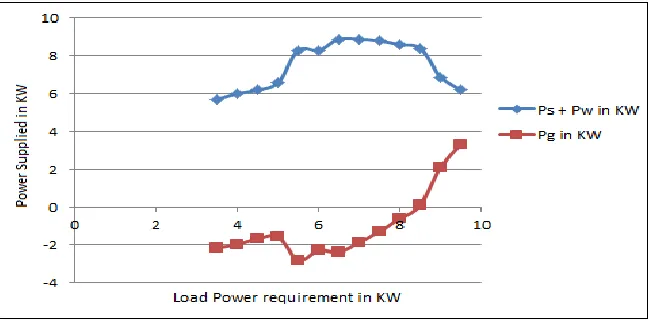
As per the algorithm and flowchart outputs are obtained from simulation of the DSP programming figure.2. The results are very interesting for the monitoring, control and protection for all parameters of power system for demand side management. The figures 4 - 6 are representing multiple RES contribution while satisfying the demand.
Figure 2: DSP TMS320F28335PGFA Texas
5.1 Experimental Setup:
Figure3:Grid integrating for multiple RES
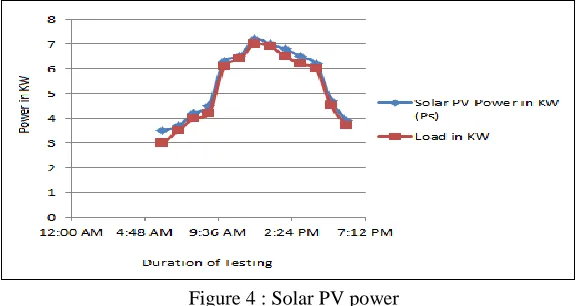
Figure 4 gives us solar PV power generation based on time of day, during testing the results were taken for day basis and same are validated for programming and system output.
Figure 4 : Solar PV power
Figure 5 gives us Wind power generation based on time of day, during testing the results were taken for day basis and same are validated for programming and system output.
Figure 5:Wind power
Figure 6: Solar PV, Wind and grid Power
6. CONCLUSION
The main contribution of the paper is the approach of independent active and reactive power control of inverter to maintain the grid stability in the scenario of renewable integration.In the present scenario of increasing complexity in Grid Power System a simple yet powerful tool is required to encounter the upcoming problems in utilization of RES. DSP programing is expected to play a major role in power sector in helping to provide an uninterrupted power supply to the consumers. DSP Programing is quite simple and very accurate. The only requirement of this concept is interfacing of Digital Signal Processors with power sources. The control is based on the references generated from the each source after analysing the instantaneous grid conditions.For maximum use of RES power and uninterrupted output power supply DSP based power system control is very convenient and accurate technique. Also it is possible to synchronizing of voltage, frequency, waveform at PCC. Eventually our system can also achieve protection to system from under, over voltage and overloads.
7. ACKNOWLEDGEMENT
For this research we received research funding from SavitribaiPhule Pune University, Pune, Maharashtra, India, under proposal no. 15ENG002505 for the years 2016–2018. Also thanks to Vishal Gadekar, SubhodhItankar, SamadhanChaundgir under graduate students of Department of Electrical Engineering of Dr. D. Y. Patil Institute of Technology, Pimpri, Pune, India for their contribution while performing testing of said analysis.
8. References:
[1] D. Chen, J. Zhang, and Z. Qian, “An improved repetitive control scheme for grid-connected inverter with frequency-adaptive capability,” IEEE Trans. Ind. Electron., vol. 60, no. 2, pp. 814–823,2013.
[2] G. M. T. Nguyen and K. Uchida, “Active and Reactive Power Control Techniques Based on Feedback Linearization and Fuzzy Logic for Three-Phase Grid-Connected Photovoltaic Inverters,” Asian J. Control, vol. 17, no. 5, pp. 1522–1546,2015.
[3] A. Camacho, M. Castilla, J. Miret, A. Borrell, and L. G. de Vicuña, “Active and reactive power strategies with peak current limitation for distributed generation inverters during unbalanced grid faults,” IEEE Trans. Ind. Electron., vol. 62, no. 3, pp. 1515–1525,2015.
[4] IEEE Standard Definitions for the Measurement of Electric Power Quantities under Sinusoidal, Nonsinusoidal, Balanced, or Unbalanced
Conditions.IEEE Std. 1459-2010, 2010.
[5] Electromagnetic Compatability (EMC) - Part 4-7: General Guide on Harmonics and Interharmonics Measurements and Instrumentation for Power
Supply Systems and Equipment Connected Thereto. IEC Std. 61000-4-7, 2002.
[6] C. Gherasim, J. Van den Keybus, J. Driesen, and R. Belmans, “DSP Implementation of Power Measurements According to the IEEE Trial-use
Standard 1459,”IEEE Trans. Instr. Meas., vol. 53, no. 4, pp. 1086–1092, 2004.
[7] M. Szmajda, K. Gorecki, and J. Mroczka, “DFT Algorithm Analysis in Low-Cost Power Quality Measurement Systems based on a DSP Processor,” in
Proc. of 9th Int. Conf. on Electrical Power Quality and Utilisation EPQU 2007. IEEE, 2007, pp. 1–6.
[8] T. Karthik, A. C. Umarikar, and T. Jain, “Empirical Wavelet Transform Based Single Phase Power Quality Indices,” in Proc. of 2014 Eighteenth National Power Systems Conference (NPSC). IEEE, 2014, pp. 1–6.
[9] K. Thirumala, A. Umarikar, and T. Jain, “Estimation of Single-Phase and Three-Phase Power-Quality Indices Using Empirical Wavelet Trans-form,”
IEEE Trans. Power Del. , vol. 30, no. 1, pp. 445–454, 2015.
[10] K. Thirumala, Shantanu, T. Jain, and A. C. Umarikar, “Visualizing Time-varying Power Quality Indices Using Generalized Empirical Wavelet
Transform,” Elect.Pow. Syst. Res. , vol. 143, pp. 99–109, 2017.
Appendix I: