Feature Selection Used for Retreving and to
Classifying Images
1
Shine Raj G, 2 Radhakrishnan B , 3 Anver Muhammed K M
1,2
Assistant Professor,
Baselios Mathews II College of Engineering Sasthamcotta, Kollam, Kerala
3
System Administrator,
Baselios Mathews II College of Engineering Sasthamcotta, Kollam, Kerala
Abstract - Searching for images from large repositories are tree some task. Rather than searching for image contents as whole intersting features of the images are looked for. We have used feature descriptors to compare images and similar images are grouped using classification algorithms. There by intersting images can be retrived effectively.
Keywords –CBIR, Object retrieval, Image Representation, Features Descriptors,BoW, Classification of Images.
1. Introduction
The idea of image retrieval was created by Database Management community in a conference organized at Florence in 1979 [10]. Database management systems consisted of annotating the images by text in early schemes. To generate descriptive texts in case of large collections of images, these kinds of approaches poses several problems. For manually annotating images a lot of labor is required which is an expensive task, Automatic generation is not feasible yet. Moreover, manually image annotations are affected by subjectivity of human perception and different people might perceive images in different ways.
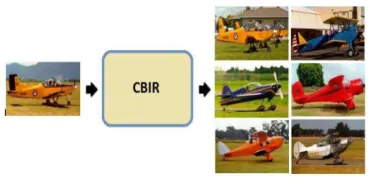
Faced with these limitations, the computer vision (CV) community introduces content-based image retrieval (CBIR) in 1992 [11]. Rather than textual representation CBIR is based on visual features of images. Lot of techniques were developed based on the concept of CBIR after the introduction of CBIR. The main application of CBIR system is to find an image or a set of images similar to those that the user provides as input query image.
Fig 1: Example of CBIR
1.1. Image Database
Offline process. Feature descriptors are extracted from each image stored on the database based on the visual content descriptors, for a multidimensional vector Then, a new database is used to store the feature vectors.
1.2. Information Need
This stage processes the image query. The system uses the query for example (QBE) paradigm. As a starting point for the search of visual information the user employs one or more sample images. The descriptors and vector format are the same as used in the Image Database.
1.3. Result Generation and Presentation
ranks the images of database. Similar images are then classified.
1.4. Relevance Feedback
The user checks the results by providing interactive information. The image will be marked as relevant (positive example) or irrelevant ( negative example) by the user based on this information. Then, the process of information needed is refined and started over again. Relevance Feedback is an optional tool in a CBIR system.
2. Object Retrieval Problems
When the aim is image retrieval, the challenge is to describe in fine a way the visual content. However there are many kinds of variations in an image that affect the classification, such as:
2.1. Illumination
Lighting causes important variations in The value of the intensity of the pixels can vary to a large extent if lightning is increased. Illumination changes in image have a key influence on its appearance. The occurrence of shadows and Illumination can sometimes change the appearance of objects which makes the recognition of an image difficult.
2.2. Scale and Size
An image can contain an object in front or far away. An object may appear alternative at different scales in the image. The scale and size of objects can considerably manipulate the similarity to other object of other classes.
2.3. Background Clutter
A complex background may result in confusion between objects in the foreground and background image. This problem increases false-positive results in object retrieval.
2.4. Viewpoint and Pose
The position of the camera in relation to the object can change the appearance of an object in an image, which may lead to different results in the classification of the object.
2.5. Occlusion, Truncation and Articulation
The visibility of some part of the object may be damaged because of the proximity or overlapping of another object in the image or position of the same
object. This causes large variations between samples of the same class and increases the intra-class variation.
2.6. Intra-Class Variability
If the objects belongs to the same class there may be variation among instances between the objects.
2.7.Inter-Class Variability
Eventhough if the scenes of various categories are quite similar sometimes it may be confusing..
3. Image Representation
All content-based image systems require an appropriate representation of the input image for retrieval of images. An image is formed by pixels, which may or may not represent features. A feature is defined as an interesting p oi n t i n an image and is used as a starting point for computer vision algorithms. In fact, it does not matter what the image features signify. The features do not even have to be localized precisely, since the goal is not to match them on an individual basis, but rather to analyze their statistics.
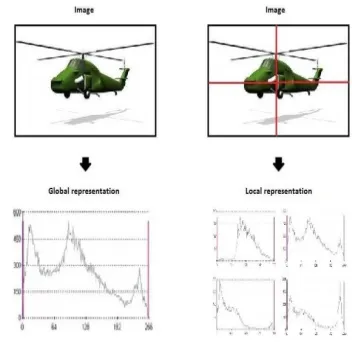
An image can be represented or can be processed globally or locally. T h e w h o l e i m a g e i s u s e d t o d e s c r i b e t h e Global approach. The selection of several regions or blocks of the image ar e utilized to characterize in case of local models. In this case, there are sparse and dense representations.
Fig 2: Example of global and local representation. (a) Global image representation. Entire image is classified as a block; (b) Local image representation. Each sub-block is independently classified obtaining a category for each one.
4. Features Descriptors
When all the features have been detected, characterizing the region around each interest point is done as the next step. F eature descriptors or feature vectors are used to compute these regions. In computer vision hundreds of descriptors have been introduced. There are descriptors just for color features (e.g. color histogram, color moments, color correlogram), shape information (e.g. moments invariants, Fourier descriptors), and texture attributes (e.g. Tamura features, fractal model). However, to achieve good performance in object recognizing task, descriptors that characterize features w h i c h a r e invariant to scale, orientation, affine distortion and partially invariant to illumination changes are used.
4.1 . Scale Invariant Feature Transform
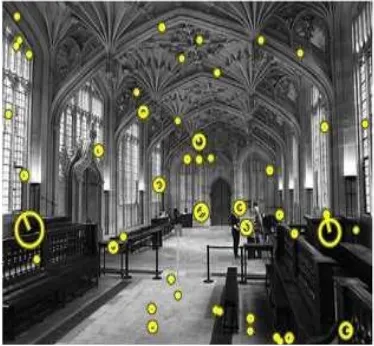
SIFT [3] is decomposed in two stages. The first stage of the SIFT is finding the keypoint localization. For that, DoG detector is used. The second step is keypoint orientation assignment and the keypoint descriptor computation . The interest point in an image is defined using a descriptor. A region around each keypoint is created and divided into orientation histograms on pixel neighborhoods (4 x 4). Each histogram contains 8 bins and each descriptor contains a 4 x 4 array of 16 histograms around the keypoint. This leads to a SIFT feature vector with 128 elements (4 x 4 x 8). Consider if each image contains n keypoints, t h en a n image c o n s t i t u t e t o t a l l y o f n x 128 elements. The SIFT descriptor process on an image is presented in Figure 3. In case of changes in illumination the feature vector is normalized to enhance invariance. The gradient histograms seem to contribute significantly to this performance by representing local shape.One disadvantage of SIFT is its high dimensionality [3].
Figure 3: Interest points.
5. Bags-Of-Word Model
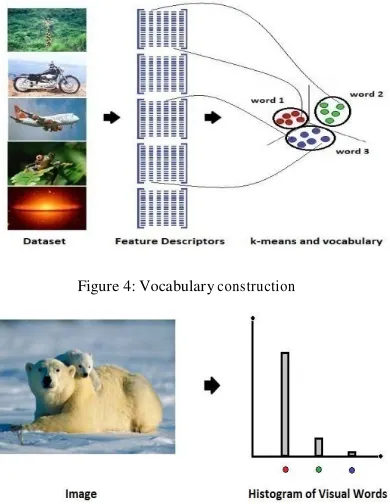
Over the last years new proposals have emerged in image classification research that uses the BoW model for image representation. This model was used in text retrieval initially . BoW is based on regions and points of interest – local patches – and corresponding features descriptions. Clustering method is used in BoW to quantize the features descriptors. The bag-of-words, also know by bag-of-features, is a histogram of words which is applied to images by using a visual analogue of a word formed by vector quantization of visual features. Visual codebook or vocabulary is used to index each interest point. This vocabulary is formed by clustering the feature descriptors - Figure 4 . Each cluster stands for a visual word and the dataset of images is clustered into k representative clusters.
The resulting cluster can be more or less compact, thus representing the variability of similarity for individual features. The value of k depends on the application, ranging from a few hundred or thousand entities for object class recognition applications. K-means is used most often for clustering. After vocabulary building, an image is then modeled as a bag of those so called visual-words. It can thus be described by a vector or histogram that stores the distribution of all assigned codebook IDs or visual words.
Therefore, the BoW process involves the following steps:
• Local patches detection;
• Local descriptors computation over these regions;
• Quantization of the descriptors into words so as to create a visual vocabulary;
The demand for occurrences in the image of each specific word in vocabulary is used , in order to build a bag-of-words. Recent works have exposed that local features represented by BoW are suitable for image classification since it showed impressive levels of performance.
Figure 4: Vocabulary construction
Fig 5: BoW representation
6. Classification of Images
Image classification is also an active area in the field of machine learning, in which it uses algorithms that map sets of input, attributes or variables – a feature space X - to set of labeled classes Y. These algorithms are known as classifiers. Figure 6 shows a simple architecture of a classification system.
Figure 6. Design of classification system.
There are two main stages in a classification system:
• Training Stage
• Testing stage
Training is the process of defining criteria by which features are recognized. In this process The classifier learns, its own classification rules from a training set in this process. The images are captured and stored in a database during this training process. The next step to be performed is the feature extraction. An image is represented by a set of descriptors that structure the feature vectors. These feature vectors are considered input variables and are introduced in a learning component. The outputs are labels associated with classes (e.g. airplanes, faces, flowers). In the testing stage, the feature vectors of a query/test image works as input. A classifier decides on the bases of learning model, with its own classification rules, as to which class that feature vector belongs.In literature, there are several approaches for classifiers, which can be characterized by two types of families
• Unsupervised Learning (UL)
• Supervised Learning (SL)
7. Conclusion
In this work, a CBIR system was implemented, combining the Scale Invariant Feature Transform (SIFT) descriptor and the Naive Bayes Nearest Neighbor (NBNN) algorithm in order to classify images according to their content. Due to the complexity and “subjectivity” of the problem, a simple classifier was applied. The advantage of this method is related to the absence of a learning phase. It just needs to assemble a group of features that label a class.
References
[1] Long, F. H., H. J. Zhang and D. D. Feng, Fundamentals of content-based image retrieval, in Multimedia Information Retrieval and Management - Technological Fundamentals and Applications, Springer-Verlag, pp.1-26, New York, 2003.
[2] Caltech-101, available at:
http://www.vision.caltech.edu/Image_Datasets/Caltech10 1
[3] Lowe, D. G., Distinctive image features from scale invariant features, International Journal of Computer Vision, Vol. 60, No. 2, pp. 91-110, 2004.
[4] Kumar, A. and Sminchisescu, C., Support kernel machines for object recognition, in ICCV, 2007. [5] Zhang, H., Berg, A., Maire, M. and Malik, J., Svm-knn:
Discriminative nearest neighbor classification for visual category recognition, in CVPR, 2006.
[6] Yang, C. C., Prasher, S. O. , Enright, P., Madramootoo, C., Burgess, C., Goel, P. K., Callum, I., Application of decision tree technology for image classification using remote sensing data, in Agricultural Systems 76, pp. 1101-1117, 2003.
Classification Using Competitive Neural Networks, 12th Scientific Conference MATLAB2004, Humusoft, 2004.
[8] Rish, I., An empirical study of the naive Bayes classifier, in IJCAI 2001 Workshop on Empirical Methods in Artificial Intelligence, 2001.
[9] Boiman, O., Shechtman, E. and Irani, M., In defense of Nearest-Neighbor based image classification, in IEEE Conference on Computer Vision and Pattern Recognition, CVPR, pp.1-8, 2008.
[10] Blaser, A., IBM Symposium: Data base techniques for pictorial applications, volume 81 of Lecture Notes in Computer Science (LNCS), Springer, Florence, 1979.
[11] Kato, K., Database architecture for content–based Image retrieval, 377 volume 1662 of SPIE Proceedings, pp. 112–123, San Jose, 1992.
[12] Müller, H., User interaction and evaluation in content-based visual Information retrieval, PhD thesis, University of Geneva, Geneva, 2002.
[13] Grubinger, M., Analysis and evaluation of visual information systems performance, Eakins, J.P. and Graham, M. E., Content–based image retrieval, JISC Technology
Application Program, University of Northumbria, Newcastle upon Tyne, 2000.
[14] Castelli, V., Bergman, L. D., Image databases: search and retrieval of digital imagery,2002
Authors Profile:
Shine Raj G is working as Asst. Professor in Computer Science
department. He has more than 8 years experience in teaching and has published papers on data mining and image processing. His research interests include image processing, data mining.
Radhakrishnan B is working as Asst. Professor in Computer
Science department. He has more than 15 years experience in teaching and has published papers on data mining and image processing. His research interests include image processing, data mining, image mining and Artificial Intelligence. Also he is a member of CSI
Anver Muhammed K.M is working as System Administrator in