December 2016, Volume 3, Issue 12 JETIR (ISSN-2349-5162)
AN EFFICIENT DIGITAL COLOR IMAGE WATERMARKING
ALGORITHM
JAYPRAKASH UPADHYAY Dr. BHARAT MISHRA Dr. PRABHAT PATEL Research scholar (Ph.D), Faculty of Engg. Asso. Prof., Faculty of En. Science Prof., Elect. & Tc Engg. Deptt.
M.G.C.G.V., Chitrakoot, Satna, M.P., INDIA M.G.C.G.V., Chitrakoot, Satna, M.P., INDIA J.E.C., JABALPUR, M.P., INDIA
Abstract— A new digital image watermarking
technique which is based on multi resolution DWT
& used a Modified LSB watermarking embedding
algorithm is proposed in this paper. The color
watermarked image is obtained & watermark can
easily be extracted in both clean and noisy
environments. Experiments are performed to verify
the robustness of the proposed algorithm. The result
shows that the proposed algorithm is better than
other existing algorithms in terms of providing a
high PSNR. It is also shown that the proposed
algorithm is highly robust against various kinds of
attacks such as noise, filtering, cropping & rotation.
Keywords— Watermarked, PSNR, MSE, DWT,
IDWT, RGB
I.INTRODUCTION
Digital image watermarking has become a
necessity in many applications such as data
authentication, broadcast monitoring on the Internet
and ownership identification. Various watermarking
schemes have been proposed to protect the
copyright information [1].
With the mostly use of the Internet and the
rapid and recent advanced development of
multimedia, there is an impending need for efficient
and powerfully effective copyright protection
techniques. Digital watermarking is typically
classified into three categories. (1) Private
watermarking technique which requires the prior
knowledge of the original data or information and
secret keys, at the receiver, (2) Semi-private or
semi-blind watermarking technique where the
watermark information and secret keys may be
available at the receiver, and (3) blind watermarking
where the receiver must only know the secret keys
[2].
Digital color image watermarking can also
be used for controlling the creating of illegal
duplicate copy of the original source of data. With
help of my proposed algorithm it is useful to track
the customer who illegally distributes the digital
images in the market. So with my proposed
watermarking system we can easily trace those
distributors who create multiple copies of the
original image or data in an illegal way. This can
easily been done by embedding the some sign or
lobo as watermark into the host image. When an
December 2016, Volume 3, Issue 12 JETIR (ISSN-2349-5162)
illegal copy is found then the watermark
information is extracted from the host image.
II.LITERATURE REVIEW
Hamidreza Sadreazami et.al: Authors
proposes an Multiplicative Watermark Decoder
based on Contourlet Domain. Basically contourlet
coefficients of an image are highly non-Gaussian
and a proper distribution to model. The proposed
watermark extraction approach is developed using
the maximum likelihood method based on the NIG
distribution. Authors performed to verify the
robustness of the proposed decoder. The result
shows that the proposed decoder is better than other
decoders in terms of providing a lower bit error rate.
From the author’s results it is shown that the
proposed decoder is highly robust against various
kinds of attacks [1].
Zhao Jian et.al has proposed A
Watermark Technique Based on Extended
Shearlet And Insertion. In this algorithm firstly, 1-
D extended discrete shearlet transform decomposes
of the test image. Next, the directional component
whose information entropy is the highest is selected
to carry watermark. Compared with existing related
algorithms based on DWT and DCT, the author’s
proposed algorithm tends to obtain preferable
invisibility when it is robust against some common
attacks & gives the better results in terms of PSNR
[3].Koyi Lakshmi Prasad et.al has proposed “A Hybrid LWT-DWT Digital Image Watermarking Scheme”. In this proposed article authors present an efficient and hybrid
approach. The hybrid approach consists of lifted wavelet
transform (LWT) and discrete wavelet transforms (DWT)
which is based on linear support vector regression (LSVR) and
QR-factorization for watermarking. Precisely the integrated
hybrid approach produces less distortion rate. The
experimental results are analyzed with other models and offers
high reliability on watermark embedding and authenticity
along with less computational cost [7].
III. WATERMARKING TECHNIQUE
In general digital watermarking involves
two major operations: (i) watermark embedding,
and (ii) watermark extraction. For both operations a
secret key is needed to secure the watermark. The
secret message embedded as watermark can almost
be anything, for example, serial number, mobile
number, video frames, image, logo etc. The most
important properties of any digital watermarking
technique are: robustness i.e. watermarking
technique should be robust to various types of
attacks, security i.e. watermarking technique should
be secure so any unauthorized person is not be able
to read, modified or destroy embedded watermark,
imperceptibility so that quality of the watermarked
image should not be destroy, and effective .
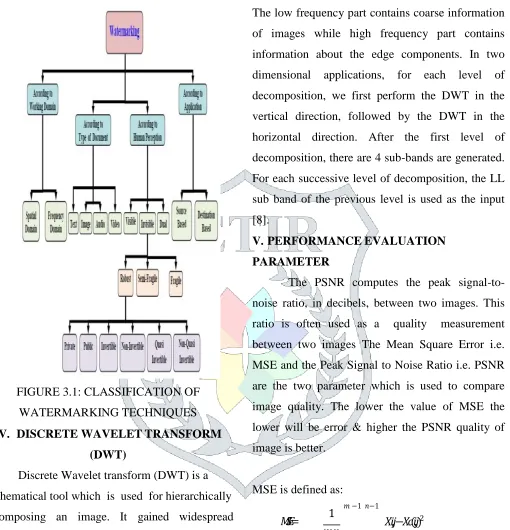
Watermarking techniques can be classified
according to the nature of data (text, image, audio
or video), or according to the working domain
(spatial or frequency), or classified according to the
human perception (robust or fragile) as shown in
figure 3.1. In images, the watermarking techniques
can broadly be classified into three types: (i) visible
watermark, (ii) invisible watermark and (iii)
December 2016, Volume 3, Issue 12 JETIR (ISSN-2349-5162)
FIGURE 3.1: CLASSIFICATION OF
WATERMARKING TECHNIQUES
IV. DISCRETE WAVELET TRANSFORM
(DWT)
Discrete Wavelet transform (DWT) is a
mathematical tool which is used for hierarchically
The low frequency part contains coarse information
of images while high frequency part contains
information about the edge components. In two
dimensional applications, for each level of
decomposition, we first perform the DWT in the
vertical direction, followed by the DWT in the
horizontal direction. After the first level of
decomposition, there are 4 sub-bands are generated.
For each successive level of decomposition, the LL
sub band of the previous level is used as the input
[8].
V. PERFORMANCE EVALUATION
PARAMETER
The PSNR computes the peak signal-to-
noise ratio, in decibels, between two images. This
ratio is often used as a quality measurement
between two images The Mean Square Error i.e.
MSE and the Peak Signal to Noise Ratio i.e. PSNR
are the two parameter which is used to compare
image quality. The lower the value of MSE the
lower will be error & higher the PSNR quality of
image is better.
MSE is defined as:
𝑚 −1 𝑛−1
decomposing an image. It gained widespread 𝑀𝑆𝐸 = 1 𝑋 𝑖, 𝑗 − 𝑋𝑐(𝑖, 𝑗) 2
acceptance in the field of image watermarking. It 𝑚𝑛 𝑖=0 𝑗 =0
decomposes an image into a set of basic functions,
called wavelets. Discrete Wavelet Transformation is
very suitable to identify the areas in the cover image
where a secret image can be embedded effectively.
The DWT splits the image into sub-band
Where, X(i,j) = original image
Xc(i,j) = compressed image
PSNR represents a measure of the peak error & is
expressed in decibels. It is defined by:
2552
coefficients such as high and low frequency parts. 𝑃𝑆𝑁𝑅 = 10log10 𝑀𝑆𝐸
December 2016, Volume 3, Issue 12 JETIR (ISSN-2349-5162)
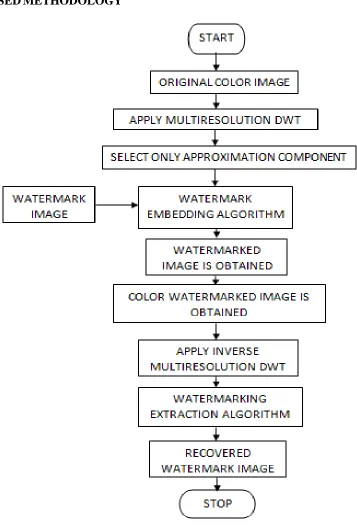
VI.PROPOSED METHODOLOGY
December 2016, Volume 3, Issue 12 JETIR (ISSN-2349-5162)
VII. EXPERIMENTAL RESULTS
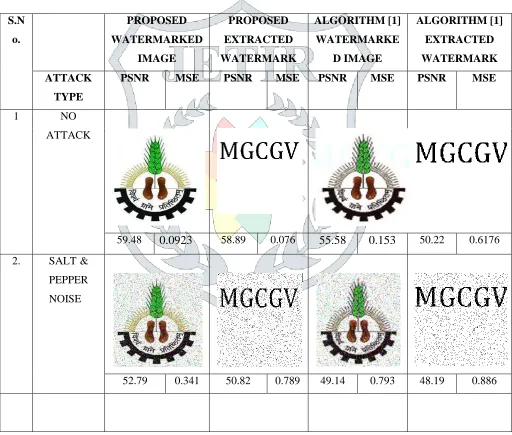
Robustness is a default measure which is used to evaluate the performance of the
proposed watermarking algorithm against various types of attacks such as salt & pepper noise,
filtering, cropping, and rotation.
TABLE 1: PSNR and MSE comparisons of test image 1 between the proposed scheme and
the algorithm in [1].
S.N
o.
PROPOSED
WATERMARKED
IMAGE
PROPOSED
EXTRACTED
WATERMARK
ALGORITHM [1]
WATERMARKE
D IMAGE
ALGORITHM [1]
EXTRACTED
WATERMARK
ATTACK
TYPE
PSNR MSE PSNR MSE PSNR MSE PSNR MSE
1 NO
ATTACK
59.48 0.0923 58.89 0.076 55.58 0.153 50.22 0.6176
2. SALT &
PEPPER
NOISE
52.79 0.341 50.82 0.789 49.14 0.793 48.19 0.886
December 2016, Volume 3, Issue 12 JETIR (ISSN-2349-5162)
3.
MEDIAN
FILTER
55.89 0.167 51.98 0.799 50.12 0.781 49.81 0.994
4. CROPPING
51.22 0.7167 52.54 0.652 48.78 0.983 46.21 1.081
5. ROTATION
100
56.79 0.341 53.82 0.599 49.67 0.811 48.99 0.986
VIII. CONCLUSION
In this paper, a new method multi-resolution DWT based watermarking algorithm has
been proposed. To investigate the robustness of proposed algorithm, different images with
different intentional and unintentional attacks were employed. PSNR values are estimated for all
the images. Comparing these PSNR values with that obtained by earlier conventional approach it
can be concluded that the fidelity of the watermarked image is improved with the proposed
method. It has been also shown that the performance of proposed algorithm is highly robust
December 2016, Volume 3, Issue 12 JETIR (ISSN-2349-5162)
XI.REFERENCES
1. Hamidreza Sadreazami et.al: “Multiplicative Watermark Decoder in Contourlet Domain
Using the Normal Inverse Gaussian Distribution” IEEE Transactions On Multimedia,
Vol. 18, No. 2, February 2016.
2. Gamal Fahmy et.al : “ Joint Watermarking and Compression for Images in Transform
Domain” International Journal of Modern Engineering Research (IJMER) Vol.2, Issue.4,
July-Aug. 2012 pp-2341-2351.
3. Zhao Jian et.al: “Image Watermark Based on Extended Shearlet and Insertion Using the
Largest Information Entropy on Horizontal Cone”: Hindawi Publishing Corporation
Mathematical Problems in Engineering Volume 2015, Article ID 450819, 10 pages.
4. R.Sudhakar et.al : “Image Compression using Coding of Wavelet Coefficients – A
Survey” ICGST-GVIP Journal, Volume (5), Issue (6), June 2005.
5. Mustafa Osman Ali et.al : “ Invisible Digital Image Watermarking in Spatial Domain
with Random Localization” International Journal of Engineering and Innovative
Technology (IJEIT) Volume 2, Issue 5, November 2012.
6. Archana Deshlahra: “Analysis of Image Compression Methods Based On Transform and
Fractal Coding” thesis NIT Rourkela 2013.
7. Koyi Lakshmi Prasad et.al : “ A Hybrid LWT-DWT Digital Image Watermarking
Scheme using LSVR and QR-factorization” International Journal of Applied Engineering
Research Volume 11, Number 6 (2016) pp 4335-4342.
8. Kaiser J. Giri et.al : “ A Robust Color Image Watermarking Scheme Using Discrete
Wavelet Transformation” I.J. Image, Graphics and Signal Processing, 2015, 1, 47-52
Published Online December 2014 in MECS.