JETIR1605059 Journal of Emerging Technologies and Innovative Research (JETIR) www.jetir.org 342
Design and Study of a Text-to-Speech Converter with
Language Conversion Using Raspberry Pi
1
Shubhra Kumari,
2Dr. Mrinal Sarvagya
1Student M.Tech, 2ProfessorSchool of ECE
Reva University, Bangalore.India
Abstract— This paper deals with the study and designing of a text to speech converter along with a language translator. Its involves details study of back end procedure of a text to speech converter. The system is designed in a way that it can be implemented on hardware as well as a software platform. The software implementation involves study and use of linux operating system where the system is programmed and on the hardware level it uses a raspberry pi board. This module is different from its preexisting models as it displays the input text on the connected monitor and announces the same text in prerecorded sound and it initiates language translations on request for two target languages i.e English to Kannada and English to Hindi.
IndexTerms- Linux, raspberry pi, text-to-speech(tts), language conversion, embedded systems
________________________________________________________________________________________________________
I. INTRODUCTION
Real time implementation on a text to speech converter has been an area of interest for many real time embedded system developers. Embedded Systems are those systems which are designed to perform many task or just one specific task as per the requirement. In this proposed system the raspberry pi is used as the embedded hardware. The use of a raspberry pi board optimizes the cost of the project as it works as a mini speaker. In our country there exist not just one but many different language which causes a hindrance in communication between two people belonging to two different language zones.
Text to speech conversion on a hardware platform is achieved by using a raspberry pi board , a keyboard is used to give the input text, a monitor that is interfaced to the board which displays the input text and a speaker which gives the output form of the input text. On the software platform the c-code is done on a linux platform where the input command is given. In this paper the proposed system uses vmware workstation software which runs the linux operating system virtually on a windows operating system. The language conversion is done using a look up table method. The source language the is given as the input and matched to the corresponding target word in the look up table and then the target language is displayed on the screen. This project can be very helpful to communicate between people belonging to different regions. Majorly its will be useful for individuals who are visually impaired, people with hearing disability and people with verbal disability for an educational purpose or for communication. It can also be used for making announcements or for educational purpose in the institutions. One advantage that this project has above the pre-existing technologies is that it does not need to pre record the sound that need to be played. Whichever text is given as input is given in the audio format.
II. METHODOLOGY
This proposed module performs two functions: 1. Text-to-speech conversion
2. Language conversion. Text-to-speech conversion
JETIR1605059 Journal of Emerging Technologies and Innovative Research (JETIR) www.jetir.org 343 Figure1 . Backend working of a tts system
Language Converter
The language conversion part of the project is operated only on the demand of the user. This project provides language conversion between two languages is English to Kannada and English to Hindi. Its involves converting the obtained text into the required target text. This is operated using a look up table method where a dictionary of the words is created in all the three languages. When the input text is given in
English language. The required target language is selected and the corresponding target word is searched in the dictionary. When the target word is matched it is displayed on the screen for the user. The quality of translation can be affected by various factors including the knowledge of the translator of the culture and linguistic pattern of the people of that area.
III. SYSTEM ARCHITECTURE
Proposed Block Diagram
Figure2. Block diagram of the system
In the proposed block diagram for this project the Raspberry pi board is connected to a keyboard which gives the text input to the system by a keyboard which is connected to the USB port on the board. A DC power supply is given. The monitor
MONITOR
RASPBERRY PI
KEYBOARD INPUT SPEAKER
SOURCE TEXT DICTIONARY
TARGET TEXT DICTIONARY
JETIR1605059 Journal of Emerging Technologies and Innovative Research (JETIR) www.jetir.org 344 which is connected is used as a display. The speaker is connected to give the audio output of the input text. The text dictionary for language conversion is the backend part of the system.
IV. SYSTEM OVERVIEW
Raspberry Pi
The raspberry pi is a credit card sized board which is developed in the United Kingdom by the Raspberry pi foundation. It was developed by the corporation with the purpose to promote basic computer science teaching in schools. It has several amazing features of which the user must be aware before they start implementing.
Figure 3. Raspberry pi processor.
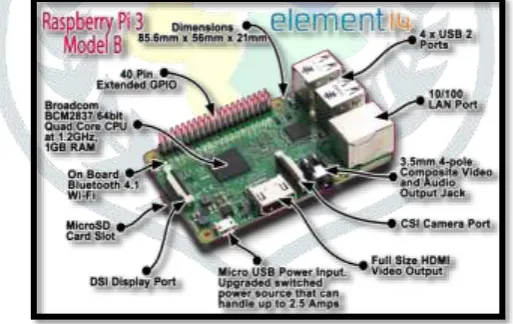
Until now several generation of raspberry pi has been released until now. It very first version was released in Feburary,2012 and updated versions were released later. All the models of raspberry pi have a Broadcom System on chip(SOC) that includes an ARM compatible CPU and an on chip GPU. The speed of CPU can range from 700 MHz to1.2GHz and the on board memory ranges from 256MB to 1GB RAM. To store the operating system and the programming code a digital SD card is used. The raspberry pi board has a upto four USB ports, one HDMI port for high definition display.
Figure 4. Features of Raspberry Pi
Features of raspberry pi:
It has an Ethernet port and an on Wifi 802.11 and a Bluetooth module.
It supports basic programming languages such as Python, Basic, C,C++, Java etc.
It uses a Broadcom BCM2837 Soc which works on 1.2GHz on a quad-core ARM Cortex-A53 which has a memory of 512KB and a shared L2 cache.
It supports peripherals like a generic USB computer keyboard and a mouse for its operation.
The video controller supports standard TV resolutions such as HD and Full HD and even older versions such as CRT Tv resolutions.
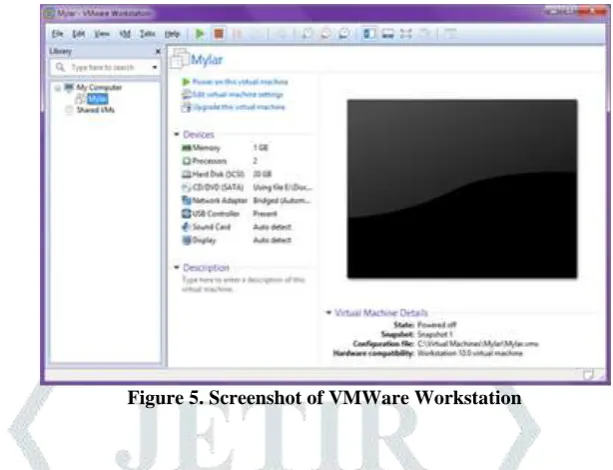
VMWare Workstation
JETIR1605059 Journal of Emerging Technologies and Innovative Research (JETIR) www.jetir.org 345 network adapters and also enables sharing of physical disk drives and USB devices with a virtual machine. The virtual hard disk drives are implemented as a .vmdk files.
Figure 5. Screenshot of VMWare Workstation
Ubuntu
Ubuntu is a Debian based Linux operating system. It was developed by a UK based company, Canonical Ltd and based on free software. It was developed on the principle of open-source software development so that it can be freely available to everyone for learning purpose. Ubuntu on installation provides many softwares by default such as LibreOffice, Firefox, Thunderbird etc. System requirements for installation of ubuntu incudes a PC which has at least 2GHz dual core processor, 2GB of RAM and 25GB of freehard disk space.
Figure 6. Screenshot of Ubuntu operating system.
V. IMPLEMENTATION
JETIR1605059 Journal of Emerging Technologies and Innovative Research (JETIR) www.jetir.org 346 VI. EXPERIMENTAL RESULTS
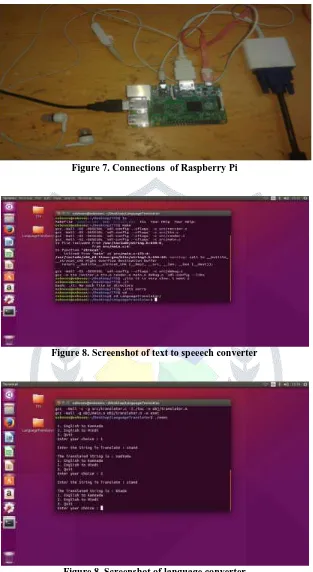
Figure 7. Connections of Raspberry Pi
Figure 8. Screenshot of text to speeech converter
Figure 8. Screenshot of language converter
VII. CONCLUSION
JETIR1605059 Journal of Emerging Technologies and Innovative Research (JETIR) www.jetir.org 347 The future scope of this project is to develop an image recognition along with text to speech converter to help visually impaired individuals for eduactional purpose.
VIII. ACKNOWLEDGEMENT
I would like to extent my sincere gratitude to my Project guide Dr.Mrinal Sarvagya for her constant support and guidance throughout the development of this project. Her vision and encouraged me to pursue a project in this particular area. I thank her for knowledge and encouragemnet which helped mr in completing this dissertation. I would also like to extent my gratitude to the Dr. S.Y Kulkarni, Principle,Reva University and Dr. R.C Biradar, Director, School of ECE, Reva University for giving us an oppurtunity excel our knowledge and technical skills and allowing us to undertake a project in our area or interest.
REFERENCES
[1]Endarpu Vanitha, Pradeep Kumar Kasarla, E Kuamarswamy, “Implementation of Text- to-Speech for Real Time Embedded System Using Raspberry Pi Processor”, International Journal&Magazine of Engineering Technology Management and Research, IISN No:2348-4845, Page 1995, July 2015.
[2]Santosh kumar G, MNVLM Krishna, “Low cost speech recognition system running on Raspberry Pi to support Automation applications”, International Journal of Engineering Trends and Technology, Volume 21 Number 5, March 2015.
[3]AnushaBhargava, Karthik V.Nath, Pritish Sachdeva,Monil Samel, “ Reading assistant for visually Impaired”,International Journal of current Engineering and Technology, E-ISSN 2277, Vol.5 No.2, April 2015.
[4]Leandro de C. T. Gomes , Edson Jose Nagle , Jose Geraldo Chiquito “Text-To-Speech Conversion System For Brazilian Portuguese Using A Formant-Based Synthesis Technique”, LPS-DECOM-FEEC-Unicamp.
[5]Sim Liew Fong, Abdelrahman Osman Elfaki, Md Gapar bin Md Johar & Kevin Loo Teow Aik , “Mobile Language Translator”, 5th Malaysian Conference in Software Engineering (MySEC),2011.
[6]D.Sasirekha, E.Chandra, “Text to speech:a simple Tutorial”, International Journal of Soft Computing and Engineering (IJSCE) ISSN: 2231-2307, Volume-2, Issue-1, March 2012.
[7]Itunuoluva Isewon, Jelili Oyelade, Olufunke Oladipupo, “Digital implementation of text to speech conversion for visually impaired people” International Journal of Applied Information Systems (IJAIS) – ISSN : 2249-0868 Volume 7– No. 2, April 2014.