JETIR1701048 Journal of Emerging Technologies and Innovative Research (JETIR) www.jetir.org 314
A Study of Solving Linear System of Equations by GAUSS-JORDAN Matrix Method-An
Algorithmic Approach
Dr. YOGEESH N
Assistant professor in Mathematics
Government First Grade College BH Road, Tumkur-572102 Government of Karnataka, INDIA
E-Mail: [email protected]
ABSTRACT
This paper shows how to solve any system of linear equations over an arbitrary field, using the Gauss-Jordan algorithm. For this, we need to define some concepts called row echelon form, elementary row operations, row equivalence and with other knowledge like linear equation, matrices and determinants also. By knowing all the above information here, we designed the Gauss-Jordan Algorithm to solve linear equations with some examples this will be useful to write the computational program to solve the system of equations using Gauss-Jordon method.
KEYWORDS
Row-echelon form, reduced row-echelon form, Elementary row operations, Row equivalence, augmented matrix, Gauss-Jordan Algorithm.
INTRODUCTION
The Gauss-Jordon method is one of the methods to solve system of linear equations using matrix method. Now a days these methods are incorporated in the computational field to solve these type of equations using the program code to compute the solutions. Therefore, by knowing the basic knowledge about the process one can easily write the computational codes in the relevant computer language.
GAUSS-JORDAN Method of solving linear equations.
We show how to solve any system of linear equations over an arbitrary field, using the GAUSS-JORDAN algorithm. We first need to define some terms.
Definition (Row-echelon form) A matrix is in row-echelon form if
a. All zero rows (if any) are at the bottom of the matrix and
b. If two successive rows are non-zero, the second row starts with more zeros than the first (moving from left to right).
JETIR1701048 Journal of Emerging Technologies and Innovative Research (JETIR) www.jetir.org 315 [
0 1 0 0
0 0 1 0
0 0 0 0
0 0 0 0
] Is in row-echelon form,
Whereas the matrix
[
0 1 0 0
0 1 0 0
0 0 0 1
0 0 0 0
] is not in row-echelon form.
The zero matrix of any size is always in row-echelon form.
Definition (Reduced row-echelon form)
A matrix is in reduced row-echelon form if
1. It is in row-echelon form,
2. The leading (leftmost non-zero) entry in each non-zero row is 1,
3. All other elements of the column in which the leading entry 1 occurs are zeros.
For example the matrices
[1 0
0 1] and [
0 1 2 0 0 2
0 0 0 1 0 3
0 0 0 0 1 4
0 0 0 0 0 0
] are in reduced row-echelon form, whereas the matrices
[
1 0 0
0 1 0
0 0 2
] 𝑎𝑛𝑑 [
1 2 0
0 1 0
0 0 0
] are not in reduced row-echelon form, but are in row-echelon
form.
The zero matrix of any size is always in reduced row-echelon form.
Notation: If a matrix is in reduced row-echelon form, it is useful to denote the column numbers in which the leading entries 1 occur, by c1, c2, . . . .cr, with the remaining column numbers being denoted by cr+1, . . . . cn, where r is the number of non-zero rows.
For example, in the 4 x 6 matrix above, we have r = 3, c1=2, c2=4, c3=5, c4=1, c5=3, c6=6.
The following operations are the ones used on systems of linear equations and do not change the solutions.
Definition (Elementary row operations) There are three types of elementary row operations that can be performed on matrices.
1. Interchanging two rows:
Ri ↔Rj interchanges rows i and j.
JETIR1701048 Journal of Emerging Technologies and Innovative Research (JETIR) www.jetir.org 316
Ri tRi multiplies row i by the non-zero scalar t.
3. Adding a multiple of one row to another row: Rj Rj + tRi adds t times row i to row j.
Definition (Row equivalence) Matrix A is row-equivalent to matrix B, if B is obtained from A by a sequence of elementary row operations.
Example. Working from left to right.
A = [
1 2 0
2 1 1
1 −1 2
] R2 R2+2R3 [
1 2 0
4 −1 5 1 −1 2 ]
R2 ↔ R3 [
1 2 0
1 −1 2 4 −1 5
] R1 2R1 [
2 4 0
1 −1 2
4 −1 5
] = B
Thus A is equivalent to B. clearly B is also equivalent to A, by performing the inverse row-operations R1 ½ R1, R2 ↔ R3, R2 R2-2R3 on B.
It is not difficult to prove that if A and B are row-equivalent augmented matrices of two systems of linear equations, then the two systems have the same solution sets – a solution of the one system is a solution of the other.
For example, the systems whose augmented matrices are A and B in the above example are respectively
{
𝑥 + 2𝑦 = 0 2𝑥 + 𝑦 = 1 𝑥 − 𝑦 = 2
𝑎𝑛𝑑 {
2𝑥 + 4𝑦 = 0 𝑥 − 𝑦 = 2 4𝑥 − 𝑦 = 5
and these systems have precisely the same solutions.
The Gauss-Jordan algorithm
We now describe the GAUSS-JORDAN ALGORITHM. This is a process, which starts with a given matrix A and produces a matrix B in reduced row-echelon form, which is row-equivalent to A. If A is the augmented matrix of a system of linear equations, then B will be a much simpler matrix than A from which the consistency or inconsistency of the corresponding system is immediately apparent and in fact, the complete solution of the system can be follow.
STEP 1
JETIR1701048 Journal of Emerging Technologies and Innovative Research (JETIR) www.jetir.org 317 STEP 2
If the matrix obtained at Step 1 has its 2nd, . . . . , mth rows all zero, the matrix is in reduced row-echelon form. Otherwise, suppose that the first column, which has a non-zero element in the rows below the first, is column c2. Then c1 < c2. By interchanging rows below the first, if necessary, ensure that a2c2 is non-zero. Then convert a2c2 to 1 and by adding suitable multiples of row 2 to the remaining rows, where necessary, ensure that all remaining elements in column c2 are zero.
The process is repeated and will eventually stop after r steps, either because we run out of rows, or because we run out of non-zero columns. In general, the final matrix will be in reduced row-echelon form and will have r non-zero rows, with leading entries 1 in columns c1, . . . .cr, respectively.
Example. [
0 0 4 0
2 2 −2 5
5 5 −1 5
] R1 ↔R2 [
2 2 −2 5
0 0 4 0
5 5 −1 5
]
R1 ½ R1 [
1 1 −1 5/2
0 0 4 0
5 5 −1 5
] R3 R3 -5R1 [
1 1 −1 5/2
0 0 4 0
0 0 4 −15/2
]
R2 ¼ R2 [
1 1 −1 5/2
0 0 1 0
0 0 4 −15/2
] {𝑅𝑅1 → 𝑅1+ 𝑅2
3 → 𝑅3− 4𝑅2 [
1 1 0 5/2
0 0 1 0
0 0 0 −15/2
]
R3 −2 15R3 [
1 1 0 5/2
0 0 1 0
0 0 0 1
] R1 R1 - 5
2R3 [
1 1 0 0
0 0 1 0
0 0 0 1
]
The last matrix is in reduced row-echelon form.
REMARK: It is possible to show that a given matrix over an arbitrary field is row-equivalent to precisely one matrix, which is in reduced row-echelon form.
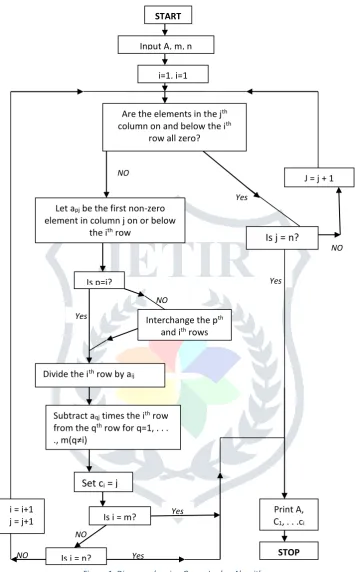
A flow-chart for the Gauss-Jordan algorithm, is presented in figure below.
Systematic solution of linear systems
JETIR1701048 Journal of Emerging Technologies and Innovative Research (JETIR) www.jetir.org 318 Figure 1: Diagram showing Gauss-Jordan Algorithm
Also assume that the remaining column numbers are cr+1, . . . , cn+1, Where 1 ≤ cr+1 < Cr+2 < . . . . < cn ≤ n+1
Case 1: cr = n+1. The system is inconsistent. For the last non-zero row of B is [0, 0, . . . , 1] and the
corresponding equation is 0x1 + 0x2 + . . . .+0xn = 1.
Which has no solutions. Consequently, the original system has no solutions.
NO
Yes
Yes
Yes
Yes
Yes
NO
NO START
Input A, m, n
i=1, j=1
Are the elements in the jth
column on and below the ith
row all zero?
J = j + 1
Let apj be the first non-zero
element in column j on or below the ith row
Is j = n?
Is p=i?
Interchange the pth
and ith rows
Divide the ith row by aij
Subtract aqj times the ith row
from the qth row for q=1, . . .
., m(q≠i)
Set ci = j
i = i+1
j = j+1 Is i = m?
Print A, C1, . . .ci
STOP Is j = n?
NO
JETIR1701048 Journal of Emerging Technologies and Innovative Research (JETIR) www.jetir.org 319 Case 2: cr ≤ n. The system of equations corresponding to the non-zero rows of B is inconsistent. First,
notice that r ≤ n here. If r = n, then c1 = 1, c2 = 2, . . ., cn = n and
B =
[
1 0 … 0 𝑑1
0 1 … 0 𝑑2
⋮ ⋮ . . ⋮ ⋮
0 0 ⋯ 1 𝑑𝑛
0 0 ⋯ 0 0
⋮ ⋮ … ⋮ ⋮
0 0 ⋯ 0 0 ]
There is a unique solution x1 = d1, x2 = d2, . . . , xn = dn.
If r < n, there will be more than one solution (infinitely many if the field is infinite). For all solutions are obtained by taking the unknowns𝑥𝑐1, . . ., 𝑥𝑐𝑟 as dependent unknowns and using the r equations corresponding to the non-zero rows of B to express these unknowns in terms of the remaining independent unknowns 𝑥𝑐𝑟+1, . . ., 𝑥𝑐𝑛, which can take on arbitrary values:
𝑥𝑐1 = b1n+1 – 𝑏1𝑐𝑟+1 𝑥𝑐𝑟+1, . . . – 𝑏1𝑐𝑛𝑥𝑐𝑛
⋮
𝑥𝑐𝑟 = brn+1 – 𝑏𝑟𝑐𝑟+1 𝑥𝑐𝑟+1, . . . – 𝑏𝑟𝑐𝑛𝑥𝑐𝑛.
In particular, taking 𝑥𝑐𝑟+1 = 0, ⋯, 𝑥𝑐𝑛−1= 0 and 𝑥𝑐𝑛= 0, 1 respectively, produces at least two solutions.
Theoretical Examples to solve this type of system of equations
1. Example. Solve the system 𝑥 + 𝑦 = 0; 𝑥 – 𝑦 = 1; 4𝑥 + 2𝑦 = 1
Solution: The augmented matrix of the system is
A = [
1 1 0
1 −1 1
4 2 1
] which is row equivalent to B = [
1 0 ½
0 1 −½
0 0 0
]
We read off the unique solution x = ½, y = -½
(Here n = 2, r = 2, c1 = 1, c2 = 2. Also cr = c2 = 2 < 3 = n+1 and r = n)
2. Example. Solve the system 2x1 + 2x2 – 2x3 = 5; 7x1 + 7x2 + x3 = 10; 5x1 + 5x2 – x3 = 5.
Solution: The augmented matrix is
A = [
2 2 −2 5
7 7 1 10
5 5 −1 5
] which is row equivalent to B = [
1 1 0 0
0 0 1 0
0 0 0 1
]
We read off inconsistency for the original system. (Here n = 3, r = 3, c1 = 1, c2= 3. Also cr = c3 = 4 = n+1)
JETIR1701048 Journal of Emerging Technologies and Innovative Research (JETIR) www.jetir.org 320 Solution: The augmented matrix is
A = [1 −1 1 1
1 1 −1 2] which is row equivalent to B = [
1 0 0 3/2
0 1 −1 1
2 ]
The complete solution is x1 = 3/2, x2 = ½ +x3, with x3 arbitrary. (Here n = 3, r = 2, c1 = 1, c2 = 2. Also cr = c2 = 2 < 4 = n+1 and r < n).
4. Example. Solve the system 6x3 + 2x4 – 4x5 – 8x6 = 8; 3x3 + x4 – 2x5 – 4x6 = 4; 2x1 – 3x2 + x3 + 4x4 – 7x5 + x6 = 2; 6x1 – 9x2 + 11x4 – 19x5 + 3x6 = 1.
Solution: The augmented matrix is
A = [
0 0 6 2 −4 −8 8
0 0 3 1 −2 −4 4
2 −3 1 4 −7 1 2
6 −9 0 11 −19 3 1
] which is row equivalent to
B = [
1 −3/2 0 11/6 −19/6 0 1/24
0 0 1 1/3 −2/3 0 5/3
0 0 0 0 0 1 1/4
0 0 0 0 0 0 0
]
The complete solution is, x1 = 241 +3 2𝑥2−
11 6 𝑥4+
19
6 𝑥5, x3 = 5 3−
1 3𝑥4+
2
3𝑥5, x6 = ¼ ,
with x2, x4, x5 arbitrary. (Here n = 6, r = 3, c1 = 1, c2 = 3, c3 = 6; cr = c3 = 6 < 7 = n+1; r < n)
CONCLUSION
Here by making use of this, Gauss-Jordan algorithm one can easily write the program code in different platforms to get desired solutions for the system of linear equations. This paper allows the program writers in different computer languages in easy and quick glimpse of idea regarding this type problem solving. Therefore, the Gauss-Jordan Algorithm to solve linear equations with some examples this will be useful to write the computational program to solve the system of equations using Gauss-Jordon method.
REFERENCES
1. Howard Anton -Elementary Linear Algebra : John Wiley & sons(1987)
2. Charles G. Cullen -Matrices and linear Transformations : Second Edition, Dover (1990) 3. Daniel T. Finkbeiner III - Introduction to Matrices and Linear Transformations: Third Edition
W.H. Freeman and company (1978)
4. R.J.Goult, R.F. Hoskins, J.A.Milner, M.J. Pratt-Computational Methods in linear Algebra:
Wiley (1975)
5. Kanneth Hoffman, Ray Kunze -Linear Algebra -Second edition Prertice-Hall(1971) 6. Donald E. Knuth -The art of computer programming :Addison Wesley (1988) 7. Serge Lang -Linear Algebra :Addison-Wesley (1966)
JETIR1701048 Journal of Emerging Technologies and Innovative Research (JETIR) www.jetir.org 321
9. Evar D. Nering - Linear Algebra and matrix theory :Second edition-John Willey (1970)
10. A. Edelman - The distribution and moments of the smallest Eigenvalue of a random matrix
of wishart type-linear Algebra :Appl(1991)
11. L. Arnold - On the asymptotic distribution of the eigenvalues of random matrices: J. Math Asar(1967)
12. D. Bau and L. Trefethem- Numerical linear algebra :Society for Industrial and applied mathematics (SIAM) Philodelphia PA (1997)
13. J. Komlos - On the determinant of (0.1) Matrice : Studia Sci math Hungar-2 (1967).
14. T. Tao and V. Vu -On random ±1 matrices: Singularity and Determinant Random structures
algorithms (2006)
15. P. Wigner -On the distribution of the roots of certain symmetric matrices : The annuals of mathematics (1958)
16. John R. Rice- Numerical methods, Software and Analysis : Second edition Academic press (1993.)
17. Lary Smith -Linear Algebra : Second edition Springer Verlag (1984)
18. Gilbert Strang -The fundamental Theorem of linear Algebra :American Mathematical Month (1993)
19. D. Hearn and M.P. Baker -Computer Graphics: Scott, Forsman and company, Glenview, iIlinois (1988)
20. R.E. Larson and B.H. Edwards -Elementary Linear Algebra :D.C. Heath and company, Lexington Massachusetts Toronto (1988)