AN INVENTORY MODEL FOR DETERIORATING ITEMS WITH TIME DEPENDENT
DEMAND USING TRIANGULAR TRIDENT FUZZY NUMBERS
1Department of Mathematics, Avinashilingam Institute for Home Science and Higher Education for Women,
2 Department of Mathematics Jayaraj Annapackiam College for Women, A R T I C L E I N F O
INTRODUCTION
Inventory is very essential in business such as manufacturing goods, selling goods etc. The inventory level should be maintained to avoid loss and increase the business profit. Uncertainties and imprecision is inherent in real inventory problems. This can be approached by probabilistic methods. But there are uncertainties that cannot be appropriately treated by usual probabilistic models. To define inventory optimization tasks in such environment and to interpre optimal solution, fuzzy set theory is considered as more convenient than probability theory. Many researchers have done their research work in fuzzy inventory models by considering the parameters as fuzzy number and defined various methods to get optimum cost. In this research work we get better optimum solution when compared to previous available methods.
The structure of this paper is as follows: Section 2 gives preliminaries that are essential for our work. Section 3 discusses an inventory model in crisp and fuzzy sense. Section 4 compares crisp model and fuzzy model (triangular trident fuzzy number) using a numerical example. Section 5 gives sensitivity analysis. Finally section 6 concludes this research paper.
International Journal of Current Advanced Research
ISSN: O: 2319-6475, ISSN: P: 2319-6505,
Available Online at www.journalijcar.org
Volume 8; Issue 07 (B); July 2019; Page No.
DOI: http://dx.doi.org/10.24327/ijcar.2019
Copyright©2019 Rama B and Michael Rosario G
which permits unrestricted use, distribution, and reproduction in any medium, provided the original work is properly cited. Article History:
Received 12th April, 2019
Received in revised form 23rd May, 2019 Accepted 7th June, 2019
Published online 28th July, 2019
Key words:
Triangular trident fuzzy numbers, deteriorating items, fuzzy inventory, Defuzzification
*Corresponding author: Rama B
Department of Mathematics, Avinashilingam Institute for Home Science and Higher Education for Women,
Coimbatore
AN INVENTORY MODEL FOR DETERIORATING ITEMS WITH TIME DEPENDENT
DEMAND USING TRIANGULAR TRIDENT FUZZY NUMBERS
Rama B
1and Michael Rosario G
2Avinashilingam Institute for Home Science and Higher Education for Women, Coimbatore
Jayaraj Annapackiam College for Women, Periyakulam, Tamil Nadu, India
A B S T R A C T
The aim of this research work is to find minimum cost and optimum time period in fuzzy inventory models. For this objective, the parameters in the inventory models are considered as triangular trident fuzzy numbers. Numerical example is worked out to explain the concept. Sensitivity analysis is also provided in this paper.
Inventory is very essential in business such as manufacturing goods, selling goods etc. The inventory level should be maintained to avoid loss and increase the business profit. inherent in real inventory problems. This can be approached by probabilistic methods. But there are uncertainties that cannot be appropriately treated by usual probabilistic models. To define inventory optimization tasks in such environment and to interpret optimal solution, fuzzy set theory is considered as more convenient than probability theory. Many researchers have done their research work in fuzzy inventory models by considering the parameters as fuzzy number and defined cost. In this research work we get better optimum solution when compared to previous
structure of this paper is as follows: Section 2 gives preliminaries that are essential for our work. Section 3 discusses crisp and fuzzy sense. Section 4 compares triangular trident fuzzy number) using a numerical example. Section 5 gives sensitivity analysis. Finally section 6 concludes this research paper.
Preliminaries
Definition
Let X be a nonempty set. Then a fuzzy set A in X (ie., a fuzzy subset A of X) is characterized by a function of
X
[0,1]. Such a function µ function and for each xϵX ,membership of x (membership grade of x) in the fuzzy set A. In other words, A fuzzy set
A
~
µA: X
[0,1]. Ғ(X) denotes the collection of all fuzzy sets inX, called the fuzzy power set of X. Definition
A fuzzy set is a fuzzy number if it satisfies the following four conditions
1. It is a convex set 2. It is normalised
3. It is defined on the real number R 4. It is piecewise continuous
Definition (Triangular trident Fuzzy Number )
A fuzzy number A =(a1q, a2q, a
fuzzy number if its membership function is given by
International Journal of Current Advanced Research
6505, Impact Factor: 6.614
www.journalijcar.org
; Page No.19451-19456
//dx.doi.org/10.24327/ijcar.2019.19456.3755
Rama B and Michael Rosario G. This is an open access article distributed under the Creative Commons Attribution License, which permits unrestricted use, distribution, and reproduction in any medium, provided the original work is properly cited.
Department of Mathematics, Avinashilingam Institute for Home Science and Higher Education for Women,
AN INVENTORY MODEL FOR DETERIORATING ITEMS WITH TIME DEPENDENT
DEMAND USING TRIANGULAR TRIDENT FUZZY NUMBERS
Avinashilingam Institute for Home Science and Higher Education for Women,
Periyakulam, Tamil Nadu, India
The aim of this research work is to find minimum cost and optimum time period in fuzzy models. For this objective, the parameters in the inventory models are considered as triangular trident fuzzy numbers. Numerical example is worked out to explain the concept. Sensitivity analysis is also provided in this paper.
Let X be a nonempty set. Then a fuzzy set A in X (ie., a fuzzy subset A of X) is characterized by a function of the form µA :
[0,1]. Such a function µA is called the membership
ϵX ,
A~
x
is the degree of membership of x (membership grade of x) in the fuzzy set A.A
~
=
x
,
A
x
/
x
X
where Ғ(X) denotes the collection of all fuzzy sets in X, called the fuzzy power set of X.A fuzzy set is a fuzzy number if it satisfies the following four
It is defined on the real number R It is piecewise continuous
Definition (Triangular trident Fuzzy Number )
, a3q) is called triangular trident
fuzzy number if its membership function is given by
Research Article
An Inventory Model for Deteriorating Items with Time Dependent Demand using Triangular Trident Fuzzy Numbers
q
q q
q q
q
q
q q
q q
q
q
A
a
x
a
x
a
a
a
a
x
a
x
a
x
a
a
a
x
a
a
x
x
q
3 3
1
3 2
3 1
2 3
2
2
2 1
3 1
1 2
2
1 3
1
,
1
,
,
0
,
,
1
)
(
Definition 2.4.( α-cut for triangular trident Fuzzy number)
The α-cut of triangular trident fuzzy number Aq is the closed
interval
q
A
a
qa
qa
qa
qa
3qa
2q
3 2 1 2 3
2
,
, α
[
0
,
1
]
.Definition 2.5 (Signed distance method)
The formula for defuzzifying triangular trident fuzzy number using signed distance method is
R=
1
0
2 3 3 2 1 2 3 2
2
1
a
a
a
a
a
d
a
=
1
0 2 3 4 2
1 2 4 2
4
)
(
4
)
(
2
1
a
a
a
a
a
a
=
8
2
2 31
a
a
a
Definition (Graded Mean Integration Representation method)
The formula for defuzzifying using gradient mean integration representation method is
R=
1
0
2 3 3 2 1 2 3
2
)
(
2
1
a
a
a
a
a
d
a
=
1
0 2 3 5 2 2 1 2 5 2 2
5
2
5
2
2
1
a
a
a
a
a
a
=
10
3
2 31
a
a
a
Inventory model in crisp and fuzzy sense
Assumptions
1. The inventory system involves production of single item.
2. Lead time is zero and shortages are not allowed. 3. Demand is time dependent.
4. Replenishment is instantaneous. Notations
A - set up cost per cycle
A
~
- fuzzy set up costθ - deterioration rate independent of time
~
- fuzzy deterioration rate independent of time T - cycle lengthP - production rate
P
~
- fuzzy production rateh - holding cost per unit per unit time
h
~
- fuzzy holding cost per unit per unit time d - ` deterioration cost per unit per unit timed
~
- fuzzy deterioration cost per unit per unit time D - demand rate which depends exponentialy over timeD
~
- fuzzy demand rate t1 - duration of productionI1(t) - inventory level at time t, 0≤t≤t1
I2(t) - inventory level at time t, t1 ≤ t ≤ T
C - total cost for the period [0,T]
C
~
- fuzzy total cost for the period [0,T]C
d
F~
- defuzzified value ofC
~
Description of Inventory model in crisp sense
At t = 0, the inventory level is zero and it increases in [0,t1]
due to the production at the constant rate P.
At t = T again it reaches the inventory level zero. This is due to demand and deterioration of the item. This can be represented by the following figure 1
For 0 ≤ t ≤ t1
The differential equation governing the situation is
) ( )
( 1
1 t P D I t
I dt d
I t P
t I dt d ) ( ) ( 1
1 Ke
-λt
, where K is the initial demand
and λ is the decreasing rate of demand. K > 0 and 0 < λ < θ t Ke P t I t I dt
d
() ) ( 1 1
Now apply the initial condition I1(t) =0 when t = 0 we get
(1 )) ( 1 t t t e P e e K t
I
For t1 ≤ t ≤ T
The differential equation governing the above condition is
()
)
( 2
2 t I t
I dt
d
Ke-λt , where K is the initial demand and λ is the decreasing rate of demand. K > 0 and 0 < λ < θ. The solution of the linear equation after applying the condition I2 (t)= 0 at t = T is
Holding cost can be calculated by using the formula
1 2 0 0 2 1(
)
(
)
.
t tdt
t
I
dt
t
I
h
C
H
we get
1 1 1 1 t P e K h T The deteriorating cost can be found out by the formula
1 1 0 21
(
)
(
)
t T t
dt
t
I
dt
t
I
d
DC
d
K
1
1
1
e
TPt
1
Total cost can be defined as
A
HC
DC
T
C
1
P T K d h KT d h A T C t Total 2 2 2 1 2 2 1cos ---(1)
[9] The optimum value of T can be found out by differentiating with respect to T
0 2 1
2 2 3
2
2
T A T C and P K K d h T A T C .
Now equate the first derivative to zero to obtain optimum time period T*
0
1
2
2
P
K
K
d
h
T
A
P
K
K
d
h
A
T
1
2
)
(
*
---(2)Description of Inventory model in fuzzy sense Triangular trident fuzzy number
It is not always possible to define certain parameters with certainty for which we fuzzify some parameters A , h, d , θ , P , D , K.
We consider triangular trident fuzzy numbers for the above parameters as
1,
2,
3
~
a
a
a
A
,
1,
2,
3
~
h
h
h
h
1,
2,
3
~
d
d
d
d
,
1,
2,
3
~
,
1,
2,
3
~
p
p
p
P
,
1,
2,
3
~
d
d
d
D
,
1,
2,
3
~
k
k
k
K
Therefore, (1) becomesCi=
i i i i i i i i i iP
T
K
d
h
T
K
d
h
A
T
4 2 2 22
1
2
1
, i =
1, 2, 3
To find the optimum value , we have to differentiate the above equation with respect to T
i i i i i i i i i i iP
K
d
h
K
d
h
T
A
C
dt
d
4 2 22
1
2
1
)
(
, i= 1,2,3 and 2 3
2
2
)
(
T
A
C
dt
d
ii
, i = 1,2,3Now defuzzifying using signed distance method
12
2 3
8
1
~
c
c
c
C
d
F
dt
dc
dt
dc
dt
dc
C
d
dt
d
F 1
2
2 38
1
~
2 3 2 2 2 2 2 1 2 22
8
1
~
dt
c
d
dt
c
d
dt
c
d
C
d
dt
d
F
3 3 3 2 31
2
2
2
2
8
1
T
a
T
a
T
a
3 3 2 14
2
T
a
a
a
which is greater than zero .Therefore we get the minimum total cost.
Now let us find optimum solution of total cost by putting
d
C
dt
d
F~
=0
1 22 31 2 3 3 3 3 2 2 2 2 2 2 3 2 1 1 1 1 3 3 3 3 2 2 2 2 1 1 1 1 2 2 1 2 2 2 1 2 1 2 2 2 1 T a a a p k d h p k d h p k d h k d h k d h k d h
T T t t
e
e
K
t
I
An Inventory Model for Deteriorating Items with Time Dependent Demand using Triangular Trident Fuzzy Numbers
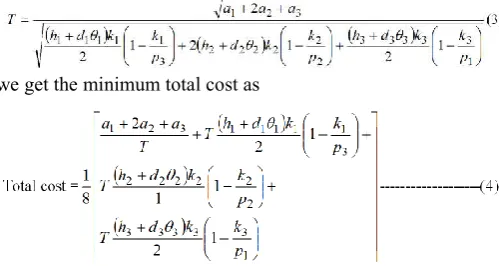
we get the minimum total cost as
Similarly defuzzifying using graded mean integration method, we get the optimum time period and minimum total cost as
Numerical Example
Crisp Model
Suppose A = 54, h = 8, θ = 0.010, P = 550, d = 1.5, K = 500 By using the formula (1) and (2), we get T* = 0.54
And total cost C = 198.37 Fuzzy Model
Signed Distance method
A = (20,26,32), h = (4,6,8), θ=(0.002,0.006,0.010), P =(500,550,600), d =(1,1.3,1.6) K=(450,500,550)
Using (3) and (4) we get T*= 0.6 and total cost = 42.495 Graded mean Integration method
A = (20,26,32), h = (4,6,8), θ=(0.002,0.006,0.010), P =(500,550,600), d =(1,1.3,1.6) K=(450,500,550)
Using (5) and (6) we get the optimum solution as T*= 0.56 and total cost = 46.41
Sensitivity Analysis
The following table shows the effect of change of each parameter in (3),(4), (5) & (6)
From the Table 1, we observe that increase in setup cost increases the time period and the total cost. Table 2 shows that if the deterioration cost increases then there is no rapid change in the time period and total cost.
(20,26,32) (30,34,38) (50,52,54) (60,70,80) Graded mean method
T(years) 0.56 0.6406 0.7922 0.9191 Signed distance method
T(years) 0.6 0.6997 0.8654 1.004 0
0.2 0.4 0.6 0.8 1 1.2
TI
M
E
P
ERI
OD
OPTIMUM TIME PERIOD FOR DIFFERENT VALUES OF FUZZY SETUP COST
Table 1
A
~
Graded mean method
Signed distance method T(years) Total
cost T(years)
Total cost
(20,26,32) 0.56 46.41 0.6 42.50
(30,34,38) 0.6406 53.08 0.6997 48.59
(50,52,54) 0.7922 65.64 0.8654 60.09
(60,70,80) 0.9191 70.25 1.004 69.72
Table 2
d
~
Graded mean method Signed distance method T(years) Total
cost T(years)
Total cost
(1,1.6,2.2) 0.6406 53.08 0.6999 48.58
(1,1.3,1.6) 0.6406 53.08 0.6997 48.59
(1.3,1.7,2.1) 0.6405 53.08 0.6997 48.59
(2,2.5,3) 0.6404 53.09 0.6997 48.59
Table 3
~
Graded mean method
Signed distance method T(years) Total
cost T(years) Total
cost
(0.002,0.006,0.010) 0.6406 53.08 0.6997 48.59
(0.003,0.006,0.009) 0.6405 53.09 0.6996 48.6
(0.005,0,010,0.015) 0.6403 53.10 0.6995 48.61
(0.008,0.015,0.022) 0.6401 53.12 0.6993 48.62
Table 4
K
~
T(years) Graded mean method Total cost Signed distance method T(years) Total cost(450,500,550) 0.6406 53.08 0.6997 48.59
(400,425,450) 0.3592 94.66 0.3638 93.45
(350,410,470) 0.3554 95.65 0.3630 93.65
(200,230,260) 0.2935 115.83 0.2942 115.56
Table 5
h
~
T(years) Graded mean method Total cost Signed distance method T(years) Total cost(2,7,12) 0.8086 42.05 1.16 29.26
(4,6,8) 0.6406 53.08 0.6997 48.59
(3,9,15) 0.6777 50.17 0.9069 37.49
(10,14,18) 0.4077 83.38 0.4396 77.35
Table 6
P
~
T(years) Graded mean method Total cost Signed distance method T(years) Total cost(500,550,600) 0.6406 53.08 0.6997 48.59
(550,575,600) 0.4573 74.35 0.4695 72.41
(600,700,800) 0.3019 112.62 0.3078 110.48
Graphical representation of Table 1
Since the deterioration rate is very minimum in our example problem, there is not much change in the time period and total cost if the deterioration rate of material increases which is depicted in Table 3. If the production is l
demand is less then there is huge rise in total cost and the time period of one cycle is very minimum which is shown in Table 4 and Table 6. Table 5 shows that if the holding cost of material for placing in the inventory increases then the c incurred for the cycle also increases.
Graphical representation of Table 2
(20,26,32) (30,34,38) (50,52,54)
Graded mean
method Total cost 46.41 53.08 Signed distance
method Total cost 42.5 48.59 20
30 40 50 60 70 80
To
tal Co
st
OPTIMUM TOTAL COST FOR DIFFERENT VALUES OF FUZZY SETUP COST
(1,1.6 ,2.2)
(1,1.3 ,1.6)
Graded mean method
T(years) 0.6406 0.6406 0.61
0.63 0.65 0.67 0.69 0.71
Ti
me
P
erio
d
OPTIMUM TIME PERIOD FOR DIFFERENT VALUES OF
(1,1.6,2. 2)
(1,1.3,1. 6)
(1.3,1.7,
Graded mean method
Total cost 53.08 53.08 53.08
Signed distance method
Total cost 48.58 48.59 48.59 46
47 48 49 50 51 52 53 54
TOT
AL COST
OPTIMUM TOTAL COST FOR DIFFERENT VALUES OF
Table 1
Since the deterioration rate is very minimum in our example problem, there is not much change in the time period and total cost if the deterioration rate of material increases which is depicted in Table 3. If the production is large while the demand is less then there is huge rise in total cost and the time period of one cycle is very minimum which is shown in Table 4 and Table 6. Table 5 shows that if the holding cost of material for placing in the inventory increases then the cost
Table 2
Graphical representation of
Graphical representation of
(50,52,54) (60,70,80)
65.64 70.25
60.09 69.72
OPTIMUM TOTAL COST FOR DIFFERENT VALUES OF FUZZY SETUP COST
(1.3,1 .7,2.1 )
(2,2.5 ,3)
0.6405 0.6404
OPTIMUM TIME PERIOD FOR DIFFERENT
(1.3,1.7,
2.1) (2,2.5,3)
53.08 53.09
48.59 48.59
OPTIMUM TOTAL COST FOR DIFFERENT
(0.00 2,0.0 06,0. 010)
Graded mean method
T(years) 0.6406 0.6
0.62 0.64 0.66 0.68 0.7 0.72
TI
M
E
P
ERI
OD
OPTIMUM TIME PERIOD FOR DIFFERENT VALUES OF
(0.002,0 .006,0.0 10) Graded mean method
Total cost 53.08 Signed distance method
Total cost 48.59 46
48 50 52 54
TOT
AL
COST
OPTIMUM TIME PERIOD FOR DIFFERENT VALUES OF
0.6406
0.3592 0.3554
0.2935
T(years)
Graded mean method
OPTIMUM TOTAL COST FOR DIFFERENT VALUES OF
53.08 94.66 95.65
115.83
Total cost
Graded mean method
OPTIMUM TOTAL COST FOR DIFFERENT VALUES OF Graphical representation of Table 3
Graphical representation of Table 4 (0.00
3,0.0 06,0. 009)
(0.00 5,0,0 10,0. 015)
(0.00 8,0.0 15,0. 022)
0.6405 0.6403 0.6401
OPTIMUM TIME PERIOD FOR DIFFERENT VALUES OF
(0.002,0 .006,0.0
(0.003,0 .006,0.0 09)
(0.005,0 ,010,0.0 15)
(0.008,0 .015,0.0 22)
53.08 53.09 53.1 53.12
48.59 48.6 48.61 48.62
OPTIMUM TIME PERIOD FOR DIFFERENT VALUES OF
0.6997
0.3638 0.363 0.2942
T(years)
Signed distance method
OPTIMUM TOTAL COST FOR DIFFERENT VALUES OF
48.59 93.45 93.65
115.56
Total cost
Signed distance method
An Inventory Model for Deteriorating Items with Time Dependent Demand using Triangular Trident Fuzzy Numbers
Graphical representation of Table 5
Graphical representation of Table 6
(2,7,12) (4,6,8) (3,9,15)
Graded mean method T(years)
0.8086 0.6406 0.6777
Signed distance method T(years)
1.16 0.6997 0.9069
0 0.2 0.4 0.6 0.81 1.2 1.4
Ti
m
e Perio
d
OPTIMUM TIME PERIOD FOR DIFFERENT VALUES OF
(2,7,12) (4,6,8) (3,9,15)
Graded mean
method Total cost 42.05 53.08 50.17
Signed distance
method Total cost 29.26 48.59 37.49 20
30 40 50 60 70 80 90
To
tal Co
st
OPTIMUM TOTAL COST FOR DIFFERENT VALUES OF
0.6406 0.6997
0.4573 0.4695
0.30190.2946 0.3078
T(years) T(years)
Graded mean method Signed distance method
OPTIMUM TIME PERIOD FOR DIFFERENT VALUES OF
53.08 74.35
112.62 115.42
Total cost
Graded mean method Signed distance method
OPTIMUM TOTAL COST FOR DIFFERENT VALUES OF
ing Items with Time Dependent Demand using Triangular Trident Fuzzy Numbers
Table 5
Table 6
CONCLUSION
In this paper an inventory model is considered. The description for the model is given in crisp and fuzzy environment. The crisp model of the problem was already discussed in [9] . In Paper [9], the fuzzy numbers we
trapezoidal fuzzy numbers. In our present paper, we used triangular trident fuzzy number. Signed distance method and graded mean integration method are used for defuzzification. We observe that, we obtain minimum total cost and opt time period while using Triangular trident fuzzy number.
References
1. Dutta D and PavanKumar., Fuzzy inventory model without shortages using trapezoidal fuzzy number with sensitivity analysis, IOSR
2012, 32- 37.
2. Hadely G, Whitin T M ., Analysis of inventory systems, Prentice hall,1963.
3. Harris F., Operations and Cost, AW Shaw co. Chicago 1915.
4. Jaggi C K, Pareek S, Khanna A and Nidhi ., Optimal Replenishment policy for fuzzy Inventory model with Deteriorating items and under
under Inflationary conditions. Yugoslav
Operations Research,10,2016, 2298/YJOR150202002Y 5. Jain R., Decision making in the presence of fuzzy
variables, IIIE Transactions on systems, Man and Cybernetics, 6, 1976, 698
6. Kacpryzk J and Staniewski P., Long term inventory policy-making through fuzzy
Fuzzy sets and systems, 8 , 1982, 117
7. Kumar S and Rajput U S., Fuzzy Inventory model for Deteriorating items with Time dependent demand and partial backlogging, Applied Mathematics, 6,2015, 496 509.
8. Nanbendusen, BimanKantiNath, SumitSaha., A fuzzy Inventory model for deteriorating items based on different defuzzification techniques
of Mathematics and statistics, 6(3), 2016, 128
9. Rama B and Michael Rosario G ., An inventory model for deteriorating items with time dependent demand in both fuzzy and crisp sense,
International Research Journal
2018, 160-170.
10. Saha S and Chakraborty T. time dependent demand and shortages, IOSR Journal of Mathematics
54.
11. Trailokyanath Singh, HadibandhuPattanayak., An EOQ model for a Deteriorating item with time dependent demand exponentially declinin
permissible delay in payment, IOSR
Mathematics, 2, 7,2012, 30
12. Wilson R.,A scientific routine for stock control. Harvard Business review,13,1934,116
13. Zadeh,L.A., Fuzzy sets, Information control, 8, 338-353.
14. Zimmermann,H J., Using fuzzy sets in Operational Research, European Journal of Operations Research
13, 1983, 201-206.
(3,9,15) (10,14,1
8)
0.6777 0.4077
0.9069 0.4396
OPTIMUM TIME PERIOD FOR DIFFERENT VALUES OF
(3,9,15) (10,14, 18)
50.17 83.38
37.49 77.35
OPTIMUM TOTAL COST FOR DIFFERENT
0.2989
OPTIMUM TIME PERIOD FOR DIFFERENT
48.59 72.41
110.48113.75
Total cost
Signed distance method
OPTIMUM TOTAL COST FOR DIFFERENT
ing Items with Time Dependent Demand using Triangular Trident Fuzzy Numbers
In this paper an inventory model is considered. The description for the model is given in crisp and fuzzy environment. The crisp model of the problem was already discussed in [9] . In Paper [9], the fuzzy numbers we used are triangular and trapezoidal fuzzy numbers. In our present paper, we used triangular trident fuzzy number. Signed distance method and graded mean integration method are used for defuzzification. We observe that, we obtain minimum total cost and optimum time period while using Triangular trident fuzzy number.
Dutta D and PavanKumar., Fuzzy inventory model without shortages using trapezoidal fuzzy number with sensitivity analysis, IOSR Journal of Mathematics, 4,
Whitin T M ., Analysis of inventory systems,
Harris F., Operations and Cost, AW Shaw co. Chicago
Jaggi C K, Pareek S, Khanna A and Nidhi ., Optimal Replenishment policy for fuzzy Inventory model with Deteriorating items and under allowable shortages under Inflationary conditions. Yugoslav Journal of
,10,2016, 2298/YJOR150202002Y Jain R., Decision making in the presence of fuzzy IIIE Transactions on systems, Man and
1976, 698-703.
Kacpryzk J and Staniewski P., Long term inventory making through fuzzy-decision making models., Fuzzy sets and systems, 8 , 1982, 117-132.
Kumar S and Rajput U S., Fuzzy Inventory model for Deteriorating items with Time dependent demand and ial backlogging, Applied Mathematics, 6,2015, 496-
Nanbendusen, BimanKantiNath, SumitSaha., A fuzzy Inventory model for deteriorating items based on different defuzzification techniques, American Journal
Mathematics and statistics, 6(3), 2016, 128-137. Rama B and Michael Rosario G ., An inventory model for deteriorating items with time dependent demand in both fuzzy and crisp sense, Mathematical Sciences, International Research Journal, 7, special issue 1,
Saha S and Chakraborty T., Fuzzy EOQ model with time dependent demand and deterioration with
Journal of Mathematics, 2, 2012,
46-Trailokyanath Singh, HadibandhuPattanayak., An EOQ model for a Deteriorating item with time dependent demand exponentially declining demand under permissible delay in payment, IOSR Journal of
, 2, 7,2012, 30-37.
Wilson R.,A scientific routine for stock control. Harvard Business review,13,1934,116-128.
Zadeh,L.A., Fuzzy sets, Information control, 8, 1965,
,H J., Using fuzzy sets in Operational