Available at http://www.ijcsonline.com/
Load Balancing in Cloud Computing
Seema SharmaȦ, Jyoti GodaraḂ Ȧ
School of Computer Science and Engineering, Lovely Professional University, Punjab, India Ḃ
Assistant Professor, School of Computer Science and Engineering, Lovely Professional University, Punjab, India
Abstract
The cloud computing is the architecture in which data can be saved virtually on the virtual server. In the cloud server provider, third party and virtual machine placed, played the important role to store and access data in efficient manner. The security, access control and load balancing are the major issues of cloud architecture. In the previous time various techniques had been proposed to balance the cloud load. Among the entire proposed techniques agent based load balancing algorithm performed well in term of CPU utilization, cost and waste time. The efficiency of the agent based load balancing algorithm reduced when any of the user node changes its location and due to which fault may occur. In this work improvement will be proposed in agent base load balancing algorithm for task reallocation and reduced fault detection time in cloud architecture.
Keywords: Cloud computing, deployment models, services of cloud computing, load balancing, fault tolerance.
I. INTRODUCTION
The basic concept of cloud computing can be understood by the following definition according to NIST [14]. “Cloud computing provides shared pool of resources (computers resources like networks, server, storage) on the demand of the user in ubiquitous and simple way that can be provisioned to the user with a very little management effort”. User retrieved data and modified data which is stored by client or an organization in centralized data called cloud. Cloud is a design, where cloud service provider provides services to user on demand and it is also known as “Cloud Service Provider” (CSP) [11]. In cloud computing there is no need to know the location, system configuration which provides the service. Basic characteristics of clouds are: Massive scale, homogeneity, virtualization, low cost software, advance security, services orientation and geographic distribution. The client can utilize the application without installation and by getting internet client can deal with their own documents at any area through distributed computing. Distributed computing gives more viable registering utilizing, the idea of concentrating stockpiling, preparing, transmission capacity and memory [13]. As the defense against the malicious services or services like identify frauds, almost all service provider organizations use the access control and user authentication mechanisms [1]. The best feature, cloud service providers are providing is that user can access the cloud from anywhere in the world. To secure the user data, enterprises use the security mechanism, such as USB port control, Full Disk Encryption (FDE).
A. Cloud Computing
Cloud computing is the environment which provides on-demand & convenient access of the network to a computing resources like storage, servers, applications, networks and the other services which can be released minimum efficiency way. Cloud design also promotes the availability [11]. There are three deployment
models and three services models defined by NIST, theses are:-
1) Service Models
Following are the service models of cloud- a) Software as a service (Saas)
This is the capability of using applications which are running on cloud infrastructure. The users access these applications through internet connections. These kinds of clouds offer the implementation of some specific business threads that gives specific cloud capabilities. For E.g. GMAIL, Face book. [2]
b) Platform as a service (Paas)
It gives the computational resources on which services and applications can be host and develop. For E.g. Online Photo Editing, Google Docs, YouTube.[1]
c) Infrastructure as a service (Iaas)
This is the capability of doing processing, storing and run software which is given to the consumer. It’s also referred as the “Resource Code” which provides resources as the services to a user. This work is done by the service provider. For E.g. Host Firewalls.[12]
2) Deployment Models
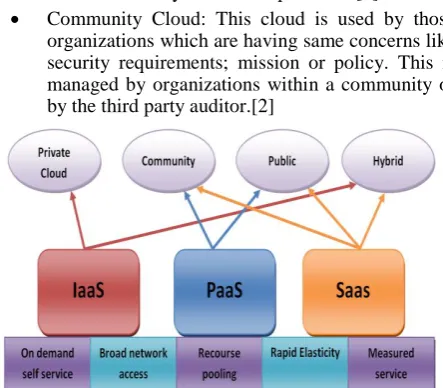
Cloud services are mainly available in the three types of cloud. These clouds are as follows-
Public Cloud: In this cloud, resources allocated are publically. Applications in this cloud are on pay-per-use basis. Public clouds can be managed by government organizations or business. For E. g. Sky Drive and Google Drive. [2]
Private Cloud: In this cloud, resources are limited and used within an organization. It is more secure as employees in an organization can access the particular data only e.g. Banks. [1]
resources which need to be delivered externally are controlled by the service provider. [1]
Community Cloud: This cloud is used by those organizations which are having same concerns like security requirements; mission or policy. This is managed by organizations within a community or by the third party auditor.[2]
Figure 1: Deployment Models and Service Models of Cloud Computing
B. Load Balancing in Cloud Computing
Load balancing is a procedure in which the total load of the network is reassigning to the individual nodes to efficiently utilize the resources and to improve the response time. In the meantime, remove a state in which there are some under loaded and over loaded nodes. A load balancing algorithm, it does not consider the previous behavior and it depends on the current behavior of the system and of the system which is dynamic in nature. This load measured can be in terms amount of memory used, Network load, CPU load, delay and network load. It has following advantages:
1. It improves the performance of the system. 2. It maintains system stability.
3. It builds fault tolerance system. 4. Resources are utilized efficiently. 5. Cost us reduced using resources.
1) Types of Load Balancing:
This load balancing can be categorized according to process initiated [12]:
a) Static
Static load balancing does not depend upon the present knowledge of the system. Previous knowledge of the system is required. In this cloud provider is installed homogenous resources. Also the resources are not flexible in static environment. It requires processing power, performance, memory and capacity of the statics user requirement. In static environment, changes are not accepted at the run-time. It is well suited and easy to implement in the static environment but not suited for heterogeneous environment. In this environment resources are serves as first come first serve. It classified into two categories: [11].
Sender Initiated: In this type of load balancing process is initialed through the sender.
Receiver Initiated: In this type of load balancing process is initiated by the receiver.
b) Dynamic
In dynamic load balancing the present state of the system is required. There is no requiring of the previous knowledge of the system. The cloud provider can install the different type of resources in this environment. Resources are flexible in nature in this type of environment. It does not rely on the prior knowledge it use run-time statistics. The main requirement of the user is guaranteed flexibility.
Symmetric: Both sender and receiver are combined in initialed processes.
Figure 2: Types of Load Balancing
II. RELATED WORK
[J.srinivas et.al] Loud computing is an adaptable innovation that can bolster a wide range of use .The minimal effort of cloud computing and its dynamic scaling it an advancement driver for little organizations, especially in the creating scene. Cloud sent endeavour recourses arranging (ERP), Supply chain administration applications (SCM), client relationship administration (CRM) application, medicinal application and versatile application can possibly achieve a large number of clients. Cloud computing has developed as a well known answer for give modest and simple to external IT assets. An expanding number of associations (e.g. exploration focuses, endeavours) advantage from distributed computing to have their application. This paper manages Characteristics, opportunities, issues and difficulties off cloud computing. From an innovation perspective, there are technical specialized issues to solve. Challenges and issues
Security Performance Cost Availability
expense of proprietorship, on-interest administrations and numerous different things. This paper examines the idea of cloud PC a percentage of the issues it tries to address, related examination themes and a "cloud usage accessible today”. [16]
[Dawn Song] In this paper the author described the data-protection-as-a-service where different services are provided for protecting data. Two techniques have discussed i.e. FDE (Full Disk Encryption) and FHE (Fully Homomorphic Encryption). There is a comparison in these techniques on the basis of key management, sharing, and ease of development, maintenance, aggregation and performance. The key management and access control are moved by DpaaS (Data-Protection-as-a-service) approach for purpose of balance easy maintenance and rapid development by user-side verification. Performance and ease of development offered by FDE is excellent [17].
[Rubal Chaudhray Wadhawan et.al] Cloud computing is a figuring term or representation that in view of utility and utilization of processing assets. Cloud is large pools of effectively usable and open virtualized assets. In which the assets can be utilized on examine premise in this way decreasing the expense and multifaceted nature of administration supplier. Distributed computing commitment to cut operational and capital expense and all the more imperatively utilized as a part of IT Departments. It is a develop that permits client to get to applications that present dwell at area other than client's own PC or web joined gadgets. There are number of advantages of this constrictive other organization has client applications they handle expense of server oversee programming upgrade and client pay less and gives administration are secrecy, respectability ,accessibility, legitimacy and security are key attentiveness toward both cloud suppliers and shoppers too. Framework as administrations (Iaas) serves as the establishment layer for alternate models and absence of security in this layer will positively influence the other conveyance models i.e Paas and Saas that are based upon Iaas layer. This paper exhibit a broad investigation of Iaas part security [5].
[Wei-tek T sai et.al] Loud computing not just changes the method for acquiring PC resources (such as PC, Infrastructure, information stockpiling application services) but additionally changes the method for taking care of and giving processing services, innovations and arrangement. The cloud computing is putting forth testing as a service (Taas) for programming as an services (Saas) and cloud. It speaks to new problem, challenges and need in programming testing, uncommonly in testing mists and cloud based application testing. It gives the extraordinary goal, highlight prerequisite and needs in cloud computing. It offers the distinctive between online programming testing and application testing is based upon cloud. Furthermore, it looks at the real issues, need and challenges in testing cloud based programming application. Cloud testing essentially adjusts to the idea of cloud and Saas. [6]
[Rajwinder kaur] In this paper it is clarified that cloud computing shares information and give numerous assets to clients. Clients pay just for those assets as much they utilized. Cloud computing stores the information and scattered resources in the environment. In this way, load adjusting is a fundamental test in cloud environment. Burden adjusting is appropriated the dynamic workload
over different hubs to guarantee that no single hub is over-burden. It helps in legitimate use of assets .It additionally enhances the execution of the framework. Numerous current calculations give burden adjusting and better asset usage. There are different sorts burden are conceivable in distributed computing like memory, CPU and system load. Burden adjusting is the procedure of discovering over-burden hubs and afterward exchanging the additional burden to different hubs. [7]
[Zenon Chaczko] In this paper they clarified the accessibility of cloud system is the fundamental worries of cloud computing. The term, approachability of mists, is for the most part assessed by omnipresence of data contrasting and asset scaling. In mists, burden adjusting, as a technique, is connected crosswise over diverse server farms to guarantee the system Accessibility by minimizing utilization of PC equipment, programming disappointments and alleviating plan of action restrictions. This work talks about the heap adjusting in cloud computing and after that exhibits a contextual analysis of framework accessibility in view of an ordinary Hospital Database Management arrangement [8].
[Mohammad Faz et.al] In this paper, we examine the load balancing in cloud computing and measurements for load balancing in cloud computing and discuss about virtualization. The proper utilization of recourses and enhance the system’s performance through load balancing. Many Issues there are present in cloud computing like load balancing, security, migration, virtual machine, energy management and server consolidation and many more. Today web traffic is increasing and different services are increasing so the major issue in cloud computing, it is load balancing. In this paper some existing algorithms of load balancing which used for better scheduling and recourses allocation techniques. These algorithms are Task allocation based on LB, Opportunistic Load Balancing, Active Clustering, Ant Colony Optimization, Shortest Response Time First, Min Min algorithm, Honeybee Foraging Behavior etc. But still there is need of improvement in techniques of resource allocation and scheduling algorithm.
[Randles] In this paper he expected uptake of Cloud processing, based on entrenched examination in Web Services, systems, utility registering, appropriated figuring and virtualization will get numerous favourable circumstances expense, adaptability and accessibility for administration clients. These advantages are relied upon to forward expedition the interest for Cloud administrations, expanding both are client depend and the size of cloud establishments. Suggestions for some specialized problem in Service Oriented Architectures and Internet of Services (IoS) - sort applications; inclusive of adaptation to non-critical failure, high accessibility and versatility. Key to these issues is the foundation of compelling burden adjusting methods. The scale and many-sided quality of these frameworks makes unified task of employments to particular servers infeasible; requiring a successful conveyed arrangement. This paper researches three conceivable conveyed arrangements proposed for burden adjusting; methodologies roused by Honeybee Foraging Behaviour, Biased Random Sampling and Active Clustering [9].
efficient data storage techniques. The load balancing is the major issues which are raised in cloud architecture. In this paper, dynamic load balancing algorithm has been introduced which is based on three parameters CPU utilization. Memory used and fitness value. On the basis of these three parameters condition of the user is defined that whether it is normal or in critical condition. In this algorithm some migrating agents are selected on which load is migrated at the time failure. The migrated agents are selected on the basics of their condition. This proposed algorithm works well in terms of load detection rate and load migrating time is very less. The algorithm performance degrades when all the migrating agents are in the destroy conditions [10].
III. PROPOSED WORK
As cloud system enlarge complicacy still to pay to large number of user requirements, tracking and adjustments are fundamental to keep them fit and running. The cloud systems have overcome the load on the central authority. The central authority is distributing the task to several other mobile systems. This system will upgrade the system throughput, consolidate execution time and decline battery utilization. Mobile network is a system which is shows as a nearly impervious of accumulation of mobile entities connected by a remote connection, with no supervision or fixed support. In the cloud mobile network, it is infrastructure less in behavior because of which the system is not connected extremely incessant between the mobile nodes. Because of on top of reasons likelihood of errors in the cloud mobile system is high. The load is separated among the cloud mobile node just as to enhance the system efficiency and to decrease the assignment execution time. At the point when the load is not distributed among the mobile node, possibility of error events will be developed. In task allocation modal on the premise of limits of processors and communication joins, we assign the tasks among processors. Disappointment issue can be solved by task redundancy. Task redundancy is given by recovery system that is appended with every node of the cloud distributed system. Here, it is noticed that recovery system does not give service to any tasks. In the event of node failure recovery system will perform the accompanying operations: 1) multicast a failure notice (FN) to caution the candidate nodes about the adjustment in the quantity of working hubs; 2) reallocate all the unfinished assignments among those candidate nodes perceived to be working. When any node fails or when load on any node will increase, back up node will come into existence. The backup node will execute the task allocation algorithms to balance load between the available mobile nodes. In the existing modal, we need efficient task allocation algorithms and we need to define the certain parameters on the basis of which backup node will identify that on which node load is increased.
IV. METHODOLOGY
Start();
1. A=Input number of tasks 2. B=maximum of failure rate 3. C=maximum execution time
4. IF (Node time(i)>maxi mum execution time && Node failure rate(i)>maximum failure rate)
{
Node(i )==candidate node }
Else {
Repeat step 4; }
5. IF( Task executed!=successfully ) {
Check node position
If( Node position !==Previous position) {
Check Node weight() {
Node(i)<Node(i+1) {
Assign task to Node(i) }
V. EXPECTED OUTCOMES
The agent base load balancing algorithm is the efficient algorithm for cloud computing which allocate tasks to the users in minimum time at reduced cost with effective CPU utilization. The performance of the proposed algorithm reduced when fault occurred in the network. In the further work improvement will be proposed in agent based load balancing algorithm which lead to reduction in fault detection time and task reallocation in the efficient manners.
VI. CONCLUSION
The cloud architecture have third party, virtual machine and cloud service provider to accomplish various tasks like load balancing, security and managing roles. The virtual machine is the users trust worthy machine which secure the data and assign required task to the user. In this work has been concluded that efficient of the agent based load balancing algorithm reduced when fault occurred in the network. The fault can be occurred in the network when user changes its location. In the further work improvement in the agent based load balancing algorithm will be proposed for the task reallocation and to reduce fault detection time in cloud architecture.
REFERENCES
[1] Dr Nashaat el-Khameesy,Hossam Abdel Rahman, 2012 “A Proposed Model for Enhancing Data Storage Security in Cloud Computing Systems” vol-3.
[2] Bhavna Makhija, VinitKumar Gupta, 2013 “Enhanced Data Security in Cloud Computing with Third Party Auditor”, International Journal of Advanced Research in Computer Science and Software Engineering, pp 341-345.
[3] Srinivas.J, K. Venkata Subba Reddy, Dr. A. Moiz Qyser, (2012) “Cloud Computing Basics”, International journal of advanced research in computer and communication engineering , pp. 343-347.
[4] Vouk A.Mladen (2008), “Cloud Computing- Issues, Research and Implementations”, Journal of Computing and Information Technology, pp. 235-246.
[5] Arora Pankaj, Wadhawan C.Rubal, Er.Ahuja P.Satinder, (2012)” Cloud Computing Security Issue in Infrastructure as a Service”,
International Journal of Advance Research in Computer Science and Software Engineering.
[6] Geo Jerry, Bai Xiaoying and Tsai T. Wei (2011)“Cloud Testing-Issues,challenges,Needs and Practice” ,Software engineering and international journal(SEIJ), pp. 09-23.
[7] Kaur Rajwinder, and Pawan Luthra. "Load Balancing in Cloud Computing." Proceedings of International Conference on Recent Trends in Information, Telecommunication and Computing, ITC. 2012.
[8] Chaczko, Zenon, et al. "Availability and load balancing in cloud computing." International Conference on Computer and Software Modeling, Singapore. Vol. 14. 2011.
[9] Randles, M.; Lamb, D.; Taleb-Bendiab, A., "A Comparative Study into Distributed Load Balancing Algorithms for Cloud Computing," Advanced Information Networking and Applications Workshops (WAINA), 2010 IEEE 24th International Conference on , vol., no., pp.551,556, 20-23 April 2010.
[10] Aarti Singh,Dimple Juneja, Manisha Malhotra, “Autonomous Agent Balancing Algorithm in Cloud Computing”, International Conference on Advanced Computing Technologies and Applications (ICACTA), 2015, Procedia Computer Science 45 (2015) 832 – 841.
[11] Punithasurya K, Esther Daniel, Dr. N. A. Vasanthi, 2013 “A Novel Role Based Cross Domain Access Control Scheme for Cloud Storage” International Journal of Advanced Research in Computer
Engineering & Technology (IJARCET) Volume 2, Issue 3, March 2013, pp 942-946.
[12] Shui Han, Jianchuan Xing, 2011 “Ensuring Data Storage through a Novel Third Party Auditor Scheme in Cloud Computing” IEEE computer science & Technology, pp 264-268.
[13] Sharma Seema, Godara Jyoti “review paper in Cloud Computing”, International Journal of Emerging Trends & Technology in Computer Science (IJETTCS),pp. 58-61.
[14] Peter Mell, Timothy Grance , “The NIST Definition of Cloud Computing”, Recommendations of the National Institute of
Standards and Technology, September 2011, Special Publication 800-145.
[15] Srinivas.J, K. Venkata Subba Reddy, Dr. A. Moiz Qyser, (2012) “Cloud Computing Basics”, International journal of advanced
research in computer and communication engineering , pp. 343-347.
[16] Vouk A.Mladen (2008), “Cloud Computing- Issues, Research and Implementations”, Journal of Computing and Information Technology, pp. 235-246.
[17] Dawn Song, Elaine Shi, 2012 “Cloud Data Protection for the Masses” IEEEComputer Society, pp 39-45.