Analyzing The Cost Differential Between Convential
System and The Structural Masonry
J. V. C. de Lima1, B. A. Vieira2, L. Nogueira3 and A. D. Monteiro4
1Universidade Federal Rural do Semi-Árido, Brazil ([email protected]) 2Universidade Federal Rural do Semi-Árido, Brazil ([email protected]) 3Universidade Federal Rural do Semi-Árido, Brazil ([email protected])
4Universidade Federal do Oeste da Bahia, Brazil ([email protected] )
Abstract-- Due to the expansion and evolution of the construction industry, it is notable the search for investments that associate quality and economy in the materials and services in a work. In this sense, it is verified that the great majority of the buildings present conventional structural constructive systems, mainly due to the ease of execution. However, structural masonry is a growing alternative system because it is a system that optimizes execution time and reduces material waste, reducing operating costs. In this context, this study aims to investigate, through a comparative analysis, the conventional and structural masonry systems, in terms of cost-benefit, aiming to identify a method that presents, for the same purpose, substantial advantages. In order to achieve the proposed objective, the study of the construction of a model school was used as the object of study, where the projects and memorials were then available at the electronic address of the National Education Development Fund (FNDE). A budget analysis was carried out considering the two construction systems for the same building, with spreadsheets containing the costs of the inputs based on SINAPI (National System of Costs Survey and Civil Construction Indices). The results show that, for the same project, the structural masonry system generates a cost 1.76% lower than the conventional system, and in only one follow - superstructure - the structural masonry costs surpass the conventional one.
Index Term-- Conventional Constructive System. Structural Masonry. Cost benefit.
1 INTRODUÇÃO
The construction sector is characterized by your great representativeness in the national economy. In this regard, the need for improvement of this branch was quite in demand over time, and, currently, this recovery increasingly accentuated, with the requirement of more streamlined so that combine economy, security and high quality (PASTRO, 2007).
In this way, according to Silva (2018), companies of the construction sector began to worry about the cost, and began to control spending, taking some decisions that impact economically. One of those choices is related to the structural system, that is, sought to analyze the most efficient, cost-effective system that meets in a satisfactory manner and secure the building. Therefore, studies were able to get details of each method, especially regarding the cost-benefit desired.
Currently, for the work assemble economy, practicality, safety and durability, are available on the market various types of constructive systems, thus demonstrating how
the construction sector developed, allowing engineers compare systems with each other and choose one that best fits the type of construction to be performed and which provide considerable benefits (BELLEI, 2013).
In this context, the structural system with higher incidence in relation to conventional buildings, composed of beams, pillars and slabs to ensure construction and masonry with support function only. One of the main advantages of this system is the ease of acquisition of materials and workmanship. However, the structural masonry is gaining space in the field of civil construction, being a structural system that dispenses with the use of structural elements, because the masonry itself constitutes the resistant building part, i.e. features and purposes structural.
In this line, Ramalho and Corrêa (2003) elencam as main strengths related to masonry structural system compared to conventional, cost reduction related to the use of trays, coat, body armor and concrete. In addition, because this system has a greater rationalisation in the Executive process, there is a decrease in execution time of edification and wastes with materials and workmanship.
Corroborating with this statement, Curtin et al. (2008) States that the structural masonry structures are cheaper than other construction systems. This economy this linked to degradation of materials needed, beyond the reduction of contracts with skilled labor, for example, carpenters and shipbuilders. Another point considered, is that running this type of structure is faster when compared with the other, and the cost of maintenance is minimal.
2 THEORETICAL FRAMEWORK
2.1 Conventional Structural System
Being the construction system known as conventional, reinforced concrete structure with brickwork of ceramic blocks is used for thousands of years. With major advances in the course of time in relation to the materials and elements used, this system is composed by the Union of ceramic bricks with mortar units, that has mechanical properties essential to build structural elements (LACERDA e OLIVEIRA GOMES, 2014).
Second Pilotto and Valle (2011), this type of structural system is currently the most widely used in Brazil, because of your great popularity. Being, for the most part, selected for use in buildings without a previous study which method could be more economical and advantageous. In those terms, in order to resist the various requests, this constructive system consists of structural elements (beams, pillars and slabs).
It's worth pointing out that for the use of reinforced concrete structural design is required, as a result of calculations performed by expert engineers. This procedure is necessary to settle the charges which shall be borne by the building, and thus set the dimensions of the beams, pillars and slabs, as well as the armor and the trace of concrete that will be used. These calculations, however, are conducted in simplified form, considering the elements of the structure separately (GIONGO, 2005).
2.2 Structural Masonry
Structural masonry arose in antiquity, where it was performed in a very simple, since there were no studies to the method, the bricks were just stacked, forcing the oversizing of the construction. Over time the lack of material was increasing, requiring study to the constructive system became more economical and effective, then came the need to perform calculations for scaling buildings (SILVA, 2018).
Currently the structural masonry is performed with a set of blocks of concrete joined by mortar. This structure is able to withstand loads in addition to your own weight. For the use of this type of structure is necessary to use calculations to scale as any other type of structure. This scaling must be calculated so that the structure withstand at least four kinds of efforts: compression, shear, bending and compression (PENTEADO, 2003).
In addition to the basic function of fence just like conventional masonry, structural masonry replaces beams and columns in its structural functions. As discussed by Bellei (2013), not only by the behavior shown, but the modulation and the streamlining of the project are essential elements for a work built in masonry structural. So the economy is significant in the work there must be compatibility between all projects.
In this sense, Sinha (2002) lists the main advantages of the constructive system from structural masonry simplicity of architectural detailing, scale benefits, since the loads are
transmitted to the Foundation elements of distributed form and reduction of time for completion of the work. In addition, the maintenance and initial costs well below than other construction systems.
In this line, Silva (2002) States that the enterprises that use structural masonry are more economical, because beyond the masonry is performed while the structure, saving expenses forms, decreasing the amount of iron and concrete that is used, speeding up the execution. The use of structural masonry makes it easy on the premises, as it is not necessary to make openings in the walls, reducing the waste of material. In your study, Corrêa (2012), points out that in a study conducted on 200 buildings distributed by Brazil, for a period of 3 years, it was found that the most constructive system adopted refers to the conventional, representing a total of 68%, while structural masonry corresponded to 20%. However, it was that tipped off companies, 63% were adopting innovative methods, structural masonry Tower in relation to others. This is due to lower costs when using this system, corresponding to approximately 30% in buildings of up to 4 decks and 15% for buildings up to 20 floors.
2.3 Importance of construction budget
The construction market occupies much of the economy of a country, so your product becomes a great investment, both for companies and professionals of the market and its customers. In view of the economic scenario, competitive and globalized. For this reason the preparation of a budget for a project, before the contract between customer and company is established, it is extremely important (AZEVEDO, 2011).
According to Kern and Formoso (2004), the budget is possible to estimate the costs of the project, providing important information, which serve as support for decisions to be taken to control costs throughout the construction. You can then decrease the impact on profit of the enterprise, which in many cases end up not coming to an end, because major inaccuracies in the budget.
In this perspective, the budget, as well as estimate the cost, is an important instrument for planning of a work, being a very important part in the realization of a project. But is seen as a challenge for companies in the sector, since each work has its peculiarities, such as the organizational and set different inputs from other projects. In front of these attributes, the managers have struggled to understand the impact that their decisions cause the result when they can't develop a budget that meets the needs of the enterprise (AZEVEDO, 2013).
3 RESEARCH METHODOLOGY
by the National Fund for educational development. However, as limitations of masonry structural analysis we decided to use as a basis for comparison of costs the indicators suggested by the work "project Indicators for Structural masonry Buildings" developed by the Federal University of São Carlos.
According to Freire (2007) the indicators were obtained through information referring to 120 buildings. Briefly, the projects were evaluated from groups following the typologies: left over; buildings of 3, 4 and 5 floors without pilotis; buildings of 7, 8 and 9 floors without pilotis and pilotis; buildings of 10, 11 and 12 floors without pilotis and pilotis; buildings over 12 floors without pilotis and pilotis. In addition, the projects were selected based on three designers from the state of São Paulo, originating the indicators of structural masonry project.
4 RESULTS
This section is to present and discuss the main results of this survey. It's worth pointing out that the conventional building system consists of structural elements, slabs, pillars and Foundation elements and for sealing masonry, consisting of ceramic blocks. On the other hand, the structural masonry is
composed of Flagstone, concrete blocks and structural Foundation.
In these terms, the analysis of budgets between methods took into consideration that some services of the work are identical, including the infrastructure (Foundation), hydraulic and electrical installations, coverage, among others. In this way the phases that will be analyzed and compared refer to superstructure, sealing, coating and painting.
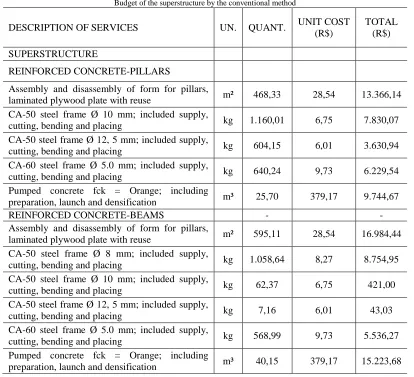
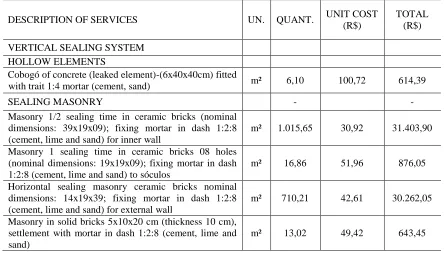
One can see that the total cost for the superstructure and masonry services to the conventional system, total R $179063.38, which corresponds to approximately 32% of the total cost of the project. Therefore, the table 1 presents the expenditures with phase of the superstructure. It was found that for the manufacture of structural elements – pillars, beams, lintels and contravergas – the cost was R $95,930.00, totaling 17.18% of the total cost of the finalized budget. Additionally, the table 2 exposes the fence costs, where did you find that for the implementation of this service the total cost was R $83,113.38, representing 14.88% of expenditure analysed.
Table I
Budget of the superstructure by the conventional method
DESCRIPTION OF SERVICES UN. QUANT. UNIT COST
(R$)
TOTAL (R$)
SUPERSTRUCTURE
REINFORCED CONCRETE-PILLARS
Assembly and disassembly of form for pillars,
laminated plywood plate with reuse m² 468,33 28,54 13.366,14
CA-50 steel frame Ø 10 mm; included supply,
cutting, bending and placing kg 1.160,01 6,75 7.830,07 CA-50 steel frame Ø 12, 5 mm; included supply,
cutting, bending and placing kg 604,15 6,01 3.630,94
CA-60 steel frame Ø 5.0 mm; included supply,
cutting, bending and placing kg 640,24 9,73 6.229,54
Pumped concrete fck = Orange; including
preparation, launch and densification m³ 25,70 379,17 9.744,67
REINFORCED CONCRETE-BEAMS - -
Assembly and disassembly of form for pillars,
laminated plywood plate with reuse m² 595,11 28,54 16.984,44 CA-50 steel frame Ø 8 mm; included supply,
cutting, bending and placing kg 1.058,64 8,27 8.754,95 CA-50 steel frame Ø 10 mm; included supply,
cutting, bending and placing kg 62,37 6,75 421,00
CA-50 steel frame Ø 12, 5 mm; included supply,
cutting, bending and placing kg 7,16 6,01 43,03
CA-60 steel frame Ø 5.0 mm; included supply,
cutting, bending and placing kg 568,99 9,73 5.536,27
Pumped concrete fck = Orange; including
FERROCONCRETE FOR VERGAS - - Verga and pre-shaped contraverga fck = 20MPa,
section 10x10cm m 216,60 24,20 5.241,72
REINFORCED CONCRETE-WALL-PILLARS - -
Assembly and disassembly of form for pillars,
laminated plywood plate with reuse m² 14,54 28,54 414,97 CA-50 steel frame Ø 8 mm; included supply,
cutting, bending and placing kg 36,20 8,27 299,37
CA-60 steel frame Ø 5.0 mm; included supply,
cutting, bending and placing kg 7,85 9,73 76,38
Pumped concrete fck = Orange; including
preparation, launch and densification m³ 0,62 379,17 235,09 REINFORCED CONCRETE-HOUSE-GAS
PILLARS, BEAMS AND SLAB - -
Assembly and disassembly of form for pillars,
laminated plywood plate with reuse m² 21,17 28,54 604,19 CA-50 steel frame Ø 6, 3 mm; included supply,
cutting, bending and placing kg 18,52 8,51 157,61
CA-50 steel frame Ø 8 mm; included supply,
cutting, bending and placing kg 19,50 8,27 161,27
CA-50 steel frame Ø 10 mm; included supply,
cutting, bending and placing kg 29,17 6,75 196,90
CA-60 steel frame Ø 5.0 mm; included supply,
cutting, bending and placing kg 25,77 9,73 250,74
Pumped concrete fck = Orange; including
preparation, launch and densification m³ 1,39 379,17 527,05 Total (R$) 95.930,00 Source: own Elaboration.
Table II
Budget of the fence by the conventional method
DESCRIPTION OF SERVICES UN. QUANT. UNIT COST
(R$)
TOTAL (R$)
VERTICAL SEALING SYSTEM HOLLOW ELEMENTS
Cobogó of concrete (leaked element)-(6x40x40cm) fitted
with trait 1:4 mortar (cement, sand) m² 6,10 100,72 614,39
SEALING MASONRY - -
Masonry 1/2 sealing time in ceramic bricks (nominal dimensions: 39x19x09); fixing mortar in dash 1:2:8 (cement, lime and sand) for inner wall
m² 1.015,65 30,92 31.403,90
Masonry 1 sealing time in ceramic bricks 08 holes (nominal dimensions: 19x19x09); fixing mortar in dash 1:2:8 (cement, lime and sand) to sóculos
m² 16,86 51,96 876,05
Horizontal sealing masonry ceramic bricks nominal dimensions: 14x19x39; fixing mortar in dash 1:2:8 (cement, lime and sand) for external wall
m² 710,21 42,61 30.262,05
Masonry in solid bricks 5x10x20 cm (thickness 10 cm), settlement with mortar in dash 1:2:8 (cement, lime and sand)
Encunhamento (shake masonry) in massive 5x10x20cm 1 time ceramic brick (esp. 20 cm), c/settlement traço1:6 mortar (cement and sand)
m 536,28 14,84 7.958,40
Partition of bathrooms and toilets in granite with
thickness of 2 cm polished seated with mortar dash 1:4 m² 15,72 610,39 9.595,33
Closing of shafts in plasterboard m² 7,20 85,00 612,00
THE MASONRY WALL - -
Horizontal sealing masonry ceramic bricks nominal dimensions: 14x19x39; fixing mortar in dash 1:2:8 (cement, lime and sand)
m² 41,77 42,61 1.779,82
Total (R$) 83.133,38 Source: own Elaboration.
Concerning the structural masonry system it was found that the total cost for the completion of superstructure and sealing services corresponds to R $297,066.48 as noted in table 3. This finding is quite interesting, since, for the same purpose, the adoption of the structural masonry is approximately 65.9% higher than using the conventional system. This difference is mainly by the high cost associated
with concrete blocks. It should be noted that for the estimation of the budget was considered structural masonry concrete blocks belonging to the family of 40 (blocks with dimensions of 14 x 19 x 39 cm). For this phase of construction, the concrete blocks spending exceeded the costs with steel frame and graute together, reaching 76.78% of the total.
Table III
Budget of the superstructure and the structural masonry
DESCRIPTION OF SERVICES UN. QUANT. UNIT COST (R$)
TOTAL (R$) SUPERSTRUCTURE AND SEALING
10.0 mm steel frame kg 4.080,00 6,92 28.233,60
Structural concrete block masonry
14x19x39 cm, fbk = 4.5 mpa. m² 4.560,00 50,02 228.091,20
Graute of back strap m³ 31,20 550,50 17.175,60
Horizontal graute m³ 45,60 516,80 23.566,08
Total (R$) 297.066,48 Source: own Elaboration.
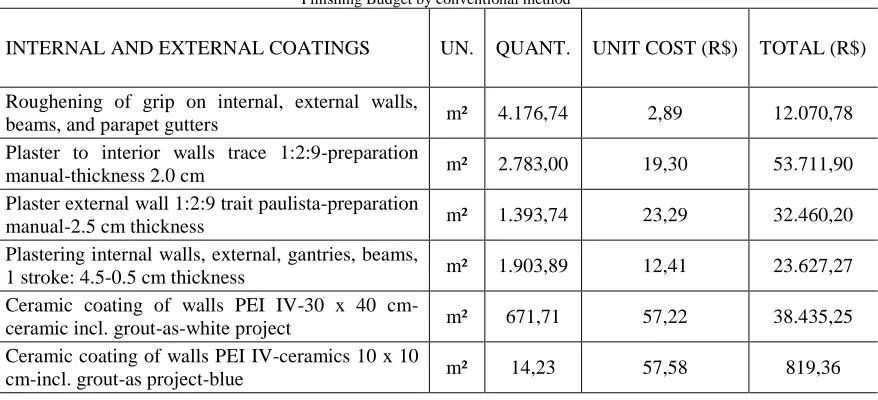
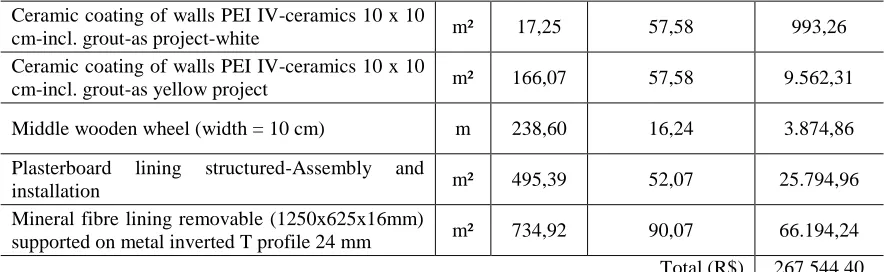
As far as finish spending reveals the tables IV and V it was found that the conventional method has a higher cost of approximately 89% in established structural masonry. In other words, conventional brickwork on practically double coatings burden of work in this follow-up costs.
Table IV
Finishing Budget by conventional method
INTERNAL AND EXTERNAL COATINGS UN. QUANT. UNIT COST (R$) TOTAL (R$)
Roughening of grip on internal, external walls,
beams, and parapet gutters m² 4.176,74 2,89 12.070,78
Plaster to interior walls trace 1:2:9-preparation
manual-thickness 2.0 cm m² 2.783,00 19,30 53.711,90
Plaster external wall 1:2:9 trait paulista-preparation
manual-2.5 cm thickness m² 1.393,74 23,29 32.460,20
Plastering internal walls, external, gantries, beams,
1 stroke: 4.5-0.5 cm thickness m² 1.903,89 12,41 23.627,27
Ceramic coating of walls PEI IV-30 x 40
cm-ceramic incl. grout-as-white project m² 671,71 57,22 38.435,25 Ceramic coating of walls PEI IV-ceramics 10 x 10
Ceramic coating of walls PEI IV-ceramics 10 x 10
cm-incl. grout-as project-white m² 17,25 57,58 993,26
Ceramic coating of walls PEI IV-ceramics 10 x 10
cm-incl. grout-as yellow project m² 166,07 57,58 9.562,31
Middle wooden wheel (width = 10 cm) m 238,60 16,24 3.874,86
Plasterboard lining structured-Assembly and
installation m² 495,39 52,07 25.794,96
Mineral fibre lining removable (1250x625x16mm)
supported on metal inverted T profile 24 mm m² 734,92 90,07 66.194,24 Total (R$) 267.544,40 Source: own Elaboration.
Table V
Budget structural masonry cladding
INTERNAL AND EXTERNAL
COATINGS UN. QUANT.
UNIT COST (R$)
TOTAL (R$) Ceramic coating of walls PEI IV-30 x
40 cm-ceramic incl. grout-as-white project
m² 671,71 57,22 38.435,25
Ceramic coating of walls PEI IV-ceramics 10 x 10 cm-incl. grout-as project-blue
m² 14,23 57,58 819,36
Ceramic coating of walls PEI IV-ceramics 10 x 10 cm-incl. grout-as project-white
m² 17,25 57,58 993,26
Ceramic coating of walls PEI IV-ceramics 10 x 10 cm-incl. grout-as yellow project
m² 166,07 57,58 9.562,31
Plasterboard lining
structured-Assembly and installation m² 495,39 52,07 25.794,96 Mineral fibre lining removable
(1250x625x16mm) supported on metal inverted T profile 24 mm
m² 734,92 90,07 66.194,24
Total (R$) 141.799,38 Source: own Elaboration.
With respect to the service of painting, even being considered the same parameters for both structural systems, this presented a total cost of R $111,803.43, as can be seen in table 6. However, it was found that this service represents a portion of the total cost relatively distinct to the constructive structural masonry and conventional corresponding, respectively, to 20.02% and 20.30% of the final value.
Table VI The Budget for both methods
PAINTS AND FINISHES UN. QUANT. UNIT COST
(R$) TOTAL (R$)
Emassamento of internal and external
walls with acrylic mass, 2 coats m² 3.308,63 13,54 44.798,85 Acrylic latex paint on internal and
external walls, 2 coats m² 3.119,59 9,86 30.759,16
Emassamento lining with spackle PVA m² 500,86 11,00 5.509,46
Synthetic enamel paint 02 coats in
wooden frames m² 186,90 18,28 3.416,53
Synthetic enamel paint 02 coats in
wooden rodameio m² 23,86 18,59 443,56
Synthetic enamel paint 02 coats in iron,
miter 2 coats m² 515,99 20,88 10.773,87
Water-based epoxy paint for wet area, 2
coats m² 189,04 34,81 6.580,48
02 Synthetic enamel paint coats to
metallic structure m² 247,08 20,88 5.159,03
Total 111.803,43 Source: Elaboration of the authors.
One can see that for the use of masonry structural system is needed greater control in implementation due to the higher cost of the blocks, and even requires a more skilled workforce, already holding the structural function of supporting the loads of the building, being of utmost importance the settlement of each block in the most appropriate way possible. In short, do not use beams, pillars and wooden forms, the cost of structural masonry diminishes, on the other hand the unit value per block is much larger.
5 FINAL CONSIDERATIONS
With the high competition in the construction market, the need arises for streamlined works, demanding, economy, efficiency, safety and high quality when designing buildings. In this way the need of improvement in the sector has been greatly in demand. To meet these needs there are various constructive systems.
Before the presented, this study has as its central problem evaluate the cost differential between two forms of constructive systems. Specifically, the costs were compared between the conventional system and the structural masonry. To this end, we used a traditional school project provided by National Educational Development Fund – FNDE – through budget composition SINAPI.
The main results showed that the cost of structural masonry system are significantly more attractive. In numbers, the expenditures with the structural masonry system generate a cost 1.76% lower when compared with the conventional system.
Additionally, the findings show that only in a follow-up-superstructure-masonry structural costs exceed the conventional. However, in General, one should consider the existing pathologies in both systems. In this respect, the literature is largely favourable to masonry construction structural system. 1
REFERENCES
[1] AZEVEDO, Rogério Cabral de et al. Modelo para avaliação de desempenho: aplicação em um orçamento de uma obra de construção civil. Production, v. 23, n. 4, p. 705-722, 2013.
1 Maiores detalhes em Curtin et al. (2008); Sinha
(2002).
[2] AZEVEDO, Rogério Cabral et al. Avaliação de desempenho do processo de orçamento: estudo de caso em uma obra de construção civil. Ambiente Construído, v. 11, n. 1, p. 85-104, 2011.
[3] BELLEI, Poliana. Análise comparativa de custos entre edificio de alvenaria estrutural e de concreto armado convencional em construção na cidade de Alegrete–RS. 2013.
[4] CURTIN, William George et al. Structural masonry designers' manual. John Wiley & Sons, 2008.
[5] FREIRE, A. S. et al. Indicadores de projeto para edifícios em alvenaria estrutural. 2007.
[6] GIONGO, José Samuel. Concreto armado: projeto estrutural de edifícios. EESC/SET, 2005.
[7] KERN, Andrea Parisi; FORMOSO, Carlos Torres. Integração dos setores de produção e orçamento na gestão de custos de empreendimentos de construção civil. Revista Tecnologia, v. 25, n. 1, 2004.
[8] LACERDA, Juliana Ferreira Santos Bastos; DE OLIVEIRA GOMES, Jefferson. Uma visão mais sustentável dos sistemas construtivos no Brasil: análise do estado da arte. Revista E-Tech: Tecnologias para Competitividade Industrial-ISSN-1983-1838, v. 7, n. 2, p. 167-186, 2014.
[9] PASTRO, Rodrigo Zambotto. Alvenaria Estrutural sistema construtivo. Universidade São, 2007.
[10] PENTEADO, Adilson Franco et al. Gestão da produção do sistema construtivo em alvenaria estrutural. 2003.
[11] PILOTTO, Gisah Abramovici; VALLE, Thompson Ricardo do. Comparativo de custos de sistemas construtivos, alvenaria estrutural e estrutura em concreto armado no caso do Empreendimento Piazza Maggiore. 2011.
[12] RAMALHO, Márcio A.; CORRÊA, Marcio RS. Projeto de edifícios de alvenaria estrutural. Pini, 2003.
[13] SILVA, Alisson Hoffmann da et al. Comparação de custos entre os processos construtivos em concreto armado e em alvenaria estrutural em blocos cerâmico e de concreto. 2002.