Assessing the Durability of Lateritic Based Earthen
Mortars/plasters Treated with Meta-Kaolin, Lime and
Cement
Gideon M. Limunga, Yun-Zhi Tan
Abstract-- Traditionally, Lime-Meta-kaolin (MK) admixtures have been applied in the past as mortars, plasters, and sealers and studies indicate that they exhibit good strength and resistance properties. Laterised mortars and plasters like most earthen materials are held as economical options for low-cost housing and historical architecture. However, the durability of lateritic mortars and plasters has been of great concern to the scholars. This work aimed at assessing the durability of lateritic mortars by treating it with pozzolans such as Meta- Kaolin, lime, and cement, which have shown in partiality or collectively to exhibit good strength and resistance properties. This was done in an attempt to exploit the full potential of laterite as a low-cost building material in earthen structures. To this end, experimental setups were established which involved investigating the effect of Meta-kaolin on Lime-treated Laterite, the unconfined compressive strength (UCS), the effect of drying and wetting cycles, the influence of water content and frost resistance. The results show that meta-kaolin greatly influences the chemical properties of lime-treated lateritic soils such as pH and calcium ions consumptions, and the amount of water present in a mortar significantly affects the strength and consequently the long-term water retention behavior. Moreover, the mortar exhibited good resistance to drying and wetting cycles, especially when sand was added to the mortar. Further, the mortar showed reasonable frost resistance under repeated freeze and thaw cycles, especially for an earthen mortar. Index Term-- Durability, Lime, Lateritic plasters, Meta-Kaolin, Unconfined compressive strength (UCS).
I. INTRODUCTION
There is a wide consensus amongst scholars that soil im-provement is a cost-effective way of dealing with problematic soils as opposed to other available options [1]. Generally, treat-ment (stabilization) enhances the durability and performance of the soil, thereby reducing its susceptibility to deterioration [2], [3]. Earthen mortars and plasters are widely applied in low-cost construction because they are economical, and yet heavily rely on soil improvement to enhance their properties viz. strength, durability, permeability, resistance, etc.
Among the frequently applied additives are Lime, cement, and Meta-kaolin (MK). Of interest in this work is MK which is a chemical phase that is produced during thermal treatment of
kaolinite. Kaolinite’s chemical structure is Al2O3:2SiO2. 2H2O
and owing to thermal treatment in the temperature ranges of
400-500ºC, it forms an amorphous alumino-silicate known as
meta-kaolin (Al2Si2O7) as the water is driven away [4], [5]. It
is imperative to recognize the fact that MK has received wide acceptance and applications in concrete technology because it enhances workability, increases strength, improves permeabil-ity and durabilpermeabil-ity, and ultimately the overall resistance to chem-ical attack [5]–[9].
Lime-MK admixtures have been historically applied as mor-tars, plasters, concrete additives and sealants. This is more prominent in the restoration of historic buildings and monu-ments, and earthen construction, wherein, the use of cement-based mortars have been heavily criticized [10]. Further, Awoyera et al [2], [3] investigated the use of ceramic tile waste in the production of laterised concrete, and their work pointed out the following conclusions: laterite can be used for nonstruc-tural purposes in construction, and replacing sand with laterite in cement mortars can potentially enhance its strength. In the dawn of sustainable construction, there has been an emphasis to consider traditional building materials as alternative green sources. However, less work has been done to assess the dura-bility of laterised mortars and plasters, especially in cases where new pozzolans have been considered.
In principle, the current work drew upon the properties of MK, and the applications of laterite, to propose a mortar or plas-ter based on partial replacement of cement and sand with MK/lime and laterite, respectively. This was done in a bid to explore the full potential of laterite for building and construc-tion, by improving its properties to overcome the shortfalls. Lit-erature has shown that to assess the suitability and applicability of admixtures such as Lime-Laterite-MK-Cement as mortars or plasters, it is paramount to investigate the durability and per-formance of these materials. Which entails looking at such fac-ets as compressive and flexural strength, microstructure changes, resistance to chemical attack, permeability, freeze and thaw cycles (frost resistance), thermal conductivity, abrasion re-sistance, sorptivity and porosity [6]–[9], [11]–[15].
Therefore, this work focused on investigating the effect of Meta-kaolin on Lime-treated Laterite, the unconfined compres-sive strength (UCS), the effect of drying and wetting cycles, the influence of water content and frost resistance, to ascertain the durability of lateritic based mortars.
————————————————
Gideon Mbwenga Limunga is currently pursuing a masters degree
pro-gram in civil engineering at China Three Gorges University, Yichang 443002, China P.R, E-mail: [email protected]
Yun-Zhi Tan is currently an Associate Professor and Researcher in civil
Fig. 2. Standard Proctor test.
10 20 30 40
1.2 1.3 1.4 1.5
S
r=1 .0 S
r=0
.9 S
r=0 .8
Water content %
Dr
y
densit
y
g
/cm
3
S
r=0 .7
wetting method
drying method
II.MATERIALS AND METHODS A. Materials
The main materials applied for this work were Laterite (LT), lime (L), cement (C), and Meta-Kaolin (MK). The laterite was sourced from Guilin, Guanxi province. The commercial
hy-drated lime (Ca(OH)2) was employed, and its natural moisture
content was 17%, and constituted of 97.3% CaO, with maxi-mum particles passing an 80µm sieve opening (see Table 1). The metakaolin (MetaMax) tested was produced by the BASF company. It was obtained from calcined kaolin at 600~800℃., its natural moisture content was 19%, and maximum particles
passing an 80µm sieve opening as shown in fig. 1.
TABLE I
PROPERTIES OF THE QUICKLIME USED (% PER UNIT MASS)
Chemical composition (%) Particle size (%)
CaO MgO CO2 SO3 ≤80μm ≤200μm ≤2mm
97.30 0.96 0.25 0.06 82.7 95.2 100.0
B. Sample Preparation
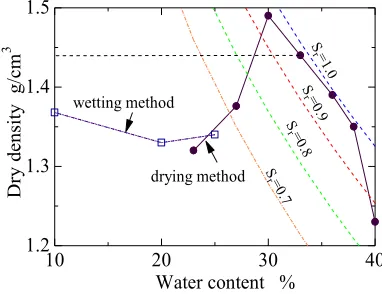
The laterite soil was air-dried to a constant mass, and the stand-ard Proctor test was performed to determine the optimum mois-ture content (OMC) and maximum dry density (MDD) in ac-cordance with ASTM D2216 and ASTM D1557, respectively, as shown in fig. 2. The air-dried soil was then split into two portions, which were crushed using a rubber hammer, sepa-rately, and passed through a 0.5mm and 2mm sieve openings.
For 0.5mm sample size, the pozzolans and laterite were thor-oughly mixed in their dry state, afterward, water was added to achieve a target moisture content of 35%. The target water con-tent corresponded to the optimum moisture concon-tent of 30%, plus 5% to account for evaporation and wastage during mixing. The mixing was done to achieve a homogenous consistency, then the samples were mellowed for 24 hours prior to compac-tion. The samples so prepared were used to investigate the ef-fect of Meta-Kaolin on pH to ascertain whether it had a significant influence on this chemical property.
TABLE II
MIX PROPORTIONS FOR THE SAMPLES
Parameter/ Sam-ple Id.
C6-L-MK S25-C6
Meta-kaolin (%) 4 4
Lime (%) 5 5
Cement (%) 6 6
Sand (%) 0 25
Water content (%) 46 46
Curing Period (days 7, 28, 60, 90, 180,
240
7, 28, 60, 90, 180, 240
The second sample sieved through a 2mm sieve was used to cast cubical specimens measuring 50x50x50mm, and based on
the unit weight of laterite (1.4g/cm3) the amount of soil required
C. Experimental Programs Unconfined compressive strength
The compressive strength was determined from a Method that was based on ASTM C109/C 109M, using GDS loading frame shown in fig. 3.
Fig. 3. Loading frame, with the sample being crushed
Effect of varying the amount of water during mixing
Under this test, samples were cast with different quantities of water i.e. 30, 35, 40,45,50,55, and 60%. Thereafter, the samples were cured until the terminal curing age is reached 180 days, then the compressive strength was determined to ascertain its variation with the casting water.
Effect of wetting and drying cycles
This test was used to determine the resistance of specimens to repeated wetting and drying cycles. In this procedure, samples were immersed in water for 24h and then dried in an oven at 40°C for the next 24h. The process was repeated for 3, 5, 8, 10, 15, and 20 cycles. After each set of cycles samples were taken for measurement of dimensions and compressive strength. Frost resistance
Freeze-thaw cycles were as follows ( method adopted from [10], [11]):
4 h freezing in the icebox or the appropriate environment at -20 ± 3°C; and 2 h thawing at +20°C in warm water. Each freeze/thaw period consisted of 15 cycles. Sets of three 50x 50x50mm specimens were prepared for every testing time. The finding by [8] showed that curing at 65%RH reduces the strength, hence curing was done at 95%RH.
Mercury Intrusion Porosimetry (MIP)
The mercury intrusion porosimetry (MIP) test was conducted by means of autopore IV 9500 mercury intrusion porosimeter with both low-pressure and high-pressure chambers. The pres-sure varies from 3 to 4 kPa in the low-prespres-sure system and goes up to around 230 MPa in the high-pressure system, which cor-responded to the maximum intruded diameter of 355 μm and to
the minimum intruded diameter of 0.006 μm, respectively. Small cubical pieces were cut out from the samples prepared as in UCS procedure above and were freeze-dried immediately, followed by 24 h sublimation in a vacuum chamber of a freeze dryer. Then the MIP test was performed on these lyophilized samples.
III.RESULTSANDDISCUSSIONS
A. pH and Ca2+ Consumption
The propagation of MK, lime and laterite reactions with time can be monitored by measuring the rate at which calcium ions are
consumed. There is a defined correlation between Ca2+ and OH
-ions concentrat-ions with pH and electrical conductivity (EC), which arises from the consumption of these ions to form calcium silicate and alumino-hydrates. Consequently, this reduces the amount of free ions available to affect the pH of the solution, similar conclusions were reported by other researchers[16]–[21]. Fig. 4 and 5 demonstrates that the pH decreases with time and
increases with EC and Ca2+. The decrease is more evident for
lat-eritetreated with lime only,meanwhile, when treated with lime
and MK, Laterite exhibits significant decrease during the initial curing periods, but eventually reaches a point where it starts to show some increase. This increase can be attributed to the slow reactivity of MK, which signifies that it gets into the reaction in
the long-term and clearly offset the reaction propagation path.
According to Rahman and Nahar [22], the pH of the soil is closely related to its strength, thus, a decrease in pH is an indica-tor of loss in strength. MK has shown to substantially improve the pH, and continually keep it at a relatively higher value. Cou-pled with its ability to resist chemical damage, it can be inferred that the addition of MK to lime-treated laterite can significantly improve its strength and chemical properties in the long-term and widen its areas of application.
B. Unconfined Compressive Strength (UCS) for Lateritic Fig. 4. Variation of Ca2+ and EC with pH
11.4 11.5 11.6 11.7 11.8 11.9
0.80 1.20 1.60
Elec. Conductivity (mS/cm) Conc. of Ca2+ (mg/L)
pH at 5% Lime for 0.5mm Max Dia. Agg
El
ec
. Conductivity (m
S/cm)
40.00 60.00 80.00 100.00 120.00 140.00
Conc. of Ca
2+ (mg/L
)
Fig. 5. Comparison of pH variation with time for Lime treated Laterite to the one jointly treated with MK
0 100 200 300 400
11.20 11.40 11.60 11.80 12.00
pH of 0.5mm Max. Dia. agg at 5%Lime pH of 0.5mm Max. Dia. agg at 5%Lime and 5%MK
Curing Period (days)
pH
of 0.
5mm M
ax.
D
ia.
a
gg a
t 5%Li
me
11.20 11.40 11.60 11.80 12.00
pH
of 0.
5mm M
ax.
D
ia.
a
gg a
t 5%Li
me
and
Mortars/Plasters
The unconfined compressive strengths tests at various curing ages were conducted. The results (see Fig. 6) shows an increase in strength for both samples i.e. the samples mixed with sand (S25-C6) and those without sand (C6-L-MK). The sample with sand shows accelerated curing and achieves terminal
strength early in comparison to the one without sand. This can be attributed to the water retention capabilities of the two samples i.e. the sample with sand has a low water retention rate and thus reaches a terminal strength earlier than the one without sand [2], [3], [23], [24]. Consequently, in the application of lateritic plasters additional of sand can serve a major role in ensuring that the sur-face water retained after rainfall evaporates faster. Further, the strength at 28 days for both samples conform to class III for weak mortars and plasters recommended by the BS EN 1015-11 method
of test for mortar for masonry. Which implies that the proposed lateritic mortars can be applied in practical applications for low-cost construction.
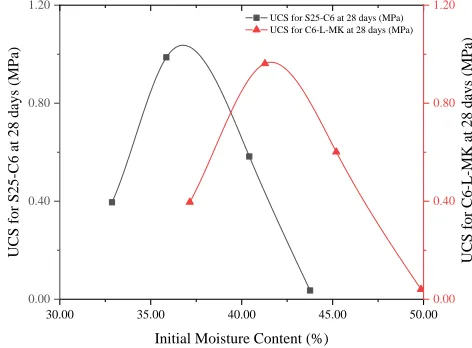
C. Variation of Casting water for Lateritic Mortars/Plasters The amount of water required for an optimal mix ratio of any mor-tar or plaster is of paramount importance. The initial water at the time of casting ultimately influences the terminal strength espe-cially at lower or higher contents. The lower end of the spectrum entails that the amount of available water for complete dissociation of a binder insufficient and consequently lead to the formation of crumps and segregation of aggregates within the mortar. This re-sults in low strength and poor workability as provided by Abrams’ rule which can be loosely applied to earthen mortars [25]. On the other hand, when the initial casting water is too high the opposite is true, especially for non-conventional mortars. However, high water content has a significant effect on setting time and ultimately the time it takes to reach a terminal strength. In this light, the effects of varying, the initial amount of water at casting was studied and the results are presented in Fig.7. Clearly, the sample with sand ex-hibits low water retention even at the peak compressive strength, while the sample without sand presents higher water retention at its
peak strength. This can be attributed to the adsorption properties of the two samples, wherein the addition of sand increases the amount
of insoluble SiO2 and reduces the overall specific surface area for
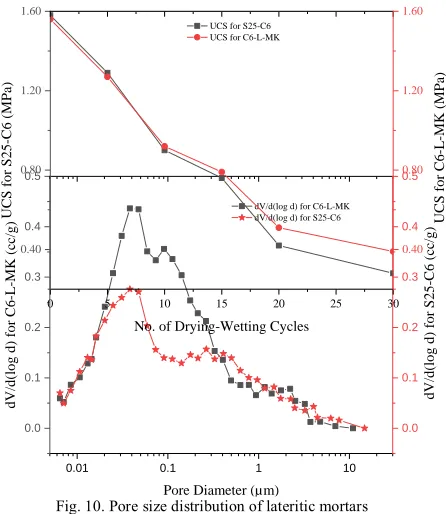
the sample. Moreover, the sample mixed with sand showed a lower pore distribution compared to its counterpart and consequently hard a lower cumulative pore volume, which ultimately translates into a lower porosity as shown in Fig. 10. Therefore, the slight in-crease in strength can be ascribed to particle distribution and pack-ing, which reduced the pore sizes and distribution, consequently,
resulting in lower water retention. Hence, to achieve a durable mor-tar the right amount of water needs to be added to achieve an opti-mal strength [26]–[28].
Fig. 7. Variation of initial casting water with strength for Lateritic Mortars
30.00 35.00 40.00 45.00 50.00
0.00 0.40 0.80 1.20
UCS for S25-C6 at 28 days (MPa) UCS for C6-L-MK at 28 days (MPa)
Initial Moisture Content (%)
UCS for S
25-C6 at 28 days
(MPa)
0.00 0.40 0.80 1.20
UCS for C6-L
-MK a
t 28 days (M
Pa)
0 3 6 9 12 15
0.40 0.60 0.80 1.00 1.20 1.40 1.60
0.40 0.60 0.80 1.00 1.20 1.40 1.60 UCS for S25-C6
UCS for C6-L-MK
No. of Freeze-Thaw Cycles
UCS for S
25-C6 (MPa)
0.4 0.6 0.8 1.0 1.2 1.4 1.6
UCS for C6-L
-MK (MPa)
0 50 100 150 200 250
0.40 0.80 1.20 1.60
0.40 0.80 1.20 1.60 Compressive Strength for S25-C6 (MPa)
Compressive Strength for C6-L-MK (MPa)
Curing Period (days)
Compress
ive Str
ength for S
25-C6 (MPa)
Compress
ive Str
ength for C6-L
-MK (MPa)
D. Effects of Wetting and Drying (W-D) Cycles on Lateritic Mortars/Plasters
The samples with sand (S25-C6) exhibit good permeability due to sand-cement-laterite bonds that are stronger. However, once these bonds break they remain apart and this causes the strength to fall drastically after 15 cycles. On the other hand, the samples without sand (C6-L-MK) shows a consistency drop in strength attributed to the fact that with an increase in W-D cycles, the outer surface gradually erodes away but water does not actually permeate to the core of the sample due to the increased
homo-geneity and a denser surface microstructure. Moreover, the UCS was based on a cross-section area measured after each number of W-D cycles; the results are shown in Fig.8. Wetting -drying cycles also substantially affect the dynamics of pore size distribution. Research has shown that increasing the inten-sity of wetting-drying cycles enhances the macro-porointen-sity and decreases the pore heterogeneity, and drying causes an increase in the frequency of smaller pores due to shrinkage, conse-quently, this leads to a reduction in strength [29][30]. The re-sults, thus, suggest that with an increasing number of W-D cy-cles, the original pore structure (see Fig. 10) of the lateritic mor-tar changes as it loses the bond strength and consequently crum-bles into friable mass. However, during the first 10 cycles, the compressive strength is within the acceptable limit for weak mortars, which implies that the mortar can still be employed for practical applications, but will require frequent maintenance
when exposed to W-D cycles.
E. Frost Resistance of Lateritic Mortars/Plasters
The inadvertent effects of climate change have caused many gions to experience extreme temperatures, especially in cold
gions. Thus, assessing the suitability of any earth-based mortar re-quires consideration of frost resistance. Experimentally, this is achieved by exposing a sample to a predetermined number of Freeze-Thaw (F-T) cycles and examining its strength loss or gain. According to Nunes and Slížková [15], the freeze-thaw
degrada-tion in lime-Metakaolin mortars results in the reducdegrada-tion of flexural strength and stiffness but increases the compressive strength . These cycles lead to bond and microstructure damage because of the liquid water present in the pores, and in form of moisture crys-talizes into ice upon freezing thereby increasing the volume and breaking linked particles. Conversely, during thawing the sepa-rated particles remain apart, hence, leaving cracks which weaken the mortar.
According to Vejmelkovà [10], frost resistance coefficient K is defined as the ratio of compressive strength of specimens ex-posed to a specified number of freezing and thawing cycles to the strength of the reference specimens, which never underwent the frost resistance test. Consequently, a material is considered frost resistant for K > 0.75. From the results shown in fig. 9, it is clear that lateritic plasters are frost resistance within five to seven cycles. Implying that under prolonged freeze-thaw cycles the mortar proposed in this work could weaken and exhibit nu-merous cracks, thereby reducing the strength substantially.
However, the number of cycles under which the mortar per-forms well goes to show that with proper maintenance Lateritic mortars treated with lime, cement and meta-kaolin can serve as an economical option for low-cost construction, and exhibit rea-sonable durability.
Overall, the mechanical behavior of the proposed mortar with respect to durability is acceptable. This was exhibited by the fact that both samples attained a strength greater than 0.4MPa within the first 28 days of curing. This is in agreement with the findings reported by Walker [31] who conducted com-pressive strength tests on hemp-lime concretes and observed that Compressive strength varied between 0.02 and 0.04 MPa at 5 days and 0.29 and 0.39 MPa at 1 year, affirming that these values fell within the range observed by authors cited therein. Moreover, for both F-T and W-D cycles, the amount of expo-sure necessary to result into a friable mass and total collapse was long enough to allow for replacement and renovation of such mortars in case of practical applications.
IV.
C
ONCLUSIONThis paper assessed the durability of lateritic-based earthen mortars and plasters Treated with Meta-Kaolin, Lime and Ce-ment, from the preceding sections the following conclusions can be drawn:
1. Meta-kaolin can significantly improve the strength
and resistance properties of lateritic earthen plasters and mortars in the long-term;
2. Addition of sand reduces the water retention rate of
capacity of lateritic mortars and slightly improves its strength, through the reduction of pore sizes and dis-tribution;
Fig. 9. Effects of Freeze-Thaw (F-T) Cycles on UCS of Lateritic Mortars
0.01 0.1 1 10
0.0 0.1 0.2 0.3 0.4 0.5
dV/d(log d) for C6-L-MK dV/d(log d) for S25-C6
Pore Diameter (µm)
dV/d(log d)
for
C6-L-MK
(cc/g)
0.0 0.1 0.2 0.3 0.4 0.5
dV/d(log d)
for
S25-C6 (cc
/g)
Fig. 10. Pore size distribution of lateritic mortars
0 5 10 15 20 25 30
0.40 0.80 1.20 1.60
UCS for S25-C6 UCS for C6-L-MK
No. of Drying-Wetting Cycles
UCS for S
25-C6 (MPa)
0.40 0.80 1.20 1.60
UCS for C6-L
-MK (MPa)
3. Wetting-drying and freeze-thaw cycles significantly affect the strength and durability of lateritic mortars and plasters, however, with proper maintenance, this material can be durable and serve as an economical option for low-cost construction; and
4. Further work needs to be conducted on permeability
and adhesion properties to further ascertain the suita-bility of these earthen mortars.
ACKNOWLEDGMENT
This work was supported by the National Natural Science Foun-dation of China (51579137).
REFERENCES
[1] J. A. Charles, “Ground improvement: the interaction of engineering science and experience-based technology,” in Ground and Soil
improvement, 2004, vol. 52, no. 7, pp. 527–532.
[2] P. O. Awoyera, J. O. Akinmusuru, and J. M. Ndambuki, “Green concrete production with ceramic wastes and laterite,” Constr. Build.
Mater., vol. 117, pp. 29–36, 2016.
[3] P. O. Awoyera, A. R. Dawson, N. H. Thom, and J. O. Akinmusuru, “Suitability of mortars produced using laterite and ceramic wastes: Mechanical and microscale analysis,” Constr. Build. Mater., vol. 148, pp. 195–203, 2017.
[4] S. Mathur, “Understanding the Benefits of High Reactivity Metakaolin.”
[5] R. Siddique and M. I. Khan, Supplementary Cementing Materials, Vol, 3. Berlin, Heidelberg: Springer, 2011.
[6] Z. Shi et al., “Role of calcium on chloride binding in hydrated Portland cement–metakaolin–limestone blends,” Cem. Concr. Res., vol. 95, pp. 205–216, 2017.
[7] K. Wianglor, S. Sinthupinyo, M. Piyaworapaiboon, and A. Chaipanich, “Effect of alkali-activated metakaolin cement on compressive strength of mortars,” Appl. Clay Sci., vol. 141, pp. 272– 279, 2017.
[8] V. Pavlík and M. Užáková, “Effect of curing conditions on the properties of lime, lime-metakaolin and lime-zeolite mortars,”
Constr. Build. Mater., vol. 102, pp. 14–25, 2016.
[9] A. S. Silva, A. Gameiro, J. Grilo, R. Veiga, and A. Velosa, “Long-term behavior of lime-metakaolin pastes at ambient temperature and humid curing condition,” Appl. Clay Sci., vol. 88–89, pp. 49–55, 2014.
[10] E. Vejmelková, M. Keppert, Z. Keršner, P. Rovnaníková, and R. Černý, “Mechanical, fracture-mechanical, hydric, thermal, and durability properties of lime-metakaolin plasters for renovation of historical buildings,” Constr. Build. Mater., vol. 31, pp. 22–28, 2012. [11] T. Cerulli, C. Pistolesi, C. Maltese, and D. Salvioni, “Durability of traditional plasters with respect to blast furnace slag-based plaster,”
Cem. Concr. Res., vol. 33, no. 9, pp. 1375–1383, 2003.
[12] K. Lemaire, D. Deneele, S. Bonnet, and M. Legret, “Effects of lime and cement treatment on the physicochemical, microstructural and mechanical characteristics of a plastic silt,” Eng. Geol., vol. 166, 2013.
[13] E. Vitale, D. Deneele, G. Russo, and G. Ouvrard, “Short-term effects on physical properties of lime treated kaolin,” Appl. Clay Sci., vol.
132–133, pp. 223–231, 2016.
[14] C. Borges, A. Santos Silva, and R. Veiga, “Durability of ancient lime mortars in humid environment,” Constr. Build. Mater., vol. 66, pp. 606–620, 2014.
[15] C. Nunes and Z. Slížková, “Freezing and thawing resistance of aerial lime mortar with metakaolin and a traditional water-repellent admixture,” Constr. Build. Mater., vol. 114, pp. 896–905, 2016. [16] M. Arabi and S. Wild, “Microstructural development in cured
soil-lime composites,” J. Mater. Sci., vol. 21, no. 2, pp. 497–503, 1986. [17] N. O. Attoh-Okine, “Lime treatment of laterite soils and gravels -
revisited,” Constr. Build. Mater., vol. 9, no. 5, pp. 283–287, 1995. [18] N. O. Attoh-Okine and E. S. K. Fekpe, “Strength characteristics
modeling of lateritic soils using adaptive neural networks,” Constr.
Build. Mater., vol. 10, no. 8, pp. 577–582, 1996.
[19] Y. Millogo, J. C. Morel, K. Traoré, and R. Ouedraogo, “Microstructure, geotechnical and mechanical characteristics of quicklime-lateritic gravels mixtures used in road construction,”
Constr. Build. Mater., vol. 26, no. 1, pp. 663–669, 2012.
[20] S. A. . Khattab, M. Al-Mukhtar, and J.-M. Fleureau, “Long-Term Stability Characteristics of a Lime-Treated,” J. Mater. Civ. Eng., vol. 19, no. 4, pp. 358–366, 2007.
[21] S. M. Rao and P. Shivananda, “Role of curing temperature in progress of lime-soil reactions,” Geotech. Geol. Eng., vol. 23, no. 1, pp. 79– 85, 2005.
[22] M. Rahman and T. T. Nahar, “Effect of pH on Shear Strength Behavior of Granular Soil,” vol. 15, no. 1, 2015.
[23] M. N. N, M. J. Mk, V. Sreevidya, and R. Preethi, “Case Study on Comparison between Laterite Stone and Concrete Block,” vol. 03, no. 02, pp. 81–88, 2018.
[24] K. Balksten, “Traditional Lime Mortar and Plaster – Reconstruction with emphasis on durability Traditional Lime Mortar and Plaster Reconstruction with Emphasis on Durability,” 2007.
[25] R. M. H. Lawrence and P. Walker, “The impact of the water/lime ratio on the structural characteristics of air lime mortars,” Struct. Anal.
Hist. Constr. Preserv. Saf. Significance, pp. 885–889, 2008.
[26] E. Hamard, J. C. Morel, F. Salgado, A. Marcom, and N. Meunier, “A procedure to assess the suitability of plaster to protect vernacular earthen architecture,” J. Cult. Herit., vol. 14, no. 2, pp. 109–115, 2013.
[27] R. Vinai et al., “Sustainable binders for concrete: A structured approach from waste screening to binder composition development,”
Heron, vol. 60, no. 1–2, pp. 27–57, 2015.
[28] R. Zawawi, “Artificial hydraulic lime mortar obtained by calcining limestone and siliceous waste materials,” 2010.
[29] G. Bodner, P. Scholl, and H. P. Kaul, “Field quantification of wetting-drying cycles to predict temporal changes of soil pore size distribution,” Soil Tillage Res., vol. 133, pp. 1–9, 2013.
[30] R. A. Hegde and S. A. Daware, “Effect of Alternate Wetting and Drying on Laterite and Their Engineering Behaviour,” Indian
Geotech. Conf. 2010, GEOtrendz, pp. 321–324, 2010.