Abstract—This study proposes an improved immune algorithm (IIA) with multiplier updating (MU) for power economic dispatch (PED) considering units with both of prohibited operating zones (POZ) and spinning reserve. The IIA equipped with an accelerated operation and a migration operation can efficiently search and actively explore solutions. The MU is introduced to handle the equality and inequality constraints of the power system. To show the advantages of the proposed algorithm, three realistic examples are investigated, and computational results of the proposed method are compared with that of previous methods. The proposed approach (IIA-MU) integrates the IIA and the MU, revealing that the proposed approach has the following merits - ease of implementation; applicability to non-convex fuel cost functions; better effectiveness than previous methods; better efficiency than immune algorithm with the MU (IA-MU), and the requirement for only a small population in applying the optimal PED problem of generators with POZ and spinning reserve.
Index Terms—Immune algorithm, Power economic dispatch, Prohibited operating zones, Spinning reserve.
I. INTRODUCTION
The PED problem is one of the most important optimization systems in a power system for allocating generation among the committed units to satisfy the system constraints imposed and minimize the energy requirements [1]. Power generators may possess some POZ between their minimum and maximum generation limits, because of the practical limitations of power plant elements. Operating in those zones may cause amplification of vibrations in a shaft bearing, which must be avoided in practice. The PED problem becomes a non-convex optimization problem because the prohibited regions separate the decision space into disjoint subsets constituting a non-convex solution space [2].
Some approaches have been adopted to resolve such PED problems with POZ. Lee et al. [2] decomposed the non-convex decision space into a small number of subsets such that each of the associated dispatch problems, if feasible, was solved via the conventional Lagrangian relaxation approach. Fan et al. [3] defined a small and advantageous set of decision space with respect to the system demand, used an algorithm to determine the most advantageous space, and then utilized the λ-δ iterative method to find the feasible optimal
Manuscript received October 15, 2013; revised December 17, 2013. This work was supported by the National Science Council, Taiwan, ROC. under Grant No. NSC100-2632-E-252-001-MY3.
C. -L. Chiang is with the Nan Kai University of Technology, Nan-Tou, Taiwan, ROC (e-mail: t129@ nkut.edu.tw).
dispatch solution. For infeasible solutions, they re-dispatch the units using some heuristic rules to probe the neighborhood for feasibility. Su et al., [4] employed a linear input-output model for neurons, enabling the development of an operational model for rapidly resolving the PED problems. Yalcinoz et al. [5] proposed an improved Hopfield neural network that used a slack variable technique to handle inequality constraints by mapping process for obtaining the weights and biases. Chiou [6] used a hybrid differential evolution (HDE) with variable scaling (VS-HDE) for the PED problem with the POZ.
IIA [7] is inspired by immunology, immune function and principles observed in nature. IIA is a very intricate biological system which accounts for resistance of a living body against harmful foreign entities. It is now interest of many researchers and has been successfully used in various areas of research [8], [9].
II. SYSTEM FORMULATION
Generally, the PED problem with some units possessing POZ can be mathematically stated as follows [10]:
p N
i i
i i P F Minimize
, 1
(1)
where Fi(Pi)is the fuel cost function of the unit i, Piis the power generated by unit i, Npis the number of on-line units, and Ω is the set of all on-line units. The PED problem subject to the following constraints:
A. Power Balance Constraint
The equality constraint of the power balance is given by:
p
N
i
L d i P P
P
1
(2)
where Pd is the system load demand, and PL is the transmission loss.
B. System Limits
The generating capacity constraints are written as:
p i
i
i P P i n
Pmin max, 1,, (3)
where Pimin and Pimax are the minimum and maximum power outputs of unit i.
Improved Immune Algorithm for Power Economic
Dispatch Considering Units with Prohibited Operating
Zones and Spinning Reserve
C.System Spinning Reserve Constraints
Units with spinning reserve can be are given as:
i
R i S
S (4)
P P S i
Si i i i
max max
,
min (5)
i
Si 0 (6) where Si is spinning reserve contribution of unit i in MW, SR stands system spinning reserve requirement in MW, Pi
max is maximum generation limit of unit i, Simax denotes maximum spinning reserve contribution of unit i, and
is set of all on-line units with prohibited zones. Due to a unit with prohibited zones may operate into one of its zones while system load is regulating, it is shown in (6) that this kind of units should not contribute any regulating reserve to the system. In other words, system spinning reserve requirement must be satisfied by way of regulating the units without prohibited zones.D.Units with POZ
The unit operating range denotes the effects of a generator with POZ [2]:
i P
P P
n j P P P
or P P P
i i u
ni i
i l
j i i u
j i
l i i i
,
or , , 2 ,
max ,
, 1
,
1 , min
(7)
where Pimaxis maximum generation limit of unit i, l j , i
P and Piu,j respectively are the lower and upper bounds of prohibited zone j of unit i, ni is the number of prohibited zones in unit i, and
is set of all on-line units with prohibited zones. Clearly, the entire operating region of a dispatching unit withni prohibited zones is divided into (ni+1) disjoint operating sub-regions. The total number of decision sub-spaces caused by that division may be counted as follows:
i i n
N ( 1) (8)
Equation (5) shows that the total number of decision sub-spaces rises extremely quickly as the number of units with prohibited zones rises.
III. THE PROPOSED IIA-MU
A. The IIA
In IA [9], mimics these biological principles of clone generation, proliferation and maturation. The main steps of IA based on clonal selection principle are activation of antibodies, proliferation and differentiation on the encounter of cells with antigens, maturation by carrying out affinity maturation process, eliminating old antibodies to maintain the diversity of antibodies and to avoid premature convergence, selection of those antibodies whose affinities with the antigen are greater. In order to emulate IA in optimization, the
antibodies and affinity are taken as the feasible solutions and the objective function respectively.
Generally, the IA involves two critical issues (evolutionary direction and population diversity). As the evolutionary direction is effective in searching, the strong evolutionary direction can reduce the computational burden and increase the probability of rapidly finding an (possibly local) optimum. As population diversity is increased, the genotype of the offspring differs more from the parent. Accordingly, a highly diverse population can increase the probability of exploring the global optimum and prevent a premature convergence to a local optimum. These two important factors are here balanced by both employing the accelerated operation and migration [11] in the proposed IIA that can determine an efficacious direction in which to search for a solution and simultaneously maintain an appropriate diversity for a small population.
B. The MU
Michalewicz et al., [12] surveyed and compared several constraint-handling techniques used in evolutionary algorithms. Among these techniques, the penalty function method is one of the most popularly used to handle constraints. In this method, the objective function includes a penalty function that is composed of the squared or absolute constraint violation terms. Powell [13] noted that classical optimization methods include a penalty function have certain weaknesses that become most serious when penalty parameters are large. More importantly, large penalty parameters ill condition the penalty function so that obtaining a good solution is difficult. However, if the penalty parameters are too small, the constraint violation does not contribute a high cost to the penalty function. Accordingly, choosing appropriate penalty parameters is not trivial. Herein, the MU [14] is introduced to handle this constrained optimization problem. Such a technique can overcome the ill conditioned property of the objective function.
Considering the nonlinear problem with general constraints as follows:
i k
e k
x
m k
x g
m k
x h to subject
x F
,..., 1 ,
0 ) (
,..., 1 ,
0 ) ( min
(9)
where hk (x) and gk (x) stand for equality and inequality constraints, respectively.
The augmented Lagrange function (ALF) [13] for constrained optimization problems is defined as:
e i
m
k
m
k
k k k k k
k k k a
x g x
h x f x L
1 1
2 2 2
2
) ( )
( ) ( , ,
(10)
where k and k are the positive penalty parameters, and the corresponding Lagrange multipliers
(
1)
e
m
,
,
and)
(
1i
m
,
,
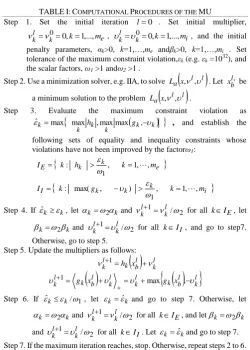
> 0 are associated with equality and inequality constraints, respectively.penalty parameters can be used in the MU. However, the shape of contour of La is changed by penalty parameters while the constraints are nonlinear, demonstrating that large penalty parameters still create computational difficulties. Adaptive penalty parameters of the MU are employed to alleviate the above difficulties, and Table I presents computational procedures of the MU. More details of the MU have shown in [15].
Fig. 1 displays the flow chart of the proposed algorithm, which has two iterative loops. The ALF is used to obtain a minimum value in the inner loop with the given penalty parameters and multipliers, which are then updated in the outer loop toward producing an upper limit of La. When both inner and outer iterations become sufficiently large, the ALF converges to a saddle-point of the dual problem [15]. Advantages of the proposed IIA-MU are that the IIA efficiently searches the optimal solution in the economic dispatch process and the MU effectively tackles system constraints.
TABLEI:COMPUTATIONAL PROCEDURES OF THE MU
Step 1. Set the initial iteration l0 . Set initial multiplier,
e k
l
k00,k1,...,m
, kl k00,k1,...,mi, and the initial penalty parameters, αk>0, k=1,…,me andβk>0, k=1,…,mi . Set
tolerance of the maximum constraint violation,εk (e.g. εk =1032), and
the scalar factors, ω1>1 andω2>1 .
Step 2.Use a minimization solver, e.g. IIA, to solve La
x,l,l
. Let xbl, bea minimum solution to the problem La
x,l,l
.Step 3. Evaluate the maximum constraint violation as
k k
k k k
k h g
ˆ max max ,maxmax , , and establish the
following sets of equality and inequality constraints whose violations have not been improved by the factorω1:
k k k i
I
e k
k E
m k g
k I
m k h
k I
, , 1 , ) , max( :
, , 1 , :
1 1
Step 4. If ˆkk, let k2kand kl1lk/2 for all kIE, let
k
k
2 and kl1kl/2 for all kII, and go to step7.
Otherwise, go to step 5. Step 5. Update the multipliers as follows:
l
k l b k l
k l k l b k l k
l k l b k l k
x g x
g
x h
, max
1
1
Step 6. If ˆkk/1, let kˆkand go to step 7. Otherwise, let
k
k
2 and kl1lk/2 for all kIE, and letk2k
and kl1kl/2 for all kII. Let kˆkand go to step 7.
Step 7. If the maximum iteration reaches, stop. Otherwise, repeat steps 2 to 6.
IV. SYSTEM SIMULATIONS
This section investigates three examples to illustrate the effectiveness of the proposed algorithm with respect to the quality of the solution obtained. The first example compares the proposed IIA-MU with the previous methods and immune algorithm with the MU (IA-MU) in terms of production cost for a 5-unit system. The second and third examples compare the IIA-MU with the previous methods and IA-MU in terms of production cost for a 15-unit system, without and with
transmission loss, in which four units (Units 2, 5, 6 and 12) have POZ and spinning Reserve.
The proposed IIA-MU was directly coded using real values, and the computation was implemented on a personal computer (P5-3.0 GHz) in FORTRAN-90. Setting factors utilized in these examples were as follows: the population size
Np was set to 5 and 10 for the proposed IIA-MU and IA-MU, respectively. Iteration numbers of the outer loop and inner loop were set to (outer, inner) as (50, 5000) for the proposed IIA-MU in all examples. For most setting of the parameters, the proposed method is able to converge satisfactorily.
Fig. 1. The flow chart of the IIA-MU. *No: maximum number of iterations of outer loop **Ni: maximum number of iterations of inner loop
TABLEII:COMPUTATIONAL RESULTS OF THE PREVIOUS METHODS AND
THE PROPOSED IGAMUM FOR EXAMPLE 1
Items - Method [3]
EP Method
[16] IIA-MU P1 (MW)
P2 (MW) P3 (MW) P4 (MW) P5 (MW) Total power (MW)
Total cost ($/h)
238.33 210.00 250.00 238.33 238.33 1,174.99 11,492.51
240.00 210.00 250.00 223.07 251.93 1,175.00 11,493.23
238.13 210.00 250.00 238.46 238.41 1,175.00 11,492.50
A. 5-Unit Test System
This example system has five on-line units with the following input-output cost functions:
P P P P h Fi i 350 8 i 0.01 i 110 i $/3 6 2
(11)
where i =1, …, 5. The operating limits are 120 MW < Pi < 450MW for i =1, 2, …, 5. Units 1, 2 and 3 have POZ as defined in [3], these zones result in a non-convex decision space composed of 27 convex sub-spaces. The system load demand PD and spinning reserve SR are 1175 MW and 100 MW, respectively.
Fan et al., [3] defined a small and advantageous set of decision space with respect to the system demand, used an algorithm to determine the most advantageous space, and then utilized the λ-δ iterative method to find the feasible optimal dispatch solution. For infeasible solutions, they re-dispatch the units using some heuristic rules to probe the neighborhood for feasibility. The IIA-MU combines the IIA and the MU. The IIA can efficiently search and actively explore solutions, the MU avoids deforming the augmented Lagrange function and resulting in difficulty of solution searching. Unlike the method [3], it requires neither the decomposition of the non-convex decision space nor the determination of the advantageous set of decision space before solving via this conventional approach.
B. 15-Unit Test System without Transmission Loss
To further demonstrate the effectiveness of the proposed method, a larger practical system of units with POZ having non-convex cost functions and spinning reserve was addressed in this example, which is identical to that used by Lee et al. [2]. The remaining units will contribute with regulating reserves [17]. This system supplies a 2650MW load demand with 200MW as spinning reserve. This system has 15 on-line units supplying a system demand of 2650MW. Among these dispatching generators, units 2, 5 and 6 have three POZ, and unit 12 has two POZ, forming 192 decision sub-spaces for this realistic system. The implementation of this example can be represented as follows:
2 2
5 1 2 1 2 1 1 1 ) ( ) ( ) ( , , k k k k k a x g x h x f x L
(12) ) ( ) ( min : 15 1 ) ,... , (1 2 15i i i P P P
x f x F P
objective
(13) 0 : 15 11
d L
i
i P P
P h
to
subject (14)
This complex optimization problem contains one objective function with fifteen variable parameters, (P1,P2,,P15), one equality constraint, (h1) and five inequality constraints, since four units have the POZ, (g1 to g4), and the spinning reserve constraint (g5).
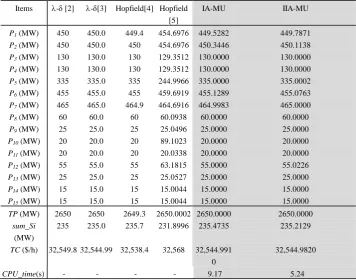
Table III lists five algorithms of this problem with POZ and spinning reserve constraints obtained by two - methods, two Hopfield methods and the proposed IIAE-MU. Computational results demonstrate that the proposed method is a little better than the two - methods and the Hopfield method. Even though the Hopfield method has a little less total cost than the proposed method, but its total generated power is 2649.3 MW, which is 0.7 MW less than the system load demand. In Table III, the sum_Si and CPU_time stand the sum of spinning reserve and simulation time obtained from the method, respectively.
0 -: , , : , , , : , , , : , , , : 15 1 5 80 12 12 75 2 , 12 65 2 , 12 12 55 1 , 12 30 1 , 12 12 20 12 4 460 6 6 455 3 , 6 430 3 , 6 6 395 2 , 6 365 2 , 6 6 255 1 , 6 230 1 , 6 6 135 6 3 470 5 5 420 3 , 5 390 3 , 5 5 335 2 , 5 260 2 , 5 5 200 1 , 5 180 1 , 5 5 105 5 2 455 2 2 450 3 , 2 420 3 , 2 2 335 2 , 2 305 2 , 2 2 225 1 , 2 185 1 , 2 2 150 2 1
i i R S S g P P P or P P P or P P P g P P P or P P P or P P P or P P P g P P P or P P P or P P P or P P P g P P P or P P P or P P P or P P P g (15)TABLE III: COMPARED RESULTS WITHOUT LOSS OF THE PREVIOUS METHODS, IIA-MU AND THE IIA-MU
Items -[2] -[3] Hopfield[4] Hopfield [5]
IA-MU IIA-MU
P1(MW) P2(MW) P3(MW) P4(MW) P5(MW) P6(MW) P7(MW) P8(MW) P9(MW) P10(MW) P11(MW) P12(MW) P13(MW) P14(MW) P15(MW)
450 450 130 130 335 455 465 60 25 20 20 55 25 15 15 450.0 450.0 130.0 130.0 335.0 455.0 465.0 60.0 25.0 20.0 20.0 55.0 25.0 15.0 15.0 449.4 450 130 130 335 455 464.9 60 25 20 20 55 25 15 15 454.6976 454.6976 129.3512 129.3512 244.9966 459.6919 464.6916 60.0938 25.0496 89.1023 20.0338 63.1815 25.0527 15.0044 15.0044 449.5282 450.3446 130.0000 130.0000 335.0000 455.1289 464.9983 60.0000 25.0000 20.0000 20.0000 55.0000 25.0000 15.0000 15.0000 449.7871 450.1138 130.0000 130.0000 335.0002 455.0763 465.0000 60.0000 25.0000 20.0000 20.0000 55.0226 25.0000 15.0000 15.0000
TP(MW) 2650 2650 2649.3 2650.0002 2650.0000 2650.0000
sum_Si
(MW)
235 235.0 235.7 231.8996 235.4735 235.2129
TC($/h) 32,549.8 32,544.99 32,538.4 32,568 32,544.991 0
32,544.9820
Table III reveals that the proposed IIA-MU not only has the lowest total cost (TC) of all methods tested, but also generates the exact total power (TP) for the system constraints of (14) and (15), showing that the proposed algorithm is more effective than other methods for the practical PED problem with POZ.
C.15-Unit Test System with Transmission Loss
Moreover, Table IV shows compared results obtained with the previous variable scaling HDE (VSHDE) [6], the GA [6],
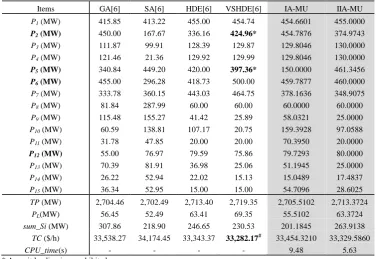
simulated annealing (SA) [6] and the propose IIA-MU for the system with the transmission loss. The result obtained by the VSHDE method is an infeasible solution, because generations of Unit 2 and Unit 5, (P2 and P5), are located in POZ, respectively. The proposed algorithm also yields better solution quality than other methods in the PED problem considering both of POZ and spinning reserve.
TABLEIV:COMPARED RESULTS CONSIDERING LOSS OF THE PREVIOUS METHODS,IIA-MU AND THE IIA-MU
Items GA[6] SA[6] HDE[6] VSHDE[6] IA-MU IIA-MU
P1(MW)
P2(MW)
P3(MW) P4(MW)
P5(MW)
P6(MW)
P7(MW) P8(MW) P9(MW) P10(MW) P11(MW)
P12(MW)
P13(MW) P14(MW) P15(MW)
415.85 450.00 111.87 121.46 340.84 455.00 333.78 81.84 115.48
60.59 31.78 55.00 70.39 26.22 36.34
413.22 167.67 99.91 21.36 449.20 296.28 360.15 287.99 155.27 138.81 47.85 76.97 81.91 52.94 52.95
455.00 336.16 128.39 129.92 420.00 418.73 443.03 60.00 41.42 107.17
20.00 79.59 36.98 22.02 15.00
454.74
424.96*
129.87 129.99
397.36*
500.00 464.75 60.00 25.89 20.75 20.00 75.86 25.06 15.13 15.00
454.6601 454.7876 129.8046 129.8046 150.0000 459.7877 378.1636 60.0000 58.0321 159.3928
70.3950 79.7293 51.1945 15.0489 54.7096
455.0000 374.9743 130.0000 130.0000 461.3456 460.0000 348.9075 60.0000 25.0000 97.0588 20.0000 80.0000 25.0000 17.4837 28.6025
TP(MW)
PL(MW)
2,704.46 56.45
2,702.49 52.49
2,713.40 63.41
2,719.35 69.35
2,705.5102 55.5102
2,713.3724 63.3724
sum_Si (MW) 307.86 218.90 246.65 230.53 201.1845 263.9138
TC($/h) 33,538.27 34,174.45 33,343.37 33,282.17# 33,454.3210 33,329.5860
CPU_time(s) - - - - 9.48 5.63
* An unit loading in a prohibited zone #
An infeasible result
V. CONCLUSION
An efficient method for solving the optimal PED problem considering both of POZ and spinning reserve has been proposed, herein. The proposed approach integrates the IIA and the MU, showing that the proposed algorithm has the following merits -1) ease of implementation; 2) applicability to non-convex fuel cost functionsof the POZand spinning reserve; 3) better effectiveness than the previous method; 4) better efficiency than IA-MU, and 5) the need for only a small population. System simulations have shown that the proposed approach has the advantagesmentioned above for solving optimal PED problems of the system with POZand spinning reserve.
ACKNOWLEDGMENT
Financial support given to this research by the National Science Council, Taiwan, ROC. under Grant No. NSC100-2632-E-252-001-MY3 is greatly appreciated.
REFERENCES
[1] F. Fang, N. D. Xiao, L. Yan, and Q. Huan, “The study on power system load regulation capacity economic analysis,” AISS: Advances in Information Sciences and Service Sciences, vol. 4, no. 1, pp. 77 -84, 2012.
[2] F. N. Lee and A. M. Breipohl, “Reserve constrained economic dispatch with prohibited operating zones,” IEEE Trans. on Power System, vol. 8, no.1, pp. 246-254, 1993.
[3] J. Y. Fan and J. D. Mcdonald, “A practical approach to real time economic dispatch considering unit’s prohibited operating zones,”
IEEE Trans. on Power System, vol. 9, no. 4, pp. 1737-1743, 1994. [4] C. T. Su and G. J. Chiou, “A Hopfield network approach to economic
dispatch with prohibited operating zones,” in Proc. the IEEE International Conf. on Energy Management and Power Delivery, 1995, pp. 382-387.
[5]
T. Yalcinoz, H. Altun, and U. Hasan, “Constrained economic dispatch with prohibited operating zones: A Hopfiled neural network approach,” in Proc. IEEE 10th Mediterranean Electro technical Conf. MEleCon, 2000, vol. 2, pp. 570-573.
[6] J. P. Chiou, “Variable scaling hybrid differential evolution for large-scale economic dispatch problems,” Electric Power Systems Research, vol. 77, pp. 212-218, 2007.
[7] M Basu, “Hybridization of artificial immune systems and sequential quadratic programming for dynamic economic dispatch,” Electric Power Components and Systems, vol. 37, pp. 1036-1045, 2009. [8] K. M. Woldemariam and G. G. Yen, “Vaccine-Enhanced artificial
immune system for multimodal function optimization,” IEEE Trans. on Man and Cybernetics- Part B: Cybernetics, vol. 40, pp. 218-228, 2010.
[9] E. J. Hunt and D. E. Cooke, “Learning using an artificial immune system,” Journal of Network and Computer Applications, vol. 19, pp. 189-212, 1996.
[10] A. J Wood and B. F. Lenberg, Power Generation Operation, and Control, New York, John Wiley & Sons, 1996.
[11] C. L. Chiang, “Improved genetic algorithm for power economic dispatch of units with valve-point effects and multiple fuels,” IEEE Trans. on Power Systems, vol. 20, no. 4, pp. 1690-1699, 2005. [12] Z. Michalewicz and M. Schoenauer, “Evolutionary algorithms for
[13] M. J. D. Powell, “Algorithms for nonlinear constraints that use Lagrangian function,” Math. Programming, vol. 14, pp. 224-248, 1978.
[14] C. L. Chiang, C. T. Su, and F. S. Wang, “Augmented Lagrangian method for evolutionary optimization of mixed-integer nonlinear constrained problems,” International Math., vol. 2, no. 2, pp. 119-154, 2002.
[15] C. L. Chiang and C. A. Wang, “Hybrid differential evolution for cogeneration economic dispatch problem,” in Proc. 2010 International Conference on Machine Learning and Cybernetics (ICMLC 2010), Qingdao, Shandong, China, 2010, vol. 3, pp. 1560-1565.
[16] T. Jayabarathi, G. Sadasivam, and V. Ramachandran, “Evolutionary programming based economic dispatch of generators with prohibited operating zones,” Electric Power Systems Research, vol. 52, pp. 261-266, 1999.
[17] W. M. Lin, F. S. Cheng, and M. T. Tsay, “Nonconvex economic dispatch by integrated artificial intelligence,” IEEE Trans. on Power System, vol. 16, no. 2, pp. 307-311, 2001.
C. L. Chiang received his M.S. degree in automatic control engineering, from Feng Chia University, Taichung, Taiwan in 1991, and Ph. D. degree from institute of electrical engineering, National Chung Cheng University, Chia-Yi, Taiwan in 2004. He is now a professor of Nan Kai University of Technology, Nan-Tou, Taiwan, ROC. His research interests are in the control theory, applications of the optimization, evolutionary algorithms and power economic dispatch