Original Research Article.
Social, Educational and Psychological Impact of High BMI in
Children and Adolescents
Haidar Mohammed Alshamrani
1, Ali Mohammad Alelyani
1, Awath Fahim Alsulami
1,
Haidar Makhasir Alshamrani
1, Faisal Owaid Alkabkabi
1, Abdulmoein Eid Al-Agha
21MBBS, Faculty of Medicine, Umm Al-Qura University, Makkah, Saudi Arabia. 2King Abdulaziz University Hospital, Al Sulaymaniyah, Jeddah, Saudi Arabia.
ABSTRACT
Objectives: To investigate how the weight status will impact the psychological, social and educational status in children and adolescents.
Methods: A cross-sectional survey was conducted in Jeddah
city western region of Saudi Arabia.
The number of samples in the study was 526 children and adolescents (356 males and 170 females) collected in June and July 2016. Participants were selected randomly to represent different economic status and level of education. Body Mass Index (BMI) calculated by research team preceded by measuring the subjects’ height and weight with light clothing and without shoes. The questionnaire included questions about social, psychological and educational experiences related to weight status. All Questions were self-reported.
Results: Increased BMI was associated with Mocking (45.2%), not satisfied with their weight (66.9%), GPA level (excellent (60.8%), feeling sadness or disappointed in the past year (never 58%, a little 18.1%, sometime 14.4%, much 6.7%, always 2.9%), feel the friends do not care (never (2.1%), a little (8.6%), sometime (26.2%), much (28.1%), always (35%)), also increased BMI wasn’t associated with decline in the academic level. Rejecting goes to school because school and anxiety
and insomnia, also wasn’t associated with mother and father care and feeling personal emotional.
Conclusion: Higher BMI significantly impact the social life and relationship with peers also it affects the psychological status. However, GPA and school performance did not significant correlation with BMI.
Key words: Psychological, Social, Educational, Obesity, Children, Adolescents.
*Correspondence to:
Haidar Mohammed Alshamrani,
MBBS, Faculty of Medicine,
Umm Al-Qura University, Makkah, Saudi Arabia.
Article History:
Received: 23-09-2017, Revised: 31-10-2017, Accepted: 10-01-2018
Access this article online
Website:
www.ijmrp.com
Quick Response code
DOI:
10.21276/ijmrp.2018.4.1.032
BACKGROUND
Worldwide obesity among children and adolescents is increasing dramatically, and this increasing is a major health issue.1,2
Overweight and obesity are more related to deaths worldwide than underweight.3 Worldwide there are more people who are
overweight than underweight – this is in every region except parts of sub-Saharan Africa and Asia.3 If we want to define obesity and
overweight they refer to an excess of fat. However, the techniques used to directly measure body fat are not easily available. Because of this, obesity Often is determined by the relationship between weight and height (i.e., anthropometrics), providing an estimate of body fat that is for clinical purposes sufficiently accurate.4 In Saudi Arabia between 1988 and 2005 it has been
reported that the prevalence of obesity increased significantly among adolescents.5 The National Growth Study presented that
the overall prevalence of obesity in adolescents and children from 5 to 18 years was 11.3%. Through the age group of 5–12 years, the prevalence of obesity in male was 7.8 and female was 11.0.
Through the age group of 13–18 years, the prevalence of obesity in male was 13.8% and female was 12.1%.6,7 Obesity in childhood
and adolescence has both current and future health consequences.8 In fact Obesity increases the risk of several
diseases, particularly cardiovascular diseases, Type 2 diabetes mellitus, endocrine and metabolic disturbances, sleep apnea, certain types of cancer.9 Also several psychological problems may
occur associated with childhood obesity include depression, anxiety, negative self-esteem, withdrawal from interaction with peers, and the feeling of continuously refused.10 These problems
may impact other aspects of children's lives, such as school performance.11-13
Although it is well known that lower academic performance among adolescents is associated with obesity, and they consider themselves worse students.14 Recently, social scientists observed
Results from several studies show that obese children are often severely stigmatized by their relatives and peers17,18 and are
repeatedly stereotyped as ugly, stupid, and lazy.17-20 The purpose
of this study was conducted to recognize how the weight status will impact the psychological, social and educational status in children and adolescents. We chose these aspects because they reflect important issues in lives of children and adolescents, such as their relationships with family and friends, and how they feel about themselves and their school.
We hope that increase awareness to improve their quality of life. We hypothesized those obese children & adolescents would be affected negatively on psychological, social, and educational
variables and would live a life less well than others depending on the level of these variables.
METHODOLOGY
Study Population and Design
A cross-sectional survey was conducted in Mecca region of Saudi Arabia. The number of samples in the study was 543 totally،
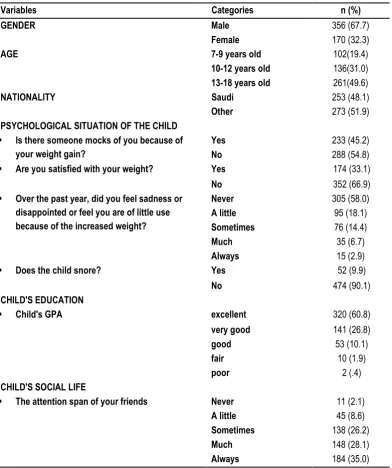
which 17 of samples are missing or invalid information. The final samples which involved in the research 526 children and adolescents (356 boys and 170 girls) 48.1% of them are Saudis, and 51.9 % are not. The subjects of sample aged from 7-18 years were collected in June 2016. (table1)
Table 1: Descriptive statistics of study variable
n (%) Categories
Variables
356 (67.7)
Male GENDER
170 (32.3)
Female
102(19.4)
7-9 years old AGE
136(31.0)
10-12 years old
261(49.6)
13-18 years old
253 (48.1)
Saudi NATIONALITY
273 (51.9)
Other PSYCHOLOGICAL SITUATION OF THE CHILD
233 (45.2)
Yes
▪ Is there someone mocks of you because of
your weight gain? No 288 (54.8)
174 (33.1)
Yes
▪ Are you satisfied with your weight?
352 (66.9)
No
305 (58.0)
Never
▪ Over the past year, did you feel sadness or
disappointed or feel you are of little use because of the increased weight?
95 (18.1)
A little
76 (14.4)
Sometimes
35 (6.7)
Much
15 (2.9)
Always
52 (9.9)
Yes
▪ Does the child snore?
474 (90.1)
No CHILD'S EDUCATION
320 (60.8)
excellent
▪ Child's GPA
141 (26.8)
very good
53 (10.1)
good
10 (1.9)
fair
2 (.4)
poor CHILD'S SOCIAL LIFE
11 (2.1)
Never
▪ The attention span of your friends
45 (8.6)
A little
138 (26.2)
Sometimes
148 (28.1)
Much
184 (35.0)
Always
Data Collection
The study was applied as a cross-sectional designed in a questionnaire form. Involving a series of questions with multiple-choice answers was applied. The questionnaire includes:
Social factors such as: Three question assessed children and adolescent perceptions of how much they felt that their mother, father, and friends cared about them. There are also three
questions if they experienced weight stigmatization or discriminatory attitude against them. Also there was a measure assessing whether they hang out with their friends or not.
lives. There are two questions, about their appetite and if there are any sleeping disorders.
Educational Factors such as: Two questions were addressed the students desire for going to school and if they face problems with colleagues or teachers. Also there were two questions for self-assessment of academic performance comparing with their colleagues and their GPA (grade point average) in last semester and two questions clarifying their expectations of finishing high school and whether they repeated a grade.
The subjects were directed to King Abdulaziz University Hospital, Jeddah, KSA, where trained health professional team filled the questionnaires based on the responses of parents or the children themselves.
Exclusion criteria were chronic diseases, anyone diagnosed with depression, and data insufficiency due to incomplete questionnaires.
For study purposes, we surveyed the following general components: personal information, demographic data, parental education level and occupation, income, family members. Body mass index (BMI) measurements. Body Mass Index is calculated as weight in kilograms divided by the square of height in meters. (21) Height and weight was documented by research
team preceded by measuring the subjects with light clothing and without shoes.
Statistical Analysis
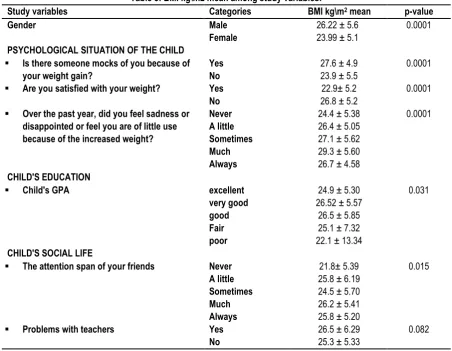
Data was entered, coded, and analyzed using the Statistical Package for Social Science, version 16 (SPSS Inc., Chicago, IL, USA). The analysis was performed by finding the correlation coefficients and testing the significance of the relationship between child's psychological situation, education levels and social life with suffered from obesity by using Point biserial correlation, a special case of Pearson correlation. Body Mass Index (BMI) kg/m 2 was used to express the obesity after we assumed that the data followed a normal distribution depends on normal curve. Independent sample t-test used to test the difference in BMI kg/m2 mean among the study variables with two
categories such as: child's exposures to mocks because weight gain and child's satisfaction with his weight. Also, we used One-way ANOVA to test the difference in BMI kg/m2 mean among the
study variables with more than two categories such as: child's education levels. Descriptive statistics were using to describe qualitative variables as frequencies and percentages and quantitative variables as mean ± SD. results were considered significant with p<0.05 and sometimes with p<0.01.
Table 2: Correlation between BMI kg\m2 and study variables
p-value (r) Study variables
0.0001(-0.319)
Is there someone mocks of you because of your weight gain?
BMI Kg\m2
0.0001(0.330)
Are you satisfied with your weight?
0.051(- 0.086)
having problems with teachers in school
Table 3: BMI kg\m2 mean among study variables:
Study variables Categories BMI kg\m2mean p-value
Gender Male 26.22 ± 5.6 0.0001
Female 23.99 ± 5.1
PSYCHOLOGICAL SITUATION OF THE CHILD
▪ Is there someone mocks of you because of
your weight gain?
Yes 27.6 ± 4.9 0.0001
No 23.9 ± 5.5
▪ Are you satisfied with your weight? Yes 22.9± 5.2 0.0001
No 26.8 ± 5.2
▪ Over the past year, did you feel sadness or
disappointed or feel you are of little use because of the increased weight?
Never 24.4 ± 5.38 0.0001
A little 26.4 ± 5.05
Sometimes 27.1 ± 5.62
Much 29.3 ± 5.60
Always 26.7 ± 4.58
CHILD'S EDUCATION
▪ Child's GPA excellent 24.9 ± 5.30 0.031
very good 26.52 ± 5.57
good 26.5 ± 5.85
Fair 25.1 ± 7.32
poor 22.1 ± 13.34
CHILD'S SOCIAL LIFE
▪ The attention span of your friends Never 21.8± 5.39 0.015
A little 25.8 ± 6.19
Sometimes 24.5 ± 5.70
Much 26.2 ± 5.41
Always 25.8 ± 5.20
▪ Problems with teachers Yes 26.5 ± 6.29 0.082
RESULTS
The aim of this study was conducted to recognize how the weight status will impact the psychological, social and educational status in children and adolescents. The study included 526 children and adolescents (boys 356/526 [67.7%] and 170/526 [32.3%] girls). Descriptive characteristics / statistics of the study variables in children and adolescents are provided in Table 1. Children and adolescents who experienced problems had a higher BMI than those who had not. Further, 45.2% (p=0.0001, r= - 0.319) of obese children exposed for mocking from surrounding people more than non-obese children, also 66.9% (p=0.0001 r=0.330) of them were not satisfied with their body shape, only 6.5 % of obese children and adolescents were thinking they had been hated because of their weight gain, 42.01% of our samples experienced some moments of feeling sadness and disappointed. We observed that 78.9 % (p=0.313) of obese children and adolescents did not have a decline in academic level and the responses showed 60.8 % and 26.8% respectively (p= 0.031) had an excellent and very good GPA last semester. 67.0% of obese children reported they interested in going to school. Also 34.98 % of them complained of problems with other students while 16.5% (p-value= 0.051, r= - 0.086) complained of problems with their teachers. Only 2.47 % (p-value= 0.300) of obese children and adolescents feel their mothers do not care about them and 4.18 %(p value= 0.331) of them feel their fathers do not care while 10.64% (p value =0.015) feel the friends do not care . …..% of obese children also did not hang out with their friends last month. (Table 2, 3)
DISCUSSION
The results showed social, psychological and educational situations adversely correlate with weight status and high BMI. The effect of high BMI on these situations emerged by many studies. As those stereotypes affect on behaviors which in turn affect personal relationships, these results are consistent with observations notified in the literature that anti- obese stereotypes have adverse outcomes for obese children and adolescents.22–25
Examination of social, educational, and psychological variables proposes that the nature of some of these aspects is related to body weight. Overweight children and adolescents were more likely than average weight to report feeling that their peers did not care at all or little about them, and they reported that they did not hang out with friends in the last month. Some studies experienced that obese children were thinking themselves as poorer students more likely than average weight. These results were not consistent with this study that demonstrated that children and adolescents with high BMI had high grade point average with no difference comparing with those of average weight. There were great positive associations between obesity and psychological and weight-specific concerns (e.g., body dissatisfaction and feeling sadness) Similar results were found in a study of 30,000 adolescents, Neumark-Sztainer et al.26 Despite the results showed
in the present study, it is important to note that in many cases, there were no differences between weight status and social, school and psychological experiences. Comparing with their average weight counterparts, as a group obese students appear to be more likely having negative social experiences, dissatisfaction of body image and some psychological experiences like feeling sadness. but also appear to have
functional family relationships and great school performance. In fact, adverse outcomes are not unavoidable for obese children and adolescents.27 Stunkard and Mendelson,28 Allon29 are studies
merged that by positive familial relationship, enough awareness to deal with obese children and parents monitoring may attenuate the adverse psychological and social consequences. In this context, the observation that obese children and were not more likely to feel that their parents did not care is hopeful.
Strengths of this study include the racially and economically diverse population-based sample of children and adolescents, the anonymity of collected data and height and weight were measured by the study team. The limitations of the study must be considered. All Questions were self-reported and thus subject to reporting bias. In addition to the negative physical consequences of obesity, we concluded that through this study there are negative psychological and social consequences of obesity on children and adolescents. Considering the epidemic of obesity among children, positive familial relationship and dealing well are timely and may be meaningful in promoting positive social and psychological experiences for those obese children.
ACKNOWLEDGEMENT
We would like to thank our data collectors: Manal khalaf alharbi, Khleel Adnan Alowayed, Mohammad Hussain Al-Swaidan, Noor Mohammad AlMohish, Bayan Jamal AL-Mulhim, Tumadhir Abdullah Alkishi, Sarah Abdullah Alkishi, Hasan Abdul-Hameed Al-Taweel, Hashim Essa Al-khalaf, Khaled Saleh Almulhim, Khleel Adnan Alowayed, Mohammad Hussain Al-Swaidan, Noor Mohammad AlMohish, Abdullah Mohammed Zain Aldeen, Mariya Maher Busaleh, Badreyah Ahmad Al-dauig.
REFERENCES
1. WHO | Obesity: preventing and managing the global epidemic [Internet]. Who.int. 2016 [cited 11 August 2016]. Available from: www.who.int/nutrition/publications/obesity/WHO_TRS_894/en/ 2. Janssen I, Katzmarzyk P, Boyce W, Vereecken C, Mulvihill C, Roberts C, et al. Comparison of overweight and obesity prevalence in school-aged youth from 34 countries and their relationships with physical activity and dietary patterns. Obes Rev 2005; 6: 123-132.
3. World Health Organization. Obesity and overweight: Fact sheet; June 2016; http://www.who.int/mediacentre/factsheets/fs311/en/ 4. William J Klish, MD, Kathleen J Motil, MD, PhD, Mitchell Geffner, MD Definition; epidemiology; and etiology of obesity in children and adolescents Uptodate 2016
http://www.uptodate.com/contents/definition-epidemiology-and-etiology-of-obesity-in-children-and-adolescents
5. World Health Organization. Country Cooperation Strategy for WHO and Saudi Arabia 2006–2011, Regional Office for the Eastern Mediterranean, Cairo; 2006. p. 845.
6. Musaiger AO. Overweight and obesity in Eastern mediterranean region: Prevalence and possible causes. J Obes 2011;2011:217.
7. ElMouzan MI, Foster PJ et al. Prevalence of overweight and obesity in Saudi children and adolescents. Ann Saudi Med 2010;30:2038.
9. WHO Consultation on Obesity (1999: Geneva S, Organization W. Obesity : preventing and managing the global epidemic : report of a WHO consultation [Internet]. Apps.who.int. 2016 [cited 12 August 2016]. http://apps.who.int/iris/handle/10665/42330 10. Richard J. Deckelbaum and Christine L. Williams, “Childhood Obesity: The Health Issue,” Obesity Research 9 (2001), 239S– 43S, doi: 10.1038/oby.2001.125.4.
11. Fuerst, D. R., Rourke, BP. (1993) Psychosocial functioning of children: relations between personality subtypes and academic achievement. J Abnorm Child Psychol. 21: 597–607.
12. Powell, C. L., Arriola, KRJ. (2003) Relationship between psychosocial factors and academic achievement among African American students. J Educ Res. 96: 175–181.
13. Livaditis, M., Zaphiriadis, K., Samakouri, M., Tellidou, C., Tzavaras, N., Xenitidis, K. (2003) Gender differences, family and psychological factors affecting school performance in Greek secondary school students. Educ Psychol. 23: 223–231.
14. Falkner, N. H., Neumark-Sztainer, D., Story, M., Jeffery, R. W., Beuhring, T., Resnick, MD. (2001) Social, educational, and psychological correlates of weight status in adolescents. Obes Res. 9: 32–42
15. Sonne-Holm S, Sorensen T. Prospective study of attainment of social class of severely obese subjects in relation to parental social class, intelligence, and education. Br Med J. 1986;292: 586–9.
16. Gortmaker SL, Must A, Perrin JM, Sobol A, Dietz WH. Social and economic consequences of overweight in adolescence and young adulthood. N Engl J Med. 1993;329: 1008–12.
17. DeJong W. The stigma of obesity: the consequences of naive assumptions concerning the causes of physical deviance. J Health Soc Behav. 1980;21:75– 87.
18. Richardson SA. Handicap, appearance and stigma. Soc Sci Med. 1971;5:621– 8.
19. Stafferi RJ. A study of social stereotype of body image in children. J Pers Soc Psychol. 1967;7:101– 4.
20. Staffieri J. Body build and behavioral expectancies in young females. Dev Psychol. 1972;6:125–7.
21. About Child & Teen BMI | Healthy Weight | CDC [Internet]. Cdc.gov. 2016 [cited 13 August 2016]. Available from: https://www.cdc.gov/healthyweight/assessing/bmi/childrens_bmi/a bout_childrens_bmi.html
22. Kaplan S. Rehabilitation counseling students’ perceptions of obese male and female clients. Rehab Counsel Bull. 1984:172–81 23. Harris M, Hopwood J. Attitudes toward the obese in Australia. J Obes Weight Reg. 1983;2:107–20.
24. Harris M, Waschull S, Walters L. Feeling fat. Motivations, knowledge, and attitudes of overweight women and men. Psychol Rep. 1990;67:1191–1202.
25. Tiggeman M, Rothblum E. Gender differences in social consequences of perceived overweight in the United States and Australia. Sex Roles. 1988;18:75– 85.
26. Neumark-Sztainer D, Story M, French S, Hannan P,vResnick M, Blum RW. Psychosocial concerns and healthcompromising behaviors among overweight and non-overweight adolescents. Obes Res. 1997;5:237– 49.
27. Friedman MA, Brownell KD. Psychological correlates of obesity: moving to the next research generation. Psychol Bull. 1995;117:3–20.
28. Stunkard A, Mendelson M. Obesity and the body image: characteristics of disturbances in the body image of some persons. Am J Psychiatry. 1967;123:1296 –1300.
29. Allon N. Self-perceptions of the stigma of overweight in relationship to weight-losing patterns. Am J Clin Nutr. 1979; 32:470–80.
[
Source of Support: Nil. Conflict of Interest: None Declared.
Copyright: © the author(s) and publisher. IJMRP is an official publication of Ibn Sina Academy of Medieval Medicine & Sciences, registered in 2001 under Indian Trusts Act, 1882. This is an open access article distributed under the terms of the Creative Commons Attribution Non-commercial License, which permits unrestricted non-commercial use, distribution, and reproduction in any medium, provided the original work is properly cited.