JETIR1803271 Journal of Emerging Technologies and Innovative Research (JETIR) www.jetir.org 1459
NATURE INSPIRED HEURISTIC
ALGORITHM FOR EFFICIENCY
DETERMINATION OF IN-SITU INDUCTION
MOTOR
V.P. Sakthivel
Assistant Professor
Department of Electrical and Electronics Engineering
Government College of Engineering, Dharmapuri – 636704, India.
Abstract: Standard induction motor efficiency estimation methods need no-load test that is not possible for in-situ induction motor (ISIM). The efficiency determination from the motor’s nameplate or manufacturer’s data is inaccurate. Inspired by the nature theory, this work proposes Glowworm Swarm Optimization (GSO) for solving the ISIM efficiency determination. The GSO approach is validated on a 5Hp motor. The proposed combined method outperforms the genetic algorithm (GA) and particle swarm optimization (PSO) approaches in solving the ISIM efficiency determination problem.
IndexTerms –Glowworm Swarm Optimization, genetic algorithm, evolutionary algorithm, efficiency estimation.
I.INTRODUCTION
All Induction motor efficiency determination enables the energy savings in industry. However, because of the uninterrupted characteristic of industrial process, traditional methods defined in IEEE Std-112 cannot be used. Nonintrusive motor efficiency estimation methods have to be developed for in-situ motor testing. Induction motor equivalent circuit-based methods are one of the least intrusive categories of motor efficiency estimation methods. Over the years, many methods have been developed based on induction motor equivalent circuit. The IEEE Std-112 F method is the standard equivalent circuit method [1]. Although this method is expected to be quite accurate, the required no-load, variable voltage, removed – rotor, and reverse rotation tests make it impossible to be used in in-situ testing. Later, the standard 112-F method is modified by Ontario Hydro by eliminating the variable voltage test [2]. However, a no-load test and a full load test both under rated voltage are still required. In [3], the authors surveyed over twenty methods for evaluating the efficiency of induction motors and proposed least intrusive methods for efficiency estimation. Shaft torque measurement is the most direct method for efficiency determination, by using the ratio of motor output power to the input power. However, all methods utilizing dynamometer measurement are not practical in the field [4]. A new method [5] for the identification of induction motor equivalent circuit parameters using the single phase test instead of the locked-rotor test was proposed. However, the no load test remains a major problem especially when the motor cannot operate at no-load since its shaft is permanently connected to its load.
Genetic algorithm (GA) [6] [7], adaptive GA [8] evolutionary algorithm (EA) [9], PSO [10] Bacterial Foraging algorithm [11] have also been used for parameter identification and efficiency estimation.
Glowworm swarm optimization (GSO) proposed by Krishnanand and Ghose, is a new algorithm for the optimization of multimodal functions [12]. It is mimicked from the behavior that glowworms exchange information of searching for food with their peers. The GSO algorithm shows outstanding performance in finding the optimal solution for the multimodal functions.
Hence, the GSO algorithm to solve the ISIM efficiency determination problem is introduced in this article. The proposed GSO algorithm has been applied on a 5HP motor. In addition, in order to study the performance of the proposed GSO algorithm, GA and PSO approaches are compared.
II.PROBLEM FORMULATION OF ISIMEFFICIENCY DETERMINATION
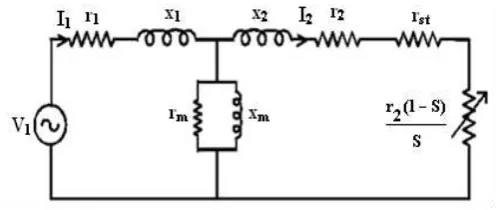
ISIM efficiency determination problem is formulated as an optimization problem. The proposed efficiency estimation method incorporates the loss segregation method, the equivalent circuit method and the EMA, as a technique for solving nonlinear equation. An equivalent stray-load resistor is added in serious with the rotor circuit as shown in Fig. 1. The aim is to reach a parameter set,
Fig. 1. Modified equivalent circuits of an induction motor
which yields minimal squared error when compared to the measured data.
fl S ) fl S (1 2 0.018r st
r
The admittance of each branch of the equivalent circuit can be calculated as follows:
2 jx st r /S 2 r 1 2 Y 1 jx 1 r 1.0 1 Y
The stator, rotor and magnetizing currents, power factor, input and output powers and efficiency of the motor can be calculated using the following equations.
m Y 2 Y 1 Y ) m Y 2 (Y 1 Y 1 V 1 I e 1 I m Y 2 Y 1 Y 2 Y 1 Y 1 V e 2 I ) m Y 2 Y 1 Y ( m r 1 Y 1 V e m I . e 1 I ) 1 I ( e pf
2 rm
e m I st r S 2 r 2 e 2 I 1 r 2 e 1 I 3 e in P fw P S S 1 2 r 2 e 2 3I e out
P
100 e in P e out p (%) e η
The objective function is written as:
2 m pf m pf c pf 2 m in P m in P c in P 2 m 1 I m 1 I c 1 I F(X)
(1)
III.GLOWWORM SWARM OPTIMIZATION
The GSO algorithm, a new swarm optimization algorithm is proposed by K.N. Krishnanad and D. Ghose [12]. The basic idea of this algorithm is mimicked from the natural glowworm’s activities in the night, the Glowworms exercise in group in nature, they interaction and inter-attraction with each other by one’s luciferin. If the glowworm emits luciferin lighter, it can attract more glowworms move toward it. Through simulate this natural phenomenon, combined with the characteristics of natural glowworm populations, each glowworm at the owns field of view in search for the glowworm, which release the strongest luciferin, also move to the strongest glowworm.
The GSO algorithm starts by placing the glowworms randomly in the search space, so that they are well dispersed. Initially, all the glowworms contain an equal quantity of luciferin. Each iteration consists of a luciferin-update phase followed by a movement phase based on the transition rule.
3.1.Luciferin update phase
The luciferin update phase depends on the function value at the glowworm position and so, even though all glowworms start with the same luciferin value during the initial iteration, these values change according to the function values at their current positions. During this phase, each glowworm adds, to its previous luciferin level, a luciferin quantity proportional to the measured value of the sensed profile (fitness) at that point. In the case of a function optimization problem, this would be value of the objective function at that point. Also, a fraction of the luciferin value is subtracted to simulate the decay in luciferin with time. The luciferin update rule is expressed by using,
0
,
(
1
)
l
(
t
)
F
(
t
1
)
max
)
1
t
(
l
j
j
j
(2)3.2.Movement phase
JETIR1803271 Journal of Emerging Technologies and Innovative Research (JETIR) www.jetir.org 1461
) t ( i N
k k
j j
)
t
(
l
)
t
(
l
)
t
(
P
(3)Where,
k
N
i(
t
)
j
:
di
,
j
(
t
)
r
(
t
);
l
(
t
)
l
(
t
)
)
t
(
Ni
di i
jLet, the glowworm i select a glowworm
j
N
i(
t
)
withp
j(
t
)
is expressed in the above Eq. Then, the discrete-time model ofglowworm movements can be defined as
)
t
(
x
)
t
(
x
)
t
(
x
)
t
(
x
s
)
t
(
x
)
1
t
(
x
i j
i j i
i (4)
Where, S = δ if dij(t) ≥ δ
dij(t) otherwise
3.3.Local-decision range update rule
When the glowworms depend on only local information to decide their movements, it is expected that the number of peaks captured would be a strong function of radial sensor range. For instance, if the sensor range of each agent covers the entire workspace, all the agents move to the global optimum point, and the local optima are ignored. Since, we have considered that a prior information about the objective function is not available, in order to detect multiple peaks, the sensor range must be made a
varying parameter. For this purpose, we associate each agent i with a local decision domain whose radial range
r
diis dynamic innature
0
r
di
r
si. The suitable function is selected to adaptively update the local-decision domain range of each glowworm and is expressed by,
rs
,
max
0
,
r
(
t
)
(
n
N
(
t
)
min
)
1
t
(
r
t ii d i
d
(5)IV.GSOALGORITHM FOR SOLVING ISIMEFFICIENCY DETERMINATION PROBLEM
The GSO algorithm for solving ISIM efficiency determination problem is as follows:
Step 1: Read the upper and lower limits of equivalent circuit parameters, constraint values, specifications of the ISIM.
Step 2: Read GSO algorithm parameters.
Step 3: Initialize initial luciferin value lo and local decision range ro.
Step 4: Initialize the glowworm within the limits of each equivalent circuit parameters.
Step 5: Find the objective value using Eq. (1) and the luciferrin value of all glowworms using Eq. (2).
Step 6: Find the neighborhood glowworms having brighter glow and are in the local decision range.
Step 7: Find the probability of glowworm moving towards a neighbor using Eq. (3).
Step 8: Update the glowworm movement using Eq. (2) and check the limits.
Step 9: Update the local decision range of all glowworms using Eq. (4).
Step 10: Repeat the above steps 5 to 9, until maximum iterations are attained.
Step 11: Display the optimal equivalent circuit parameters and their corresponding objective value.
V. RESULTS AND DISCUSSION
To verify the effectiveness and feasibility of GSO based ISIM efficiency determination problem, numerical simulations are conducted on a 5 HP motor and the results obtained are compared with that of GA and PSO approaches. The numerical assessments are implemented through a proposed method-based software module in Matlab.
The parameters used in GSO parameters are as follows:
Luciferin decay constant () is 0.95,
Luciferin enhancement constant () is 0.95,
Constant parameter (
) is 0.0005; Neighborhood threshold (nt) is 4;
Radial range of Luciferin sensor (rs) is 0.005; and
Local decision domain range (rd) is 0.0005.
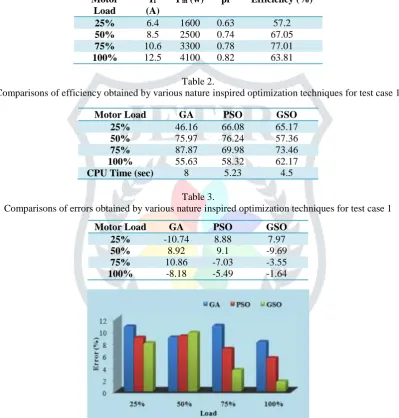
The results of the load test on ISIM are depicted in Table 1. The two methods of experiments are conducted on a 5 HP motor whose specifications is given in Appendix and the simulation results of the different nature inspired optimization techniques are compared.
Test Case 1: Initially, full load experimental data is considered for equivalent circuit parameter estimation.
5.1.Test Case 1
In this test case, only full load experimental data are used for motor parameter determination. The equivalent circuit parameters, X1, R2, Xm, and Rm are randomly generated by GSO method. Then these values are used to compute the stator line
current, power factor, input power, output power, and the corresponding efficiencies at different load points. The calculated values are compared with the measured experimental data. The error is the difference in the percentage efficiency obtained from nature inspired optimization techniques and the measured data at each load point.
The comparative results for test case 1 are summarized in Tables 2 and 3, and Fig. 2 show the errors and efficiencies obtained by various approaches for this test case respectively. The results show that the error produced by GSO is less when compared with other nature inspired optimization techniques which emphasizing its better solution quality. Moreover, it is observed from Table 2 that average simulation time of the GSO approach is significantly less than that of GA and PSO.
Table 1.
Load test data of three-phase induction motor
Motor Load
I1
(A)
Pin (w) pf Efficiency (%)
25% 6.4 1600 0.63 57.2 50% 8.5 2500 0.74 67.05 75% 10.6 3300 0.78 77.01 100% 12.5 4100 0.82 63.81
Table 2.
Comparisons of efficiency obtained by various nature inspired optimization techniques for test case 1
Motor Load GA PSO GSO
25% 46.16 66.08 65.17 50% 75.97 76.24 57.36 75% 87.87 69.98 73.46 100% 55.63 58.32 62.17 CPU Time (sec) 8 5.23 4.5
Table 3.
Comparisons of errors obtained by various nature inspired optimization techniques for test case 1
Motor Load GA PSO GSO 25% -10.74 8.88 7.97
50% 8.92 9.1 -9.69
75% 10.86 -7.03 -3.55 100% -8.18 -5.49 -1.64
Fig. 2. Magnitude of errors in percentage efficiency for test case 1
5.2. Test Case 2
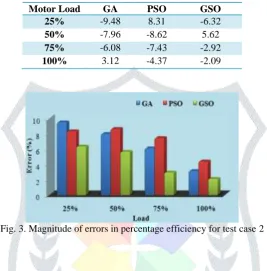
In this test case, each load point experimental data is used for motor parameter and efficiency determination. The comparison of various nature inspired optimization techniques based ISIM efficiency determination problem for test case 2 is summarized in Tables 4 and 5, and Fig. 3.
JETIR1803271 Journal of Emerging Technologies and Innovative Research (JETIR) www.jetir.org 1463 Table 4.
Comparisons of efficiency obtained by various nature inspired optimization techniques for test case 2
Motor Load GA PSO GSO 25% 47.72 65.51 50.88 50% 59.09 58.43 72.67 75% 70.93 69.58 70.54 100% 66.93 59.44 61.72 CPU Time
(sec)
9.2 6.62 5.12
Table 5.
Comparisons of errors obtained by various nature inspired optimization techniques for test case 2
Motor Load GA PSO GSO 25% -9.48 8.31 -6.32 50% -7.96 -8.62 5.62 75% -6.08 -7.43 -2.92 100% 3.12 -4.37 -2.09
Fig. 3. Magnitude of errors in percentage efficiency for test case 2
V.CONCLUSION
This paper has demonstrated the feasibility of employing GSO approach for efficient solving of ISIM efficiency determination problem. A comparative analysis has been done for various nature inspired optimization techniques. The effectiveness of these methods has been demonstrated and validated on a 5 HP test motor. In ISIM efficiency determination problem, GSO performed much better than other nature inspired optimization techniques (GA, PSO) in terms of convergence rate, solution time, minimum objective value and probability of attaining better solutions. The results achieved by GSO are quite encouraging and indicate the viability of the proposed GSO technique to deal with electrical machine design and power system optimization problems.
APPENDIX Specifications of 5 HP Motor
Specifications Value
Capacity 5 HP
Voltage 230 V
Current 12.5 A
REFERENCES
[1] IEEE Power Engineering Society, “IEEE Standard test procedure for polyphase induction motors and generators,” IEEE Std. 112 – 1991.
[2] Ontario Hydro Report TSDD – 90 – 043, “Inplant electric motor loading and efficiency techniques,”1990.
[3] B. Lu, T.G. Habetler, and R.G. Harley, “A survey of efficiency estimation methods of in- service induction motors with considerations of condition monitoring,” in Proc. 2005 International Electric Machine and drive conference, pp.1365 – 1372, 2005.
[4] A.V. Gumaste, and I. Tsal, “Apparatus for measuring torque to a shaft,” Caterpillar Inc., Pat. No. 4899598, 1990.
[5] Gaspli, M. Takeshita, , and N. Matsui, “An automated equivalent circuit parameter measurements of an induction motor using a V/ f PWM inverter’, Proceedings of the 1990 International Power Electronics Conference, Japan, vol.2, pp.659 – 666, 1990.
[6] P. Pillai, R. Nolan, and T. Haque, “Application of genetic algorithms to motor parameter determination for transient torque calculations,” IEEE Transactions on Industry Applications, vol. 33, no.5, pp.1273 – 1281, 1997.
[7] F. Alonge, F. Dlppolito, G. Ferrante, and F.M. Raimondi, “Parameter identification of induction motor model using genetic algorithm,” IEE Proceedings on Control Theory Applications, vol. 145, no. 6, pp. 587-593, 1998.
[8] Abdelhadi, A. Benoudjit, and N. Nait Said, “Identification of induction machine parameters using a new adaptive genetic algorithm,”Electric Power Components and Systems, vol.32, pp. 767-784, 2004.
[9] S. Subramanian, and R. Bhuvaneswari, “Evolutionary programming based determination of induction motor efficiency,”
Electric Power Components and Systems, vol. 34, pp. 565-576, 2006.
[10] V.P. Sakthivel, R. Bhuvaneswari, and S. Subramanian, “On-site efficiency evaluation of three-phase induction motor based on particle swarm optimization,” Energy, vol. 36, no. 3, pp. 1713-1720, 2011.
[11] V.P. Sakthivel, R. Bhuvaneswari, and S. Subramanian, “A non-intrusive efficiency estimation method for energy auditing and management of in-service induction motor using bacterial foraging algorithm,” IET Electric Power Applications, vol. 4. no. 8, pp. 579-590, 2010.