Abstract—In this article, we aimed to investigate the
dynamics of higher education texts from 2002 to 2011 by
identifying the most frequently cited references, the highest
cited authors, and the correlations among the co-citations.
Citation and Co-Citation analyses were used to examine 1,941
cited journal articles from 41,001 publications published in SCI
and SSCI databases. We juxtaposed the status of citations
between two periods of 2002-2006 and 2007-2011. Results
showed research trends changed significantly. Some generative
reflections, methodological limitations, future research
recommendations were discussed as well.
Index Terms—Higher education, citation analysis, co-citation
analysis, citation-enhanced databases.
I.
I
NTRODUCTIONAlbeit the first Western universities, which were
established in Paris and Bologna, have existed since the
twelfth century [1]-[6], higher education as an academic
discipline in the research that employs the citation indexing
methodology [7] to graphically and quantitatively document
the emerging and competing education texts, the most
influential scholars, and the correlations among the author
co-citations remains scant [8]. This methodological chasm, in
one degree or another, hinders the development of the
research territory of higher education [8].
Hence, how to swiftly, efficiently, and accurately locate
the classic (must-read, best-quality, and wide-cited) texts
related to higher education has become an indispensable
capability, demand, and challenge for potential academic
novices, or even seasoned/senior faculty members at times,
especially facing the era within the rapid evolution of the
Internet, the dramatic proliferation of new technologies,
various types of software and programs, and the explosion of
knowledge that complicate the process of doing a literature
search in a way [9], [10]. Many scholars even identify this
competence of the highest-speeding data mining or
knowledge generation as one of the reputation indicators that
contributes to academic productivity and publication quality
in the making of the world-class university rankings
[11]-[13].
In the first twenty-first century, higher education research
paradigm has emerged various paradigm shifts that heavily
Manuscript received January 12, 2013; revised March 13, 2013. C.-H. Tai and Y. Lee are with the Graduate School of Business and Operations Management, Chang Jung Christian University, Tainan 71101, Taiwan (R.O.C.) (e-mail: [email protected], [email protected]).
C.-W. Lee is with the Institute for International Studies in Education, University of Pittsburgh, PA 15206, USA (e-mail: [email protected])
emphasize on marketization [14], globalization [15],
McDonaldization [16], and New Managerialism [17]-[19],
the alignment/integration of digital technologies, effective
finance management, and academic capitalism [20]-[26]. Yet
this variation in patterns of research falls short of a
documentary evidence sufficient to visualize this paradigm
transformation.
The purpose of this study was thus, in terms of a
quantitative viewpoint, to help identify the linkage among
different publications and to confirm their statuses and
positions in their contributions to the development of higher
education research field. We aim to help academic novices
and potential contributors quickly grasp the unabridged
picture of higher education field from 2002 to 2011 based on
the condition of the citations in selected databases.
Furthermore, we intend to form a timely
comprehensively-established knowledge structure as a
cognitive basis and threshold for future studies in this field.
Those who are interested in higher education research can
benefit from our pilot study and thereby devoted more time to
engaging in the epistemological innovation and
methodological breakthrough, rather than identifying the
prominent scholars along with their celebrated works.
Four research questions focus on (a) which references
(journals and books) were cited the most, (b) whose works
were the most frequently cited, and (c) who were highly
nominated?
II.
M
ETHODA.
Research Design
We employed Garfield’s [7] citation indexing as our
methodology, combined with the citation [27] and author
co-citation analyses [28] richly used in the bibliometrics [29],
[30] and cybermetrics [30], as well as scientometrics [31],
[32]. To compare the dynamics of the cited authors,
references, co-cited authors in 2002-2006 with that in
2007-2011, we divided a ten-year timeline into two periods
respectively since contemporary higher education research
studies for the past decades has generated research paradigm
shift since 2002 [20]-[26]. The objective of this study is to
provide the researchers of higher education with a complete
understanding by ranking publications according to the total
number of the citations. The ranking we designed was based
on publications in Thomson Reuters’ Web of Science
database in the period of 2002-2011.
B.
Data Source
Our data analyzed in this study derived from the
Social
Citation Analysis of Higher Education Texts in Selected
Databases: A Comparison between 2002-2006 and
2007-2011
Citation Index
(SCI) and
Social Science Citation Index
(SSCI). Because of the characteristics of peer review, strict
filtering mechanism, the most accepted and comprehensive
databases, more than 9,000 world’s leading scholarly
journals have been published in this generally acknowledged
and selected database. We therefore selected the publications
related to higher education as our targeted data analyzed.
Only publications in the sciences and the social sciences are
included. Publications in the arts and humanities are excluded
because in these domains the bibliometric indicators of the
Leiden Ranking do not have sufficient accuracy. Furthermore,
only publications of the Web of Science document types
article, letter, and review are considered in the Leiden
Ranking. The data cited in this study included authors,
journal articles, publication outlets, cited references, and
publication dates. It was worth note that we seemingly
focused our search on the journal articles, yet we found that
in fact the results included the online journals (e.g., The
Chronicle of Higher Education), e-/books, e-/volumes, and
international organizations’ reports (e.g., Work Bank)
automatically.
C.
Data Collection Procedure
Searches for peer-reviewed articles were conducted in SCI
and SSCI databases. We restrained our search from 2002 to
2011 because a prior review from these perspectives was
published in 2002. We identified the sources of the
publications in higher education research from the SCI and
SSCI databases. Then we designed a data mining means to
retrieve the authors, topics, and journals closely associated
with higher education research. The key word for search was
higher education. 1,941 search results were found out from
41,001 publications, including journal articles, books,
volumes, and online journals.
D.
Data Analysis
We utilized the
Microsoft Excel 2010
sheets to screen, sort,
sub-total, sum, and rank the collected data by the citation
frequency. Then we restrained our amount of refined data to
the top 30 results, and identified the key nodes in the invisible
network of knowledge through tabulations of the citation
status, including the most frequently cited references, the
highly nominated authors followed by the highest cited
works. Finally, we used co-citation analysis to tabulate the
author factor loadings.
III.
R
ESULTSTwo primary results demonstrated the dynamics of
reference citation in the field higher education between
2002-2006 and 2007-2011. The following tabulates the
knowledge distribution process.
A.
Which References Were Cited the Most?
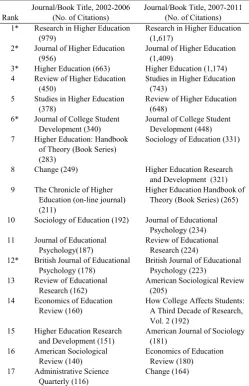
TABLE I lists the ranking of the 17 most frequently cited
journals during the periods of 2002-2006 and 2007-2011. All
number of the citation frequency averages over 110 times.
The rankings 1 to 3, 6, and 12 remain the same journals
within the two periods, including Research in Higher
Education, Journal of Higher Education, Higher Education,
Journal of College Student Development, and British Journal
of Educational Psychology in sequence.
TABLEI:RANKING COMPARISON OF THE 17MOST FREQUENTLY CITED
REFERENCES,2002-2006 AND 2007-2011
Rank
Journal/Book Title, 2002-2006 (No. of Citations)
Journal/Book Title, 2007-2011 (No. of Citations) 1* Research in Higher Education
(979)
Research in Higher Education (1,617)
2* Journal of Higher Education (956)
Journal of Higher Education (1,409)
3* Higher Education (663) Higher Education (1,174) 4 Review of Higher Education
(450)
Studies in Higher Education (743)
5 Studies in Higher Education (378)
Review of Higher Education (648)
6* Journal of College Student Development (340)
Journal of College Student Development (448) 7 Higher Education: Handbook
of Theory (Book Series) (283)
Sociology of Education (331)
8 Change (249) Higher Education Research and Development (321) 9 The Chronicle of Higher
Education (on-line journal) (211)
Higher Education Handbook of Theory (Book Series) (265)
10 Sociology of Education (192) Journal of Educational Psychology (234) 11 Journal of Educational
Psychology(187)
Review of Educational Research (224) 12* British Journal of Educational
Psychology (178)
British Journal of Educational Psychology (223)
13 Review of Educational Research (162)
American Sociological Review (205)
14 Economics of Education Review (160)
How College Affects Students: A Third Decade of Research, Vol. 2 (192)
15 Higher Education Research and Development (151)
American Journal of Sociology (181)
16 American Sociological Review (140)
Economics of Education Review (180) 17 Administrative Science
Quarterly (116)
Change (164)
Note. *The journal’s ranking remains the same within the two periods.
B.
Whose Works Were the Most Frequently Cited?
Table II indicates the ten most frequently cited
publications from 2002 to 2006 along with the specific
name(s) of the author(s) followed by the publication years.
Pascarella and Terenzini’s [33] work stands the first place
according to the total number of citations, which is 88 times.
Astin’s [34] work ranked the second place was cited 63 times.
Biggs’ [35] and Tinto’s [36] works share the sixth place with
the identical citation frequency of 39, whereas Becher’s [37]
and Gibbons, et al.’s [38] works are tied for the eighth place
with the equal citation frequency of 36. The rest of those
ranged between 49 and 35 cited times include Slaughter and
Leslie’s [39], Boyer’s [40], Tinto’s [41], and Clark’s [42]
works.
TABLEII:LIST OF THE 10MOST FREQUENTLY REFERENCES,2002-2006 Rank Abbreviated Bibliographic Entries No. of Citations 1 E.T.Pascarella&P.T.Terenzini 1991 88
2 A.W.Astin 1993 63
3 S.Slaughter&L.L.Leslie 1997 49
4 E.L.Boyer 1990 47
5 V.Tinto 1993 42
6 J.B.Biggs 1999 39
6 V.Tinto 1975 39
8 T.Becher 1989 36
8 M.Gibbons,etal. 1994 36
10 B.R.Clark 1983 35
Note. See the complete bibliography in appendix.
TABLEIII:LIST OF THE 10MOST FREQUENTLY CITED REFERENCES, 2007-2011
Rank Abbreviated Bibliographic Entries No. of Citations
1 V.Tinto 1993 85
2 E.T.Pascarella&P.T.Terenzini 1991 69
3 A.W.Astin 1993 65
4 E.T.Pascarella&P.T.Terenzini 2005 57 5 S.Slaughter&L.L.Leslie 1997 53 6 E.T.Pascarella&P.T.Terenzini 2005 52
7 V.Tinto 1975 51
8 T.Becher&P.R.Trowler 2001 46
9 E.L.Boyer 1990 44
10 M.Gibbons,etal. 1994 41
Note. See the complete bibliography in appendix.
C.
Who Were Highly Nominated?
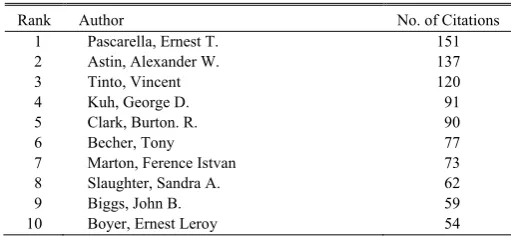
TABLE IV presents the ten most frequently cited authors
from 2002 to 2006. Ernest T. Pascarella was the highest cited
author during this period, whereas Alexander W. Astin stood
the second place. After Vincent Tinto who was ranked the
third position, the other authors were cited lower than 100
times.
TABLEIV:LIST OF THE 10MOST FREQUENTLY CITED AUTHORS, 2002-2006
Rank Author No. of Citations
1 Pascarella, Ernest T. 151
2 Astin, Alexander W. 137
3 Tinto, Vincent 120
4 Kuh, George D. 91
5 Clark, Burton. R. 90
6 Becher, Tony 77
7 Marton, Ference Istvan 73
8 Slaughter, Sandra A. 62
9 Biggs, John B. 59
10 Boyer, Ernest Leroy 54
TABLEV:LIST OF THE 10MOST FREQUENTLY CITED AUTHORS,2007-2011
Rank Author No. of Citations
1 Pascarella, Ernest T. 232
2 Tinto, Vincent 183
3 Kuh, George D. 129
4 Astin, Alexander W. 119
5 Slaughter, Sandra A. 97
6 Becher, Tony 89
7 Hurtado, Sylvia 86
8 Clark, Burton. R. 78
8 Marton, Ference Istvan 78
10 Biggs, John B. 76
TABLE V shows the top ten highly cited authors between
2007 and 2011. Ernest T. Pascarella stayed the first place,
while Vincent Tinto was promoted to be the second place,
where replaced Alexander W. Astin who has transformed to
the fourth position. George D. Kuh was advanced to the third
position in this phase. The rest of authors’ citations averaged
below 100 times. Surprisingly, Sylvia Hurtado entered this
top 10 highly cited roll as the seventh status, whereas Ernest
Leroy Boyer has been eliminated from this competition over
a short span of five years.
IV.
D
ISCUSSION ANDC
ONCLUSIONFour critical reflections on the outcomes of our examined
quantitative data include (a) the cautions of treating the
highly cited journals (b) the warnings about the use of the
most frequently cited works, and (c) the implications for the
development of higher education from the highly nominated
authors.
First, we unveiled that the journals in higher education
field has a high-speed replacement ratio between 2002-2006
and 2007-2011. Amid 17 journals, merely 5 journals
maintain their academic authority for the latter 5 years. Many
researchers in this area seemingly tend to publish their best
works in the top 3 journals that contribute to advance their
established worldwide reputation much higher, such as
Research in Higher Education, Journal of Higher Education,
and Higher Education. Yet this ranking roster solely based on
the citation frequency fails to justify that the quality of the
relatively-less cited journals is poor. Without having
deliberate understanding of the characteristics of various
journals, the prospective contributors are likely to miss the
fittest journals for their specific subfields, or to blindly
contribute to the journals with the highest impact factor
devised by Garfield [7] because of a conformity mentality.
Some new contributors more often feel frustrated because of
the wrong journal choices that make publication more
unlikely.
Second, our ranking design helped recognize the most
frequently cited works that provide new academics with a
good sense to locate the standard of the high quality
publications. The value of these leading works that dominate
the higher education research paradigm not just create several
landmarks in the evolution of higher education scholarship
that position the authors’ historical significance, but also
unfold the life cycle of the popularity of certain research
topics. Nonetheless, we should be continually aware of that
the citation frequency of a piece is insufficient to
overgeneralize that is the sole cause of becoming a classic
production, although it can be one of at least the bottom lines.
The sophistication of knowledge in a work is the essence of
excreting it to the world’s foremost authority. Barely relying
on the quantitatively-cumulative citation frequency to judge
the impact of the works of those recently emerging scholars is
unfair.
Finally, by means of the citation analysis some biases still
inevitably emerged against new scholars who place more
emphasis on the publication quality, as opposed to the
quantity, of the documents produced by a given scholar than a
ranking of authors based on the frequencies with which a
paper-based ranking (as in Table II and III) and a particular
author has been cited (as in Tables IV and V). Moreover, we
can see the key research themes in a field to indicate the
popularity of certain research topics and preference
according to Table II and III. We argue this likely causes
publication privatization without other various contributors’
engagement. The result further indicate high citations have
influence on what can be termed field-defining titles and they
lay down the ground work for the understanding of higher
education research as a distinct phenomenon. Tables II and
III showed a pattern from the first five years to the second
five years. First of all, the most influential publications in the
last five years dominated their positions for the past five
years on higher education research. Finally, the past decade
have extensive research commitment to higher education.
This methodological consideration for macro mapping in
higher education field has the potential to lead to future
research directions, as several aspects of this research have
not been conducted previously. The mapping of the
intellectual structure of higher education studies has
somehow created its own literature that has gained the
reputation as a legitimate academic field, with specific
journals related to higher education research gaining the
status qualified for an independent research field.
R
EFERENCES[1] B. Wildavsky, The Great Brain Race: How Global Universities Are Reshaping the World, Princeton, NJ: Princeton University Press, 2010, ch. 1, pp. 14-41.
[2] A. Hall, Managing People, Berkshire, U.K.: Open University Press, 2003, ch. 1, pp. 1-7.
[3] R. O. Berdahl, P. G. Altbach, and P. J. Gumport, “Introduction: The contexts of American higher education,” in American Higher Education in the Twenty-First Century: Social, Political, and Economic Challenges, 3rd ed., P. G. Altbach, P. J. Gumport, and R. O. Berdahl, Eds. Baltimore, MD: The Johns Hopkins University Press, 2011, pp. 1-11.
[4] P. G. Altbach, “Patterns of higher education development,” in
American Higher Education in the Twenty-First Century: Social, Political, and Economic Challenges, 3rd ed., P. G. Altbach, P. J. Gumport, and R. O. Berdahl, Eds. Baltimore, MD: The Johns Hopkins University Press, 2011, ch. 1, pp. 15-36.
[5] R. L. Geiger, “The ten generations of American higher education,” in
American Higher Education in the Twenty-First Century: Social, Political, and Economic Challenges, 3rd ed., P. G. Altbach, P. J. Gumport, and R. O. Berdahl, Eds. Baltimore, MD: The Johns Hopkins University Press, 2011, ch. 2, pp. 37-68.
[6] R. O. Berdahl, “Academic freedom: Past, present, and future,” in
American Higher Education in the Twenty-First Century: Social, Political, and Economic Challenges, 3rd ed., P. G. Altbach, P. J. Gumport, and R. O. Berdahl, Eds. Baltimore, MD: The Johns Hopkins University Press, 2011, ch. 4, pp. 88-110.
[7] E. Garfield, Citation Indexing—Its Theory and Application in Science, Technology, and Humanities, New York: John Wiley & Sons, 1979, ch. 1-ch. 10, pp. 1-252.
[8] R. L. Geiger, Knowledge and Money: Research Universities and the Paradox of the Marketplace, Stanford, CA: Standard University Press, 2004, ch. 4, pp. 132-179.
[9] W. F. Massy, “Productivity issues in higher education,” in Resource Allocation in Higher Education, W. F. Massy, Ed. Ann Arbor, MI: The University of Michigan Press, 1996, ch. 3, pp. 49-86.
[10] C. Hart, Doing a Literature Search: A Comprehensive Guide for the Social Sciences, Thousand Oaks, CA: Sage Publications, 2001, pp. 1-194.
[11] G. Federkeil, “Reputation indicators in rankings of higher education institutions,” in University Rankings, Diversity, and the New Landscape of Higher Education, B. M. Kehm and B. Stensaker, Eds. Rotterdam, The Netherlands: Sense Publishers, 2009, pp. 19-33. [12] P. G. Altbach and J. Balán, World Class Worldwide: Transforming
Research Universities in Asia and Latin America, Baltimore, MD: The Johns Hopkins University Press, 2007, pp. 1-312
[13] J. Salmi, The Challenge of Establishing World-Class Universities, Washington, DC: The World Bank, 2009, pp. 1-115.
[14] S. M. Natale and C. Doran, “Marketization of education: An ethical dilemma,” Journal of Business Ethics, vol. 105, no. 2, pp. 187-196, Jan. 2012.
[15] R. A. Morrow and C. A. Torres, “The state, globalization, and educational policy,” Globalization and Education: Critical Perspectives, N. C. Burbules and C. A. Torres, Eds, New York: Routledge, 2000, pp. 27-56.
[16] D. Hayes and R. Wynyard, Ed, The McDonalidization of Higher Education, Westport, CT: Bergin & Garvey, 2002, pp. 1-210. [17] D. Braun, “New managerialism and the governance of universities in a
comparative perspective,” in Towards a New Model of Governance for Universities? A Comparative View, D. Braun and F.-X. Merrien, EDs, Philadelphia, PA: Jessica Kinsley Publishers, 1999, pp. 239-261. [18] R. Deem, “New managerialims in UK universities: Manager-academic
accounts of change,” in Globalization and Reform in Higher Education, H. Eggins, Ed, Berkshire, U.K.: Society for Research into Higher Education & Open University Press, 2003, pp. 1-246.
[19] R. Deem, S. Hillyard, and M. Reed, Knowledge, Higher Education, and the New Managerialism: The Changing Management of UK Universities, Oxford: Oxford University, 2007, pp. 1-245.
[20] D. B. Johnstone, “Financial higher education: Who should pay?” in
American Higher Education in the Twenty-First Century: Social, Political, and Economic Challenges, 3rd ed., P. G. Altbach, P. J. Gumport, and R. O. Berdahl, Eds. Baltimore, MD: The Johns Hopkins University Press, 2011, ch. 12, pp. 315-340.
[21] J. Willinsky, G. Fischman, and A. S. Metcalfe, “The digital technologies of learning and research,” in American Higher Education in the Twenty-First Century: Social, Political, and Economic Challenges, 3rd ed., P. G. Altbach, P. J. Gumport, and R. O. Berdahl, Eds. Baltimore, MD: The Johns Hopkins University Press, 2011, ch. 13, pp. 341-364.
[22] P. J. Gumport, “Graduate education and research: Interdependence and strain,” in American Higher Education in the Twenty-First Century: Social, Political, and Economic Challenges, 3rd ed., P. G. Altbach, P. J. Gumport, and R. O. Berdahl, Eds. Baltimore, MD: The Johns Hopkins University Press, 2011, ch. 14, pp. 365-408.
[23] M. N. Bastedo, “Curriculum in higher education: The organizational dynamics of academic reform,” in American Higher Education in the Twenty-First Century: Social, Political, and Economic Challenges, 3rd ed., P. G. Altbach, P. J. Gumport, and R. O. Berdahl, Eds. Baltimore, MD: The Johns Hopkins University Press, 2011, ch. 15, pp. 409-432. [24] S. Slaughter and G. Rhoades, “Markets in higher education: Trends in
academic capitalism,” in American Higher Education in the Twenty-First Century: Social, Political, and Economic Challenges, 3rd ed., P. G. Altbach, P. J. Gumport, and R. O. Berdahl, Ed. Baltimore, MD: The Johns Hopkins University Press, 2011, ch. 16, pp. 433-464. [25] D. G. Smith, “The diversity imperative: Moving to the next generation,”
in American Higher Education in the Twenty-First Century: Social, Political, and Economic Challenges, 3rd ed., P. G. Altbach, P. J. Gumport, and R. O. Berdahl, Ed. Baltimore, MD: The Johns Hopkins University Press, 2011, ch. 17, pp. 433-464.
[26] J. E. Graoccia and J. E. Miller, Eds, On Becoming a Productive University: Strategies for Reducing Costs and Increasing Quality in Higher Education, Bolton, MA: Anker, pp. 1-331.
[27] H. F. Moed, Citation Analysis in Research Evaluation, Dordrecht, The Netherlands: Springer, 2005, pp. 1-335.
[28] S. Eom, Author Cocitation Analysis: Quantitative Methods for Mapping the Intellectual Structure of an Academic Discipline, Hershey, PA: Information Science Reference, 2009, pp. 1-.342.
[29] S. E. Beck and K. Manuel, Practical Research Methods for Librarians and Information Professionals, New York: Neal-Schuman Publishers, 2008, ch. 7, pp. 165-194.
[30] N. D. Bellis, Bibliometrics and Citation Analysis: From the Science Citation Index to Cybermetrics, Lanham, MD: Scarecrow Press, 2009, pp. 1-394.
[31] S. Harnad, “Open access scientometrics and the UK research assessment exercise,” Scientometrics, vol. 79, no. 1, pp. 147-156, April 2009.
[33] E. T. Pascarella and P. T. Terenzini, How College Affects Students: Findings and Insights from Twenty Years of Research, San Francisco, CA: Jossey-Bass, 1991.
[34] A. W. Astin, “What matters in college?” Liberal Education, vol. 79, no. 4, pp. 4-15, Fall 1993.
[35] J. B. Biggs, Teaching for Quality Learning at University: What the Student Does, Buckingham: Society for Research into Higher Education and Open University Press, 1999, pp. 1-250.
[36] V. Tinto, “Dropout from higher education: A theoretical synthesis of recent research,” Review of Educational Research, vol. 45, no. 1, pp. 89-125, Jan. 1975.
[37] T. Becher, Academic Tribes and Territories: Intellectual Enquiry and the Cultures of Disciplines, Philadelphia, PA: The Society for Research into Higher Education and Open University Press, 1989, pp. 1-200. [38] M. Gibbons, C. Limoges, H. Nowotny, S. Schwartzman, P. Scott, and
M. Trow, The New Production of Knowledge: The Dynamics of Science and Research in Contemporary Societies, London: Sage, 1994, pp. 1-179.
[39] S. Slaughter and L. L. Leslie, Academic Capitalism: Politics, Policies, and the Entrepreneurial University, Baltimore, MD: Johns Hopkins University Press, 1997, pp. 1-276.
[40] E. L. Boyer, Scholarship Reconsidered: Priorities of the Professoriate, Lawrenceville, NJ: Princeton University Press, 1990, pp. 1-147. [41] V. Tinto, Leaving College: Rethinking the Causes and Cures of Student
Attrition, 2nd ed. Chicago: The University of Chicago Press, 1993, pp. 1-296.
[42] B. R. Clark, The Higher Education System: Academic Organization in Cross-National Perspective. Berkeley and Los Angeles: University of California Press, 1983, pp. 1-315.
[43] T. Becher and P. R. Trowler, Academic Tribes and Territories: Intellectual Enquiry and the Culture of Disciplines, 2nd ed. Buckingham: The Society for Research into Higher Education and Open University Press, 2001, pp. 1-2000.
[44] E. T. Pascarella and P. T. Terenzini, How College Affects Students: A Third Decade of Research, vol. 2. San Francisco, CA: Jossey-Bass, 2005, pp. 1-.827
Chin-Hsiu Tai is library director and mathematics
teacher of Lai-Yi High School in Pingtung, and a Doctoral student in the Graduate School of Business and Operations Management at the Chang Jung Christian University in Taiwan. She received a MA degree in Mathematics from the National Kaohsiung Normal University in 2002 and the degree of Master of Business Administration (MBA) from the National University of Kaohsiung in 2011. Prior to joining the Lai-Yi high school, Tai has served in a number of leadership during education positions as a primary school teacher and teaching director in Taiwan.
Her research interests include educational leadership, ethical leadership and decision making in education, education management, strategic marketing for educational institutions, and human resources. Tai is also a member of several professional memberships and associations, including the Academy of Management (AOM), Administrative Sciences Association of Canada (ASAC), Australian and New Zealand Academy of Management (ANZAM), and Decision Science Institute (DSI). She also has written and published various topics related to mathematics, education management, human resources, and technology management in many academic conferences.
Che-Wei Lee is program coordinator at the University
of Pittsburgh Institute for International Studies in Education (IISE) in the United States, which is located in the School of Education. Lee is also a doctoral student in the Social and Comparative Analysis in Education Program. Prior to pursuing his graduate studies in National Chung Cheng University (CCU) in Chiayi, Lee earned his Bachelor of Education (BEd) from National Pingtung University of Education. Lee received his Master of Education in Graduate Institute of Education at CCU in Chiayi, Taiwan in 2008 with an emphasis in indigenous education issues of culture, language, and identity in relation to secondary education. He served as a research assistant for several projects on Taiwan Aboriginal education and cultural identity issues. His research interests include indigenous higher education, indigenous methodologies, comparative education, international organization and development education, anthropology of education, and cultural anthropology. Recent publications include a chapter with Dr. Kuan-Ting Tang “Reconstructing Subject and the Tenuous Praxis of Liberating Education: A Critical Ethnography of an Aboriginal Community-based School” in an edited book The Compilation of Indigenous Peoples 2009 (2009) published by the Council of Indigenous Peoples, Executive Yuan, and one forthcoming chapter with Dr. W. James Jacob and Jing Liu, “Policy Debates and Indigenous Education: The Trialectic of Language, Culture and Identity” in a forthcoming edited volume, entitled Indigenous Education: Language, Culture, and Identity
(forthcoming) scheduled for publication by Springer in 2013. Prior to joining the University of Pittsburgh’s IISE, Lee has served in a number of leadership during his studies and education position as a primary school teacher in Taiwan. Lee is also a member of several Professional Memberships and Associations, including Comparative and International Education Society (CIES), Chinese Comparative Education Society-Taipei (CCEST), Taiwan Higher Education Society (THES), Taiwan Association for Sociology of Education (TASE), and Association for Curriculum and Instruction, Taiwan, R.O.C. (ACI). He is currently working on IISE’s Indigenous Education Project with Drs. W. James Jacob, Sheng-Yao Cheng, and Maureen Porter.
Yender Lee is professor of Graduate School of