e-ISSN: 2278-7461, p-ISSN: 2319-6491
Volume 5, Issue 4 [March 2016] PP: 13-17
Solar Water Heating - Performance And Materials Of Rational
And Alternative Energy Fundamental For Sustainable
Development.
Vendramin, Aurea
1, Yamamoto, Dr. Carlos Itsuo
2, Camargo Nogueira,
Dr. Carlos Eduardo
3.
1UFPR, Av. Brasil,6282, Sala42, Central Park, Cascavel – PR, Brazil, ZIP Code: 85801-000,
2
LACAUT ETs - Departamento de Engenharia Química - Setor de Tecnologia Usinas Piloto – Bloco A, Centro Politécnico - Jardim das Américas, Curitiba – PR, Brazil. P.O.Box 19024, ZIP Code: 81531-990, 3LENE - Laboratório de Energia - UNIOESTE – Rua Universitária 1619, Jardim Universitário - Cascavel –
PR, Brazil. ZIP Code: 85814-110.
Abstrat: This article aimed to evaluate energy efficiency and the cost benefit of a solar water heating system - SWHS with 1,00 m2 of flat solar collector - FPC installed in Smart Home - campus Unioeste, city of Cascavel - PR, the study includes benefits and technological advances for energy efficiency and sustainability, without damage to the environment, using materials such as expanded polyethylene, PVC pipes, aluminum, glass and insulation blankets, mixing them with reuse materials to minimize the loss of efficiency and same time lower your cost. The system was tested over a year and the collector obtained maximum temperature recorded was 69 °C fluid outlet, while the maximum temperature of the water in the lower part of the hot water tank was 57 °C. The daily average efficiency of solar collector was 60.6%, while the average efficiency of the system was 52.8%.
Keywords: Energy efficiency, recycled materials, Solar Collector, Sustainability, solar water heater.
I.
INTRODUCTION
Making architecture assumes, first of all, to know the extent of the very definition of architecture as a human manifestation that meets the requirements socio-cultural, philosophical, physical, aesthetic, functional, economic, environmental comfort, among others. The appreciation of resources to improve the environmental system as a whole, requires an alternative system and, better than that, the immediate commencement of viable alternatives and favorable solutions to the electric shower system.
The shower is responsible for 34% of total energy consumption in the tip for the Brazilian energy system. For popular segments earning up to 2 minimum wages, electricity consumption with electric shower is 22.8% of income (average consumption of 20.3 kWh / household / month) and 20.3% for those earning between 2 and three minimum wages (23.2 kWh / household / month), according [1].
This article contributes to increased adoption of residential solar heater exclusively directed the community where you can reduce spending on electricity in heating water for showers, as well as maintaining the good reputation of the energy carrier.
In this paper we developed a methodology to evaluate the use of a technology with solar heaters flat plate, a great alternative to provide the desired hot water in homes and contribute to the social and environmental impacts of the Brazilian electric sector.
The technology has large environmental, economic and social benefits: to replace hydroelectricity and fossil fuels, each installation of solar heaters reduces regional environmental damage and associated location to conventional energy sources, and does not require reservation of water resources, additional for electricity generation and not leave radioactive waste as a dangerous legacy for future generations.
Fig.1: Solar Water Heating System With Flat Plate Collector. Source: Author
II.
METHODOLOGY
2.1 Design of solar collector
The design of the flat plate solar collector (FPC) has the mission to absorb as efficiently as possible solar radiation and transform it into usable heat energy through their transfer to the heat transfer fluid.
The materials used to manufacture the plate must have high thermal conductivity to reduce the resistance to heat flow by conduction. The flat plate solar collector (FPC), it consists of five main elements: a transparent cover (glass 3mm transparent), PVC 32 tubes ", (painted with matte black ink), the aluminum plate with form of Omega has on its sides slope of 45 degrees every 2.5 cm, thermal insulation (expanded polyurethane foam TYTAN PRO 30) and the housing.
The transparent cover is in charge of producing the greenhouse effect, reduce losses by convection and ensure the tightness of the collector to water and air, in union with the housing and seals. The greenhouse effect achieved by the cover causes a portion of the radiation that passed through the coverage and reach of PVC pipe collector is reflected to the transparent cover, with a wavelength for which it is opaque, retaining the radiation inside.
This effect defines the coverage of the characteristics: high transmittance of solar radiation; low coefficient of transmission to long waves; low thermal conductivity; high reflectance for the long wavelength of the radiation emitted by the collector plate.
The heat absorbed by the aluminum plate painted gloss black and retained within the flat plate collector (FPC) and is transferred to the water by PVC columns also painted black. Although simple, a solar heating system has fundamental details in its manufacture and installation, to a smooth operation.
The dimensioning of the solar collector in relation to the water tank or accumulator is important to limit the temperature to levels that maintain the stiffness of PVC (maximum temperature 55 °C when applied in systems where the heated water decreases its density and begins to move towards the box, starting a natural process and circulation of water, called thermo-siphon), without causing the softening of the material and consequently compromise the structure of the solar collector or of the whole, been causing leaks or even the destruction of the solar collector.
The correct dimensioning allows the water flowing in the collector is heated and also limits the temperature to safe levels PVC.
The aluminum plate below the PVC tubing is secured at its bottom by means of a thermal insulation laminates to avoid heat losses to the outside. The main feature is the insulating withstand high temperatures without deteriorating, the material used was expanded polyurethane. Aluminium is a light metal, soft and durable. It has a gray appearance and was painted black.
We used the aluminum to be not toxic as metal, non-magnetic and does not create sparks when exposed to friction. Pure aluminum has strength of about 20 MPa and 400 MPa is inserted into an alloy. Its density is approximately one third of steel or copper.
It is very soft, very ductile, able to mechanization and casting, as well as having an excellent corrosion resistance and durability because of the protective oxide layer.
according [2] "is a light metal (density = 2.7 g /cm3, ie a third of the density of steel) with low melting point (660 ⁰C when the purity of 99.80%), "with high specific resistance mainly in the form of alloys, as well as other properties such as long life, corrosion resistance, excellent thermal conductor and electric, good reflective properties and infinitely recyclable.
The insulation is made of expanded polyurethane foam has a density in their properties from 30-80 kg / m³, a compression strength of 200 N/mm², thermal conductivity around 0.023 W/mK, coefficient of friction μ = 0.0135, the coef. conductivity equal to 0.030 kcal/hm °C, and its optimum working temperature is around -40 to 115 °C, tensile, bending and impact, light and does not conduct electric current, enables broad design flexibility, enabling molding wrapped pieces to the collector.
The FPC housing consists of an aluminum profile collected on site, he spent the following steps: collection, cast and rolled.
2.2 Analysis of the thermal performance of solar collector
Consider the amount of solar energy that reaches FPC flat plate solar collector solar receiving area with dimensions of 1.20 x 0,83m, consideration of sky quality in relation to an isotropic or anisotropic sky and shine on it.
Measurement of solar radiation at the site of research has been done by a manufacturing pyranometer Kipp & Zonen, CMP3 model, with a sensitivity of 15.30 microvolts /watt.m2, installed near the collector, and the radiation values, temperatures and water flow were measured and stored in the Data Logger 5 in 5 minutes, to be compared with the results of the heat energy of the system.
2.2.1 Energy collected.
The useful energy collected by the solar collector is calculated:
Qc = mCp (Tc;o -Tc;i) (1.1) Where:
Qc = collected useful heat (J);
m = mass Solar fluid flow rate (kg / s);
Cp = specific heat capacity of the solar fluid (J / kg / K); Tc; o = external collector temperature (° C);
Tc; i = internal collector temperature (° C).
2.2.2 Helpful Energy and supply losses in the pipes.
The useful energy emitted by the solar collector to the hot water tank is given as: Qd = mCp(Tsc;i - Tsc;o) (1) Where:
Qd = delivered useful heat (J); m = mass Solar fluid flow rate (kg / s);
Cp = specific heat capacity of the solar fluid (J / kg / K); Ts, the external system = temperature (° C);
Ts; i = internal system temperature (° C).
2.2.3 Solar fraction (FS) - The ratio between the yield of solar radiation for heating water requirement, and is given:
SF = Qs/(Qs + Qaux) (2) Where:
SF = solar fraction (%); Qs = solar yield (MJ);
Qaux = auxiliary heating requirement (MJ).
2.2.4 Efficiency Solar Collector:
Ƞc = [mCp(Tc;o - Tc;i)]/ AcGt (3) Where:
m = mass Solar fluid flow rate (kg / s);
Cp = specific heat capacity of the solar fluid (J / kg / K); Tc; o = external collector temperature (° C);
Tc; i = internal collector temperature (° C); C = collector area (m2);
Gt = total solar radiation collector surface (W / m²).
2.2.5 System Efficiency:
Where:
m = mass Solar fluid flow rate (kg/s);
Cp = specific heat capacity of the solar fluid (J/kg/ K); Ts, the external system = temperature (°C);
Ts; i = internal system temperature (°C); C = collector area (m2);
Gt = total solar radiation collector surface (W/m²).
III.
SYSTEM PERFORMANCE AND THE SOLAR COLLECTOR
3.1 Energy collected, delivered and losses.
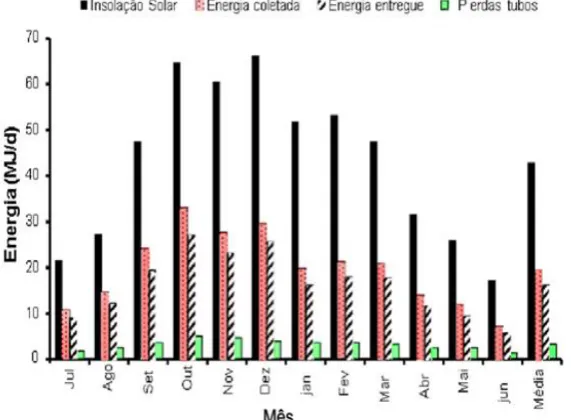
Fig. 3.1 shows the average monthly and annual daily incoming solar insolation on the surface energy of the collected collector and delivered to the hot water tank, and supply pipes losses.
The average monthly global solar collector daily insolation at the surface ranged from 17.3 MJ / d in July and 66.2 MJ/d in December, energy collected ranged from 7.2 MJ/d in July and 33.1 MJ/d in October, the energy delivered varied between 5.8 MJ/d in July and 27.0 MJ/d in October, while the loss of feeding tubes ranged from 1.4 MJ/d in December and 5.0 MJ/d in October.
The average annual daily solar insolation on the collector surface was 43.0 MJ/d, the collected energy was 19.6 MJ/d, provided energy was 16.2 MJ/d; loss in the supply pipe was 3.2 MJ/d. For an annual global solar insolation on the collector surface 15 680.4 MJ, a total of 7 150.4 MJ was collected when 5 924.0 MJ was delivered to the hot water tank.
Second [3], analyzed the annual performance solar FPCs manufactured in India, with values ranging between 5139 MJ delivered to the hot water tank and 7024 MJ collected.
Heat losses through the circuit occurred especially at high temperatures in the output hopper. The total annual loss of heat in the feed pipe for the SWHS was 1 171.7 MJ corresponding to 16.4% of the energy collected by the FPC and 19.8% of the energy supplied to the hot water tank. The feed tube length must therefore be kept as short as possible and all joints insulation to reduce heat losses. However, this was not the case for our test equipment from the hot water tank was located next to the shower where the FPC was installed.
Fig. 3.1 - Monthly Average And Annual Sunstroke Daily On Global Solar Collector Surface, Collected Energy, Give And Losses In Power Tubes.
Source: Author.
3.2 Efficiency of the system and efficiency of the solar collector.
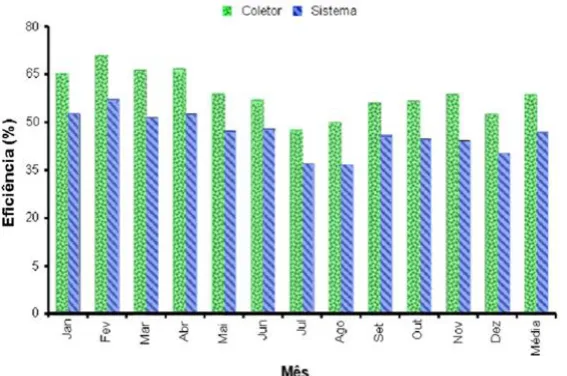
It appears in Fig. 3.2 monthly average daily solar collector efficiency. The average daily solar collector ranged from 38.2% in July to 69% in February, while the system's efficiency ranged from 38.3% in June to 59.8% in September.
Fig. 3.2 - Monthly Average Daily Collector Efficiency And System Efficiency. Source: Author
IV.
CONCLUSIONS
The analysis of the energy performance throughout the period of SWHSs commonly installed with FPC was performed using a prototype rattlesnake - PR. The SWHS is designed and operated to mimic the operation of real life taking into account the interaction between the FPC and the user.
The results showed that for a total solar insolation on the surface of the collector 15 680.4 MJ (corresponding to 4.35 kW and 1.08 KW/m2), a total of 7 150.4 MJ was collected when 5 924.0 MJ was delivered to the hot water tank. For solar fraction was 32.2%.
Average daily collected energy, energy provided by the solar plate, supply tubes were losses of 19.6 MJ / d, 16.2 MJ / 3.2 MJ / d, respectively.
The average daily solar collector ranged from 38.2% in July to 69% in February, while the system's efficiency ranged from 38.3% in June to 59.8% in September. The average annual efficiency of solar collector was 60.6%, while the average efficiency of the system was 52.8%.
The maximum temperature recorded in flat plate collector outlet temperature was 69 ⁰C, while the total annual loss of heat to the supply pipe was 1 171.7 MJ SWHS corresponding to 16.4% of the energy collected by the FPC and 19, 8% of the energy supplied to the hot water tank.
V.
ACKNOWLEDGEMENTS
I thank Professor Carlos Itsuo Yamamoto, an immense honor and pride to have it for this walk, do not forget his eternal teachings, and his advice invaluable confiança.Manifesto my gratitude to all teachers UNIOESTE campus and the indispensable support of PIPE LACAUT and Funpar.
REFERENCES
[1] European Standards, CSN EN 12975-2 e Thermal Solar Systems and Compo- nents e Solar Collectors e Part 1: General Requirements (2006).
[2] ASHRAE-93, Methods of Testing to Determine the Thermal Performance of Solar Collectors, ASHRAE, Atlanta, 2003.
[3] R.C. Tiwari, A. Kumar, S.K. Gupta, G.D. Sootha, Thermal performance of flat- plate solar collectors manufactured in India, Energy Conversion and Man- agement 31 (4) (1991) 309e313.