e-ISSN: 2278-7461, p-ISSN: 2319-6491
Volume 8, Issue 1 [January 2019] PP: 83-91
Experimental Investigation on The Influence of Temperature on
The Adsorption of Henna Extract on Kaolinite in Reducing
Surfactant Adsorption
Mohd Syazwan Mohd Musa
1, Wan Rosli Wan Sulaiman
1, Zaiton Abdul Majid
2,
Zulkifli Abdul Majid
3, Ahmad Kamal Idris
4, Kourosh Rajaei
11Department of Petroleum Engineering, School of Chemical and Energy Engineering, Faculty of Engineering,
UniversitiTeknologi Malaysia, 81310 UTM, Johor Bahru, Malaysia
2
Department of Chemical, Faculty of Science, UniversitiTeknologi Malaysia
3UTM-MPRC Institute for Oil and Gas, UniversitiTeknologi Malaysia
4Department of Petroleum Engineering, Faculty of Geoscience and Petroleum Engineering, UniversitiTeknologi
PETRONAS, 32610 Bandar Seri Iskandar, Perak DarulRidzuan, Malaysia Corresponding Author: Mohd Syazwan Mohd Musa
ABSTRACT
: The adsorption ability of henna extract as anenvironment-friendly and easily availablesacrificial agent was investigated. Fourier transform infrared-attenuated total reflectance (FTIR-ATR) was used to characterized henna extract and kaolinite. The adsorption of henna extract on kaolinite was done using Ultraviolet-visible spectroscopy (UV-Vis). The influence of temperature on the henna extract adsorption on kaolinite was studied. The mechanisms of the adsorption process were interpreted. Also, henna extract performances in reducing the adsorption of surfactant were assessed. The outcome shows that henna extract adsorption on kaolinite was decreased with increasing temperature. The adsorption value decreased from 7.88 to 7.04 mg/g from the temperature of 25oC to 75oC due to the increased of the kinetic energies of the henna extract molecules. A reduction of 38% of surfactant adsorption was observed and showed a profound drop in the adsorption of surfactant in the presence of henna extract suggesting a possibility to be utilized as a sacrificial agent in reducing the adsorption of surfactant.
Keywords: Henna extract, Adsorption, Kaolinite, Temperature.
---Date of Submission: 10-05-2019 ---Date of acceptance:27-05-2019
---I.
INTRODUCTION
Surfactant flooding has performed a vital part in enhanced oil recovery (EOR) by being utilized to reduce the interfacial tension (IFT) of oil and water to improve the displacement efficiency through oil recovery [1]. However, the surfactant adsorption on reservoir rock may impact the deprivation of the concentration of surfactant, which may yield them less competent and unproductive [2].
Due to the adsorption phenomenon of surfactants, endeavors have been made to lessen the adsorption of surfactant on reservoir rocks. A few investigations have been done on the usage of similarly charged surfactant on the same surface charge of the rock and concluded that anionic surfactant adsorption is decreased on sandstone, and the adsorption of cationic surfactant is decreased on carbonate owing to the repulsion of electrostatic between the adsorbent and the type of surfactants used [3,4].
Applications of sacrificial agent (SA) are thought to be a promising method in reducing surfactant adsorption. The SA is a material that is injected in a way to significantly inhibit or conceal all probable adsorption sites of the rock within the hydrocarbon formation. Weston et al. [5] have found that the capability of the molecules of surfactant in forming admicelles on the solid surface is the primary reason adsorption occurs. The principle reason SA strategy is exceptionally engaging for is to keep the development of these admicelles.
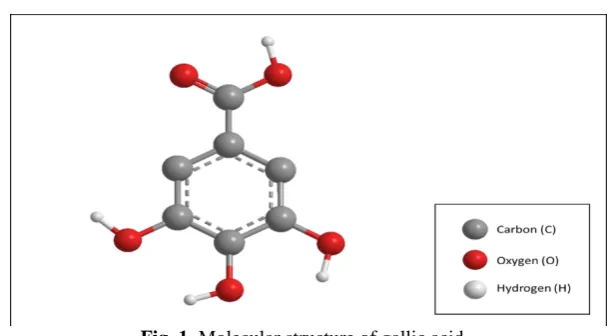
Fig. 1. Molecular structure of gallic acid.
The adsorption of surfactant at various temperatures have been investigated by some researchers. Temperature significantly influences the adsorption of surfactant on reservoir rock surface as specified by Beraet al. [11]. They came to the conclusion that with an increase in temperature, the adsorption capacity decreases. These observations are consistent with the one investigated by Yekeenet al.[12] and Khan & Zareen[13]who uncovers the trend of declining of adsorption with respect to the increase of temperatures. Be that as it may, the influence of temperature on the adsorption of henna extract on kaolinite is still unclear. Furthermore, there is an absence of detailed knowledge of the effect of temperature on the ability of henna extract as an SA in reducing surfactant adsorption.
The inspiration driving this work is to grasp a comprehension into the adsorption behavior of henna extract on kaolinite and its ability in reducing surfactant adsorption with the influence of temperature. The mechanisms of the adsorption process were analyzed. This study expects to validate to the point that henna extract could be used as an SA in minimalizing the surfactant adsorption.
II.
MATERIALS AND METHODS
2.1. Materials
Fresh henna leaves were gathered from henna trees in Johor, Malaysia. Methanol of 99.9% (Acros Organics (USA)) was used as the solvent in methanolic extraction. Anionic surfactant, sodium dodecyl sulfate (SDS) of 98% purity with a molecular weight of 288.38 g/mol manufactured by Fisher Chemical (UK) was used for the surfactant adsorption. Kaolinite was obtained from Fisher Chemical (UK). Deionized water (DIW) was used for all experiments. All substances utilized were of scientific quality and were used as acquired devoid of added purifications.
2.2. Preparation of Henna Powder
The fresh leaves of henna were dried at room temperature and then grounded into powder using an electric blender. The henna powder was carefully packed in an airtight BPA free container and stored under room temperature until further used.
2.3. Characterization of Henna Extract and Kaolinite 2.3.1. FTIR-ATR Analysis
The FTIR-ATR was conducted using Perkin Elmer FTIR Spectrometer (USA). Functional groups of henna extract and kaolinite were identified by the spectrometer by observing the vibrational motion of bonds in the molecules. The spectra were measured in the range of 650-4000 cm-1 with a scan resolution of 2 cm-1. The FTIR data were documented in the transmittance mode. The pattern of the spectrum was examined and compared to the IR absorption table to determine the functional groups encompassed in the samples.
2.3.2. XRD Analysis
The kaolinite sample was further characterized by using the X-ray diffraction (XRD) in the continuous scanning mode on SmartLab X-Ray Diffractometer (Rigaku, Japan) operated at 40 kV and a current of 30 mA with Cu-Kβ filter and Cu-Kα radiation source (λ = 0.154056 nm). Particle size ought to be fine to attain a tolerablestatistical representation of the components and their numerous diffracting crystal planes and to evade diffraction-related artifacts [14]. All the patterns were collected at room temperature with steps of 0.02o in the 2θ range of 3o-100o. The measurements were taken at room temperature with a scan rate of 8.2551o per minute.
Solutions of henna extract were prepared in standard 250 ml Erlenmeyer flasks. Henna extract was weighed and transferred into the flask, then DIW water was added to the required volume. Henna extract concentrations were prepared in the range of 3000 to 8000 mg/L. Surfactant solutions were preparedsimilarly as henna extract solutions. Different concentrations of surfactant were preparedin the range of 1000 to 5000 mg/L.
2.5. Adsorption Experiments
The adsorption of henna extract on kaolinite was determined using depletion method, that was, the differences between the concentrations of henna extract before and after adsorption on kaolinite. Kaolinite of 6 g was mixed with 30 mL of henna extract solutions. The mixture was then agitated in a temperature controller shaker using IKA KS 3000 I control (USA)at 180 rpm for 24 hours at 25oC under atmospheric pressure to reach equilibrium. They were then centrifuged using Rotofix 32A (Hettich Zentrifugen, Germany) at 4000 rpm for 30 min to isolate the buoyant liquid. The concentrations of henna extract in the buoyant liquid was measured with a UV-Vis spectrophotometer. Adsorption amount at equilibrium time, qe (mg/g), was calculated using (Equation (1)). Same procedures were applied in calculating the adsorption of surfactant on kaolinite. Surfactant concentrations of 1000 mg/L to 5000 mg/L were chosen to determine the surfactant adsorption on kaolinite. In evaluating henna extract performances in reducing surfactant adsorption on kaolinite, the solution mixtures of henna extract and kaolinite were filtered out, leaving only kaolinite behind. Then, 30 mL of surfactant solution (concentration of 2000 mg/L) were mixed with the pretreated kaolinite with henna extract solution. The mixtures were then left to reach equilibrium for 24 hours throughout which they were recurrently shaken in a temperature controller shaker at 180 rpm. After equilibrium was reached, the mixtures were centrifuged, and the buoyant liquid was examined using UV-Vis spectrophotometer. Adsorption amount at equilibrium time, qe (mg/g), was calculated using (Equation (1)).
qe = Co− Ce × V
m (1)
where qe is the adsorption of henna extract and surfactant on kaolinite (mg/g), Co and Ce are the henna extract and surfactant concentrations before and after the adsorption experiment, respectively (mg/L), V is the volume of henna extract and surfactant solutions added to the volumetric flask (L) and m is the total mass of the kaolinite added (g).
III.
RESULTS AND DISCUSSION
3.1. Characterization of Henna Extract and Kaolinite 3.1.1. FTIR Analysis
Fig. 2. FTIR-ATR spectrum of henna extract.
Table 1 Assignment of functional group frequency in the spectra of henna extract.
Wavenumber (cm-1) Functional groups
3311 OH group
2926, 2855 Aliphatic CH group
1712, 1632 C=O group
1449, 1400, 1366, 1231 C=C group in aromatic benzene ring
1030 C-OH of phenolic group
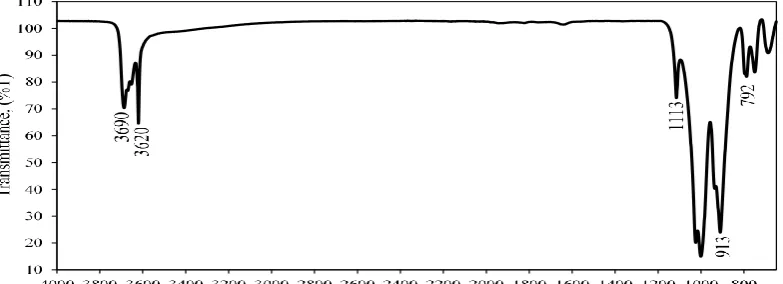
Fig. 3 presents the infrared spectra of kaolinite. The FTIR-ATR spectrum of kaolinite shows bands at 3690, 3669, and 3651 cm-1 credited to the hydroxyl modes of the inner surface hydroxyl groups and the absorption at 3620 cm-1 was attributed to the hydroxyl modes of the inner hydroxyl groups as similar bands were conveyed by Balan et al. [20] and Li et al. [21]. Si-O and Si-O-Si stretching vibration were seen at 1113 cm-1, 1023 cm-1,and 1000 cm-1 as similar results were obtained by Dawodu and Akpomie [22]. The absorption band at 938 cm-1tallies to the inner surface Al-OH group whereas the band at 913 cm-1 resembles the inner Al-OH group and the bands were close to the ones reported by Duarte-Silva et al. [23]. The bands that appeared at 792, 755, and 685 cm-1were attributed to Si-O-Al and OH group. These groups are comparable to the ones determined by Ming and Spark [24] and Saikia and Parthasarathy [25]. A summary of the IR spectra of kaolinite is displayed in Table 2.
Fig. 3. FTIR-ATR spectrum of kaolinite.
Table 2 Assignment of functional group frequency in the spectra of kaolinite.
Wavenumber (cm-1) Assignments
3690, 3669, 3651 Hydroxyl modes of inner surface hydroxyl groups
3620 Hydroxyl modes of inner hydroxyl groups
1113, 1023, 1000 Si-O and Si-O-Si groups
938 Inner surface Al-OH group
913 Inner Al-OH group
792, 755, 685 Si-O-Al and OH groups
3.1.2. XRD Analysis
Fig. 4.XRD diffractogram of kaolinite.
3.2. Adsorption Experiments
3.2.1. Effect of Temperature on The Adsorption of Henna Extract on Kaolinite
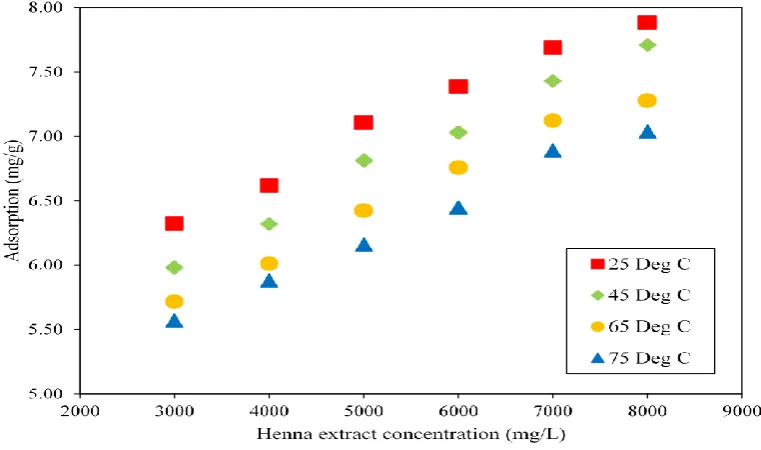
The effect of temperature on henna extract adsorption was studied at 25, 45, 65 and 75oC. Fig. 5 depicted henna extract adsorption at various concentrations on kaolinite at different temperatures.
Fig. 5. Adsorption of henna extract on kaolinite at different temperature.
A decrease in henna extract adsorption on the adsorbent with an increase in temperature was observed. The adsorption of henna extract on kaolinite decreased from 7.88 to 7.04 mg/g with increasing temperature. Increase in temperature causes an increase in the mobility of henna extract molecules. Hence, the chance of physical contact between henna extract molecules and the kaolinite surface decreases [26]. Furthermore, when the temperature increased further, the kinetic energies of henna extract molecules became higher than the potential attractive forces of the active sites on the surface of kaolinite [27], leading to a decrease in the adsorption of henna extract on kaolinite, which may explain this behavior.
temperature leads to a considerable decrease in the maximum quantity adsorption of surfactants. Overall, the reduction in adsorption at higher temperature is expected as an increase in the kinetic energy of the species which then resulted in a decrease of aggregation of the henna extract molecules on the surface of kaolinite [31].
3.2.2. Influence of Temperature on The Adsorption of Surfactant on Kaolinite without The Presence of Henna Extract
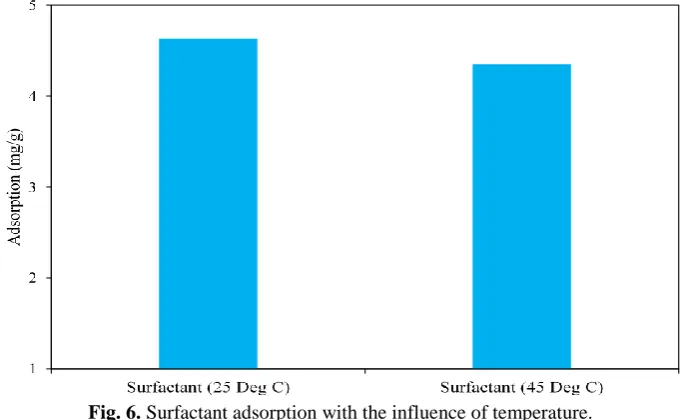
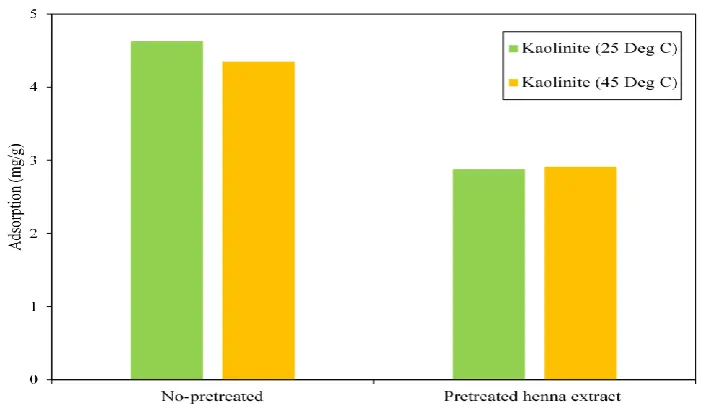
Surfactant adsorption in ambient temperature (25oC) and temperature of 45oC was executed,and the results were exhibited in Fig. 6. From the figure, the adsorption decreased when increasing the temperature from 25oC to 45oC.
Fig. 6. Surfactant adsorption with the influence of temperature.
The reduced adsorption from 4.63 mg/g to 4.35 mg/g for kaolinite, is owing to the active molecules that have high kinetics energies which made the interactions between the kaolinite surface reduced. Some of the studies which investigated the effect of temperature in surfactant adsorption, agree with the results [32,33].
3.2.3. Influence of Temperature on The Adsorption of Surfactant on Kaolinite with The Presence of Henna Extract
Henna extract performance in reducing surfactant adsorption at different temperature was investigated. Based on results in section 3.2.2, the temperature of 25oC and 45oC gave the highest henna extract adsorption rather than 65oC and 75oC, thus these conditions were further evaluated in the surfactant adsorption.
Fig. 7. Henna extract performances on the reduction of the surfactant adsorption with the influence of temperature.
Although henna extract was successful in reducing the surfactant adsorption at the temperature of 45oC, nevertheless, a declined in the percentage of surfactant adsorption with henna extract was observed. The adsorption decreased from 38% to 33% and can be due to the diminished binding strength of henna extract as discussed in section 3.2.2 above. As a consequence, surfactant molecules were capable of binding to the kaolinite surface and henna extract molecules via hydrogen bonding and hydrophobic interactions, thus, produced less surfactant molecules.
IV.
CONCLUSION
The existence of these functional groups in henna extract, hydroxyls, carbonyls, phenolics, aromatic benzene ring, and aliphatic carbon-hydrogen groups made the adsorption process conceivable. Kaolinite was characterized and used as an adsorbent to investigate the influence of temperature on henna extract adsorption on kaolinite and to evaluate the performances of henna extract as an SA in reducing surfactant adsorption. The adsorption of henna extract with several temperatures has been investigated. It was noticed that by increasing the temperature from 25oC to 75oC, the adsorption of henna extract was decreasing. This was because of the henna extract molecules gained higher kinetic energies when the temperature was raised, consequently, reduced the time spent on the surface of kaolinite. The experimental results at different temperatures established that by increasing the temperature, the adsorption of surfactant decreased. Similar findings were obtained with the henna extract adsorption. It was observed that the highest adsorption occurred was at room temperature rather than elevated ones. Higher temperatures tend to increase the kinetic energies of the molecules and hence, increase the entropy of the systems. This led to the shorter time taken for the molecules to make contact with the kaolinite surface, therefore, caused in the decrease of the molecule’s aggregation on the surface of the adsorbent. When the temperature was at 25oC, a reduction of 38% of the surfactant adsorption on kaolinite can be perceived. This is due to the coating of the henna extract on the surface of the adsorbent, which led to the inability of the surfactant to adsorb on the surface of kaolinite. However, upon increasing the temperature to 45oC, a decrease of 33% in the surfactant adsorption was noticed. The rationality behind this was, by the increased kinetic energies of the molecules. Since some of the henna extract molecules could not afford to adsorb on the surface of kaolinite, there was a possibility that some of the surfactant molecules contentedly adsorbed on the surface leading to the increased quantity of surfactant adsorption.
ACKNOWLEDGEMENTS
The authors wish to thank the Ministry of Higher Education (MOHE), Malaysia, and UniversitiTeknologi Malaysia for assisting this research through Fundamental Research Grant Scheme (R.J130000.7846.4F931) and Research University Grant (12429).
REFERENCES
[1]. A.A. Olajire, Review of ASP EOR (alkaline surfactant polymer enhanced oil recovery) technology in the petroleum industry:
Prospects and challenges, Energy. 77 (2014) 963–982. doi:10.1016/j.energy.2014.09.005.
[2]. A. Barati, A. Najafi, A. Daryasafar, P. Nadali, H. Moslehi, Adsorption of a new nonionic surfactant on carbonate minerals in
doi:10.1016/j.cherd.2015.10.047.
[3]. R. Zhang, P. Somasundaran, Advances in adsorption of surfactants and their mixtures at solid/solution interfaces, Adv. Colloid Interface Sci. 123–126 (2006) 213–229. doi:10.1016/j.cis.2006.07.004.
[4]. M. Ishiguro, L.K. Koopal, Surfactant adsorption to soil components and soils, Adv. Colloid Interface Sci. 231 (2016) 59–102. doi:10.1016/j.cis.2016.01.006.
[5]. J.S. Weston, J.H. Harwell, B.J. Shiau, M. Kabir, Disrupting admicelle formation and preventing surfactant adsorption on metal oxide surfaces using sacrificial polyelectrolytes, Langmuir. 30 (2014) 6384–6388. doi:10.1021/la501074x.
[6]. S. Rajendran, M. Agasta, R. Bama Devi, B. Shyamala Devi, K. Rajam, J. Jayasundari, Corrosion inhibition by an aqueous extract of
Henna leaves (Lawsonia Inermis L), Zaštita Mater. 50 (2009) 77–84.
[7]. H.G. Chaudhari, R.T. Vashi, The study of henna leaves extract as green corrosion for mild steel in acetic acid, J. Fundam. Appl. Sci.
8(2) (2016) 280–296.
[8]. A. Moslemizadeh, S.R. Shadizadeh, M. Moomenie, Experimental investigation of the effect of henna extract on the swelling of sodium bentonite in aqueous solution, Appl. Clay Sci. 105–106 (2015) 78–88. doi:10.1016/j.clay.2014.12.025.
[9]. A. Rahmat, S. Edrini, P. Ismail, T.Y.Y. Hin, M.F. Abu Bakar, Chemical constituents, antioxidant activity and cytotoxic effects of
essential oil from strobilanthes crispus and lawsonia inermis, J. Biol. Sci. 6 (2006) 1005–1010. doi:10.3923/jbs.2006.1005.1010.
[10]. A. Ostovari, S.M. Hoseinieh, M. Peikari, S.R. Shadizadeh, S.J. Hashemi, Corrosion inhibition of mild steel in 1 M HCl solution by
henna extract: A comparative study of the inhibition by henna and its constituents (lawsone, gallic acid, α-d-glucose and tannic acid), Corros. Sci. 51 (2009) 1935–1949. doi:10.1016/j.corsci.2009.05.024.
[11]. A. Bera, T. Kumar, K. Ojha, A. Mandal, Adsorption of surfactants on sand surface in enhanced oil recovery: Isotherms, kinetics and
thermodynamic studies, Appl. Surf. Sci. 284 (2013) 87–99. doi:10.1016/j.apsusc.2013.07.029.
[12]. N. Yekeen, M.A. Manan, A.K. Idris, A.M. Samin, Influence of surfactant and electrolyte concentrations on surfactant Adsorption
and foaming characteristics, J. Pet. Sci. Eng. 149 (2017) 612–622. doi:10.1016/j.petrol.2016.11.018.
[13]. M.N. Khan, U. Zareen, Sand sorption process for the removal of sodium dodecyl sulfate (anionic surfactant) from water, J. Hazard.
Mater. 133 (2006) 269–275. doi:10.1016/j.jhazmat.2005.10.031.
[14]. V. Singh, H.M. Agrawal, Qualitative soil mineral analysis by EDXRF, XRD and AAS probes, Radiat. Phys. Chem. 81 (2012)
1796–1803. doi:10.1016/j.radphyschem.2012.07.002.
[15]. M. Brahmi, W. Ahmed, F. Olfa, H. Abdennaceur, Henna wood as an adsorptive material for bentazon, African J. Biotechnol. 13 (2014) 3597–3606. doi:10.5897/ajb2013.13000.
[16]. I. Ebrahimi, M.P. Gashti, Extraction of polyphenolic dyes from henna, pomegranate rind, and Pterocarya fraxinifolia for nylon 6 dyeing, Color. Technol. 132 (2015) 162–176. doi:10.1111/cote.12204.
[17]. N.E. Safie, N. Ahmad Ludin, M.S. Su’ait, N.H. Hamid, S. Sepeai, M.A. Ibrahim, M.A. Mat Teridi, Preliminary study of natural
pigments photochemical properties of Curcuma longa L. and Lawsonia inermis L., Malaysian J. Anal. Sci. 19 (2015) 1243–1249.
[18]. A. Hamdy, N.S. El-Gendy, Thermodynamic, adsorption and electrochemical studies for corrosion inhibition of carbon steel by
henna extract in acid medium, Egypt. J. Pet. 22 (2013) 17–25. doi:10.1016/j.ejpe.2012.06.002.
[19]. S. Saadaoui, M.A. Ben Youssef, M. Ben Karoui, R. Gharbi, E. Smecca, V. Strano, S. Mirabella, A. Alberti, R.A. Puglisi,
Performance of natural-dye-sensitized solar cells by ZnO nanorod and nanowall enhanced photoelectrodes, Beilstein J. Nanotechnol. 8 (2017) 287–295. doi:10.3762/bjnano.8.31.
[20]. E. Balan, A. Saitta, E.T.B. Alan, A.M.A.S. Aitta, F.R.M. Auri, G.E.C. Alas, First-principles modeling of the infrared spectrum of
kaolinite, Am. Mineral. 86 (2001) 1321–1330. doi:10.2138/am-2001-11-1201.
[21]. Z. Li, L. Schulz, C. Ackley, N. Fenske, Adsorption of tetracycline on kaolinite with pH-dependent surface charges, J. Colloid Interface Sci. 351 (2010) 254–260. doi:10.1016/j.jcis.2010.07.034.
[22]. F.A. Dawodu, K.G. Akpomie, Simultaneous adsorption of Ni(II) and Mn(II) ions from aqueous solution unto a Nigerian kaolinite
clay, J. Mater. Res. Technol. 3 (2014) 129–141. doi:10.1016/j.jmrt.2014.03.002.
[23]. R. Duarte-Silva, M.A. Villa-García, M. Rendueles, M. Díaz, Structural, textural and protein adsorption properties of kaolinite and
surface modified kaolinite adsorbents, Appl. Clay Sci. 90 (2014) 73–80. doi:10.1016/j.clay.2013.12.027.
[24]. H. Ming, K.M. Spark, Radio frequency plasma-induced hydrogen bonding on kaolinite, J. Phys. Chem. B. 107 (2003) 694–702.
doi:10.1021/jp025803i.
[25]. B.J. Saikia, G. Parthasarathy, Fourier Transform Infrared Spectroscopic Characterization of Kaolinite from Assam and Meghalaya,
Northeastern India, J. Mod. Phys. 01 (2010) 206–210. doi:10.4236/jmp.2010.14031.
[26]. A. Hassani, F. Vafaei, S. Karaca, A.R. Khataee, Adsorption of a cationic dye from aqueous solution using Turkish lignite: Kinetic,
isotherm, thermodynamic studies and neural network modeling, J. Ind. Eng. Chem. 20 (2014) 2615–2624. doi:10.1016/j.jiec.2013.10.049.
[27]. M. Uysal, I. Ar, Removal of Cr(VI) from industrial wastewaters by adsorption. Part I: Determination of optimum conditions, J. Hazard. Mater. 149 (2007) 482–491. doi:10.1016/j.jhazmat.2007.04.019.
[28]. Y. Chen, D. Lu, Applied Clay Science CO 2 capture by kaolinite and its adsorption mechanism, Appl. Clay Sci. 104 (2015) 221–
228. doi:10.1016/j.clay.2014.11.036.
[29]. T. De Oliveira, R. Guégan, T. Thiebault, C. Le Milbeau, F. Muller, V. Teixeira, M. Giovanela, M. Boussafir, Adsorption of diclofenac onto organoclays: Effects of surfactant and environmental (pH and temperature) conditions, J. Hazard. Mater. 323 (2017) 558–566. doi:10.1016/j.jhazmat.2016.05.001.
[30]. S. Paria, K.C. Khilar, A review on experimental studies of surfactant adsorption at the hydrophilic solid-water interface, Adv. Colloid Interface Sci. 110 (2004) 75–95. doi:10.1016/j.cis.2004.03.001.
[31]. P.C. Pavan, E.L. Crepaldi, J.B. Valim, Sorption of anionic surfactants on layered double hydroxides, J. Colloid Interface Sci. 229
(2000) 346–352. doi:10.1006/jcis.2000.7031.
[32]. S. Zendehboudi, M.A. Ahmadi, A.R. Rajabzadeh, N. Mahinpey, I. Chatzis, Experimental study on adsorption of a new surfactant
onto carbonate reservoir samples-application to EOR, Can. J. Chem. Eng. 91 (2013) 1439–1449. doi:10.1002/cjce.21806.
[33]. M.S. Kamal, I.A. Hussein, A.S. Sultan, Review on Surfactant Flooding : Phase Review on Surfactant Flooding : Phase Behavior,