FACIAL EXPRESSION ANALYSIS OF STUDENTS IN CLASSROOM USING
MACHINE LEARNING TECHNIQUE
Department of Computer Science and Engineering, Coimbatore Institute
A R T I C L E I N F O
INTRODUCTION
Facial expression plays a major role in many
such application lies in the factor of analyzing the human mind set and their mood analysis in a particular event or situation or influence of any environment. In the current era students faces various emotional sequences when facing the
their own. Students show varied expression when going to school every day. There may be various causes for their mood and change in facial expression but it is the duty of every faculty/trainer in high priority to identify such facial expressions that every student expresses. Only few students get notified in the eye of the faculty at an instant of time and rest of the students are uncovered under the faculty observation. This stands as the motivation to take up the project and not as a blaming factor as the human capacity is limited to certain extent.
The constant monitoring of students and identifying the students’ expression is difficult to judge manually and if the events are abnormal it is a near impossible task as it requires a workforce and their constant attention. This creates a need to automate the identification of the facial expression in every child. Also, there is a need to identify the expression under which frame and under what situation the student is prone to the expression.
International Journal of Current Advanced Research
ISSN: O: 2319-6475, ISSN: P: 2319-6505,
Available Online at www.journalijcar.org
Volume 8; Issue 04(A); April 2019; Page No.
DOI: http://dx.doi.org/10.24327/ijcar.2019
Copyright©2019 Abirami S.P., Poornima S and Kousalya G
License, which permits unrestricted use, distribution, and reproduction in any medium, provided the original work is properly Article History:
Received 6th January, 2019
Received in revised form 15th
February, 2019
Accepted 12th March, 2019
Published online 28th April, 2019
Key words:
Facial Expression; Feature Extraction; Support Vector Machine; SVM Classification
*Corresponding author: Abirami S.P
Department of Computer Science and Engineering, Coimbatore Institute of Technology
FACIAL EXPRESSION ANALYSIS OF STUDENTS IN CLASSROOM USING
MACHINE LEARNING TECHNIQUE
Abirami S.P., Poornima S and Kousalya G
Department of Computer Science and Engineering, Coimbatore Institute of Technology
A B S T R A C T
Facial Expression recognition is an important aspect in building pervasive environments. Such Facial expression recognition plays a key role in many domains and applications, such as: Video Retrieval, Video Surveillance, Health Care, Human
and Entertainment Industry. The aim of the paper is to analyze the facial expression of the students in a classroom which in turn helps in motivating and increasing the students’ attention. The methodology involves expression detection that uses Open Source Computer Vision Library (Open CV) and Dlib for Feature extraction which detects the location of facial landmark points and finally classifies the facial expressions that is implemented using SVM (Support Vector Machines). This recognition of facial expression provides insights about the following findings such as i) the students who are not attentive inside t classroom ii) students distraction rate iii) time interval between various expressions. This in turn helps the faculty in improvising their teaching learning process. The idea could also be further enhanced in a live video streaming for the entire educa
identifies the students’ emotion in every part of the campus with the availability of high computing capacity.
Facial expression plays a major role in many applications. One such application lies in the factor of analyzing the human mind set and their mood analysis in a particular event or situation or influence of any environment. In the current era students faces various emotional sequences when facing the environment on their own. Students show varied expression when going to school every day. There may be various causes for their mood and change in facial expression but it is the duty of every faculty/trainer in high priority to identify such facial sions that every student expresses. Only few students get notified in the eye of the faculty at an instant of time and rest of the students are uncovered under the faculty observation. This stands as the motivation to take up the ng factor as the human capacity is
The constant monitoring of students and identifying the expression is difficult to judge manually and if the events are abnormal it is a near impossible task as it requires a workforce and their constant attention. This creates a need to automate the identification of the facial expression in every there is a need to identify the expression under which frame and under what situation the student is prone to
This analysis will aid the faster judgment of unusual behavior shown by the students. Identification of such facial expression in students inside the classroom can be used as a biomarker to identify the interestingness of the students towards the class they attend. Also the identification of expression when they enter the school campus can be used to analyze the students’ mood in attending the school. This could bring an early analysis of the child towards the school and necessary counseling could be arranged.
The paper mainly focuses in identifying the students face through facial detection and the detected face is analyzed to identify the facial expression shown by the students.
Summary: The paper is organized in a way in which section 2 discusses the state of art that is related to the work specified in this paper, section 3 describes the methodology involved in the implementation of the idea and section 4 provides the acquired insights made on facial expression of students and their impacts through this paper implementation respectively.
State of Art
The state of art of this paper majorly covers on the facial detection, feature analysis and classification. As the novelty of the paper lies in the application, the state of art covers the positive and negative impacts of the techniques, comparison on various algorithms used for the implementation and motivation for choosing the application.
International Journal of Current Advanced Research
6505, Impact Factor: 6.614
www.journalijcar.org
; Page No.18072-18077
//dx.doi.org/10.24327/ijcar.2019.18077.3446
Abirami S.P., Poornima S and Kousalya G. This is an open access article distributed under the Creativ License, which permits unrestricted use, distribution, and reproduction in any medium, provided the original work is properly
Department of Computer Science and Engineering,
FACIAL EXPRESSION ANALYSIS OF STUDENTS IN CLASSROOM USING
of Technology
Facial Expression recognition is an important aspect in building pervasive environments. recognition plays a key role in many domains and applications, such as: Video Retrieval, Video Surveillance, Health Care, Human-Computer Interaction and Entertainment Industry. The aim of the paper is to analyze the facial expression of the lassroom which in turn helps in motivating and increasing the students’ attention. The methodology involves expression detection that uses Open Source Computer Vision Library (Open CV) and Dlib for Feature extraction which detects the location of ndmark points and finally classifies the facial expressions that is implemented using SVM (Support Vector Machines). This recognition of facial expression provides insights about the following findings such as i) the students who are not attentive inside the classroom ii) students distraction rate iii) time interval between various expressions. This in turn helps the faculty in improvising their teaching learning process. The idea could also be further enhanced in a live video streaming for the entire educational institution that identifies the students’ emotion in every part of the campus with the availability of high
This analysis will aid the faster judgment of unusual behavior shown by the students. Identification of such facial expression in students inside the classroom can be used as a biomarker to identify the interestingness of the students towards the class they attend. Also the identification of expression when they enter the school campus can be used to analyze the students’ attending the school. This could bring an early analysis of the child towards the school and necessary
The paper mainly focuses in identifying the students face through facial detection and the detected face is analyzed to
dentify the facial expression shown by the students.
The paper is organized in a way in which section 2 discusses the state of art that is related to the work specified in this paper, section 3 describes the methodology involved in the ation of the idea and section 4 provides the acquired insights made on facial expression of students and their impacts through this paper implementation respectively.
The state of art of this paper majorly covers on the facial eature analysis and classification. As the novelty of the paper lies in the application, the state of art covers the positive and negative impacts of the techniques, comparison on various algorithms used for the implementation and
he application.
Research Article
The paper [4] presents an approach which eliminates geometric variability in emotion expression; thus, appearance features can be accurately used for facial expression recognition. Hence, a fixed geometric model is used for geometric normalization of images consisting facial structures. In addition Local Binary Patterns are utilized to represent facial appearance features.
Aleix Martinez et al [2] briefed on how expressions of emotion can be viewed at different intensity levels. On the contrary, the proposed model includes C classifiers, which can be classified under a precise grouping of expression.
The early screening method of facial expression identification initiates the process by face detection through Viola Jones algorithm. Viola, et.al proposed Viola Jones algorithm for face detection that proves to be for Haar Classifiers for more approximate facial detection and feature identification[6]. The algorithm undergoes Haar cascade classification where Jing- Wein Wang, et.al suggested an algorithm for facial feature specification that categorized the face into T shaped structure extracting eyes, nose and position as three feature dimensions[7].
A facial feature tracker could gather a combination of displacement factors from feature motion obtained from images or a live motion video and is subsequently used to train an SVM classifier [18]. Such classifications classify the expressions that are unseen by the humans. Such kinds of SVM based expression classifications are notified in common in adhoc based, incrementally trained architecture for person - independent expression identification and analysis[6][8].
Sathik et al [5] deals with the experiment of finding whether the facial expression can be considered as a means to analyze the behavior of the students in the classroom. The results from this paper have proved that the facial expression is the most common used means of communication towards a lecture delivered by the teacher.
The paper [6] presents a method for improving the efficiency of teaching in education industry using a fusion feature and KNN classifier. This focuses on analyzing the students based on five different types of expressions.
Yelin Kim et al [9] focused on the survey of the components and technologies to be considered both on technological and operational level for a upcoming emotionally dependent smart classroom. This concept of smart classroom provides real time immediate feedback which helps the presenter to improve their effectiveness towards teaching, their communication skills and other aspects. This paper provides a detailed study of the technologies and challenges involved in designing an effective AI based smart classroom.
The paper [12] discusses on analyzing the emotions of the students in a lively face-to-face interaction inside the classroom. This paper considers the snapshots of the web recordings as the input and provides a web application which demands the user intervention to see the analysis of the student’s emotions.
Pedro et al [13] presents an approach to distinguish the levels of motivation of the students by taking the facial expression into consideration. This paper provides the results which confirm that the facial expressions are the most effective means to identify the student’s motivational level and helps the
teacher to improve the process of learning in students. Thus the analysis of the discussed papers provided the motivation to implement the proposed method.
METHODOLOGY
The major process flow of the proposed method lies in the fact that the image is captured and hence face is detected in the image. When more than one face is detected then face with maximum width and height is chosen for detection.
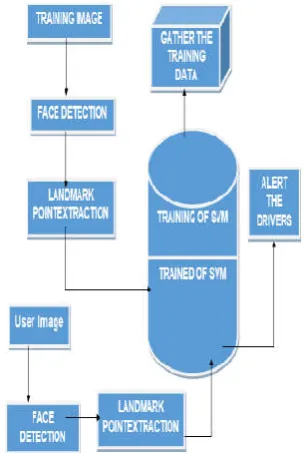
Fig 1 briefs the complete architecture of the proposed model for the facial expression analysis in classroom and various parts of the institution where student’s expression is much concerned.
Fig 1 System Architecture for emotion recognition
Detection of face by Viola Jones Algorithm
The eminent Viola-Jones Algorithm has been employed to detect the face in the input image. After detecting the face, we need to generate the landmarks or points along the corners and edges of the face, nose, eyes and mouth in a 2D space using D-Lib which is a cross platform library used for feature extraction. Once the images are trained we put the system under testing for classifying the emotion of an unknown person. This is done using a supervised learning model called Support Vector Machine (SVM).
The basic principle of Viola-Jones Algorithm is to scan a subspace of an image window which is capable of detecting faces in a given input image. There are three main process of the object detection framework. The first step in the input image is to turn the input image into an integral image through eqn (1).
' , '
( , )
( ', ')
x x y y
ii x y
i x y
(1)( , )x yWXYZi x y( , )ii Z( )ii W( )ii X( )ii Y( )
(2)The next portion of implementation is a method to construct a classifier through the selection of small number of priority features using AdaBoost technique. Within any image sub-space the total number of Harr-like features is much larger than the number of pixels. Hence the weak learner is constrained so that each weak classifier returned can depend on only a single feature. As a result of Ada boost technique implementation in each stage, every new weak classifier can be viewed as a feature selection process thus resulting in a greater insight that AdaBoost technique provides an efficient learning algorithm and strong bounds on generalization performance.
The next major task is a method for combining more complex classifiers in a cascade structure which dramatically increases the speed of the detector by focusing attention on important regions of the image.
Table I Algorithm For Cascade Classification Technique
Algorithm
Process 1: face recoding in live
Import numpy and cv2 Include cascade classifier of cv2 Read frames
Convert into gray scale
Record the frames for a specified time period (say 10sec) For every (x,y,z,h), include cv2.rectangle //draws the rectangle block in the frame
Process for live video recording of the faces
Process 2: face detection
Import cv2
Include cv2. Cascade classifier #Get list of all images
Convert image to grayscale using cv2.cvtColor(frame,cv2.COLOR_BGR2GRAY)
Detect face using 4 different classifiers Compare the faces classified in all 4 classifiers.
If face found in a classifier, save the face with frame coordinates(x,y,w,h)
Resixe the frame to an uniform size (say cv2.resize(gray, (350, 350))
Getting Landmarks from Faces Using D-Lib
After the image is cropped, the image is converted into a gray scale image and then to a Clahe-image which is created by adjusting the brightness and contrast of the face image. This is mainly done to make the feature extraction easier. After conversion the image is subjected to a predictor and detector function of Dlib class which finds the corners and edges of the face, nose, mouth and nose and finally generate landmark points for those features,
Each Landmark Point Contains 4 Points.
1. The X Co-ordinate 2. The Y Co-ordinate
3. The distance from the central tip of the nose 4. The angle of the landmark point
Using these features 268 points for each face is obtained. These values are used for classification of the emotion. These points are then identified as the input data to feed the classifier. Though the Dlib automatically identifies face in any frame, the face detection through Viola Jones improves much higher in the accuracy of facial classification with decreased processing capability in feature extraction process.
Classification of Expression Using SVM
After getting those landmark features we classify the images for training using SVM.
In this paper, the training data and training labels is obtained in the form of numpy arrays. SVM has many Kernels and the classification of images differ mainly based upon the kernels. Here in this project Linear Kernel method is employed and the training data(X) is fitted in the respective training label (Y) using Fit(x,y) function.
After training of all data images, we test the system by giving an image as input which is not already trained. These images are classified based on the probability of the emotion obtained using predict_proba() function of prediction data. After the finding the emotion, the emotion is analyzed with respect to time factor and variation of one emotion to another emotion is also observed.
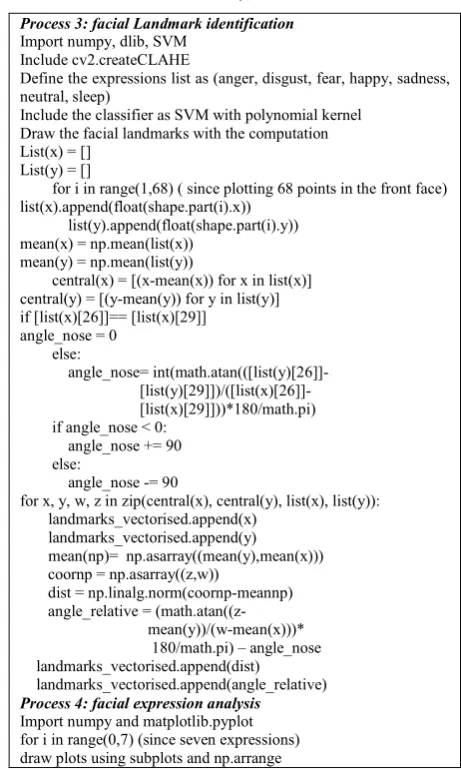
Table II Algorithms For Landmark Identification And Analysis
Process 3: facial Landmark identification
Import numpy, dlib, SVM Include cv2.createCLAHE
Define the expressions list as (anger, disgust, fear, happy, sadness, neutral, sleep)
Include the classifier as SVM with polynomial kernel Draw the facial landmarks with the computation List(x) = []
List(y) = []
for i in range(1,68) ( since plotting 68 points in the front face) list(x).append(float(shape.part(i).x))
list(y).append(float(shape.part(i).y)) mean(x) = np.mean(list(x))
mean(y) = np.mean(list(y))
central(x) = [(x-mean(x)) for x in list(x)] central(y) = [(y-mean(y)) for y in list(y)] if [list(x)[26]]== [list(x)[29]]
angle_nose = 0 else:
angle_nose= int(math.atan(([list(y)[26]]- [list(y)[29]])/([list(x)[26]]- [list(x)[29]]))*180/math.pi) if angle_nose < 0:
angle_nose += 90 else:
angle_nose -= 90
for x, y, w, z in zip(central(x), central(y), list(x), list(y)): landmarks_vectorised.append(x)
landmarks_vectorised.append(y) mean(np)= np.asarray((mean(y),mean(x))) coornp = np.asarray((z,w))
dist = np.linalg.norm(coornp-meannp) angle_relative = (math.atan((z- mean(y))/(w-mean(x)))* 180/math.pi) – angle_nose landmarks_vectorised.append(dist)
landmarks_vectorised.append(angle_relative)
Process 4: facial expression analysis
Import numpy and matplotlib.pyplot for i in range(0,7) (since seven expressions) draw plots using subplots and np.arrange
Dataset Description
random selection, 80 percent of the student’s expression was used for training and the remaining 20 percent was used for testing the application. On observation the average performance of the algorithm was found to be approximately 84% which proved to be an improved performance in facial expression recognition in crowd.
RESULT AND ANALYSIS
Training the Machine
The machine is trained by feeding sample images of every facial expression as a sample along with the available images in source to Github as shown in Fig 2
Fig 2 Face detection using OpenCV for training dataset
On training each of the seven classified array of facial expression, the sample of the trained data set will resemble Fig 3. The training of expressions is made by capturing the real time scenario of varied facial expressions of the students in the classroom so as to achieve better training data sets.
Fig 3 Sample images inside the selected dataset
Once the dataset is trained, on live execution of facial landmark will look alike in Fig 5.3. The Fig 5.3 shows the 68 landmark points vectorized in the detected face as points under (x,y) co ordinates. This facial landmark is established through the DLib functionality available in the Open CV component.
Testing the Machine
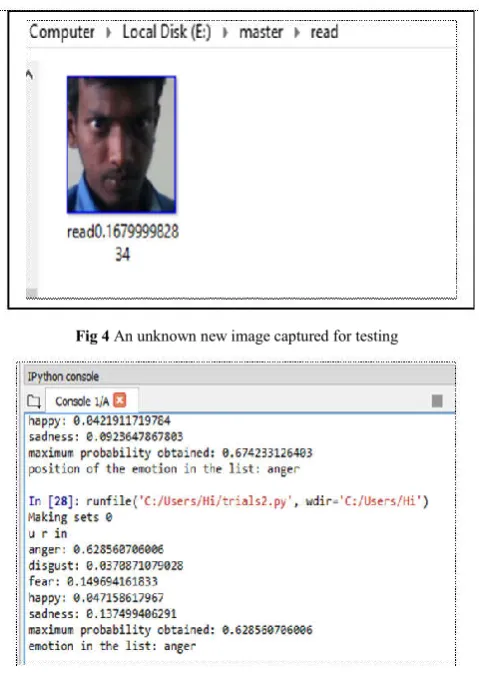
Once 80 percent of the students’ facial expression is trained in random, the remaining 20 percent is used for testing the implementation. In that case, Fig 4 and 5 specifies the image considered for testing and average probability of facial expression faced by the students at a particular instant or time say t respectively.
Fig 4 An unknown new image captured for testing
Fig 5 Output showing probabilities for the face
Apart from the probability computation Fig 5.6 shows the identified facial expression of the students in live video analysis. The major pitfall faced is that in a live video analysis the algorithm holds good only for the fully detected face and not a portion as shown in Fig 6.
Fig 6 An example of a frame showing the emotions in each face
Insights obtained through probability analysis of facial expressions
and similarly the priority could be set for every category of emotion as intended by the trainer or faculty.
Fig 7 Probability of average facial expression of the class
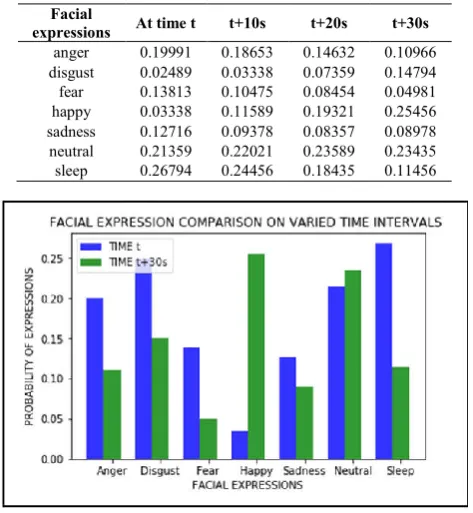
Table III briefs the probabilistic values of the facial expression of one student at time t, t+10s, t+20s and t+30s. The time interval is varied by 10s as the frames are initially monitored for 10 seconds. As a sequence of continuous monitoring the time interval is fixed to be 10s. These frames collected during the time interval could be minimized on application of dropping alternate frames do as to minimize the execution complexity. This could be further improved on application of proper optimization technique that selects the intended frame for analysis.
Table III Probabilistic Values of A Student’s Facial Expression Under Varied Time Sequence
Facial
expressions At time t t+10s t+20s t+30s
anger 0.19991 0.18653 0.14632 0.10966 disgust 0.02489 0.03338 0.07359 0.14794 fear 0.13813 0.10475 0.08454 0.04981 happy 0.03338 0.11589 0.19321 0.25456 sadness 0.12716 0.09378 0.08357 0.08978 neutral 0.21359 0.22021 0.23589 0.23435 sleep 0.26794 0.24456 0.18435 0.11456
Fig 8 probability of a student under increased time sequence
The Fig 8 shows the probability of the facial expression faced by an individual student. From this probability graph, it is made clear to point out when a student falls into the category of expression. This clearly identifies the reasons for the fall or change of facial expression category. This also suggests that the time taken by the student to toggle between various facial expression. This time interval is used to observe the listening
state or even the maximum time taken by the student to change from one state to the other.
CONCLUSION
This work is a novel approach for monitoring of students in remote based classrooms and could be further extended to environments like examination halls, laboratories and a campus wide application. The project proves better performance results in facial expression analysis with the dataset undertaken for the implementation. These expressions provide insights regarding the mood of the student and the variation of the expression shown by them at every period of instance. This work can serve as the starting point of a series of works that helps in improving the capabilities of the classroom monitoring system. The major limitation of the work lies in that fact of increased computing resources to make live video analysis of students in classroom; highly equipped 360 degree cameras are required to capture the complete environment.
Future Work
Though the paper proves in the novelty of the application to a maximum extent possible, there arise few major challenges that pave way for the future enhancements. The technical challenges faced during the implementation is the computing capacity , video clarity, number of cameras and even the maximized students count in the classroom. These technically faced challenges could be solved and the major future implementation lies in the enhancement of the facial expression identification in live video streaming with minimized computing capacity.
References
1. Roberto Valenti, NicuSebi, Theo Gevers., “Facial Expression Recognition: A fully integrated approach”, Workshop on Visual and Multimedia Digital Libraries 2007.
2. Aleix Martinez and Shichuan Du., “A Model of the perception of the facial expressions of emotion by humans”.
3. Tao Xiang and Shaogang Gong., “Video Behavior Profiling for Anomaly Detection”, IEEE Transactions on Pattern Analysis and Machine Intelligence (Volume: 30, Issue: 5, May 2008).
4. J. Chen, D. Chen, Y. Gong., “Facial expression recognition using Geometric and Appearance Features” In: 4th International Conference on Internet Multimedia Computing and Services. pp. 29-33. (2012)
5. Sathik and Jonathan, “Effect of facial expressions on student’s comprehension recognition in virtual educational environments”, Springer Plus 2(1):455, September 2013.
6. Tang C., Xu P., Luo Z., Zhao G., Zou T., “Automatic Facial Expression Analysis of Students in Teaching Environments”, Yang J., Yang J., Sun Z., Shan S., Zheng W., Feng J. (eds) Biometric Recognition. CCBR 2015. Lecture Notes in Computer Science, vol 9428. Springer, Cham.
7. Gary Bradski and Adrian Kaehler., “Learning Open CV: Computer vision with the Open CV library” Originally published: September 2008.
International Conference on Computer Communication and Informatics, pp. 1-5, 2014.
9. Yelin Kim, Tolga Soyata, Reza Feyzi Behnagh, “Towards Emotionally Aware AI Smart Classroom: Current Issues and Directions for Engineering and Education”, IEEE Access, Volume 6, pp 5308 – 5331, 2018
10. Kaiqi Cen, “Study of Viola-Jones Real Time Face Detector”, 2016.
11. Philipp Michel, Rana El Kaliouby, “ Real Time Facial Expression Recognition in Video using Support Vector Machines” ICMI’03, Vancouver, British Columbia, Canada, November 5–7, 2003
12. Andreas Savva, Vasso Stylianou, Kyriacos Kyriacou, Florent Domenach, “Recognizing student facial expressions: A web application”, IEEE Global Engineering Education Conference (EDUCON), 2018 13. Pedro Bispo Santos, Caroline Verena Wahle, Iryna
Gurevych, “Using Facial Expressions of Students for Detecting Levels of Intrinsic Motivation”, IEEE 14th International Conference on e-Science (e-Science), 2018
14. R. Grossman, T. Guha, Z. Yang, D. Hedley, S. S. Narayanan, “Missing the mark: Dynamic differences in facial expressions of children with hfa,”, Meeting for Autism Research (IMFAR), 2015.
15. O. H. Jensen, “Implementing the Viola-Jones face detection algorithm”, PhD thesis, Technical University of Denmark, DTU, DK-2800 Kgs. Lyngby, Denmark, 2008.
16. C. Zhang and Z. Zhang. “A survey of recent advances in face detection”, 2010
17. Selin Baskana, M. Mete Buluta, Volkan Atalay, "Projection based method for segmentation of human face and its evaluation", Pattern Recognition Letters 23 (2002) 1623-1629.
18. Bhumika G. Bhatt1, Zankhana H. Shah2, "Face Feature Extraction Techniques: A Survey:" National Conference on Recent Trends in Engineering & Technology, 2011 19.
https://www.pyimagesearch.com/2017/04/03/facial-landmarks-dlib-opencv-python/
20. https://docs.opencv.org/3.3.0/d7/d8b/tutorial_py_face_d etection.html.
21. https://docs.opencv.org/2.4/doc/tutorials/objdetect/casca de_classifier/cascade_classifier.html.
22. https://docs.opencv.org/3.3.0/dc/d88/tutorial_traincasca de.html.
23. N. Cristianini and J. Shawe-Taylor, “An Introduction to Support Vector Machines and other Kernel-based Learning Methods”, Cambridge University Press, Cambridge, UK, 2000.
How to cite this article:
Abirami S.P., Poornima S and Kousalya G (2019) 'Facial Expression Analysis of Students in Classroom Using Machine Learning Technique', International Journal of Current Advanced Research, 08(04), pp.18072-18077.
DOI: http://dx.doi.org/10.24327/ijcar.2019.18077.3446