Page 59 www.ijiras.com | Email: [email protected]
Effect Of Normalization Techniques In Robot Selection Using
Weighted Aggregated Sum Product Assessment
Manoj Mathew
Sagar Sahu
Ashish Kumar Upadhyay
Department of Mechanical Engineering, Shri Shankaracharya Institute of Professional Management and Technology, Raipur
I. INTRODUCTION
Industrial robotic manipulators are general purpose machine to do certain task like moving materials, tools or parts. There are other reprogrammable robots which can be used for welding, spray painting and do certain hazardous task. Robots perform these tasks with precision, accuracy and can also increase the productivity. In today’s competitive world a large number of robots are available in the market with different specification. While selecting a robot the decision maker should look in detail all the attributes which affect the manipulators performance. The attributes can be categorized into beneficial and non beneficial attributes. The attributes in which higher value is desired are known as beneficial attributes like load carrying capacity, end effectors reach etc. Attributes in which lower value is desired is termed as non beneficial attributes like cost, error etc. All these attributes have different unit and are conflicting in nature. Thus decision makers face difficulty in comparing different attributes and selecting Robot.
Researchers have solved various industrial robot selection problems using MADM methods. Also the effect of normalization methods was checked on these MADM methods. This paper is another attempt to check the variation in raking performance with the change in normalization technique in a new MADM method i.e. WASPAS method. This paper contain seven section introduction, the literature review of the previous work, Normalization Techniques employed in the paper, Weighted Aggregated Sum Product Assessment method, its application with the help of Illustrative Example, Comparative Analysis with other methods and conclusion.
II. LITERATURE REVIEW
Agrawal et al. (1991) using Technique for Order Preference by Similarity to Ideal Solution (TOPSIS) method created a rank for the selection of industrial robots. Jian Ma (1999) proposes an approach to find weights of attribute in the Abstract: The process of Selecting Industrial Robot from number of alternatives having advanced features is a complex and tough job. This choice of selecting the best out of all the available alternatives can be done with the help of Multi attribute Decision making (MADM) Methods. The main focus of this paper is to select an industrial robot using weighted aggregated sum product assessment method (WASPAS) using best normalization technique. Normalization is the first step which makes the decision matrix comparable. The raking performance was compared with other MADM method for the same example with the help of Spearman’s rank correlation coefficient. The effect in the raking order was studied for normalization technique. Linear Normalization (Max-Min) proved to be best normalization method for WASPAS.
Page 60 www.ijiras.com | Email: [email protected] MADM problems. A Robot selection example was considered
to illustrate the suitability of the approach. Pavličić, D. (2001) checked the effect of normalization in MADM methods like SAW, TOPSIS and ELECTRE. Bhangale et al. (2004) used graphical methods and TOPSIS for the selection of industrial robot. He evaluated and compared the relative rankings of the robots which were derived using the above mentioned methods. Rao, and Padmanabhan (2006) Presented digraph and matrix method for the selection of industrial robots. A robot selection index was created which ranked the robots for industrial application. Rao and Padmanabhan (2007) presented digraph and matrix method for the selection of industrial robots. A robot selection index was created which ranked the robots for particular industrial application. Rao (2007) has compared different MADM methods for the selection of Industrial robot and other manufacturing method. Chakraborty, S., & Yeh, C. H. (2007) in his simulation study proved that vector and linear scale transformation, method are best for SAW. Zavadskas, E. K., & Turskis, Z. (2008) introduced a new logarithmic normalization technique for MADM methods. Devi (2011) extended VIKOR method in intuitionistic fuzzy environment, aimed to solve MADM problems. The weights of alternatives were taken as triangular intuitionistic fuzzy set. A robot selection problem for material handling was used to verify the proposed method. Athawale and Chakraborty (2011) compared the ranking performance of ten Multi Criteria Decision Making methods used for the selection of robots engaged in industrial activities. Singh and Rao (2011) proposed a hybrid of graph theory and matrix approach (GTMA) along with analytical hierarchy process (AHP). The potential of method was checked and compared with other methods. Šaparauskas et al. (2011) and Zavadskas et al. (2013) considered three criteria of optimality for ranking the facades of commercial and public building using Weighted Sum Model (WSM), Weighted Product Model (WPM) and WASPAS. These were compared with Multiple Objective Optimization on the basis of Ratio Analysis (MOORA) method. Athawale et al. (2012) applied compromise ranking method for selecting Industrial Robot. Mondal and Chakraborty (2013) compared models of data envelopment analysis (DEA) to identify robots having optimum performance in order to satisfy the objectives with respect to cost and other parameters. Chakraborty and Zavadskas (2014) solved eight manufacturing decision making problems. It was found that WASPAS has the ability of ranking accurately the alternatives in all the eight selection problems. Azimi et al. (2014) presented Polygons Area Method for robot selection problem. The results obtained were compared with the result of other MADM methods using Spearman’s rank correlation coefficient. Chatterjee, P., & Chakraborty, S. (2014) checked the effect of normalization in PROMETHEE, grey relation analysis (GRA) and TOPSIS for flexible manufacturing system selection. Çelen, A. (2014) evaluated the normalization effect on TOPSIS method for financial performances of 13 Turkish banks. Chakraborty and Antucheviciene (2015) illustrated the acceptability of WASPAS as a multi attribute decision making tool using five real time manufacturing related problems. Jahan, A., & Edwards, K. L. (2015) investigated the influence of normalization techniques in ranking performance of MADM methods. Vafaei, N. et al.
(2016) investigated the normalization effect on Analytical Hierarchy Process (AHP). Karande, P. et. al. (2016) in his paper compared the ranking performance of 6 MCDM methods. It was found that the multiplicative form of MOORA is least affected by the change of weights.
III. NORMALIZATION TECHNIQUES
X= [xij]mxn is the Decision matrix ,where xij is the
performance value of ith alternative and jth attribute , m is the number of available alternatives and n is the number of attributes. The performance is made dimensionless and comparable with the help of normalization. This is one of the important steps in solving decision making problem. ij is the
normalized value of Xij. The different normalization
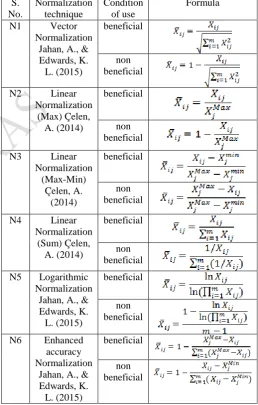
techniques used in this paper is presented in Table 1. S.
No.
Normalization technique
Condition of use
Formula
N1 Vector
Normalization Jahan, A., & Edwards, K. L. (2015)
beneficial
non beneficial
N2 Linear
Normalization (Max) Çelen,
A. (2014)
beneficial
non beneficial
N3 Linear
Normalization (Max-Min)
Çelen, A. (2014)
beneficial
non beneficial
N4 Linear
Normalization (Sum) Çelen,
A. (2014)
beneficial
non beneficial N5 Logarithmic
Normalization Jahan, A., & Edwards, K. L. (2015)
beneficial
non beneficial N6 Enhanced
accuracy Normalization
Jahan, A., & Edwards, K. L. (2015)
beneficial
non beneficial
Table 1: Different normalization techniques
IV. WASPAS METHOD
Page 61 www.ijiras.com | Email: [email protected] i.e. Weighted Aggregated Sum Product Assessment Method
(Chakraborty and Zavadskas 2014). The joint criterion of optimality is obtained by weighted summation of two criteria of optimality. The 1st criterion of optimality is similar to that of Weighted Sum Model. The total relative importance of the alternatives are calculated with the help of equation (1)
(1) Wj are weights associated/ allocated to jth attributes
Then the second criterion of optimality is similar to Weighted Product Model. The relative importance of the alternative are calculated with the help of equation (2)
(2) A joint generalized criterion of weighted aggregation of additive and multiplicative methods is then proposed as follows (Zavadskas et al., 2013)
(3)
V. ILLUSTRATIVE EXAMPLE
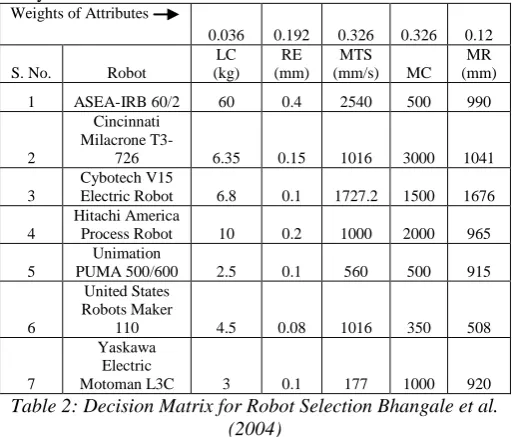
To validate and check the accuracy of WASPAS method with different normalization methods, an example is considered which deals with the selection of the industrial pick-n-place robot. Bhangale et al. (2004) created a preference list for robots using graphical methods and TOPSIS. The criteria on which industrial robot are selected is specified as attributes of the robot. These attributes can be categorized as beneficial and non beneficial. The beneficial attributes in this example are Load carrying capacity, memory capacity (MC), maximum tip speed (MTS) and manipulator reach (MR). Repeatability error (RE) is a non beneficial attribute. Rao (2007) determined the weights of the attributes using AHP method, WLC = 0.036, WRE = 0.192, WMTS = 0.326, WMC = 0.326 and WMR = 0.12, which will be used for subsequent analyses.
Weights of Attributes
0.036 0.192 0.326 0.326 0.12
S. No. Robot
LC (kg)
RE (mm)
MTS
(mm/s) MC
MR (mm)
1 ASEA-IRB 60/2 60 0.4 2540 500 990
2
Cincinnati Milacrone
T3-726 6.35 0.15 1016 3000 1041
3
Cybotech V15
Electric Robot 6.8 0.1 1727.2 1500 1676
4
Hitachi America
Process Robot 10 0.2 1000 2000 965
5
Unimation
PUMA 500/600 2.5 0.1 560 500 915
6
United States Robots Maker
110 4.5 0.08 1016 350 508
7
Yaskawa Electric
Motoman L3C 3 0.1 177 1000 920
Table 2: Decision Matrix for Robot Selection Bhangale et al. (2004)
The Decision matrix is normalized using various normalization techniques. Table 2 shows the decision matrix for robot selection by Bhangale et al. (2004). The decision matrix is vector normalized, final value of
was calculated which is shown in Table 3. It can be seen that the ranking performance of the vector normalized WAPAS is 3-2-4-1-6-5-7. Similarly the generalized criterion of WASPAS and ranking was calculated using various normalization techniques shown in Table 4. Where N1, N2,...., N6 are the serial number corresponding to normalization technique as shown in Table 1. , ,……., are the performance criteria of WASPAS using normalization technique N1,N2,....,N6 respectively.
S. No .
Robot LC (kg) RE
(mm) MTS (mm/s )
MC MR
(mm)
1
ASEA-IRB 60/2
0.9705 0.2138 0.7087 0.1217 0.3557 0.3894 0.2952 0.3423
(4) 2 Cincinnati
Milacrone T3-726
0.1027 0.7052 0.2834 0.7303 0.374 0.5145 0.4582 0.4863
(2)
3 Cybotech
V15 Electric
Robot
0.1099 0.8034 0.4819 0.3651 0.6022 0.5066 0.473 0.4898
(1)
4 Hitachi
America Process Robot
0.1617 0.6069 0.2790 0.4869 0.3467 0.4137 0.3909 0.4022
(3)
5 Unimation
PUMA 500/600
0.04043 0.8034 0.1562 0.1217 0.3288 0.2858 0.2054 0.2456
(6)
6 United
States Robots Maker 110
0.07278 0.8427 0.2834 0.0852 0.1825 0.3065 0.2133 0.2599
(5)
7 Yaskawa
Electric Motoman
L3C
0.04852 0.8034 0.0493 0.2434 0.3306 0.2911 0.1782 0.2346
(7)
Table 3:Vector normalized decision Matrix
S. No.
Robot
1
ASEA-IRB 60/2 0.342317 (4) 0.243608 (7) 0.214987 (4) 0.142556 (4) 0.152538 (1) 0.792384 (7) 2 Cincinnati
Milacrone T3-726 0.486362 (2) 0.622574 (2) 0.605407 (2) 0.183018 (2) 0.151381 (2) 0.902112 (2)
3 Cybotech
V15 Electric Robot 0.489813 (1) 0.634132 (1) 0.627671 (1) 0.188539 (1) 0.150857 (3) 0.919419 (1)
4 Hitachi
America Process Robot 0.402278 (3) 0.506704 (3) 0.474559 (3) 0.147004 (3) 0.150295 (4) 0.857 (3)
5 Unimation
PUMA 500/600 0.245609 (6) 0.302272 (5) 0.146553 (7) 0.086335 (6) 0.13114 (6) 0.833053 (6)
6 United
States Robots Maker 110 0.259917 (5) 0.319789 (4) 0.1545 (5) 0.096957 (5) 0.13263 (5) 0.840142 (4)
7 Yaskawa
Electric Motoman L3C 0.234661 (7) 0.287461 (6) 0.151302 (6) 0.082541 (7) 0.128212 (7) 0.833526 (5)
Table 4: Generalized criteria of WASPAS and ranking obtained from normalization techniques
VI. COMPARATIVE ANALYSIS
Page 62 www.ijiras.com | Email: [email protected] coefficient . Mean value of was calculated to find the
best normalization method for WASPAS.
Table 5: Spearman’s rank correlation coefficient between the rankings of MADM methods
Table 6: Mean Spearman’s rank correlation coefficient
VII.CONCLUSIONS
The ranking performance obtained from weighted aggregated sum product assessment (WASPAS) method for different normalization techniques was compared with other MADM methods. Spearman’s rank correlation coefficient was used as a measure to evaluate the degree of agreement between the methods. It is evident from Table 6 that normalization technique N5 i.e. Logarithmic Normalization gave the least mean spearman’s rank correlation coefficient hence this method is not recommended for the normalization in WASPAS. Normalization method N3 i.e. Linear Normalization (Max-Min) gave the best mean correlation coefficient and can be used as the perfect normalization technique for WASPAS. It can be seen that the criterion for calculating the rank is distinct from each other because while normalizing the decision matrix the performance which is least preferred becomes zero and highly preferred becomes one.
REFERENCES
[1] Athawale, V. M., & Chakraborty, S. (2011). A comparative study on the ranking performance of some multi-criteria decision-making methods for industrial robot selection. International journal of industrial engineering computations, 2(4), 831-850.
[2] Athawale, V. M., Chatterjee, P., & Chakraborty, S. (2012). Selection of industrial robots using compromise ranking method. International Journal of Industrial and Systems Engineering 1, 11(1-2), 3-15.
[3] Azimi, M., Taghizadeh, H., Farahmand, N., & Pourmahmoud, J. (2014). Selection of industrial robots
using the Polygons area method. International Journal of Industrial Engineering Computations, 5(4), 631-646. [4] Bhangale, P.P., Agrawal, V.P., & Saha, S.K. (2004).
Attribute based specification, comparison and selection of a robot. Mechanism and Machine Theory, 39, 1345-1366. [5] Chakraborty, S., & Yeh, C. H. (2007, February). A
simulation based comparative study of normalization procedures in multiattribute decision making. In Proceedings of the 6th Conference on 6th WSEAS Int. Conf. on Artificial Intelligence, Knowledge Engineering and Data Bases (Vol. 6, pp. 102-109).
[6] Çelen, A. (2014). Comparative analysis of normalization procedures in TOPSIS method: with an application to Turkish deposit banking market. Informatica, 25(2), 185-208.
[7] Chakraborty, S., & Zavadskas, E. K. (2014). Applications of WASPAS method in manufacturing decision making. Informatica, 25(1), 1-20.
[8] Chatterjee, P., & Chakraborty, S. (2014). Investigating the effect of normalization norms in flexible manufacturing sytem selection using multi-criteria decision-making methods. Journal of Engineering Science and Technology Review, 7(3), 141-150.
[9] Chakraborty, S., & ANTUCHEVICIENE, J. (2015). APPLICATIONS OF WASPAS METHOD AS A MULTI-CRITERIA DECISION-MAKING TOOL. Economic Computation and Economic Cybernetics Studies and Research, 49(1), 5-22.
[10]Devi, K. (2011). Extension of VIKOR method in intuitionistic fuzzy environment for robot selection. Expert Systems with Applications, 38(11), 14163-14168. [11]Jahan, A., & Edwards, K. L. (2015). A state-of-the-art
survey on the influence of normalization techniques in ranking: Improving the materials selection process in engineering design. Materials & Design, 65, 335-342. [12]Karande, P., Zavadskas, E., & Chakraborty, S. (2016). A
study on the ranking performance of some MCDM methods for industrial robot selection problems. International Journal of Industrial Engineering Computations, 7(3), 399-422.
[13]Ma, J., Fan, Z. P., & Huang, L. H. (1999). A subjective and objective integrated approach to determine attribute weights. European journal of operational research, 112(2), 397-404.
[14]Mondal, S., & Chakraborty, S. (2013). A solution to robot selection problems using data envelopment analysis. International journal of industrial engineering computations, 4(3), 355-372.
[15]Pavličić, D. (2001). Normalization affects the results of MADM methods. Yugoslav journal of operations research, 11(2), 251-265.
[16]Rao, R.V., & Padmanabhan, K.K. (2006). Selection, identification and comparison of industrial robots using digraph and matrix methods. Robotics and Computer-Integrated Manufacturing, 22, 373-383.
Page 63 www.ijiras.com | Email: [email protected] [18]Šaparauskas, J., Kazimieras Zavadskas, E., & Turskis, Z.
(2011). Selection of facade's alternatives of commercial and public buildings based on multiple criteria. International Journal of Strategic Property Management, 15(2), 189-203.
[19]Singh, D., & Rao, R. (2011). A hybrid multiple attribute decision making method for solving problems of industrial environment. International Journal of Industrial Engineering Computations, 2(3), 631-644.
[20]V.P. Agrawal, V. Kohli, S. Gupta, Computer aided robot selection: the multiple attribute decision making approach, International Journal of Production Research 29 (8) (1991) 1629–1644
[21]Vafaei, N., Ribeiro, R. A., & Camarinha-Matos, L. M. (2016, April). Normalization Techniques for Multi-Criteria Decision Making: Analytical Hierarchy Process
Case Study. In Doctoral Conference on Computing, Electrical and Industrial Systems (pp. 261-269). Springer International Publishing.
[22]Zavadskas, E. K., & Turskis, Z. (2008). A new logarithmic normalization method in games theory. Informatica, 19(2), 303-314.
[23]Zavadskas, E. K., Antucheviciene, J., Šaparauskas, J., & Turskis, Z. (2013). Multi-criteria assessment of facades’ alternatives: peculiarities of ranking methodology. Procedia Engineering, 57, 107-112.