JETIR1504087 Journal of Emerging Technologies and Innovative Research (JETIR) www.jetir.org 1311
Analysis of Productivity by Comparing Mivan and
Conventional Formwork
1
Prathul U,
2Leeladhar Pammar
1PG student, 2 Assistant Professor
1, 2Department of Civil Engineering, NMAMIT, Nitte
Abstract—Productivity is the important factor affecting the overall efficiency in Construction site. At site level productivity can be grouped under various departments like productivity in concrete, steel work and shuttering. The main aim of the study is to analyze the productivity by comparing conventional and Mivan formwork. The study showed that mivan formwork has higher productivity when compared to conventional formwork and proves economical for repetitive job.
Index Terms—Productivity, formwork, conventional, mivan, man-day’s
________________________________________________________________________________________________________
I.INTRODUCTION
With advancement in cost industry it has become necessary to keep account of expenditure made in the process. The view of this productivity has become a major concern to delt with. It is crucial for the welfare of industrial firm also for the economic growth of the country. High productivity refers to doing the work in a shortest possible time with least expenditure on inputs without sacrificing quality and with minimum wastage of resources. Productivity measurement at construction site level enables companies to monitor their own performance against their site performance. Construction productivity at construction site level can be grouped under various departments likes, productivity in concrete, steel work and shuttering.
Formwork is a total system of support required before placing of concrete. It includes the molder, sheathing which contacts the concrete as well as all supporting members, hardware and necessary bracing. It is used to shape and support concrete until it attains sufficient strength to carry its own weight. Formwork should be able to carry all imposed dead and live loads apart from its own weight.As Formwork governs quality, cost and time, it is essential to choose a right scheme of formwork for project.
II. LITERATURE REVIEW
Gary R. Smith, Awad S. Hannal, (1993), were studied on Factors influencing formwork productivity. Estimates indicate that 30 to 70 percent of cast-in-place concrete cost is attributable to the assembly and stripping of formwork. Two groups of factors were found to have a great effect on formwork productivity, non-measurable factors such as contract document and measurable factors such as engineering design[3].
James D. Sumway, (1992), studied on A comparative analysis of concrete formwork productivity influence factors. Concrete formwork labor costs constitute over 1/3 of total concrete construction costs. Their study identified the factors which can reduce the number of labor hours required to erect, align and strip concrete formwork will help to improve the cost effectiveness of construction operations. Formwork labor expenses constitute nearly 35% of the total cost of vertical concrete work. Proper system selection, repetitive design dimensions, efficient scheduling, and careful activity coordination can yield significant productivity savings. Productivity depends on form type, panel size, formed surface shape, form height, method of assembly and placement [4].
Osama Mosheli, Jaffer Khan, (2010), were studied on Analysis of Labour Productivity in Building. A neural network model was used to study a number of factors considered to impact labour productivity on daily basis. These included temperature, relative humidity, wind speed, precipitation, gang size, crew composition, height of work, type of work and construction method employed. The data were then analyzed to determine the influence of these parameters on site labour productivity [6].
III. SCOPE AND OBJECTIVE A. Scope
The main scope of the study is to analyze the productivity of mivan and conventional formwork and their suitability under different circumstances.
B. Objective
The main objectives are
To determine the productivity of mivan and conventional formwork for different months. To track the variation of productivity from target productivity.
JETIR1504087 Journal of Emerging Technologies and Innovative Research (JETIR) www.jetir.org 1312
IV. DATA COLLECTION AND METHODOLOGY A. Data collection
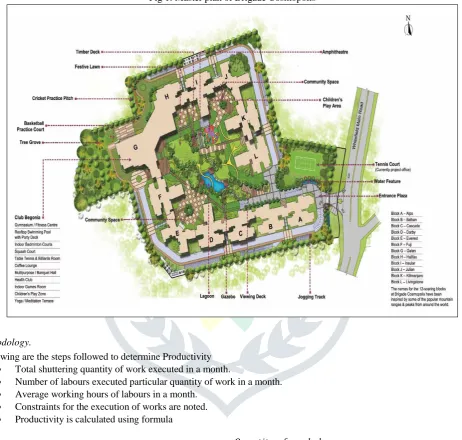
The data for the study was collected from Brigade Cosmopolis site, under taken by Shapoorji Pallonji & Co.Ltd in Whitefield, Bangalore. Collection of data was done for 16 months. The project consisted of 12 towers, construction was done in 2 Phase, each phase had 6 towers. Study was done for Phase1 (Tower F, G, H, I, J, K, L) Comprising 2 Basement, Ground floor and 18upper floors. Total built up area of Phase 1 is 11, 22,000Square feet. Mivan and conventional formwork were used for Construction.
Fig 1: Master plan of Brigade Cosmopolis
B. Methodology.
Following are the steps followed to determine Productivity Total shuttering quantity of work executed in a month.
Number of labours executed particular quantity of work in a month. Average working hours of labours in a month.
Constraints for the execution of works are noted. Productivity is calculated using formula
𝑃𝑟𝑜𝑑𝑢𝑐𝑡𝑖𝑣𝑖𝑡𝑦 =𝑄𝑢𝑎𝑛𝑡𝑖𝑡𝑦 𝑜𝑓 𝑤𝑜𝑟𝑘 𝑑𝑜𝑛𝑒
𝑁𝑢𝑚𝑏𝑒𝑟 𝑜𝑓 𝑚𝑎𝑛𝑑𝑎𝑦′𝑠
Quantity of work done in a month is determined using quantity estimation. Number of labours worked in a month and average working hours is taken from labour report. Labour reports are updated on daily basis from which monthly labour report is prepared. Constraints which will affect the overall productivity are also noted. Unit of productivity is square meter per man-day’s.
JETIR1504087 Journal of Emerging Technologies and Innovative Research (JETIR) www.jetir.org 1313
V.RESULTS AND DISCUSSIONS
A. Conventional Formwork
The plywood shuttering is known as the conventional type of formwork. The main advantage of using plywood formwork is it is economical (for small scale construction) and it can mould(making) into different shapes so it doesn’t require typical floors criteria as in aluminum formwork, though having typical floors helps in easy repetitions.
Sl No. Month
Quantity of work done (Sqm) per month
(a)
No of Labours per month
(b)
Working hours per day
(c)
No of man-day’s per Month (1
man-day’s =8hours) (d) = (b)*(c) / 8
Productivity (Sqm/man-day’s)
(e) = (a) / (d)
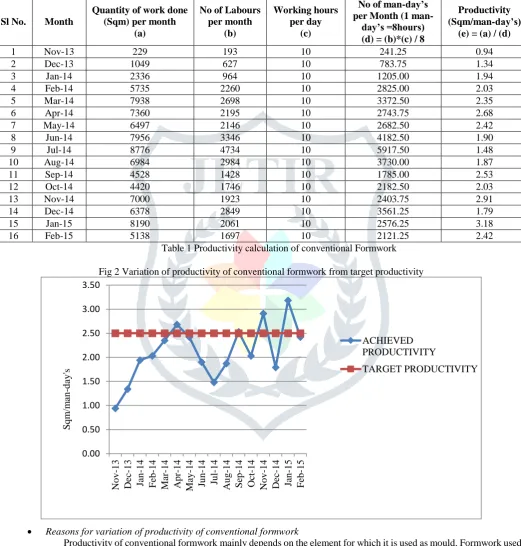
1 Nov-13 229 193 10 241.25 0.94
2 Dec-13 1049 627 10 783.75 1.34
3 Jan-14 2336 964 10 1205.00 1.94
4 Feb-14 5735 2260 10 2825.00 2.03
5 Mar-14 7938 2698 10 3372.50 2.35
6 Apr-14 7360 2195 10 2743.75 2.68
7 May-14 6497 2146 10 2682.50 2.42
8 Jun-14 7956 3346 10 4182.50 1.90
9 Jul-14 8776 4734 10 5917.50 1.48
10 Aug-14 6984 2984 10 3730.00 1.87
11 Sep-14 4528 1428 10 1785.00 2.53
12 Oct-14 4420 1746 10 2182.50 2.03
13 Nov-14 7000 1923 10 2403.75 2.91
14 Dec-14 6378 2849 10 3561.25 1.79
15 Jan-15 8190 2061 10 2576.25 3.18
16 Feb-15 5138 1697 10 2121.25 2.42
Table 1 Productivity calculation of conventional Formwork
Fig 2 Variation of productivity of conventional formwork from target productivity
Reasons for variation of productivity of conventional formwork
Productivity of conventional formwork mainly depends on the element for which it is used as mould. Formwork used for column as shuttering has higher no of repetitions when compared with shuttering material used for beams and slabs. Since the Deshuttering time for column is 24 hours where as in slab its 28 days although it covers large area. Increase in no of repetition results in increase in quantity of work done per month which in turn increases the productivity. Constraints such as rain, failure of tower crane also lowers the productivity.
JETIR1504087 Journal of Emerging Technologies and Innovative Research (JETIR) www.jetir.org 1314 B. Shuttering Usage Ratio (SUR) of conventional formwork
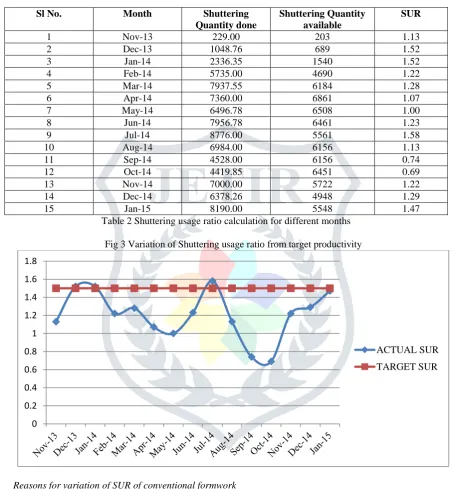
Shuttering usage ratio is defined as ratio of Quantity of shuttering done in a month to the total quantity of shuttering available for month.
𝑆ℎ𝑢𝑡𝑡𝑒𝑟𝑖𝑛𝑔 𝑈𝑠𝑎𝑔𝑒 𝑅𝑎𝑡𝑖𝑜(𝑆𝑈𝑅) = 𝑄𝑢𝑎𝑛𝑡𝑖𝑡𝑦 𝑜𝑓 𝑠ℎ𝑢𝑡𝑡𝑒𝑟𝑖𝑛𝑔 𝑑𝑜𝑛𝑒 𝑖𝑛 𝑎 𝑚𝑜𝑛𝑡ℎ
𝑇𝑜𝑡𝑎𝑙 𝑠ℎ𝑢𝑡𝑡𝑒𝑟𝑖𝑛𝑔 𝑎𝑣𝑎𝑖𝑙𝑎𝑏𝑙𝑒 𝑓𝑜𝑟 𝑡ℎ𝑒 𝑚𝑜𝑛𝑡ℎ
Sl No. Month Shuttering Quantity done
Shuttering Quantity available
SUR
1 Nov-13 229.00 203 1.13
2 Dec-13 1048.76 689 1.52
3 Jan-14 2336.35 1540 1.52
4 Feb-14 5735.00 4690 1.22
5 Mar-14 7937.55 6184 1.28
6 Apr-14 7360.00 6861 1.07
7 May-14 6496.78 6508 1.00
8 Jun-14 7956.78 6461 1.23
9 Jul-14 8776.00 5561 1.58
10 Aug-14 6984.00 6156 1.13
11 Sep-14 4528.00 6156 0.74
12 Oct-14 4419.85 6451 0.69
13 Nov-14 7000.00 5722 1.22
14 Dec-14 6378.26 4948 1.29
15 Jan-15 8190.00 5548 1.47
Table 2 Shuttering usage ratio calculation for different months
Fig 3 Variation of Shuttering usage ratio from target productivity
Reasons for variation of SUR of conventional formwork
The SUR mainly depends on the utilization of material per month. Shuttering material used for column has maximum utilization but for slabs areas covered will be high, which will results in variation of SUR. Delay in Deshuttering will also results in lowering of SUR value. Proper housekeeping, Maintenance and movement of material are also required to attain target SUR. If shuttering material is idle for long time results in decrease of SUR.
0 0.2 0.4 0.6 0.8 1 1.2 1.4 1.6 1.8
ACTUAL SUR
JETIR1504087 Journal of Emerging Technologies and Innovative Research (JETIR) www.jetir.org 1315 C. Mivan Formwork
Aluminium formwork is a type of formwork in which shuttering material is made of prefabricated aluminum into different shapes/sizes based on design of the structure. This reduces the time in making of the shuttering onsite (like in conventional) and make the repetitions of formwork easy. Aluminum formwork is used in construction mainly to increase the pace of the construction i.e. decrease the duration of slab cycle. It is applicable in cases where there are typical floors or floors with very less modification. The aluminum formwork material is costlier compared to the plywood formwork, so having high number of repetitions is essential to make this formwork usage economical.
Sl No. Month Quantity of work done (Sqm) per month
(a)
No of Labours per month (b)
Working hours per day
(c)
No of man-day’s per Month (1 man-day’s =8hours)
(d) = (b)*(c) / 8
Productivity (Sqm/man-day’s) (e) = (a) / (d)
1 Jul-14 3000 1022 10 1277.50 2.34
2 Aug-14 7212 1586 10 1982.50 3.63
3 Sep-14 19424 2610 10 3262.50 5.95
4 Oct-14 24240 2464 10 3080.00 7.87
5 Nov-14 31000 2832 10 3540.00 8.75
6 Dec-14 29002 3189 10 3986.25 7.27
7 Jan-15 16995 2703 10 3378.75 5.02
8 Feb-15 18304 2525 10 3156.25 5.80
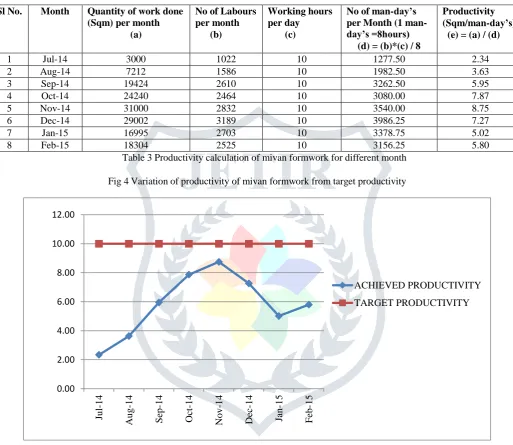
Table 3 Productivity calculation of mivan formwork for different month
Fig 4Variation of productivity of mivan formwork from target productivity
Reasons for variation of productivity of mivan formwork
At the beginning, productivity of mivan formwork is low because it takes time for setting out and aligning. As no of floors increases there is increase in productivity because of repetition of same job. In this project all 6 towers have different date of start hence the overall productivity get affected.
In mivan formwork system materials are shifted manually from one floor to another, use of tower crane for shifting of mivan panel is almost nil but for transferring reinforcement bars tower cranes are used. Failure in tower will delay the 7 day slab cycle.
0.00 2.00 4.00 6.00 8.00 10.00 12.00
Ju
l-1
4
Au
g
-1
4
Sep
-1
4
Oct-1
4
No
v
-1
4
Dec
-1
4
Jan
-1
5
Feb
-1
5
ACHIEVED PRODUCTIVITY
JETIR1504087 Journal of Emerging Technologies and Innovative Research (JETIR) www.jetir.org 1316 D. Cost comparison of mivan and conventional formwork
Initial cost of mivan formwork is high when compared with conventional formwork. Rate of Aluminium formwork varies from 125 US dollars to 225 US dollars. Mivan formwork is economical when floors are typical and also labour cost for mivan is slightly less when compared with conventional formwork. Aluminium formworks are more durable, maximum repetition of 300 can be achieved where as in conventional maximum repetition of 10 can be achieved which makes aluminium formwork more economical.
Sl No. Description Type of formwork Remarks
Conventional Mivan
1 Initial Cost (Rs/Sqm) 2000 8000
Cost of Conventional formwork includes plywood and system.
2 Labour cost (Rs/Sqm) 175 125
3 Material Cost (Rs/Sqm) 200 200
Considering 10 repetition for conventional formwork and 40 repetitions for Mivan Formwork.
4 Total cost of
operation(Rs/Sqm) 375 325
Total cost of operation = Material cost + Labour cost Table 4 Cost comparison of mivan and conventional formwork
VI. CONCLUSION
Productivity is the effective tool in determining the efficiency in construction site. It enables the companies to monitor their own performance against site performance. Selection of right formwork for the project increases productivity saves time and also helps in achieving profit for the firm.
Conventional formwork is best suited for small scale constructions where it can be moulded to different shapes without many repetitions. It is observed that for the given site condition average productivity of 2.1 Sqm/man-day’s is achieved. Conventional formwork productivity mainly depends on elements for which it used as shuttering material, period of Deshuttering and dimension of the element.
Mivan formwork is best suited for large scale construction with typical floors where number of repetition is high. It is observed that for the given site condition average productivity of 5.8 Sqm/man-day’s is achieved and there is a gradual increase in productivity as no of floor increases in case of typical floors. Productivity up to 10 Sqm/man-day’s can be achieved. Average productivity is less than target productivity because the progress of all 6 towers is different which affects the average productivity.
Initial cost of mivan is high when compared with conventional formwork. For typical floors mivan formwork is economical since number of repetition are high and labour cost is comparatively less when compared with conventional formwork.
VII.ACKNOWLEDGMENT
I would like to express my sincere gratitude to Mr. Leeladhar Pammar for his invaluable guidance. I would like to convey my sincere thanks to Mr. Vishagan K V (AGM, Shapoorji Pallonji Co. Ltd) for his continuous suggestions and assistance throughout this research.
REFERENCES
[1] D.M. Wijesekara, “Cost Effective and Speedy Construction for High-Rise Buildings in SriLanka by Using Aluminium Panel
System Formworks”, ACEPS, 2012, pp 238-244.
[2] Eng. Varma Santosh, Prof. M. R. Apte, “Productivity in building construction”, IOSR Journal of mechanical and civil eng – Vol
10, Issue 5, 2014, pp 64-71.
[3]Gary R. Smith, Awad ,S. Hanna, “factors influencing formwork productivity”, Canadian journal of civil engineering, 1993, pp
144-153.
[4] James D. Sumway, “A comparative analysis of concrete formwork productivity influence factors”, Ph.D Thesis, 1992, The
Pennsylvania university, pp 20-33.
[5] Nuzul Azam Haron, Salihuddin Hassim, Mohd. Razali, ABD. kadir and Mohd Saleh Jaafar, “Conventional and formwork
system”, Universiti Teknoki Malaysia, 2005,pp1-11.