ORIGINAL PAPER
Fuel consumption optimization in air transport: a review,
classification, critique, simple meta-analysis, and future
research implications
Vedant Singh1&Somesh Kumar Sharma1
Received: 9 March 2014 / Accepted: 16 March 2015 / Published online: 8 April 2015 #The Author(s) 2015. This article is published with open access at SpringerLink.com
Abstract
Objective This paper presents a review, classification schemes, critique, a simple meta-analysis and future research implication of fuel consumption optimization (FCO) literature in the air transport sector. This review is based on 277 articles published in various publication outlets between 1973 and 2014.
MethodologyA review of 277 articles related to the FCO in air transport was carried out. It provides an academic database of literature between the periods of 1973–2014 covering 69 journals and proposes a classification scheme to classify the articles. Twelve hundred of articles were identified and reviewed for their direct relevance to the FCO in air transport. Two hundred seventy seven articles were subsequently select-ed, reviewed and classified. Each of the 277 selected articles was categorized on four FCO dimensions (Aircraft technology & design, aviation operations & infrastructure, socioeconomic & policy measures, and alternate fuels & fuel properties). The articles were further classified into six categories of FCO re-search methodologies (analytical - conceptual, mathematical, statistical, and empirical- experimental, statistical, and case studies) and optimization techniques (linear programming, mixed integer programming, dynamic programming, gradient based algorithms, simulation modeling, and nature based al-gorithms). In addition, a simple meta-analysis was also carried
out to enhance understanding of the development and evolu-tion of research in the FCO.
Findings and conclusions This has resulted in the identifica-tion of 277 articles from 69 journals by year of publicaidentifica-tion, journal, and topic area based on the two classification schemes related to FCO research, published between, 1973 to December- 2014. In addition, the study has identified the 4 dimensions and 98 decision variables affecting the fuel con-sumption. Also, this study has explained the six categories of FCO research methodologies (analytical - conceptual, mathe-matical, statistical, and empirical-experimental, statistical, and case studies) and optimization techniques (linear program-ming, mixed integer programprogram-ming, dynamic programprogram-ming, gradient based algorithms, simulation modeling, and nature based algorithms). The findings of this study indicate that the analytical-mathematical research methodologies represent the 47 % of FCO research. The results show that there is an increasing trend in research of the FCO. It is observed that the number of published articles between the period 1973 and 2000 is less (90 articles), so we can say that there are 187 articles which appeared in various journals and other publica-tion sources in the area of FCO since 2000. Furthermore there is increased trend in research on FCO from 2000 onward. This is due to the fact that continuously new researchers are commenc-ing their research activities in FCO research. This shows clearly that FCO research is a current research area among many re-search groups across the world. Lastly, the prices of jet fuel have significantly increased since the 2005. The aviation sector’s fuel efficiency improvements have slowed down since the 1970s– 1980s due to the slower pace of technological development in engine and aerodynamic designs and airframe materials.
We conclude that FCO models need to address the com-posite fuel consumption problem by extending models to in-clude all the dimensions, i.e. aircraft technology & design, aviation operations & infrastructure, socioeconomic & policy
This article is part of the Topical Collection on Accessibility and Policy Making
* Vedant Singh [email protected]
Somesh Kumar Sharma [email protected]
1 Department of Mechanical Engineering, National Institute of
measures, and alternative fuels & fuel properties. FCO models typically comprise all the four dimensions and this reality need to be taken into account in global FCO models. In addition, these models should have objectives or constraints to evaluate the aircraft sizes according to market structure, impact of various policy measures on fuel burn, and near term potential alternative fuel options in the global FCO problem. In the models reviewed, we evaluated that, only the few authors considered these factors. The literature identifies 98 decision variables affecting the fuel consumption related to various dimensions in air transport. So we can conclude that this analysis could represent the informa-tional framework for FCO research in air transport.
Future scope Our analysis provides a roadmap to guide future research and facilitate knowledge accumulation and creation concerning the application of optimization techniques in fuel consumption of air transport. The addressed dimensions & decision variables could be of potential value to future searchers on the aviation fuel consumption optimization re-search and is also capable of further refinements. In future, for fuel consumption optimization the explored decision variables could be checked for their reliability and validity and a statis-tically significant model with minimum number of decision variable could be developed. Further, on the basis of this sta-tistical significant model and with the best market requirement for transport aircraft, the researchers can frame the objective function for fuel consumption minimization problem & decide their dependent variables, independent variables, constant, and constraints. Furthermore, this study will also provide the base for fuel conservation, energy efficiency, and emission reduction in the aviation sector.
Keywords
Air transport industry . Meta-analysis . Aircraft fuel efficiency . Fuel consumption optimization (FCO)1 Introduction
Air Transport industry acts as a catalyst to the economic and social development of a nation. This industry encompasses all those activities which involve transportation of goods and people, by air. Air transport connects people, countries and cultures across the face of the globe. Additionally, it opens up a market to global players, thereby supporting trade and tourism significantly.
The Air transport industry has contributed significantly to the growth of commerce, communication, trade and tourism globally. In spite of a marked expansion, the air transport industry is faced with major issues like high fuel consumption, fuel prices, air traffic growth, competition, economic crisis, aviation emission, safety, design and operational challenges. In this study, fuel consumption has been considered, to be a major challenge for the air transport industry. Attributable to high oil prices and an escalation of competition, fuel
consumption is rapidly becoming a critical aspect of the air transport industry. Widespread improvement in the global economy during the past year has also contributed to the de-mand of oil, thereby inflating its price. David L. Greene [1] pointed out that in the early 1970s, air transport doubled its energy efficiency and restrained the growth rate of fuel. In spite of this improvement, energy use by commercial air car-riers grew at an annual rate of 2 % from 1970 to 1987. Mohammad Mazraati [2] concluded upon continuously in-creasing fuel consumption and air traffic. According to this study, world aviation oil demand was 1.18 MB/d in 1971, and reached 4.9 MB/d in 2006. The aviation sector accounts for about 5.8 % of total oil consumption worldwide. Aviation fuel consumption today corresponds to between 2 and 3 % of total fossil fuel use worldwide, more than 80 % of which is used by civil aviation [3]. Emma Nygren et al. [4] predicted that traffic will grow 5 % per year to 2026 and fuel demand 3 % per year. According to Schlumberger [5] the demand for jet fuel and aviation gasoline in the air transport sector is projected to reach 14 % of fuel demand in transportation in 2035, com-pared to 12 % in 2009.
and reviews the published literature and also to identify the factors causing the variation in fuel consumption.
The goal of this study was to examine the historical trends published in fuel consumption optimization (FCO) research studies in air transport industry, and to explore the potential fuel consumption reduction areas in future. We cover the lit-erature that relates to transportation, aerospace sciences, ener-gy & fuel, and environmental sciences. It is hoped that the finding of this research study can highlight the importance of the FCO in the air transport and provide an insight into current FCO research for both academics and air transport industry. The content of this paper is organized as follows: first, the research methodology used in the study is described; second, the methods for classifying FCO research is present-ed; third, a simple meta-analysis of FCO research are pro-posed, and the results of the classification are reported; and finally, the conclusions, future research implications, and lim-itations of the study are discussed.
2 Research methodology
As the nature of research in the FCO in air transport is difficult to confine to specific disciplines, the relevant materials are scattered across various journals. A number of journals have very few articles on FCO to their name, making it dif-ficult to gain credible simplistic inferences regarding the focus of research in a particular direction. Hence the research journals reviewed have been grouped discipline wise, i.e. Transportation (TP), Aerospace Sciences (AS), Fuel & Energy (F&E), and Environmental Science (ES); all of them being relevant to FCO research.
This gave us some broad fields of foray into the study of the FCO in aviation, letting us draw inferences on the trends in research and research output density in these particular fields. The studies that were selected for inclusion in this study were identified from online electronic databases since from 1973 to 2014. A computerized search of the literature was conducted utilizing Science Direct, Springer Link, Emerald Insight, Jstor, Taylor & Francis, AIAA Journal, SAE Journals, and Google Scholar. Keywords for the computerized search of the litera-ture were:Bair transportation fuel consumption optimization^, Bfuel efficiency in aviation^,Bairline fuel conservation^, Baviation fuel alternatives^,Benergy efficiency in aviation^, Baviation emission mitigation^and aviation or jet fuel con-sumption, which identified approximately 1200 articles. After that the full text of each article was reviewed, to eliminate those that were not actually related to FCO research in air transport. The selection process was mainly based on three criteria as follow: (1) only those articles which clearly de-scribed how the mentioned FCO techniques and strategies could be applied were selected. (2) Only those articles that had been published in transportation, aerospace sciences,
energy & fuel, and environmental sciences related journals were selected, as these were the most appropriate outlet for FCO research in air transport. (3) Only the papers selected and published in the international journals were included in the study as these journals represents the highest level of research. Unpublished, working papers, conference papers, master and doctoral dissertations and text books were excluded from the study. Based on these criteria we trimmed it down to 277 articles.
Thereafter, each article was carefully reviewed and sepa-rately classified according to the four categories of FCO di-mensions and seven categories of research methodologies of the FCO in air transport. Though our research may not be exhaustive, it is sufficiently representative for an understand-ing of FCO research. In addition, this study may suggest/brunderstand-ing light to some unexplored research problems in the area of air transport fuel consumption. The purpose of this paper is main-ly descriptive and anamain-lytical, thereby not introducing much statistical methodology. Instead, we have conducted a simple meta-analysis to identify trends and patterns in research, in order to shed greater understanding of the development and evolution of research in fuel consumption in the air transport industry and to identify the potential research areas for further research and improvement. We present this simple meta-analysis result in the form of tables and graphs.
3 Classification method of FCO research in air
transport
3.1 Classification scheme based on dimensions of FCO in air transport
and the analysis of the study showed that some of the mea-sures were directly implemented on the market because they directly reduce the fuel consumption and fuel cost, but some were not due to market constraints.
Sgouridis et al. [15] examined and evaluated the impact of the five policies for reducing emission of commercial aviation; technological efficiency improvement, operational efficiency improvement, use of alternative fuels, demand shift, and car-bon pricing. Similarly the study of Lee & Mo [16]; Green [11]; Lee [3]; Janic [17] and Singh & Sharma [18] collectively iden-tified the above mentioned dimensions of the FCO.
3.1.1 Aircraft technology & design
Today airlines operate in an increasingly competitive environ-ment caused by the globalization of air transport network worldwide and therefore a necessary condition for airlines are commercially successful is the reduction of direct operat-ing costs, which mainly depends on the technological & de-sign characteristics of the aircraft used. Technology develop-ment is going on at a rapid rate and we can effectively make use of this technological revolution to reduce the fuel sumption of a commercial aircraft. Moreover the fuel con-sumption of air transport can be reduced through the variety of options such as increased aircraft efficiency, improved op-erations, use of alternate fuels, socioeconomic measures, and improved infrastructure, but most of the gain so far have been resulted from the aircraft technological improvement. Aircraft technological improvement mainly depends upon the three factors: structural weight, aircraft aerodynamics, and engine specific fuel efficiency [14]. Moreover the aircraft technolog-ical efficiency is described by three aircraft performance met-rics: engine efficiencies are expressed in terms of thrust spe-cific fuel consumption (TSFC), aerodynamic efficiencies are measured in terms of maximum lift over drag ratio (Lmax/D) and structural efficiency is quantified using operating empty weight (OEW) divided by maximum takeoff weight (MTOW) [19,20]. Further, Graham et al. [21] have considered the clas-sical range equation in order to understand how the aircraft technology affects the fuel burn. Fuel consumption per pay-load range of idealized cruise, keeping the aircraft operating
parameters fixed are expressed in terms of aerodynamic effi-ciency, structural effieffi-ciency, engine effieffi-ciency, and calorific value of the fuel.
In addition the studies of Henderson et al. [10] and Wang et al. [22] explained the fuel burn reduction by considering aircraft technology & design dimensions. Henderson et al. [10] studied the aircraft design for optimal environmental per-formance and the design variables considered in this study for optimization problems were from aircraft geometry, engine parameters, and cruise setting. This concludes that the aircraft optimized for minimum fuel burn encompass a high aspect ratio wing with lower induced drag, high bypass ratio engines and high core pressures and temperatures. In addition the mis-sion range and cruise Mach number were also optimized for maximum payload fuel efficiency. Furthermore the possibility of designing larger aircraft for shorter ranges was also exam-ined and result shown that the reduction in structural weight can be achieved by reducing fuel burn. Also, Wang et al. [22] studied the multi objective optimization of aircraft design for emission and cost reduction. A multi-objective optimization of aircraft design for the tradeoff between emission effect and direct operating cost was performed with five geometry vari-ables (i.e. Wing area, aspect ratio, ratio of thickness to chord at root, sweep, and taper ratio), one is mass of the designed fuel for specific range 5000 Km, two flight condition parameters (i.e. cruise Mach number and initial cruise altitude) and three performance requirement as constraints (i.e. take off field length, landing field length, and the 2nd climb gradient). The result of the study showed that, a decrease of 29.8 % in direct operating cost was attained at the expense of an increase of 10.8 % in greenhouse gases. Currently the evolutionary developments of engine technology, air-frame technology, and use of advance light weight al-loys and composite material, have resulted in a positive trend of fuel efficiency improvements. The merging technology and optimized design dimensions finally lead to the fuel consumption optimization. Aircraft technolo-gy & design have the highest potential to optimize the aviation fuel consumption, and some of their successful appli-cations in the FCO have been proposed in the literature [1,3,10,11,13–107].
Aviation operations & infrastructure Aircraft
technology & design
Aviation alternate fuels & fuel
properties Socioeconomic &
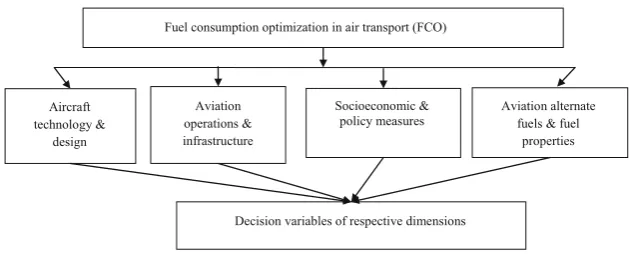
policy measures Fuel consumption optimization in air transport (FCO)
Decision variables of respective dimensions
Fig. 1 Classification scheme
3.1.2 Aviation operations & infrastructure
The amount of fuel consumed by an aircraft during its opera-tion from start-up through to taxi and takeoff, to cruise, to approach for landing and taxiing on arrival, depends upon several factors. Many of the factors can be influenced by air-lines with proper operations planning and strategies. The cur-rent operational practices are not always optimal from the fuel consumption point of view and hence there is need for oper-ational improvements. Operoper-ational improvement can be expressed in term of operational efficiency, which is the com-bination of ground and airborne efficiency. In general the ac-tual aircraft performance can be determined by how the air-craft is operated subject to operational constraints and the efficient operational procedures are those, in which the actual fuel burn used falls close to the theoretical minimum [14]. Furthermore the operational efficiency can be expressed in term of operational and payload-fuel energy intensity, and the payload factor [13]. Also the operational factors to reduce the fuel consumption per passenger-km include the increasing load factor, optimizing the aircraft speed and fuel weight, lim-iting the use of auxiliary power, eliminating the non essential weight, and reducing taxiing. In addition, highly sophisticated flight-planning system also improves the aircraft fuel efficien-cy because this allows pilots to exploit prevailing wind con-ditions, calculate precise fuel loads & set different flight levels and speeds for the aircraft to achieve the most economic performance. For a typical flight there are a number of factors such as cruise altitude and speed, mass, and weather conditions that affects the fuel consumption [108]. Therefore, by optimizing the aircraft operations from start-up through to taxi and takeoff, to cruise, to approach for landing and taxiing on arrival, have the significant to reduce the fuel burn.
Aviation infrastructure also plays an important role in fuel consumption optimization. Infrastructure improvements pres-ent a major opportunity for fuel consumption reduction in aviation. The design of an airport, including the location of the runways and taxiways relative to terminal buildings, clear-ly has an effect on aircraft fuel burn, because reduction of delays and decreased taxiing time can provide significant air-craft fuel burn reduction. Airport congestion and improper air traffic management increase the fuel consumption. Airport congestion occurs whenever the actual traffic demand is great-er than what the system can handle without the delay. According to Simaiakis et al. [109] airport surface congestion at major airports in the United States and Europe is responsi-ble for increased taxi-out times, fuel burn and emissions. Air Traffic Management (ATM) plays an important role in ing the environmental impacts of air transportation by reduc-ing the inefficiencies durreduc-ing the operations of an aircraft [110]. Ryerson et al. [111] analyzed the possible fuel savings from Air Traffic Management (ATM) improvements and the study
explored the impact of the airborne delay, departure delay, and excess planned flight time, and terminal efficiency in fuel consumption using econometric techniques. In addition the better terminal design can also reduce the fuel consumption. There are a number of ways that airports, airlines and ATM providers can improve the air transportation system to mini-mize fuel burn and emissions. These include improving the use of the airspace, air traffic control and operations and fur-ther improving the use of airspace and air traffic control in-cludes the flexible use of airspace, route redesign, using the new tools and programmes to find most effective route, and reduced separation between the aircraft. Salah [112] devel-oped the model of optimal flight paths taking into consider-ation jet noise, fuel consumption, constraints and extreme op-erational limits of the aircraft on approach. The results of this study showed that, the environmental impacts and fuel con-sumption are reduced by the use of aircraft trajectory optimi-zation during arrivals. Beside this there are some constraints to the improved ATM which includes the air traffic controller (ATC). ATC prevents the ideal trajectory of the aircraft to be flown due to a number of reasons such as safe separation, congested airspace, restricted airspace, delay management and weather avoidance etc. The priorities of controller are also taken into the account. For air traffic controller the safety comes first thereafter the performance. Therefore, by optimiz-ing the aviation infrastructure, there is the potential to reduce fuel consumption. A comprehensive list of the reviewed stud-ies of aviation operations & infrastructure affecting FCO is presented in the literature [1,3,7,11–20,32,33,38,40–42,
44, 48,53,54,61, 67,69,70, 72–75,85, 86,94,95, 98,
104–182].
3.1.3 Socioeconomic & policy measures
transport and there will be many airline customers who have never thought of aviation emission as an environmental prob-lem. Information should be widely available regarding the impact of flying, so that airlines have the background infor-mation they need to understand the changing circumstances of aviation. Informed choice is a key component of the transport demand and environmental policy implication. Furthermore, the economic/policy measures for reducing the fuel consump-tion includes the emission trading, taxes on aviaconsump-tion fuel, and carbon emission charges [17]. Beside this there are some con-straints on the airline operations, training, maintenance & res-ervations, planning & routes, scheduling, airways, and labour, these constraints should be removed for fuel burn reduction [183]. In addition, the economic and policy measures should be introduced in an incremental fashion to give the air trans-port and consumers time to adjust to the changes. So therefore, by optimizing the socioeconomic & political factors, we can improve the air transportations fuel efficiency. Studies related to socioeconomic & policy measures have been proposed in the literature [2,3,14–20,29,33,41,42,44,53,54,73,74,
94,113,114,150,154,158–160,172,183–224].
3.1.4 Aviation alternative fuels & fuel properties
Aviation alternative fuels can also play an important for the optimization of aviation fuel consumption. Since the energy crises of the 1970s, all the aircraft companies, aviation sectors, engine companies, and other government organization are working for practicality of using alternative fuel in aircraft. A viable alternative aviation fuel can stabilize fuel price fluc-tuation and reduce the reliance from the crude oil. According to Hileman & Statton [225] economic sustainability, environ-mental concerns, energy supply diversity, and competition for energy resources are the main drivers for alternative jet fuels development. The replacement for current alternative fuels need no aircraft modifications and can be used with the current aviation system, encompassing existing distribution and refueling infrastructure [226]. Hileman & Statton examined the criteria for the potential alternative jet fuels and highlight-ed that the synthetic liquid alternative fuels were compatible with current aircraft fleet, but the economic cost of production and the current lack of feedstock availability limits their near term availability to air transport. In addition the study explored the potential of the alternative aviation fuels: conventional jet fuel from petroleum resources, synthetic jet fuels, biodiesel and bio-kerosene, ethanol and butanol, liquefied natural gas and hydrogen and highlighted the technical feasibility param-eters: high energy density, high specific energy, high flash point, low freezing point and vapor pressure, high thermal stability, adequate lubricity, and sufficient aromatic compound content. Janic [17]; Pereira et al. [227], Verstraete [228], and Yılmaz et al. [229] studied the liquid hydrogen as an alterna-tive fuel for air transport and these studied identifies the
important parameters affecting the fuel consumption. Chuck & Donnelly [230] tested the compatibility of the potential aviation bio-fuels with the Jet A-1 and viscosities, cloud point temperature, flash points, energy content, effect of fuel burn in the range vs. the payload were studied. The result of the study shown that, only the hydrocarbons, matched the range vs. payload of Jet-A1 and the limonene was found to fulfill the required specification. Therefore a suitable alternative fuel can be selected on the basis of a variety of criteria, societal prior-ities, economic viability, and sustainability considerations, which will further reduce the aviation fuel consumption. Aviation alternative fuels & fuel properties studies related to FCO have been proposed in the literature [3,11,13–18,32,
33, 40–42, 53, 54, 59, 79, 86, 94, 104, 140, 150, 194,
225–282].
3.1.5 Identifications of decision variables based on FCO dimensions
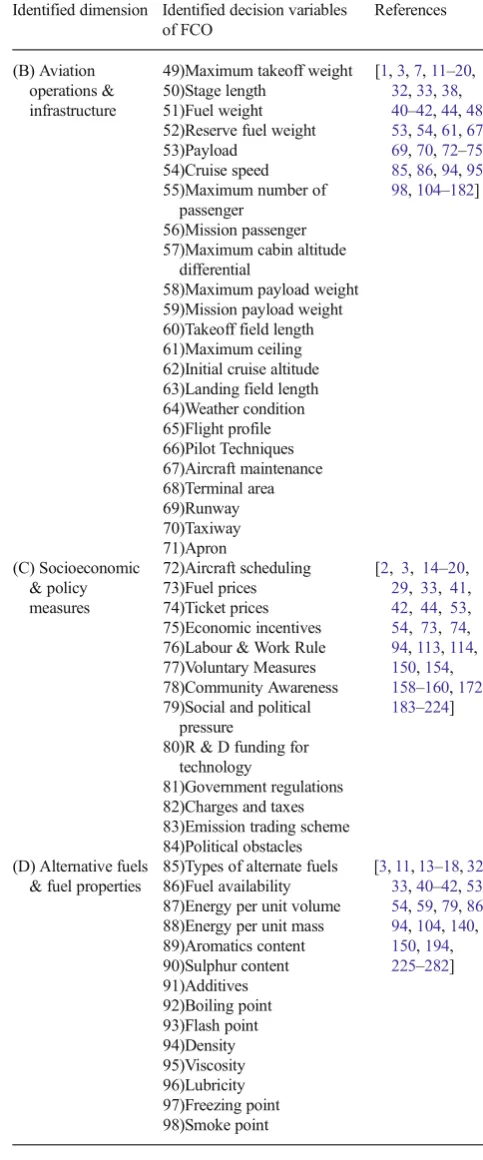
Further, the decision variables of respective dimensions of FCO were selected from the literature on the basis of the description and examination of the relationships between fuel consumption and respective dimensions & their variables, logical reasoning, conceptual basis, and strong influence on fuel burn. Theses dimensions & their respective decision var-iables affect the fuel consumption in an air transport indirect way and indirectly. As clearly evident from the literature these dimensions are closely related to each other so care has been taken that, a single decision variable cannot be repeated more than one time under the two different dimensions. Table 1
shows the decision variables based on the identified dimen-sions and the reviewed literature. Table2shows the number of decision variables of respective dimension and their percent-age. From Table2 it is clear that the A had the highest per-centage of decision variables (48.99 %), while B dimension has 23.47 %, and C has 13.26 % and D has 14.28 % each.
3.2 Classification scheme based on research methodologies of FCO research
methods while the empirical research uses the induction meth-od to arrive at conclusions. Analytical-research consists the logical, mathematical, and statistical methods [283]. Table 3
shows the research methodologies FCO in air transport.
Table 1 Identified the decision variables based on the FCO dimensions
Identified dimension Identified decision variables of FCO
References
(A) Aircraft technology & design
1)Aircraft structural weight 2)Wing reference area 3)Wing leading edge sweep 4)Wing quarter chord sweep 5)Wing aspect ratio 6)Wing mid span 7)Wing dihedral 8)Wing root thickness to
chord ratio 9)Wing tip height 10)Wing span 11)Wing fuel weight 12)Wing exposed root chord 13)Wing quarter chord
sweep
14)Wing average thickness to chord ratio
15)Ultimate load factor 16)Maximum design speed 17)Fuselage seat abreast 18)Fuselage cargo height 19)Maximum height of
fuselage
20)Effective maximum diameter of fuselage 21)Maximum cabin width of
fuselage
22)Fuselage nose length 23)Fuselage parallel length 24)fuselage tail length 25)Fuselage cabin length 26)Fuselage fineness ratio 27)Horizontal tail area 28)Horizontal tail span 29)Horizontal tail aspect ratio 30)Horizontal tail taper ratio 31)Vertical tail area 32)Vertical tail span 33)Vertical tail aspect ratio 34)Vertical tail taper ratio 35)Drag type factor 36)Critical mach number 37)Aircraft wetted area to
wing reference area ratio 38)Cruise lift to drag ratio 39)Oswald efficiency factor 40)Effective wing aspect
ratio
41)Takeoff thrust sea level 42)Engine bypass ratio 43)Number of engines 44)Engine dry weight 45)Operating specific fuel
consumption 46)Static margin
47)Centre of gravity position of aircraft from leading edge of wing
48)Aerodynamic centre of aircraft from leading edge of wing
[1,3,10,11,
13–107]
Table 1 (continued)
Identified dimension Identified decision variables of FCO
References
(B) Aviation operations & infrastructure
49)Maximum takeoff weight 50)Stage length
51)Fuel weight 52)Reserve fuel weight 53)Payload
54)Cruise speed 55)Maximum number of
passenger 56)Mission passenger 57)Maximum cabin altitude
differential
58)Maximum payload weight 59)Mission payload weight 60)Takeoff field length 61)Maximum ceiling 62)Initial cruise altitude 63)Landing field length 64)Weather condition 65)Flight profile 66)Pilot Techniques 67)Aircraft maintenance 68)Terminal area 69)Runway 70)Taxiway 71)Apron
[1,3,7,11–20,
32,33,38,
40–42,44,48,
53,54,61,67,
69,70,72–75,
85,86,94,95,
98,104–182]
(C) Socioeconomic & policy measures 72)Aircraft scheduling 73)Fuel prices 74)Ticket prices 75)Economic incentives 76)Labour & Work Rule 77)Voluntary Measures 78)Community Awareness 79)Social and political
pressure
80)R & D funding for technology
81)Government regulations 82)Charges and taxes 83)Emission trading scheme 84)Political obstacles
[2, 3, 14–20,
29, 33, 41,
42, 44, 53,
54, 73, 74,
94,113,114,
150,154,
158–160,172,
183–224]
(D) Alternative fuels & fuel properties
85)Types of alternate fuels 86)Fuel availability 87)Energy per unit volume 88)Energy per unit mass 89)Aromatics content 90)Sulphur content 91)Additives 92)Boiling point 93)Flash point 94)Density 95)Viscosity 96)Lubricity 97)Freezing point 98)Smoke point
[3,11,13–18,32,
33,40–42,53,
54,59,79,86,
94,104,140,
150,194,
3.2.1 Analytical research methodology
In this study, the analytical research includes the case studies for conceptualization, intro-respective research, and concep-tual modeling for fuel consumption research in air transport [1,3,4,11,13,14,16,19,21,32,34,38,40,41,43–45,49,
50,52–54,57,59,61,73,79–83,87,92,94,96,97,100,101,
103,105,106,110,128,140,146,148,151,155,163,164,
168, 174, 175, 183, 187, 193, 201, 209, 211, 213, 215,
218–220,225, 231, 232, 236, 258,267, 273]. Analytical mathematical research develops the new mathematical rela-tionships between closely defined concepts and uses the sim-ulated data to draw the conclusions [284, 285]. Here the analytical-mathematical research for fuel consumption in avi-ation includes the; fuel burn and emission prediction and fore-cast for future scenario studies which primarily consist of log-ical and descriptive modeling [2,22,25,29,35,37,42,46–48,
55,63–65,67,69,70,72,75–78,84,85,88–91,93,95,98,
99,102,104,107, 113–115,117,132,133,136,138,147,
149,152,153,165,178–182,184,188,190,191,199,212,
244]. Additionally the analytical-mathematical techniques can further be classified into the linear programming [24,28,39,
62,108,116,122–125,129,134,150,157,160,162,166,
170,177,185,192,197,198,203,216,217,221,224], mixed
integer programming [12,135,197,221,224], dynamic pro-gramming [17,75,76,107, 119, 154,159, 161,171,186,
189], gradient based methods [26,27,30,31,36,51,56,60,
71], simulation modeling [15,112,121,142,227,228], and nature based algorithms [10,58,66,68,118,120,176]. These techniques mainly deal with the FCO models that are the main thematic area of this study. Each of these techniques has its own strengths and weaknesses and can be helpful in solving certain types of FCO problems. Mathematical programming models have been demonstrated to be useful analytical tools in optimizing decision-making problems such as those encoun-tered in air transport fuel consumption.
Linear programming (LP) models consist of a linear fuel consumption function which is to be minimized subject to a certain number of constraints [157,162]. Mixed integer pro-gramming (MIP) is applicable when some or all of the vari-ables are restricted to be integers [286]. Dynamic program-ming is used when sub problems are not independent and we solve the problem by dividing them into sub problem [284]. As the aircraft fuel consumption during its operation is not always linear in nature, therefore complex mathematical rela-tionships are used for the FCO. The mathematical techniques, i.e. linear programming and MIP may not be very effective in solving real world FCO problems, because of the large
Table 2 Percentage of identified
decision variables of FCO dimensions
Key Dimension No. of Decision Variables Percentage (%)
A Aircraft technology & design 48 48.99
B Aviation operations & infrastructure 23 23.47
C Socioeconomic & policy measures 13 13.26
D Alternative fuels & fuel properties 14 14.28
Research methodology as observed in literature of FCO in air transport industry
Analytical research Empirical research
Analytical mathematical
Analytical conceptual Analytical statistical
Linear programming
Mixed integer programming
Dynamic programming
Gradient based algorithms
Simulation modeling Empirical
experimental
Empirical statistical
Empirical case study
Genetic algorithm Particle swarm algorithm Simulated annealing Immune algorithm Nature based algorithms Logical and
descriptive modeling
number of variables and constraints involved. These are only suitable for solving the FCO problems with limited variables and constraints and also LP require high computer memory and long CPU time in order to process complex mathematical algorithms [287]. Linear programming has shown to be inca-pable of describing the actual complexity of realism of FCO models. Also the dynamic programming has the limitations: lack of general algorithms and dimensionality [284].
Gradient based methods are mainly used for aerodynamic design optimization of aircraft and they minimize the convex differential functions. Gradient-based methods provide a clear convergence criterion. The limitations of gradient-based methods are; high development cost, noisy objective function spaces, inaccurate gradients, categorical variables, and topol-ogy optimization [285]. This limits their use for global FCO. Simulation modeling in the area of the FCO is used to observe how an aircraft performs, diagnose problems and predict the effect of changes in the aircraft system, evaluates fuel con-sumption, and suggest possible solutions for improvements. Simulation techniques can be ideal for reproducing the
behaviors of a complex design system of the aircraft. Many previous studies have analyzed the capability of simulation modeling in fuel consumption modeling and optimization [15,112,121,142,227,228]. One of the major limitations of simulation techniques is its inability to guarantee optimality of the developed solution. Also the simulation technique is very expansive.
The nature based algorithms can be based on swarm intel-ligence, biological systems, physical and chemical systems [288]. The researchers have learned from biological systems, physical and chemical systems to design and develop a num-ber of different kinds of optimization algorithms that have been widely used in both theoretical study and practical appli-cations. Since the nature is the main source of inspiration of these algorithms, so they are called nature based algorithms [288,289]. In FCO problems the nature based algorithms are classified into the genetic algorithm (GA), particle swarm op-timization (PSO), simulated annealing, and immune algo-rithm. GA is an evolutionary based stochastic optimization algorithm with general-purpose search methods which
Table 3 Research methodologies
for FCO research in air transport Reference Research methodology
[1,3,4,11,13,14,16,19,21,32,34,38,40,41,43–45,49,50,
52–54,57,59,61,73,79–83,87,92,94,96,97,100,101,103,
105,106,110,128,140,146,148,151,155,163,164,168,174,
175,183,187,193,201,209,211,213,215,218–220,225,231,
232,236,258,267,273]
Analytical conceptual research
[2,22,25,29,35,37,42,46–48,55,63–65,67,69,70,72,75–78,
84,85,88–91,93,95,98,99,102,104,107,113–115,117,132,
133,136,138,147,149,152,153,165,178–182,184,188,190,
191,199,212,244]
Analytical mathematical research-Logical and descriptive modeling
[24,28,39,45,62,108,116,122–125,129,134,157,160,162,
166,170,177,185,192,197,198,203,216,217,221]
Analytical mathematical - Linear programming
[12,135,197,221,224] Analytical mathematical -Mixed integer programming
[17,75,76,107,119,154,159,161,171,186,189] Analytical mathematical -Dynamic programming
[26,27,30,31,36,51,56,60,71] Analytical mathematical- Gradient based algorithms
[10,58,66,68,118,120,176] Analytical mathematical- Nature based algorithm:
Genetic algorithms Particle swarm algorithms Simulated annealing Immune algorithm
[15,112,121,142,227,228] Analytical mathematical- Simulation modelling
[20,23,109,111,130,137,144,145,156,158] Analytical statistical research
[18,126] Empirical statistical research
[86,204,229,230,233–235,238–240,243,245–247,250–252,
256,259,261,263–265,268–271,281,282]
Empirical experimental research
[131,138,141,167,169,172,187,194,195,205–208,210,214,
222,223,226,237,241,242,248,253–255,257,260,262,
266,272,274–280]
simulate the processes in a natural evolution system [290]. GA is an efficient algorithm with flexibility to search the complex spaces such as the solution space for the global air transport fuel consumption. GA algorithms are well suited to multi-objective optimization problems because they can handle large populations of solutions [58]. The advantages of using GA techniques for solving large optimization problems are its ability to solve multidimensional, non-differential, non-con-tinuous, and even nonparametric problems [291]. Moreover, it solves the problem with multi solutions. GAs has been proven to be a highly effective and efficient tool in solving complex aircraft design, and some of their successful applications in the optimization of fuel consumption models have been proposed in the literature [58,68,176]. There are, however, a number of challenges when designing a customized GA procedure to solve a certain FCO problem. The first difficulty is the con-struction of customized genetic operators to perform the mat-ing process on the chromosomes. Secondly, designmat-ing a con-straint handling mechanism is generally a complicated task in order to ensure the effective implementation of the model constraints. In addition, when populations have a lot of sub-jects, there is no absolute assurance that a genetic algorithm will find a global optimum [290]. PSO has been extensively used to many engineering optimization areas due to its simple conceptual framework, unique searching mechanism, compu-tational efficiency, and easy implementation [290]. In order to find the optimal solution, the PSO algorithm simulates the movement of a set of particles in the search space under predetermined rules [292]. The particles use the experience accumulated during the evolution, for finding the global max-imum or minmax-imum of a function [118]. The PSO algorithm does not require sorting of fitness values of solutions in any process and this might be a significant computational advan-tage over GA, especially when the population size is large [293].
Simulated annealing (SA) is a one of the most common meta-heuristics techniques, and has been successfully applied to solve several types of combinational optimization problems [294]. The main advantages of SA are; it deals with arbitrary systems and cost functions, relatively easy to code, even for complex problems. But its main disadvantage is that, it cannot tell whether it has found an optimal solution, it requires some complimentary bound [295]. Pant, R. [66] used SA for the aircraft configuration and flight profile optimization. In case of aircraft fuel consumption, the objective function was found to be highly nonlinear and discontinuous, with several com-binations of design variables not having a feasible solution. Hence, gradient-based optimization methods could not be ap-plied to obtain the optimal solution, and the SA approach was adopted [66]. Ravizza, S. et al., [120] adopted the population based immune algorithm for tradeoff between the taxi time and fuel consumption in airport ground movement. Immune Algorithms are related to the Artificial Immune Systems field
of study concerned with computational methods. Immune Algorithms are inspired by the process and mechanisms of the biological immune system. The main advantages of the algorithm are dynamically adjustable population size, combination of local with global search, defined convergence criterion, and the capability of maintaining stable local optimum solutions [296]. More knowledge about the fuel-based objective function is needed to formulate the combined FCO function. Lastly the analytical-statistical research integrates logi-cal, mathematical models from analytical-research and statistical models from empirical research for fuel con-sumption & optimization research. Table 2 shows the list of analytical statistical studies [20, 23, 109, 111,
130, 137, 144, 145, 156, 158]. Summarily, the main objective of analytical statistical research is to provide, the more cohesive model for empirical statistical testing [283].
3.2.2 Empirical research methodology
The empirical research methodology uses data from external organizations or businesses to test if relationships hold in the external world [283]. Empirical research methods for fuel consumption & optimization studies are classified into three sub-categories, namely; empirical-experimental [86,204,229,
230,233–235,238–240,243,245–247,250–252,256,259,
261,263–265,268–271,281,282], empirical statistical [18,
126], and empirical case studies [131,138,141,167,169,
172,187,194,195,205–208,210,214,222,223,226,237,
4 A simple meta-analysis
In general, the nature of data available in the studies reviewed determines the type of meta-analytic method that can be ap-plied. In this paper, we perform summary counts of the deter-minants of the article studied, fuel prices, and evolution of fuel efficiency trends. Though this simple meta-analysis provides only descriptive information with no statistics, it is expected to shed greater understanding of the development and evolution of FCO research trends in the air transport industry and to identify potential research areas for further research and for improvement. Accordingly, we analyzed 277 articles related to FCO re-search in air transport by (1) Yearly distribution of articles, and evolution of fuel prices and fuel efficiency trends (2) Distribution of research methodologies (3) Journal wise (Discipline) distribution.
4.1 Yearly distribution of research articles, fuel prices and evolution of fuel efficiency trends
Progresses in literature related to fuel consumption have been started since after 1973–74 Arab oil embargoes. After that, the oil crises fuel conservation and efficiency became the main focus of the aviation industry. Table4Yearly distributions of research articles, fuel prices, and evolution of fuel efficiency trends of air transport from 1973 to 2014 [298]. The major growth in optimum use of fuel occurred after the 1973 Arab oil embargo. During the period 1973–1980, the oil prices in-creased sharply and U.S. economy had focused the need for more fuel efficient transportation [98]. The first oil shock was in 1973–1974 and the second one in 1978–1980 [16]. During the period 1973–1975, the oil prices increased sharply as shown in Table4, while the airline jet fuel prices stabilized in 1976 compared to sharply rising prices in the three preced-ing years. The jet fuel price in 1975 rose to about 2.01 dollar/ million BTU, from the 1.54 dollar/ million BTU in 1974. During the period 1973–1975, the net average percentage change in fuel prices was 51 % and during the period 1976– 1978, the fuel prices increased by an amount 8-13 %, this shows the stability of jet fuel prices. But, again during the period (1978–1980) second oil shock the jet fuel prices in-creased sharply, by net average percentage 49 % and this was only 2 % less than the 1973–1975 time periods. Also increased air travel volume was one more main reason behind the rising fuel prices, because the passengers were relatively unconcerned to the ticket price because the benefits of faster travel and this was a very interesting trend in that period [16]. Table4shows the distribution of research articles during the period 1973–1980. Total number of articles from 1973 to 1980 were 38 and most of the studies have been found in 1978 i.e.9. It is clear from the Table4, that the numbers of the articles during the first oil shock (1973–1975) were 9 and
after first oil shock and second oil shock, they have been increased to 29. Figure3 shows the yearly distribution of a number of articles and fuel prices.
In the early 1980s, the non OPEC countries had also started production of oil therefore oil consuming counties decreased their oil demand from OPEC countries. As a result the OPEC production declined after 1981 and in response to declining production. Furthermore, Iran and Iraq war, and ceasing of oil production by Saudi Arabia were the main reasons for fuel price decline [299]. During the period 1981–1985 the US airline jet fuel prices declined from 7.49 to 6.51 dollar/ million BTU and also the net average % decline in fuel prices was 3.4 %. But, the biggest decline in jet fuel prices occurred in 1986, during this year the jet fuel prices decreased by 32 % as compared to 1985 prices. After, the 1986 to 1989 the fuel prices stabilized with net average % change of only 2 %. Again, in 1989 the fuel prices increased by 28 % as compared to 1988 prices. The 1990 spike was mainly attributable to the first Gulf War, but the price spike was only for shorter periods [299]. It is clear from the Fig.3that the fuel prices from 1973 to 1981 increased continuously and from 1981 to 1989 de-creased continuously. The total numbers of articles during this period were 23. Most of the studies have been found in 1987 i.e. 8. During the period 1981–1990, the number of articles also decreased as compared to 1973–1980.
In the period 1991–2003 the jet fuel prices remained rela-tively low and stable. During the period 1991–1995, the fuel prices continuously decreased and they fell from 5.18 to 4.04 dollar/million BTU. In 1998 oil prices were affected by the Asian financial crisis. They fell to below 25 % as that of 1997 jet fuel prices. But, the Asian economies recovering from the financial crisis, prices increased during 2000. The fuel prices rose by 63 % as compared to that of 1999 prices. The total number of articles from 1991 to 2003 were 61 and most of the studies have been found in 2003 i.e.9. The numbers of the articles were more than the last two decades.
Table 4 Yearly distributions of research articles, fuel prices, and evolution of fuel efficiency trends [298]
Year No. of Articles
Evolution of fuel efficiency trends research trends References Jet fuel prices (dollar/ million BTU)
1973 3 Turbojet revolution, fuel burning rate study [102,103,281] 0.89 1974 5 Operational efficiency, socioeconomic and political
measures, aircraft size
[174,175,183,222,223] 1.54
1975 1 Hydrogen fuel [280] 2.01
1976 7 Turbofan 1st generation, policy measures, Hydrogen fuel, operational efficiency
[101,171–173,220,221,
279]
2.18
1977 7 Aircraft size, turboprop potential, fuel management model [96–100,170,278] 2.51 1978 9 Fuel combustion requirement, future turbofan, hydrogen
fuel, airport and terminal design,
[92–95,168,169,
275–277];
2.86
1979 2 Engine efficiency, airport capacity [91,167] 3.85
1980 4 Turbofan 2nd generation, and 3rd generation aircraft design, hydrogen fuel
[88–90,274] 6.27
1981 1 Fuel allocation model [166] 7.49
1982 3 Fuel burn estimation [85–87] 7.02
1983 1 Hydrogen fuel [182] 6.94
1984 2 Aircraft design, fuel consumption estimation [106,165] 6.87
1985 1 Turbofan performance estimation [84] 6.51
1986 2 Advance turboprop, Aircraft material potential [82,83] 4.42 1987 8 Alternative fuels, hydrogen fuel, fuel prices, modern
turboprop, optimal cyclic cruise
[79–81,107,219,
270–272]
4.55
1988 1 Variable wing camber [78] 4.15
1989 3 Aerodynamic efficiency, fuel properties [77,268,269] 4.70
1990 1 Ground efficiency [164] 6.03
1991 2 Hydrogen fuel, terminal area traffic management [163,267] 5.18 1992 5 Hydrogen fuel, endurance performance optimization, fuel
management model, optimum cruise lift
[1,75,76,162,266] 4.84
1993 1 Thermal stability of jet fuel [282] 4.47
1994 5 Fuel properties, taxation policy, fuel consumption modeling [161,218,263–265] 4.14
1995 2 Policy measures [73,74] 4.04
1996 5 Wave rotor optimization, hydrogen fuel & fuel properties, engine design
[71,72,105,261,262] 4.88
1997 5 Alternatives fuels & fuel properties, cruise range performance and prediction
[70,257–260] 4.53
1998 2 Terminal airdrome, policy measures [69,160] 3.40
1999 5 Turbofan engine design and flight profile optimization, incentive based regulations
[65–68,217] 4.23
2000 2 Aircraft turnaround efficiency, chemical kinetic model [159,256] 6.90 2001 5 Technological and operational efficiency, policy options,
turbofan and turbojet engine
[20,63,158,216,255] 5.79
2002 5 Airport infrastructure, technological and operational efficiency, socioeconomic and policy options
[7,19,157,214,215] 5.54
2003 9 Biodiesel and fuel properties, aircraft size, socioeconomic and policy options, engine performance optimization
[61,62,154–156,213,
252–254]
6.76
2004 5 Blended wing body, technological measures, alternative fuels, infrastructure, socioeconomic & policy options
[59,60,152,153,212] 9.06
2005 6 Aircraft design optimization, fuel management model, alternative fuels, operational and socioeconomic & policy measures
[57,58,150,151,211,251] 13.10
2006 8 Technological and operational efficiency, fuel properties optimization, turbofan engine optimization
[55,56,113,114,148,149,
249,250]
14.89
2007 13 Airport infrastructure, alternative fuels & fuel properties, SAGE model, operational efficiency, aircraft size
[52–54,143–147,209,
210,246–248]
16.46
2008 12 Hydrogen fuel and fuel properties, operational and technological efficiency, aircraft landing scheduling
[48–51,142,178–181,
224,244,245]
23.13
2009 13 Socioeconomic & policy measure, alternative fuels & fuel properties, technological and operational efficiency
[11,42–47,137–140,208,
243]
total numbers of articles from 2004 to 2014 were 165, which is more than the number of articles than from 1973 to 2003. Most of the studies have been found in 2014 i.e. 28. Figure3shows the increasing trend of number of articles from 2004 to 2007 and during the same period the oil prices had also increased. But in the last 2 years the total numbers of articles were 50, and this represents the 18 % of the total number of articles. From Table4 it is observed that the number of published articles between the period 1973 and 2000 is less (90 articles), than that of the period 2001–2014.
Historically, jet fuel prices have been the main driver for improvements in aircraft fuel efficiency [16]. Table 4 also shows the yearly evolution of the fuel efficiency trends from
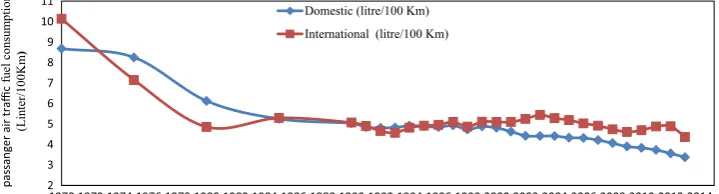
1973 to 2014. Evolution of fuel efficiency trends has explored the four factors .i.e. technological efficiency improvement, operational efficiency improvement, socioeconomic & policy measures, and alternate fuel use, similar as that identified ear-lier. But, the alternative fuels have only shown the future po-tential options for fuel efficiency improvement, because of concerns regarding their economic cost of production and the current lack of feedstock availability limits their near term availability of aviation [225]. So, only the improvement in aircraft fuel efficiency from 1960 to 2014 were mainly due to technological factors, operational factors, load factors, and aircraft size. The various trends evolved in the Table4are also grouped under these four factors. From Table4it is clear that the entire fuel efficiency factor have been evolved continuous-ly from 2007 to 2014, as compared to other time span. According to Grote, [14] average fuel-efficiency improvement between 1960 and 2008 was 1.5 % per annum, but over the time it has slowed down. Lee et al. [20] predicted that the reduction in energy intensity during the period 1959–1995 were mainly due to improvement in engine efficiency (57 %), aerodynamic efficiency (22 %), aircraft capacity (17 %), and other changes such as increased aircraft size (4 %). Owen, [301] showed a 70 % improvement in fuel efficiency as fuel per RPK between 1970 and 2006 and these improvements were mainly due to improvements in load fac-tor (20 %), aircraft size (26 %) and finally technical and op-erational improvements to the fleet (24 %). However a great part of this improvement was gained during the 1970–1980 (40 %) and rest of improvements had been achieved during 1980–1990 (22 %), 1990–2000 (23 %), and 2000–2006 (15 %). Figure4shows the evolution of fuel efficiency trends in US domestic and international aviation from 1970 to 2013. It is clear from Fig.4that the US domestic and international airlines passengers’air traffic, fuel consumption decreased from 9 liters/100Km to 3 liters/100Km and 10 liter/100Km to 4 liters/100Km during the time period from 1970 to 2013.
Table 4 (continued)
Year No. of Articles
Evolution of fuel efficiency trends research trends References Jet fuel prices (dollar/ million BTU)
2010 21 Technological & operational efficiency, Socioeconomic & policy measure, alternative fuels & fuel properties
[2,3,37–41,104,134–136,
202–207,240–242]
16.43
2011 18 Technological & operational efficiency, Socioeconomic & policy measure, alternative fuels & fuel properties
[15,16,34–36,129–133,
199–201,236–239]
22.77
2012 16 Technological & operational efficiency, Socioeconomic & policy measure, alternative fuels & fuel properties
[10,32,33,123–128,
196–198,229,233–235]
24.44
2013 22 Geared turbofan, Technological & operational efficiency, Socioeconomic & policy measure, alternative fuels & fuel properties
[13,29–31,118–122,177,
187–195,228,231,232]
23.30
2014 28 Technological & operational efficiency, Socioeconomic & policy measure, alternative fuels & fuel properties
[12,14,17,18,21–28,
108–112,115–117,176,
184–186,225–227,230]
22.58
Total 277
Table 5 Percentage (%) of research methodologies for FCO research
Research methodology of FCO research Percentage (%) of research methodologies
A. Analytical research :
1) Analytical conceptual research 2) Analytical mathematical:
a) Logical and descriptive modeling b) Linear programming
c) Mixed integer programming d) Dynamic programming e) Gradient based algorithms f) Nature based algorithm h) Simulation modeling 3) Analytical statistical research
26 22 10 2 4 3 2 2 4 B. Empirical research
1) Empirical statistical research 2) Empirical experimental research 3) Empirical case study
1 10 14
Improvements were particularly rapidly during the 1970s, when wide body aircraft came into the service and in the early to mid-1980s, when mid-range aircraft like turbofan 2nd and third generation entered into the service. Figure4shows the 60 % and 52 % reduction of fuel burn of US domestic and international airlines on a seat-Km (passengers only) during the time period 1970–1985. The flattening slope of the fuel burns curve in Fig.4suggests a notable decrease in the rate of fuel efficiency improvement over the time period 1985–2000. Through 1985–2000, we estimate that the efficiency of aircraft improved 15 % for both airlines. Lastly, the figure shows that the fuel efficiency improvement of 9 % and 11 % for the domestic and international US airlines during the time period 2001–2014.
4.2 Distribution of articles by research methodologies of FCO research
Table5shows the percentage distribution of research method-ologies for the FCO research in air transport. It is clear from the Table5that the analytical research methodologies have the higher percentage (75 %) than the empirical research method-ologies (15 %). Also, the near about haft of the research meth-odologies are from the analytical- conceptual, logical, and descriptive modeling. These studies mainly include the; fuel burn and emission calculation, prediction and forecast for fu-ture scenario. Moreover, the analytical-conceptual, logical, and descriptive modeling, empirical-experimental and, empir-ical case studies are more predominately proposed by many
researchers 72 % of methodologies rather than 21 % method-ologies of optimization modeling. It is also observed from Table5 that the optimization modeling research techniques, i.e. Linear programming, dynamic programming, MIP, gradi-ent based methods, and natural algorithms have very low per-centage (21 %).
4.3 Distribution of articles by journals (discipline wise)
The journal wise the number of FCO research articles in in-ternational journals is computed and the same is shown in Table6. During the period 1973 to 2014 there are 277 research articles on FCO research appeared in 69 journals and most of the article have been found in Journal of Air Transport Management (9 %) followed by Transportation Research Part D: Transport and Environment, and International journal of Hydrogen Energy both having 7 % each. Since the numbers of articles against many journals are few to get some simple inferences, the research journals reviewed are grouped with respect to disciple wise, i.e. Transportations (TP), Aerospace Sciences (AS), Fuel & Energy (F&E) and Environmental Science (ES). Table6 shows the discipline wise total % of the articles. Accordingly, distribution of articles of journals (discipline wise) is computed and shown in Fig. 5. It is ob-served that the Transportation (TP) related journals have far the most articles i.e. 111. This indicates that TP is a major important field affecting the FCO in air transport. Followed to TP related journals, the Aerospace sciences (AS) are having more articles on FCO research. The differences between the
0 5 10 15 20 25 30
1973 1975 1977 1979 1981 1983 1985 1987 1989 1991 1993 1995 1997 1999 2001 2003 2005 2007 2009 2011 2013 2015
Years
Jet fuel prices(dollars/ million Btu)
Number of articles
Fig. 3 Yearly distribution of
number of articles and jet fuel prices
2 3 4 5 6 7 8 9 10 11
1970 1972 1974 1976 1978 1980 1982 1984 1986 1988 1990 1992 1994 1996 1998 2000 2002 2004 2006 2008 2010 2012 2014
US d
o
m
estic
and
in
ternatio
nal
pass
an
ger air
traffic
fu
el co
n
sum
p
tion
(L
in
ter/10
0
K
m
)
Year
Domestic (litre/100 Km) International (litre/100 Km)
Fig. 4 Evolution of fuel
Table 6 The discipline wise total % of articles
SI. No. Journal name No. of
articles
Discipline code
Discipline total & % articles
1. Journal of Air-Transport Management 26 TP 111 [40 %]
2. Transportation Research Part D: Transport and Environment 19 TP
3. Transport Policy 10 TP
4. Transportation Research Part A: Policy and Practice 6 TP
5. Journal of Transport Economics and Policy 6 TP
6. Transportation Research 5 TP
7. Transportation Journal 4 TP
8. Transportation Planning and Technology 4 TP
9. Transportation Research Part E: Logistics and Transportation 3 TP
10. European Transport Research Review 3 TP
11. Journal of Air Transportation 2 TP
12. Transportation Research Part B: Methodological 2 TP
13. Transportation Research Part C: Emerging Technologies 2 TP
14. Transportation Science 1 TP
15. Transport Reviews 1 TP
16 Journal of Advance Transportation 1 TP
17. Public Transport 1 TP
18. Journal of Transport Geography 1 TP
19. Technology Analysis & Strategic Management 4 TP
20. Interfaces 3 TP
21. Operations Research 2 TP
22. European Journal of Operational Research 1 TP
23. Journal of Technology Management & Innovation 1 TP
24. Management Science 1 TP
25. The Journal of Operational Research Society 1 TP
26. Industrial Engineering Letter 1 TP
27. Aircraft Engineering and Aerospace Technology 14 AS 89 [32 %]
28 Journal of Aircraft 14 AS
29. Progress in Aerospace Sciences 12 AS
30. Aerospace Science and Technology 10 AS
31. Journal of Propulsion and Power 8 AS
32. The Aeronautical Journal 6 AS
33. AIAA Journal 4 AS
34. Acta Astronautica 4 AS
35. Proceeding of Institution of Mechanical Engineers, Part G: Journal of Aerospace Engineering 2 AS
36. SAE : International Journal of Aerospace 2 AS
37. Aircraft Design 2 AS
38. Chinese Journal of Aeronautics 2 AS
39. Journal of Engineering for Gas Turbines and Power 2 AS
40. Canadian Aeronautics and Space Journal 1 AS
41. Technology and Culture 1 AS
42. Material & Design 1 AS
43. Advance Material Research 1 AS
44. Technological Forecasting and Social Change 1 AS
45. Automatica 1 AS
46. Fuzzy Sets and Systems 1 AS
47. International Journal of Hydrogen Energy 19 F & E 64 [23 %]
TP and AS articles are only 8 %. This could be due to the fact most of the articles reported in TP are also related to road and rail transport and those were not included in the study. The number of articles that ap-peared in discipline F&E and ES are relatively low with discipline TP, and AS. This could be due to the low correlation between the objectives of various studies report-ed on FCO research in air transport and scope of the respective journals.
5 Findings, conclusions, direction for future research
implications, and limitations
It is known that the history of the FCO research is not long compared with other industries. To the best of our knowledge, so far, no attempt has been made to classify and analyze the literature dealing with FCO with air transport research. Thus, in this paper we have attempted to review and classify the FCO research. Accordingly, an extensive literature review has been attempted from various journals and web based arti-cles that are possible outlets for this research. This resulted in the identification of 277 articles from 69 journals by year of publication, journal, and topic area based on the two classifi-cation schemes related to FCO research, published between, 1973 to December- 2014. In addition, the study has identified the 4 dimensions and 98 decision variables affecting the fuel consumption. Also, this study have explained the six catego-ries of FCO research methodologies (analytical - conceptual, mathematical, statistical, and empirical-experimental, statisti-cal, and case studies) and optimization techniques (linear pro-gramming, mixed integer propro-gramming, dynamic program-ming, gradient based algorithms, simulation modeling, and nature based algorithms). The findings of this study indicate that the analytical-mathematical research methodologies
Table 6 (continued)
SI. No. Journal name No. of
articles
Discipline code
Discipline total & % articles
49. Energy Conversion and Management 5 F & E
50. Energy 5 F & E
51. Energy Policy 4 F & E
52. Progress in Energy and Combustion Science 3 F & E
53. The OPEC Energy Review 3 F & E
54. Proceedings of the Combustion Institute 2 F & E
55. Journal of Energy (AIAA) 2 F & E
56. Fuel Science and Technology International 2 F & E
57. Annual Review of Energy and the Environment 2 F & E
58. Applied Energy 2 F & E
59. Renewable and Sustainable Energy Reviews 1 F & E
60. Combustion and Flame 1 F & E
61. Fuel Processing Technology 1 F & E
62. Journal of Energy Technologies and Policy 1 F & E
63. Atmospheric Environment 6 ES 13 [5 %]
64. Journal of Cleaner Production 2 ES
65. Environment Science and Policy 1 ES
66. International Journal of Environmental Research and Public Health 1 ES 67. Philosophical Transactions: Mathematical, Physical and Engineering Sciences 1 ES
68. Climate Policy 1 ES
69. Carbon Management 1 ES
Total 277 100
0 5 10 15 20 25 30 35 40 45
TP AS F&E ES
% of a
rcl
es
Discipline
Percentage of arcles
represent the 47 % of FCO research. The results show that there is an increasing trend in research of the FCO. It is ob-served that the number of published articles between the pe-riod 1973 and 2000 is less (90 articles), so we can say that there are 187 articles which appeared in various journals and other publication sources in the area of FCO since 2000. Furthermore there is increased trend in research on FCO from 2000 onward. This is due to the fact that continuously new researchers are commencing their research activities in FCO research. This shows clearly that FCO research is a current research area among many research groups across the world. Lastly, the prices of jet fuel have significantly increased since the 2005. The aviation sector’s fuel efficiency improve-ments have slowed down since the 1970s–1980s due to the slower pace of technological development in engine and aero-dynamic designs and airframe materials.
From the matching of published articles according to our proposed classification schemes and according to perfor-mance metric, it seems there are considerable untouched re-search problems in FCO rere-search. Over the last four decades, the significance of FCO at tactical and operational levels has been recognized by academics and practitioners as a compet-itive advantage for the better performance of airlines. This study reviewed the state of the art in optimization modeling of fuel consumption. Our findings have some important con-clusions of FCO research and suggest the following directions for future research in the area:
& We classified the current literature into four dimensions
based on the degree of complexity and identified 98 deci-sion variables affecting the FCO. This classification of dimensions and their respective decision variables could be of potential value to future researchers in the field and is also capable of further refinements. These parameters, if addressed, could result in a consistent, and comparable database of the FCO research.
& We conclude that FCO models need to address the
com-posite fuel consumption problem by extending models to include all the dimensions, i.e. aircraft technology & de-sign, aviation operations & infrastructure, socioeconomic & policy measures, and alternative fuels & fuel properties. FCO models typically comprise all the four dimensions and this reality need to be taken into account in global FCO models. In addition, these models should have ob-jectives or constraints to evaluate the aircraft sizes accord-ing to market structure, impact of various policy measures on fuel burn, and near term potential alternative fuel op-tions in the global FCO problem. In the models reviewed, we evaluated that, only the few authors considered these factors.
& We also conclude that the performance measures (.i.e.
technological efficiency and operational efficiency) adopted in FCO models need to be broadened in definition
to address socioeconomic & political and alternative fuels potentials. Although real FCO models emphasize a variety
of performance measures in practice—none of FCO
models allow for this variety.
& A second classification was also presented in the paper
based on the research methodologies and techniques used for tackling the proposed fuel consumption problems. One perpetual concern is the development of appropriate re-search approaches for tackling large fuel consumption and optimization problems. Various research techniques have been used to deal with aircraft design, operations, infrastructure, socioeconomic & political, and alternate fuel problems ranging from mathematical models; gradi-ent based algorithms, simulation modeling, and to the lat-est nature based algorithms. Hence, there is a need to further extend the effectiveness of the existing solution techniques to be capable of handling realistic FCO prob-lems with large numbers of variables and constraints. Heuristics and meta-heuristic techniques are still the dom-inant solution techniques in the literature of FCO [10,58,
66,68,118,120,176]. Genetic algorithms (GAs), particle swarm optimization (PSO), simulated annealing (SA), and immune algorithm (IA), has been recognized by several researchers as the most promising techniques. There is still a need to further extend the effectiveness of the existing research methodologies and to test the new arrivals such as Ant Colony Optimization (ACO), Bee Colony Optimization (BCO) techniques, and Firefly optimization techniques (FA).
& Only 1 % and 2 % articles discussed the empirical
statis-tical methodology and analystatis-tical-mathemastatis-tical methodol-ogy based on the natural algorithms within the context of the FCO. As far as the empirical statistical research meth-odology is concerned, it verifies models for their empirical validity in larger populations to reduce the number of re-lationships in future research, while the nature based algo-rithms has been considered the most powerful tool for optimization. More research could be done on this issue. Therefore, we observed that, the combination of empirical statistical methodology followed by analytical- mathemat-ical nature based algorithms could be of potential research methodologies to future researchers in the field.
& It is observed that the number of published articles


![Table 4Yearly distributions of research articles, fuel prices, and evolution of fuel efficiency trends [298]](https://thumb-us.123doks.com/thumbv2/123dok_us/887605.1586168/12.595.53.541.78.718/table-yearly-distributions-research-articles-prices-evolution-efficiency.webp)