RESEARCH
Poor quality of life and functioning
in bipolar disorder
Louisa G. Sylvia
1,2*, Rebecca E. Montana
1, Thilo Deckersbach
1,2, Michael E. Thase
3, Maurcio Tohen
4,
Noreen Reilly‑Harrington
1,2, Melvin G. McInnis
5, James H. Kocsis
6, Charles Bowden
7, Joseph Calabrese
8,
Keming Gao
8, Terence Ketter
9, Richard C. Shelton
10, Susan L. McElroy
11,12, Edward S. Friedman
13,
Dustin J. Rabideau
14and Andrew A. Nierenberg
1,2Abstract
Background:
This study explores the association of demographic and clinical features with quality of life and func‑
tioning in individuals with bipolar disorder.
Methods:
Adult participants (
N
=
482) with bipolar I or II disorder were enrolled in a comparative effectiveness study
across eleven study sites and completed baseline measures of medical and psychiatric history, current mood, quality
of life, and functioning. Participants with at least mildly depressive or manic/hypomanic symptomatic severity were
randomized to receive lithium or quetiapine in addition to adjunctive personalized treatment for 6 months.
Results:
Participants with more severe depressive and irritability symptoms had lower quality of life and higher func‑
tional impairment. All psychiatric comorbid conditions except substance use disorder were associated with worse
quality of life. On average, females had lower quality of life than males. Patients who were married, living as married,
divorced, or separated had
worse
functional impairment compared with patients who were single or never married. A
composite score of social disadvantage was associated with worse functioning and marginally associated with worse
quality of life. Symptom severity did not moderate the effect of social disadvantage on quality of life or functioning.
Conclusions:
Our findings highlight that depression, irritability, and psychiatric comorbid conditions negatively
impact quality of life and functioning in bipolar disorder. The study suggests that individuals with social disadvantage
are at risk for functional impairment.
Trial Registration
This study is registered with ClinicalTrials.gov. Identification number: NCT01331304
Keywords:
Bipolar disorder, Quality of life, Functioning, Social disadvantage
© The Author(s) 2017. This article is distributed under the terms of the Creative Commons Attribution 4.0 International License (http://creativecommons.org/licenses/by/4.0/), which permits unrestricted use, distribution, and reproduction in any medium, provided you give appropriate credit to the original author(s) and the source, provide a link to the Creative Commons license, and indicate if changes were made.
Background
Individuals with bipolar disorder frequently experience
lower quality of life and worse functioning than the
gen-eral population (Abraham et al.
2014
; Sierra et al.
2005
;
Sylvia et al.
2013
), even when not in a mood episode
(Ful-ford et al.
2014
; Gazalle et al.
2007
; Shabani et al.
2013
).
Moreover, those who experience a lower quality of life
exhibit higher inter-episode impulsivity and more
cogni-tive impairment as well as residual depressive and
psy-chotic symptoms (Depp et al.
2006
; Victor et al.
2011
).
Beyond psychiatric symptoms, other sources of stress
could contribute to lower quality of life and
function-ing. One complex construct that might explain these
deficits is social disadvantage. Social disadvantage is
a composite measure composed of education level,
employment status, income level, and occupational
prestige (Duncan
1961
). Bipolar disorder is
associ-ated with higher rates of unemployment and disability
(Fulford et al.
2014
; Sanchez-Moreno et al.
2009
; Sylvia
et al.
2013
), and greater social disadvantage has been
associated with higher levels of stress, higher mortality,
and decreased access to healthcare (Adler and Newman
2002
; Brennan et al.
2013
; Mielck et al.
2014
). Thus,
it remains unclear as regards the association of social
Open Access
*Correspondence: [email protected]
1 Department of Psychiatry, Massachusetts General Hospital, 50 Staniford
Street, Suite 580, Boston, MA 02114, USA
disadvantage with quality of life and functioning in
bipolar disorder.
The purpose of this paper is to explore the
determi-nants of quality of life and functioning, especially the
construct of social disadvantage, in a representative
cohort of bipolar patients who participated in a
com-parative effectiveness trial.
Methods
Participants
We enrolled 482 participants across eleven study sites
for a comparative effectiveness trial [Bipolar CHOICE
study—(Nierenberg et al.
2014
)] that compared lithium
with quetiapine in addition to adjunctive personalized
treatment. The main inclusion criteria were being at least
18 years of age; having a primary diagnosis of bipolar I
or II disorder; and being at least mildly symptomatic,
either depressed, or manic/hypomanic. Participants were
excluded if they were currently a psychiatric or medical
inpatient, or had a history of failed treatment response to
lithium or quetiapine, current lithium or quetiapine usage,
and any contraindication to either medication (e.g., severe
cardiovascular disease, renal disease, or pregnancy).
Study design
The clinical and health outcomes initiative in comparative
effectiveness for bipolar disorder study (Bipolar CHOICE)
was a 6-month, parallel group, randomized controlled trial
that compared the effectiveness of a second generation
antipsychotic (quetiapine) and a classic mood stabilizer
(lithium) (Nierenberg et al.
2014
). Each group received
adjunctive personalized treatments (APTs), or any other
medications as needed, except the quetiapine group
(QTP
+
APT) could not be prescribed lithium (Li
+
APT)
or other antipsychotics and the lithium group could not be
prescribed antipsychotics. APTs allow for greater
general-izability and flexibility, as opposed to the strict
monother-apy that patients typically receive in standard comparative
effectiveness trials. APT was both evidence based and
per-sonalized to current symptoms, prior treatment history,
and course of illness (Suppes et al.
2005
).
Patients completed baseline measures assessing
medi-cal and psychiatric history as well as current mood,
qual-ity of life, and functioning and were then randomized to
either Li
+
APT or QTP
+
APT. This report focuses on
the baseline measures related to the quality of life.
Measures
The mini international neuropsychiatric interview (Sheehan
et al.
1997
) (MINI 6.0)
The mini international neuropsychiatric interview is a
clinician-administered, semistructured diagnostic
inter-view that was designed specifically for clinical trials and
epidemiological studies (Sheehan et al.
1997
). The MINI
was administered at the baseline visit to determine
diagno-ses, which correspond to DSM-IV-TR or ICD-10 diagnoses.
Quality of life, enjoyment, and satisfaction questionnaire
(Endicott et al.
1993
) (Q‑LES‑Q)
The Q-LES-Q is a self-report measure that assesses
sub-jective quality of life (i.e., physical health, subsub-jective
feel-ings, leisure activities, and social relationships) over the
previous week. Participants rate items on a scale from a
5-point scale that ranges from “very poor” to “very good.”
Longitudinal interval follow‑up evaluation—range
of impaired functioning tool (Leon et al.
2000
) (LIFE‑RIFT)
The LIFE-RIFT assesses the extent to which
psychopathol-ogy has impacted current functioning in work, household
chores, interpersonal relationships with partner, family,
and friends, recreational activities, and life satisfaction. A
reliable and valid measure of functioning, the LIFE-RIFT,
assesses impairment in four areas—work (employment,
household, school), interpersonal relationships (spouse,
child, other relatives, friends), satisfaction, and recreation.
Social disadvantage
Social disadvantage was defined as the sum of three
dichotomous variables: household income (1 if less than
$25,000, 0 if $25,000 or more), education status (1 if
highest level was high school or less, 0 if at least some
college), and employment status (1 if unemployed/
disabled, 0 if employed/student/retired). We omitted
occupational prestige in the study’s definition of social
disadvantage as it was not assessed given the subjectivity
of this component and that prestige likely varies for this
clinical population (i.e., based on high rates of disability,
any job could, and probably should, be prestigious for an
individual with bipolar disorder) (Oakes and Rossi
2003
).
It has been widely noted that low socioeconomic status
is correlated with psychiatric illness and higher rates of
disability (Hirschfeld et al.
2003
; Lorant et al.
2003
).
Bipolar inventory of symptoms scale (Bowden et al.
2007
)
The BISS is a clinician-administered, structured
inter-view that was originally developed with a focus on
assessing bipolar symptoms in an outpatient sample.
Items are assessed on a 5-point Likert scale, 0
indicat-ing not at all to 4 indicatindicat-ing severe. The BISS measures
the domains of mania, depression, irritability, anxiety,
and psychosis (Thompson et al.
2010
). BISS domain
scores were re-scaled to range from 0 to 40.
Statistical analysis
models were fit to explore whether baseline quality of life
(Q-LES-Q) and functioning (LIFE-RIFT) were
associ-ated with baseline demographics, clinical severity, social
disadvantage, and current psychiatric comorbid
condi-tions. The composite score of social disadvantage
(calcu-lated based on household income, education level, and
employment status) ranged from 0 to 3, corresponding,
respectively, to no, mild, moderate, and severe
disadvan-tage. Variables (excluding comorbid conditions) were
considered for inclusion in the multivariate linear
regres-sion model if univariate screening
p
value was less than
0.25 and were ultimately included in the model if the
adjusted
p
value was less than 0.05.
To explore whether clinical symptom severity (BISS
total) moderated the effect of social disadvantage on
quality of life and functioning, we fit linear regression
models with main effects for disadvantage and clinical
severity as well as their interaction. If the interaction was
significant, we determined there to be evidence of
mod-eration. For these moderator analyses, we conducted a
sensitivity analysis separating social disadvantage into
each of its three components (rather than using the
cat-egorical composite score) to determine whether our
conclusions were sensitive to this composite definition.
Statistical analyses were performed using SAS 9.4 (Cary,
NC, USA) and R version 3.2.1 (
www.r-project.org
).
Results
At baseline, the mean quality of life (Q-LES-Q) score was
44.3 (SD
=
17.8), and the mean functioning (LIFE-RIFT)
score was 14.2 (SD
=
3.4). The baseline associations of
quality of life and functioning with demographics,
clini-cal severity, current psychiatric comorbid conditions, and
social disadvantage are reported in Table
1
. On average,
females had lower quality of life than males. Patients who
were married, living as married, divorced, or separated
had worse functional impairment (higher scores on
LIFE-RIFT) compared with patients who were single or never
married. Age, ethnicity, and race were not significantly
related to quality of life or functioning.
Participants with greater clinical symptom severity
measured with BISS (total, depression, anxiety,
irritabil-ity, and psychosis) had lower quality of life and higher
functional impairment (Table
1
). Patients with greater
manic severity reported marginally better quality of life.
No association was found between severity of manic
symptoms and functioning. Only BISS depression and
BISS irritability remained significant in both
multivari-ate models (Q-LES-Q and LIFE-RIFT). We also found
that although most of the BISS symptom domains
(anxi-ety, irritability, depression, and psychosis) were
associ-ated with social disadvantage, mania was not (Table
2
).
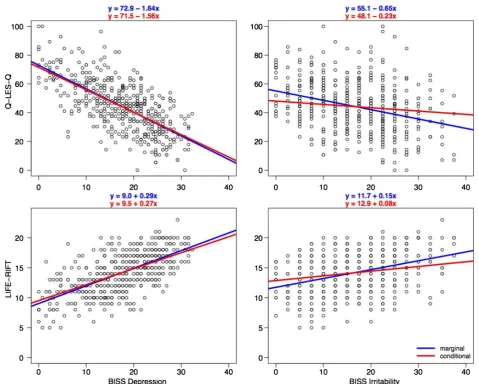
In Fig.
1
, we display the marginal (unadjusted) and
conditional (adjusted for other covariate in model) effects
of depressive and irritability symptom severity on quality
of life and functioning. In both cases, the marginal and
conditional effects of BISS depression were similar, while
the effect of BISS irritability decreased when adjusting
for BISS depression.
Social disadvantage was significantly associated with
worse functioning and marginally associated with worse
quality of life (
p
=
0.07) (Table
1
). Each component
(income, education, and employment) was at least
mar-ginally associated with functioning, such that patients
with lower income, lower education, and unemployed/
disabled had worse functioning (all
p
< 0.07). Those who
were unemployed or disabled were marginally
associ-ated with lower quality of life (
p
=
0.06), whereas neither
income nor education was significantly associated with
quality of life.
All psychiatric comorbid conditions, except
substance-use disorder, were significantly associated with worse
quality of life (Table
1
). Panic disorder, agoraphobia,
social disorder, ADHD, and any anxiety disorder were
also associated with worse functional impairment. The
total number of psychiatric comorbid conditions was
associated with quality of life and functioning, such that
for each additional comorbid condition, the mean quality
of life decreased by 3.8 points and the mean functional
impairment increased by 0.7 points (both
p
< 0.001).
We found no evidence to suggest that clinical symptom
severity moderated the effect of social disadvantage on
quality of life and functioning (both
p
> 0.05).
Discussion
Our results are consistent with earlier reports that show
that individuals with bipolar disorder often experience
overall poor quality of life and life functioning (Abraham
et al.
2014
; Sierra et al.
2005
; Sylvia et al.
2013
). We also
found that females had lower quality of life than males.
Patients who were married, living as married, divorced,
or separated had worse functional impairment compared
with patients who were single or never married. All
psychi-atric comorbid conditions, except substance-use disorder,
were associated with worse quality of life. Panic disorder,
agoraphobia, social disorder, ADHD, and any anxiety
dis-order were also associated with worse functional
impair-ment. These findings are consistent with previous studies
examining comorbid conditions and functioning in
bipo-lar disorder (Mendlowicz and Stein
2000
; Otto et al.
2006
;
Rapaport et al.
2005
; Simon et al.
2004
).
functioning in individuals with bipolar disorder.
Consist-ent with prior studies (Boylan et al.
2004
; McElroy et al.
2001
; Simon et al.
2004
), our findings suggest that current
symptom severity and psychiatric comorbid conditions
negatively impact quality of life and functioning in bipolar
disorder.
Table 1 Baseline correlations of quality of life and functioning with demographics, clinical severity, social disadvantage,
and current psychiatric comorbidities
Q-LES-Q quality of life enjoyment and satisfaction questionnaire, LIFE-RIFT longitudinal interval follow-up evaluation-range of impaired functioning tool, REF reference level, BISS bipolar inventory of symptoms scale, ADHD attention deficit hyperactivity disorder. Coefficients and p values based on linear regression models. Coefficients represent the change in Q-LES-Q/LIFE-RIFT per 1-point increase for continuous variables and change from reference level for categorical variables
a Includes patients with any of the following current diagnoses (based on MINI): panic disorder, agoraphobia, social phobia, and generalized anxiety disorder
Variable % (n) or mean + SD Q-LES-Q LIFE-RIFT
Coefficient p value Coefficient p value
Demographics
Age 38.9 + 12.1 0.03 0.65 0.01 0.34
Female (REF: male) 59% (283) −4.6 0.006 0.5 0.10
Hispanic/Latino (REF: not) 11% (53) 2.1 0.43 0.6 0.21
Race 0.94 0.83
White 72% (348) REF REF
Black 20% (96) −1.1 0.2
Asian 3% (16) 0.7 0.1
Native American <1% (1) 5.6 0.9
Other 4% (21) 2.2 0.9
Marital status 0.66 0.05
Single/never married 47% (225) REF REF
Married/living as married 31% (150) −2.1 0.9
Divorced/separated 21% (100) −1.3 0.8
Widowed 1% (7) 2.3 0.2
Clinical symptom severity
BISS total 56.1 + 18.8 −0.46 <0.001 0.09 <0.001
BISS depression 17.5 + 7.3 −1.64 <0.001 0.29 <0.001
BISS mania 9.2 + 6.4 0.23 0.08 −0.03 0.29
BISS anxiety 15.9 + 8.5 −0.92 <0.001 0.17 <0.001 BISS irritability 16.8 + 8.5 −0.65 <0.001 0.15 <0.001
BISS psychosis 2.8 + 4.5 −0.48 0.007 0.15 <0.001
Social disadvantage
Household income <$25 K (REF: ≥25 K) 52% (249) −1.7 0.30 0.6 0.06 High school diploma or less (REF: at least some college) 25% (122) −2.0 0.29 0.8 0.03 Unemployed/disabled (REF: employed/student/retired) 51% (244) −3.1 0.06 0.7 0.03
Social disadvantage 0.07 0.03
No disadvantage 28% (133) REF REF
Mild 30% (142) −1.1 0.6
Moderate 29% (138) −5.3 0.8
Severe 13% (65) −2.2 1.4
Current psychiatric comorbidity
Generalized anxiety disorder 22% (107) −5.9 0.002 0.6 0.11
Substance use disorder 23% (109) −0.6 0.76 0.2 0.49
Obsessive–compulsive disorder 11% (51) −4.9 0.02 0.9 0.08
Panic disorder 23% (112) −8.7 <0.001 0.8 0.03
Agoraphobia 37% (176) −5.8 0.001 0.9 0.003
Social disorder 25% (119) −5.3 0.005 0.8 0.03
ADHD 34% (161) −4.2 0.02 1.0 0.002
These results support findings in other clinical
popula-tions that social disadvantage can have a negative effect
on the overall functioning of individuals with bipolar
dis-order (Bowie et al.
2010
; Huxley and Baldessarini,
2007
;
Judd and Akiskal
2003
). Social disadvantage has been
associated with higher levels of stress, greater likelihood
of depression, and higher rates of disability (Lorant et al.
2003
). Given the frequency of depression and
irritabil-ity as well as severirritabil-ity of these symptoms in this clinical
population, it is perhaps not surprising that these
symp-toms were primarily associated with social disadvantage
among individuals with bipolar disorder; however, we
expected that mania would correlate with this outcome
Table 2 Association between BISS symptom domains
and social disadvantage
REF reference level
a Pairwise comparison with 0-REF is significant (p < 0.05)
Social disadvantage score Overall 0-REF 1 2 3 p value
BISS domain score
Depression 16.3 + 7.1 16.7 + 7.1 18.6+7.7a 19.3+7.0a 0.006
Mania 8.13 + 5.9 9.2 + 6.8 9.9 + 6.9 9.4 + 4.8 0.15 Anxiety 13.8 + 8.0 15.6 + 8.3 17.0+9.0a 18.3
+8.4a 0.001
Irritability 15.9 + 8.3 15.2 + 8.3 17.7 + 8.9 20+7.9a 0.0006
Psychosis 1.7 + 3.2 2.6 + 4.3 3.5+5.4a 4.0+4.6a 0.0006
given the degree to which these symptoms can
dis-rupt one’s functioning (e.g., ability to work, obtain high
incomes). It is likely that we did not find this correlation
as most participants were depressed (opposed to manic)
throughout the duration of the study (Tohen et al.
2015
)
(see Table
1
).
Interestingly, while patients with greater clinical
sever-ity (i.e., total, depression, anxiety, irritabilsever-ity) had lower
quality of life, patients with greater manic severity
reported marginally better quality of life. No association
was found between manic severity and functioning,
con-sistent with the literature (Rosa et al.
2010
), and mania
was not associated with social disadvantage. These
find-ings could be explained by the use of a self-report
meas-ure of quality of life as this relies on the insight and
perception of the individual, which are often altered
dur-ing this mood state with grandiosity and expansiveness.
This study is unique in its analysis of the association of
mood symptoms with social disadvantage in a large
sam-ple of bipolar I and bipolar II patients; however, it should
be noted that education and employment (two
compo-nents of social disadvantage) are potentially overlapping
constructs of quality of life and functioning. Further,
the limited inclusion and exclusion criteria may have
enhanced generalizability of our findings. However, these
participants were recruited for a study at academic
medi-cal centers, and thus, replication in community settings is
warranted.
Conclusions
Individuals with bipolar disorder commonly report poor
quality of life and have difficulty functioning. This study
also sought to explore those who might be at greater
risk for poor outcomes by examining the impact of a
composite variable of several, overlapping demographic
aspects, or social disadvantage. It appears that
depres-sion and irritability (but not mania) worsen quality of life
and functioning in this clinical population. Overall, these
data suggest that better interventions for individuals
with social disadvantage, depression, and irritability are
needed as they may be at greater risk for improvement in
quality of life and functioning.
Authors’ contributions
LS contributed to the study design, assisted with study coordination, oversaw the analyses, and wrote the manuscript. RM assisted in planning the data analyses and writing the manuscript. TD assisted with conducting the study, overseeing the study analyses, and writing the manuscript. MT assisted with conducting the study and writing the manuscript. NRH assisted with conduct‑ ing the study and writing the manuscript. MM assisted with conducting the study and writing the manuscript. JK assisted with conducting the study and writing the manuscript. CB assisted with conducting the study and writing the manuscript. JC assisted with conducting the study and writing the manu‑ script. KG assisted with conducting the study and writing the manuscript. TK assisted with conducting the study and writing the manuscript. RS assisted with conducting the study and writing the manuscript. SM assisted with con‑ ducting the study and writing the manuscript. EF assisted with conducting
the study and writing the manuscript. DR conducted the statistical analyses and assisted in writing the manuscript. AN conceived of the study, and partici‑ pated in its design and coordination and helped to draft the manuscript. All authors read and approved the final manuscript.
Author details
1 Department of Psychiatry, Massachusetts General Hospital, 50 Staniford
Street, Suite 580, Boston, MA 02114, USA. 2 Harvard Medical School, 25 Shat‑
tuck Street, Boston, MA 02115, USA. 3 Department of Psychiatry, University
of Pennsylvania School of Medicine, Philadelphia, PA, USA. 4 Department
of Psychiatry and Behavioral Sciences, University of New Mexico, Health Sci‑ ences Center, Albuquerque, NM, USA. 5 Department of Psychiatry, University
of Michigan, Ann Arbor, MI, USA. 6 Department of Psychiatry, Weill Cornell
Medicine, New York City, NY, USA. 7 Department of Psychiatry, University
of Texas Health Science Center at San Antonio, San Antonio, TX, USA. 8 Bipolar
Disorders Research Center, University Hospital’s Case Medical Center, Case Western Reserve University, Cleveland, OH, USA. 9 Department of Psychiatry
and Behavioral Sciences, Stanford University School of Medicine, Stanford, CA, USA. 10 Department of Psychiatry, University of Alabama Birmingham School
of Medicine, Birmingham, AL, USA. 11 Lindner Center of HOPE, Mason, OH,
USA. 12 Department of Psychiatry, University of Cincinnati College of Medicine,
Cincinnati, OH, USA. 13 University of Pittsburgh School of Medicine, Pittsburgh,
PA, USA. 14 Biostatistics Center, Massachusetts General Hospital, Boston, MA,
USA.
Acknowledgements
This study was funded by the Agency of Healthcare Research and Quality (AHRQ) Grant R01 HS019371‑01
Competing interests
and contracts from AHRQ, NIMH, Pritzker Consortium, Qatar National Research Fund, and Rockefeller Treatment Development Fund. He holds an Elan. Patent (No. 8,853,279), entitled “Method for Determining Sensitivity or Resistance to Compounds That Activate the Brain Serotonin System.” Dr. Bowden is conducting a biological study in mood disorders sponsored by Myriad Inc. He has no competing interests. Dr. Calabrese has received federal funding from the Department of Defense, Health Resources Services Administration and National Institute of Mental Health as well as grant support from: Abbott Laboratories; AstraZeneca; Bristol‑Myers Squibb Company; Cephalon, Inc. (now Teva Pharmaceutical Industries Ltd.); Dainippon Sumitomo Pharma Co., Ltd.; GlaxoSmithKline; Janssen Pharmaceuticals, Inc.; Eli Lilly and Company; Intra‑Cellular Therapies, Inc.; Pfizer, Inc; H. Lundbeck A/S; Sunovion Pharmaceu‑ ticals Inc.; Takeda Pharmaceutical Company Limited. Dr. Calabrese has served as a consultant/advisory board member/speaker for: Abbott Laboratories; Allergan; AstraZeneca; Bristol‑Myers Squibb Company; Cephalon, Inc. (now Teva Pharmaceutical Industries Ltd.); Dainippon Sumitomo Pharma Co., Ltd.; GlaxoSmithKline; Janssen Pharmaceuticals, Inc.; H. Lundbeck A/S,;Merck & Co., Inc.; Otsuka Pharmaceutical Co., Ltd.; Pfizer, Inc; Repligen Corporation; Servier; Sunovion Pharmaceuticals Inc.; Solvay Pharmaceuticals, Inc.; Takeda Pharmaceutical Company Limited. Dr. Gao has been on a speaker’s bureau of Sunovion and was on an advisory aboard of Sunovion. He received grant support from AstraZeneca, Brain and Behavior Research Foundation, and Cleveland Foundation. Dr. Ketter has the following financial interests/ arrangements or affiliations that could be perceived as real or apparent conflicts of interest: Grant/Research Support from the AstraZeneca Pharmaceuticals LP, Cephalon Inc., Eli Lilly and Company, Pfizer Inc., and Sunovion Pharmaceuticals; Consultant Fees from Allergan, Inc., Avanir Pharmaceuticals, Bristol‑Myers Squibb Company, Cephalon Inc., Forest Pharmaceuticals, Janssen Pharmaceutica Products, LP, Merck & Co., Inc., Sunovion Pharmaceuticals, Teva Pharmaceuticals; Lecture Honoraria from Abbott Laboratories, Inc., AstraZeneca Pharmaceuticals LP, GlaxoSmithKline, and Otsuka Pharmaceuticals; and Publication Royalties from American Psychiatric Publishing, Inc. In addition, Dr. Ketter’s spouse is an employee of and holds stock in Janssen Pharmaceuticals. Dr. Shelton has been a consultant for: Allergan, Inc., Cerecor, Inc., Cyberonics, Inc., Janssen Pharmaceutica, Medtronic, Inc., Naurex, Inc., Nestle’ Health Science, Pfizer, Inc., Takeda Pharmaceuticals. Grant/Research Support: Allergan, Inc., Assurex, Inc., Avanir Pharmaceuticals, Cerecor, Inc., Genomind, Janssen Pharmaceutica , Naurex, Inc., Novartis Pharmaceuticals, Otsuka America, Nestle’ Health Science, Takeda Pharmaceuticals. Dr. McElroy is a consultant to or member of the scientific advisory boards of Allergen, Alkermes, Corcept, Ironshore, MedAvante, Naurex, NovoNordisk, Shire, Sunovian, and Teva. She is a principal or co‑investigator on studies sponsored by the Agency for Healthcare Research & Quality (AHRQ), Azevan, Alkermes, AstraZeneca, Cephalon, Eli Lilly and Company, Marriott Foundation, National Institute of Mental Health, Orexigen Therapeutics, Inc., Shire, Sunovian,Takeda Pharmaceutical Company Ltd., and Transcept Pharmaceutical, Inc. She is also an inventor on United States Patent No. 6,323,236 B2, Use of Sulfamate Derivatives for Treating Impulse Control Disorders, and along with the patent’s assignee, The University of Cincinnati, Cincinnati, Ohio, has received payments from Johnson & Johnson, which has exclusive rights under the patent. Dr. Friedman receives royalties from Springer. Mr. Rabideau reports no competing interests. Dr. Nierenberg is a consultant for Abbott Laboratories, Alkermes, American Psychiatric Association, Appliance Computing Inc. (Mindsite), Basliea, Brain Cells, Inc., Brandeis University, Bristol Myers Squibb, Clintara, Corcept, Dey Pharmaceuti‑ cals, Dainippon Sumitomo (now Sunovion), Eli Lilly and Company, EpiQ, L.P./ Mylan Inc., Forest, Genaissance, Genentech, GlaxoSmithKline, Healthcare Global Village, Hoffman LaRoche, Infomedic, Intra‑Cellular Therapies, Lundbeck, Janssen Pharmaceutica, Jazz Pharmaceuticals, Medavante, Merck, Methylation Sciences, NeuroRx, Naurex, Novartis, PamLabs, Parexel, Pfizer, PGx Health, Otsuka, Ridge Diagnostics Shire, Schering‑Plough, Somerset, Sunovion, Takeda Pharmaceuticals, Targacept, and Teva; consulted through the MGH Clinical Trials Network and Institute (CTNI) for Astra Zeneca, Brain Cells, Inc, Dianippon Sumitomo/Sepracor, Johnson and Johnson, Labopharm, Merck, Methylation Science, Novartis, PGx Health, Shire, Schering‑Plough, Targacept and Takeda/Lundbeck Pharmaceuticals. He is a stakeholder in Appliance Computing, Inc. (MindSite), Brain Cells, Inc., and Medavante. He receives research support from American Foundation for Suicide Prevention, AHRQ, Brain and Behavior Research Foundation, Bristol‑Myers Squibb, Cederroth, Cephalon, Cyberonics, Elan, Eli Lilly, Forest, GlaxoSmithKline, Intra‑Cellular Therapies, Janssen Pharmaceutica, Lichtwer Pharma, Marriott Foundation,
Mylan, NIMH, PamLabs, PCORI, Pfizer Pharmaceuticals, Shire, Stanley Foundation, Takeda, and Wyeth‑Ayerst. Honoraria include Belvoir Publishing, The University of Texas Southwestern Dallas, Brandeis University, Bristol‑Myers Squibb, Hillside Hospital, American Drug Utilization Review, American Society for Clinical Psychopharmacology, Baystate Medical Center, Columbia University, CRICO, Dartmouth Medical School, Health New England, Harold Grinspoon Charitable Foundation, IMEDEX, International Society for Bipolar Disorder, Israel Society for Biological Psychiatry, Johns Hopkins University, MJ Consulting, New York State, Medscape, MBL Publishing, MGH Psychiatry Academy, National Association of Continuing Education, Physicians Postgraduate Press, SUNY Buffalo, The University of Wisconsin, The University of Pisa, The University of Michigan, The University of Miami, The University of Wisconsin at Madison, APSARD, ISBD, SciMed, Slack Publishing and Wolters Klower Publishing, ASCP, NCDEU, Rush Medical College, Yale University School of Medicine, NNDC, Nova Southeastern University, NAMI, Institute of Medicine, CME Institute, ISCTM, World Congress on Brain Behavior and Emotion, Congress of the Hellenic Society for Basic and Clinical Pharmacology, and ADAA. He has copyright joint ownership with MGH for Structured Clinical Interview for MADRS and Clinical Positive Affect Scale.
Consent to publish
Consent to publish this work has been obtained from the participant (or legal parent or guardian for children) to report individual patient data.
Ethics, consent, and permissions
This study was approved by the Internal Review Board at the Coordinat‑ ing Center for this study, or Massachusetts General Hospital (Protocol # 2010P001442), as well as the Internal Review Boards at each study site. All participants were consented to participate in this study.
Received: 29 July 2016 Accepted: 20 January 2017
References
Abraham K, Miller C, Birgenheir D, Lai Z, Kilbourne A. Self‑efficacy and quality of life among people with bipolar disorder. J Nerv Ment Dis. 2014;202(8):583–8.
Adler N, Newman K. Socioeconomic disparities in health: pathways and poli‑ cies. Health Aff. 2002;21(2):60–76.
Bowden C, Singh V, Thompson P, Gonzalez J, Katz M, Dahl M, et al. Develop‑ ment of the bipolar inventory of symptoms scale. Acta Psychiatr Scand. 2007;116(3):189–94.
Bowie CR, Depp C, McGrath JA, Wolyniec P, Mausbach BT, Thornquist MH, Luke J, Patterson TL, Harvey PD, Pulver AE. Prediction of real‑world functional disability in chronic mental disorders: a comparison of schizophrenia and bipolar disorder. Am J Psychiatry. 2010;167(9):1116–24.
Boylan KR, Bieling PJ, Marriott M, Begin H, Young LT, MacQueen GM. Impact of comorbid anxiety disorders on outcome in a cohort of patients with bipolar disorder. J Clin Psychiatry. 2004;65(8):1106–13.
Brennan S, Williams L, Berk M, Pasco J. Socioeconomic status and quality of life in population‑based Australian men: data from the Geelong Osteoporo‑ sis study. Aust NZ J Public Health. 2013;37(3):226–32.
Depp CA, Davis CE, Mittal D, Patterson TL, Jeste DV. Health‑related quality of life and functioning of middle‑aged and elderly adults with bipolar disorder. J Clin Psychiatry. 2006;67(2):215–21.
Duncan OD. A socioeconomic index for all occupations. 1996. Class: Crit Concepts. 1961;1.
Endicott J, Nee J, Harrison W, Blumenthal R. Quality of life enjoyment and satisfaction questionnaire. Psychopharmacol Bull. 1993;29(2):321–6. Fulford D, Peckham A, Johnson K, Johnson S. Emotion perception and quality
of life in bipolar I disorder. J Affect Disord. 2014;152:491–7. Gazalle F, Hallal P, Andreazza A, Frey B, Kauer‑Sant’Anna M, Weyne F, et al.
Manic symptoms and quality of life in bipolar disorder. Psychiatry Res. 2007;153(1):33–8.
Hirschfeld R, Calabrese JR, Weissman MM, Reed M, Davies MA, Frye MA, et al. Screening for bipolar disorder in the community. J Clin Psychiatry. 2003;64(1):53–9.
Judd LL, Akiskal HS. The prevalence and disability of bipolar spectrum disor‑ ders in the US population: re‑analysis of the ECA database taking into account subthreshold cases. J Affect Disord. 2003;73(1):123–31. Leon A, Solomon D, Mueller T, Endicott J, Posternak M, Judd L, et al. A brief
assessment of psychosocial functioning of subjects with bipolar I disorder: the LIFE‑RIFT. longitudinal interval follow‑up evaluation‑range impaired functioning tool. J Nerv Ment Dis. 2000;188(12):805–12. Lorant V, Deliège D, Eaton W, Robert A, Philippot P, Ansseau M. Socioeco‑
nomic inequalities in depression: a meta‑analysis. Am J Epidemiol. 2003;157(2):98–112.
McElroy SL, Altshuler LL, Suppes T, Keck PE Jr, Frye MA, Denicoff KD, et al. Axis I psychiatric comorbidity and its relationship to historical illness variables in 288 patients with bipolar disorder. Am J Psychiatry. 2001;158(3):420–6. Mendlowicz MV, Stein MB. Quality of life in individuals with anxiety disorders.
Am J Psychiatry. 2000;157(5):669–82.
Mielck A, Vogelmann M, Leidl R. Health‑related quality of life and socioeco‑ nomic status: inequalities among adults with a chronic disease. Health Quality Life Outcomes. 2014;12(1):58.
Nierenberg AA, Sylvia LG, Leon AC, Reilly‑Harrington NA, Shesler LW, McElroy SL, et al. Clinical and health outcomes initiative in comparative effective‑ ness for bipolar disorder (bipolar CHOICE): a pragmatic trial of complex treatment for a complex disorder. Clin Trials. 2014;11(1):114–27. Oakes JM, Rossi PH. The measurement of SES in health research: current prac‑
tice and steps toward a new approach. Soc Sci Med. 2003;56(4):769–84. Otto M, Simon N, Wisniewski S, Miklowitz D, Kogan J, Reilly‑Harrington N, et al.
Prospective 12‑month course of bipolar disorder in out‑patients with and without comorbid anxiety disorders. Br J Psychiatry. 2006;189(1):20–5. Rapaport MH, Clary C, Fayyad R, Endicott J. Quality‑of‑life impairment in
depressive and anxiety disorders. Am J Psychiatry. 2005;162(6):1171–8. Rosa AR, Reinares M, Michalak EE, Bonnin C, Sole B, Franco C, et al. Functional
impairment and disability across mood states in bipolar disorder. Value Health. 2010;13(8):984–8.
Sanchez‑Moreno J, Martinez‑Aran A, Tabares‑Seisdedos R, Torrent C, Vieta E, Ayuso‑Mateos J. Functioning and disability in bipolar disorder: an exten‑ sive review. Psychother Psychosom. 2009;78(5):285–97.
Shabani A, Ahmadzad‑Asl M, Zangeneh K, Teimurinejad S, Kokar S, Taban M, et al. Quality of life in patients with bipolar I disorder: is it related to disorder outcome? Acta Medica Iranica. 2013;51(6):386–93.
Sheehan D, Lecrubier Y, Sheehan KH, Janavs J, Weiller E, Keskiner A, et al. The validity of the mini international neuropsychiatric interview (MINI) according to the SCID‑P and its reliability. Eur Psychiatry. 1997;12(5):232–41.
Sierra P, Livianos L, Rojo L. Quality of life for patients with bipolar disorder: relationship with clinical and demographic variables. Bipolar Disord. 2005;7(2):159–65.
Simon NM, Otto MW, Wisniewski SR, Fossey M, Sagduyu K, Frank E, et al. Anxi‑ ety disorder comorbidity in bipolar disorder patients: data from the first 500 participants in the systematic treatment enhancement program for bipolar disorder (STEP‑BD). Am J Psychiatry. 2004;161(12):2222–9. Suppes T, Dennehy E, Hirschfeld R. The Texas implementation of medication
algorithms: update to the algorithms for treatment of bipolar I disorder. J Clin Psychiatry. 2005;66(7):870–86.
Sylvia L, Friedman E, Kocsis J, Bernstein E, Nierenberg A. Association of exercise with quality of life and mood symptoms in a comparative effectiveness study of bipolar disorder. J Affect Disord. 2013;151(2):722–7.
Thompson PM, Gonzalez JM, Singh V, Schoolfield JD, Katz MM, Bowden CL. Principal domains of behavioral psychopathology identified by the bipolar inventory of signs and symptoms scale (BISS). Psychiatry Res. 2010;175(3):221–6.
Tohen M, Bowden C, Nierenberg A, Geddes J. Clinical trial design challenges in mood disorders. London: Elsevier Inc; 2015.