REVIEW
Noninvasive ventilation with helium–
oxygen mixture in hypercapnic COPD
exacerbation: aggregate meta-analysis
of randomized controlled trials
Fekri Abroug
1*, Lamia Ouanes‑Besbes
1, Zeineb Hammouda
1, Saoussen Benabidallah
1, Fahmi Dachraoui
1,
Islem Ouanes
1and Philippe Jolliet
2Abstract
When used as a driving gas during NIV in hypercapnic COPD exacerbation, a helium–oxygen (He/O2) mixture reduces the work of breathing and gas trapping. The potential for He/O2 to reduce the rate of NIV failure leading to intubation and invasive mechanical ventilation has been evaluated in several RCTs. The goal of this meta‑analysis is to assess the effect of NIV driven by He/O2 compared to air/O2 on patient‑centered outcomes in hypercapnic COPD exacerbation. Relevant RCTs were searched using standard procedures. The main endpoint was the rate of NIV failure. The effect size was computed by a fixed‑effect model, and estimated as odds ratio (OR) with 95% confidence interval (CI). Additional endpoints were ICU mortality, NIV‑related side effects, and the length and costs of ICU stay. Three RCTs fulfilled the selection criteria and enrolled a total of 772 patients (386 patients received He/O2 and 386 received air/O2). Pooled analysis showed no difference in the rate of NIV failure when using He/O2 mixture compared to air/O2: 17 vs 19.7%, respectively; OR 0.84, 95% CI 0.58–1.22; p = 0.36; I2 for heterogeneity = 0%, and no publication bias. ICU mortality was also not different: OR 0.8, 95% CI 0.45–1.4; p = 0.43; I2= 5%. However, He/O2 was associated with less NIV‑related adverse events (OR 0.56, 95% CI 0.4–0.8, p = 0.001), and a shorter length of ICU stay (difference in means =−1.07 day, 95% CI −2.14 to −0.004, p = 0.049). Total hospital costs entailed by hospital stay and NIV gas were not different: dif‑ ference in means =−279$, 95% CI −2052–1493, p = 0.76. Compared to air/O2, He/O2 does not reduce the rate of NIV failure in hypercapnic COPD exacerbation. It is, however, associated with a lower incidence of NIV‑related adverse events and a shortening of ICU length of stay with no increase in hospital costs.
Keywords: COPD, Exacerbation, Acute respiratory failure, Noninvasive ventilation, Helium
© The Author(s) 2017. This article is distributed under the terms of the Creative Commons Attribution 4.0 International License
(http://creativecommons.org/licenses/by/4.0/), which permits unrestricted use, distribution, and reproduction in any medium,
provided you give appropriate credit to the original author(s) and the source, provide a link to the Creative Commons license, and indicate if changes were made.
Background
Noninvasive ventilation (NIV) has become a standard of care in COPD patients with acute exacerbation requir-ing ventilatory support [1–4]. Avoiding tracheal intuba-tion drastically reduces the rate of ventilator-associated pneumonia (VAP), antibiotic use, the time spent under mechanical ventilation, ICU length of stay, and associ-ated mortality [5–9]. The sustained mastering of the
clinical and technological aspects of NIV (defining opti-mal indications, selection of ventilators and interface, improvements in patient–ventilator synchrony) has been associated with substantial advances in NIV success rates, allowing a wide range of patients to be managed entirely by this technique, thereby minimizing the risk of complications inherent to conventional invasive ventila-tion [2, 8, 9]. Despite these advances, it is believed that an additional success margin is possible, leading to further reduction in the number of patients still in need of inva-sive ventilation. One such area of potential progress is the gas used for ventilation [10–12].
Open Access
*Correspondence: [email protected]
1 Intensive Care Unit, CHU Fatouma Bourguiba, Research Laboratory
Compared to air–oxygen (air/O2), a mixture of helium
and oxygen (He/O2) has been consistently shown to
con-vey numerous beneficial effects in the setting of increased airway resistance owing to its lower density. Indeed, the lower density of helium enhances the transition from a turbulent to a laminar flow, thereby reducing density-dependent components of airway resistance within bron-chi with increased resistance, as is the case in COPD exacerbation [10–16]. These effects translate into a reduction in dynamic hyperinflation and a lower work of breathing [10, 15, 17]. These studies provide sound scien-tific grounds to anticipate a reduction in NIV failure rate when using He/O2 instead of air/O2 in COPD
exacerba-tion requiring ventilatory support [10]. This hypothesis has been tested in randomized controlled trials (RCTs).
The aim of the present systematic review and meta-analysis is to compare the effect of He/O2 and air/O2 NIV
on patient-centered clinical outcomes.
Methods
Search strategy and study selection
Relevant studies were searched in MEDLINE, EMBASE, and Science Citation Index with the restriction of ran-domized clinical trial for article type published up to September 20, 2016, with the following MeSH terms: [“non-invasive ventilation” or “Bilevel”] AND [(“pulmo-nary disease, chronic obstructive”[MeSH Terms] OR (“pulmonary”[All Fields] AND “disease”[All Fields] AND “chronic”[All Fields] AND “obstructive”[All Fields]) OR “chronic obstructive pulmonary disease”[All Fields] OR “copd”[All Fields]) AND “exacerbation”[All Fields] AND [“heliox” or “helium–oxygen” or “helium”]. We have also conducted a manual search in journals and contacted authors of trials.
Study selection
We included all randomized controlled clinical tri-als designed to evaluate the efficacy and safety of NIV using a mixture of helium and oxygen to ventilate COPD patients with acute hypercapnic respiratory failure. Standard treatment (e.g., bronchodilators and antibiot-ics) had to be comparable in control and intervention arms. Patients included in these studies were adults aged 18 and older with COPD diagnosed on clinical criteria and respiratory function tests.
Data extraction and study characteristics
Two independent evaluators (FA and LOB) selected stud-ies according to the inclusion criteria and extracted the following: type and baseline characteristics of included patients, the criteria for NIV, type and composition of He/O2 mixture (78/22 or 65/35%), time to the first
NIV session and its duration, total duration of He/O2
administration, minimum NIV duration with a given gas mixture during the first 24 h, composition of the gas administered between NIV sessions (whether helium/ O2 or air/O2), type of associated medications, and
crite-ria for primary and secondary endpoints. Disagreements were resolved by consensus.
Data were extracted to allow quality assessment of the included studies. The risk of bias tool from the Cochrane Handbook was used [18].
Data synthesis
In this meta-analysis, the primary endpoint was the rate of NIV failure during the index ICU stay. The second-ary endpoints included the intubation rate per se as the definition of NIV failure was not uniform; in one study, the failure rate was a composite of necessity of intuba-tion and/or death without intubaintuba-tion during the ICU stay [19]. Additional endpoints were ICU mortality, the length of ICU stay, and the costs of ICU stay. Safety was assessed through the number of serious adverse events related to He/O2 mixture, and the number of episodes of
complication related to NIV. The latter consisted of facial skin necrosis, gastric distension, pneumothorax, and nosocomial pneumonia. NIV failure was not considered an NIV adverse effect since it was counted separately as the primary outcome.
Statistical analysis
For binary outcomes (NIV failure rate, intubation rate, mortality, NIV complications, and adverse effects of He/ O2 mixture), we reported the effect sizes estimates as
odds ratios (ORs) with 95% confidence intervals (CIs). For the length of ICU stay, and the difference in costs of the total hospitalization per patient, results were expressed as difference of means and 95% CIs. Only two out of three included studies reported the total costs per patient, which consisted of both the costs of hospital stay and those of the gas used for noninvasive ventila-tion. The first study was a Swiss one [20], and expressed the expenses in US$, while the second was a multicenter study and reported detailed costs in French patients rely-ing on diagnosis-related group (DRG) tools [19]. In the latter, costs were expressed in euros, and converted to US$ (1€ = 1.1386US$).
Statistical significance was set at p < 0.05 for hypoth-esis testing and p < 0.1 for heterogeneity testing. We measured heterogeneity and expressed it as I2, with
suggested thresholds for low (I2 = 25–49%), moderate
(I2 = 50–74%), and high (I2 ≥ 75%) values. We used a
we visually examined the funnel plot for NIV failure and performed the Egger test of the intercept which uses pre-cision to predict the standardized effect. All statistical tests were two-sided.
The meta-analysis was conducted using the Com-prehensive Meta-Analysis (CMA) program version 2 software (Biostat, Englewood, NJ, USA). This meta-analysis was conducted in accordance with the PRISMA guidelines.
Results
Search results and trials characteristics
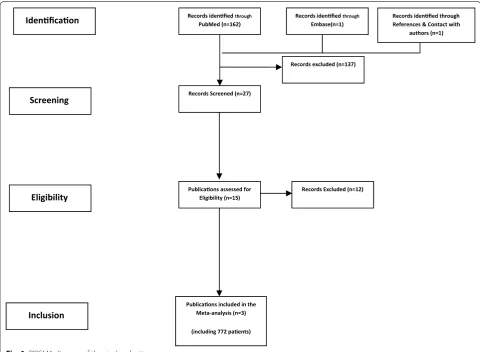
The literature search initially identified 164 citations. Among these studies, only 15 dealt with the use of He/ O2 for NIV in COPD exacerbation. Of these, three
rand-omized controlled studies evaluating the efficacy of NIV using He/O2 in acute COPD exacerbation were included
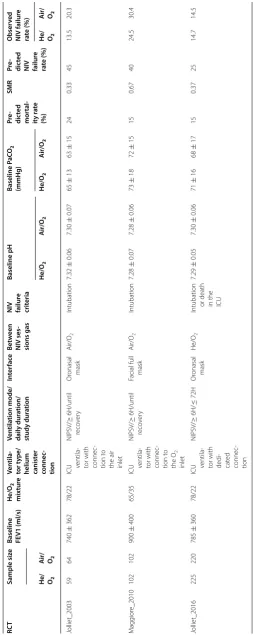
in the final analysis [19–21]. The selection process is illustrated by the flowchart in Fig. 1. The included studies enrolled a total of 772 patients. The main clinical charac-teristics of included studies are depicted in Table 1.
Quality assessment
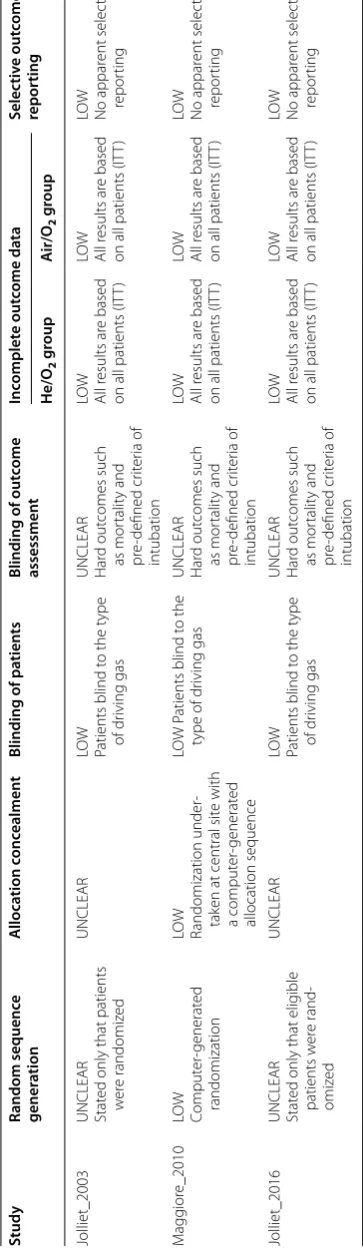
The three studies were randomized, controlled, non-blinded studies. The risk of bias regarding random sequence generation and allocation concealment was low in the study by Maggiore et al. [21] and unclear in the remaining two. Blinding of patients was possible in the three studies. All studies were open-label regarding phy-sicians’ assessment of outcomes, which were either hard outcomes such as ICU mortality, or relied on pre-defined objective criteria such as the main efficacy criteria (tra-cheal intubation). In the most recent study by Jolliet et al. [19], an adjudication and safety committee determined in a blinded manner whether intubation criteria were met in every case. All included studies had low bias for incomplete data. There was no selective outcome report-ing bias in the three studies (Table 2).
The studies included a majority of males (65%) with a mean age of 69 ± 14 years (Table 1). All
studies included COPD patients (mean baseline FEV1 = 808 ± 110 ml), experiencing severe exacerba-tion requiring ventilatory support. COPD diagnosis
Idenficaon
Screening
Eligibility
Inclusion
Records idenfied through
PubMed (n=162) Records idenfied
through
Embase(n=1) Records idenfied throughReferences & Contact with authors (n=1)
Records Screened (n=27)
Records excluded (n=137)
Publicaons assessed for Eligibility (n=15)
Records Excluded (n=12)
Publicaons included in the Meta-analysis (n=3)
(including 772 paents)
Table
1
C
har
ac
teristics of included studies
FE V1 for ced e xpir at or y v
olume in 1 s
, NIPSV nonin vasiv e pr essur e suppor t v en tila tion, SMR standar diz ed mor talit y r atio RC T Sample siz e
Baseline FEV1 (ml/s)
He/O 2 mix tur e Ven tila -tor t ype/
helium canist
er connec -tion Ven tila tion mode/ daily dur ation/ study dur ation In ter fac e Bet w een NIV ses -sions gas
NIV failur
e crit eria Baseline pH Baseline PaC O2 (mmHg) Pr e-dic ted mor tal -it y r at e (%) SMR Pr e-dic ted
NIV failur
e ra te (%) Obser ved NIV failur e ra te (%)
He/ O2
A
ir/ O2
He/O 2 A ir/O 2 He/O 2 A ir/O 2
He/ O2
A
ir/ O2
Jolliet_2003 59 64 740 ± 362 78/22
ICU ventila
‑
tor with connec
‑
tion t
o
the air inlet
NIPSV/ ≥ 6H/until reco ver y Or
onasal mask
Air/O 2 Intubation 7.32 ± 0.06 7.30 ± 0.07 65 ± 13 63 ± 15 24 0.33 45 13.5 20.3 M agg ior e_2010 102 102 900 ± 400 65/35
ICU ventila
‑
tor with connec
‑ tion t o the O2 inlet NIPSV/ ≥ 6H/until reco ver y
Facial full mask
Air/O 2 Intubation 7.28 ± 0.07 7.28 ± 0.06 73 ± 18 72 ± 15 15 0.67 40 24.5 30.4 Jolliet_2016 225 220 785 ± 360 78/22
ICU ventila
‑
tor with dedi
‑ cat ed connec ‑ tion NIPSV/ ≥ 6H/ ≤ 72H Or
onasal mask
He/O
2
Intubation or death in the ICU
Table 2 Q ualit y assessmen t of R CT s Study Random sequenc e gener ation A lloca tion c onc ealmen t Blinding of pa tien ts Blinding of out come assessmen t Inc omplet e out come da ta Selec tiv e out come repor ting He/O 2 g roup A ir/O 2 g roup Jolliet_2003 UNCLEAR Stat
ed only that patients
w er e randomiz ed UNCLEAR LO W
Patients blind t
o the t
ype of dr iving gas UNCLEAR Har d out comes such as mor talit y and pr e‑ defined cr iter ia of intubation LO W All r esults ar e based
on all patients (IT
T) LO W All r esults ar e based
on all patients (IT
T) LO W No appar ent selec tiv e repor ting M agg ior e_2010 LO W Comput er ‑generat ed randomization LO W Randomization under ‑ tak
en at central sit
e with a comput er ‑generat ed allocation sequence LO W P
atients blind t
o the
type of dr
iving gas UNCLEAR Har d out comes such as mor talit y and pr e‑ defined cr iter ia of intubation LO W All r esults ar e based
on all patients (IT
T) LO W All r esults ar e based
on all patients (IT
T) LO W No appar ent selec tiv e repor ting Jolliet_2016 UNCLEAR Stat
ed only that elig
ible patients w er e rand ‑ omiz ed UNCLEAR LO W
Patients blind t
o the t
ype of dr iving gas UNCLEAR Har d out comes such as mor talit y and pr e‑ defined cr iter ia of intubation LO W All r esults ar e based
on all patients (IT
T) LO W All r esults ar e based
on all patients (IT
was either known or suspected on smoking status, clinical and radiologic signs, and respiratory function tests. The need for ventilatory support and ICU admis-sion relied on the association of respiratory acidosis (pH ≤ 7.35 and PaCO2 ≥ 45 mmHg), and a respiratory
rate ≥25 b/min. In the group of patients receiving He/ O2, the gas mixture composition varied among studies
with similar formulations: He/O2 78/22% in both
stud-ies conducted by Jolliet et al. [19, 20], and a 65/35% formulation in the study by Maggiore et al. [21]. In the most recent study by Jolliet et al., the group of patients allocated to He/O2 also received this mixture
continu-ously during the first 72 h after inclusion, both dur-ing NIV sessions and durdur-ing spontaneous breathdur-ing between NIV sessions [19]. In the previous studies, patients belonging to both study arms inhaled an air/ O2 mixture between NIV sessions.
Overall, the severity of the index exacerbation was high as inferred from the baseline arterial pH (7.3 as a mean in two studies and 7.28 in one study) and from the pre-dicted mortality derived from mortality prediction sys-tems (SAPS and APACHE scores): between 15 and 24% in the three studies. NIV failure was defined as the need for tracheal intubation in the studies by Jolliet and Mag-giore [20, 21], and by the need for intubation or death in the ICU without intubation, in the ECHO ICU trial [19].
Data analysis
Comparison of NIV gas mixtures involved 386 patients who received He/O2 and 386 ventilated with air/O2.
Primary endpoint
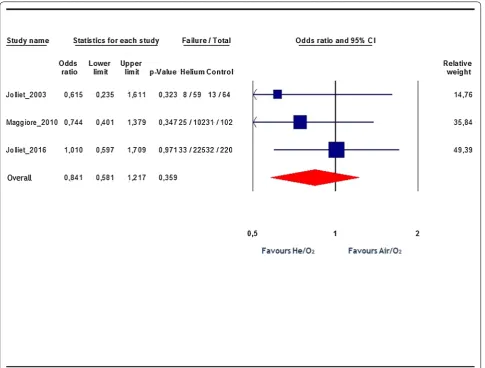
Pooled analysis shows no statistically significant differ-ence in the rate of NIV failure when using He/O2 mixture
Fig. 2 Effects of He/O2 mixture on NIV failure rate. Blue squares represent odds ratios (ORs) in individual trials with the size proportional to the
compared to air/O2: 17 vs. 19.7%, respectively; OR 0.84,
95% CI 0.58 to 1.22; p = 0.36 (Fig. 2). Overall, there was no heterogeneity (I2 = 0%). There was no obvious
publica-tion bias detected by visual inspecpublica-tion of the “funnel plot.” The Egger test was also non-significant (regression inter-cept = −2.18, p = 0.3). We also computed the aggregate effect on the need for tracheal intubation per se, as it was a common definition of NIV failure in the included studies. The pooled analysis of the intubation rate reported in the three studies yielded no statistically significant difference between patients ventilated with He/O2 or air/O2: OR
0.81, 95% CI 0.56–1.17; p = 0.27; I2 = 0%.
Secondary endpoints
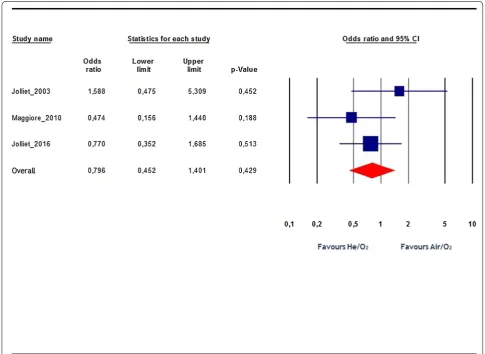
Overall, the ICU mortality rate was not statistically dif-ferent between the He/O2 and air/O2 groups: OR 0.8,
95% CI 0.45–1.4; p = 0.43; I2 = 5% (Fig. 3).
No adverse event attributable to He/O2 was reported.
Regarding NIV complications (facial skin necrosis,
gastric distension, pneumothorax, and nosocomial pneu-monia), there was a statistically significant difference, with less events in the He/O2 patients: OR 0.56, 95% CI
0.4–0.8, p = 0.001, I2: 0.02 (Fig. 4).
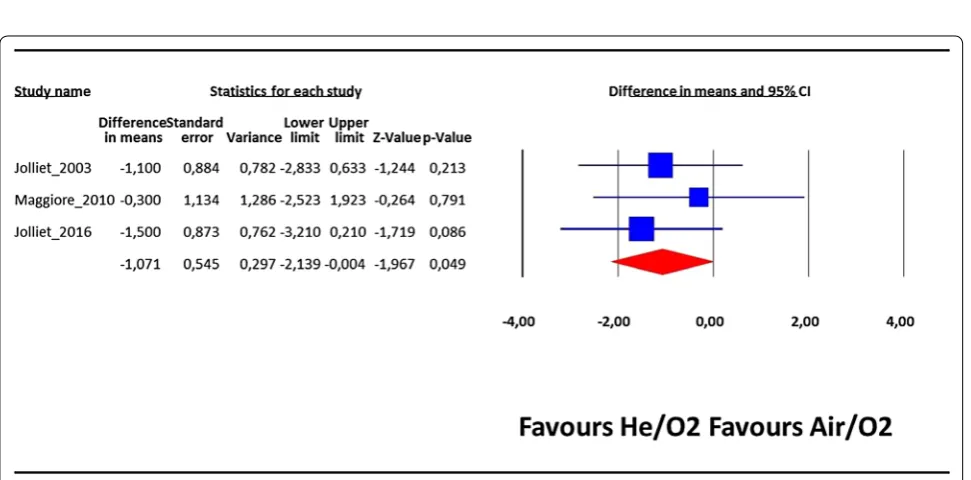
The length of ICU stay was also significantly lower in the He/O2 group compared to the standard treatment
group: difference in means = −1.07 day 95% CI −2.14 to –0.004, p = 0.049, I2: 0% (Fig. 5). Regarding total
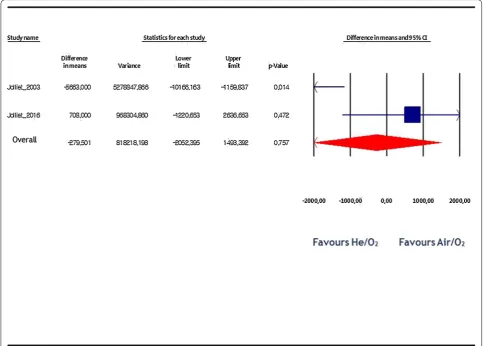
hos-pital costs incurred by hoshos-pital stay and NIV gas (air or helium), there was no statistical difference between both study groups: difference in mean = −279$ by fixed-effect model, 95% CI −2052 to 1493, p = 0.76, I2:
85% (Fig. 6).
Discussion
The current meta-analysis of controlled studies evaluat-ing the use of He/O2 as a driving gas for NIV in
hypercap-nic COPD exacerbation found no significant reduction in either the failure rate of NIV or ICU mortality. However,
He/O2 significantly reduced the length of ICU stay and
the rate of NIV-associated complications.
Beyond the lack of statistical heterogeneity in the main or secondary outcomes analysis, one of the strengths of
the current meta-analysis is the lack of clinical heteroge-neity incurred by the three included studies. Indeed, the included patients were fairly similar between the first and last study with similar levels of baseline FEV1, pH
Fig. 4 Rate of NIV complications. Blue squares represent odds ratios (ORs) in individual trials, while the red diamond represents the combined overall effects. I2 test for heterogeneity: 0.02%
at inclusion, predicted mortality, etc. In addition, given the relevance of the ventilatory strategy to NIV success/ failure, the investigators applied a so-called bundle ven-tilatory strategy that sought to conform both to evolving technological advances (quality of the interface, compat-ibility of accessories and ventilators with helium gas) and to clinical standards (mode and ventilatory settings, NIV sessions duration, interaction with patients). Moreover, in each new study, researchers tried to tackle shortcom-ings of the preceding one as reflected by the extension of the duration of administration of the gas to NIV-free periods in the most recent study [19]. The participating research teams also had comparable levels of performance and mastering of NIV techniques, and have clearly ben-efited from the learning curve of NIV implementation. This observation is reflected by a steady reduction in the failure rate recorded in the three studies, a fact that negatively impacted subsequent study design. Indeed, in the three RCTs that evaluated He/O2 in hypercapnic
COPD exacerbation, there was a recurrent overestima-tion of the NIV failure rate in the control group, leading to an underestimation of the sample size, thereby yield-ing substantially underpowered trials. Yet, the first two RCTs conducted by Jolliet et al. [20] and Maggiore et al. [21] exhibited a reduction in the intubation rate with He/ O2 which went well beyond what could be considered as
a minimal clinically relevant effect. In fact, these studies were conducted at times when the “learning curve” of NIV in real life was still in its ascending limb [22]. For exam-ple, Jolliet et al. [20] assumed an intubation rate of 45%, the rate assumed by Maggiore et al. [21] was 40%, while these assumptions were reduced to 25% in the recent and largest study conducted by Jolliet et al. [19]. However, the observed intubation rate recorded in the control group of each study was actually much lower, amounting to 20, 30.4, and 14.5%, respectively [19–21]. Of note, the ECHO
ICU study, which was the largest study on the evaluation
recorded the lowest rate of primary outcome event, i.e., NIV failure and tracheal intubation [19].
Should a new study be conducted in order to provide a definitive answer on the benefit of He/O2 in hypercapnic
COPD exacerbation? Besides the cumbersome logistics (ventilators with helium option, gas cylinders blended with the needed He/O2 mixture, specific
high-concentra-tion facial masks using He/O2), the sample size needed
to detect a clinically relevant reduction in the NIV fail-ure rate (considering that recorded with standard air/ O2, 14.5%) would amount to no less than 1000 patients
in each arm, with a type 1 and type 2 errors of 5 and 10%, respectively [19].
We cannot readily account for the observed reduc-tion in the rate of NIV complicareduc-tions by the use of He/ O2 mixture. Explanation cannot be based solely on
differ-ences in the properties of the two inhaled mixtures with the change in the flow pattern from turbulent to laminar. Explanation must remain a matter of speculation at the present time.
The initial assumption of systematically substituting air/O2 by He/O2 in patients with hypercapnic COPD
exacerbation seems actually unreasonable in the light of the downward trend in the failure rates reported in the most recent studies, particularly those issued from well-trained teams [2, 5]. He/O2 mixture becomes in this
con-text a much less attractive option given its constraining logistics and high costs. However, real-life surveys have recently reported significantly higher failure rates than those observed by Jolliet et al. in the most recent RCT, where the experienced participating teams and a poten-tial study effect probably had a positive impact. The cost–benefit trade-off could under these conditions still lean toward the use of He/O2 [1, 9, 23, 24].
Nonethe-less, it seems unrealistic to propose He/O2 invariably to
all patients with hypercapnic COPD exacerbation [25]. Because the response to He/O2 mixture breathing has a
large variability between subjects according to diseases phenotypes, every effort should be made to identify a subgroup of patients who might derive a real clinical ben-efit from the physiological effects of He/O2, which may
make the small difference that would reduce the intuba-tion rate further [15, 26–29]. Indeed, the use of He/O2
instead of air/O2 in such patients may reduce the work
of breathing and dynamic hyperinflation to a sufficient level to avert intubation. Clinical indicators that are well correlated with the work of breathing, and capable of detecting impending respiratory muscle fatigue, are therefore warranted and need to be validated in the clini-cal setting [30–32]. Identifying such a subgroup of poten-tial responders to He/O2 mixture can also be addressed
in a specifically designed RCT, or through an individual patient data meta-analysis.
Conclusion
in the light of the results uncovered by the current meta-analysis, there is insufficient evidence to recommend the systematic use of He/O2 in all patients with hypercapnic
COPD exacerbation requiring NIV despite the reduction in the ICU length of stay and NIV side effects, given the constraining logistics. One may argue that with standard air/O2 we have probably reached an acceptable level of
NIV failure. However, a subset of patients (which remains to be clearly delineated) at high risk of NIV failure might benefit from the use of He/O2, and efforts should now be
directed at identifying such a subgroup.
Abbreviations
CI: Confidence interval; COPD: Chronic obstructive pulmonary disease; DRG: Diagnosis‑related group; ICU: Intensive care unit; NIV: Noninvasive ventilation; OR: Odds ratio; PRISMA: Preferred Reporting Items for Systematic Reviews and Meta‑ Analysis; RCT: Randomized controlled trial; VAP: Ventilator‑associated pneumonia.
Authors’ contributions
FA, LOB, and PJ conducted the literature searches, selected the studies, and extracted the data. ZH, SB, FD, and IO screened the abstracts, selected the studies meeting the inclusion criteria, and extracted the data. All authors assessed the study quality. FA prepared the initial and subsequent drafts of the manuscript. FA and LOB carried out the statistical analyses. All authors read and approved the final manuscript..
Author details
1 Intensive Care Unit, CHU Fatouma Bourguiba, Research Laboratory LR12SP15,
University of Monastir, 5000 Monastir, Tunisia. 2 Département des Centres
Interdisciplinaires et de Logistique Médicale, Lausanne, Switzerland.
Competing interests
FA, LOB, and PJ were investigators in the ECHOICU trial which was sponsored
by Air Liquide Santé International. There is no potential competing interests relevant to this article for the other authors.
Availability of data and materials
Anonymized datasets can be shared with other researchers on request.
Publisher’s Note
Springer Nature remains neutral with regard to jurisdictional claims in pub‑ lished maps and institutional affiliations.
Received: 7 November 2016 Accepted: 26 April 2017
References
1. Lindenauer PK, Stefan MS, Shieh MS, Pekow PS, Rothberg MB, Hill NS. Hospital patterns of mechanical ventilation for patients with exacerba‑ tions of COPD. Ann Am Thorac Soc. 2015;12(3):402–9.
2. Stefan MS, Nathanson BH, Higgins TL, Steingrub JS, Lagu T, Rothberg MB, et al. Comparative Effectiveness of Noninvasive and Invasive Ventilation in Critically Ill Patients With Acute Exacerbation of Chronic Obstructive Pulmonary Disease. Crit Care Med. 2015;43(7):1386–94.
3. Stefan MS, Shieh MS, Pekow PS, Hill N, Rothberg MB, Lindenauer PK. Trends in mechanical ventilation among patients hospitalized with acute exacerba‑ tions of COPD in the United States, 2001 to 2011. Chest. 2015;147(4):959–68. 4. Lindenauer PK, Stefan MS, Shieh MS, Pekow PS, Rothberg MB, Hill NS.
5. Ouanes I, Ouanes‑Besbes L, Ben Abdallah S, Dachraoui F, Abroug F. Trends in use and impact on outcome of empiric antibiotic therapy and non‑invasive ventilation in COPD patients with acute exacerbation. Ann Intensive Care. 2015;5(1):30.
6. Girou E, Brun‑Buisson C, Taille S, Lemaire F, Brochard L. Secular trends in nosocomial infections and mortality associated with noninvasive ventila‑ tion in patients with exacerbation of COPD and pulmonary edema. JAMA. 2003;290(22):2985–91.
7. Girou E, Schortgen F, Delclaux C, Brun‑Buisson C, Blot F, Lefort Y, et al. Association of noninvasive ventilation with nosocomial infections and survival in critically ill patients. JAMA. 2000;284(18):2361–7.
8. Brochard L, Mancebo J, Wysocki M, Lofaso F, Conti G, Rauss A, et al. Noninvasive ventilation for acute exacerbations of chronic obstructive pulmonary disease. N Engl J Med. 1995;333(13):817–22.
9. Chandra D, Stamm JA, Taylor B, Ramos RM, Satterwhite L, Krishnan JA, et al. Outcomes of noninvasive ventilation for acute exacerbations of chronic obstructive pulmonary disease in the United States, 1998‑2008. Am J Respir Crit Care Med. 2012;185(2):152–9.
10. Jolliet P, Tassaux D, Thouret JM, Chevrolet JC. Beneficial effects of helium:oxygen versus air:oxygen noninvasive pressure support in patients with decompensated chronic obstructive pulmonary disease. Crit Care Med. 1999;27(11):2422–9.
11. Morice AH. Helium/oxygen and severe COPD. Lancet. 2000;356(9244):1785–6.
12. Laden G. Helium/oxygen and severe COPD. Lancet. 2001;357(9255):559–60.
13. Allan PF, Thomas KV, Ward MR, Harris AD, Naworol GA, Ward JA. Feasibil‑ ity study of noninvasive ventilation with helium‑oxygen gas flow for chronic obstructive pulmonary disease during exercise. Respir Care. 2009;54(9):1175–82.
14. Hussain O, Collins EG, Adiguzel N, Langbein WE, Tobin MJ, Laghi F. Con‑ trasting pressure‑support ventilation and helium‑oxygen during exercise in severe COPD. Respir Med. 2011;105(3):494–505.
15. Jaber S, Fodil R, Carlucci A, Boussarsar M, Pigeot J, Lemaire F, et al. Nonin‑ vasive ventilation with helium‑oxygen in acute exacerbations of chronic obstructive pulmonary disease. Am J Respir Crit Care Med. 2000;161(4 Pt 1):1191–200.
16. Pecchiari M, Pelucchi A, D’Angelo E, Foresi A, Milic‑Emili J, D’Angelo E. Effect of heliox breathing on dynamic hyperinflation in COPD patients. Chest. 2004;125(6):2075–82.
17. Tassaux D, Gainnier M, Battisti A, Jolliet P. Helium‑oxygen decreases inspiratory effort and work of breathing during pressure support in intubated patients with chronic obstructive pulmonary disease. Intensive Care Med. 2005;31(11):1501–7.
18. Higgins JPT AD, Sterne JAC, editors. Chapter 8: Assessing risk of bias in included studies. Cochrane Handbook for Systematic Reviews of Inter‑ ventions Version 510: Cochrane 2011; 2011.
19. Jolliet P, Ouanes‑Besbes L, Abroug F, Ben Khelil J, Besbes M, Garnero A, et al. A Multicenter Randomized Trial Assessing the Efficacy of Helium/ Oxygen in Severe Exacerbations of Chronic Obstructive Pulmonary Disease. American journal of respiratory and critical care medicine. 2016.
20. Jolliet P, Tassaux D, Roeseler J, Burdet L, Broccard A, D’Hoore W, et al. Helium‑oxygen versus air‑oxygen noninvasive pressure support in decompensated chronic obstructive disease: a prospective, multicenter study. Crit Care Med. 2003;31(3):878–84.
21. Maggiore SM, Richard JC, Abroug F, Diehl JL, Antonelli M, Sauder P, et al. A multicenter, randomized trial of noninvasive ventilation with helium‑ oxygen mixture in exacerbations of chronic obstructive lung disease. Crit Care Med. 2010;38(1):145–51.
22. Schnell D, Timsit JF, Darmon M, Vesin A, Goldgran‑Toledano D, Dumenil AS, et al. Noninvasive mechanical ventilation in acute respiratory failure: trends in use and outcomes. Intensive Care Med. 2014;40(4):582–91. 23. Gacouin A, Jouneau S, Letheulle J, Kerjouan M, Bouju P, Fillatre P, et al.
Trends in Prevalence and Prognosis in Subjects With Acute Chronic Respiratory Failure Treated With Noninvasive and/or Invasive Ventilation. Respiratory care. 2015;60(2):210–8.
24. Toft‑Petersen AP, Torp‑Pedersen C, Weinreich UM, Rasmussen BS. Trends in assisted ventilation and outcome for obstructive pulmonary disease exacerbations. A nationwide study. PloS one. 2017;12(2):e0171713. 25. Carr J, Jung B, Chanques G. Jaber S. Helium as a therapeutic gas: An old
idea needing some new thought. European Respiratory Monograph; 2012. p. 124–32.
26. Mutlu GM, Budinger GRS. Not much turbulence: addition of heliox to noninvasive ventilation fails to improve outcomes in patients with exacerbations of chronic obstructive pulmonary disease. Crit Care Med. 2010;38(1):319–20.
27. Burgel PR, Paillasseur JL, Peene B, Dusser D, Roche N, Coolen J, et al. Two distinct chronic obstructive pulmonary disease (COPD) phenotypes are associated with high risk of mortality. PLoS ONE. 2012;7(12):e51048. 28. Adler D, Pepin JL, Dupuis‑Lozeron E, Espa‑Cervena K, Merlet‑Violet R,
Muller H, et al. Comorbidities and Subgroups of Patients Surviving Severe Acute Hypercapnic Respiratory Failure in the ICU. American journal of respiratory and critical care medicine. 2016.
29. Turner AM, Tamasi L, Schleich F, Hoxha M, Horvath I, Louis R, et al. Clinically relevant subgroups in COPD and asthma. European respira‑ tory review: an official journal of the European Respiratory Society. 2015;24(136):283–98.
30. Roche N, Chavaillon JM, Maurer C, Zureik M, Piquet J. A clinical in‑hospital prognostic score for acute exacerbations of COPD. Respir Res. 2014;15:99. 31. Quintana JM, Esteban C, Unzurrunzaga A, Garcia‑Gutierrez S, Gonzalez
N, Barrio I, et al. Predictive score for mortality in patients with COPD exacerbations attending hospital emergency departments. BMC Med. 2014;12:66.