Researching Elementary Engineering Education: An Exploratory Study
Defined by the UK Government as where science meets society and where scientific advances impact on the health, wealth and wellbeing of individuals (DIUS, 2008), engineering is widely acknowledged as being the link between science and society. The demand for qualified engineers able to bridge the academic / scientific and social divide has never been greater. Indeed, we live in a time when engineering is frequently called upon to solve contemporary global, national and local problems (IMechE, 2009; Spinks et el, 2006). Conversely, whilst the demand for engineers is increasingly reflected in government rhetoric, the demographic nature of the engineering profession is dominated by white middle class males, with a notable shortage of females and individuals from ethnic minorities (Gill et al, 2008; NSF, 2009). Likewise, engineering education at university level is also manifested by significant gender and ethnicity gaps, with the majority of students being young, white males (RAE, 2009). This situation is augmented by the fact that universities experience considerable difficulties maintaining student numbers enrolled on engineering programmes (RAE, 2007). Moreover, from a professional perspective, some evidence exists to suggest that skills shortages (reflected by a lack of appropriately qualified graduates), and skills gaps (where there are deficiencies in the skills possessed by engineering graduates), means that many employers are forced to look overseas to fill engineering vacancies (Spinks et al, 2006). Whilst the current state of affairs may appear somewhat dire, current predictions regarding future shortages of engineers means that the situation looks set to worsen over the forthcoming two to three decades. There is little argument that predicted shortfalls in the numbers of young people entering the engineering profession over the next 10 to 20 years will represent a serious challenge to future governments – particularly in terms of a lack of suitably qualified talent able to ensure a sustainable infrastructure and global community (Spinks et al, 2006).
engineering itself. It is against this backdrop that the need to conduct empirical investigation, and the possibility of introducing engineering education into the elementary school curriculum, is considered. Although the issues presented in this paper are from a UK perspective, the challenges discussed are very much global in nature. Thus, in bringing elementary engineering education to the forefront of discussion, this paper makes a notable contribution to debates in both the engineering education and pedagogical fields.
Engineering Education at an Elementary Level in the UK
The pivotal role played by engineering in maintaining contemporary society is reflected in the literature (Wilson & Harris, 2004; Smith & Monk, 2005) with much attention being paid to the need to spark children’s engineering imagination early-on in their school life. Several UK government, and professional association, policy documents highlight the value of embedding engineering into the school curricula, arguing that programmes aimed at inspiring children through a process of real-life learning experiences are vital pedagogical tools in promoting engineering to future generations (see for example: DIUS, 2008; IMechE, 2009).
Despite such academic, professional and public policy focused attention, engineering education at Elementary and High School (pre-14) level in the UK remains sporadic, often reliant on individual engineering champions; teachers who, through personal interest, get children involved in extra-curricula, time-limited, engineering focused programmes. Moreover, current provision is often based around a ‘competition model’ whereby children participate in short term projects whereby they are encouraged to utilise basic engineering skills to develop a working, three dimensional replica of a vehicle or other form of exhibit and then compete against other children (for example see Young Engineers, 2009). Whilst such programmes raise the profile of certain aspects of engineering, and do much to illicit interest in the subject, the elitist nature of competitive education inevitably means there are more losers than winners. Thus, the possibility that the vast majority of children will be ‘turned off’ by participation in engineering competitions represents a real pedagogical dilemma.
reality current pedagogic practice is failing to spark children’s engineering imagination with current efforts focusing on Science, Technology and Maths. Indeed, Engineering seems to be the forgotten discipline. An important facet of Engineering, Design and Technology has been part of the UK Elementary School curricula for several years (Davies, 2000; Twyford & Jarvinen, 2000). The rationale for this subject is to facilitate pupils’ ability to participate in future technological advances and to learn to think in a creative manner in order to improve quality of life (Rasinen, 2003). However, as a stand-alone subject Design and Technology differs markedly from Engineering as a discipline. The latter necessitating the development and application of critical thinking skills in a manner that brings together Technology, Design, Science, and Maths to identify, understand, analyse and solve a range of socially constructed problems (Brophy et al, 2008). Put simply, whilst Design and Technology constitute important tools used by engineers (Mitcham, 2001) the ‘art of engineering’ involves synthesising and applying knowledge from a much wider theoretical spectrum including Science, Social Science, Maths and Humanities (for further discussion see Vlot, 2000, Mitcham, 2001, Brophy et al, 2008).
The lack of attention given to Engineering as a discipline within the school curriculum is notable in the recent Independent Review of the Elementary Curriculum (Rose Review, 2007) in which Science and Technology are brought together in the pre-secondary school curriculum. This Review does not mention Engineering Education at all. At present, the Government’s solution to the dearth in engineering education in schools appears to focus very much on the introduction of the new Engineering Diploma. However, the fact that the Diploma is focused on pupils aged 14-19 years means that it does not directly impact elementary education in any way (DCSF, 2009)
- Methodological Approach: An Exploratory Study
somewhat limited amount of previous empirical study in this area, this approach proved particularly useful in that it allowed the researchers to build theory based upon the emergent data by undertaking a constant comparative analysis of the data.
Having undertaken a literature review in which the pedagogic, political, academic and social influences on, and determinants of, engineering education were analysed, a semi-structured interview schedule was devised. The researchers then utilised theoretical sampling techniques in order to identify suitable interviewees. This meant that the sample were selected in a theoretically grounded manner based upon the needs of the study and their socio-demographic characteristics. The sample comprised; representatives from government bodies responsible for STEM education, individuals working for non-profit organisations that provide one-off engineering learning focused projects for school children aged 6-11; and teachers with experience at elementary and secondary level (responsible for children aged 12 and under). Questions were grounded in the issues identified in the literature review
The advantage of qualitative interview techniques are that they provide the
participants with the opportunity to raise issues important to them whilst affording the researchers the flexibility to explore, in depth, the relevant concepts (King, 1994). On the negative side, potential difficulties of undertaking qualitative research are
discussed in the literature with particular note being made of problems with sampling, interviewer bias and potential personality clashes being highlighted (Robson:1993). Whilst such difficulties did not arise during the exploratory study, the researchers remained aware of their own perceptions and took into account the impact that they, as educators and professionals had on the research process.1
The research findings were analysed using a system of open coding, in which the data was theoretically analysed and the relationships between the relevant concepts and sub-concepts critiqued (Strauss & Corbin, 1991).
Findings
Three main concepts were identified during the analysis of findings, each relevant to elementary engineering education. These were: pedagogic issues; exposure to engineering within the curriculum; and children’s interest.
- Pedagogic Issues
Half of the participants were involved in providing or facilitating engineering education initiatives to UK schools either nationally or locally, on either a paid or voluntary basis. All of these had previously been employed as engineers or teachers. For this particular group of participants, the main pedagogic issue related to teacher training and a perceived lack of confidence amongst teachers in providing practical ‘hands-on’ engineering:
… teachers get panicked by the thought of engineering…
We need to boost teachers’ confidence and introduce programmes
that fit with what’s going on…
Ex-Elementary School Teacher
It’s difficult to engage teachers…… Teacher Training needs
addressing. We need to build a critical mass.
Representative of National Engineering Body
Insufficient training, augmented by a lack of confidence amongst teachers, was manifest by a lack of understanding regarding engineering:
I don’t know whether teachers understand what engineering
is all about.
[7]Engineering Education Initiative Provider
Representative of National STEM Education Body
For some, the solution seemed relatively simplistic – that is to embed engineering education into the elementary school curriculum:
We need to embed engineering into the curriculum……
to show how Maths, Science and Technology are used
together in the discipline of engineering.
Ex-Elementary School Teacher
We need to integrate engineering into what is already
being taught. To make teachers aware that engineering brings
together all the different disciplines. To bring education to life
using engineering concepts.
Director of ‘Non-Profit’ Engineering Education Provider
We’ve tried to embed engineering across the curriculum.
It’s not easy though… … to get them to see that engineering
comes into all aspects of like, whether it’s History, Maths,
English or whatever…
Engineering Teacher [Specialist Secondary School]
For others, the issue was not about embedding engineering education, but rather related to manner in which the curriculum is constructed:
In terms of the curriculum we are constrained. If I don’t
teach the [ ] curriculum… I could go to prison… I can’t
just say, oh we should scrap that and do an engineering
based topic.
We have such a tight curriculum that sometimes [ ] we’re
just spoon-feeding rather tan encouraging thinking and learning …
Design Technology Teacher [Secondary]For the teachers amongst the sample, the restraints placed upon them by the National Curriculum represent a real barrier to the introduction of engineering education at both elementary and secondary level. Such constraints inevitably mean that engineering is a low priority discipline – to which most children receive little or no exposure.
- Exposure to Engineering Education
All of the participants discussed the lack of access to engineering education within the vast majority of UK schools. Closely linked to lack of provision were concerns that currently, there is no overall picture regarding what is happening in the discipline in UK Schools:
There’s a lot of separate groups across the country
offering engineering initiatives, but there’s no real
real record of what these are or where they are…
Local Non-Profit Engineering Education Provider
… we face a lack of awareness regarding what
elementary schools are doing… … There’s no overall picture
Regional Facilitator STEM EducationThe lack of a coherent engineering education strategy means that, outside the technology and design curriculum, the vast majority of elementary school pupils do not have access to engineering at all. Those that are able to access engineering education do so by means of extra curricula activities such as afterschool clubs and competitions. All of the participants felt that, on the whole, the ‘competition model’ of engineering education is inappropriate:
… not just the bright ones, or those who attend clubs
Director: National Provider Afterschool Engineering Clubs
…
whilst competitions might work to switch some children
onto engineering, the rest get excluded or are turned off…
Engineering Teacher: Specialist Secondary School
Competitions tend to exclude most children and only
concentrate on a few. This does little to widen the reach of
engineering to the majority
Director: Local Provider Afterschool Engineering Clubs
However, on the positive side, clubs and initiatives were praised for encouraging teachers to ‘try’ engineering:
Clubs can encourage teachers to try a foot in the
water… … a way of getting engineering on the agenda
without panicking the teachers
Ex-Elementary Schoolteacher
Teachers aren’t confident with engineering education.
That’s why we’ve developed a range of tools and
strategies for them to
[be able to]offer engineering initiatives
Director: National Provider Afterschool Engineering ClubsWhilst engineering clubs and non-competitive initiatives were generally perceived to be a good thing, the lack of empirical evidence regarding their long term value and impact was also discussed:
Director: National Provider STEM Education
We have been working with some elementary schools for
six years… … The problem is we don’t know what impact
this has had…
Director: National Provider Afterschool Engineering Clubs
There’s a lot of anecdotal evidence about the success of
[afterschool clubs]but we have very little scientific evidence
about how it works…
Local Provider: Afterschool Engineering Club
The theoretical sampling techniques utilised in the study, reflective of the methodological need to talk to ‘expert-practitioners’, meant that all of the participants had an interest in the provision of engineering education to
schoolchildren under the age of 12 years. For all of them, exposure to engineering was a vital prerequisite to sparking children’s engineering imagination – yet all of them were aware that they were merely ‘scratching the surface’. The vast majority of schoolchildren in the UK receive no exposure to engineering whatsoever.
- Child’s Interest in Engineering & Science
In describing current provision around engineering education, the majority of the participants discussed the lack of pupils’ awareness:
The problem is raising awareness
[of engineering]in
schools… it’s more or less impossible
Director: National Provider Afterschool Engineering Clubs
Engineering just isn’t part of the curriculum. Historically
it’s not part of the vocabulary.
This lack of attention, resulting in limited, or non-existent, pupil exposure to engineering, was reflected in the fact that most participants discussed engineering education within the wider context of science. For some, the transition between elementary and secondary education was manifested by a decline in interest in science education:
There’s an issue around transition from elementary to secondary.
This is seen in a drop off in interest in science amongst children
when they get to secondary level.
Local Provider: STEM Education
Children in elementary schools are usually enthusiastic about science.
The problem happens when they get here. Something happens
between elementary and secondary school.
Engineering Teacher [Specialist School]
Given the perceived drop in interest in science between elementary and secondary education, the need to spark children’s interest in engineering during elementary education was identified as particularly important:
What is needed is a ‘hook’ to get children interested in
engineering. If we can get them early enough then we’ve
got them for the whole of the time they’re at school.
Director: National Provider Afterschool Engineering Clubs
We ought to be sewing the seed about engineering
before secondary school…
Ex-Elementary Schoolteacher
If you don’t get children interested in engineering before
the age of 11 then it’s too late.
One of the main barriers to getting children interested in engineering related to misconceptions regarding what engineering actually is:
Most 11 year olds tend to think engineering is about
working on cars or fixing engines
Ex-Elementary Schoolteacher
I’d say most people don’t understand what engineering is
and think that a mechanic is an engineer
[3]For a minority of participants, children’s lack of understanding was made worse by gender stereotypes:
It’s mostly boys who chose to take part… by the time
we come to secondary school we’ve lost the girls
Engineering Teacher [Specialist School]
There are still the stereotypical difference between boys
and girls.
[Girls]are frightened to get hands on…
Maths Teacher [Secondary]
Others pointed to difficulties in developing and then sustaining initiatives, including afterschool engineering clubs:
It’s difficult to get into hard to reach schools… If you don’t
have buy-in from the Head then there’s no chance…
Facilitator: STEM Education Provider
Sustainability is difficult where you only have one teacher
involved. If that teacher goes sick or leaves the whole thing
stops… It’s a perennial problem in schools. Teachers move on.
Discussion
The study findings indicate that the main pedagogical issue in respect of elementary level engineering education relates to the curriculum and teachers lack of training and awareness of engineering as a discipline. This directly impacts on children’s learning. Learning may be conceived as a permanent change in behaviour occurring as a result of experiences (Coon, 1983; Anderson, 1995). Thus, in order to effect a change in children’s perceptions of engineering, it is important that they are provided with exciting learning opportunities that are flexible enough to take account of individual learning approaches whilst meeting the demands of the wider school curricula. Such approaches need to provide children with the opportunity to begin to develop an understanding of the main principles of engineering and its role in supporting wider society (IMechE, 2009; RAE, 2007, 2009).
One important pedagogic factor shaping children’s exposure to engineering education within the elementary school curricula relates to teacher education. This is an issue at all levels of teacher training, for example, at a post-graduate level, out of 1865 Teacher Training courses currently being offered in the UK, only 4 offer a specialism in engineering – and all train teachers to work at secondary level (GTTR, 2009). With regards to elementary level education, the QAA Benchmarks for the Bachelors in Education fails to mention engineering (see QAA, 2009, for further details). It is therefore not unreasonable to comment that, notable by its absence, the lack of attention given to engineering education by government agencies at pre-university level in general, and at an elementary level in particular, does little to reinforce government rhetoric about the importance of engineering as part of the STEM agenda.
That the majority of children receive limited exposure to engineering education at elementary level means that their interest in this area is likely to be severely restricted, or (in the case of the majority who receive no exposure to engineering) non-existent. The importance of exposing children to a range of learning opportunities in order to promote cognitive development was raised by Piaget (1963). Piaget argued that a child’s development is a gradual and continuous process of change. Thus, in order to promote children’s interest in this area, engineering needs to be introduced at an early stage in the curriculum. From this perspective, the influential role of wider society in sparking a child’s interest is paramount. This approach reinforces arguments that social influences and related interactions are central in sparking a children’s interest and consequently in shaping their development. From this perspective the introduction of engineering education should be a collaborative and deliberate process in which exposure to engineering is built into the curriculum from the beginning of a child’s school life – sparking their interest and engineering imagination from an early age.
What Next? Current & Methodological Challenges.
As discussed earlier, with one or two notable exceptions (see for example English et al 2009), previous empirical investigation in this area is somewhat scarce. Thus, in considering this issue the researchers have found themselves on new ground. The lack of previous empirical research in this area, combined with the seemingly random nature of any meaningful activity, makes the need to clarify the key conceptual, theoretical and practical phenomena of great importance. Thus, in order to provide such clarity the development of a conceptual framework, upon which the research process may be built, becomes necessary.
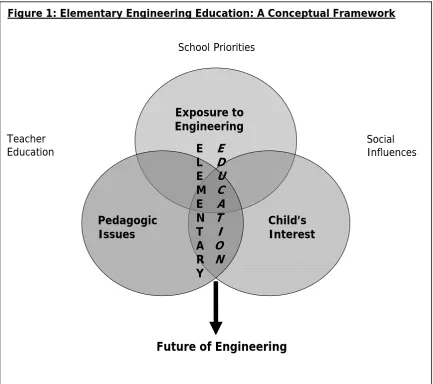
In developing a conceptual framework with which to conduct research into elementary engineering education within the UK, three main concepts have been identified: pedagogic issues: exposure to engineering education; and children’s. Furthermore, three sub-concepts have been identified each of which is intrinsically linked to the main concepts: teacher education; social influences; and school priorities. Figure 1, below, depicts the relationship between these concepts and sub-concepts in a diagrammatic format, and shows how they may impact and influence the future of engineering in the UK.
The disparate and seemingly random nature of elementary level engineering education means that prior to conducting further investigation it is necessary for the researchers to gain a detailed and accurate picture of current provision of elementary engineering education. Thus, the next stage of the research process will be to undertake an in-depth mapping and critical analysis of elementary level engineering education at an elementary level. The researchers are aware that the collation of
Exposure to
Engineering
Child’s
Interest
Pedagogic
Issues
E
E
L D
E U
M C
E A
N T
T I
A O
R N
Y
Figure 1: Elementary Engineering Education: A Conceptual Framework
Future of Engineering
School PrioritiesTeacher
such data needs to be undertaken in an empirical manner, thus a critical framework with which to record and analyse the data will be developed. The framework will capture the activities undertaken within the various projects and after-school clubs across the UK. It is anticipated that an analysis of the mapping activity will allow the researchers to identify current practice across the country.
The next stage of the study will be to critically analyse current provision in a manner that captures the perspectives and experiences of a wide range of relevant stakeholders. Building upon the approach adopted in the exploratory study, semi-structured interviews will be undertaken the aim of which will be to consider how engineering may be introduced into the pre-secondary school curriculum in a manner that enhances current teaching across a range of subjects.
Following a typical action research approach (Norton, 2009), the researchers will then work with interested stakeholders to develop empirically grounded pedagogic interventions with which engineering may be introduced into the elementary school curriculum. Building on current best practice identified in the mapping exercise and taking account of stakeholder perspectives identified in the interviews, the interventions will piloted in a small number of key schools. The ‘pilot’ interventions will be monitored contemporaneously before being evaluated, modified, and further enhanced. Following this, formal recommendations in respect of how to embed engineering into the elementary school curriculum will be made to all interested stakeholders including policy makers.
Conclusion
References
Anderson, J.R., 1995. Learning and Memory: An Integrated Approach. Chichester: Wiley.
Brophy, S., Klein, S., Portsmore, M. & Rogers, C. (2008). ‘Advancing Engineering Education in P-12 Classrooms’. Journal of Engineering Education. July 2008. pp 369-387
Coon, D., 1983. Introduction to Psychology. St Paul, Minnesota: West Publishing. 3rd Edition.
Cummings, L., 1985. ‘Qualitative Research in the Infant Classroom: A personal account’. In Burgess, R., (ed). Issues in Educational Research: Qualitative methods:. Lewes. Falmer. pp 216-250.
Davies, T., 2000. ‘Confidence! Its role in the Creative Teaching and Learning of Design and Technology. Journal of Technology Education. 12. 1. pp. 18-31
Dewey, J., 1938. Logic – The Theory of Inquiry. New York: Holt.
DCSF., 2009. The Diploma in Engineering. Available from
http://www.engineeringdiploma.com/ Accessed 30th September 2009. Department
for Children Schools & Families.
DIUS.,2008. A Vision for Science and Society. London: The Royal Academy of Engineering. Department of Innovation, Universities & Science.
English, L.D., Dawes, L., Hudson, P., & Byers, T., 2009. Introducing Engineering Education in the Middle School. http://rees2009.pbworks.com/Program-with-Papers Accessed 24/7/09. Proceedings of Research in Engineering Education
Symposium(REES) July 2009. Palm Grove, Queensland, Australia.
GTTR., 2009. Find a Course, 2009.
http://www.tda.gov.uk/Recruit/thetrainingprocess/choosingacourse.aspx
Accessed 14th August 2009. Graduate Teacher Training Register.
IMechE., 2009. Education for Engineering: IMECHE Policy Summary. London: Institute for Mechanical Engineering.
King, N., 1994. The Qualitative Research Interview. In Cassell, C., & Symon, G., (eds), Qualitative Methods in Organisational Research: A Practical Guide. London. Sage. pp 14-26.
Mitcham, C. (2001). ‘Dasein Versus Design: The Problematics of Turning Making into Thinking’. International Journal of Technology and Design Education. 11. 27-36.
Norton, L.S., 2009. Action Research in Teaching & Learning: A Practical Guide to
Conducting Pedagogical Research in Teaching and Learning. London: Routledge.
NSF., 2009. Closing the Gender Skills Gap: A National Skills Forum Report on Women, Skills and Productivity. London: National Skills Forum.
Piaget, J., 1963. The Origins of Intelligence in Children. New York: Norton.
QAA., 2009. Subject Benchmark Statements: Education Studies.
http://www.qaa.ac.uk/academicinfrastructure/benchmark/honours/Education07.pdf
Accessed 14th August. Quality Assurance Agency.
RAE., 2007. Education Engineers for the 21st Century. London. Royal Academy of Engineers.
RAE., 2009. Inspiring Women Engineers. London: Royal Academy of Engineering
Rasinen, A. (2003). ‘An Analysis of the Technology Education Curriculum of Six Countries’. Journal of Technology Education. 15. 1. pp 31-47
Rose Review., 2009. Independent Review of the Elementary Curriculum. Nottingham. Department for Children, Schools and Families.
Smith, N. & Monk, M., 2005. 'Attracting Tomorrow's Engineers: An Evaluation of a Scheme to Enhance Recruitment into Engineering', European Journal of Engineering Education, 30. 2. pp. 233-243.
Spinks, N., Silburn, N. & Birchall, D., 2006. Educating Engineers for the 21st Century: The Industrial View. London: Royal Academy of Engineers.
Strauss, A., & Corbin, J., 1998. Basics of Qualitative Research: Techniques and Procedures for Developing Grounded Theory. London: Sage.
Twyford, J., & Jarvinen, E.M., 2000. ‘The Formation of Children’s Technological Concepts: A Study of What it Means to Do Technology from a Child’s Perspective’. Journal of Technology Education. 12. 1. pp 32-46
Vlot, A. (2000). ‘Toward a Judicial Turn for Ethics of Technology? An Aerospace Case’. In Kroes, P. (ed). The Empirical Turn for the Philosophy of Technology. Research in Philosophy and Technology. Oxford. Elsevier Science.
Wilson, V., & Harris, M., 2004. Creating Change? A Review of the Impact of Design and Technology in Schools in England. Journal of Technology Education. 15. pp 46-65.
Young Engineers, 2009. Young Engineers.
http://www.youngeng.org/index.asp?page=166. Accessed 12th August 2009.