https://doi.org/10.1007/s00421-018-3801-7
ORIGINAL ARTICLE
Sodium bicarbonate supplementation improves severe-intensity
intermittent exercise under moderate acute hypoxic conditions
Sanjoy K. Deb1 · Lewis A. Gough1 · S. Andy Sparks1 · Lars R. McNaughton1,2
Received: 18 July 2017 / Accepted: 2 January 2018
© The Author(s) 2018. This article is an open access publication
Abstract
Acute moderate hypoxic exposure can substantially impair exercise performance, which occurs with a concurrent exacerbated rise in hydrogen cation (H+) production. The purpose of this study was therefore, to alleviate this acidic stress through sodium
bicarbonate (NaHCO3) supplementation and determine the corresponding effects on severe-intensity intermittent exercise performance. Eleven recreationally active individuals participated in this randomised, double-blind, crossover study per-formed under acute normobaric hypoxic conditions (FiO2% = 14.5%). Pre-experimental trials involved the determination of
time to attain peak bicarbonate anion concentrations ([HCO3−]) following NaHCO
3 ingestion. The intermittent exercise tests
involved repeated 60-s work in their severe-intensity domain and 30-s recovery at 20 W to exhaustion. Participants ingested either 0.3 g kg bm−1 of NaHCO
3 or a matched placebo of 0.21 g kg bm−1 of sodium chloride prior to exercise. Exercise
tolerance (+ 110.9 ± 100.6 s; 95% CI 43.3–178 s; g = 1.0) and work performed in the severe-intensity domain (+ 5.8 ± 6.6 kJ; 95% CI 1.3–9.9 kJ; g = 0.8) were enhanced with NaHCO3 supplementation. Furthermore, a larger post-exercise blood lactate concentration was reported in the experimental group (+ 4 ± 2.4 mmol l−1; 95% CI 2.2–5.9; g = 1.8), while blood [HCO
3−]
and pH remained elevated in the NaHCO3 condition throughout experimentation. In conclusion, this study reported a
posi-tive effect of NaHCO3 under acute moderate hypoxic conditions during intermittent exercise and therefore, may offer an
ergogenic strategy to mitigate hypoxic induced declines in exercise performance.
Keywords Alkalosis · Altitude · Extreme environments · Intermittent hypoxic exercise · Critical power · Severe-intensity domain
Abbreviations
[HCO3−] Bicarbonate anion concentrations
[lactate] Blood lactate concentrations CI Confidence intervals CP Critical power
g Hedge’s g
H+ Hydrogen cation
̇
VO2peak Peak rate of oxygen consumption
O2 Oxygen
spo2 Oxygen saturation NaHCO3 Sodium bicarbonate
NaCl Sodium chloride VT1 Ventilatory threshold 1
Wʹ W prime
Introduction
Acute ambient hypoxic environments are often used as an ergogenic strategy to enhance exercise-induced train-ing adaptations (Lundby et al. 2012). Indeed, methods that involve interspersed acute hypoxic exercise bouts within a training programme, are suggested to augment molecular training adaptations leading to enhanced anaerobic glyco-lytic activity (Faiss et al. 2013). This benefit is not without cost however, as the lower availability of oxygen (O2) may elicit an ergolytic effect on exercise intensity and volume during intermittent and continuous exercise (Aldous et al.
2016; Clark et al. 2007). The precise reasons causing these
Communicated by Michael Lindinger.
* Sanjoy K. Deb
1 Sports Nutrition and Performance Research Group,
Department of Sport and Physical Activity, Edge Hill University, Ormskirk, Lancashire L39 4QP, UK
2 Department of Sport and Movement Studies, Faculty
attenuations in exercise performance are ambiguous; how-ever, an integrated central and peripheral fatigue response is likely (Fan and Kayser 2016). This includes a lower convec-tive O2 delivery to active skeletal muscle (Amann and
Cal-bet 2008), an exacerbated disturbance to acid–base balance during exercise (Hogan et al. 1999; Romer et al. 2007) and under severe hypoxic conditions (> 3000 m), a further reduc-tion in group III/IV afferent feedback to diminish central motor output is apparent (Amann et al. 2007). The resultant decline in exercise performance presents a challenge to the management of training load during acute hypoxic training regimes to ensure the acute cost to exercise performance does not hamper the potential medium to long-term benefits of these strategies.
Acute dietary strategies have previously been used to mitigate for the impaired exercise performance caused by acute hypoxia. This includes dietary nitrate supplementation to enhance convective O2 delivery (Shannon et al. 2017) and sodium bicarbonate (NaHCO3) supplementation as an
alkalotic buffer to dampen the elevated acidic stress (Deb et al. 2017). The latter presents an interesting physiologi-cal paradigm, given the relative increase in glycolytic flux with hypoxic exposure potentiating hydrogen cation (H+)
production. However, their concurrent removal may be hin-dered as blood bicarbonate buffering capacity may be dimin-ished under hypoxic conditions, due to a suggested lower bicarbonate anion concentrations ([HCO3−]) (Cerretelli and
Samaja 2003). It is therefore intuitive to assess ergogenic strategies that may facilitate the removal of excess H+ during
exercise and compensate for the suggested [HCO3−]
reduc-tions. Indeed, Deb et al., (2017) reported that the efficacy of NaHCO3 supplementation is enhanced under acute hypoxia
compared to sea level as the magnitude of improvement was greater during high-intensity exercise in acute hypoxic con-ditions. This should be interpreted with caution however, given that previous studies have either reported no benefit with NaHCO3 under acute hypoxic conditions (Saunders
et al. 2014a; Flinn et al. 2014), or inconsistencies in the over-all ergogenic response (Froio de Araujo Dias et al. 2015). Furthermore, there remains considerable contention on the importance of the acid–base balance on fatigue and exercise performance, as exercise performance can be maintained despite perturbations in acid–base balance (Fitts 2016; West-erblad 2016). Consequently, further research is required to elucidate the importance of the acid–base balance, particu-larly under acute hypoxic exposures where pre-exercise alkalotic manipulation may induce beneficial performance outcomes for isolated exercise bouts.
It is evident through viewing blood lactate kinetics dur-ing exercise, and corresponddur-ing disturbances in acid–base balance, that the ergogenic effects of NaHCO3 may only
arise during exercise intensities at or above the severe-intensity domain. This cluster of exercise intensities can
be distinguished by physiological markers defined by the second lactate and ventilatory (or otherwise known as the respiratory compensation point) thresholds, or critical power at the lower boundary, whilst the upper boundary is defined as the intensity at the peak rate of oxygen consumption ( V̇
O2peak) (Jones et al. 2010). Within this given intensity range, an inexorable rise in lactate occurs and the acid–base bal-ance becomes substantially perturbed to performbal-ance limit-ing levels (Jones et al. 2007). Indeed, work performed in the severe-intensity domain during continuous exercise is enhanced with prior NaHCO3 supplementation (Egger et al.
2014); however, this is not reflected in exercise tolerance during severe-intensity intermittent exercise under hypoxic conditions in acclimatised individuals (Kozak-Collins et al.
1994). The acclimatised participants used in the latter study may explain the lack of effect, given altitude acclimatisa-tion negates the addiacclimatisa-tional acidic load apparent in acclima-tised individuals under acute hypoxia (West 2007). As the ergogenicity of NaHCO3 is dependent on the magnitude of
acid–base perturbations, it is hypothesised that NaHCO3
supplementation will improve severe-intensity intermittent exercise under acute hypoxic conditions.
Method
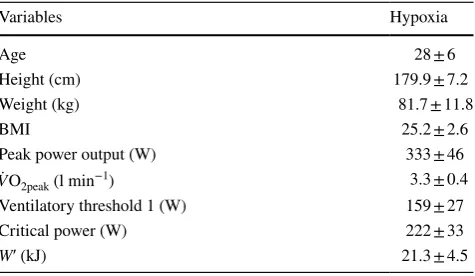
Eleven recreationally active male volunteers (see Table 1 for participant characteristics), with no sustained altitude expo-sure in the preceding 6 months, participated in this investi-gation. All participants performed regular physical exercise and were also accustomed to repeated high-intensity inter-mittent cycling exercise. This included eight participants that regularly partook in cycling exercise (> 60 km week−1
and > 7 h week−1), which is in accordance with the
train-ing volume that classifies individuals as trained (De Pauw et al. 2015), whilst the remaining three participants per-formed cycling activity as part of a regular exercise regime (≥ 4 h week−1), which represents volume of work that
clas-sifies individuals as recreationally active individuals (De
Table 1 Participant characteristics
Variables Hypoxia
Age 28 ± 6
Height (cm) 179.9 ± 7.2 Weight (kg) 81.7 ± 11.8 BMI 25.2 ± 2.6 Peak power output (W) 333 ± 46
̇
VO2peak (l min−1) 3.3 ± 0.4
Ventilatory threshold 1 (W) 159 ± 27 Critical power (W) 222 ± 33
Pauw et al. 2015). Prior to obtaining written consent, par-ticipants were informed of the purpose, benefits and risks of participation. Ethical approval was attained from the institutional ethics committee and conducted in accordance with the Helsinki Declaration. Participants were instructed to refrain from strenuous exercise and alcohol consumption in the preceding 24 h before each laboratory visit; while also abstaining from caffeine for 12 h. A 24-h dietary recall was completed during the initial visit, with participants asked to replicate dietary intake for subsequent visits. This was confirmed verbally on arrival to each laboratory visit. Par-ticipants arrived in a 3-h postprandial state and were asked to maintain water intake prior to arrival to limit confounding nutritional effects on exercise performance.
Experimental design
A randomised, double-blind, crossover experimental design was employed with participants attending the laboratory up to six separate occasions at the same time of day (± 1 h). All exercise trials were a minimum 24 h apart and com-pleted within a 3-week period. A normobaric environmental chamber (Model S016r-7-sp, TISS, Portsmouth, UK) was used to recreate ambient hypoxic conditions with a fractional inspired O2 percentage (FiO2%) of 14.5%; while temperature (20 °C) and humidity (40%) was also regulated throughout the study. Participants were exposed to hypoxic air 10 min prior to exercise to allow equilibrium between atmospheric and body O2 stores (Andreassen and Rees 2005).
During the initial visit, individual blood acid–base response to 0.3 g kg−1 body mass of NaHCO
3
supplemen-tation was established through measuring the time course of blood acid–base balance across a 90-min period follow-ing follow-ingestion (Gough et al. 2017). Sodium bicarbonate was administered in 400 ml of chilled water and mixed with 50 ml of sugar-free cordial (blackcurrant squash, Heritage, UK); with the participants asked to consume the supplement within a 10-min time period. Fingertip capillary blood sam-ples (70 µl) were drawn every 10 min for 60 min and then every 5 min from 60 to 90 min. Participants remained seated during the collection of blood into a capillary tube (Elec-trolyte balanced heparin clinitube, Radiometer, Denmark). Blood samples were analysed for [HCO3−] using a blood
gas analyser (Radiometer ABL800, Denmark). The indi-vidual time taken for peak [HCO3−] to occur was then used
for the pre-ingestion timing for subsequent experimental exercise trials. This method controls for the intra-individual differences in acid–base kinetics following NaHCO3 sup-plementation (Jones et al. 2016; Gough et al. 2017) and ena-bles individuals to exercise at their peak blood [HCO3−] to
maximise the HCO3− buffering potential. This timeframe in
attaining peak blood [HCO3−] following NaHCO
3 is shown
to be reproducible (r = 0.94; p < 0.001) between ingestions
within participants (Gough et al. 2017) and therefore, repre-sents a reliable method to administer NaHCO3.
Following the first visit to establish the timeframe for attaining peak [HCO3−], baseline V̇O2peak and the ventilatory
threshold 1 (VT1) were determined on the second labora-tory visit using an incremental RAMP test performed under simulated hypoxic conditions (FiO2% = 14.5%). This was
followed by familiarisation to the 3-min all-out test after 30-min recovery from the RAMP test. Subsequently, on separate laboratory visits, participants performed the 3-min test on a further two occasions under acute hypoxic condi-tions. However, if a valid test was not completed (described in further detail below), participants would repeat the test during additional laboratory visits. The final two visits involved an exhaustive intermittent exercise test performed under two different randomised experimental conditions, with the prior ingestion of either 0.3 g kg bm of NaHCO3 or placebo containing 0.21 g kg bm of sodium chloride (NaCl). The placebo was also mixed in 400 ml of water and 50 ml of cordial to mask the experimental conditions; while the dose of NaCl was chosen as it presents an equimolar composition of sodium to 0.3 g kg bm of NaHCO3, which
consequently mitigates for the potential ergogenic effects of sodium (Mora-Rodriguez and Hamouti 2012).
Determination of V̇O2peak and ventilatory threshold1
The RAMP test commenced with 3-min unloaded pedalling into a ramped increase of 1 W s−2, equivalent to 30 W min−1.
A preferred cadence was selected prior to the test, which participants were asked to maintain until volitional exhaus-tion. The test was terminated when this cadence could no longer be maintained within 10 rpm for 10 s, despite strong verbal encouragement. Exercise tests were performed on an electrically braked ergometer (Lode Excalibur Sport, Gro-ningen, The Netherlands), with the frame dimensions and pedals adjusted to participant preference and replicated for all subsequent exercise trials. Breath-by-breath pulmonary gas exchange was recorded throughout, and in all subse-quent trials, using a metabolic analyser (Oxycon, Jaeger, Germany). Peak power output (PPO) was defined as the greatest power output attained at the termination of the test, whilst V̇O2peak was defined as the highest 30 s rolling average of V̇O2. Ventilatory threshold 1 (VT1) was estimated using the detection of inflection points on gas exchange graphs as outlined by Beaver et al. (1986).
Three‑min critical power test
A 3-min test was used to determine critical power (CP) and
involved 3-min unloaded pedalling into an abrupt start of the 3-min sprint phase, during which the ergometer instantly switched to the linear mode. A 10-s countdown was provided to prompt the participants to increase cadence over 120 rpm and to enable the attainment of peak power at the start of the sprint phase. Visual feedback of cadence was available during the test, with participants instructed to maintain the highest possible cadence throughout the test; strong verbal encouragement was provided for the whole test. The linear factor resistance (linear factor = power/cadence2) was
estab-lished using the power output corresponding to 50% of the difference between VT1 and PPO during the RAMP test, along with the individual preferred cadences used during the ramp test. Critical power was calculated on the aver-age power output during the last 30 s of the test and Wʹ as the volume of work (kJ) performed above CP. The test was deemed valid when there was no evidence of pacing; in that, the end 30-s power output was the lowest recorded through-out the test. In addition, pulmonary V̇O2 had to reach 95% of maximum within 60 s of the sprint phase and be maintained without any downward drift for the remainder of the test (Jones et al. 2010). If these criteria were not attained, the test was repeated.
Intermittent tests
All intermittent tests commenced with 1-min pedalling at 20 W followed by an abrupt start in to repeated intervals of 60-s work and 30-s recovery until exhaustion. The intensity of the work interval was determined by the intensity pre-dicted to attain task failure in 4-min (P4), in accordance with the two-parameter CP model (Eq. 1), whilst the recovery was set at 20 W:
The use of threshold models to set the work profiles of intermittent exercise is suggested to increase the accuracy of standardising cardiopulmonary and metabolic response to exercise within and between individuals, relative to tradi-tional percentiles of max heart rate, power output or V̇O2peak (Tschakert and Hofmann 2013). The work completed in the severe-intensity domain could also be calculated by multi-plying the time spent above CP by the difference between the work intensity and CP.
A pre-established preferred cadence was held throughout the intermittent test, with task failure defined as the inability to maintain cadence within 60% of the preferred cadence (Amman et al. 2008), despite strong verbal encouragement. Exercise tolerance was determined as the time, in seconds, participants could maintain a cadence < 60% of their pre-ferred cadence at the required power output; whilst the cumulative work performed above CP was defined as the work performed in the severe-intensity domain during the (1) P4= (W�∕240) + CP.
intermittent test. Heart rate (Forerunner 15, Garmin, US) and oxygen saturation (SpO2) using a fingertip pulse
oxi-meter (Autocorr® Digital Pulse Oximeter, BCI, US) were
recorded at the end of every work stage and reported as a test average. Fingertip blood samples were collected prior to and within 1 min of exercise termination during intermit-tent experimental trials, using the methods described earlier. Samples were analysed for blood pH and [HCO3−]
(Radi-ometer ABL800, Denmark), with blood lactate concentra-tions ([lactate]) assessed using a portable measuring device (Lactate Pro 2, Arkray, Japan).
Statistical analysis
The Shapiro–Wilk test provided no evidence to reject the hypothesis that all data were normally distributed. A paired
t test was used to compare the exercise durations, work completed in severe-intensity domain, mean heart rate and SpO2. Blood variables, including [HCO3−], [H+] and
[lac-tate], were analysed through a two-way (treatment [placebo vs. NaHCO3] × time [pre-and post-exercise]) ANOVA. Where a significant main effect was found, Bonferroni post hoc paired comparisons were determined. Effect sizes and their 95% confidence intervals (CI) were calculated using Hedge’s g for paired comparisons, with the effects inter-preted and discussed against effects of the relevant prior literature (Thompson 2007). These effect sizes can also be interpreted as trivial (< 0.20), small (0.20–0.49), moderate (0.50–0.79) or large (≥ 0.80) (Cohen 1988). The Hedge’s g
correction was used to mitigate positive bias of the Cohen’s
d effect size when using sample sizes less than 20 (Lakens
2013). Frequentist inferences were assessed against mean difference ± 95% CI between experimental conditions, with variances that do not cross the zero-boundary inter-preted as significant. All descriptive data are presented as mean ± standard deviation, unless otherwise stated. Statisti-cal analysis was performed using open source statistiStatisti-cal soft-ware, R (R Foundation for Statistical Computing, Vienna, Austria).
Results
The time taken to reach individual peak blood [HCO3−]
ranged from 40 to 90 min with a median of value of 70 min. Mean CP and Wʹ were 226 ± 31 W and 20.3 ± 7.0 kJ, respec-tively. Exercise tolerance during the intermittent test (Fig. 1) was significantly greater during the NaHCO3 treatment condition by 14.6 ± 12.5% from 734.3 ± 175.7 s during the placebo condition to 845.3 ± 242.4 s under NaHCO3
(95% CI 1.3–9.9 kJ), from 41.6 ± 14.7 to 47.2 ± 17.6 kJ in the placebo and NaHCO3 conditions, respectively. Despite the positive outcome, an increase in work completed in the severe-intensity domain was not consistent across all partici-pants, with participant 9 experiencing an ergolytic effect and participant 2 showing no difference between experimental conditions (Fig. 2).
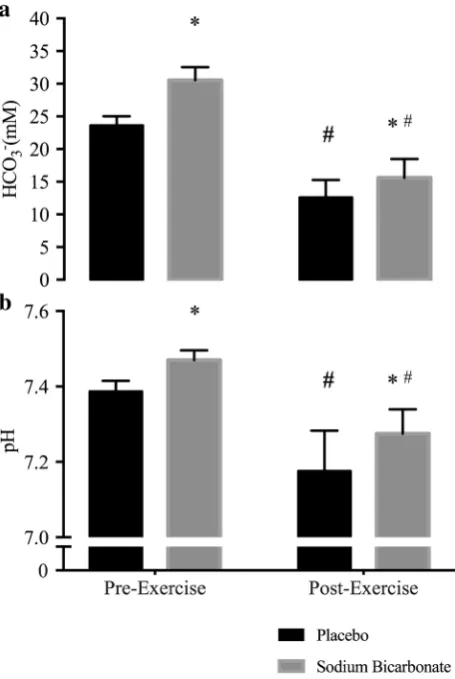
An overall main effect for blood [HCO3−] was
appar-ent (Fig. 3a), with a significantly greater concentration observed with NaHCO3 compared to placebo prior to exercise (6.9 ± 1.9 mmol l−1; 95% CI 5.6–8.1 mmol l−1).
Blood [HCO3−] remained elevated in the NaHCO3
treatment condition post-exercise compared to pla-cebo (3.0 ± 2.0 mmol l−1; 95% CI 1.6–4.3 mmol l−1),
despite the larger reduction in [HCO3−] during exercise
in the NaHCO3 condition (− 14.9 ± 2.9 mmol l−1; 95%
CI − 16.9 to − 13.0 mmol l−1) compared to placebo
(− 11.0 ± 2.6 mmol l−1; 95% CI − 12.8 to − 9.3 mmol l−1).
An equivalent result was found for pH (Fig. 3b), with a greater pre-exercise values observed in the NaHCO3
treat-ment condition compared to placebo (0.08 ± 0.03; 90% CI 0.06–0.11); whilst pH also remained elevated following exercise (0.09 ± 0.06 95% CI 0.05–0.15). This difference in pre- and post-exercise pH was apparent given the similar reduction during exercise in the placebo (− 0.21 ± 0.08; 95% CI − 0.28 to − 0.14) and NaHCO3 conditions
(− 0.20 ± 0.08; 95% CI − 0.24 to − 0.15). Post-exercise blood [lactate] increased by 4.0 ± 2.4 mmol l−1 (95% CI
2.2–5.9) from 13.9 ± 4.3 mmol l−1 during the placebo
condition compared to 17.9 ± 5.9 mmol l−1 with NaHCO 3
treatment. There were no significant differences in mean heart rate (0.4 ± 4.7 bpm; 95% CI − 3.5 to 4.3 bpm) and SpO2 (0.8 ± 2.3%; 95% CI − 1.1 to 2.7%) between
conditions.
Fig. 1 Hedge’s g effect size and 95% CI of the effect of NaHCO3
treatment against placebo treatment for all outcome variables
Fig. 2 Difference in work complete between NaHCO3 treatment
against placebo treatment for all participants. Values greater than zero indicate that a greater volume of work was performed with NaHCO3
and values lower than zero indicate that less work was performed with NaHCO3 compared to placebo. Dashed line represents mean
dif-ference in work complete and the shaded band shows the ± 95% CI of effect between treatments
Fig. 3 Pre- and post-exercise blood [HCO3−] (a) and blood pH (b)
during NaHCO3 and placebo experimental trials. *Significant (95%
CI) difference to corresponding placebo time point. #Significant (95%
Discussion
The ergogenicity of NaHCO3 during intermittent exercise
has only been demonstrated with work intervals involving maximal or supra-maximal intensity (Carr et al. 2011). Consequently, this study is the first to report that NaHCO3 improves exercise tolerance and work performed during intermittent exercise in the severe-intensity domain, whilst exposed to acute hypoxic conditions. Furthermore, this study demonstrated NaHCO3 improves severe-intensity intermittent exercise performance under acute hypoxic conditions. The blood acid–base and [lactate] perturba-tions during exercise observed in the current study are similar to previous investigations (Carr et al. 2011), there-fore suggesting the ergogenic effects of NaHCO3 is likely
to be mediated through the manipulation of acid–base bal-ance. The current study also adds to the growing body of literature that has utilised a methodology to elicit peak blood [HCO3−] at the onset of exercise by accounting
individual variance in blood acid–base kinetics following NaHCO3 ingestion (Miller et al. 2015; Deb et al. 2017). Together, this study demonstrates NaHCO3 supplementa-tion prescribed to account for the individual variance in time to peak blood [HCO3−], enhances severe-intensity
intermittent exercise under acute moderate hypoxic con-ditions. This therefore may offer an ergogenic strategy to improve high-intensity intermittent exercise tolerance under acute moderate hypoxic conditions.
This study adds to the paucity of research evaluating the effect of NaHCO3 supplementation on exercise per-formed in the severe-intensity domain, which have demon-strated equivocal outcomes (George and MacLaren 1988; Egger et al. 2014). Egger et al. (2014) reported a signifi-cant improvement equivalent to 0.41 Hedge’s g units in 21 well-trained cyclists; whereas George and MacLaren (1988) found no significant effect in seven healthy par-ticipants. This disparity between studies and the positive outcome in the current study, could be explained by a dose-dependent effect of NaHCO3. Given that the
cur-rent study demonstrated positive outcomes with a rela-tive 0.3 kg−1 body mass dose compared to the 0.2 g kg−1
body mass administered by George and MacLaren (1988). Interestingly, the observed effect on exercise tolerance and work done in the severe-intensity domain in current study was 2–2.5-fold greater than that previously observed during severe-intensity exercise. It is important to high-light the use of intermittent exercise in the current study and continuous exercise in previous research may also account for the larger ergogenic effect observed in exer-cise performance. A proposition that is supported with meta-analytic evidence, with Carr et al. (2011) reporting greater performance improvements with NaHCO3 during
repeated compared to continuous exercise. Nevertheless, a hypoxic mediated effect cannot be dismissed, as the effi-cacy of NaHCO3 may be greater under acute moderate
hypoxic conditions (Deb et al. 2017), due to the exacer-bated acid–base perturbations (Hogan et al. 1999). This hypothesis should, however, be viewed with caution until further research has evaluated the efficacy of NaHCO3
with normoxic and hypoxic comparators.
Despite this assertion and the ergogenic outcomes found in the current study, a number of previous investi-gations have not reported similar performance-enhancing properties of NaHCO3 under acute moderate hypoxic con-ditions (Saunders et al. 2014a; Flinn et al. 2014). Flinn et al. (2014) performed a similar exhaustive intermit-tent exercise protocol to the present study, but utilised a supra-maximal exercise intensity under acute hypoxic conditions; while Saunders et al. (2014a) used a repeated sprint protocol prolonged across 90 min to simulate soccer performance, and found no positive performance effect. This discrepancy between the current study and prior research could be attributed to the timing of administer-ing NaHCO3, since both Saunders et al. (2014a) and Flinn
et al. (2014) used a gelatine capsule delivery method over a 4-h and 90-min period prior to exercise, respectively. In contrast, the current study accounted for the individual temporal characteristics of acid–base kinetics following NaHCO3 supplementation, by ensuring participants
com-menced exercise tests at the peak blood [HCO3−], to
max-imise buffering potential (Jones et al. 2016; Gough et al.
2017). Indeed, the time course to peak blood [HCO3−]
using a gelatine capsule has previously been shown to range from 75 to 180 min and a median of 120 min in a similar participant cohort; while the range from liquid supplementation was between 40 and 90 min in the pre-sent study. However, when comparing pre-exercise blood [HCO3−] between current and previous studies it is not
clear that utilising an individualised strategy is superior at maximising the ergogenic effect of NaHCO3. The
cur-rent study reported a mean 6.9 mmol l−1(g = 3.5, 95% CI
2.1–5.0) increase in blood [HCO3−] compared to placebo,
which is greater than the 5.7 mmol l−1 (g = 3.4, 95% CI
2.9–3.8) increase reported by Saunders et al. (2014a) but Flinn et al. (2014) reported a greater 7.6 mmol l−1 (g = 4.4,
95% CI 3.7–5.0) increase; despite showing no positive per-formance effect. Interestingly, the standardised effect sizes and corresponding 95% confidence intervals suggest the effect on pre-exercise [HCO3−] was similar between
inves-tigations as the confidence intervals overlap. Therefore, while an individualised supplementation strategy may be appropriate to maximised blood [HCO3−] prior to exercise
research is therefore required to determine the efficacy of individualised timing against a standardised timing strategy.
Despite the contemporary development of personalised NaHCO3 supplementation ingestion time, the adverse gas-trointestinal (GI) side effects remain apparent. As evident in participant 9 (Fig. 2), who experienced substantial GI complaints, the side effects of supplementation may pro-duce an ergolytic performance effect. Previous research sug-gests that the variability in NaHCO3 ergogenic properties
may be dependent on presence and severity of GI symp-toms (Saunders et al. 2014b). However, GI complaints and a negative or no performance effect are not always apparent, as the ergogenic and adverse effects of NaHCO3 have been
shown to coexist (McNaughton et al. 2016), with Cameron et al. (2010) reporting a weak association between the two parameters (r = 0.35; p = 0.09). Given this lack of clarity in this relationship and the failure of the current study to empirically quantify GI complaints, the negative influence of NaHCO3 can only be inferred in this study as it provides little direct evidence to support the notion that GI complaints from NaHCO3 supplementation can impair exercise
perfor-mance or lessen the ergogenic effects.
Independent of individual exercise performance effects, the temporal blood acid–base behaviour following NaHCO3 supplementation and exhaustive exercise, were
comparable to the wider literature base (Carr et al. <link rid="bib9">2011</link; Flinn et al. 2014; Saunders et al.
2014a; Deb et al. 2017). Oral NaHCO3 supplementation induced peak blood [HCO3−] concentrations that are greater
than 6 mmol l−1 compared to placebo, which is above the
suggested level required for NaHCO3 to exhibit an ergo-genic effect (Carr et al. 2011). The change in blood pH and [HCO3−] was greater during exercise with NaHCO3
com-pared to placebo, with an equivalent larger rise in blood [lac-tate] during the NaHCO3 experimental trial. Indeed, there is evidence to suggest NaHCO3 promotes non-oxidative energy metabolism, as observed through greater muscle lactate pro-duction, and muscle glycogen utilisation during intermittent exercise performed in the severe-intensity domain (Percival et al. 2015). Despite not measuring muscle glycogen utilisa-tion or muscle lactate producutilisa-tion in the current study, based on previous research it is appropriate to speculate that the observed ergogenic effects of NaHCO3 may be mediated through augmenting glycolytic bioenergetic contribution, and an enhanced muscle glycogen utilisation. While this is a plausible theory, it is important to highlight that the rise in blood [lactate] during the treatment condition may be explained by a reduction lactate uptake into inactive mus-cle tissue (Granier et al. 1996) and/or an increase in lactate efflux from intramuscular to extracellular regions (Bishop et al. 2004) following NaHCO3 supplementation. As such, an increase in glycolytic activity can only be speculated in
the current investigation. In addition, it is also prudent to highlight that pH at the end of exercise did not reach com-parable values in the experimental and placebo trials, which conforms with previous research (Carr et al. 2011). This suggests that pH may not be the solitary reason for exercise termination in the experimental condition. Given the multi-faceted nature of fatigue alternative explanations may exist; such as the strong ion difference, which refers to the intra- and extracellular ions (e.g. potassium, sodium, chloride) that are involved in skeletal muscle contraction. Evidence suggests NaHCO3 can alter the ionic charge of these
com-partments by attenuating the efflux of potassium ions from the musculature and therefore, maintaining muscle contrac-tile properties during exercise (Siegler et al. 2016). Muscle potassium concentrations were however, not measured in the current study and consequently its role in this context can only be speculated. The SID also has an independent effect on pH (Stewart 1978), and thus it may exert skeletal mus-cle performance impairing effects through altering intra- or extra-cellular pH. Further research is required to understand the alternative reasons for exercise termination in the experi-mental condition despite pH remaining elevated; this may include assessing the function of the strong ion difference.
It is prudent to highlight the diversity in training status of the participant cohort as both trained and recreationally active individuals volunteered for this study. This does not however, limit the applicability of our findings given the wide-ranging applications of acute hypoxic training meth-ods, from trained athletes (Faiss et al. 2013), healthy indi-viduals (Shatilo et al. 2008) to patient cohorts (Millet et al.
2016). Consequently, further research investigating the effects of NaHCO3 as a training aid during acute hypoxic training programs in a range of population may be benefi-cial. In addition, a limitation to the application of this study may be in the environment at which NaHCO3 was ingested;
in that, ingesting NaHCO3 whilst remaining under acute hypoxic conditions prior to exercise may have altered the outcomes of the study as opposed to the ingestion under normoxic conditions in this study. Indeed, exposure to hypoxic conditions is suggested to diminish blood [HCO3−]
(Cerretelli and Samaja 2003) and therefore, prolonged prior hypoxic exposure may have perturbed the manipulation of the acid–base balance following NaHCO3 ingestion. This
however, can only be hypothesised until further experimental work investigates the temporal acid–base response following NaHCO3 under acute hypoxic conditions and the subsequent
demonstrates that ingesting NaHCO3 at a pre-determined peak blood [HCO3−] prior to commencing exercise is an
efficacious method to enhance blood HCO3− buffering
potential. However, caution should be taken as the adverse GI complaints associated with NaHCO3 may produce ergo-lytic effects. To build on the current investigation, further empirical research should consider the use of NaHCO3 as a
training aid during hypoxic training strategies, to determine if repeated acute supplementation prior to exercise alters the molecular training adaptations associated with intermittent acute hypoxic training.
Author contributions SKD, SAS, LRM conceived and designed
research. SKD conducted experiments. SKB analysed the data. SKD wrote the manuscript with ongoing critical comments/input from all other authors. All authors read and approved the manuscript.
Open Access This article is distributed under the terms of the Creative
Commons Attribution 4.0 International License ( http://creativecom-mons.org/licenses/by/4.0/), which permits unrestricted use, distribu-tion, and reproduction in any medium, provided you give appropriate credit to the original author(s) and the source, provide a link to the Creative Commons license, and indicate if changes were made.
References
Aldous JWF, Chrismas BCR, Akubat I et al (2016) Hot and hypoxic environments inhibit simulated soccer performance and exac-erbate performance decrements when combined. Front Physiol 6:421. https://doi.org/10.3389/fphys.2015.00421
Amann M, Calbet JAL (2008) Convective oxygen transport and fatigue. J Appl Physiol 104:861–870. https://doi.org/10.1152/ japplphysiol.01008.2007
Amann M, Romer LM, Subudhi AW et al (2007) Severity of arterial hypoxaemia affects the relative contributions of peripheral mus-cle fatigue to exercise performance in healthy humans. J Physiol 581:389–403. https://doi.org/10.1113/jphysiol.2007.129700
Amann M, Hopkins WG, Marcora SM (2008) Similar sensitivity of time to exhaustion and time-trial time to changes in endur-ance. Med Sci Sport Exerc 40:574–578. https://doi.org/10.1249/ MSS.0b013e31815e728f
Andreassen S, Rees SE (2005) Mathematical models of oxygen and carbon dioxide storage and transport: interstitial fluid and tis-sue stores and whole-body transport. Crit Rev Biomed Eng 33:265–298
Beaver WL, Wasserman K, Whipp BJ (1986) A new method for detecting anaerobic threshold by gas exchange. J Appl Physiol 60:2020–2027
Bishop D, Edge J, Davis C, Goodman C (2004) Induced metabolic alkalosis affects muscle metabolism and repeated-sprint ability. Med Sci Sports Exerc 36:807–813
Cameron SL, McLay-Cooke RT, Brown RC et al (2010) Increased blood pH but not performance with sodium bicarbonate supple-mentation in elite rugby union players. Int J Sport Nutr Exerc Metab 20:307–321
Carr AJ, Hopkins WG, Gore CJ (2011) Effects of acute alkalosis and acidosis on performance: a meta-analysis. Sports Med 41:801– 814. https://doi.org/10.2165/11591440-000000000-00000
Cerretelli P, Samaja M (2003) Acid–base balance at exercise in normoxia and in chronic hypoxia. Revisiting the “lactate
paradox”. Eur J Appl Physiol 90:431–448. https://doi.org/10.1007/ s00421-003-0928-x
Clark SA, Bourdon PC, Schmidt W et al (2007) The effect of acute simulated moderate altitude on power, performance and pacing strategies in well-trained cyclists. Eur J Appl Physiol 102:45–55.
https://doi.org/10.1007/s00421-007-0554-0
Deb SK, Gough LA, Sparks SA, McNaughton LR (2017) Determi-nants of curvature constant (Wʹ) of the power duration rela-tionship under normoxia and hypoxia: the effect of pre-exer-cise alkalosis. Eur J Appl Physiol 117:901–912. https://doi. org/10.1007/s00421-017-3574-4
De Pauw K, De Pauw B, Cheung SS et al (2013) Guidelines to clas-sify subject groups in sport-science research. Int J Sports Physiol Perform 8:111–122
Egger F, Meyer T, Such U, Hecksteden A (2014) Effects of sodium bicarbonate on high-intensity endurance performance in cyclists: a double-blind, randomized cross-over trial. PLoS One 9:e114729. https://doi.org/10.1371/journal.pone.0114729
Faiss R, Léger B, Vesin J-M et al (2013) Significant molecu-lar and systemic adaptations after repeated sprint training in hypoxia. PLoS One 8:e56522. https://doi.org/10.1371/journal. pone.0056522
Fan J-L, Kayser B (2016) Fatigue and exhaustion in hypoxia: the role of cerebral oxygenation. High Alt Med Biol 17:72–84. https:// doi.org/10.1089/ham.2016.0034
Fitts RH (2016) The role of acidosis in fatigue. Med Sci Sport Exerc 48:2335–2338. https://doi.org/10.1249/ MSS.0000000000001043
Flinn S, Herbert K, Graham K, Siegler JC (2014) Differential effect of metabolic alkalosis and hypoxia on high-intensity cycling performance. J Strength Cond Res 28:2852–2858. https://doi. org/10.1519/JSC.0000000000000489
Froio de Araujo Dias G, da Eira Silva V, de Salles Painelli V et al (2015) (In)Consistencies in responses to sodium bicarbonate supplementation: a randomised, repeated measures, counterbal-anced and double-blind study. PLoS One 10:e0143086. https:// doi.org/10.1371/journal.pone.0143086
George KP, MacLaren DP (1988) The effect of induced alkalosis and acidosis on endurance running at an intensity corresponding to 4 mM blood lactate. Ergonomics 31:1639–1645. https://doi. org/10.1080/00140138808966813
Gough LA, Deb SK, Sparks AS, McNaughton LR (2017) The repro-ducibility of blood acid base responses in male collegiate ath-letes following individualised doses of sodium bicarbonate: a randomised controlled crossover study. Sport Med 1–11. https:// doi.org/10.1007/s40279-017-0699-x
Granier PL, Dubouchaud H, Mercier BM et al (1996) Effect of NaHCO3 on lactate kinetics in forearm muscles during leg exer-cise in man. Med Sci Sports Exerc 28:692–697
Hogan MC, Richardson RS, Haseler LJ (1999) Human muscle perfor-mance and PCr hydrolysis with varied inspired oxygen fractions: a 31P-MRS study. J Appl Physiol 86:1367–1373
Jones AM, Wilkerson DP, DiMenna F et al (2007) Muscle meta-bolic responses to exercise above and below the “critical power” assessed using 31P-MRS. AJP Regul Integr Comp Physiol 294:R585–R593. https://doi.org/10.1152/ajpregu.00731.2007
Jones AM, Vanhatalo A, Burnley M et al (2010) Critical power: implications for determination of VO2max and exercise tolerance. Med Sci Sports Exerc 42:1876–1890. https://doi.org/10.1249/ MSS.0b013e3181d9cf7f
Kozak-Collins K, Burke ER, Schoene RB (1994) Sodium bicarbonate ingestion does not improve performance in women cyclists. Med Sci Sports Exerc 26:1510–1515
Lakens D (2013) Calculating and reporting effect sizes to facilitate cumulative science: a practical primer for t-tests and ANOVAs.
https://doi.org/10.3389/fpsyg.2013.00863
Lundby C, Millet GP, Calbet JA et al (2012) Does “altitude training” increase exercise performance in elite athletes? Br J Sports Med 46:792–795. https://doi.org/10.1136/bjsports-2012-091231
McNaughton LR, Gough L, Deb S et al (2016) Recent develop-ments in the use of sodium bicarbonate as an ergogenic aid. Curr Sports Med Rep 15:233–244. https://doi.org/10.1249/ JSR.0000000000000283
Miller P, Robinson A, Sparks A et al (2015) The effects of novel inges-tion of sodium bicarbonate on repeated sprint ability. J Strength Cond Res. https://doi.org/10.1519/JSC.0000000000001126
Millet GP, Debevec T, Brocherie F et al (2016) Therapeutic use of exercising in hypoxia: promises and limitations. Front Physiol 7:224. https://doi.org/10.3389/fphys.2016.00224
Mora-Rodriguez R, Hamouti N (2012) Salt and fluid loading: effects on blood volume and exercise performance, pp 113–119
Percival ME, Martin BJ, Gillen JB et al (2015) Sodium bicarbonate ingestion augments the increase in PGC-1α mRNA expression during recovery from intense interval exercise in human skel-etal muscle. J Appl Physiol 119:jap.00048.2015. https://doi. org/10.1152/japplphysiol.00048.2015
Romer LM, Haverkamp HC, Amann M et al (2007) Effect of acute severe hypoxia on peripheral fatigue and endurance capacity in healthy humans. Am J Physiol Regul Integr Comp Physiol 292:R598–R606. https://doi.org/10.1152/ajpregu.00269.2006
Saunders B, Sale C, Harris RC, Sunderland C (2014a) Effect of sodium bicarbonate and Beta-alanine on repeated sprints during intermit-tent exercise performed in hypoxia. Int J Sport Nutr Exerc Metab 24:196–205. https://doi.org/10.1123/ijsnem.2013-0102
Saunders B, Sale C, Harris RC, Sunderland C (2014b) Sodium bicarbo-nate and high-intensity-cycling capacity: variability in responses. Int J Sports Physiol Perform 9:627–632. https://doi.org/10.1123/ ijspp.2013-0295
Shannon OM, McGawley K, Nybäck L et al (2017) “Beet-ing” the mountain: a review of the physiological and performance effects of dietary nitrate supplementation at simulated and terrestrial altitude. Sport Med. https://doi.org/10.1007/s40279-017-0744-9
Shatilo VB, Korkushko OV, Ischuk VA et al (2008) Effects of intermit-tent hypoxia training on exercise performance, hemodynamics, and ventilation in healthy senior men. High Alt Med Biol 9:43–52.
https://doi.org/10.1089/ham.2007.1053
Siegler JC, Marshall PW, Bishop D et al (2016) Mechanistic insights into the efficacy of sodium bicarbonate supplementation to improve athletic performance. Sport Med Open 2:41. https://doi. org/10.1186/s40798-016-0065-9
Stewart PA (1978) Independent and dependent variables of acid–base control. Respir Physiol 33:9–26
Thompson B (2007) Effect sizes, confidence intervals, and confidence intervals for effect sizes. Psychol Sch 44:423–432. https://doi. org/10.1002/pits.20234
Tschakert G, Hofmann P (2013) High-intensity intermittent exercise: methodological and physiological aspects. Int J Sports Physiol Perform 8:600–610
Vanhatalo A, Doust JH, Burnley M (2007) Determination of critical power using a 3-min all-out cycling test. Med Sci Sports Exerc 39:548–555. https://doi.org/10.1249/mss.0b013e31802dd3e6
West JB (2007) Point: the lactate paradox does/does not occur dur-ing exercise at high altitude. J Appl Physiol 102(6):2398–2399.
https://doi.org/10.1152/japplphysiol.00039.2007