Volume 2007, Article ID 52965,15pages doi:10.1155/2007/52965
Research Article
Digital Video Encryption Algorithms Based on
Correlation-Preserving Permutations
Daniel Socek,1Spyros Magliveras,2Dubravko ´Culibrk,1Oge Marques,1Hari Kalva,1and Borko Furht1
1Department of Computer Science and Engineering, Florida Atlantic University, Boca Raton, FL 33431, USA 2Department of Mathematical Sciences, Florida Atlantic University, Boca Raton, FL 33431, USA
Correspondence should be addressed to Daniel Socek, [email protected]
Received 28 February 2007; Accepted 19 June 2007
Recommended by Qibin Sun
A novel encryption model for digital videos is presented. The model relies on the encryption-compression duality of certain types of permutations acting on video frames. In essence, the proposed encryption process preserves the spatial correlation and, as such, can be applied prior to the compression stage of a spatial-only video encoder. Several algorithmic modes of the proposed model targeted for different application requirements are presented and analyzed in terms of security and performance. Experimental results are generated for a number of standard benchmark sequences showing that the proposed method, in addition to providing confidentiality, preserves or improves the compression ratio.
Copyright © 2007 Daniel Socek et al. This is an open access article distributed under the Creative Commons Attribution License, which permits unrestricted use, distribution, and reproduction in any medium, provided the original work is properly cited.
1. INTRODUCTION
Application-specific video encryption represents an impor-tant problem in multimedia security. In order to support a wide range of real-world video applications, an encryption algorithm should be designed within a specific video com-pression framework. Conventional encryption is designed for generic data, and as such, it does not support many spe-cific video application requirements. For instance, video en-cryption algorithms that support one or more of the follow-ing application requirements are often needed.
(1) Perceptual quality control. An encryption algorithm can be used to intentionally degrade the quality of per-ception, but still keep the video visually perceivable. (2) Format compliance.It could be desired that the
encryp-tion algorithm preserves the video compression for-mat, so that the ordinary decoders can still decode the encrypted video without crashing.
(3) Codec standard compliance. A typical video system is likely to consist of a premanufactured standard-conforming encoder and decoder modules, and a video encryption method that requires no modifica-tion to either of the two modules is often desirable. (4) Minimal processing speed.In many real-time video
ap-plications, it is important that the encryption and
de-cryption algorithms are fast enough to ensure the min-imal processing speed needed for the normal video system functioning.
(5) Constant/near-constant bitrate. It is often required that the encryption transformation preserves the size of a bitstream, where the output produced by an encryption-equipped encoder and the output pro-duced by an ordinary encoder have same or similar sizes.
frame rate, bit rate, and buffer size), and the ISO end code. Bhargava et al. [3] proposed to encrypt only the sign bits of the DCT coefficients and differential values of motion vec-tors in P- and B-frames of MPEG video. In approach by Li et al. [4] only the fixed length coded (FLC) data elements of a video stream are encrypted. However, the following security issues regarding selective encryption have been identified: (1) encrypting only I-frames of a video sequence does not pro-vide enough security against ciphertext-only attacks, since the unencrypted B- and P-frames can reveal partial visible information [5]; (2) neither encrypting the sign bits nor en-crypting multiple significant bits of the DCT coefficients is secure enough against ciphertext-only attacks utilizing the unencrypted bits [6]; (3) if all encrypted DCT coefficients are set to fixed values, it is possible to recover a rough view of the plaintext frame [7,8]. In addition, many selective ap-proaches require modification to both standard encoder and decoder, and a number of approaches result in a format defi-ant video stream.
The second type of algorithms use anonconventional full encryptionmethodology, where the encryption is performed on the entire bitstream using a nonconventional encryption algorithm. Most of these algorithms are targeted for speed. Methods relying on fast chaotic maps are promising due to their fast performance. Although many chaotic encryption approaches were shown to be insecure, there are chaotic en-cryption algorithms that, up to date, remain unbroken, such as the method of Li et al. [9]. An excellent overview of these approaches, along with their comparative security analysis is presented in [10,11]. There are a few recently proposed fast, hardware-friendly full encryption methods that are based on a class of neural networks [12]. However, these methods were later shown to be less secure than originally anticipated [13]. There are also nonconventional full approaches based on other mathematically hard problems, but most of them have been shown insecure due to oversimplification. For ex-ample, Yi et al. [14] proposed a new fast encryption algo-rithm for multimedia (FEA-M), which bases the security on the complexity of solving nonlinear Boolean equations. The scheme was shown insecure against several different attacks [15,16]. In addition to questionable security, most noncon-ventional full encryption approaches are applied after en-coding which does not support format compliance require-ments. Also many of these algorithms are obsolete in recent years after the wide adoption of advanced encryption stan-dard (AES) that offers much faster performance in compar-ison to the previous conventional cryptosystems, including data encryption standard (DES).
An approach to video encryption where the encryption step occurs before encoding is attractive since many of the application requirements are inherently supported. However, most encryption algorithms have a property to randomize the source data and thus negatively affect compression per-formance of an encoder. The first attempt to creating an encryption scheme that preserves the compressibility of the source was made by Pazarci and Dipc¸in [17], in which the en-cryption occurs in the RGB color space using four secret lin-ear transforms before the video is compressed by the MPEG-2 encoder. However, in [4] it was shown that the scheme is
not secure against brute force attacks where searching com-plexity is estimated to a computationally feasible number of possibilities, and that the scheme is not secure against known/chosen-plaintext attacks. Also, the scheme by Pazarci and Dipc¸in necessarily produces a perceivable output with degraded quality but does not offer a mode where the output encrypted video is nonperceivable.
An encryption scheme of much stronger security based on permutations of video frames was proposed in [18], and in this work we extend this approach to a family of algo-rithms that can be used for a variety of video applications. The scheme from [18] is based on the correlation-preserving “almost sorting” permutations which are derived from the previous frames. The proposed methodology is based on the fact that both sorting and “almost sorting” permutations can serve to preserve or improve compressibility of frames, and at the same time to disguise the frames to a nonperceivable form. This duality represents the main principle upon which our proposed algorithms rely.
The rest of the paper is organized as follows. Section2
introduces permutations and examines their dual role in ar-eas of data compression and data encryption. The proposed video encryption algorithms based on permutation trans-formations are presented in Section3, while in Section4a thorough security analysis is performed. Experimental re-sults showing the performance of proposed algorithms are given in Section5. Finally, Section6serves to present our conclusions and ideas for future work related to this research.
2. DUALITY OF PERMUTATIONS
Permutation-based transformations are basic building blocks for many compression and encryption techniques. However, the dual use of these transformations has not been extensively studied. In this work we analyze the compression-encryption duality of permutations and develop actual methodologies for the dual use of certain permutation-based transformations in domain of digital video compression and encryption. To set the stage for the later discussion, some preliminary definitions are established next.
2.1. Permutations on sequences
A video frame can be represented in a one-dimensional fi-nite sequence using raster scan order. Apermutationof a fi-nite sequencesis a bijection fromsonto itself. Permutation
Pis often represented by itsCartesian formorbrackets form denoting the indices for the rearrangement ofs:
P=i1 i2 · · · in
, (1)
whereij, 1 ≤ j ≤ n, is a sequence ofnunique indices of elements of s, andn is the size ofs. The family of all per-mutations on a sequence of sizenforms an algebraicgroup under functional composition, denoted bySn.Pis called sort-ing permutationofsif it rearrangessin ascending order. We usesf1
1,. . .,s
fk
are distinct elements ofsin the ascending order and fithe frequency of elementsi.
Theorem 1. If a histogram of finite sequencesissf1 1,. . .,s
fk
k, there are exactly f1!× · · · ×fk!sorting permutations ofs.
Proof. LetPbe a sorting permutation ofs. The indices cor-responding to the positions ofs1appear in the first f1places
of the Cartesian form ofP, the indices ofs2 appear in the
second f2 places, and so on. Thus, one can partitionPinto ksegments of indices of sizes f1,. . .,fk, and rearranging the indices within each segment results in another sorting per-mutation ofssince the indices correspond to same values. At the same time, exchanging elements across segments dis-rupts ascending order of the resulting rearrangement of s, and the corresponding permutation is not a sorting permu-tation. Since there are fi! ways of rearranging indices of the
ith segment of the Cartesian form of P, there are exactly
f1!×f2!× · · · ×fk! sorting permutations ofs.
Thus, if a frame F is of dimension w ×h, rearrange-ments of pixel values fromFare achieved when permutations from Sw×h act on the corresponding raster scan sequence. IfF haskcolors, and f1,. . .,fk are frequency values of the color histogram ofF, then according to Theorem1there are
f1!× · · · ×fk! permutations inSw×hthat sort frameF.
2.2. Permutations and compression
Permuting a sequence affects the correlation of the neighbor-ing samples. If a random permutation acts on a sequence, the correlation of the neighboring samples is likely destroyed and the compressibility is decreased. On the other hand, if a sort-ing permutation acts on a sequence, the sample-to-sample correlation of the symbols is the best possible, and thus very suitable for run-length encoding (RLE) and similar compres-sion primitives that exploit such correlation.
Many compression algorithms that assume neighboring sample correlation in the source, such as the image and video coding methods, are likely to take advantage of the sorted sig-nal and produce very good compression. Figure1illustrates how compressibility of a natural image dramatically changes when pixel values are rearranged according to either a ran-dom permutation or a sorting permutation.
2.2.1. Compressing a sorting permutation
Even though certain permutations, such as sorting permuta-tions, can affect the compression of source data in the posi-tive way, compression of the permutation itself is usually not efficient. If a permutationPof degreen, that is,P∈Sn, is to be transmitted, an obvious way is to representPas a sequence of length n, consisting of unique log2n-bit indices corre-sponding to a Cartesian form ofP. Total transmission cost is in that case nlog2nbits. If an ordering of permutations fromSnis fixed, such as the lexicographic ordering, each per-mutation have its own index according to that ordering. For permutations with small indices transmitting the index it-self could be more efficient, but in the worst case the cost
of this transmission is log2n!. This approach is analogous to a fixed dictionary compression approach. Unfortunately, sorting permutations of a natural image usually do not have lexicographically small index to compress well. Furthermore, for frames withk-bit color palette, where k < log2n, it is cheaper to send an uncompressed frame (nkbits) from which the sorting permutation can be calculated, than to directly transmit the sorting permutation usingnlog2nbits.
Thus, directly compressed source data is usually smaller in size than compressed permuted source data plus the com-pressed permutation that is used to recover the original order of the source. If efficient compression can be performed on a source data, which is the case for natural images and video frames, it is likely that the cheapest way to transmit a sort-ing permutation is to transmit the compressed source from which the receiver can calculate the sorting permutation after uncompressing the received data. This reveals the rationale used in the proposed algorithms.
2.3. Role of permutations in data compression
Permutation-based transformations were considered to serve as a compression primitive in the past. In [19], Burrows and Wheeler introduced one such transformation, which is referred to as theBurrows-Wheeler transformation (BWT). The authors presented an approach called block sorting loss-less data compression algorithm, which combined BWT with move-to-front coding and a standard compressor such as Huffman coding or arithmetic coding. The algorithm report-edly achieves compression rates similar to that of content-based lossless methods, but at execution times comparable to that of the fast general-purpose lossless compressors, such as Ziv-Lempel techniques. The work by Burrows and Wheeler was further investigated and improved by Deorowicz [20]. Using the concept of permutation codes, Arnavut and others also studied applications of permutations and permutation codes to the compression of digital images [21]. According to study by Arnavut and Otu a good compression is achieved when BWT is used in lossless compression of color-mapped images where pixel values represent indices that point to color values in a look-up table [21]. In [22], Arnavut and Magliveras introduced lexical permutation sorting algorithm (LPSA), a more generalized version of BWT which has bet-ter performance than BWT when transmitting permutations. Sample reordering is used in many transform-based image and video coding methods. Specifically, in JPEG and MPEG type of image and video compression, a special reordering (permutation) is used to reorder transform coefficients (e.g., DCT coefficients) in a fixed order that allows for a more ef-ficient symbol entropy coding. Although some alternate re-orderings exist for certain applications, best performance on average is expected when the coefficients are permuted ac-cording to a zigzag ordering.
2.4. Permutations and encryption
(a) (b) (c)
Figure1: Compressibility of a natural image affected by permutations: (a) the original 256×256 greyscale imageLena[GIF=66.5 KB], (b)
randomly permuted imageLena[GIF=85.3 KB], and (c) sorted imageLena[GIF=7.38 KB].
Raw video
Output video
Encryption
Decryption
Encoding
Decoding
Encrypted encoded video
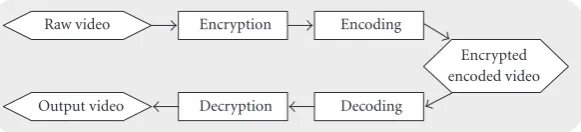
Figure2: Block diagram of an approach where encryption occurs before video encoding (compression).
algorithms proposed for both analog and digital image and video encryption.
In most modern symmetric-key cryptosystems, permu-tations are used for data diffusion. Systems such as AES or DES are essentially a substitution-permutation networks, or shortly S-P networks, where permutation transformations are employed in every round. In fact, most symmetric-key block ciphers rely on permutations of symbols (e.g., bits) in order to provide data diffusion [23]. In addition, there are cryptosystems based solely on transformations that use per-mutation groups. For instance, cryptosystem PGM (permu-tation group mapping) is based on logarithmic signatures of finite permutation groups [24].
Permutations are extensively used in analog video en-cryption. Techniques such as scan line shuffling [25] or pixel position shuffling [26–28] represent common approaches for analog video encryption. Similarly, in digital video encryp-tion domain, secret permutaencryp-tions are widely used to shuffle the positions of pixels [29], but also to shuffle DCT/wavelet coefficients [30,31], Huffman table codewords [3], and even blocks or macroblocks [32]. These algorithms are based solely on secret permutations that are generated by a secret key.
Video encryption algorithms based solely on secret per-mutations often receive harsh criticism. In [32] it is pointed out that these algorithms are inherently and necessarily inse-cure against several types of cryptanalysis, including known-plaintext, chosen-known-plaintext, and chosen-ciphertext attacks. The authors even discuss cryptanalytic techniques that are universally applicable to all permutation-only encryption al-gorithms. While the methods proposed in this work techni-cally belong to this category of algorithms, there is a cru-cial difference between the algorithms proposed here and
the previously proposed permutation-only encryption algo-rithms. In Section4it is discussed in detail why this diff er-ence makes the proposed algorithms robust against the vari-ous attacks presented in [32].
3. CORRELATION-PRESERVING VIDEO ENCRYPTION
Most encryption algorithms have a randomization effect on the source data, and as such, cannot be effectively applied before the compression stage. In this section we present a set of encryption algorithms for spatial-only video coding based on permutation transformations that have a correlation-preserving property. Using these algorithms, one can per-form encryption prior to video encoding, as illustrated in Figure2.
Initialization:Setato a copy ofw×hframeF,pto [0 1 2· · ·(w×h)−1] (the identity permutation with zero-based index),lto 0, andrto (w×h)−1.
Input:a,p,landr.
(1) Seti=l−1,j=r, andv=a[r] (2) Ifr≤lreturn from the algorithm (3) Start an infinite loop and do the following:
(a) Seti=i+ 1
(b) Whilea[i]< vdo the following: (i) Seti=i+ 1
(c) Setj=j−1
(d) Whilev < a[j] do the following: (i) Ifj=lbreak from this while loop (ii) Setj=j−1
(e) Ifi≥jbreak from the infinite loop (f) Exchangea[i] anda[j]
(g) Exchangep[i] andp[j] (4) Exchangea[i] anda[r] (5) Exchangep[i] andp[r]
(6) Recursively call this algorithm witha=a,p=p,l=landr=i−1 (7) Recursively call this algorithm witha=a,p=p,l=i+ 1 andr=r.
Algorithm1: Modified recursive quicksort algorithm for computing the unique sorting permutation of a given frame.
Input:Raw video sequence (or scene)F1,. . .,Fm.
(1) Alice first computes the permutationP1from frameF1.
(2) Alice calculatesE(F1) and transmits it throughChS.
(3) For each subsequent frameFi,i=2,. . .,m, Alice does the following:
(a) She computes the permutationPiand the framePi−1(Fi);
(b) Alice then applies the standard encoder to the framePi−1(Fi) and
transmits the encoded frameE(Pi−1(Fi)) to Bob throughChR.
Algorithm2: Basic encryption algorithm for lossless spatial-only video coding.
static-camera low motion sequences (e.g., video conferenc-ing or telephony) and spatial-only video codecs (e.g., motion JPEG) are used.
3.1. Global system settings
The system is assumed to have two channels of communica-tion (in physical or abstract sense).ChRdenotes a regular, nonsecure channel where all messages are plain and open for eavesdropping, whileChSdenotes a secure channel that can also be eavesdropped, however, the messages are encrypted using a secure communication protocol based on a conven-tional cryptosystem such as AES. In our model, a video con-sists of one or more scenes and each scene concon-sists of a se-quence of framesF1,F2,. . .,Fm. For a given frame, there are likely a large number of sorting permutations of it (see The-orem1). The system must fix a method by which aunique sorting permutation is always selected for a given image.
Al-gorithm1illustrates a method that we used for computing a unique sorting permutation for a given frame. This particu-lar method is based on a modification to a recursive quicksort algorithm, however, similar approach can be used with other sorting methods.
3.2. Basic algorithms
IfFis a frame of sizen=width ofF×height ofF, letP(F) be a frame obtained by permuting the elements ofF accord-ing to a permutationPfromSn. The inverse of permutation
P is denoted byP−1. For a given frameF
Input:Encoded first frameE(F1) and encrypted encoded subsequent frames
of a video sequence (or scene)E(P1(F2)),. . .,E(Pm−1(Fm)).
(1) Bob computesD(E(F1))=F1and obtains the permutationP1.
(2) For each successive received frameE(Pi−1(Fi)),i=2,. . .,m, Bob does
the following:
(a) ComputesD(E(Pi−1(Fi)))=Pi−1(Fi) and calculatesFi=
P−1
i−1(Pi−1(Fi)) wherePi−−11is the inverse permutation ofPi−1;
(b) Calculates the permutationPiofFi.
Algorithm3: Basic decryption algorithm for lossless spatial-only video coding.
Input:Raw video sequence (or scene)F1,. . .,Fm.
(1) Alice first computesE(F1) and thenF1=D(E(F1)) from which she
obtains the unique sorting permutationP1.
(2) Alice sendsE(F1) throughChSto Bob.
(3) She computesE(P1(F2)) and sends it throughChRto Bob.
(4) Next, she computesF2=D(E(P1(F2))) and thenF2 =(P1)−1(F2) from
which she calculates the unique sorting permutationP2.
(5) For each subsequent frameFi,i=3,. . .,m, Alice does the following:
(a) ComputesE(Pi−1(Fi)), and sends it to Bob throughChR;
(b) ComputesFi=D(E(Pi−1(Fi)));
(c) Applies (Pi−1)−1to getFi=(Pi−1)−1(Fi);
(d) Calculates the canonical sorting permutationPi.
Algorithm4: Basic encryption algorithm for lossy spatial-only video coding.
corresponds to the model from Figure2where encryption completely precedes video encoding. This is achieved by cre-ating “almost sorted” frames that are sent through open channelChR. In spatial-only lossless video encoding, adap-tive dictionary-based compression primiadap-tives are often used to exploit neighboring pixel correlation prior to applying en-tropy coding. In particular, this technique is employed in an-imated GIF and motion PNG coding. Sorted and “almost sorted” data is well suited to this type of compression. Com-pression with a pixel prediction model such as the one used in motion JLS (lossless JPEG) also relies on correlation of the currently encoded pixel and the pixels in the neighbor-hood area. In motion JLS, for instance, a current pixel is pre-dicted in raster order, from pixels directly on top, to the diag-onal and to the left of the current pixel. Sorted and “almost sorted” data are also suitable for this compression model.
Similar, but slightly different approach to video encryp-tion can be taken when dealing with lossy spatial-only video coding. However, to compensate for the loss of data and to prevent error propagation issues, “almost sorting” permuta-tions must be calculated on the compressed frames which re-sults in somewhat more involved encryption step. The algo-rithm (encryption and decryption) targeted for lossy video coding is depicted in Algorithms4and5, respectively. This algorithm requires a compression stage as a preprocessing to
the encryption, so technically it does not exactly correspond to Figure 2. When compression is seen as a preprocessing step, the algorithm should still be considered to be a pre-compression encryption approach, and as such, inherently possesses the nice properties such as codec-standard compli-ance and format complicompli-ance.
In lossy transform-based coding of digital images and video frames, typically a block of pixels undergoes the trans-formation such as DCT or wavelet. For instance, this is the case with motion JPEG (M-JPEG) coding. The given block of pixels represents a small subimage of the image or frame, thus containing a set of two-dimensional neighboring pix-els. In this setting sorted and “almost sorted” images and frames compress well. If the sorted and “almost sorted” data is grouped in to the blocks of the same size that is used in transform coding, the compression is further improved, as indicated by an example in Figure3.
Input:Encoded first frameE(F1), encrypted encoded second frameE(P1(F2))
and encrypted encoded subsequent frames of a video sequence (or scene) E(P2(F3)),. . .,E(Pm−1(Fm)).
(1) Bob calculatesD(E(F1))=F1≈F1and sorting permutationP1.
(2) FromE(P1(F2)) he computesF2=D(E(P1(F2))).
(3) Bob approximatesF2≈F2=(P1)−1(F2).
(4) He then recovers the unique sorting permutationP2ofF2.
(5) For each received frameE(Pi−1(Fi)),i=3,. . .,m, Bob:
(a) DecodesE(Pi−1(Fi)) intoFi=D(E(Pi−1(Fi)));
(b) ApproximatesFi≈Fi=(Pi−1)−1(Fi);
(c) Ifi < mhe calculates a sorting permutationPiofFi.
Algorithm5: Basic decryption algorithm for lossy spatial-only video coding.
(a) (b) (c)
Figure3: Improving compressibility by adhering to block size used in transform-based coding: (a) 256×256 greyscale imageLena[JPEG
=6.95 KB], (b) sorted imageLenain raster order [JPEG=1.81 KB], and (c) imageLenafully sorted and arranged according to 8×8 blocks conforming to the encoder’s transform coding block size [JPEG=1.09 KB]. The compression quality parameter of JPEG encoder was set to 50 (where 0 is the best quality and 100 the worst).
The basic algorithms proposed in this section can be ex-tended to accommodate for additional application require-ments. For instance, these algorithms do not offer perceptual quality control, cannot handle global camera motion such as translation, and do not support VCR-like functionality. Next, we introduce several extensions to the basic algorithms in or-der to support these additional application requirements.
3.3. Extensions to basic algorithms
The following extensions to the basic algorithms from Algo-rithms2,3,4, and5are established in order to broaden their applicability.
(i) Block-based extension for perceptual quality control.
(ii) Extension for handling global camera translational motion.
(iii) Extension for hiding the histogram.
(iv) Extension for enabling VCR-like functionality and bet-ter error resilience.
3.3.1. Block-based approach
The proposed algorithm can be applied on individual blocks within a frame the same way it is applied on the entire frame. By doing so, two different features are achieved: (1) the algo-rithm is more robust to high motion within a frame as long as the motion is limited to small number of blocks, and (2) by controlling the block size one can also control the degree of perception in the sense that the video becomes degraded (blocky) but perceivable for smaller blocksizes. This algorith-mic mode is illustrated in Figures6(g),6(h), and6(i).
3.3.2. Extensions for handling global camera motion
Fixed content (a) Fixed content New area x x (b) Fixed content New area y y (c) Fixed content New area y
y x
x
(d)
Figure4: Translational camera motion.
Assuming that the camera moves in a simple transla-tional motion, as illustrated in Figure4, wherexandy rep-resent the amount of pixels that camera moved withinx-axis andy-axis, respectively, the sorting permutation can be read-justed to almost sort the current frame provided that the val-ues ofxandyare given.
Suppose a scene in which no movement occurred is cap-tured with a camera that solely moved horizontally onx-axis a distance that translates to exactlyxpixels and vertically on
y-axis a distance that translates to exactlyypixels. Note that the value ofxis positive if the camera moves to the right, and negative if it moves to the left, while value of yis positive if the camera moves down, and negative if it moves up. The al-gorithm presented in Alal-gorithm6is used for readjusting the sorting permutation of frameFi, represented with zero-based index and denoted byPi, intoPito make it more suitable “al-most sorting” permutation of the next frameFi+1.
3.4. Histogram-hiding extension
Histogram information in the basic model is known when the “almost sorted” frames are sent through the regular chan-nel. Thus, from a security point of view, it is a good idea to hide the histogram from the adversary. Since the original his-togram is actually secret, it is possible to hide the rest of the video histograms by subtracting the sorted image (the his-togram) of the previous frame from the currently “almost sorted” frame, which introduces some computational over-head in order to compute the differences. This extension can be combined with a block-based extension to either pro-vide some limited perceptual encryption and to restrict the motion-related permutation noise to the block where motion occurred, as illustrated in Figures6(k)and6(l). This trans-formation is equivalent to applying a secret permutation (or secret permutations in the case of block-based approach with histogram-hiding extension) on the ordinary frame diff er-ences, where a given permutation changes significantly from frame to frame.
Given twow×hvideo framesIandJ, theframe difference betweenIandJ, denoted byΔ(I,J), is defined as follows:
Δ(I,J)[x,y]=clip
I[x,y]−J[x,y] +
x
peak
2
,
1≤x≤w, 1≤y≤h, (2)
where I[x,y] denotes the pixel value of I at coordinates (x,y),xpeakis the maximum pixel value (e.g., 2n−1 forn
-bit-per-pixel frames), and clip(·) is the following function:
clip(x)=
⎧ ⎪ ⎪ ⎨ ⎪ ⎪ ⎩
xpeak, x > xpeak;
0, x <0;
x, 0≤x≤xpeak.
(3)
One should note the following property regarding frame differencing and permutations. For two givenw×hframesI
andJand a permutationP∈Sw×h, the following holds:
ΔP(I),P(J)=PΔ(I,J). (4)
In the proposed extension, it is more efficient from the computational point of view to perform the transformation
Pi(Δ(Fi,Fi+1)) than the transformationΔ(Pi(Fi),Pi(Fi+1)).
In the histogram-hiding extension, the spatial correlation is likely improved over the base approach (see Section 5). When additional computation is allowed, this extension usu-ally reduces bitrate. A sole frame differencing technique can be used to achieve a limited form of perceptual encryption provided that the initial frame is kept secret, however, it is not an effective perceptual encryption mechanism since dif-ference frames carry too much visible information about the content and additional encryption transformation is neces-sary to provide confidentiality. When combined with block-based extension, histogram-hiding approach achieves per-ceptual encryption with a considerably limited quality con-trol. Thus, the recommended use of this extension is with the basic algorithms where entire frames are permuted.
3.5. Extension for enabling VCR-like functionality and improved error resilience
Input:Sorting permutationPiofw×hframeFi, and a global horizontal and
vertical camera translational motion from frameFito frameFi+1, denoted by xandy, respectively.
(1) Setc=0 andd=w×h
(2) For 0≤k < w×hdo the following: (a) Seti=x+Pi[k] modw
(b) Setj=y+Pi[k]/w
(c) Ifj < h,j≥0,i < wandi≥0 then setPi[c]=j×w+iand
incrementcby 1
(d) Otherwise, setPi[d]=(jmodh)×w+ (imodw) and decrease
dby 1.
Algorithm6: Permutation readjustment algorithm to handle global translational motion.
(a) (b) (c) (d)
Figure5: Readjustment of the sorting permutation: (a) previous frame, (b) current frame with global motionx =6,y= −4, (c) frame
sorted with a sorting permutation of the previous frame, and (d) frame sorted with a readjusted sorting permutation of the previous frame.
4. SECURITY ANALYSIS
This section serves to analyze security aspects of the proposed methods. The security strengths and weaknesses are pointed out.
Brute-force attack
Brute-force attack is based on exhaustive key search, and is feasible only for the cryptosystems with relatively small key space. In our case, the brute-force attack consists of two possible venues: one could either attack the underly-ing conventional cryptosystem used for encryption in chan-nel ChS, or the proposed permutation-based method used in channel ChR. For that reason, it is recommended to use a strong conventional symmetric-key cryptosystem such as AES with 128-bit or stronger keys. The size of the key space related to our permutation-based method is equiva-lent to the following: given a color histogram of a w×h
image F, how many different images can be formed out of the histogram color values? Note that F is just one of these images.
Letsf1 1,. . .,s
fk
k be the histogram of frame F. In [18] it was shown that the number of different images that can be formed by permuting F is equal to the size of the Sw×h -orbit ofF, denoted bySw×h(F), under the group action of
Sw×h on the set of all possible images of dimensionw×h. Since
Sw×h(F)= (wh)!
k
i=1fi!
, (5)
there are exactly (wh)!/ki=1fi! different images with the same color histogramsf1
1,. . .,s
fk
k . These distinct images de-termine the effective key space of our method. If one uses an n-bit conventional cryptosystem to encrypt key frames in channel ChS, the actual key space of the proposed method is
min
2n,(whk )! i=1 fi!
. (6)
The size of the key space depends on the color histogram of the encrypted frame. As one can see, this number is ex-tremely large when considering any meaningful images of reasonable dimensions, and it is usually much larger than brute-forcing 2nkeys of the used conventional symmetric-key cryptosystem.
(a) (b) (c)
(d) (e) (f)
(g) (h) (i)
(j) (k) (l)
Figure6: 150th frame of the following sequences: (a) original Akiyo, (b) sequence obtained by encrypting Akiyo with the basic encryption
algorithm for lossless coding and decoding it without decryption, (c) sequence obtained by properly decrypting an encrypted Akiyo with lossless coding, (d) sequence obtained by encrypting Akiyo with the basic encryption algorithm for lossy MJPEG coding (with quality 90) and decoding it without decryption, (e) sequence decoded from a regular, not encrypted encoded Akiyo (compressed size 16 KB, PSNR 45.198 dB), (f) sequence obtained by properly decrypting an encrypted Akiyo using the proposed basic algorithm with M-JPEG coding (compressed size 12 KB, PSNR 41.737 dB), (g) (h) (i) sequence obtained by encrypting Akiyo with the block-based approach (blocksizes 32×32, 16×16, and 8×8, resp.) for lossless coding and decoding it without decryption, and (j) (k) (l) sequence obtained by encrypting Akiyo with the histogram-hiding approach combined with the basic encryption algorithm and the block-based approach (blocksizes 32×32 and 8×8, resp.) for lossless coding and decoding it without decryption.
Table1: Sequences used in the experiments.
Sequence No. of frames Format Bits/pixel
Hall monitor 250 CIF 8
Akiyo 250 CIF 8
Mother daughter 250 CIF 8
Grandma 100 QCIF 8
Claire 100 QCIF 8
Table2: Compression performance of the proposed encryption algorithms with lossless spatial-only video coding.
Animated GIF
Algorithm Hall monitor Akiyo Mother Grandma Claire Miss Am
Basic 0.746 0.433 0.745 0.685 0.776 0.867
blk32 0.959 0.597 0.955 — — —
blk16 0.976 0.655 0.968 0.845 0.908 0.981
blk8 0.980 0.745 0.975 0.877 0.941 0.990
Basic+hh 0.633 0.254 0.634 0.438 0.475 0.683
blk32+hh 0.657 0.264 0.654 — — —
blk16+hh 0.657 0.262 0.652 0.444 0.487 0.686
blk8+hh 0.658 0.259 0.650 0.445 0.487 0.688
Motion PNG
Algorithm Hall monitor Akiyo Mother Grandma Claire Miss Am
Basic 0.813 0.421 0.789 0.695 0.765 0.891
blk32 0.993 0.555 0.969 — — —
blk16 1.007 0.631 0.982 0.869 0.941 0.995
blk8 1.011 0.738 0.993 0.915 0.990 1.011
Basic+hh 0.699 0.302 0.709 0.510 0.571 0.729
blk32+hh 0.713 0.314 0.713 — — —
blk16+hh 0.715 0.310 0.710 0.517 0.587 0.740
blk8+hh 0.716 0.307 0.708 0.518 0.583 0.743
Motion JLS
Algorithm Hall monitor Akiyo Mother Grandma Claire Miss Am
Basic 1.113 0.693 1.135 0.757 0.954 1.131
blk32 1.120 0.691 1.122 — — —
blk16 1.128 0.750 1.132 0.818 1.037 1.142
blk8 1.150 0.854 1.147 0.882 1.135 1.163
Basic+hh 1.053 0.441 1.085 0.662 0.789 1.069
blk32+hh 1.049 0.445 1.056 — — —
blk16+hh 1.048 0.440 1.047 0.660 0.794 1.064
blk8+hh 1.046 0.433 1.035 0.664 0.797 1.064
b×cblock inFhas the color histogramsfi1
i1,. . .,s
fik
ik. Then, the size of the key space is
min
2n, wh/bc
j=1
(bc)!
k
i=1fji!
, (7)
which is for reasonable blocksizes, such as 8×8 or larger, still computationally infeasible.
Known/chosen-plaintext and chosen-ciphertext attacks
Permutation-only video encryption is considered weak against known/plain-text attack, and a chosen-ciphertext attack [32]. However, all of the previously pro-posed methods rely on generating the secret permutation using a secret key. Under this scenario, all of the aforemen-tioned attacks are trying to recover the secret key (or a part of it) that was used for the current or future encryptions. Our algorithms do not rely on such a principle, and there is no secret key upon which a permutation is generated. The
proposed approaches rely on the sorting permutation of pre-vious frame, and thus, a key is directly dependant of the plaintext. Under a chosen-plaintext attack, the adversary can compute the sorting permutation for the chosen frame, but this gives no information about the sorting permutations for the unknown frames. Under a chosen-ciphertext attack, the adversary can recover the unsorting permutation for the cho-sen encrypted frame, but this gives no information regarding other unknown ciphertexts.
Known weaknesses and consequential applicability limitations
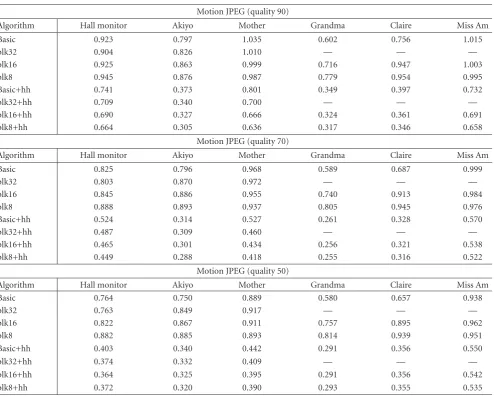
Table3: Compression performance of the proposed encryption algorithms with lossy spatial-only video coding.
Motion JPEG (quality 90)
Algorithm Hall monitor Akiyo Mother Grandma Claire Miss Am
Basic 0.923 0.797 1.035 0.602 0.756 1.015
blk32 0.904 0.826 1.010 — — —
blk16 0.925 0.863 0.999 0.716 0.947 1.003
blk8 0.945 0.876 0.987 0.779 0.954 0.995
Basic+hh 0.741 0.373 0.801 0.349 0.397 0.732
blk32+hh 0.709 0.340 0.700 — — —
blk16+hh 0.690 0.327 0.666 0.324 0.361 0.691
blk8+hh 0.664 0.305 0.636 0.317 0.346 0.658
Motion JPEG (quality 70)
Algorithm Hall monitor Akiyo Mother Grandma Claire Miss Am
Basic 0.825 0.796 0.968 0.589 0.687 0.999
blk32 0.803 0.870 0.972 — — —
blk16 0.845 0.886 0.955 0.740 0.913 0.984
blk8 0.888 0.893 0.937 0.805 0.945 0.976
Basic+hh 0.524 0.314 0.527 0.261 0.328 0.570
blk32+hh 0.487 0.309 0.460 — — —
blk16+hh 0.465 0.301 0.434 0.256 0.321 0.538
blk8+hh 0.449 0.288 0.418 0.255 0.316 0.522
Motion JPEG (quality 50)
Algorithm Hall monitor Akiyo Mother Grandma Claire Miss Am
Basic 0.764 0.750 0.889 0.580 0.657 0.938
blk32 0.763 0.849 0.917 — — —
blk16 0.822 0.867 0.911 0.757 0.895 0.962
blk8 0.882 0.885 0.893 0.814 0.939 0.951
Basic+hh 0.403 0.340 0.442 0.291 0.356 0.550
blk32+hh 0.374 0.332 0.409 — — —
blk16+hh 0.364 0.325 0.395 0.291 0.356 0.542
blk8+hh 0.372 0.320 0.390 0.293 0.355 0.535
possible videos to be encrypted, he or she may be able to rec-ognize which video sequence is being transmitted from Alice to Bob by observing the publicly given pixel value histograms of frames. Another related problem is the adversary’s ability to analyze the properties of a given histogram for rough clues about the content. Namely, cartoon pictures and real photos have different histograms, and photos of human faces usu-ally have narrower histograms than photos of natural scenes [10]. Finally, since the encrypted frames look less smooth when a fast motion occurs within a scene, it is possible to gain a limited knowledge about the scene dynamics by ob-serving the “almost sorted” frames. Although limited, these attacks are unavoidable in the proposed methodology and our video encryption algorithms should not be used in ap-plications where these attacks are of interest to an adversary. Histogram-hiding extension of the proposed algorithms is much more robust against the second type of the known histogram attack since the adversary does not have the ac-tual color histograms of the frames needed to analyze the properties of a given histogram for rough clues about the content. Source recognition attack still holds since the
adver-sary have the access to the distribution of frame differences in the encrypted video, a statistics that can reveal the previously known video.
Even though some weaknesses have been identified, the proposed video encryption algorithms are applicable to a majority of real-word video security scenarios.
5. EXPERIMENTAL RESULTS
To evaluate the performance of our method in terms of com-pression, experiments are performed on six benchmark se-quences in CIF (352×288) and QCIF (176×144) formats. Table1shows the technical summary of the used sequences. The following is a legend of acronyms used in Tables2,3, and
4:
(i) basic—basic algorithm operating on entire frames; (ii) blk32—block-based extension operating on 32×32
blocks;
Table4: Resulting PSNR (in dB) with lossy spatial-only video coding.
Motion JPEG (quality 90)
Algorithm Hall monitor Akiyo Mother Grandma Claire Miss am
None 43.03 45.10 45.05 40.62 44.74 45.18
basic 38.76 41.50 39.61 41.14 41.81 41.14
blk32 39.03 43.04 40.64 — — —
blk16 39.94 43.17 40.93 41.66 43.16 42.10
blk8 40.23 43.25 41.22 41.40 43.16 42.37
Basic+hh 39.98 46.15 41.35 45.05 46.12 43.47
blk32+hh 40.37 46.66 42.13 — — —
blk16+hh 40.57 47.00 42.47 45.44 46.80 43.96
blk8+hh 40.85 47.52 42.82 45.63 47.18 44.32
Motion JPEG (quality 70)
Algorithm Hall monitor Akiyo Mother Grandma Claire Miss am
None 37.97 40.23 40.73 36.11 39.46 41.10
basic 33.38 36.04 34.27 35.98 36.23 35.61
blk32 34.90 37.42 35.42 — — —
blk16 35.42 37.70 35.88 36.34 37.26 36.70
blk8 35.72 38.03 36.39 36.19 37.35 37.18
Basic+hh 36.09 42.91 38.36 43.47 43.53 40.67
blk32+hh 36.74 43.19 38.90 — — —
blk16+hh 37.13 43.56 39.27 43.72 44.11 41.03
blk8+hh 37.64 44.15 39.79 43.90 44.49 41.49
Motion JPEG (quality 50)
Algorithm Hall monitor Akiyo Mother Grandma Claire Miss am
None 35.80 38.04 38.71 34.46 37.13 39.32
basic 31.27 33.84 32.33 33.72 34.01 33.49
blk32 32.76 35.03 33.47 — — —
blk16 33.25 35.43 33.98 34.05 34.83 34.55
blk8 33.63 35.81 34.61 33.99 35.04 35.10
Basic+hh 34.95 41.02 37.51 42.35 42.09 39.78
blk32+hh 35.42 41.14 37.88 — — —
blk16+hh 35.82 41.39 38.21 42.51 42.49 39.93
blk8+hh 36.43 41.82 38.73 42.65 42.78 40.32
(iv) blk8—block-based extension operating on 8 × 8 blocks;
(v) basic+hh—basic algorithm with histogram-hiding ex-tension operating on entire frames;
(vi) blk32+hh—block-based extension operating on 32× 32 blocks with histogram-hiding extension;
(vii) blk16+hh—block-based extension operating on 16× 16 blocks with histogram-hiding extension;
(viii) blk8+hh—block-based extension operating on 8×8 blocks with histogram-hiding extension;
(ix) none—encoding without encryption.
Each sequence from Table1was encrypted with the pro-posed video encryption algorithms and encoded with both lossless and lossy spatial-only video coding. The encrypted sequences are evaluated in terms of compression perfor-mance, and in case of lossy coding, also in terms of re-sulting PSNR. The goal was to measure how the proposed
correlation-preserving algorithms affect compressibility. Ta-bles2and3show the ratio of encrypted encoded bitsize and the unencrypted encoded bitsize.
Finally, Table4shows the resulting PSNR for the lossy coding case. There is often a modest loss of quality due to slight salt-and-pepper noise that is added to the recon-structed (decrypted) video due to quantization, as depicted in Figures6(e)and6(f).
6. CONCLUSIONS AND FUTURE WORK
in-stances even improve the spatial correlation of the source data since “almost sorted” frames on average have a better spatial sample-to-sample correlation than the actual frames. Therefore, spatial-only video codecs can be enhanced with an encryption-equipped preprocessor and a decryption-equipped postprocessor that can result in similar or im-proved compression performance but in the same time pro-viding a significant level of computationally provable se-curity. In effect, the algorithms produce fully application-friendly output and require no modification to the codec modules. Both security and performance analysis of the proposed methodology show that the algorithms are com-putationally efficient and resistant to typical cryptanalytic attacks.
There are several obvious applications in practice for which the proposed algorithms are suitable. Industrial and business-related video telephony and videoconferencing of-ten requires confidentiality. The types of videos and price of spatial-only codecs, such as M-JPEG, clearly suit the require-ments of the proposed encryption approaches. Surveillance video monitoring is also a suitable application. In this appli-cation it is important not to use motion-based coding since motion coding tends to reduce the spatial resolution, but more importantly, interpolated video is inadmissible as ev-idence in many legal jurisdictions. Due to recent terrorist at-tacks on western countries such as United States and United Kingdom, airplane cockpits and other public transportation places are monitored by their governments. Here, M-JPEG is currently the preferred method as it allows each picture to be wholly compressed into a data file, whereas MPEG de-rives frames from a sequence, storing mainly the differences and use interpolated frames which really do not stand up in court [33]. Digital multimedia captured for medical pur-poses is likely to be encoded with lossless video coding and without any kind of interpolation since the highest precision is necessary for correct diagnosis, and many medical multi-media videos are indeed represented by a single scene with low-motion.
Future directions should include an investigation of ex-tending or modifying the proposed principle to achieve ef-ficiency in exploiting temporal correlation as well, in order to achieve applicability to more advanced video codecs such as H.26x and MPEG family. The proposed algorithms could be combined with an object segmentation approach to im-prove their robustness against movement of objects within the scene, for instance, by using the sorting permutations of each object from the previous frame (including back-ground). Another possibility for future research include the extension to spatial selectivity (e.g., to achieve anonymity) where only objects of interest (such as human face, etc.) are encrypted, while other objects are kept unencrypted.
REFERENCES
[1] J. Meyer and F. Gadegast, “Security mechanisms for multime-dia data with the example MPEG-1 video,” Project Description of SECMPEG, Technical University of Berlin, 1995.
[2] G. Spanos and T. Maples, “Performance study of a selective encryption scheme for the security of networked, real-time video,” inProceedings of the 4th International Conference on Computer Communications and Networks (ICCCN ’95), pp. 2– 10, IEEE Press, Las Vegas, Nev, USA, September 1995. [3] B. Bhargava, C. Shi, and S.-Y. Wang, “MPEG video encryption
algorithms,”Multimedia Tools and Applications, vol. 24, no. 1, pp. 57–79, 2004.
[4] S. Li, G. Chen, A. Cheung, B. Bhargava, and K.-T. Lo, “On the design of perceptual MPEG-Video encryption algorithms,” IEEE Transactions on Circuits and Systems for Video Technology, vol. 17, no. 2, pp. 214–223, 2005.
[5] I. Agi and L. Gong, “An empirical study of secure MPEG video transmissions,” inProceedings of the Symposium on Net-work and Distributed System Security (SNDSS ’96), pp. 137– 144, IEEE Computer Society, San Diego, Calif, USA, February 1996.
[6] C.-P. Wu and C.-C. J. Kuo, “Fast encryption methods for au-diovisual data confidentiality,” inMultimedia Systems and Ap-plications III, vol. 4209 ofProceedings of SPIE, pp. 284–295, Boston, Mass, USA, November 2000.
[7] J. Wen, M. Severa, W. Zeng, M. Luttrell, and W. Jin, “A format-compliant configurable encryption framework for access con-trol of multimedia,” inProceedings of the 4th IEEE Workshop on Multimedia Signal Processing (MMSP ’01), pp. 435–440, Cannes, France, October 2001.
[8] T. Lookabaugh, D. C. Sicker, D. M. Keaton, W. Y. Guo, and I. Vedula, “Security analysis of selectively encrypted MPEG-2 streams,” inMultimedia Systems and Applications VI, vol. 5241 ofProceedings of SPIE, pp. 10–21, Orlando, Fla, USA, Septem-ber 2003.
[9] S. Li, X. Zheng, X. Mou, and Y. Cai, “Chaotic encryption scheme for real-time digital video,” inReal-Time Imaging VI, vol. 4666 ofProceedings of SPIE, pp. 149–160, San Jose, Calif, USA, January 2002.
[10] S. Li, G. Chen, and X. Zheng, “Chaos-based encryption for digital images and videos,” inMultimedia Security Handbook, vol. 4 ofInternet and Communications Series, pp. 133–167, CRC Press, Boca Raton, Fla, USA, 2004.
[11] B. Furht, E. Muharemagic, and D. Socek,Multimedia Encryp-tion and Watermarking, vol. 28 ofMultimedia Systems and Ap-plications, Springer, Berlin, Germany, 2005.
[12] D. Guo, L. M. Cheng, and L. L. Cheng, “A new symmetric probabilistic encryption scheme based on chaotic attractors of neural networks,”Applied Intelligence, vol. 10, no. 1, pp. 71–84, 1999.
[13] D. Socek and D. ´Culibrk, “On the security of a clipped hopfield neural network-based cryptosystem,” inProceedings of the 7th ACM Workshop on Multimedia and Security (MM-Sec ’05), pp. 71–76, New York, NY, USA, August 2005.
[14] X. Yi, C. H. Tan, C. K. Siew, and M. R. Syed, “Fast encryption for multimedia,”IEEE Transactions on Consumer Electronics, vol. 47, no. 1, pp. 101–107, 2001.
[15] A. M. Youssef and S. E. Tavares, “Comments on the security of fast encryption algorithm for multimedia (FEA-M),”IEEE Transactions on Consumer Electronics, vol. 49, no. 1, pp. 168– 170, 2003.
[16] M. J. Mihaljevi´c, “On vulnerabilities and improvements of fast encryption algorithm for multimedia FEA-M,”IEEE Transac-tions on Consumer Electronics, vol. 49, no. 4, pp. 1199–1207, 2003.
[18] D. Socek, H. Kalva, S. Magliveras, O. Marques, D. ´Culibrk, and B. Furht, “A permutation-based correlation-preserving encryption method for digital videos,” inProceedings of the 3rd International Conference on Image Analysis and Recognition (ICIAR ’06), vol. 4141 ofLecture Notes in Computer Science, pp. 547–558, Springer, P ´ovoa de Varzim, Portugal, September 2006.
[19] M. Burrows and D. J. Wheeler, “A block-sorting lossless data compression algorithm,” Research Report 124, Digital Systems Research Center, Palo Alto, Calif, USA, 1994.
[20] S. Deorowicz, “Improvements to Burrows-Wheeler compres-sion algorithm,” Software-Practice and Experience, vol. 30, no. 13, pp. 1465–1483, 2000.
[21] Z. Arnavut and H. Otu, “Lossless compression of color-mapped images with Burrows-Wheeler transformation,” in Proceedings of the IASTED Signal Processing Conference, pp. 185–189, Acta-Press, Rhodes, Greece, July 2001.
[22] Z. Arnavut and S. Magliveras, “Lexical permutation sorting al-gorithm,”The Computer Journal, vol. 40, no. 5, pp. 292–295, 1997.
[23] A. J. Menezes, P. C. van Oorschot, and S. A. Vanstone, Hand-book of Applied Cryptography, CRC Press, Boca Raton, Fla, USA, 1996.
[24] S. Magliveras, “A cryptosystem from logarithmic signatures of finite groups,” inProceedings of the 29th Midwest Symposium on Circuits and Systems, pp. 972–975, Elsevier, Lincoln, Neb, USA, August 1986.
[25] L. Brown, “Technical options for implementing pay-TV in Australia,” Australian Telecommunication Research Journal, vol. 24, no. 2, pp. 1–8, 1990.
[26] A. D. Wyner, “An analog scrambling scheme which does not expand bandwidth—part I: discrete time,”IEEE Transactions on Information Theory, vol. 25, no. 3, pp. 261–274, 1979. [27] A. D. Wyner, “An analog scrambling scheme which does not
expand bandwidth—part II: continuous time,”IEEE Transac-tions on Information Theory, vol. 25, no. 4, pp. 415–425, 1979. [28] Y. Matias and A. Shamir, “A video scrambling technique based on space filling curves,” inProceedings of the Conference on the Theory and Applications of Cryptographic Techniques on Ad-vances in Cryptology (CRYPTO ’87), vol. 293 ofLecture Notes in Computer Science, pp. 398–417, Springer, Santa Barbara, Calif, USA, August 1987.
[29] J.-C. Yen and J.-I. Guo, “Efficient hierarchical chaotic image encryption algorithm and its VLSI realisation,”IEE Proceed-ings: Vision, Image and Signal Processing, vol. 147, no. 2, pp. 167–175, 2000.
[30] L. Tang, “Methods for encrypting and decrypting MPEG video data efficiently,” inProceedings of the 4th ACM International Multimedia Conference, pp. 219–229, ACM Press, Boston, Mass, USA, November 1996.
[31] A. Uhl and A. Pommer, Image and Video Encryption: From Digital Rights Management to Secured Personal Communica-tion, vol. 15 of Advances in Information Security, Springer, Berlin, Germany, 2005.
[32] S. Li, C. Li, G. Chen, N. G. Bourbakis, and K.-T. Lo, “A gen-eral cryptanalysis of permutation-only multimedia encryp-tion algorithms,” IACR’s Cryptology ePrint Archive: Report 2004/374, 2004.