© Schweizerische Zeitschrift für Volkswirtschaft und Statistik 2007, Vol. 143 (3) 283–329 * Currently honorary professor at the University of Bern and private consultant, director and
head of the economic division of the Swiss National Bank until 2001. I wrote this paper in August and September 2002 as a visiting expert at the European Central Bank. I would like to thank the ECB for affording me the opportunity to do research on Swiss monetary policy. In particular, I am indebted to Vítor Gaspar, former director general of research at the ECB. I would never have embarked on this project without his encouragement and support. I am also grateful to Jean-Pierre Roth, Michel Peytrignet, Peter Stalder and Markus Zimmerli for their help with this paper. The analysis of this paper reflects my own views, which need not accord with those of the SNB. Address: Parkweg 7, CH-5000 Aarau, Switzerland. Telephone: +41 62 822 2945. Fax: +41 62 823 3916. Email: [email protected].
The Role of Internal Policy Analysis
Georg Rich*
JEL-Classification: E31, E32, E41, E52, E58
Keywords: Monetary policy, monetary targets, policy rules, price stability
1. Introduction
1 See, for example, the address by President Stopper to the 1971 annual meeting of the SNB. 2 SNB (1982, pp. 230–235) contains a good description of these measures.
3 Address by President Stopper to the 1973 annual meeting of the SNB.
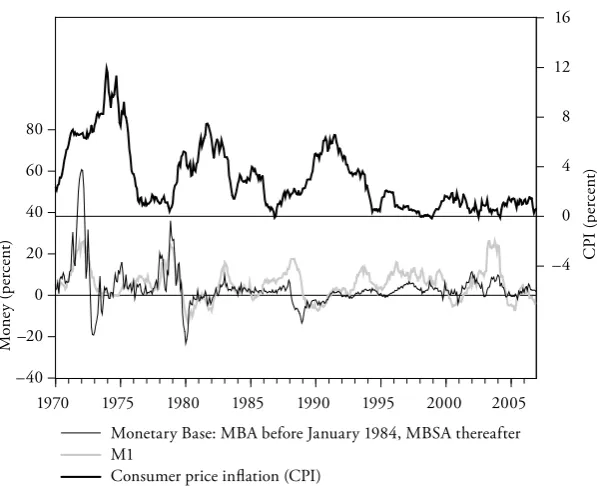
In 1971 the inflows of speculative capital assumed alarming proportions. Within a few months, the monetary base increased by over 50 percent (Fig. 1). The SNB was clearly aware of the inflationary dangers emanating from this Latin American type of explosion in the money supply. As a staunch supporter of the gold standard, it had always warned against the potential inflationary conse-quences of detaching domestic money creation from the scarce world supply of gold.1 In an effort to reduce or contain the monetary overhang, Swiss monetary authorities accepted two revaluations of the Swiss franc in 1971, the second in the context of the Smithsonian realignment of exchange rates. Moreover, they imposed restrictions on inflows of foreign capital and introduced various devices designed to sterilise part of the increase in the monetary base.2 However, these measures only provided a temporary respite from the speculative activity on the foreign exchange markets. When a new disruptive speculative attack loomed in January 1973, Swiss monetary authorities, reluctantly, decided to float the Swiss franc on the foreign exchange market.3
Thanks to the switch to a floating exchange rate, the SNB, in principle, gained full control of the money supply. It employed its new powers to fight inflation, which had already crept up to about 7 percent early in 1973. To this end, the SNB ceased intervening on the foreign exchange market and kept the monetary base more or less stable until the summer of 1974 (Schiltknecht, 1977, pp. 13–16). However, inflation, measured in terms of the CPI, continued to rise, peaking at over 10 percent in 1974 (Fig. 1). The Swiss public regarded inflation in excess of 10 percent as a major catastrophe, as the rate of increase in the CPI had not normally reached such high levels, except during the two world wars. Of course, keeping the monetary base stable while inflation was running at over 10 percent implied an extremely restrictive monetary policy. The SNB knew that it could not maintain such a tight stance for long without inflicting undue hardship on the economy. In the summer of 1974, it began to increase the monetary base again. Moreover, it searched for a monetary policy approach that would guaran-tee price stability in the longer run and simultaneously allow the Swiss economy to exploit its growth potential.
6 percent. From the growth target for M1, it derived and announced an analo-gous subsidiary target for the monetary base, which also amounted to 6 percent. It continued to fix annual growth targets for M1 until the end of 1977, but it soon ceased to publish the subsidiary targets for the monetary base. After a brief interlude of targeting the exchange rate in 1978/79, the SNB altered its monetary targeting approach at the end of 1979. It decided to bypass the aggregate M1 and to announce annual growth targets directly for the monetary base. Although the monetary base remained the SNB’s target variable until 1999, it modified its tar-geting approach again at the end of 1990. In lieu of announcing annual growth targets for the monetary base, the SNB introduced a medium-term targeting strategy. It began to publish five-year target paths for the monetary base. Since
Figure 1: Growth in the Monetary Base and M1 and CPI Inflation (Monthly year-on-year rates of change)
1970 1975 1980 1985 1990 1995 2000 2005
80 60 40 20 0 –20 –40
16
12
8
4
0
–4
Mone
y (p
er
ce
n
t)
Monetary Base: MBA before January 1984, MBSA thereafter M1
Consumer price inflation (CPI)
C
P
I (p
er
ce
n
t)
Source for all the figures: SNB, Monthly Statistical Bulletin, Historical Time Series, and internal data.
the medium-term strategy ran up against a number of difficulties, the SNB at the end of 1999 decided to abandon monetary targeting altogether and to switch to a policy approach based on inflation forecasts.
Due to the adoption of monetary targeting, the SNB was able to reduce tion quickly. In the course of 1976, it managed to restore price stability as infla-tion fell to about 1 percent. However, while the SNB was able to keep the trend increase in the CPI at low levels, it was less successful in avoiding a temporary resurgence of inflation in 1980/81 and in 1989/90 (Fig. 1). For these reasons, until the early 1990s, the SNB’s inflation performance, though good by comparison with most other central banks, was not spectacular by any means, as the annual increase of the CPI averaged 3.4 percent from 1977 to 1993. Since the beginning of 1994, the Swiss inflation record has become much better, with the average rate of increase in the CPI declining to as little as 0.9 percent per year.
The SNB’s approach to monetary targeting has been analysed extensively (especially, SNB, 1982; Schiltknecht, 1983; Baltensperger, 1984, 2007; Genberg and Kohli, 1997; Rich, 1997, 2000, 2002; Laubach and Posen, 1997; Bernanke et al., 1999; Kugler and Rich, 2002; Bernholz, 2007; Peytri gnet, 2007). These studies examine the choice of monetary aggregates, as well as the reasons for switching to a medium-term targeting strategy and for abandoning monetary targeting. They also assess critically the SNB’s record in achieving and maintaining price stability, and in communicating its policies to the public. Although they discuss the advantages and disadvantages of the various target-ing approaches followed by the SNB, they only throw limited light on a crucial aspect of monetary targeting. They fail to provide a comprehensive analysis of the role played by the monetary aggregates in setting monetary policy and in communicating the SNB’s policy decisions to the public.
The purpose of this study is to fill the gap in existing research. To identify the role played by the monetary aggregates, I examine critically the SNB’s internal policy analysis. Moreover, I review the SNB’s efforts in communicating its policy decisions to the public. In particular, I illustrate the difficulties of disseminating the essence of complex internal economic analysis.
4 Normally, the SNB will open its internal records only after 30 years.
5 The SNB published the annual policy statements in German and French, from 1989 onwards also in English and Italian. If English translations of the SNB’s publications are unavailable, I cite the German version. MB is now called Monthly Statistical Bulletin.
6 QB is now called Quarterly Bulletin (available in English since September 2002).
7 The SNB is structured as a public corporation listed on the Zurich stock exchange, but gov-erned by a special law providing only limited powers to shareholders. In particular, the federal government appoints the top officials of the SNB, notably the three members of the Govern-ing Board, the SNB’s policy makGovern-ing body.
Switzerland is concerned, there are both similarities and differences between the monetary targeting strategies followed until 1999 and the current approach based on inflation forecasts. I will return to this issue at the end of my paper.
I do not regard my study as a rigorous historical analysis of Swiss monetary tar-geting. Such an analysis will not be feasible so long as the SNB’s internal records remain closed to the public.4 Therefore, the following analysis is based on my recollections as a SNB researcher from 1977 to 1985 and the SNB’s chief econo-mist from 1985 to 2001, and on numerous discussions with Kurt Schiltknecht, who not only served as chief economist until 1985 but was also instrumental in introducing monetary targeting to Switzerland. In addition, I rely on a variety of documents published by the SNB in order to communicate and justify its policy decisions to the public. Three categories of publications are particularly relevant:
– Annual policy statement of the SNB: This statement was normally presented at a press conference in December and summarised the SNB’s policy plans for the following year. It was subsequently published, until the end of 1983 in SNB,
Monatsbericht (henceforth MB)5 and thereafter in SNB, Geld, Währung und Konjunktur (henceforth QB).6
– Address by the president of the SNB to the annual meeting of shareholders:7 In this address, the SNB-president reviewed and still reviews monetary policy and the economic situation, and discusses other relevant topics (published as an insert to MB until 1983, thereafter in the June issue of QB).
– Annual Report of the SNB (henceforth AR): The Annual Report is used by the SNB to explain its monetary strategies and policies, and to account for its policy actions (available in German and French, from 1982 onwards also in English).
information on Swiss monetary policy. Nevertheless, I largely restrict myself to the publications listed above. The policy pronouncements contained in these publications are approved by the Governing Board and, therefore, present the official views of the SNB.
Under monetary targeting, the SNB relied on the following procedure for set-ting monetary policy. In the autumn, the economic staff prepared its proposals for the policy course to be pursued in the following year and for the monetary target to be fixed. At a meeting normally held in November, the Governing Board discussed the economic staff ’s proposals, with representatives from the opera-tional and press departments of the SNB also participating in the debate. After the Governing Board had decided about the prospective course, it prepared, in close collaboration with the press department and the economic staff, the policy statement to be distributed to the public. The SNB-president in turn announced the intended policy course at the December press conference already mentioned above. During the year, the Governing Board regularly reviewed its monetary policy. At a minimum, these reviews took place each quarter on the basis of a quarterly report written by the economic staff. While the economic staff played an important advisory role, it was the Governing Board that ultimately took the policy decisions and the responsibility for the SNB’s actions.
Of course, some readers may ask what insights will be gained from a study of Swiss monetary targeting. After all, monetary targeting has gone out of fashion, even in Switzerland. Nevertheless, Swiss experience offers at least two important lessons that may continue to remain pertinent in a world dominated by infla-tion targeting.
policy decisions involving a great deal of uncertainty about the effects of the SNB’s planned actions.
Second, the SNB has acquired strong credibility as a central bank committed to preserving price stability. The SNB’s credibility probably explains why Swiss interest rates – both in nominal and real terms – tend to be lower than in any other European country. I am not sure whether I can explain fully the SNB’s strong credibility. Nevertheless, my study identifies several factors that are likely to have fostered credibility: The SNB always endeavoured to disclose to the public its policy objectives, as well as the measures it would take to achieve these objectives. Moreover, the SNB accepted full responsibility for price develop-ments, especially when inflation returned temporarily in 1980/81 and 1989/90. It admitted that it was mainly to blame for these lapses from the path of virtue. It also promised to make every effort to restore price stability again.
The remainder of the paper is structured as follows. Section 2 covers the initial period of monetary targeting and shows how the SNB determined and commu-nicated its growth targets for M1. In Section 3, I analyse the brief interlude of exchange rate targeting and the return to an approach centred on money growth. Sections 4 and 5 review the SNB’s experience with targets for the monetary base, that is, with the annual growth targets fixed until the end of 1989 and with the medium-term approach adopted thereafter. The study ends with the year 1996, when the late Markus Lusser retired as president of the SNB. Section 6 offers a summary and conclusions.
2. The Inception of Monetary Targeting: 1974–1978
8 The SNB always fixed point targets. Considering the state-contingent nature of its targets, the SNB was concerned that a target range would mislead the public into believing that the Swiss central bank possessed ample knowledge about the contingencies likely to afflict mon-etary policy (Schiltknecht, 1983, p. 73).
9 The SNB also used another method for determining the target by relying on the quantity equation of money, that is, MV=PY, where M denotes the money supply M1, V velocity, P the GNP deflator and Y real GNP respectively. The target for the growth in M1 was derived by inserting forecasts for the rates of change in P and Y, as well as in the velocity of M1 expected to occur in 1975. This method yielded a somewhat lower forecast of the increase in M1. SNB opted for a state-contingent monetary target, with the exchange rate serv-ing as a crucial state variable to be considered in settserv-ing monetary policy. Sub-sequently, time and again, the SNB emphasised the state-contingent nature of its targeting approach.
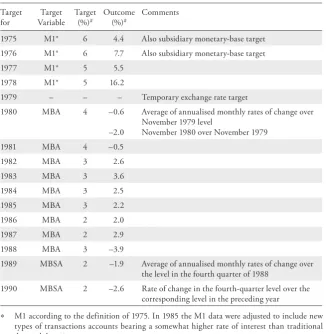
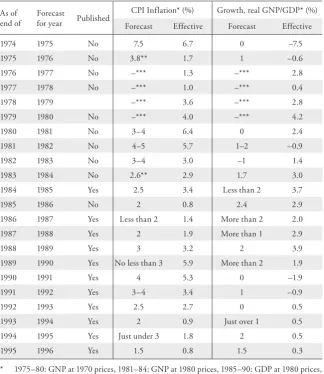
Since inflation was still running at about 10 percent per year, the SNB was willing to set a relatively generous growth target for M1. It intended to fight infla-tion gradually and to avoid undue disrupinfla-tions in the real economy. It chose a target of 6 percent for 1975 (Table 1), implying that M1 growth would lie in the upper part of the desirable range of 3–7 percent.8 To derive its target, the SNB departed from a forecast of movements in demand for M1 on the assumption that interest rates would remain unchanged. To this end, the SNB relied on the available econometric estimates of money demand. Furthermore, it needed fore-casts of two other important determinants of money demand, that is, inflation and real output growth. The forecasts of inflation and output growth underly-ing the SNB’s analysis are shown in Table 2.
Table 1: Annual Monetary Targets of the SNB
Target for
Target Variable
Target (%)#
Out come (%)#
Comments
1975 M1∗ 6 4.4 Also subsidiary monetary-base target 1976 M1∗ 6 7.7 Also subsidiary monetary-base target
1977 M1∗ 5 5.5
1978 M1∗ 5 16.2
1979 – – – Temporary exchange rate target
1980 MBA 4 –0.6
–2.0
Average of annualised monthly rates of change over November 1979 level
November 1980 over November 1979
1981 MBA 4 –0.5
1982 MBA 3 2.6
1983 MBA 3 3.6
1984 MBA 3 2.5
1985 MBA 3 2.2
1986 MBA 2 2.0
1987 MBA 2 2.9
1988 MBA 3 –3.9
1989 MBSA 2 –1.9 Average of annualised monthly rates of change over the level in the fourth quarter of 1988
1990 MBSA 2 –2.6 Rate of change in the fourth-quarter level over the corresponding level in the preceding year
∗ M1 according to the definition of 1975. In 1985 the M1 data were adjusted to include new types of transactions accounts bearing a somewhat higher rate of interest than traditional demand deposits.
# Unless otherwise indicated in the “Comments” column, the target and the outcome represent annual averages of year-on-year monthly rates of change.
Table 2: SNB-Forecasts of Inflation and Output Growth
As of end of
Forecast
for year Published
CPI Inflation* (%) Growth, real GNP/GDP* (%)
Forecast Effective Forecast Effective
1974 1975 No 7.5 6.7 0 –7.5
1975 1976 No 3.8** 1.7 1 –0.6
1976 1977 No –*** 1.3 –*** 2.8
1977 1978 No –*** 1.0 –*** 0.4
1978 1979 –*** 3.6 –*** 2.8
1979 1980 No –*** 4.0 –*** 4.2
1980 1981 No 3–4 6.4 0 2.4
1981 1982 No 4–5 5.7 1–2 –0.9
1982 1983 No 3–4 3.0 –1 1.4
1983 1984 No 2.6** 2.9 1.7 3.0
1984 1985 Yes 2.5 3.4 Less than 2 3.7
1985 1986 No 2 0.8 2.4 2.9
1986 1987 Yes Less than 2 1.4 More than 2 2.0
1987 1988 Yes 2 1.9 More than 1 2.9
1988 1989 Yes 3 3.2 2 3.9
1989 1990 Yes No less than 3 5.9 More than 2 1.9
1990 1991 Yes 4 5.3 0 –1.9
1991 1992 Yes 3–4 3.4 1 –0.9
1992 1993 Yes 2.5 2.7 0 0.5
1993 1994 Yes 2 0.9 Just over 1 0.5
1994 1995 Yes Just under 3 1.8 2 0.5
1995 1996 Yes 1.5 0.8 1.5 0.3
* 1975–80: GNP at 1970 prices, 1981–84: GNP at 1980 prices, 1985–90: GDP at 1980 prices, 1991–96: GDP at 1990 prices. For prices and output, the forecasts pertain to the percentage changes in annual averages, except for the years 1990–1993, for which the SNB forecasted the change from the fourth quarter of the current to the fourth quarter of the subsequent year. For 1994 onwards, the SNB provided forecasts for both the average and the fourth-quarter to fourth-quarter changes.
** GNP-Deflator.
10 See Büttler et al. (1979) and Schiltknecht (1983) for the money-multiplier model employed by the SNB.
From the growth target for M1, the SNB derived the subsidiary target for the mon-etary base by forecasting the multiplier linking the two monmon-etary aggregates.10 It came to the conclusion that the monetary base would be likely to rise at about the same rate as the aggregate M1. Finally, from the forecast of base-money growth, the SNB established an operational target for bank reserves, that is, the banks’ deposits with the SNB. The Swiss central bank preferred to operate on bank reserves, rather than on short-term interest rates, in order to manage money growth. By operating on bank reserves, both the SNB and market participants could elicit the changes in interest rates required to achieve the monetary target.
Figure 2: Interest Rates on Euro-Swiss-Franc and Euro-Deutsche-Mark (Euro) Deposits, and Domestic Savings Deposit Rate
0 2 4 6 8 10 12
1975 1980 1985 1990 1995 2000 2005
Pe
rc
en
t
11 See Schiltknecht (1974) and Ettlin (1989) for econometric studies of the demand for bank notes. For various reasons, Swiss large-denomination bank notes, which account for over half of the aggregate note circulation, play an important role as a store of value.
In principle, the SNB was able to control the monetary base with a reasonable degree of precision. Until the introduction of a new electronic interbank payments system in the late 1980s (see Section 4.2), bank reserves were negatively related to short-term interest rates (Rich and Béguelin, 1985, p. 92). To increase the mon-etary base, the SNB supplied additional reserves to the banks. This prompted a fall in short-term interest rates, inducing the banks to absorb the additional base money. After several months, the lower interest rates began to stimulate demand for bank notes, notably demand for the large denominations. The lagged response in the circulation of large-denomination bank notes to changes in interest rates can still be observed today. It derives from the fact that note demand reacts to changes in interest rates on savings deposits, which in turn adjust sluggishly to variations in short-term interest rates.11 The relationship between the interest rate on three-month time and on savings deposits is shown in Fig. 2.
In its press release of December 1974 (MB, Jan. 1975, p. 3), the SNB announced its intention to increase the monetary base by 6 percent the following year. On the assumption of an unchanged money multiplier, the aggregate M1 would rise by a similar order of magnitude. The wording of the press release implied that the SNB was about to fix multiple targets. It did not explicily state that the objective for the monetary base only played a subsidiary role. However, in the AR for 1975 the SNB made clear that the primary target referred to M1. In its policy announcement for 1976, the SNB again mentioned a target for the monetary base, but in subsequent press releases it dropped any reference to this aggregate.
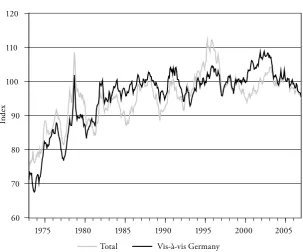
A major concern of the SNB was a sharp nominal and real appreciation of the Swiss franc after the switch to a flexible exchange rate (Fig. 3). The president’s speech at the 1975 annual meeting and the AR for 1975 both addressed this con-cern. The SNB felt it was waging a war on two fronts. On the one hand, it tried to curb the rise in the exchange rate through elaborate controls on inflows of for-eign capital and through extensive interventions on the forfor-eign exchange market. On the other hand, it was determined to reduce inflation through a controlled expansion in the money supply. Of course, as the SNB had discovered earlier, a controlled expansion in the money supply was inconsistent with unlimited pur-chases of foreign currencies against Swiss francs. The SNB resolved this conflict by according priority to the monetary target. It treated the planned expansion in the monetary base as the ceiling on its purchases of foreign currencies. In its
AR for 1975 the SNB provided a detailed review of its attempts to slow the Swiss franc’s appreciation and of its efforts to boost base-money growth. It also stressed the state-contingent nature of its monetary target.
Figure 3: Real Exchange Rate of the Swiss Franc
60 70 80 90 100 110 120
1975 1980 1985 1990 1995 2000 2005
Ind
ex
12 This statement was consistent with its forecast (Table 2).
13 The SNB repeatedly praised the virtues of steady money growth (in German: “Verstetigung des Geldmengenwachstums”). See its AR for 1979 (p. 10) and President Leutwiler’s address to the annual meeting of 1981.
During following three years, the SNB continued to employ the analytical pro-cedure established at the end of 1974, except that it relied on forecasts for growth in nominal final demand (defined as GNP plus imports), rather than for output growth and inflation (Table 2). Final demand was considered to be a better pre-dictor of activity-induced changes in M1 demand than real GNP and prices. At the end of 1975, SNB decided to keep the targets for M1 and base-money growth unchanged at 6 percent. However, in its press release of December 1975 (MB, Jan. 1976, p. 3), the SNB explicitly pointed out that money growth would not only depend on the target but also on the state of the economy. Expecting a modest recovery of the Swiss economy, the SNB emphasised that it would not hesitate to tighten monetary policy, should the strength of the recovery exceed expectations.12 Furthermore, it would not buy foreign exchange beyond the limits
imposed by the monetary target. At the end of 1976, the SNB reduced the growth target for M1 to 5 percent. Even though by the summer of 1976 inflation had fallen to very low levels, the SNB still undertook to keep money growth in the middle of the desirable range in order to discourage a further appreciation of the Swiss franc on the foreign exchange market (MB, Dec. 1976, p. 3)
As indicated by Table 1, the SNB largely met its targets, except in 1978, for reasons to be discussed in Section 3. In its AR for 1977 (pp. 10–11), the SNB por-trayed its monetary policy concept. After describing key monetarist principles, the SNB argued that monetarists had developed these principles for large closed economies. Therefore, they were not applicable to Switzerland without major modifications. The Swiss concept entailed a medium-run approach to monetary targeting with two aims: Achieving and maintaining price stability, and stabil-ising the real economy through a strategy of steady money growth. In manag-ing the money supply, the SNB was prepared to react flexibly to developments on the foreign exchange market in order to curb undesirable movements in the Swiss franc exchange rate.
Consequently, the SNB in the late 1970s developed a coherent and transparent policy framework based on monetary targeting. Nevertheless, the internal policy analysis, though playing a crucial role in setting monetary targets, suffered from several flaws. First, it was unclear whether the SNB’s emphasis on steady money growth13 was in sympathy with the call for a state-contingent target. As I show
14 Monetarists today admit that steady money growth need not be an optimum strategy (see Meltzer, 1998).
sufficiently pre-emptive policy approach in the face of unexpected shocks threat-ening to jeopardise price stability.14 Although the SNB managed to lower signifi-cantly the inflation trend, it invariably failed to quell a temporary acceleration of inflation during business-cycle expansions.
Second, the forecasts of activity-induced changes in money demand were marred by two problems. In fixing its monetary targets, the SNB was ambivalent about the role played by its inflation objective and potential output. The SNB neither announced an explicit inflation objective nor did it make clear whether its monetary target pertained to potential or actual output growth. In its offi-cial publications at least after 1976 (MB, Dec. 1977, p. 3), the SNB stressed that potential output mattered, but its internal analysis only featured actual growth. Moreover, the analysis underlying the monetary targets disregarded expected movements in interest rates. In principle, the targets matched the anticipated activity-induced change in money demand. This procedure implied that once the targets had been fixed, interest rates would remain unchanged provided the SNB’s macroeconomic forecasts materialised. Therefore, the internal analysis ignored an important issue. If the SNB merely adapted the money supply to the expected activity-induced change in demand, it would not be able to achieve price stabil-ity. To lower inflation, the SNB had to push up interest rates, that is, it could not fully accommodate the expected activity-induced change in demand.
3. Exchange Rate Targeting and the Return to Money:
1978–1981
3.1 Temporary Target for the Exchange Rate
15 The movements in base-money growth in 1978 reflected the SNB’s actions (Fig. 1). See the AR for 1978 (pp. 8–13) for a more detailed description of the SNB’s measures.
16 The SNB was under enormous pressure from the export sector, the federal government and the general public to halt the upsurge of the Swiss franc. The government threatened to intro-duce a dual foreign exchange market, under which it would have applied a fixed exchange rate to most current-account transactions and a floating exchange rate to all the other balance-of-payments flows. This was an anathema to the liberally-minded Swiss central bank. In his speech at the 1976 annual meeting, President Leutwiler had already discussed the drawbacks of a dual foreign exchange market.
17 The target zone considered by the SNB was 84 to 100 CHF/100DEM. A more detailed dis-cussion of the 1978 policy switch is provided by Bernholz (2007, pp. 179–181), who had access to such internal SNB documents as the minutes of the Governing Board.
18 In November 1978, US monetary authorities decided to take measures to fight inflation and to strengthen the dollar. This also contributed to weakening the Swiss franc.
the money market.15 The SNB’s action convinced market participants that the Swiss central bank would remain loyal to its monetarist beliefs. As a result, they descended on the foreign exchange market with a vengeance and pushed up the exchange rate of the Swiss franc to levels never seen before. The spectre of a dras-tic slump in economic activity forced the SNB to react.16 In September 1978, the SNB contemplated introducing an exchange rate target zone for the Swiss-franc price of the DM. The idea was to conduct non-sterilised purchases of for-eign currencies until the exchange rate had reached the lower bound of the target zone. Once the situation on the foreign exchange market had calmed down, the SNB should remove again the overhang of base money that was bound to result from these interventions. However, the SNB did not adopt a target zone. Instead, at the beginning of October 1978, it announced that it would fix a temporary exchange rate target with the aim of keeping the Swiss-franc price of the DM “clearly” above 80.17
19 The SNB used year-on-year growth rates as a method of seasonal adjustment.
20 They resulted from minimum reserve requirements that were enforced only at month ends and window-dressing activities.
3.2 Annual Target for the Monetary Base
At the end of 1979, the SNB was ready to reintroduce a monetary target. It was convinced that the overhang had been completely eliminated, both in terms of the monetary base and M1, an assessment confirmed by subsequent research (Kugler and Rich, 2002). However, the SNB decided to simplify its targeting approach. It bypassed the aggregate M1 and elevated the subsidiary objective for the monetary base to the position of key target variable.
Treating the monetary base as the key target variable raised two tricky prob-lems. The first one was related to the fact that the SNB had always defined its target as an annual average of monthly year-on-year rates of change.19 Since the monetary base had fallen drastically in the first months of 1979, the year-on-year rates of change were bound to be strongly negative in the early part of 1980. Therefore, the target likely to be set by the SNB would also be negative. It would be hard to explain to the public why the SNB saw a need for fixing a negative target. A second problem stemmed from the available data on the mon-etary base. Swiss bank reserves were characterised by massive month-end bulges.20 The monetary base could not be used as a sensible target variable unless the data were adjusted for these bulges. Unfortunately, satisfactory data on the monetary base – adjusted in this way – did not exist upon the target switch, as the SNB did not start to publish such a series until 1981. From the end of 1980 onwards, the target referred to the adjusted monetary base (MBA), which excluded the month-end bulges in bank reserves.
21 I used two methods of calculating the effective increase in the monetary base. These calcula-tions rely on the data for MBA that the SNB began to publish in 1981. Interestingly, the SNB in its AR for 1980 (p. 8) did not provide a figure for the effective increase in the monetary base. It merely stated that the increase in the monetary base had been below target.
not increase MBA as it had anticipated.21 Two factors explain the target miss. First, inflation, fuelled by the second oil price shock, was on the rise again, compelling the SNB to pursue a more restrictive course than initially intended. Second, the demand for bank notes declined unexpectedly. This demand shift was related to the fact that the SNB at the beginning of 1980 had lifted all the remaining restrictions on inflows of foreign capital. Apparently, foreign inves-tors had circumvented these restrictions by acquiring Swiss bank notes (AR for 1979, pp. 7–9).
For 1981 the SNB again fixed a growth target for MBA of 4 percent. In its press release of December 1980, the SNB stated that the target of 4 percent was a bit higher than was warranted in the medium term (AR for 1980, p. 9). It justi-fied the relatively generous target by the uncertain prospects of the world econ-omy. As in the preceding year, the SNB soon realised that its intended course was too easy. In his address to the annual meeting of April 1981, President Leutwiler admitted that the SNB should have fixed a lower target as it had underestimated the inflationary pressures in the Swiss economy. He attributed the rise in inflation mainly to the monetary policy the SNB had pursued late in 1978 and to an exces-sive depreciation of the Swiss franc. Therefore, the SNB had decided to tighten monetary policy and to undershoot the target. Since the SNB failed to halt the drop in the value of the Swiss franc, the SNB in the autumn of 1981 tightened its reins once more. As a result, interest rates rose sharply (Fig. 2). While it now succeeded in reversing the decline in the exchange rate (Fig. 3), it could not help accepting another substantial target miss (Table 1), which reflected mainly the switch to a more restrictive course, rather than renewed instabilities in money demand. As may be seen from Table 2, the SNB underestimated significantly both inflation and output growth for 1981.
22 The SNB never published this research. It was aware of McKinnon’s (1982; 1984) distinc-tion between direct and indirect currency substitudistinc-tion. It focused entirely on direct currency substitution (see Kugler and Rich, 2002).
was well advised to ease monetary policy in response to a massive appreciation of the Swiss franc that raised the spectre of a slump in economic activity and deflation. Why did the temporary shift to an expansionary stance, though fun-damentally correct, re-ignite inflation? Existing studies offer two possible answers to this question.
First, Schiltknecht (1989) argues that the SNB was too tardy in eliminating the monetary overhang created by the interventions of late 1978 and thus allowed the inflationary forces to take root again. Second, Kugler and Rich (2002) point to the flaws in the SNB’s strategy of steady money growth as another possible source of inflation. The SNB may have failed to adopt a sufficiently pre-emptive restrictive stance when the economy embarked on a cyclical expansion in 1979. Kugler and Rich test empirically these two explanations for the SNB’s failure of containing inflation. They conclude that both factors account for the surge of inflation early in the 1980s. The SNB should have reduced M1 more decisively in 1979 and pursued a much tighter course in 1980 than it actually did.
The SNB believed that a target for the monetary base would help mitigating undesirable movements in the exchange rate such as had occurred in 1978. Its internal analysis was strongly coloured by the then popular literature on currency substitution. The SNB assumed that market expectations of a strong apprecia-tion of the Swiss franc had prompted investors to substitute domestic for foreign money. In its view, the demand for the aggregate M1 was particularly vulner-able to currency substitution. In 1978, the expectation of a stronger Swiss franc had prompted the public to demand additional Swiss money in the form of M1. Had the SNB failed to accommodate the rise in demand for M1, it would have pushed up short-term interest rates and magnified the currency appreciation. By targeting the monetary base, the SNB would allow the supply of M1 to respond to shifts in exchange rate expectations and thus to play a stabilising role. However, the SNB’s internal analysis was flawed. Although actual demand for M1 seemed to exceed the estimated values in 1978, subsequent research by the SNB failed to uncover any statistically significant evidence of currency substitution.22
23 Benjamin Friedman (1977) had already discussed the consequences of interest-elastic money demand for monetary targeting.
24 President Leutwiler stressed these points in his address to the 1984 annual meeting. interest rates than the demand for base money. As I show below, a monetary target helps stabilising cyclical fluctuations in inflation and output provided demand for the targeted aggregate is not too sensitive to changes in interest rates.23 Fur-thermore, demand for M1 became temporarily unstable (Belongia, 1988), due to the introduction of new types of transaction accounts. These instabilities dis-appeared again when the SNB adjusted the M1 series for these innovations.
In other respects, the events of the late 1970s had a salutatory effect on the SNB. Reviewing the exchange rate policies it had pursued in the 1970s, the SNB concluded that sterilised interventions on the foreign exchange market were use-less in managing the exchange rate (Schiltknecht, 1983). The SNB could not really affect the exchange rate unless it was willing to change monetary poli-cy.24 However, in aiming monetary policy at the exchange rate, the SNB had to exercise caution because of possible conflicts between its overriding objective of price stability and the desire for a stable exchange rate. Moreover, the SNB lost its faith in the effectiveness of capital controls in influencing the exchange rate. From the early 1980s onwards, sterilised interventions became rare events indeed and capital controls were never used again.
4. The Quiet before the Storm, 1982–1990
4.1 Quiet Period up to the Middle of 1987
The period from 1982 to the summer of 1987 did not feature major challenges to monetary policy makers. The renewed decline in inflation after 1981 was pre-ceded by a cyclical contraction, starting in the summer of 1981 and lasting until the end of 1983. As a result of a strong recovery in the United States, the Swiss economy began to pick up again in 1984. Aside from a temporary slowdown in real growth in 1987, the cyclical expansion continued until 1989. Inflation declined from over 7 percent in 1981 to about 3 percent in 1982. However, the SNB did not succeed in reducing inflation further to the range that it defined as price stability (see below). Even in the second half of the 1980s, the inflation trend never fell below 2 percent, for reasons to be discussed later.
flaws mentioned at the end of Section 2. From the end of 1982 onwards, it relied on a four-step procedure for determining the monetary target to be set for the fol-lowing year. The first step involved establishing a benchmark for the growth in the monetary base. The benchmark equalled the average annual rate of growth in the monetary base that the SNB thought to be consistent with potential output growth and its “objective” of low inflation. The second step embraced the fore-cast of the activity-induced change in the demand for base money for the fol-lowing year, that is, the procedure developed in the 1970s. However, in contrast to its earlier approach, the SNB now undertook to forecast base-money demand directly, rather than indirectly by way of the aggregate M1. In a third step, the SNB determined the target to be set for the following year. In determining the annual target, the SNB compared the expected activity-induced change in base-money demand with the benchmark. In particular, it explored the question of whether the annual target should differ from the benchmark. The fourth step entailed a conditional forecast of the movements in interest rates likely to be elic-ited by the policy course planned for the following year. If the expected activity-induced change in the demand for base money did not match the annual target, interest rates were bound to adjust in order to keep the growth in demand in line with the target. The forecast of interest rates, of course, was conditional on the SNB’s forecast of output growth and inflation. If the macroeconomic fore-casts did not materialise, movements in interest rates would also deviate from the SNB’s original expectations.
As monetarists had often emphasised, a monetary target providing for steady growth in the money supply was likely to trigger interest rate movements designed to smooth cyclical fluctuations in inflation and output, besides keeping the infla-tion trend at low levels. Suppose that the Swiss economy suffered from a cycli-cal contraction, with output expected to fall the following year. Because of the expected drop in nominal income, the activity-induced demand for base money, in all probability, would decrease too. Suppose further that the SNB planned to increase the supply of base money by 2 percent in accordance with its bench-mark. Considering the expected gap between supply and demand for base money, the SNB had to allow interest rates to fall in order to keep the money market in equilibrium. If the drop in output turned out to be more severe than expected, interest rates would also have to decline more strongly than the SNB had initially anticipated. Thus, the monetary target elicited stabilising movements in interest rates designed to raise output.
25 See Schiltknecht (1974) and Vital (1978) for the then available econometric studies of demand for M1. The SNB also assumed a constant long-run multiplier of M1 with respect to MBA. At the end of 1982, the SNB ceased to derive the target for the monetary base by way of M1 because the multiplier model no longer provided reliable forecasts. Moreover, as indi-cated above, the aggregate M1 became temporarily unstable. Instead, the SNB directly esti-mated the income elasticity of MBA and its components (Rich and Béguelin, 1985; Kohli, 1985, and Ettlin, 1989).
26 This research was later published (Büttler, Ettlin and Ruoss, 1987) and yielded an esti-mate of potential output growth of 1.8–1.9 percent per year.
appropriate benchmark, establishing and interpreting the forecasts of activity-induced changes in money demand, and the continuing problem of dealing with the exchange rate. A further issue concerned the question of how best to communicate to the public the economic analysis underlying the SNB’s policy decisions.
As regards the benchmark, the SNB in the early 1980s considered an aver-age increase in MBA and M1 of 2–3 percent per year to be consistent with price stability and potential output growth. At first, the benchmark did not rest on rigorous analysis. The SNB merely conjectured that potential output would grow by about 2 percent per year. Moreover, it assumed an inflation “objective” of 0–1 percent per year. This yielded an annual increase in nominal potential output of 2–3 percent. Drawing on the then available econometric research, the SNB postulated a unitary long-run elasticity of demand for MBA and M1 with respect to output and the price level.25 In 1986, the SNB investigated thoroughly the evolution of potential output. It concluded that its earlier assumption had been realistic.26 Later reviews of its estimates did not yield significantly differ-ent results.
27 The quantitative definition appeared again in the AR for 1987, p. 7. From 1988 to 1994, the SNB once again failed to provide a definition of price stability. Since 1995 (AR for 1994, p. 8) the SNB has spelled pout explicitly its definition of price stability, i.e., an annual inflation rate of 1 percent until 1999 and less than 2 percent thereafter.
28 Recall that the demand for bank notes depends on the savings deposit rate and, therefore, responds to changes in market interest rates with a lag. This explains why demand for base money still grew relatively strongly in 1983 even though the cyclical contraction was about to end.
an annual trend increase in velocity of 2 percent and nominal potential output growth of 2–3 percent, a benchmark of about 1 percent would have been more appropriate. As a matter of fact, the SNB reduced its benchmark to 1 percent upon the switch to the medium-term targeting approach at the end of 1990. Its tendency to overestimate the benchmark explains why the SNB did not succeed in lowering trend inflation below 2 percent in the course of the 1980s.
The policy announcements were coloured by the difficulties of determining an appropriate benchmark. In its press release of December 1982, the SNB disclosed for the first time a benchmark of 2–3 percent for the growth in the monetary base. At the end of 1984, it reduced the benchmark to 2–2.5 percent and a year later to 2 percent (MB, Dec. 1982, p. 3, QB, Dec. 1984, p. 7, and Dec. 1985, p. 247). In contrast to publishing a benchmark, the SNB was reluctant to quantify its defi-nition of price stability. At the 1984 annual meeting, President Leutwiler defined price stability as a rate of increase in the CPI of close to zero (italics mine). Because of the uncertainties about the official definition of price stability, the SNB had to resort to somewhat opaque language to explain the assumptions underlying the benchmark. At the end of 1985, it stated that MBA growth of 2 percent was con-sistent with potential output growth of about 2 percent in real terms and slightly more than 2 percent in nominal terms, given its assumption about the inflation trend (QB, Dec. 1985, p. 247). Only in its AR for 1986 (p. 7), did the SNB decide to clarify this issue and to quantify its definition of price stability.27
growth far exceeded the SNB’s forecast (Table 2). The SNB seized the opportu-nity, offered by the excellent performance of the Swiss economy, to reduce MBA growth towards the new benchmark of 2 percent that it was to announce at the end of the year (AR for 1985, pp. 7–8). Even so, the deviations from the targets fixed for the years 1982 to 1986 were negligible (Table 1).
As far as the exchange rate was concerned, the fluctuations in the external value of the Swiss franc between 1982 and the summer of 1987 were more moderate than in the 1970s. Nevertheless, as already indicated, the SNB continued to take account of the exchange rate, especially in 1983 and 1985. Moreover, it undertook to explore various schemes for combining monetary targeting with target zones for the exchange rate of the Swiss franc, notably against the DM. However, the internal discussions of these schemes revealed the pitfalls of a target zone. If the SNB were to adopt a narrow zone, it would de facto return to a fixed exchange rate, while a wide one would not add much to the status quo. Furthermore, a target zone not disclosed to the public would probably be counterproductive, as it might enhance exchange rate volatility. Foreign exchange traders suspect-ing a modification in the monetary regime might test the SNB by drivsuspect-ing up or down the exchange rate in order to force the policy makers to reveal the upper or lower bound of the target zone. For these reasons, the SNB did not warm up to the idea of a target zone. Since 1979, the SNB has not fixed – either formally or informally – targets for the exchange rate.
Communicating to the public the analytical framework underlying the bench-mark and the annual targets raised a number of problems. Since the policy announcements were addressed to the general public, rather than to economic specialists, the SNB refrained from encumbering its policy statements with com-plicated technical details. Therefore, the SNB’s December press releases did not cover the full internal analysis, but only contained the core required for understanding its intentions. Nevertheless, from the end of 1984 onwards, the press releases became more substantial and, in general, embraced the following points:
– Statements about the annual target for the following year and the benchmark growth in the monetary base.
– The SNB’s quantitative forecasts of output growth and inflation for the fol-lowing year.29
– A statement about the expected activity-induced change in the demand for base money.
– A statement about the extent to which the annual target fixed by the SNB would serve to accommodate the expected activity-induced change in the mon-etary base.
– A statement about the state-contingent nature of the target.
More controversial was the question of whether the SNB, at least in qualitative terms, should also disclose its conditional forecasts of interest rates, as the public might misunderstand such forecasts and mistakenly treat them as operational targets. While the SNB at first remained silent on this issue, the press releases published between December 1986 and December 1989 contained statements on expected movements in interest rates (QB, Dec. 1986, p. 297, Dec. 1987, p. 231, Dec. 1988, p. 271, and Dec. 1989, p. 292).
30 In Switzerland these requirements are known as liquidity requirements. In the 1970s they served as one among several instruments designed to absorb the monetary overhang created by speculative inflows of foreign capital.
4.2 The Storm of 1987–1990
In 1987, the real exchange rate of the Swiss franc once again reached levels (Fig. 3) that created difficulties for the domestic economy. A slowdown in real growth (Table 2) suggested that the cyclical expansion was coming to an end. Internal demand remained the only source of growth in the Swiss economy, while exports were stagnating. In the summer of 1987, the SNB realised that it would over-shoot its monetary target unless it was prepared to curtail bank reserves and raise interest rates. In normal circumstances, the SNB would have stuck to its target and allowed interest rates to go up. However, it decided against curbing money growth because it was concerned that a rise in interest rates would magnify the upward pressures on the real exchange rate. Furthermore, after the stock market crash of October 1987, Swiss banks, like their counterparts in the US, endeav-oured to augment their liquidity. As a result, short-term interest rates began to rise sharply. In an effort to avert a liquidity squeeze, the SNB supplied additional base money to the banks. For these reasons, the SNB exceeded the target for 1987 by about one percentage point (Table 1, AR for 1987, p. 8).
The discussions about the policy course to be pursued in 1988 were overshad-owed by the dire forecasts of world economic growth that began to appear after the stock market crash. In addition to world economic developments, the launch of Swiss Interbank Clearing (SIC), the world’s first electronic real-time gross set-tlement system, complicated the SNB’s task of setting monetary policy. Thanks to SIC, domestic banks were able to curtail their holdings of base money. To allow banks to exploit fully the advantages of SIC, Swiss authorities agreed to cut banks’ minimum reserve requirements, which had been placed at an exces-sively high level in the 1970s.30 These innovations caused considerable uncer-tainty about the future development of base-money demand.
31 Swiss non-banks held about 20 percent of their financial wealth in the form of equity, as com-pared with a share of 6 percent in Germany. The Swiss share was similar to those recorded for the United States and Canada.
32 The 1987 statement was shorter then any other press release published in the SNB’s QB after 1983.
33 In its press release of December 1986 (QB, Dec. 1986, pp. 208–209), the SNB had already discussed the consequences of SIC for monetary policy, but did not take up this analysis in its policy statement for 1988.
34 Real GDP increased by 2.9 percent in 1988 as compared with a forecast of 1 percent by the SNB (Table 2).
stock market crash on domestic consumption ruled out an increase in interest rates (Rich, 1988).31 Therefore, the first scenario called for hiking the target to 3 percent. In the second scenario the SNB took account of the expected down-ward shift in money demand that was likely to arise from the impending finan-cial innovations. Unfortunately, the SNB could not reliably forecast the extent of this shift, but internal research pointed to a drop in demand for base money by as much as 3 percent in 1988.
Because of these uncertainties, the SNB decided to lift the target to 3 percent. In its press release of December 1987, the SNB signalled the possibility of a fall in base-money demand that might call for undershooting the target. However, due to the extreme brevity of the press release (QB, Dec. 1987, p. 231),32 the public did not grasp the complexities of the analysis underlying the SNB’s policy deci-sion. In particular, the SNB failed to spell out fully the meaning of an annual monetary target in the presence of major financial shocks.33
Immediately after the new reserve requirement regime had entered into force, the banks began to cut their holdings of base money. Bank reserves fell more quickly and more strongly than had been anticipated. As may be seen from Table 1, the demand shift assumed such proportions that the SNB was compelled to undershoot its target by about 7 percentage points. Furthermore, the banks’ preference for a rapid reduction in their reserve holdings caused short-term inter-est rates temporarily to fall to very low levels. Nevertheless, the SNB was tardy in adjusting the supply of base money to the fast drop in demand. At the SNB’s annual meeting of April 1988, President Languetin justified this procedure with a desire to ease the banks’ adjustment to the new financial environment.
35 The boom setting in during the spring and summer of 1988 also triggered a bubble in real estate and housing prices that burst early in the 1990s and caused severe problems among Swiss mortgage banks.
36 Internal calculations by the SNB yielded similar results (Rich, 1997, p. 122).
overheating.35 For this reason, the SNB decided to switch back to a restrictive stance in the summer of 1988. Due to the SNB’s sluggish response to the drop in base-money demand, however, short-term interest rates continued to stay rela-tively low. Only in November 1988 did they start to rise above the levels before the stock market crash (Fig. 2). Therefore, partly against the SNB’s intentions, monetary policy remained expansionary during much of the rest of 1988. The OECD (1989, p. 44) argued that MBA would have attained a growth rate of 4 percent in 1988 in the absence of any financial innovations.36 Monetary policy turned out to be even easier than the SNB had foreseen at the end of 1987.
In December 1988, the SNB reduced the target again to 2 percent. Since activity-induced money demand was expected to increase by 4 percent, the SNB in its press release of December 1988 explicitly stated that it foresaw a rise in inter-est rates. It also stressed the continuing uncertainties with regard to the banks’ reserve behaviour (QB, Dec. 1988, pp. 271–272). However, the SNB once again underestimated the cyclical expansion in the Swiss economy (Table 2), as the booming world economy continued to buttress domestic growth. Furthermore, Swiss franc strength gave way to a pronounced weakness pushing up the prices of imported goods (Fig. 3). In all likelihood, the decline in the Swiss franc exchange rate stemmed from the fact that the Bundesbank too was compelled to tighten severely monetary policy, as indicated by the sharp increase in German interest rates (Fig. 2). The SNB became concerned that the dangerous mix of continu-ing strong growth and domestic currency weakness might spark a new bout of inflation. Therefore, early in 1989, it tightened further its monetary reins. In his address to the annual meeting of April 1989, President Lusser emphasised that with hindsight the industrialised countries, including Switzerland, had pursued overly expansionary monetary policies in the past three years. Since the course originally fixed for 1989 was still too soft, the SNB would undershoot its target of 2 percent (Table 1). In its AR for 1989 (p. 9), the SNB attributed about half of the deviation from the target to its tighter course and the remainder to a further decline in bank demand for base money. As a result of the SNB’s restrictive stance, short-term interest rates rose to almost 9 percent at the end of 1989 (Fig. 2).
37 The Gulf War of 1990 led to an inflow of save-haven funds to Switzerland, temporarily push-ing up the exchange rate of the Swiss franc. This provided additional scope for easpush-ing mon-etary policy (AR for 1990, p. 9).
currently high levels or to increase even a bit further (QB, Dec. 1989, p. 292). While the SNB correctly forecast a decline in output growth, it grossly underesti-mated the inflationary pressures afflicting the Swiss economy (Table 2). Ushered in by a sharp increase in the oil price at the end of 1989, inflation soared to over 6 percent in the summer of 1990. In these uncomfortable circumstances, the SNB reluctantly decided once again to adopt a tighter course than it had announced. In the summer of 1990, first indications of a slowdown in real growth appeared on the scene. Therefore, the SNB cautiously tried to relax monetary policy.37 As a result, the monetary base rebounded (Fig. 4). However, the economic effects of German reunification upset the SNB’s calculations. Towards the end of 1990, German interest rates began to increase again, keeping the Swiss franc weak and putting continued upward pressure on the price level. Since the SNB could not but return to a restrictive policy, the monetary base ceased to expand. At the end of 1990, base-money growth for the third time in three years fell short of the SNB’s target. However, the 1990 target miss no longer reflected shifts in demand for base money. It was due mainly to the necessity of pursuing a tighter course than the SNB had anticipated (AR for 1990, pp. 9–10).
Another criticism addressed at the SNB concerned the causes of the surge in inflation at the end of 1989. Many analysts claimed that the SNB’s easy stance of 1988 – whether deliberate of not – had triggered the subsequent increase in inflation. Although President Lusser in his address to the annual meeting of April 1990 accepted responsibility for the re-emergence of inflation, the reasons for the SNB’s failure of preserving price stability are not as evident as might be believed at first sight. The SNB had clearly learnt a lesson from the unfortunate episode of 1978–1981. At the end of the 1980s, it endeavoured to react pre-emptively to the inflation threat, in contrast to its behaviour a decade earlier. It undertook to tighten monetary policy in the autumn of 1988, about a year before inflation began to soar. Needless to say, the SNB’s pre-emptive action would have been more convincing had it tightened already in the spring or summer of 1988. I do not know to what extent an earlier switch to monetary restriction would have moderated the price increases of late 1989 and 1990. However, there is little doubt that monetary policy in this period was complicated by at least three factors.
First, the SNB was forced to pay a price for the cautious approach it had fol-lowed in the 1980s. To minimise the output effects of its anti-inflationary mon-etary policy, it had pursued an overly gradual course that had failed to restore fully price stability. Therefore, the expansionary external shocks of the late 1980s hit the Swiss economy at a time when inflation had not been conquered com-pletely. This made it all the more difficult to ward off the expansionary forces and to contain the price increases.
Second, the inflationary impulses stemming from the external sector of the Swiss economy were reinforced by a variety of domestic indexing schemes that had taken root in the 1980s. A particularly pernicious scheme – still in exist-ence today – involves the Swiss practice of linking housing rents to mortgage rates. Inflation, at least in the short run, tends to accelerate when mortgage rates increase as a result of a tighter monetary policy. In 1989 and 1990, the SNB’s fight against inflation was severely hampered by the temporary stimulating effect on inflation of high interest rates.
38 See Stalder (2001, Fig. 3b). The numerical values of the forecasts for CPI inflation underly-ing his figure, on average, are 3.2 percent for 1990 and 4.2 percent for 1991. They are derived from within-sample dynamic simulations and represent one-year-ahead quarterly forecasts (information obtained from Stalder by e-mail on 18 Nov. 2002). The effective inflation rates amounted to 5.9 and 5.3 percent respectively (Table 2). Stalder models Swiss monetary policy with the help of a Taylor rule. This does not imply that the SNB actually followed a Taylor rule. As I show elsewhere (Rich, 2002, especially Fig. 6), the SNB’s approach to monetary targeting yielded a path for short-term interest rates that frequently agreed with that derived from a Taylor rule.
39 The share of bank notes in the monetary base rose from about 70 to 90 percent and more after 1988.
the type of policy strategy followed, the SNB would likely have underestimated the rise in inflation in the late 1980s and early 1990s.
The repeated and massive deviations in base-money growth from the SNB’s objectives discredited entirely the practice of setting annual monetary targets and called for a new policy approach.
5. Medium-Term Targets after 1990
5.1 Trial and Error: 1990–1993
40 These comments on alternative aggregates were based on research conducted by two staff members of the SNB (Fischer and Peytrignet, 1990). In the meantime, M3 has become a much better predictor of future inflation.
41 The target for 1989 also referred to the increase over the level recorded in the fourth quarter of the previous year. However, the SNB decided to compare the target with the average annualised The SNB decided to retain monetary targeting because of the strong leading-indicator role of money. While growth in the monetary base provided reliable information on the evolution of inflation in the medium and long runs, it was not a good predictor of short-term movements in the inflation rate. To stabilise inflation both in the short and long runs, the SNB would have to look at other indicators, besides money. Depending on the signals emitted by these additional indicators, the SNB might have to push money growth temporarily above or below the medium-term target. In particular, if a weak Swiss franc and/or a vig-orous cyclical expansion abroad were to fuel domestic inflation, the increase in interest rates, triggered by a strategy of steady expansion in the monetary base, might not be sufficiently large to stabilise the price level. Even in the case of base-money demand, the interest sensitivity was too high for a policy of steady expan-sion in the money supply to act as an effective stabiliser. Therefore, to strengthen the stabilising role of monetary policy, the SNB would have to lower temporarily base-money growth below the term target of 1 percent. The medium-term approach would compel the SNB to behave more pre-emptively. In this way, it would be able to prevent temporary surges in the inflation rate as had occurred in 1980/81 and 1989/90.
The SNB also pointed out that it would continue to rely on the monetary base as its target variable. The money stock M1 was also a good predictor of medium- and long-term movements in the inflation rate. However, due to its high inter-est sensitivity, the aggregate M1 was even less effective in stabilising short-term fluctuations in the inflation rate than the monetary base. Moreover, the SNB ruled out a target for the aggregate M3 because of its poor quality as a predic-tor of future inflation.40
monthly rates of change in MBSA relative to the fourth quarter of 1988 (Table 1). The rate of change in MBSA, therefore, did not depend on the level reached in the fourth quarter of 1989 alone. The SNB dropped this complicated procedure for calculating the annual rate of change in MBSA the following year because it was incomprehensible to the public.
42 To estimate the activity-induced change in money demand, therefore, the SNB began to fore-cast the fourth-quarter-over-fourth-quarter change in the CPI and output. See also Table 2. as reported by the SNB, always referred to the level in the fourth quarter over the level in the same period the year before.42
The public welcomed the SNB’s willingness to give up strict monetary tar-geting and to take account of other indicators besides money. Nevertheless, the press release of December 1990 raised various concerns among the public. Some observers of Swiss monetary policy believed that the SNB was about to shift to a discretionary policy approach. They bemoaned the vagueness of the press release, which did not commit the SNB to a precise policy framework. It is indeed true that the SNB’s policy announcement of 1990 was not exemplary for its precision and clarity. Even though the press release provided a comprehensive general expla-nation of the SNB’s medium-term strategy, it omitted three elements that were essential for understanding fully the new approach. These omissions were attrib-utable to the fact that the SNB had not managed to tie up all the loose ends of the new medium-term strategy before the announcement of December 1990.
The first omission concerned the length of the target period. The medium-term nature of the new approach implied that the length of the target period should cover a full business cycle. Over a full cycle, the SNB would undertake to expand MBSA at an average rate of 1 percent per year. However, within the cycle, the SNB, if necessary, would push money growth above or below the medium-term target. In general, it would keep money growth below 1 percent during the expansion phase and above 1 percent during the contraction phase of the business cycle. Even so, the SNB fixed a target period of 3 to 5 years, which was shorter than the length of a typical business cycle. It was concerned that a period exceeding 5 years would fail to limit effectively its discretion in managing money growth. Because of these uncertainties, the SNB at first did not specify the length of the target period. In response to media complaints about the vague-ness of the policy announcement, it subsequently explained that it had in mind a target period lasting 3 to 5 years.
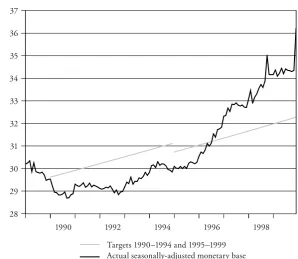
fourth quarter of 1990 and implying average annual growth of 1 percent. How-ever, this interpretation of the SNB’s intentions did not accord with the logic of the medium-term approach. On the contrary, strict application of the new approach called for a starting point of the expansion path that would lie substan-tially above the level of MBSA recorded in the fourth quarter of 1990. As may be gleaned from Fig. 4, MBSA at the end of 1990 was at a very low level, due to the restrictive course the SNB had pursued since the autumn of 1988. Once the SNB was able to ease monetary policy, short-term interest rates, which still amounted to roughly 8 percent, would have to fall drastically. Therefore, the SNB would have to raise money growth, at least for a while, above the medium-term target of 1 percent in order to accommodate the drop in interest rates. If the SNB were to prevent base-money growth from rising temporarily above 1 percent, mon-etary policy would be far too restrictive. The slowdown in real growth that had started in the summer of 1990 was about to develop into a veritable recession. Since an overly restrictive course would prolong unnecessarily the impending slump in activity, it was imperative to choose a strategy allowing for a tempo-rary surge in money growth.
While the logic of the medium-term approach was clear, the SNB was less cer-tain about the best way of communicating this idea to the public. Obviously, the SNB – at the end of 1990 – could not simply announce that it intended to keep money growth at an average of 1 percent over the next 3 to 5 years. Because it would be obliged, sooner or later, to boost money growth, it would, in all likeli-hood, overshoot the medium-term target. By setting an unrealistic medium-term objective prone to be missed, the SNB would needlessly discredit monetary tar-geting. For this reason, the SNB adopted another solution. It derived a medium-term target line for the level of MBSA, which it considered being in sympathy with price stability in the medium and long runs. Such a line could be obtained by moving the starting point of the target period back to the fourth quarter of 1989 (Fig. 4). The slope of the target line of course matched the medium-term target of 1 percent.
point for calculating the medium-term target of 1 percent matched the actual level of MBSA recorded in the fourth quarter of 1989 (QB, Dec. 1992, p. 312). In the AR for 1992 (p. 9) the SNB also published a chart similar to Fig. 4.
The third element missing in the press release of December 1990 was a state-ment about the SNB’s intentions for the immediate future. The press and other observers of monetary policy quickly realised that in the absence of an annual target, they did not really know what the SNB was up to in the coming months. To fill this void, President Lusser, in his address to the annual meeting of April 1991, announced that in the future the Swiss central bank would publish – at the beginning of each quarter – a forecast of the average level of MBSA in the subsequent three months.
Another, albeit less burning, issue concerned the controllability of MBSA. The financial innovations of the late 1980s not only altered the composition of the monetary base, but also eliminated to a large extent the interest sensitivity of the demand for bank reserves. This affected the SNB’s ability to control MBSA.
Figure 4: Medium-Term Target Lines
1990 1992 1994 1996 1998
Bi
ll
ion
s of S
w
is
s f
ra
n
cs
37
36
35
34
33
32
31
30
29
28
43 The SNB discussed the problems arising from the control of MBSA in its AR for 1991, p. 9. After 1988, an easing of monetary policy no longer affected MBSA instantane-ously through an increase in bank reserves, but only a few months later after a reduction in the rate on savings deposits had prompted the demand for bank notes to expand. In principle, the SNB could still control MBSA. However, MBSA no longer provided information on the SNB’s current policy stance, as current movements in that aggregate reflected the policy measures taken a few months earlier. Instead, the SNB increasingly relied on short-term interest rates as a barometer of monetary ease or tightness.43 In September 1993, the Govern-ing Board instructed the economic staff to furnish regularly internal guidelines on the evolution of interest rates considered to be consistent with its planned course of action. These guidelines were not disclosed to the public but used by the SNB’s operational department in managing bank liquidity.
The international environment, notably the economic consequences of German reunification, complicated considerably its task of fighting inflation without inflicting undue hardship on the real sector of the domestic economy. In 1991 the SNB continued to pursue the course initiated the year before and tried to expand cautiously MBSA. In effect, the SNB’s course was a bit more expansionary than indicated by the recorded growth in MBSA because of a further downward shift in the demand for bank reserves. Contrary to expectations, inflation remained stubbornly high in 1991. Therefore, the inflation figure of 5.3 percent attained in the fourth quarter of 1991 once again exceeded the SNB’s forecast (Table 2).