O R I G I N A L A R T I C L E
Open Access
Marker Assisted Breeding to Develop
Multiple Stress Tolerant Varieties for Flood
and Drought Prone Areas
Nitika Sandhu
1,2, Shalabh Dixit
1, B. P. M. Swamy
1, Anitha Raman
1, Santosh Kumar
3, S. P. Singh
4, R. B. Yadaw
5,
O. N. Singh
6, J. N. Reddy
6, A. Anandan
6, Shailesh Yadav
1, Challa Venkataeshwarllu
7, Amelia Henry
1, Satish Verulkar
8,
N. P. Mandal
9, T. Ram
10, Jyothi Badri
10, Prashant Vikram
1,11and Arvind Kumar
1*Abstract
Background:Climate extremes such as drought and flood have become major constraints to the sustainable rice crop productivity in rainfed environments. Availability of suitable climate-resilient varieties could help farmers to reduce the grain yield losses resulting from the climatic extremities. The present study was undertaken with an aim to develop high-yielding drought and submergence tolerant rice varieties using marker assisted introgression of
qDTY1.1,qDTY2.1,qDTY3.1andSub1.Performance of near isogenic lines (NILs) developed in the background of Swarna was evaluated across 60 multi-locations trials (MLTs). The selected promising lines from MLTs were nominated and evaluated in national trials across 18 locations in India and 6 locations in Nepal.
Results:Grain yield advantage of the NILs withqDTY1.1+ qDTY2.1+qDTY3.1+Sub1andqDTY2.1+qDTY3.1+Sub1 ranged from 76 to 2479 kg ha−1and 396 to 2376 kg ha−1under non-stress (NS) respectively and 292 to 1118 kg ha−1and 284 to 2086 kg ha−1under reproductive drought stress (RS), respectively. The NIL, IR96322– 34-223-B-1-1-1-1 havingqDTY1.1+ qDTY2.1+qDTY3.1+Sub1has been released as variety CR dhan 801 in India. IR 96321– 1447-651-B-1-1-2 havingqDTY1.1+qDTY3.1+Sub 1and IR 94391–131–358-19-B-1-1-1 havingqDTY3.1+Sub1have been released as varieties Bahuguni dhan-1′and‘Bahuguni dhan-2’respectively in Nepal. Background recovery of 94%, 93% and 98% was observed for IR 96322–34-223-B-1-1-1-1, IR 96321–1447-651-B-1-1-2 and IR 94391–131–358-19-B-1-1-1 respectively on 6 K SNP Infinium chip.
Conclusion:The drought and submergence tolerant rice varieties with pyramided multiple QTLs can ensure 0.2 to 1.7 t ha−1under reproductive stage drought stress and 0.1 to 1.0 t ha−1under submergence conditions with no yield penalty under non-stress to farmers irrespective of occurrence of drought and/or flood in the same or different seasons.
Keywords:Drought, Marker-assisted breeding, QTL pyramiding, Rice, Submergence, Varieties
Background
Increasing incidences of abiotic stresses under changing climate are major constraints to meet the ever-growing demand for food for rapidly escalating population and attain the global food security (Lesk et al. 2016). Drought and flood are the two most prevalent abiotic stresses reducing rice yield in the rainfed environments.
Worldwide, drought and flood stresses have been reported to affect approximately 40 million hectares of total rice area at different crop stages producing negative impacts on plant growth, development and yield (Barnabás et al. 2008; Neeraja et al. 2007). Rainfed rice ecosystems in South Asia and Southeast Asia are the key hotspots for the occurrence of combination of drought and flood stresses (Dilley et al.2005). High rainfall over short period during crop growth or low rainfall or early withdrawal of monsoon rains may bring flood or prolonged dry spell causing substantial reduction to crop yields (Lobell et al. * Correspondence:[email protected]
1International Rice Research Institute, DAPO Box 7777, Metro Manila,
Philippines
Full list of author information is available at the end of the article
2011). Many times, both flood and drought may occur in the same season at different crop growth stages. In the coming years rainfed shallow lowland areas will face heavy precipitation during early crop growth stage leading to flood, and then dry period leading to drought at terminal stages. Variability in the pattern, intensity and frequency of rainfall with the changing climate are several of the fac-tors leading to unpredictable occurrence of drought and flood conditions. These adverse conditions are causing crop failures, volatility in economic growth and making it harder for the small and marginal farmers to move up from the persistent poverty (Mottaleb et al.2015).
In Nepal, about 50% and in India more than 33% of the total cropland is dedicated to cultivation of rice (Pandey and Bhandari 2007; Gumma et al. 2011). Large area in the rainfed rice-growing ecologies India and Nepal are vulnerable to submergence and drought (Dar et al.2014). More than 7.3 and 0.27 million hect-ares of rainfed lowland rice ecologies in India and Nepal respectively, are affected by drought stress (Pandey and Bhandari 2008). Over 5 million hectares of rice land in India is prone to submergence, leading to a paddy loss of 4 million tons per year which is otherwise enough to provide food to 30 million people (Mottaleb et al.2015).
The rice varieties such as Swarna, Samba Mahsuri, IR64 and MTU1010 are popular among the farmers in India because of their high yield, preferred grain quality traits and higher market value. However, most of these rice varieties are extremely sensitive to drought and sub-mergence, leading to high yield losses every year in re-gions of their cultivation. The traditional varieties cultivated before the development of semi-dwarf green revolution varieties are less sensitive to drought and flood but poor in yield and grain quality. Introgression of drought and flood tolerance into existing popular rice varieties has been an effective approach to cope with the effects of drought and submergence and reduce yield losses under drought and flood.
In past few decades, efforts have been devoted at the International Rice Research Institute (IRRI) in identify-ing major genes/QTLs (Kumar et al. 2014), developing selection strategies (Kumar et al.2018) and understand-ing the genetics of grain yield under drought in rice (Sandhu and Kumar 2017). Major effect drought QTLs explaining large proportion of the phenotypic variance for grain yield such as qDTY1.1 (Vikram et al. 2011;
Ghimire et al. 2012; Sandhu et al. 2014), qDTY2.1
(Venuprasad et al. 2009; Sandhu et al. 2014) and
qDTY3.1(Dixit et al.2014; Venuprasad et al.2009) have
been identified. These QTLs in synergistic combina-tions of two to three together can provide grain yield advantage of 0.8 to 1.0 t ha−1under reproductive stage drought stress (Sandhu and Kumar2017).
A major effect QTL Sub1 from a landrace FR13A explaining phenotypic variation of 69% (Xu and Mackill 1996; Septiningsih et al.2015) providing tolerance to two weeks of complete submergence has also been identified. The submergence tolerance of many mega varieties such as Swarna (Neeraja et al.2007), Ciherang (Septiningsih et al. 2015; Toledo et al.2015) and PSB Rc18 (Septiningsih et al. 2015) were improved using marker-assisted back-cross breeding ofSub1.
The rice varieties combining drought and submergence can provide yield insurance to farmers in regions exposed to occurrence of drought or submergence or both in the rainfed ecosystems. In this study, the strategy of marker assisted backcross selection in the early stages combined with phenotypic selection at later stage of development has been followed. The present study was conducted with the aim to develop the drought-submergence tolerant near-isogenic lines (NILs) in the background of Swarna combining high yield under non-stress, drought and sub-mergence conditions with preferred grain quality traits. The objectives of the present study include (1) to intro-gress qDTY1.1, qDTY2.1 and qDTY3.1 with Sub1 in the
background of Swarna (2) to study the interactions between the drought QTLs andSub1in terms of perform-ance under drought or submergence when introgressed together (3) to study the performance of breeding lines with different combinations of DTY QTLs and Sub1 on grain yield under reproductive stage drought stress (RS), submergence stress (Sub) and non-stress conditions (NS).
Results
Single trial analysis
The developed NILs were screened at IRRI and in national trials in India (Hyderabad, Sabour, Faizabad, Madhepura, Dhangain, Patna, Varanasi, Tripura, Cuttack and Raipur) and Nepal (Hardinath and Nepalgunj). A total of 60 multi-locations experiments were conducted (Additional file1: Table S1). The mean grain yield ranged from 2037 to 9848 kg ha−1 under NS (non-stress), 175 to 6739 kg ha−1 under RS (reproductive stage drought stress) and 1278 to 8068 kg ha−1 under submergence conditions (Additional file 1: Table S1). The days to 50% flowering (DTF) ranged from 83 to 116 days under NS, 85 to 118 days under RS and 83 to 128 under submergence condi-tions. The plant height varied from 84 to 110 cm under NS, 54 to 99 cm under RS and 74 to 115 cm under sub-mergence conditions (Additional file1: Table S1).
Performance of Swarna lines introgressed with drought and submergence QTLs
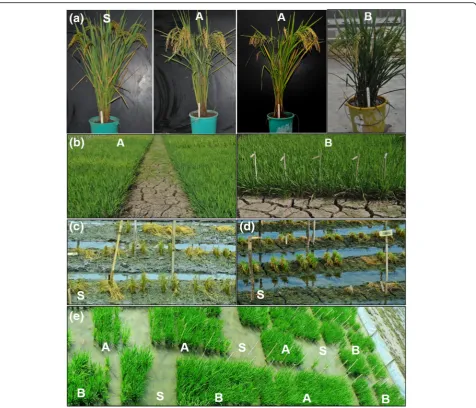
The NILs in Swarna background with either single or mul-tiple QTL produced grain yield advantage over Swarna (Additional file 1: Table S2; Fig. 1). The NILs with
qDTY3.1+Sub1 showed grain yield advantage that ranged
from 76 to 2479 kg ha−1 and 396 to 2376 kg ha−1 over Swarna under NS respectively. Grain yield advantage of 292 to 1118 kg ha−1and 284 to 2086 kg ha−1was observed in
qDTY1.1 + qDTY2.1+qDTY3.1+Sub1 and qDTY2.1+
qDTY3.1+Sub1 NILs respectively over Swarna under RS
(Additional file 1: Table S2). The grain yield advantage of NILs having qDTY1.1+qDTY3.1+Sub1 QTL combination
ranged from 37 to 1350 kg ha−1and 95 to 629 kg ha−1over Swarna under NS and RS, respectively. In addition, the two QTL classes (qDTY1.1 + qDTY2.1+qDTY3.1+Sub1 and
qDTY2.1+qDTY3.1+Sub1) showed consistently higher
per-formance than other QTL classes under both NS and RS across advancing generations (Additional file1: Table S2).
The NILs with days to 50% flowering less than that of Swarna and Swarna-Sub1 under NS and RS were identified (data not shown). Most of the NILs showed similar plant height as that of Swarna and Swarna-Sub1 under NS and less under RS (data not shown).
QTL × environment
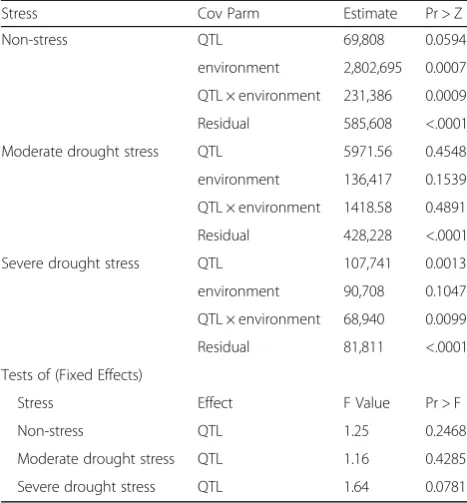
The variance component for QTL × environment inter-action was significant at all stress levels; non-stress, moderate drought stress and severe drought stress. A significant environment variance component was ob-served in the case of non-stress experiments. The QTL main effect was significant only under severe drought stress (Table1).
Fig. 1aThe morphological differences between Swarna and introgressed NILs;bfield view of introgressed NILs under reproductive stage
drought stress condition; submergence tolerance of introgressed NILs compared to Swarna (c) one day after draining;dsix day after draining;
erecovery of introgressed NILs compared to Swarna one month after draining. S: Swarna, A: introgressed NIL withqDTY2.1+qDTY3.1+Sub1B:
The selected NILs showed significant yield advantage over recipient parent Swarna under reproductive stage drought indicating capture of positive interaction between QTL × QTL or QTL × genetic background utilizing strat-egy combining genotypic and phenotypic selection for grain yield under NS and RS.
Performance of Swarna NILs with different QTL combinations across different locations
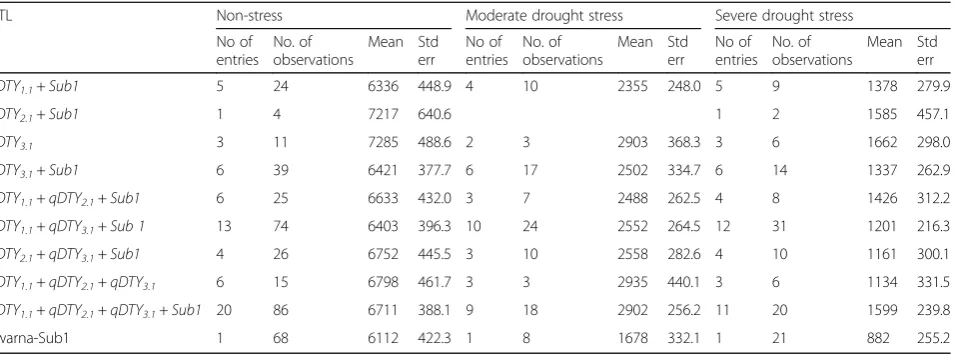
The tested NILs across all location and trials (Additional file 1: Table S1) were pooled together and categorised based on QTL combinations into three different stress levels; non-stress, moderate drought stress and severe drought stress. The NILs with qDTY1.1 + qDTY2.1+
qDTY3.1+Sub1, qDTY1.1 + qDTY3.1+Sub1 and qDTY3.1
+Sub1 had shown consistent grain yield advantage across different locations and seasons (Table2).
Selection of promising NILs
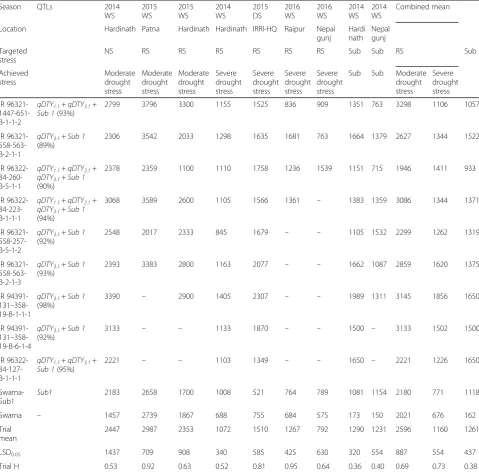
Seeds of the selected promising lines (48 lines in 2014WS) were multiplied and shared with NARES (National Agri-cultural Research and Extension Systems) partners for fur-ther screening across multi locations under NS, RS and submergence conditions. The selected NILs showed grain yield advantage over both Swarna and Swarna-Sub1 under NS, RS and submergence stress conditions. Under NS and RS, IR 94391-131-358-19-B-1-1-1 showed highest grain yield advantage followed by IR 96322-34-223-B-1-1-1 and IR 96322-34-127-B-1-1-1 over Swarna (Table 3). Similar pattern of grain yield advantage was observed for NILs
over Swarna-Sub1 under NS and RS (Table3). The three selected promising NILs had shown grain yield advan-tage ranged from 109 to 2382 kg ha−1 over Swarna and 99 to 2448 kg ha−1 over Swarna-Sub1 under NS (Table 3). Under RS, the grain yield advantage of three selected promising NILs ranged from 415 to 1933 kg ha−1 over Swarna and 38 to 1786 kg ha−1 over Swarna-Sub1 (Table 4). The selected NILs had shown consistent performance across different locations and seasons. Under submergence conditions, the NIL IR 94391-131-358-19-B-1-1-1 had shown highest grain yield advantage followed by IR 96322-34-127-B-1-1-1 and IR 96322-34-223-B-1-1-1 over Swarna and Swarna-Sub1 both.
In addition, other NILs such as IR 96321-1447-651-B-1-1-2, IR 96321-558-563-B-2-1-3 and IR 94391-131-358-19-B-6-1-4 had shown grain yield advan-tage that ranged from 72 to 1600 kg ha−1, 155 to 1556 kg ha−1 and 38 to 828 kg ha−1 over Swarna-Sub1, respect-ively under RS (Table4). The promising NILs had shown better survival percentage over Swarna-Sub1 under 13 and 21 days of submergence. The survival percentage ranged from 83 to 96% after 14 days of submergence period and 75 to 92% after 21 days of submergence (Table5).
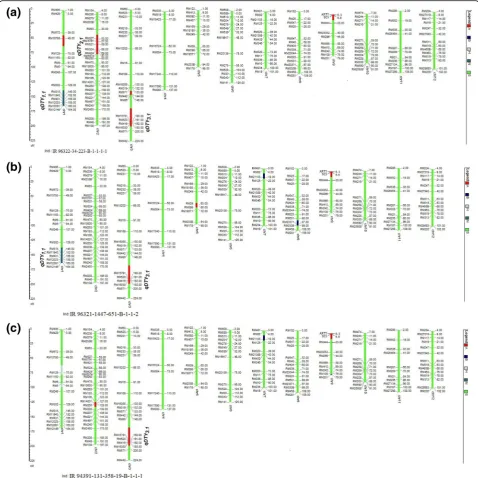
Performance of selected NILs under national trials The selected nine promising lines were nominated under All India Co-ordinated Rice Improvement Program (AICRIP) in India and in Nepal for varietal release. The 156 polymorphic SSRs markers were used to study the percentage background recovery of selected nine promis-ing lines. The percentage background recovery ranged from 89 to 98% (Tables3,4and5). In addition, out of the nine selected lines, 5 promising lines with good perform-ance over locations (IR 96321-1447-651-B-1-1-2, IR 96322-34-223-B-1-1-1, IR 96321-558-257-B-5-1-2, IR 96321-558-563-B-2-1-3 and IR 96322-34-127-B-1-1-1) were genotyped using 6 K SNP chip. Among these five, IR 96322-34-223-B-1-1-1-1 in India and IR 94391-131-358-19-B-1-1-1 and IR 96321-1447-651-B-1-1-2 in Nepal have been released/identified for release as varieties. The graphical representation of the allelic distribution of the three NILs released as varieties (IR 96322-34-223-B-1-1-1-1, IR 96321-1447-651-B-1-1-2 and IR 94391-131-358-19-B-1-1-1) across 12 rice chromosomes is presented in Fig. 2. The performance of IR 96322– 34-223-B-1-1-1-1 in comparison with Swarna-Sub1 and Swarna across 2015WS and 2016WS at 18 different loca-tions under NS, RS and submergence condiloca-tions in AICRIP is presented in Fig. 3. The Swarna-Sub1 NIL, IR 96322–34-223-B-1-1-1-1 having qDTY1.1 + qDTY2.1+
qDTY3.1+Sub1has been released for cultivation in India
in 2017 as variety under name‘CR dhan 801’. It has ma-turity duration of 125 to 130 days, suitable to be grown
Table 1The mixed model (REML) parameters of the combined analysis for all three stresses levels
Stress Cov Parm Estimate Pr > Z
Non-stress QTL 69,808 0.0594
environment 2,802,695 0.0007
QTL × environment 231,386 0.0009
Residual 585,608 <.0001
Moderate drought stress QTL 5971.56 0.4548
environment 136,417 0.1539
QTL × environment 1418.58 0.4891
Residual 428,228 <.0001
Severe drought stress QTL 107,741 0.0013
environment 90,708 0.1047
QTL × environment 68,940 0.0099
Residual 81,811 <.0001
Tests of (Fixed Effects)
Stress Effect F Value Pr > F
Non-stress QTL 1.25 0.2468
Moderate drought stress QTL 1.16 0.4285
under shallow to medium lowland areas, have short bold grain type, plant height of 80 to 98 cm, and an average yield of 5.0 to 5.5 t ha−1.
The performance of IR 94391-131-358-19-B-1-1-1 and IR 96321-1447-651-B-1-1-2 in comparison with Swarna-Sub1 in 2014WS and 2015WS at 6 different locations in Nepal under NS in national trials is shown in Fig.4a. The performance of IR 94391-131-358-19-B-1-1-1 and IR 96321-1447-651-B-1-1-2 in comparison with Swarna and Swarna-Sub1 in 2015WS at Hardinath under NS, RS and Submergence conditions is presented in Fig. 4b. The Swarna-Sub1 NILs, IR 96321-1447-651-B-1-1-2 having
qDTY1.1+qDTY3.1+Sub 1 and IR
94391-131-358-19-B-1-1-1 having qDTY3.1+Sub 1 have been released as
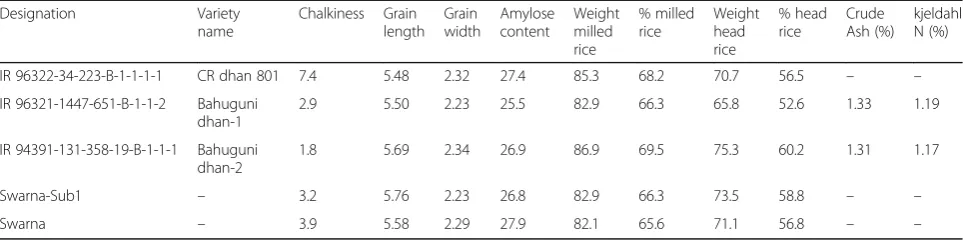
varieties in Nepal in 2017 under name‘Bahuguni dhan-1’ and ‘Bahuguni dhan-2’, respectively. Both these varieties have maturity duration of 130 to 135 days, plant height of 95 to 105 cm, and shown average grain yield of 4.5 to 5.5 t ha−1. The grain quality parameters of released varieties in comparison to Swarna and Swarna-Sub1 are presented in Table 6. Bahuguni Dhan 1 is fine grain and Bahuguni Dhan 2 has medium grain type as Swarna. The background recov-ery of 94%, 93% and 98% was observed for IR 96322-34-223-B-1-1-1-1, IR 96321-1447-651-B-1-1-2 and IR 94391-131-358-19-B-1-1-1, respectively on 6 K SNP Infinium chip.
Discussion
Farmers in drought and submergence prone areas are mainly cultivating the abiotic stress susceptible rice var-ieties primarily due to their good grain yield potential and market-driven grain quality traits. The performance of these varieties is generally good during the non-drought-submergence affected years (Dar et al. 2018).
However, during the natural calamities, large reduction in grain yield is observed in these varieties due to their inability to survive and yield under drought or submer-gence or both. Some of the rice growing regions are equally vulnerable to both drought and submergence. There is a need to look at the problem of farmers in a holistic way to improve the resilience of farmer’s liveli-hood so that food and other basic needs can be met on a sustainable basis. Development of dual flood and drought tolerant rice varieties lead to the overall in-crease in the farm output, farmer’s income and will improve the livelihood systems of rice farming communities.
The introduction of marker-assisted breeding in agriculture has provided new opportunities towards the introgression of identified trait associated genes/ QTLs in several popular rice varieties (Dixit et al. 2017; Shamsudin et al. 2016). The grain yield advan-tage over Swarna and Swarna-Sub1 under RS drought stress and submergence, of those NILs possessing earl-ier identified major and consistent-effect QTLs,
qDTY1.1 (Vikram et al. 2011; Ghimire et al. 2012;
Sandhu et al. 2014), qDTY2.1 (Venuprasad et al. 2009;
Sandhu et al. 2014), qDTY3.1(Dixit et al. 2014;
Venu-prasad et al. 2009) and Sub1 (Neeraja et al. 2007) in the current marker-assisted backcrossing breeding programs indicates the suitability of these loci in im-proving drought-submergence tolerance in the Swarna background. In addition, the selected NILs showed significant grain yield advantage under NS as the se-lection for grain yield under both NS and RS was made across generation advancement. IR 96322-34-223-B-1-1-1 showed grain yield advantage of 2 to 54% under NS (Table 3) and 1 to 17% under moderate to severe drought stress (Table 4) over the combined
Table 2The mean grain yield performance of Swarna NILs with different QTL combinations across different locations at three different stress levels
QTL Non-stress Moderate drought stress Severe drought stress
No of entries
No. of observations
Mean Std err
No of entries
No. of observations
Mean Std err
No of entries
No. of observations
Mean Std err
qDTY1.1+Sub1 5 24 6336 448.9 4 10 2355 248.0 5 9 1378 279.9
qDTY2.1+Sub1 1 4 7217 640.6 1 2 1585 457.1
qDTY3.1 3 11 7285 488.6 2 3 2903 368.3 3 6 1662 298.0
qDTY3.1+Sub1 6 39 6421 377.7 6 17 2502 334.7 6 14 1337 262.9
qDTY1.1+qDTY2.1+Sub1 6 25 6633 432.0 3 7 2488 262.5 4 8 1426 312.2
qDTY1.1+qDTY3.1+Sub 1 13 74 6403 396.3 10 24 2552 264.5 12 31 1201 216.3
qDTY2.1+qDTY3.1+Sub1 4 26 6752 445.5 3 10 2558 282.6 4 10 1161 300.1
qDTY1.1+qDTY2.1+qDTY3.1 6 15 6798 461.7 3 3 2935 440.1 3 6 1134 331.5
qDTY1.1+qDTY2.1+qDTY3.1+Sub1 20 86 6711 388.1 9 18 2902 256.2 11 20 1599 239.8
Swarna-Sub1 1 68 6112 422.3 1 8 1678 332.1 1 21 882 255.2
mean across seasons and locations. IR 94391-131-358-19-B-1-1-1 showed grain yield advantage of 5 to 19% under NS (Table 3) and 8 to 24% under moderate to se-vere drought stress (Table 4) over the combined mean across seasons and locations. Similarly, IR 94391-131-358-19-B-1-1-1 showed grain yield improvement of 3 to 48% under NS (Table3) and 4 to 38% under moderate to severe drought stress (Table 4) over the combined means across seasons and locations. The improvement of 0.8 to 1.0 t ha−1in the yield of pyramided lines in different
backgrounds as reported earlier (Vandana, IR64, MTU1010, TDK1, and MRQ74) (Kumar et al. 2014; Sandhu and Kumar2017) as well as in the current study validates the success of QTL introgression in improving grain yield and tolerance to multiple stresses. The devel-oped NILs were previously shown to perform well across different severity/intensity of drought and in regions with different conditions/ soil types (Singh et al.2017). Some of the selected NILs showed early days to flowering than Swarna under NS (data not shown) and this may have
Table 4The mean grain yield (kg ha−1) performance of selected promising lines across different locations and seasons under moderate and severe reproductive stage drought stress (RS) and submergence conditions (Sub)
Season QTLs 2014
WS
2015 WS
2015 WS
2014 WS
2015 DS
2016 WS
2016 WS
2014 WS
2014 WS
Combined mean
Location Hardinath Patna Hardinath Hardinath IRRI-HQ Raipur Nepal gunj
Hardi nath
Nepal gunj
Targeted stress
NS RS RS RS RS RS RS Sub Sub RS Sub
Achieved stress
Moderate drought stress
Moderate drought stress
Moderate drought stress
Severe drought stress
Severe drought stress
Severe drought stress
Severe drought stress
Sub Sub Moderate drought stress
Severe drought stress
IR 96321- 1447-651-B-1-1-2
qDTY1.1+qDTY3.1+ Sub 1(93%)
2799 3796 3300 1155 1525 836 909 1351 763 3298 1106 1057
IR 96321- 558-563-B-2-1-1
qDTY3.1+Sub 1 (89%)
2306 3542 2033 1298 1635 1681 763 1664 1379 2627 1344 1522
IR 96322- 34-260-B-5-1-1
qDTY1.1+qDTY2.1+ qDTY3.1+Sub 1 (90%)
2378 2359 1100 1110 1758 1236 1539 1151 715 1946 1411 933
IR 96322- 34-223-B-1-1-1
qDTY1.1+qDTY2.1+ qDTY3.1+Sub 1 (94%)
3068 3589 2600 1105 1566 1361 – 1383 1359 3086 1344 1371
IR 96321- 558-257-B-5-1-2
qDTY3.1+Sub 1 (92%)
2548 2017 2333 845 1679 – – 1105 1532 2299 1262 1319
IR 96321- 558-563-B-2-1-3
qDTY3.1+Sub 1 (93%)
2393 3383 2800 1163 2077 – – 1662 1087 2859 1620 1375
IR 94391-131– 358-19-B-1-1-1
qDTY3.1+Sub 1 (98%)
3390 – 2900 1405 2307 – – 1989 1311 3145 1856 1650
IR 94391-131– 358-19-B-6-1-4
qDTY3.1+Sub 1 (92%)
3133 – – 1133 1870 – – 1500 – 3133 1502 1500
IR 96322- 34-127-B-1-1-1
qDTY1.1+qDTY3.1+ Sub 1(95%)
2221 – – 1103 1349 – – 1650 – 2221 1226 1650
Swarna-Sub1 Sub1
2183 2658 1700 1008 521 764 789 1081 1154 2180 771 1118
Swarna – 1457 2739 1867 688 755 684 575 173 150 2021 676 162
Trial mean
2447 2987 2353 1072 1510 1267 792 1290 1231 2596 1160 1261
LSD0.05 1437 709 908 340 585 425 630 320 554 887 554 437
Trial H 0.53 0.92 0.63 0.52 0.81 0.95 0.64 0.36 0.40 0.69 0.73 0.38
DSdry season, WSwet season, NSnon-stress, RSreproductive stage drought stress, SubSubmergence stress DS dry season,IRRI HQ IRRI headquarter (Philippines),
resulted from the linkages of the qDTYs with earliness (Vikram et al.2016). The plant height of most of the se-lected NILs were similar to the PHT of Swarna under NS but higher under RS (data not shown), this may be due to their increased ability to produce more biomass under RS. The linkage has been successfully broken and semi-dwarf, medium duration NILs in Swarna background have been developed.
QTL × environment interaction is a phenomenon in which QTL effects may significantly differ across envi-ronments. In the present study, the significant QTL × environment interaction for all the stress levels and the release of varieties with different combinations of QTLs in different ecosystems indicating the role of environ-ment in influencing the effect of QTLs. The expression of introgressed genomic loci affecting grain yield and yield contributing components is influenced by the en-vironment and the same loci may have differential effects in different ecosystems, signifying strong QTL × environment interaction (Xing et al. 2002). In the present study, the differential performance of NILs with same QTL combination in same or different ecosystem could be due to unknown QTL x genetic background interactions. There is urgent need to identify such epi-static gene interactions which complicates the genotype phenotype relationship of complex trait (Carlborg and Haley2004) such as drought and submergence.
The phenotypic screening of NILs under different stresses; non-stress, drought stress and submergence conditions revealed huge variation among different com-binations of QTLs. The selection of NILs outperforming under different intensities of multiple stresses allows the selection of lines with desirable characteristics. The se-lected lines with significantly high grain yield advantage
over Swarna under both NS as well as RS captured posi-tive interaction due to both genotypic and phenotypic selection practised in the present study, a strategy sug-gested to be followed in marker assisted breeding for abiotic stress tolerance till all such unknown interactions are identified. Revealing of such epistatic interactions, between introgressed QTL and genetic background sheds light in understanding the differential phenotypic expression of introgressed/pyramided lines for quantita-tive traits that can be useful in future marker-assisted se-lection programs.
In our study, across ecosystems in India and Nepal, Swarna and Swana-Sub1 showed similar performance under drought at majority of the locations as against Swarna-Sub1 reported to show higher performance over Swarna under drought (Fukao et al.2011).
The release of marker-assisted breeding product for drought earlier in IR64 background (Sandhu and Kumar 2017) and now in the present study in Swarna-Sub1 background are successful examples that should encourage breeders to use QTLs in the breed-ing programs targetbreed-ing grain yield improvement under abiotic stresses. This is one of the first studies in rice developing stable and high-yielding varieties combin-ing both drought and submergence tolerance in a high yielding variety background through marker-assisted backcrossing breeding successfully released as varieties for cultivation by farmers. In the present study, we observed improved performance of selected NILs over Swarna and Swarna-Sub1 under drought and submer-gence but we are yet to evaluate the lines under vary-ing incidences of subsequent submergence and drought in the same season and observe plants adapta-tion. Even after affected by submergence under which duration of varieties increases by 10–12 days, the de-veloped NILs showed an average of 10 days earlier flowering than Swarna-Sub1. This will allow the timely planting of second season crop hence enhancing sus-tainable productivity. The yield improvement across three different backgrounds, TDK-Sub1 (Dixit et al. 2017), IR64-Sub1 (data not published) and Swarna-Sub1 (present study) possessing both QTLs combining drought (DTYs) and submergence (Sub1) clearly indi-cates that the drought and submergence tolerance can be efficiently combined even though both have differ-ent molecular and physiological regulatory mecha-nisms. QTLs on grain yield under drought has been reported to effect water-uptake, stomatal conductance, canopy temperature, transpiration and root growth at depth (Henry et al. 2014, 2015) whereas the physio-logical evidence for the submergence tolerance points towards the proper balance between the production and consumption of plant assimilates (Singh et al.2014; Kretzschmar et al. 2015), fast coleoptile elongation,
Table 5Survival percentage (%) of NILs screened at Patna in 2015DS under submergence conditions
Designation Background
recovery (%)
Survival %
14 daysa 21 daysa
IR 96321-315-323-B-3-1-3 93 96 82
IR 96321-315-323-B-3-1-1 93 90 82
IR 96321-558-209-B-6-1-1 98 83 82
IR 96321-558-257-B-4-1-2 91 92 92
IR 96321-1099-227-B-3-1-3 90 94 89
IR 96321-558-563-B-2-1-3 95 87 75
IR 96321-558-563-B-2-1-1 89 88 81
Swarna Sub 1 – 85 54
Swarna – 58 6
LSD0.05 – 7 26
a
Submergence period, date of seeding 17-2-2015, Date of first-time
expansin genes expression, and lower cell division and peroxidase activity (Magneschi and Perrata2009). “The development and release of three drought-submergence tolerant varieties (CR dhan 801, Bahuguni dhan-1 and Bahuguni dhan-2) for cultivation in rainfed lowland areas of India and Nepal are successful examples of contribution of use of genomic tools to improve yield under drought and submergence”.
Conclusions
Over last one-decade marker assisted breeding for abi-otic stress has moved from just improving yield under drought or submergence to combining high yield potential with good yield under multiple stresses. The nine selected promising NILs with different QTL com-bination showed an average grain yield advantage of 0.2 to 1.7 t ha−1 under RS and 0.1 to 1.0 t ha−1 under
Fig. 2Graphical representation of the background recovery of NILs (a) IR 96322-34-223-B-1-1-1-1 (b) IR 96321-1447-651-B-1-1-2 (c) IR
94391-131-358-19-B-1-1-1 using molecular marker data was performed in Graphical Genotypes (GGT 2.0) software (Van Berloo1999). Apo parent allele, N22
Fig. 3The grain yield performance of IR 96322-34-223-B-1-1-1-1 in comparison with Swarna-Sub1 and Swarna (a) under NS {control for RS};b
under RS;cunder NS {control for Submergence};dunder Submergence in 2015WS and 2016WS in different locations under AICRIP trials in India.
CMB: Coimbatore, CUT: Cuttack, GGT: Ghaghraghat, HZG: Hazaribag, MUG: Mugad, MRT: Maruteru, PAT: Patna, PUS: Pusa, RPR: Raipur, REW: Rewa,
SIR: Sirsi, VAR: Varanasi, WRN: Warangal, DS: dry season, WS: wet season, NS–non-stress, RS: reproductive stage drought stress, mod: moderate
drought stress, sev: severe drought stress
submergence conditions with no yield penalty under NS. The three drought-submergence tolerant varieties CR dhan 801, Bahuguni dhan-1 and Bahuguni dhan-2 have been released for cultivation in India and Nepal. The marker-assisted derived drought and submer-gence tolerant rice varieties will help to reduce the yield losses associated with farming in drought-flood prone rainfed lowland areas, provide farmers with in-surance of good yield and shall encourage marker-breeding programs developing better varieties tolerant to multiple abiotic and biotic stresses.
Material and methods
Plant material
Swarna, the popular rice variety, (released in 1979) and cultivated in 30–40% of rainfed lowland areas (~ 4.3 mil-lion ha) was chosen as a recipient to develop NILs using marker assisted backcrossing approach. Swarna-Sub1, the submergence tolerant NIL of Swarna was selected as the donor forSub1gene. This variety is a long duration (140– 145 days), medium-tall (95–100 cm), medium bold grain type with high tillering and an average yield of 6000–6200 kg ha−1 was selected as donors for Sub1. Swarna-Sub1 provided yield advantage over Swarna under submergence condition. It has high head hulling percentage, high rice recovery and intermediate amylose content. Instead of traditional donors, advanced breeding lines possessing QTLs with high-yield potential were used in marker assisted breeding. IR 91659-54-35, an improved BC3F3
breeding line from the mapping population N22/Swarna possessing qDTY1.1, IR 81896-B-B-195, an improved
BC1F5 line from Apo/Swarna population possessing
qDTY2.1 and qDTY3.1 and Swarna-Sub1 possessing Sub1
gene were used in the marker-assisted backcrossing pro-gram to combine three drought QTLs andSub1 gene in Swarna background.
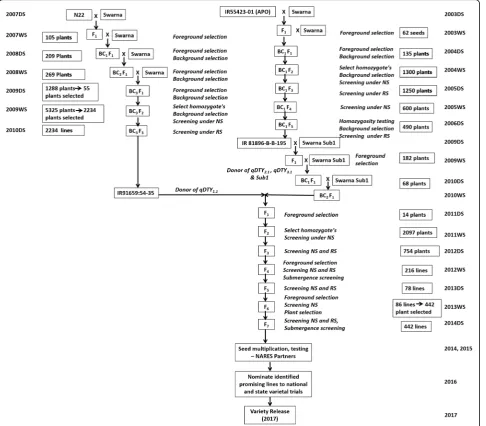
Development of NILs in Swarna-Sub1 background The crossing scheme to develop NILs in Swarna-Sub1 background was initiated in 2009DS (DS: dry season), the NIL IR 81896-B-B-195, an improved BC1F5line from
Apo/Swarna population possessing QTLs qDTY2.1 and
qDTY3.1 was crossed with (Swarna-Sub1), F1 was two
times backcrossed with IR05F102 (Swarna-Sub1). In 2010WS (WS: Wet season), a BC2F1 plant possessing
qDTY2.1,qDTY3.1 andSub1 was crossed with IR 91659–
54-35, an improved BC3F3 breeding line from the
map-ping population N22/Swarna possessing qDTY1.1. The
backcrossed line IR 81896-B-B-195 used for introgres-sion and pyramiding of qDTY2.1, qDTY3.1 QTLs came
from the mapping population developed for identifica-tion of QTLs, from a crossing plan initiated in 2003DS (Fig. 5). The backcrossed line IR 91659-54-3-5 carrying
qDTY1.1was developed using N22 as donor, a crossing
pro-gram initiated in 2007DS (Fig.5). The detailed description on backcrossing, phenotypic plant selection, foreground, re-combinant and background selection genotyping to identify NILs with desirable plant and grain type having intro-gressed QTLs is presented in Fig.5. The markers linked to the QTLs targeted for introgression; qDTY1.1 (RM315,
RM11943, RM431, RM12023, RM12091and RM12233),
qDTY2.1(RM5791, RM327, RM521, RM3549, RM324, and
RM6374, RM424) and qDTY3.1 (RM15791, RM416,
RM16030, RM520) and Sub1 (ART5, SC3) were used for foreground selection in Swarna background.
Description on experiments and agronomic management The breeding lines were developed and screened under lowland transplanted control (non-stress; NS); lowland reproductive-stage drought stress conditions (RS) and seedling stage submergence condition (Sub). For evalu-ation of the introgressed lines and to identify the su-perior lines, a total of 60 experiments were conducted in Philippines (IRRI), Nepal (Hardinath, Nepalgunj) and India (Hyderabad, Sabour, Faizabad, Madhepura, Dhangain, Patna, Varanasi, Tripura, Cuttack, Hazaribagh and Raipur) from 2014DS to 2016WS. In all experiments each plot was 1 to 4 or more (advanced national trials) rows of 3 to 5 m plot length, with 0.20 m row-to-row spacing and 0.15-m plant to plant spa-cing. Nursery bed was raised and 21 to 25-days old
Table 6Grain quality parameters of the varieties released in India and Nepal in Swarna background in 2017
Designation Variety name
Chalkiness Grain length
Grain width
Amylose content
Weight milled rice
% milled rice
Weight head rice
% head rice
Crude Ash (%)
kjeldahl N (%)
IR 96322-34-223-B-1-1-1-1 CR dhan 801 7.4 5.48 2.32 27.4 85.3 68.2 70.7 56.5 – –
IR 96321-1447-651-B-1-1-2 Bahuguni dhan-1
2.9 5.50 2.23 25.5 82.9 66.3 65.8 52.6 1.33 1.19
IR 94391-131-358-19-B-1-1-1 Bahuguni dhan-2
1.8 5.69 2.34 26.9 86.9 69.5 75.3 60.2 1.31 1.17
Swarna-Sub1 – 3.2 5.76 2.23 26.8 82.9 66.3 73.5 58.8 – –
seedlings were transplanted. The agricultural manage-ment practices were followed as Vikram et al. (2011).
Screening for reproductive stage drought stress
The non-stress experiments were conducted under ir-rigated, flooded, puddled, transplanted, and anaerobic conditions with no drought and submergence stress. The reproductive-stage drought stress experiments re-ferred to the experiments maintained as described by Sandhu et al. (2014). Depending on the site’s ability to measure data, tensiometers (at 30 cm depth), water pipes (1.1 m length) were installed and rainfall data was recorded across different years (Additional file 1: Figure S1). These measurements were collected from
50 to 100 days after seeding (DAS), which approxi-mately represents the reproductive stage of the NILs evaluated under reproductive stage drought stress. For the reproductive stage drought stress, the stress was initiated at 50–52 days after seeding, after which the drought stress treatment was maintained depending on the rainfall. When the tensiometers reading ranged from −50 to −70 kPa, and the water table in PVC dropped to 100 cm from the soil surface and wilting and drying of leaves were observed (data not shown), the plots were re-irrigated. This cyclic screening at reproductive stage allows the precise screening of breeding lines with wide range of growth duration (Lafitte et al.2004).
Screening for submergence tolerance
The screening for submergence tolerance was carried out in Nepal (Hardinath, Nepalgunj) and India (Faizabad, Madhepura, Dhangain, Patna). The protocol for the screening for submergence tolerance was as described in Dixit et al. (2017). Selected NILs were planted in the nur-sery beds along with Swarna, Swarna-Sub1 and susceptible check IR42. The field was submerged for about two weeks from 14 days after seeding (DAS) to 27 days after seeding and then field was drained. The final recovery was re-corded seven days after draining (Dixit et al. 2017). The tolerance to submergence was recorded on 1–9 scale of increasing order of susceptibility based on the standard evaluation system for submergence tolerance (IRRI2002). In dry season, the submergence screening was conducted in a concrete tank facility. The selected lines were seeded in the seeding trays and at 14 DAS the trays were sub-merged along with IR42. The concrete tanks were drained on 30 DAS depending upon the survival of IR42, the sus-ceptible check. The numbers of seedlings survived per line were recorded before submergence and at 2, 7, 14, and 21 days after draining the tanks, and percentage survival was calculated (Dixit et al.2017). Survival percentage = (num-ber of seedling survived after submergence/total num(num-ber of seedlings planted)*100.
Phenotypic evaluation
Key traits such as days to 50% flowering (DTF, days), plant height (PHT, cm), grain yield (GY, kg ha−1) were measured and submergence was scored based on 1–9 scale. Days to 50% flowering referred to the day when more than 50% of the plants in plot showed panicle ex-ertion. Plant height from root-shoot base to the highest panicle was recorded from three plants per plot and av-eraged. Grain yield data was recorded per plot and nor-malized for moisture content to 14% before final yield computation in kg ha−1. Plant and panicle selections were made to get grain type similar to Swarna.
Genotyping
Genotyping work was carried out at GSL (Genotyping Service Laboratory); IRRI Genomic DNA was extracted from leaves of 21 days old seedling using modified CTAB method (Murray and Thompson1980).
The polymorphic markers linked to qDTY1.1 (RM315,
RM11943, RM431, RM12023, RM12091, RM12146 and RM12233; Vikram et al. 2011), qDTY2.1 (RM5791,
RM327, RM521, RM3549, RM324, and RM6374, RM424; Venuprasad et al.2009) andqDTY3.1 (RM15791, RM416,
RM16030, and RM520; Venuprasad et al.2009) andSub1 (ART5; Septiningsih et al.2009) was used for foreground selection in Swarna background. A total of 156 poly-morphic markers out of a total of 600 were used for the background study. PCR (polymerase chain reaction)
amplification was carried out to check and confirm the introgressed loci and the amplicon size was checked on non-denaturing 6% or 8% PAGE (polyacrylamide gel elec-trophoresis) depending on size of amplicon. SYBR SafeTM was used to stain the gel, viewed after 20 min, and allelic profile was recorded. Stepwise and precise selection involving both phenotyping and genotyping strategies were used to select and advance the plants with desired introgressed loci in every generation. The background genotyping of selected Swarna-Sub1 NILs was also done at GSL- IRRI using 6 K SNP Infinium chip.
Evaluation of NILs in national trials
In India, in 2015, in All India Coordinate Rice Improve-ment Project (AICRIP), IR 96322-34-223-B-1-1-1-1 was evaluated along with 17 other introgressed lines and their respective recurrent parents, sensitive checks and donor parents of drought QTLs (IR 81896-B-B-195) in the Advance Variety Trial 1-Near Isogenic Line-Drought and Submergence’ (AVT1 NIL-Drt and Sub). The experiment was conducted at six locations (Cuttack, Pusa, Chinsurah, Titabar, Gerua and Ghagharaghat) to evaluate the entries under submer-gence and normal irrigated conditions. For drought stress as well as control conditions, trials were evalu-ated at four locations (ICAR-Patna, Varansai, Rewa and Coimbatore). In 2016, the entries that were promising during 2015 that includes IR 96322-34-223-B-1-1-1-1 along with recurrent parents, sensitive checks and donor parents of drought QTLs (IR 81896-B-B-195) were evaluated at eight locations (Maruteru, Chinsurah, Gerua, Moncompu, Pusa, NRRI, Ghaghraghat, Titabar) for submergence and at six locations (Gangavati, Masodha, Mugad, ICAR-Patna, Warangal and Coimbatore) for drought stress. At these locations, experiment was also con-ducted under normal irrigated conditions.
In both the years and at all locations in both stress and normal situations, the experiment was laid out in three replications in the randomized complete block design (RCBD), following the spacing of 20 × 15 cm in a plot size of 15 m2. Sowings under submergence were taken up in the last week of June and plantings in the last week of July to first week of August. Under normal irrigated conditions, sowings were taken up in the last week of June to first week of July and plantings in the last week of July to first week of August. In case of drought stress conditions, sowings were taken up from last week of June to second week of July and plantings from last week of July to second week of August. Fertil-izers were applied as N:P2O5:K2O (90:30: 30) kg ha−1in
control trials. In drought trials, fertilizer dose of 75:30:30 N:P2O5:K2O was applied. Observations were
and harvest index. Under drought stress conditions, data was recorded on number of rain free days during crop growth season and stage of crop under drought stress was noted along with the severity of the stress. Protective irrigations were given at critical crop growth stages depending on the severity of the drought im-posed as observed from the performance of susceptible checks and the recurrent parents. Under submergence stress, water stagnation of 30–80 cm was maintained.
A total of 46 Swarna-Sub1 + drought QTLs intro-gressed NILs were evaluated in three environments namely as control, reproductive drought stage stress and submergence at National Rice Research Program (NRRP, Hardinath, Nepal) during 2014 and 2015. The seeding date was June 19 in 2014 and June 18 in 2015. The twenty-one days old seedlings were transplanted in each trial. Two selected breeding lines, IR 96321– 1447-651-B-1-1-2 and IR 94391–131–358-19-B-1-1-1 were evaluated in the National Coordinated Varietal Trials (NCVT) at Regional Agricultural Research Station, Tarahara, Parwanipur, Nepalgunj, and Lumle, National Maize Research Program, Rampur, National Wheat Research Program, Bhairahawa, under rainfed condition in 2015WS and 2016WS. All the experiments at NRRP Hardinath were laid out in alpha lattice with three replications where as in NCVT, the experiments were laid in RCBD design with two replications. The spacing was 20 cm between rows and 20 cm between plants. The plot size was 5 × 2 m2. Fertilizers were ap-plied as N:P2O5:K2O (90:30: 30) kg ha−1. In drought
trials, fertilizer dose of 75:30:30 N:P2O5:K2O was
ap-plied. The submergence trial was subjected to 15 days complete submerge and then field was de-submerged. Seeding of drought stress trail was delayed by 25 days from normal planting so that rainy season terminated with the onset of reproductive stage of the crop. Trench was constructed around trial having the drought experiments to prevent seepage of water from other fields as well as for efficient drainage for drought imposition. In drought trials, tensiometer was installed to monitor soil moisture during the crop in the drought field. Pizzometer was also installed to monitor water table from the drought field. The observations on heading days, plant height (cm), and grain yield were recorded.
Statistical analysis
Step 1: Single-trial analysis
Experimental designs across trials varied. For all the ex-periments with alpha lattice design, the effects of repli-cations and blocks within replication were considered as random and lines as fixed. The model used for alpha lat-tice (AL) design was:
yijk ¼μþgiþrjþbljþeijk;
For the Randomized Complete Block Design (RCBD) was:
yijk¼μþgiþrjþeijk
For the augmented RCBD, the model used was:
yijk¼μþgiþblþeilk
whereμrepresents overall mean,girepresents the effect of theithgenotype,rjrepresents the effect of thejth rep-licate, bljrepresents the effect of thelth block within the
jth replicate, b
l represents the effect of the lth block and
eijkis the error.
Step 2: Mean comparison of qDTY and Sub1 combinations
The performance of the breeding lines nested within the QTL class in the block within the replicate is modeled as follows:
yijkl¼μþrkþb rð Þklþqiþg qð Þijþeilkl
whereμ is the population mean,rkis the effect of the
kthreplicate,b(r)
kl+qiis the effect of thelthblock within
the kth replicate, qi is the effect of the ith QTL, g(q)ij is
the effect of the jth genotype nested within the ith QTL and eijkl is the error. The effects of QTL and genotypes
within QTL are considered fixed while the replicate and blocks within replicate effects are considered random. ANOVA and F test using SAS v9.2 were used to see whether the QTL classes differed significantly from each other.
Step 3: Q × E interaction model based on genotype means
Based on the trial mean grain yield, each experiment was re-classified for the observed drought stress inten-sity based on the yield reduction compared to non-stress (control) as per Kumar et al. (2009). The trials were clas-sified as non-stress (control); moderate stress (30% to 65% yield reduction); severe stress (greater than 65%); and over-stressed (greater than 85%). Experiments which were classified as being overstressed were excluded from the analysis due to poor expression of their genetic variability.
The linear model used to study the Q×E interactions for the breeding lines tested across environment was:
ykmj¼μþqkþg qð Þkjþlmþqlkmþg qlð Þkmjþekmj
Where ykmjis the yield of the jthbreeding line nested
in the kth QTL class in the mth environment, μ is the overall mean,qkis the effect of the kthQTL class,g(q)kj
is the effect of the mthenvironment,qlkmis the effect of
the kth QTL class in the mth environment, g(ql)kmj
g(ql)kmjis the effect of the jthline nested in the kthQTL
class in the mthenvironment,∈kmjekmjis the random error
of the jthline nested in the kthQTL class in the mth envir-onment. (Knapp 2001). All effects except the QTL were considered as random.
Graphical representation of the selected NILs
Graphical representation of the background recovery of NILs using molecular marker data was performed in Graphical Genotypes (GGT 2.0) software (van Berloo 1999). The parent alleles of Swarna- Sub1, Apo, N22, and the heterozygous allele were scored as‘S’,‘A’,‘B’, and
‘H’, respectively. The estimated proportion of the S, A, B, and H alleles in each NIL was calculated using the GGT 2.0.
Additional file
Additional file 1:Table S1.Detailed description on experiments with mean values of days to 50% flowering, plant height and grain yield across different experiments conducted at IRRI and at different location
in India and Nepal between 2014 to 2016.Table S2.Comparison of QTL
classes for mean grain yield (kg ha−1) across generation advancement
under irrigated NS and RS drought stress conditions at IRRI, Philippines.
Figure S1.Rainfall data (mm) collected at different experimental sites during the reproductive stage drought stress screening in (A) 2014, (B) 2015, and (C) 2016. (DOCX 373 kb)
Acknowledgements
We thank Ma. Teresa Sta. Cruz and Paul Maturan for the management of field experiments, Jocelyn Guevarra and RuthErica Carpio for assistance with seed preparations.
Funding
This study was supported by the Bill & Melinda Gates Foundation (BMGF) and the Deutsche Gesellschaft für Technische Zusammenarbeit (GTZ). The authors thank BMGF and GTZ for financial support for the study.
Availability of data and materials
The relevant supplementary data has been provided with the manuscript.
Authors’contributions
NS was involved in conducting the experiments at IRRI, analysis, interpretation of the data, and drafting the manuscript, SD and BPM was involved in developing the pyramided lines and conducting experiments at IRRI, AR was involved in analysis and interpretation of data, SK and SPS was involved in conducting experiments in India, RBY was involved in conducting experiments in Nepal, ONS, JNR, AA, SY and CV was involved in conducting experiments in India, AH was involved in conducting experiments at IRRI, SV, NPM, TR and JB was involved in conducting experiments in India, PV was involved in conducting experiments at IRRI, AK conceived the idea of the study and was involved in critical revision and final approval of the version to be published. All authors read and approved the final manuscript.
Ethics approval and consent to participate
Not applicable.
Consent for publication
The manuscript has been approved by all authors.
Competing interests
The authors declare that they have no competing interests.
Publisher’s Note
Springer Nature remains neutral with regard to jurisdictional claims in published maps and institutional affiliations.
Author details
1International Rice Research Institute, DAPO Box 7777, Metro Manila,
Philippines.2Punjab Agricultural University, Ludhiana, India.3ICAR Research
Complex for Eastern Region, Patna, Bihar, India.4Bihar Agricultural University,
Sabour, Bihar, India.5National Rice Research Program Hardinath, Dhanusha, Nepal.6ICAR-National Rice Research Institute, Cuttack, Odisha, India. 7International Rice Research Institute, South Asia Hub, ICRISAT, Patancheru,
Hyderabad, India.8Indira Gandhi Krishi Vishwavidyalaya, Raipur, Chhattisgarh,
India.9Central Rainfed Upland Rice Research station, National Rice Research Institute, Hazaribagh, Jharkhand, India.10ICAR-Indian Institute of Rice
Research, Hyderabad, India.11International Maize and Wheat Improvement
Centre (CIMMYT), Texcoco, Mexico.
Received: 19 September 2018 Accepted: 11 February 2019
References
Barnabás B, Jäger K, Fehér A (2008) The effect of drought and heat stress on
reproductive processes in cereals. Plant Cell Environ 31(1):11–38
Carlborg Ö, Haley CS (2004) Epistasis: too often neglected in complex trait
studies? Nat Rev Genet 5:618–625
Dar MH, Singh S, Singh US, Zaidi NW, Ismail AM (2014) Stress Tolerant Rice
Varieties-Making Headway in India. SATSA Mukhaptra Ann Tech Issue 18:1–14
Dar MH, Zaidi NW, Waza SA, Verulkar SB, Ahmed T, Singh PK, Roy SB, Chaudhary B, Yadav R, Islam MM, Iftekharuddaula KM (2018) No yield penalty under favorable conditions paving the way for successful adoption of flood tolerant rice. Sci Rep 8(1):9245
Dilley M, Chen RS, Deichmann U, Lerner-Lam AL, Arnold M (2005) Multihazard exposure analysis. In: Natural disaster hotspots: a global risk analysis. Chapter 5, 47-52. The World Bank and Columbia University, Washington, DC Dixit S, Singh A, Sandhu N, Bhandari A, Vikram P, Kumar A (2017) Combining
drought and submergence tolerance in rice: marker-assisted breeding and QTL combination effects. Mol Breed 37:143
Dixit S, Singh A, Sta Cruz MT, Maturan PT, Amante M, Kumar A (2014) Multiple major QTL lead to stable yield performance of rice cultivars across varying drought intensities. BMC Genet 15:16
Fukao T, Yeung E, Bailey-Serres J (2011) The Submergence Tolerance Regulator
SUB1AMediates Crosstalk between Submergence and Drought Tolerance in
Rice. Plant Cell 23:412–427
Ghimire KH, Quiatchon LA, Vikram P, Swamy BM, Dixit S, Ahmed H, Hernandez JE,
Borromeo TH, Kumar A (2012) Identification and mapping of a QTL (qDTY1.1)
with a consistent effect on grain yield under drought. Field Crop Res 131:88–96
Gumma MK, Gauchan D, Nelson A, Pandey S, Rala A (2011) Temporal changes in rice-growing area and their impact on livelihood over a decade: A case
study of Nepal. Agric Ecosyst Environ 142(3–4):382–392
Henry A, Dixit S, Mandal NP, Anantha MS, Torres R, Kumar A (2014) Grain yield
and physiological traits of rice lines with the drought yield QTLqDTY12.1
showed different responses to drought and soil characteristics in upland
environments. Function Plant Bio 41(11):1066–1077
Henry A, Swamy BM, Dixit S, Torres RD, Batoto TC, Manalili M, Anantha MS, Mandal NP, Kumar A (2015) Physiological mechanisms contributing to the QTL-combination effects on improved performance of IR64 rice NILs under
drought. J Exp Bot 66(7):1787–1799
IRRI (2002) Standard Evaluation System for Rice (SES), vol 4. International Rice
Research Institute (IRRI), Los Banos, pp 15–16
Knapp SJ (2001) Mapping quantitative trait loci. In: Philipps RL, Vasil IK (eds) DNA
based markers in plants, pp 58–96
Kretzschmar T, Pelayo MAF, Trijatmiko KR, Gabunada LFM, Alam R, Jimenez R, Mendioro MS, Slamet-Loedin IH, Sreenivasulu N, Bailey-Serres J, Ismail AM (2015) A trehalose-6-phosphate phosphatase enhances anaerobic germination tolerance in rice. Nat Plants 1(9):15124
Kumar A, Dixit S, Ram T, Yadaw RB, Mishra KK, Mandal NP (2014) Breeding high-yielding drought-tolerant rice: genetic variations and conventional and
Kumar A, Sandhu N, Dixit S, Yadav S, Swamy BPM, Shamsudin NAA (2018) Marker-assisted selection strategy to pyramid two or more QTLs for quantitative trait-grain yield under drought. Rice 11:35
Kumar A, Verulkar S, Dixit S, Chauhan B, Bernier J, Venuprasad R, Zhao D,
Shrivastava MN (2009) Yield and yield-attributing traits of rice (Oryza sativaL.)
under lowland drought and suitability of early vigor as a selection criterion.
Field Crop Res 114(1):99–107
Lafitte HR, Price AH, Courtois B (2004) Yield response to water deficit in an upland rice mapping population: associations among traits and genetic
markers. Theor App Genet 109(6):1237–1246
Lesk C, Rowhani P, Ramankutty N (2016) Influence of extreme weather disasters on global crop production. Nature 529(7584):84
Lobell DB, Bänziger M, Magorokosho C, Vivek B (2011) Nonlinear heat effects on African maize as evidenced by historical yield trials. Nat Clim Chang 1(1):42 Magneschi L, Perata P (2009) Rice germination and seedling growth in the
absence of oxygen. Ann Bot 103:181–196
Mottaleb KA, Gumma MK, Mishra AK, Mohanty S (2015) Quantifying production losses due to drought and submergence of rainfed rice at the household
level using remotely sensed MODIS data. Agric Syst 137:227–235
Murray HG, Thompson WF (1980) Rapid isolation of high molecular weight DNA.
Nucleic Acids Res 8:4321–4325
Neeraja CN, Maghirang-Rodriguez R, Pamplona A, Heuer S, Collard BC, Septiningsih EM, Vergara G, Sanchez D, Xu K, Ismail AM, Mackill DJ (2007) A marker-assisted backcross approach for developing submergence-tolerant
rice cultivars. Theor App Genet 115(6):767–776
Pandey S, Bhandari H (2007) Analytical Framework. In: Economic Costs of
Drought and Rice Farmers’Coping Mechanisms. International Rice Research
Institute, Los Baños
Pandey S, Bhandari H (2008) Drought economic costs and research implications. In: Serraj R, Bennett J, Hardy B (eds) Drought frontiers in rice: crop improvement for increased rainfed production. International Rice Research
Institute, World Scientific, Singapore and Los Baños, pp 3–17
Sandhu N, Kumar A (2017) Bridging the rice yield gaps under Drought: QTLs, genes, and their use in breeding programs. Agronomy 7(2):27 Sandhu N, Singh A, Dixit S, Cruz MTS, Maturan PC, Jain RK, Kumar A (2014)
Identification and mapping of stable QTL with main and epistasis effect on rice grain yield under upland drought stress. BMC Genet 15(1):63 Septiningsih EM, Hidayatun N, Sanchez DL, Nugraha Y, Carandang J, Pamplona
AM, Collard BC, Ismail AM, Mackill DJ (2015) Accelerating the development of new submergence tolerant rice varieties: the case of Ciherang-Sub1 and PSB
Rc18-Sub1. Euphytica 202(2):259–268
Septiningsih EM, Pamplona AM, Sanchez DL, Neeraja CN, Vergara GV, Heuer S, Ismail AM, Mackill DJ (2009) Development of submergence-tolerant rice
cultivars: the Sub1 locus and beyond. Ann Bot 103(2):151–160
Shamsudin NAA, Swamy BM, Ratnam W, Cruz MTS, Sandhu N, Raman AK, Kumar A (2016) Pyramiding of drought yield QTLs into a high-quality Malaysian rice cultivar MRQ74 improves yield under reproductive stage drought. Rice 9(1):21
Singh S, Mackill DJ, Ismail AM (2014) Physiological basis of tolerance to complete
submergence in rice involves genetic factors in addition to theSUB1gene.
AoB Plants 6:1–20
Singh SP, Jain A, Anantha MS, Tripathi S, Sharma S, Kumar S, Prasad A, Sharma B, Karmakar B, Bhattarai R, Das SP, Singh SK, Shenoy V, Babu RC, Robin S, Swain P, Dwivedi JL, Yadaw RB, Mandal NP, Ram T, Mishra KK, Verulkar SB, Aditya T, Prasad K, Perraju P, Krishna RM, Sharma S, Anitha KR, Kumar A, Henry A (2017) Depth of soil compaction predominantly affects rice yield reduction by reproductive-stage drought at varietal screening sites in Bangladesh,
India, and Nepal. Plant Soil 417(1–2):377–392
Toledo AMU, Ignacio JCI, Casal C, Gonzaga ZJ, Mendioro MS, Septiningsih EM (2015) Development of improved Ciherang-Sub1 having tolerance to
anaerobic germination conditions. Plant Breed Biotech 3(2):77–87
van Berloo R (1999) Computer note. GGT: software for the display of graphical
genotypes. J Heredity 90(2):328–329
Venuprasad R, Dalid CO, Del Valle M, Zhao D, Espiritu M, Cruz MS, Amante M, Kumar A, Atlin GN (2009) Identification and characterization of large-effect quantitative trait loci for grain yield under lowland drought stress in rice
using bulk-segregant analysis. Theor App Genet 120(1):177–190
Vikram P, Swamy BM, Dixit S, Ahmed HU, Cruz MTS, Singh AK, Kumar A (2011)
qDTY1.1, a major QTL for rice grain yield under reproductive-stage drought stress with a consistent effect in multiple elite genetic backgrounds. BMC Genet 12(1):89
Vikram P, Swamy BM, Dixit S, Trinidad J, Cruz MTS, Maturan PC, Amante M, Kumar A (2016) Linkages and interactions analysis of major effect drought grain yield QTLs in rice. PLoS One 11(3):e0151532
Xing Y, Tan Y, Hua JP, Sun X, Xu C, Zhang Q (2002) Characterization of the main effects, epistatic effects and their environmental interactions of QTLs on the
genetic basis of yield traits in rice. Theor App Genet 105(2–3):248–257
Xu K, Mackill DJ (1996) A major locus for submergence tolerance mapped on rice