creative pedagogies imprint 1/2
1
winter 2019
The ar
t of w
alkin
g. F
os
terin
g e
xperiential learnin
g through obser
vation and creativ
e pr
ac
tice
The art of walking.
Fostering experiential learning through observation and creative practice Dr. Nuria Querol, Lecturer
BA (Hons) Fine Art, Arts University Bournemouth
Abstract
This paper explores how the art of walking can foster learning through everyday observation and creative practice. Based on an empirical case study investigating postgraduate students’ learning through a specially designed pedagogical activity of ‘City Walks’, I suggest the need for practice-based, experiential learning and discuss existent pedagogic debates on walking in the city and creative processes. Following Kolb (1984), experiential learning reinforces active learning processes where students “learn by doing” through fieldwork, observation and experience. To discuss experiential learning through the art of walking, I examine the ‘City Walks’, a teaching activity that I designed for an MA module in a creative and arts programme at King’s College London. I draw on my observations as the module leader and data collected from a student questionnaire to offer evaluative reflections on this activity. My findings reveal that the ‘City Walks’ were an effective pedagogical activity that can link the theories learned in the classroom to everyday urban observation and creative practice. This exercise increased the level of creative intellectual exchange between students. Through the analysis of this pedagogical activity as a meta-learning experience, I conclude with four main strategies to further enhance the art of walking as a pedagogical tool.
Keywords: walking practices, experiential learning, teaching, everyday observation, creative practices
Learning by doing, or why walking in the city matters
The use of walking as a pedagogical tool can be best understood through the lens of experiential learning first developed by David A. Kolb (1984). According to Kolb, “learning, change and growth are seen to be facilitated best by an integrated process that begins with here-and-now experience followed by collection of data and observations about that experience” (1984, p.21). Experiential learning reinforces active learning processes where students “learn by doing” through fieldwork, observation and experience. This teaching and learning approach is particularly relevant to creative practices and cultural studies, disciplines with a solid tradition of observing and experiencing the city through practicing the art of walking. As Michael de Certeau summed up: “space is a practiced place. Thus the street geometrically defined by urban planning is transformed into a space by walkers” (1984, p. 30).
The ar
t of w
alkin
g. F
os
terin
g e
xperiential learnin
g through obser
vation and creativ
e pr
ac
tice
I designed the City Walks as a key component of the two seminar groups for the module ‘Culture and the City’ (January-April 2015). Through the course we looked at culture and city from multiples perspectives: such as people as culture, urban mobility, diversity and artistic interventions, and the idea of the creative class and the creative city. The various disciplines and perspectives involved in our study were also reflected in the students’ backgrounds. The majority of the thirty-seven students enrolled in the course were international students, with a high percentage of them coming from China. This was also manifested in their former academic experiences, consisting of a broad range of disciplines. These primarily enriched the class, and brought forward some challenges, which I shall discuss later on.
The City Walks comprised of ethnographic observations and walks as a learning tool. I encouraged students to use walking and visual methodologies, such as taking photographs and drawings of their walks, to examine the creative city through the case of London. To explain this creative task so that students could assess the activity and its learning goals, in the first weeks of the module I guided the class, with the involvement of the students. In week one, alongside explaining the module’s seminar structure and preparation, I presented a PowerPoint on Culture & the City Walks. I stressed participant observation as a research and learning method, including the act of walking as an ethnographic tool for understanding urban environments. I also raised issues of ethics and personal safety, such as not doing the walk in the night and being mindful of who they were taking pictures of (i.e. not to take pictures of vulnerable people, which could be seen as exploitative for the purpose of the learning activity). Drawing from my own research experience, I explained some positive outcomes and challenges that I encountered while conducting ethnographic work in India. In turn, I invited students to share in small groups, moments where they have learnt from observation and experience and to discuss how they thought walking could enhance their practice, in line with de Certeau’s text (1984), which was part of the core reading in the first weeks. This proved an effective meta-learning exercise, which illuminated the theory through our shared practices and experiences.
I also asked the students to sign up for the City Walks. There was a total of seven walking slots available for each seminar group. Each walking group had a maximum of two to three partici-pants. Students had to select a walking route that would take them a maximum of an hour. The resulting PowerPoints were presented in class – with 10 minutes maximum per presentation - and then uploaded on a virtual learning environment so everybody could see and access each other’s walking presentations.
From week three onwards, students lead the seminar activities and started to present their City Walks. Within both seminar groups, a total of fourteen City Walks were conducted by the students and presented in the classroom. Since City Walks were presented at the end of the seminars after a discussion about the weekly readings, the walking activity served as a creative counterpoint to the first part of the sessions. I designed the City Walks as an enjoyable and effective learning activity. Week after week, the pleasurable and active learning aspects of the walks were manifest. Students’ comments and smiles during the presentations denoted a positive response. I also observed that students were expectant to find out where “our weekly learning stroll” would take us in each session and, as the course advanced, increasingly linked their experiences to theories discussed in the lectures such as gentrification, multicultural neighbor-hoods, arts, tourism and local heritage.
An example of a City Walk undertaken and presented by the students was a walk from Dulwich to Peckham (see Figure 1). Three students selected this route since it crosses two socio-economi-cally diverse London zones, from Zone 3 to Zone 2, with an innovative and buzzy atmosphere characteristic of South London (Landry, 2001). In their presentation students drew on questions around local heritage through the Dulwich Picture Gallery and how this art institution has impacted on the local public sphere through commissioning street artists like Stik to reinterpret specific paintings from the gallery and recreate them as street art.
2
creative pedagogies imprint 1/2
3
winter 2019
The ar
t of w
alkin
g. F
os
terin
g e
xperiential learnin
g through obser
vation and creativ
e pr
ac
tice
From my observations, the walks and presentations were coherent and effective, and evidenced a high degree of engagement of the students. I shall now proceed to examine the City Walks with more detail, drawing from empirical data to offer further evaluative reflections.
The Findings
To evaluate the effectiveness of the City Walks as a pedagogical activity, I prepared a tailored evaluation which was circulated in the last day of the seminars. I divided the evaluation form into three sections. In the first section, students had to rate within a scale from one to five -corresponding to “strongly disagree” and “strongly agree” respectively - their perceptions of the City Walks’ learning experience, methods and feedback. In the second section, students responded to three questions about the City Walks’ contribution to their experiential learning, with space to give suggestions on what could be improved. Finally, in section three, I gathered information about the participants, and asked students to reflect on their destination. Given that students’ information such as age, gender, nationality and City Walk destination could comprise their anonymity, I gave the option to not fill in these questions. A total of thirty-two students completed the form, of which fifteen came from the seminar Group 1 and seventeen from the seminar Group 2.
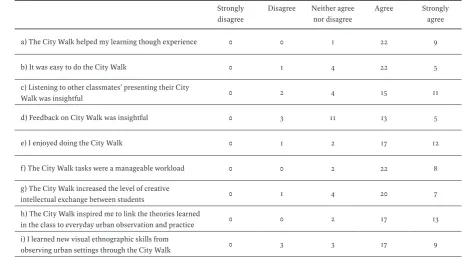
Considering the responses gathered in Section A around perception of the task (see Table 1), 97% of respondents were in agreement that the city walks helped them to learn through experience. This self-directed walking activity was mostly an enjoyable, easy and manageable workload for the students. The major part of the class felt that City Walk inspired them to link the theories learned in class to everyday urban observation and practice; and increased the level of creative intellectual exchange between students. One of the students commented: “Observation of urban settings become more effective and comprehensive as I linked the theory taught in class to real findings”. Other similar responses included: “It was good to find and understand the creative city through the local area”; “it challenged me to find ways to apply learning in real life” and “made us look at our surroundings differently”. Interestingly the discovering aspect of the walks was also highlighted by several students, both in terms of seeing the city through new perspectives and discovering new areas in London.
By contrast, the items from Table 1 that saw a higher number of students’ disagreeing were: c) listening to other classmates’ presenting their City Walk was insightful (6%); d) feedback on City Walk was insightful (9%); and i) I learned new visual ethnographic skills from observing urban settings through the City Walk (9%). Not surprisingly, those aspects were also highlighted as some of the features that could be improved. As one student commented: “Students did not had [sic] time to comment on each other’s walks. Although the walks were always inspiring, discussion would had [sic] helped more on this aspect”. Indeed, since the presentations of the City Walks often took place towards the end of the sessions, some days there was no time to provide extensive feedback and open up a discussion on the walks.
With regard to listening to other students’ presentations, some dissatisfaction expressed included: “Sometimes it seemed a tour guide by just suggesting the background of the area Figure2. Thomas Gainsborough, A
Couple in a Landscape, 1753, oil on canvas, 76.2 x 67 cm, DPG588. By Permission of Dulwich Picture Gallery, London
4
The ar
t of w
alkin
g. F
os
terin
g e
xperiential learnin
g through obser
vation and creativ
e pr
ac
tice
Overall, the City Walks proved to be an effective pedagogical activity, with some room for improvement. As shown in Table 1 and in the students’ responses, there was a general agreement with the task. However future improvement could potentially enhance this self-directed learning activity.
Future steps
In the first seminar of the module ‘Culture and the City’, I included the following quote from bell hooks: “I entered the classroom with the conviction that it was crucial for me and every other student to be an active participant, not a passive consumer” (1994, p.14). Although students’ active participation was certainly true while conducting and presenting the City Walks, future improvements should enhance the learning experience in terms of facilitating the walking activity’s preparatory task, developing a better understanding of the learning outcomes and enhancing feedback. With these aims, I suggest four main strategies to improve the City Walks.
First, I shall suggest some specific areas and routes for those students that consider the city a foreign terrain to walk through and experience it. Previously I had not done so since I considered that the choice of walking routes was part of the task and this would enhance the learning moment. However, it proved difficult for some international students to select walking routes beyond the most touristic destinations such as South Kensington, Southbank or Soho. Teaching expectations should be realistic on what students’ real experiences are, especially considering that London might be a foreign city for most of the students. I shall give the option to the students to select their walking routes, but also suggest some walks for those who are unfamiliar with the city. This will facilitate the task while implementing students’ destination choices and ability to link the theories discussed in the classroom to city’s real findings. This also relates to my second improvement: to give clearer explanations on the walking activity’s learning goals.
disagree nor disagree agree
a) The City Walk helped my learning though experience 0 0 1 22 9
b) It was easy to do the City Walk 0 1 4 22 5
c) Listening to other classmates’ presenting their City
Walk was insightful 0 2 4 15 11
d) Feedback on City Walk was insightful 0 3 11 13 5
e) I enjoyed doing the City Walk 0 1 2 17 12
f) The City Walk tasks were a manageable workload 0 0 2 22 8
g) The City Walk increased the level of creative
intellectual exchange between students 0 1 4 20 7
h) The City Walk inspired me to link the theories learned
in the class to everyday urban observation and practice 0 0 2 17 13
i) I learned new visual ethnographic skills from
observing urban settings through the City Walk 0 3 3 17 9
TOTAL: 32 evaluation forms
creative pedagogies imprint 1/2
5
winter 2019
The ar
t of w
alkin
g. F
os
terin
g e
xperiential learnin
g through obser
vation and creativ
e pr
ac
tice
Second, in future I shall stress more clearly the value of experiential learning and walking in the city and explain why these learning methods are useful for studying and analyzing culture and the city. I will explain that the main goal of this task is to link observations to theory and to learn through everyday walking experiences and practices. I shall state these learning goals clearly in the module handbook, produce a handout with guidelines and highlight these instructions in the first introductory seminars and reiterate them throughout the course.
Third, to address the lack of time for extensive feedback and discussion after the students’ walk presentations, I shall start the City Walks section earlier. I believe that by providing more clear directions to the students, the discussion of key reading at the beginning of the seminar would be more focused and I will make sure that it lasts 30 minutes maximum, leaving equal time to present and discuss the City Walks. Finally, to enhance the self-directed learning approach of this activity, I shall ask students to offer feedback on each other’s presentations. In this way, by highlighting the strengths and weaknesses of their classmates’ walks, students will be in charge of setting the standards collectively and, in turn, this shall increase their motivations and clarity on the task.
Bibliography
Ambrose, S.A., Bridges, M.W., DiPietro, M., Lovett, M.C., & Norman, M.K., (2010), How learning works: Seven research-based principles for smart teaching, San Francisco: Jossey-Bass Brown, B. et al. (2007). ‘Seeing ethnographically: teaching ethnography as part of CSCW’, in L.
Bannon, I. Wagner, C. Gutwin, R. Harper, and K. Schmidt, (eds.), ECSCW’07: Proceedings of the Tenth European Conference on Computer Supported Cooperative, London: Springer, 411-430 Bulut, S., (2005). ‘The do’s of doing: looking experiential learning within a wide perspective’, Ç.Ü.
Sosyal Bilimler Enstitüsü Dergisi, 14:2,139-151
Certeau, M. de (1984). The Practice of Everyday Life. Berkeley: University of California Press Dick, B., (2002). ‘The design of experiential learning activities’. Unpublished paper (mimeo). Available
at: http://www.aral.com.au/DLitt/DLitt_p10explng.pdf [Last accessed: 31 May 2018] Dobson, S. (2006). Urban pedagogy: a proposal for the twenty-first century. London Review of
Education, 4:2, 99-114
Fraser, B. (2009). ‘The ‘kind of problem cities pose’: Jane Jacobs at the intersection of philosophy, pedagogy, and urban theory. Teaching in Higher Education, 14:3, 265-276
Feinberg, P. (2016). ‘Towards a walk-based pedagogy’. Journal of the Canadian Association for Curric-ulum Studies, 14:1, 147-165
Henthorn, T. (2014). ‘Experiencing the city: Experiential learning in urban environments’. Journal of Urban History, 40:3, 450-461
Hooks, B. (1994). Teaching to transgress. Education as the practice of freedom. New York and London: Routledge
Kolb, D. (1984). Experiential learning. London: Prentice Hall
Landry, C. (2001). London as a creative city. Hong Kong: Central Policy Unit
Long, J. (2012). ‘Understanding the everyday: In-class ethnography for social science students’. Teaching Innovation Projects, 2:1. Available at: http://ir.lib.uwo.ca/tips/vol2/iss1/1 [Accessed: 31 May 2018]
McCarthy, M. (2010). ‘Experiential learning theory: From theory to practice’. Journal of Business & Economics Research, 8:5, 131-140
McClafferty, K., Torres, C. and Mitchell, T., (eds), (2000), Challenges of urban education. Sociological perspectives for the next century, New York: State University Press
Moon, J. (2004). A handbook of reflective and experiential learning. Theory and Practice. London and New York: Routledge
Oppezzo, M. and Schwartz, D.L. (2014). ‘Give your ideas some legs: The positive effect of walking on creative thinking’. Journal of Experimental Psychology: Learning, Memory, and Cognition, 40:4, 1142-1152
6
The ar
t of w
alkin
g. F
os
terin
g e
xperiential learnin
g through obser
vation and creativ
e pr
ac
tice
Author