Transformative Teaching and Learning
in Further Education
Summative report for the University and College Union
Transforming Lives and Communities project
Dr Vicky Duckworth is Professor of Education at Edge Hill
University. Vicky has developed considerable expertise as an
educationalist and researcher in the field of Adult Literacy and
Education. She is deeply committed to challenging inequality
through critical and emancipatory approaches to education,
widening participation, inclusion, community action and engaging
in research with a strong social justice agenda. Presently, she is
leading UCU funded research project (with Dr Rob Smith) which
aims to understand and provide evidence of how the further
education (FE) sector is vital in transforming lives and
communities in 21st century Britain.
transforminglives.web.ucu.org.uk/about-this-project
Dr Rob Smith is a Reader in Education at Birmingham City
University and Co-Director of the Centre for the Study of Practice
and Culture in Education (CSPACE). His body of work explores the
impact of funding and marketisation on FE provision. He has
researched and written extensively in collaboration with FE and
HE practitioners. His recent research with Professor Vicky
Duckworth focuses on further education as a space for
transformative learning. Other research projects include Social
Justice and Leadership in Further Education (funded by the
Further Education Trust for Leadership, with Vicky Duckworth)
and Off the Job training – stakeholders’ perceptions (funded by
the Gatsby Foundation).
© University and College Union 2019
Carlow Street, London NW1 7LH
www.ucu.org.uk
Published by University and College Union
Design: Mark Molloy
Print: The Printroom UK Ltd
Contents
Foreword
Angela Rayner, Shadow Secretary of State for Education 5
The UCU Further Education in England: Transforming Lives & Communities Research Project 6
Why this research is important 7
The development of the research 11
How who we are as researchers shaped the research 12
Research approaches 13
Research aims 13
Project methodology 16
The project’s theoretical lenses 21
Data, themes and findings 23
Further education: agency, pathways and the fabric of hope 23
1. The teacher’s role 24
2. Routes into further education 31
3. Restorative education: addressing students’ prior educational experiences and psychological needs 34
4. Diversity and further education 38
5. Further education, leadership and localism 41
6. Parenthood, challenging intergenerational poverty and the ‘ripple effect’ 45
7. Mental health and well-being 50
8. Further education: planned futures and social mobility 52
9. So what is transformative teaching and learning? 56
Transformative teaching and learning and the importance of breaking the triple lock 59
Conclusions and recommendations 61
The power of sharing stories 61
Some key themes 64
Looking ahead 66
Recommendations 69
A very special thanks to the learners and their families and communities, teachers, employers and everyone who has contributed to this research project.
We would also like to offer a special thanks to Matt Waddup for commissioning the research and being encouraging and responsive in its development and throughout the research process
Foreword
Angela Rayner,
Shadow Secretary of State for Education
Education is one of the most valuable investments that any government can make. It has the power to transform and enrich our lives in so many ways, with benefits for individuals, employers and our society as a whole.
But in recent years Tory austerity has led to our education system being chronically under-valued and under-funded. Nowhere has this been truer than in further education, which has seen successive cuts in every year since 2010.
Yet I know from my own experience that further education has a vital role to play in helping people get on in life. I wouldn't be where I am today if it wasn't for my local college giving me a second chance at education; helping me to build my skills and gain the confidence I needed to succeed.
I welcome this report because it reminds us that education is about more than numbers – it’s about the people like me whose lives are transformed by learning.
The stories in this report show how further education embodies Labour’s values of fairness and social justice, and why we need to invest more in it. It’s stories like these that have inspired Labour’s vision for a National Education Service – an institution in the mould of the National Health Service which will ensure that education is free at the point of delivery, funded by progressive taxation, and serving everyone from cradle to grave.
The report also reminds us that our further education system is built on the incredible contributions of education staff. They work tirelessly to support people from all backgrounds to reach their full potential, and we need to do much more to recognise the value of their work.
Labour’s National Education Service isn’t just about educating - it's about empowering. Through access to transformative learning, we want to give people from all walks of life the power to take control over their own future and thrive. This report helps to demonstrate why that expansive vision of education is so important in building a fairer future for the many, not the few.
Angela Rayner
Commissioned by UCU, the Further Education in England: Transforming lives & Communities research project aims to understand and provide robust evidence of how further education is vital in transforming lives and communities in 21st century Britain. It also provides evidence of how and why further education is an important lever for supporting social justice, sustainability and social cohesion; it presents a picture of colleges challenging intergenerational poverty and of offering people from diverse communities hope, agency and a positive orientation towards the future.
The first phase of the project (2016-17) led to the generation of a number of outputs which included, the production of an interim report, an interactive digital platform and a National practitioner handbook (Duckworth and Smith 2017A & 2017B). We gathered data from more than 150 participants across more than thirty five institutions: learners, teachers, managers, employers, community members, parents and other family members shared their stories. This enabled us to build up a robust qualitative evidence base to illustrate the nature of transformative teaching and learning, the power of further education to reach into diverse communities and its expanding ‘ripple effect’: the powerful individual, social, economic, and health benefits it produces (e.g. see Duckworth and Smith 2016, 19).
The first stage of the research sought to collate qualitative evidence of the distinctness of further education and its impact on individuals, society and the economy. In addition, we gathered evidence related to why teachers enter further education, how teachers conceive of themselves as further education teachers, how they respond to and overcome challenges and difficulties in their teaching career and finally how these factors influence their career progression. We emphasised the role of the teacher in making a difference to quality teaching and learning.
The second phase of the study (2017-19) expanded the qualitative data set and added a quantitative dimension. This involved developing, implementing and analysing two key surveys: one for staff and one for students. This enabled us to expand the theoretical underpinnings of the central concept of transformative teaching and learning that sits at the heart of the project. The first stage of the research used a sociological lens to uncover substantive evidence about how further education impacts hugely on research participants’ identities as learners, their lives and the lives of their families and communities. The second phase sought to build on this and to flesh out key aspects of teachers’ and students’ experience in order to strengthen the psychological and quantitative basis for the claims we are making about transformative teaching and learning. Together the data from both phases constitutes a powerful evidence base to support the contention that the ‘transformative’ aspect of the research participants’ educational experiences was an effect of a multitude of variables but that the teachers’ role in this
transformative aspect was a crucial facilitating factor.
Central to the project was the establishment of the UCU website, Further Education in England:
Transforming Lives and Communities1 as a ‘live’ interactive platform through which project findings can
be uploaded and shared with an ever-growing project audience (Duckworth and Smith 2019B). The website provides timely evidence of how further education has played, and continues to play, a vital role in contributing to transforming lives, families and communities in Britain by providing educational opportunities across age ranges and disciplines and across communities. The research illuminates learners’ and teachers’ narratives, the overarching aim being to acknowledge, understand and celebrate the journeys of students and the work of teachers against the backdrop of wider socio-economic, political and historical contexts (Duckworth and Smith 2016, 2017A, 2018A, 2019B).
Why this research is important
Further education is often marginalised by policy. Indeed, as everyone who works in colleges knows, since 2009, further education in England and the UK has been subjected to deep cuts – and these cuts have gone far beyond anything endured by other sectors of education (Paton 2010). In effect, these cuts have hurt the communities that colleges serve and have penalised college staff who work hard day in and day out to provide transformative teaching and learning experiences. There is a host of research evidence that provides detail about the extent to which further education funding has been targeted in the last decade and the impact of this.
In their comparative study on levels of funding across further and higher education, referring to data on students and learners in two academic years: 2012/13 and 2013/14, Conlon and Halterbeck (2015) identify the overall reduction in expenditure on further education. Total funding:
decreased from £3.205 billionto £3.031 billion between the two academic years of interest;
however, this essentially reflects the decrease in the total number of 16-19 learners (from
685,000in 2012/13 compared to 643,000in 2013/14). (Conlon and Halterbeck 2015: 64-5)
In addition, they identify a decline in adult numbers:
an 11% decline in the number of 19+ learners from approximately 3.3 million in 2012/13 to
2.9 million in 2013/14. The contraction in the student body was especially pronounced among
learners on non-apprenticeship programmes, decreasing (by 13%) from approximately
2.6 million in 2012/13 to 2.3 million in 2013/14; (Conlon and Halterbeck 2015: 54)
The authors compare the funding reductions for further education provision with funding for students in Higher Education. They state:
Funding per student within the Adult Skills system is extremely low in comparison to the level of funding associated with higher education… funding per apprentice aged 19 or above amounts
o £1,554 per annum, equivalent to 18% of comparable higher education funding, while funding
per non-apprentice learner stands at £1,323 (equivalent to 15% of annual funding per full-time
undergraduate student from England attending HEIs in England in 2013/14).
Funding for 16-19 education in General FE Colleges… is considerably smaller than funding for
higher education students. Funding per 16-19 apprentice stands at £3,759 per annum
(equivalent to 42% of higher education funding), while funding per 16-19 non-apprentice was
estimated to be £4,820 per learner per annum (equivalent to 54% of the total public funding
per full-time undergraduate student from England studying in England in 2013/14). (Conlon and Halterbeck 2015: iv)
In the continuing cuts overseen by government as part of their ongoing austerity measures, while school funding remained ‘ring-fenced’ (Peraudin and Winter 2015) – an ambiguous term which ultimately meant static – despite rising costs, pupil numbers and additional employer pension contributions – further education seems to have fared particularly badly. The severe reductions imposed at the beginning of the decade have continued to the present. Foster (2018: 4) states that:
The total 16-19 programme and high needs funding allocated to providers fell from £6.09 billion in 2013-14 to £5.49 billion in 2018-19 – a reduction of 10% in cash terms and 17% in real terms.
Alongside this tremendous assault on college funding, there have been significant changes to the funding of education in colleges since 2010. Funding arrangements for 16-19 year old students changed in 2013 with the introduction of a so-called national funding formula. But the use of funding to incentivise changes originating in the latest policy anxiety have continued. So, from 2014, colleges faced reductions in funding if young people were not enrolled in English and maths (if they had not previously achieved a grade C or
Within this unjust targeting of further education, additional reforms have also impacted negatively. Another important change in the area of funding came about through the removal of the Education Maintenance Allowance (EMA). The EMA was a means-tested universal benefit scheme that paid all 16-19 students between £10 and £30 per week while they attended college. The overall cost of this was £550m per year. Michael Gove replaced EMA with the Discretionary Learner Support Fund (DLSF) and payments to ‘vulnerable students’ – a scheme that was administered by colleges and cost £180m per annum in 2014/5 and 2015/16 (Hubble and Roberts 2017). This move appears to have been justified through reference to a single piece of research by NFER (Spielhofer et al 2010) which appeared to suggest that only 12% of students receiving EMA in a subset (838) of a sample of 2000 surveyed stated that they would not have attended college if they had not received the EMA (Chowen 2010). From this, the government interpreted a high percentage of EMA ‘deadweight’: ‘65 out of every 69 individuals aged 16 who are eligible for the EMA would have stayed in education without the payment’ (Chowdry and Emmerson 2010).
The immediate savings from the abolition of EMA may have been great but the move to the discretionary bursary scheme effectively introduced structural inequality as individual colleges were put in charge of a (smaller) budget to distribute.
While the emphasis of the EMA which was “to incentivise participation in learning nationally, using the same criteria of eligibility for all learners”, for the DSLF it was “to provide some financial assistance for only the learners in greatest need of assistance” (NFER (2011, p.2).
According to Hubble et al (2017: p), there has been a longer term effect of the policy. The change from EMAs to DLSFs meant that almost half of the young people who had received EMA money no longer received support.
replacing EMAs with 16-19 bursaries was associated with a relatively modest decrease in
participation and attainment in the first two years of the scheme’s operation.However, this
disproportionately affected low-income young people. (our emphasis).
Interestingly, there is no routine data published on the take-up of these bursaries. Research commissioned by the Government puts their number at 23,900 at a cost of £23.5 million (Roberts and Hubble 2017: 8). It is striking that while further education providers are deluged with demands for data on every aspect of their activities, a similar level of scrutiny is surprisingly absent when it comes to data about the impact of the financial support for students in further education.
According to a recent report by the Institute of Fiscal Studies (IFS), funding for teaching and learning in adult further education was chopped by 24% in real terms between 2010/11 and 2015/16. Alongside this, the Adult Skills Budget funding, which covers all education for people older than 19, declined by 29% in cash terms in the same period. Despite these cuts, the existing regime of funding and so-called ‘accountability, (through Ofsted) has continued to enforce colleges’ adherence to maintaining high standards of ‘quality’ through the production of favourable performance data. This systematic under-resourcing means that at the time of writing, 16-19 students in Birmingham are likely to be funded between £1000-£1500 less per year when they leave school go on to a local further education college than they were in 2010. (see Belfield et al 2018: 19-21).
At this point, we need to be clear about the scope of the claims we are making about further education and transformative teaching and learning. This is because we recognise that this research needs to be contextualised within a broad discourse about education policy and that by its nature, this is a politically
contested area of work. A mark of this is the extent to which the terms transformation, transformative
education, transformational learning, transforming lives etc are being used (some might say ‘colonised’) by a range of different voices in the field of education. Most of these voices see education as a social good but clearly there is a risk of the notion of transformation being harnessed to a neoliberal project of uncritical, competitive individualism. Many of these voices share our concern that the enormous potential of colleges to contribute social and economic benefits – often to marginalised groups and through that to help realise social equality and justice – is being diminished and even squandered.
We are mindful then that transformative teaching and learning as a phrase and concept risks being emptied out of meaning by misuse and / or overuse. Our study needs to be framed by a broader policy critique of the marketization imposed by the Further and Higher Education Act (1992), which brought about the incorporation of colleges, since when further education has been viewed in increasingly reductive and instrumentalist terms by successive governments. Different elements combine to create the abstraction of ‘the FE sector’ that appears to shape policy makers’ decisions about further education. The growth of ‘datafication’ in education (Stevenson 2017) – the production of performance data and the tendency on the part of government to use this data to inform policy making in an undifferentiated and decontextualized way is an additional feature. These policies, in turn, reinforce a particular distorted ‘version’ of further education in ways that have been immensely damaging to teachers’ and students’ lives.
What this report is not claiming then is that all further education is transformational. Neither are we
claiming that the so-called ‘FE sector’ is inherently or essentially transformational. Instead, this report
provides substantial evidence that, despite a funding and policy environment that objectifies students and incentivises a transmission view of teaching and learning, across the broad spectrum of further education, amazing and inspiring stories are being played out. Typically, these are stories in which people – whose previous educational experience led them to believe that they were failed learners or ‘thick’ – have been helped to (re)discover that education can be a positive experience. These are stories in which students have been able to rearticulate a meaningful link between education and their lives. These are stories in which the personal, professional and educational relationships that college teachers establish with their students have created the conditions in which hope has flowered and dramatic changes have been made possible.
Underpinning these stories are the colleges: local, historically embedded institutions whose networks and rootedness make them such an important feature of municipal landscapes across the country. These important institutions may have managed (just about) to withstand the wrecking ball of austerity measures and budget cuts, but the undermining of their vital role in their communities through the incessant, interventionist policy churn issuing from the DfE / BIS (the vulnerability of further education may stem from its being positioned between government departments) has left them seriously weakened. The disruptive policy churn corresponds to the election cycle and the movement of ministers from one portfolio to another. The result: successive waves of ‘reform’, none being given time to ‘bed in’ properly, amounts to systemic governmental vandalism.
Evidence from this research demonstrates that transformative teaching and learning is directly linked to social mobility (although we develop a refreshed definition of this term, see Section 8 below (p52). It is grossly unfair therefore, that young people in further education colleges are receiving less funding per
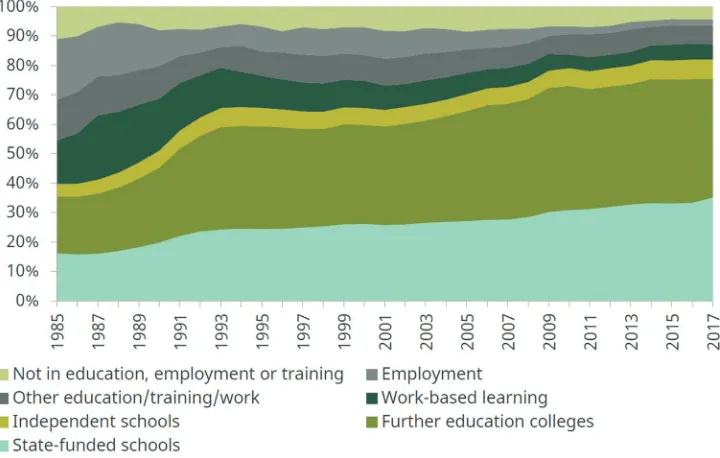
head than their peers in VIth forms in schools. Belfield et al (2018: 39) provide an important overview of
the percentage of 16- and 17-year-olds taking different education and employment choices which shows how this discriminatory funding system targets a majority of young people.
According to this chart, further education and VIth form colleges are the preferred route for the majority of 16 & 17 year olds and this proportion has increased steadily since incorporation (1993).
The development of the research
The Transforming Lives and Communities research commenced in the summer of 2016 and has to date gathered data from almost forty colleges across the UK. The first phase of the research gathered qualitative data nationally through more than fifty video interviews. The project used an interactive digital platform in an innovative way in order to i) present the data as it was gathered but also and importantly ii) to elicit responses and further narratives from further education students and practitioners in response to this data. When we established the website, while we planned for it to have an interactive dimension, we had no idea of the extent to which people would interact with it and provide their own stories about teaching and learning in further education colleges. This was an experimental aspect of the project and we were overwhelmed by the volume of responses and the level of engagement. The website flourished and garnered a large number of narratives and biographical accounts from every region in the UK (see pages 19 & 20).
As critical educators as well as researchers, throughout this research project we have and continue to critically engage in examining our own practice, the premise being: how can we critically examine others’ claims to knowledge without knowing our own positioning and making that transparent? For that reason, we will briefly outline our own backgrounds in order to frame what follows.
The research project that underpins this report explores how consciousness-raising and dissemination of narratives about further education in the local, national and international domain can engage learners, teachers and communities in learning and participatory knowledge production. As such, the research itself coheres with the values of the researchers in seeking to provide the conditions for nurturing hope and working towards social justice.
Rob’s Journey
I attended a multicultural comprehensive school in Birmingham in the 1970s and followed a traditional route, doing A levels and then after a year working abroad studied English in London before doing a PGCE and becoming a secondary English teacher. While in secondary I saw the introduction of the National Curriculum and the Local Management of Schools. I then got a job in a further education college in September 1992 and witnessed the changes brought about by incorporation at first hand. The experience was ‘character-building’. The next ten years were characterised by involvement in trade union activity and a long-running contract dispute. My doctorate issued from these experiences as I sought to understand how policy in further education (and more widely) was impacting on teachers’ work and the culture of college management and leadership. From there, I strengthened my understanding of further education in a teacher education role at the University of Wolverhampton. This involved circulating around lots of colleges in the West Midlands region supporting students and seeing the ongoing impact of funding and marketisation.
Vicky’s Journey
At sixteen I left behind the local comprehensive school where I’d spend most of the day staring out at the clueless sky. I couldn’t wait to be grown up, working and earning. The school bell ringing for the last time, see me and my mates breaking free, as we run through the green gates. Full of laughter and screams, we chase one another across the school fields, egging each other’s white shirts. Excited to be leaving the classroom behind, I didn’t realise back then that I’d never see some of those kids that I’d grown up with. Our lives would fork in different directions, directions of no return. I swapped my school socks for tights and started my first job on a Youth Training Scheme which paid twenty-five pounds a week; I worked in a couple of local factories before the penny dropped and the monotony set in. I wanted more – didn’t know what that more was I wanted more than time passing behind the redbrick that had seen my nana and granddad grind away their years.
Research approaches
The project makes use of the UCU Transforming Lives digital platform in order to enhance its democratic and dialogical approach to knowledge production. A key aspect of this is the use of video recorded interviews which are edited and posted on a dedicated project Youtube
channel2. These videos are also then embedded in a narrative frame on the UCU project website.
The website features perspectives from learners, teachers, family members, employers, community members and policy makers.
Participants were consulted throughout, before their narratives were placed in the public domain. Their views about final videos were sought and the videos re-edited in response to their viewing and recommendations. Our aim with these videos is to present individuals’ stories in a powerful way.
Alongside providing insights into the history of the diverse communities we entered, the key focus was on researching learners’ stories of transformative teaching and learning through access to and participation in further education, their prior educational and social experience (including their socio-economic background) and the intergenerational and wider impact of their educational experience.
There is also a strand that connects to notions of capital; this is an aspect that impacts on choice and transitions.
A further main strand explores transformative teaching and learning from teachers’ perspectives.
Research aims
Our aims in carrying out this research was to turn a spotlight onto the powerful and important work that further education colleges do. We wanted to focus on the social benefits that typically are not measured in a sector that in response to government and funding policies has built up cultures and practices that focus instead on ‘measurable’ outcomes. Our belief in carrying out this research was that these metrics alone give an inaccurate and slanted view of the enormous importance of further education.
The narratives of transformative teaching and learning presented here are a way of articulating some of these hidden benefits and of getting at the full value of further education as provided by local colleges. The study examined what makes further education unique. Another aim of the project was to celebrate these achievements and affirm the positive identities being forged in college classrooms across the nation. But we wanted the celebration to move beyond the noise of applause for success and instead to connect the stories fully to the background issues (often rooted in social inequality) that lie behind the successes and achievements. The research necessarily aimed to foreground and to problematize these to document a fuller picture of what further education means and where it is positioned in our social fabric. In capturing this information, the research team sought to provide answers to a set of research questions.
The first year of our study sought to provide answers to the following questions:
How does further education provide routes to higher education for learners who would not otherwise access it?
How does further education offer learners the chance to engage in education at multiple stages of life, recognising that their relationships to employment/education are not neat and linear?
What approaches and strategies are utilised to successfully support the integration of recent arrivals to the UK through ESOL provision?
In what ways does further education provide vocational education at all levels on a holistic personalised basis that are successful in providing learners with the confidence, knowledge and skills to progress?
What is special and particular about the learning experiences offered by niche further education provision (e.g. land-based, arts, SLD / SEN provision, and provision for excluded 14-16s and 14-16 yr olds who want to follow vocational courses in colleges in preference for school?
Questions that arose also included:
How does further education help provide routes into education, training and employment?
How does further education offer learners the chance to engage in education at multiple stages of life, recognising that their relationships to employment /education are not neat and linear?
What is special and particular about further education in encouraging social mobility - particularly for students from ‘non-traditional’ backgrounds - by increasing the range and types of student support available?
What are the short term and longer term impacts on individuals’ lives – including on their confidence, resilience, and careers?
What is the wider impact on their families and communities?
For Phase Two a further set of research questions was addressed, as follows:
What are the factors that influence teachers to choose further education teaching as a career?
What are teachers’ understandings of themselves as further education teachers; how do they judge their competence, do they feel in control of their teaching and do they feel valued in their role?
How does teachers’ understanding of themselves as a further education teachers, influence their progression in the sector?
How do teachers respond to and overcome challenges and difficulties in teaching in colleges?
The research utilised a mixed method approach to capture the rich narratives not just of the students but of their teachers, family members, friends, community voices, employers and, in some cases, communities as well. The diversity of the participants necessitated an exploration of their views framed by a broad analysis of the educational landscape. Participants engaged with the project because they had a positive story to tell. The research approach itself became a part of the affirmative practice that helped create the conditions for the transformative learning that participants had often experienced. In that sense, taking part in the research reinforced the positive learning identities that the participants talk about having achieved.
The methodological approach adopted in this study sought to be forward-looking: to endorse newly established learning identities and to share in a collective imagining of future plans. We drew on participatory methodologies where the oppressive qualities of the ‘researcher’ and the ‘researched’ relationship were challenged, this cohered with our intention to position social justice at the core of the undertaking. As such we strove then to convene research discussions in a safe space, a space moreover that shared some characteristics with critical pedagogical space. Underpinning this was a sense of research as a social practice (Herndl & Nahrwold 2000) i.e. not divorced from everyday relations or having any ‘mystique’ that might in any way make participants feel like ‘subjects’. Instead, just as education can be experienced as a socially embedded process that is to a greater or lesser degree conditioned by the social forces and structures that shape our society, so as researchers we were aware of how research can reduce to a limited and convention-ridden exchange between people who do not enjoy an equal social footing (Duckworth and Smith 2019A). As such, the methodological approach adopted for the study was closely aligned to critical pedagogy (Freire 1995, Breunig 2005) and extended a number of its underpinning principles.
Research conversations (early on we rejected the term ‘interviews’ because of the connotations it carried of an unequal and uni-directional exchange and distribution of power) were framed to foster and sustain a sense of equality between participants. This term better reflects the egalitarian atmosphere we tried to achieve while conducting the research. For us, it was vital to achieve a relationship of trust with participants so that they were active in the co-construction of knowledge and meaning that sat at the heart of the research process. We shared our stories of further education and our educational journeys with participants as we acknowledged that these encounters had a social significance above and beyond the ‘research’ element. These meetings were typically reciprocal and dialogical as stories were exchanged and opinions and feelings shared. They were also often affirmative in tone as we talked with participants about how they had ‘(re)learned to learn’ and how this had brought about changes in the ways they felt about themselves and about their future.
While participants understood that they could remain anonymous, most wanted their real names used, seeing this as an affirmative aspect of participation in the project. Colleges and teachers that were mentioned were anonymised or permission was sought to include names. The question we as researchers thought it important to ask ourselves when producing this knowledge and disseminating it was: what meanings were being foregrounded? Where were participants being positioned? What impact might dissemination have on their hopes and trajectories? Participants’ experience of education frequently involved symbolic violence that sought to position them at the bottom of an existing social order. But symbolic violence does not only occur in educational circles. A critical and reflexive research methodology has to be conscious of the potential for research interactions to visit just the same kind of violence of definition and imposed meanings and of use on participants and their stories.
The dissemination of the research in the local, national and international domain through the website can be viewed as crossing spaces and boundaries in an attempt at consciousness-raising as it can engage learners and communities in the development of knowledge that can inspire hope and work towards social justice.
Phase two of the research utilised two surveys: one for staff and one for students. There are important methodological considerations to be taken into account in this. There were several aims behind the use of surveys to gather data about transformative teaching and learning. Foremost amongst these was a drive to get a sense of how widespread was the recognition of the narratives of transformative teaching and learning that we had gathered in Phase One. Survey respondents were asked to familiarise themselves with the existing data on the project website prior to completing the survey. The use of video was key here as we were conscious of the limitations of communicating a concept using only language
The
Transforming Lives
project has gained
considerable traction
nationally and
internationally.
To date, the virtual UCU Transforming Lives website has had 22,271 sessions,
14,000 users and more
than 87,724 page views
(Wordpress Google
analytics). The project
twitter account has
1603 followers.
(as of June 2019)
Digitising
Two national online surveys – one for staff and one for students –were then developed and distributed using snowball sampling via regional and national networks. The teachers’ survey used items that were developed from the qualitative data such as:
I try to map students’ lives onto the curriculum. I try to develop relations of trust with students.
I try to ensure assessment addresses students’ individual needs not just accreditation. I try to provide emotional support for my students, when necessary.
I try to ensure that my students feel respected and valued. I try to foster students’ autonomy.
In addition to items that originated in our findings from the qualitative data, some items drew on psychological research in education where we saw connections. For example, the last two items in the examples above map against self-determination theory (Deci and Ryan 2000, Niemiec et al 2010) in which psychological theorists foreground the importance of autonomy and competence in teaching and learning environments. These two factors are also linked strongly to students’ motivation. Self-determination theory posits that: ’satisfaction of both autonomy and competence needs is essential to maintain intrinsic motivation’ (Niemic and Ryan 2009: 135).
We see the adoption of this cross-disciplinary approach as important for a number of reasons. The first of these connects with the cross-disciplinary nature of the concept of transformative learning identified by Mezirow (2009). But we also took this approach because we believe the classification of sociological and psychological disciplines and the insulation between them have become entrenched (and some would argue politicised) in ways that are unhelpful and constraining not least in educational research. Clearly, notions of ‘mindset’ (Dweck 2006) are capable of providing insights into teaching and learning (at the level of the individual) which can sit alongside ideas about the impact of social class (Willis 1977) or race (Gillborn 2008) or other sociological perspectives. For that reason we believe that establishing the (complementary) psychological basis for our formulation of transformative teaching and learning can add weight to the research. Niemiec and Ryan’s work is interesting because it suggests that the introduction of what they call ‘controlling conditions’, close supervision, monitoring and evaluations undermines ‘the sense of relatedness between teachers and students’ and displaces the ‘natural’ feelings of ‘joy, enthusiasm and interest’ that students should experience in educational activity with experiences of ‘anxiety, boredom or alienation’ (p134). In addition they state:
The more that teachers’ satisfaction of autonomy is undermined, the less enthusiasm and creative energy they can bring to their teaching endeavours. Second, the pressures toward specified outcomes found today in so many educational settings promotes teachers’ reliance on extrinsically focused strategies that crowd out more effective, interesting and inspiring teaching practices that would otherwise be implemented.” (p140)
This insight resonates strongly with the project data. In many ways this speaks to the picture from existing research of college environments that are funding-driven, data-fixated and disfigured by managerialist cultures. The factors that feed into self-determination theory are related to the social conditions experienced by students and teachers and connect in particular to a feature of teacher/student relations that we call ‘care’. This also fits with a view of teaching as being more than understanding ‘how the brain works’: – some kind of technical exercise that assumes that universal physiological qualities can usefully be seen as over-riding the myriad other variables that affect student learning.
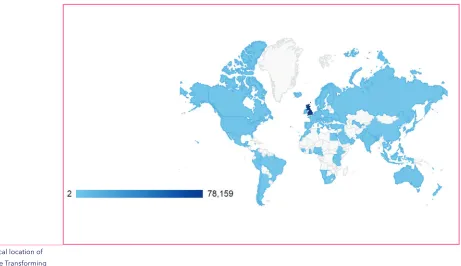
The student survey garnered 630 responses almost equally divided between male and female students. The age range of respondents was from 14-16 yr olds (24%) through to 35+ (15%) but the majority of respondents were aged 17-19 (40%). The majority of respondents (81%) were full time students. Respondents were attending colleges across the country as can be seen in the chart below.
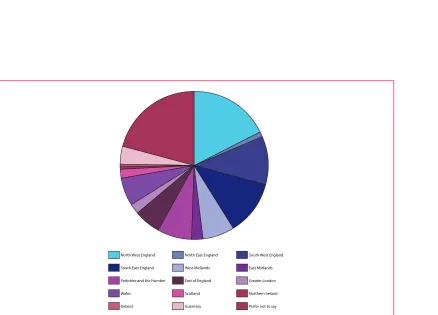
The teacher survey garnered 730 responses 62% of whom identified as female. Respondents were asked to indicate their age against a range of categories and responded as follows: 21-34 (14%), 35-44 (23%), 45-54 (34%) and 55 and over (29%). 72% of respondents were on full time contracts. In terms of the number of years’ experience teaching in further education the data were as follows: 0-5 years (20%), 5-10 years (20%), 5-10-15 years (24%), 15-20 years (19%) and over 20 years (17%). 72% of respondents were teachers, the rest were senior leaders, managers and others. Importantly, while a large majority of respondents were working in colleges, 19% were working in training providers and other further education institutions. Similarly to the student survey, the staff survey respondents came from across the country as can be seen in the following chart.
Guernsey Ireland
Northern Ireland Scotland
Wales
Greater London East of England
Yorkshire and the Humber
East Midlands West Midlands
South East England
South West England North East England
North West England
As with the student survey, the chart above shows that survey respondents were working in colleges from all regions and countries of the UK and included small numbers from Ireland as well. A significant number indicated that they preferred not to say which region / college they were working in. This is an index of the extent to which respondents might have felt vulnerable about sharing their views about their practice. This vulnerability is a clear indicator of i) teachers’ lack of job security in the current funding environment and ii) the ‘high-stakes’ market cultures within which the voices of teachers are discouraged and even deprecated and silenced. This then connects with the claims we are making about transformative teaching and learning that we have already touched on. It also presages the way we develop and refine our definition through reference to the project data below.
The distribution also connects to the way in which the sample was generated. The survey link was distributed through professional networks and then on social media and via the project website in an open invitation to respondents to provide their views, opinions and experiences of transformative teaching and learning.
Whilst this research has been broadly welcomed, we are aware that there has also been some suspicion of the project's goals. For us, this connects to a healthy scepticism about the instrumentalist discourses that have attached to further education over the last quarter century. Generally speaking, these discourses promote an abstracted view of further education as a problem-free panacea for employers’ (and the nation’s) skills needs. It is easy to see how the tag of ‘transformation’ might feature as a magical signifier in an instrumentalist and heuristic lexicon. This scepticism might also feed off a warranted fatigue with the effects of marketization on language use. The tendency to use overblown and exaggerated terms in making claims about the impact of further education is (by now) an established trope. Think of the advertisements for the local college in your town / city / borough: is it not claiming that it can ‘Maximise your potential’ or otherwise that ‘Your future starts here!’ or an injunction to ‘Follow your dreams’? While all of these may be sincerely meant and may be grounded in the stories of real students, the critical reader cannot but be concerned that the underpinning and over-riding impulse behind such slogans is a commercial one.
Guernsey Ireland
Northern Ireland Scotland
Wales
Greater London East of England
Yorkshire and the Humber
East Midlands West Midlands
South East England
South West England North East England
North West England
Prefer not to say
It is within this linguistic context that asking teachers and students to complete a survey about transformative teaching and learning (notwithstanding the invitation to browse through the project website) might be expected to elicit a polarised response: any respondent might be expected to be already viewing the concept in a positive light before completing the survey. In that sense, the survey might be accused of acting as an echo chamber which serves to amplify a set of pre-existing views and opinions.
Inevitably, then, there are limitations to this study – despite a design that sought to combine qualitative and quantitative data. With regards to the survey data, these limitations include an acknowledgement that generalisability of findings from the survey sample is not possible as the sample was not random and cannot be claimed to be representative of all teachers or students in the sector.
An alternative way of viewing the project is to see it as an exercise in dynamic meaning-making: we used a website and videos of the interviews as tools to communicate a message about the power of further education to teachers, learners, policy makers and the public. These include nested narratives: about teachers, learners, family members, community and employers.
The project harnesses the powerful democratic potential of digital media to communicate information, narratives and values to an increasingly digitally-adept public. In that sense, the website acts as more than a repository and is indeed crucial in allowing us not only to disseminate the research findings but also to invite engagement with a wider audience (Duckworth and Smith 2018A, 2019B). The stories of the participants are inspirational in the messages of hope they communicate. As such they can provide a resource and a roadmap for others who face similar challenging circumstances. The website offers a forum on which people can contribute narratives about their own transformative learning experiences and Twitter has become a way of connecting the Transforming Lives research project to a growing audience. These voices (often silenced in the public domain) are role models and a source of social capital that reaches across physical barriers. For example, as identified by Hughes et al (2015) rural circumstances can prevent access to learning and employability including lone parents.
The project’s theoretical lenses
The project was founded on a simple premise: that for some people further education colleges provide a lifeline and a (re)introduction to learning that has the power to transform their lives. We knew this from our personal and professional experience of working in further education as teachers but also, and alongside it, as teacher educators and researchers. We wanted to explore the extent of these stories but also to look for patterns in them in order to identify if transformative learning could be regarded as a unitary concept. In addition, we wanted to find out if the transformative stories of students found their complement in transformative pedagogical approaches. In other words, if there was such a thing as transformative learning, was it an experience originating in the realisation of potential within the individual or was it enabled or facilitated by teachers and / or the social conditions of learning that they established? In our experience, critical reflection and dialogue can facilitate the move from a transmission and / or competence-based curriculum to a holistic approach which we suggest empowers the learners and their communities. Our report illustrates that transformative teaching and learning are two, interdependent sides of a whole. Teachers can provide the (transformative) conditions but students are the authors of the change, growth and development.
That college teachers’ work is frequently ‘under the radar’, and can centre on the biographical background of individuals was key in the analysis. Such holistic approaches were identified in much of the research produced in the Transforming Learning Cultures (TLC) further education strand of the Teaching and Learning Research Programme (TLRP) that ran between 2001-8 (e.g. Hodkinson, Biesta and James 2007, Gleeson and James 2007). This is a model of professional practice that is focused on the needs of students as a necessary precursor to learning. It pays close attention to student biographies (Biesta and Tedder 2007) and addresses issues arising with a view to scaffolding the classroom experience. In many cases, without this scaffolding, further education students simply would not be able to learn never mind achieve.
Transformative teaching and learning experiences are largely hidden from view because their impact falls outside the metrics that drive further education policy and underpin funding in the UK. Their wider impact remains unmeasured by blunt assessment. We argue that further education programmes should be viewed through the lens of transformative teaching and learning as this enables a reclaiming of educational space and purposes that do not objectify students in instrumentalist ways (Duckworth and Smith 2018A) and instead offer a renewed hope and dignity which is a catalyst to higher education and beyond. The research data illustrate that further education offers organic transformative tools for consciousness-raising (Freire 1995) and a caring space where hope can act as a change agent that fuels learners’ lives and teachers’ practice (Duckworth 2013; Duckworth and Smith 2017A, 2017B, 2019A).
The research also utilises sociological theories of capital to explore the structural context and to further understand notions of choice / no choice among diverse groups of people (Duckworth and Smith, 2018A). Bourdieu (1986) distinguishes three fundamental forms of capital: economic, cultural, and social. Economic capital may be manifested in family income and wealth. Reay, Crozier, & James (2011) argue that access to these capitals is socially structured and patterned, typically to the advantage of white middle-class students. Cultural capital may be defined as symbolic resources or goods that may be transmitted from generation to generation among the middle and upper classes in order to maintain class
status. The resonance with the Transforming Lives project here relates to social justice. In common with
many educationalists, we see education as an engine of social justice. In other words, we see education as having an important role in addressing the social division and inequality that exists in our society. Further education is key in this as, among other things, it provides routes into university. Accessing higher education provides opportunities for people to enhance their social, cultural and economic capital. Ball
Data, themes and findings
Further education: agency, pathways and the fabric of hope
We live in a world of great complexity in which social inequalities have become increasingly evident, both within local communities at a micro level and between the global north and south from a macro perspective. Living in ‘liquid’ and uncertain times (Bauman, 2007), in which the impact of the 2008 banking crash still resonates locally and internationally (Dorling, 2011), we are experiencing political upheavals and their consequences for people and the communities we serve and beyond (Duckworth and Smith 2017A, 2019B).
We are at a pivotal moment where abundant evidence of social inequality and widespread demands for social justice require more than a rhetorical response. This evidence requires us to direct our focus, energy and resources as a society in general and as educationalists in particular to generate genuine and sustained social and educational change that meets the needs of all. This research positions further education at the heart of the debate. Our contention is that further education colleges are a national resource that is currently being misused and squandered. The instrumentalist view of further education that has dominated policy making for the last quarter century has limited colleges’ ability to function in a broader way that addresses localised social and economic needs. Despite this, further education maintains its unique position in the British education system. The historical and socially-embedded nature of the colleges in towns and cities across the nation and the breadth of its functions are what gives further education its strength. These colleges, often with their roots in local industry and with a history closely linked to the socio-economic circumstances of the people and areas in which they are situated, have established relationships with communities, employers, students and local authorities all of which positions them as potential key players in tackling social inequality.
Further education provides a multitude of social benefits that have remained largely unmeasured – precisely because they can be hard to quantify. The UCU Transforming Lives research project aims to provide rigorous and rich evidence for the important benefits that accrue from further education that are often not reflected in traditional measures of success. As such it consciously aims to cut across the grain of the current skills policy discourse, in order to provide a rounded picture of the impact of transformative teaching and learning, what underpins it and how it has been able to take root and flourish in the sometimes stony ground of the further education ‘sector’.
We begin our commentary on the findings from the research with data gathered from the interviews and online narratives provided by teachers. This is a deliberate decision on our part as the extensive research carried out into teachers’ work roles and professional identities has identified a trend towards devaluation. Stephen Ball’s (2003) perspectives that teachers in general under marketised systems are being reduced to ‘technicians’ who deliver curricula rather in the way that a robot might, is one of many critiques. Literature that focuses on further education in particular speaks of the de-professionalisation (Yarrow and Esland 1998: 11) and even proletarianisation (Randle and Brady 1997: 134) of further education teachers. Data from the survey can be interpreted as supporting a view that teachers’ conditions have worsened and their work has intensified.
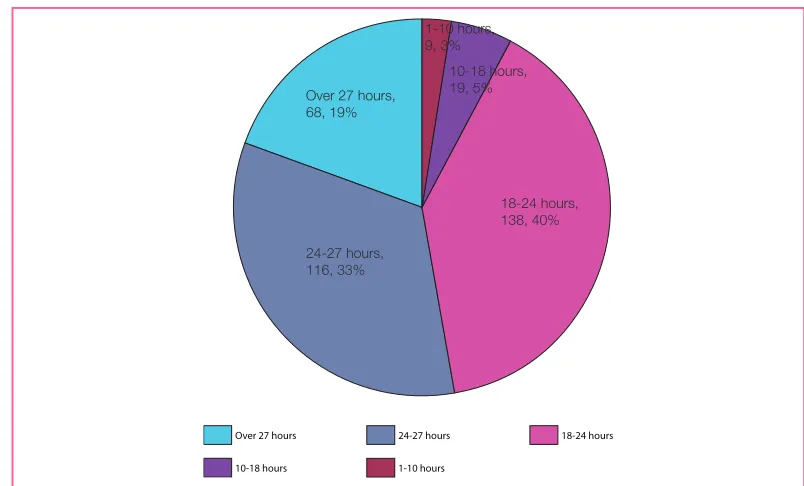
The pie chart above shows that 52% of respondents are in classrooms teaching for more than 24 hours a week. It is a staple of managerialist discourses in further education to deny that increasing a teachers’ weekly contact time will result in a decline in ‘quality’ which may explain these high figures. This rationale can be seen as dominating further education settings for the last quarter century. We consider it an appropriate time to evaluate this common sense view which has worked to generally to increase teachers’ contact time in further education. In the current context, while there are no nationally recognised upper limits on contact time in colleges, it has been left to organised labour to call out excessive hours, usually on the basis of the health and safety of members. The enforcement of local negotiation by teachers’ trade unions in colleges can mean that teachers’ working conditions and the working week of individuals depends on the relative power of local branches. Consequently, that can mean, in a financially insecure college with a bullish management, college teachers are forced to take on additional hours in the name of ‘efficiency’. This doesn’t only mean that working in colleges is less attractive, we contend that it has damaging consequences for the conditions in which transformative teaching and learning takes place – as we will outline below.
1-10 hours 10-18 hours
18-24 hours 24-27 hours
Over 27 hours
Figure 5 Hours spent teaching per week (full time teachers only, n = 350)
18-24 hours, 138, 40%
24-27 hours, 116, 33% Over 27 hours, 68, 19%
While secondary school teachers are reported as teaching between 20 and 21 hours per week (Sellen 2016: 18), our sample suggests that a much higher total of teaching hours per week is common in colleges. At the upper end of this, 19% - very nearly a fifth of respondents reported teaching more than 27 hours per week. Anyone who has taught full time knows that a weekly workload of that number of hours for longer than a few weeks is likely to lead to health problems. In the context of this report, when viewed alongside other factors, we would argue that such a workload will considerably reduce teachers’ ability to facilitate transformative teaching and learning. The following figure gives an indication of the amount of time per week respondents were spending on administrative tasks.
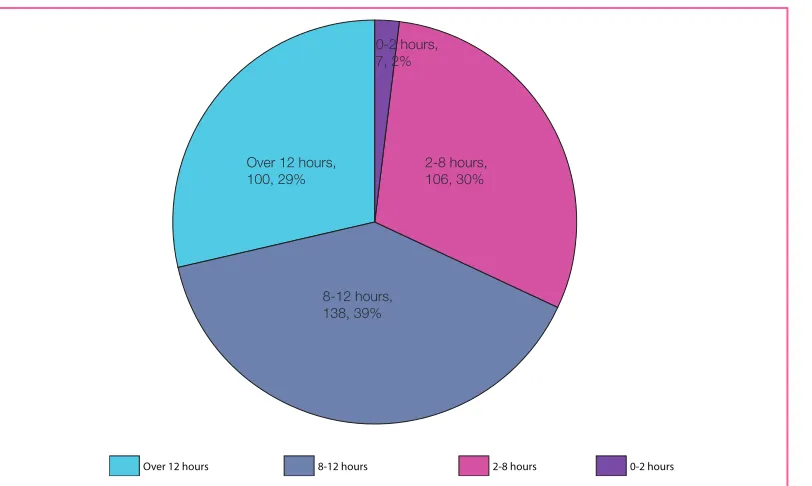
The data above is suggestive of a broader context in which the administrative work of teachers is high. While teachers may be key in creating the conditions in which transformative learning takes place, college senior leaders and managers are responsible for creating the social conditions in which teachers work. But they in turn are constrained by the external pressures of accountability for quality assurance for Ofsted and funding agencies. How these pressures are mediated while a culture that is supportive of teachers’ efforts to do more than simply spoon-feed students for assessment purposes is all-important. Figures 4 and 5 illustrate how the market environment brought about by the Further and Higher Education Act has led to heavy workloads and conditions in which the kinds of educational relationship that underpin transformative teaching and learning are unlikely to thrive.
Some of this critique draws on the impact of the Further and Higher Education Act (1992) that presaged a national contracts dispute in colleges and led to a worsening of terms and conditions for teachers (see Smith 2015). But it is an argument that is more telling in the light of the Lingfield Report (Lingfield 2012) that, in an effort to justify the removal of public funding from the Institute for Learning, revoked the mandatory qualification for further education teachers. This was something, it was argued, that could be left to the discretion of college principals and presumably, ‘the market’. How it is possible to remove a regulatory requirement for college teachers to be qualified educators (with, as we have seen, potentially
0-2 hours 2-8 hours
8-12 hours Over 12 hours
Figure 6 Hours spent working on administrative tasks per week (full time teachers only, n = 351) 0-2 hours,
7, 2%
2-8 hours, 106, 30%
The role of teachers in facilitating dialogic care
The commentary on our findings begins with teachers because the data indicates that they do not have a merely ‘technical’ or extraneous role in transformative teaching and learning. According to our research data, teachers in further education play a vital role in creating the social conditions and establishing the strong relational ties through which transformative learning takes place (Duckworth and Smith, 2016). As a starting point, their practice needs to take account of the negative prior educational experiences of learners who in many cases have been judged and written off by a rigidly linear school system that assesses individuals against a normative, age-staged matrix of ‘learning progression’. These teachers understand that in some cases it has taken enormous courage on the part of some would-be adult learners to cross the threshold onto college premises. An initial focus of their work is to create a safe learning environment, establish trust and build confidence. The teachers form affective bonds and these bonds arise from an awareness of the historical positioning of the learners and their communities and how their location has shaped their trajectories (Duckworth and Smith, 2018C).
One participant, Judith, an Access to HE teacher, was conscious
of the importance of her teaching work in a region with historically high levels of unemployment and job losses.
For me transformational teaching is teaching that makes a difference. Whether it’s people enjoying the lesson... or sometimes… people have come in and they’ve been very quiet and haven’t had much confidence. You’ll see them five or ten years later and they’ll say I’m a primary school teacher now or I’m a social worker or I’m doing my master’s degree, I’m doing my PhD. And you think: Wow what a difference!
What’s interesting about the description is that Judith sees the transformative potential as immanent in the students. Judith sees this transformative process as a collective phenomenon and as having social as well as individual origins:
People feel once they get to their twenties or thirties, Oh I didn’t stick in at school or I’m not clever enough or I’m never going to do anything. And it only takes one person in a friendship group to go and do something like an Access Course and go on and do well and then their friends want to come on as well. …
What’s interesting about the description is that Judith sees the transformative potential as immanent in the students. Judith sees this transformative process as a collective phenomenon and as having social as well as individual origins:
Judith here signals how the impact of the Access course on an individual often led to the recruitment of others from that individual’s social network. Judith identifies some important ingredients in the formation of dialogic caring relationships with the learners. Amongst these, although not specifically named, is the respect she has for them as people. Once more the egalitarian nature of transformative teaching and learning comes across powerfully:
We try to get to know the students as people and be part of their journey... A lot of people think they’re not academic when actually, they are… They’re so used to thinking of all the things they can’t do, we’ve got to focus on what they can do… By the time they finish they realise that they can do the same as those people they thought were better than them because they had a degree or they are a doctor. I’ve had people say to me: … I’ve learned how to phone up
and complain if I’m not happy about something. I’ve learnt to say, I disagree with that. At the
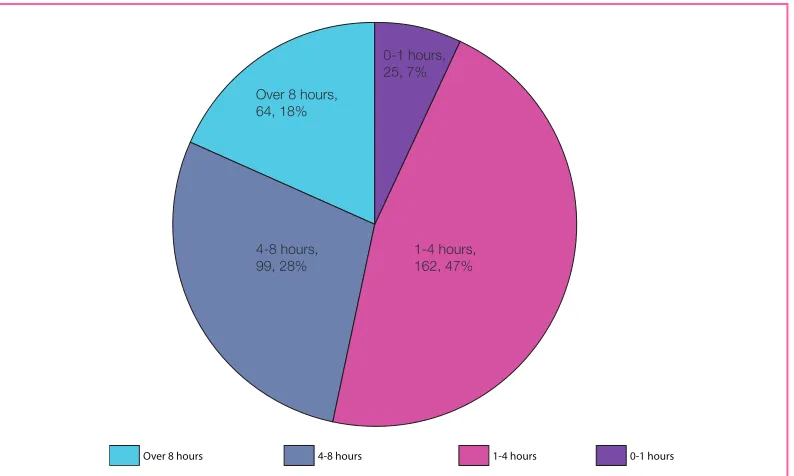
Getting to know students involves supporting them and being interested in them as people outside the classroom. Data from the survey supports this perspective and gives a vantage point on a kind of educational space and interaction that is not accounted for in existing metrics. Figure 6 below gives a picture of the amount of time respondents spend per week supporting students outside of classroom time. While this time is not counted as so-called ‘contact’ time, our research shows that it underpins the kind of educational relationships that make transformative teaching and learning possible. Typically, it is elastic time. It may involve providing additional support for students to complete classroom work but interview data suggests that it spills over into helping individuals manage bigger personal issues (housing, travel, relationships, food, money), issues that sit outside the taught curriculum but, if they are not resolved, make learning difficult or impossible to achieve.
0-1 hours 1-4 hours
4-8 hours Over 8 hours
Figure 7 Hours spent supporting students outside class per week (full time teachers only, n = 350) Over 8 hours,
64, 18%
4-8 hours, 99, 28%
It’s important to add here that managers’ time too is significantly occupied in this aspect of further education work.
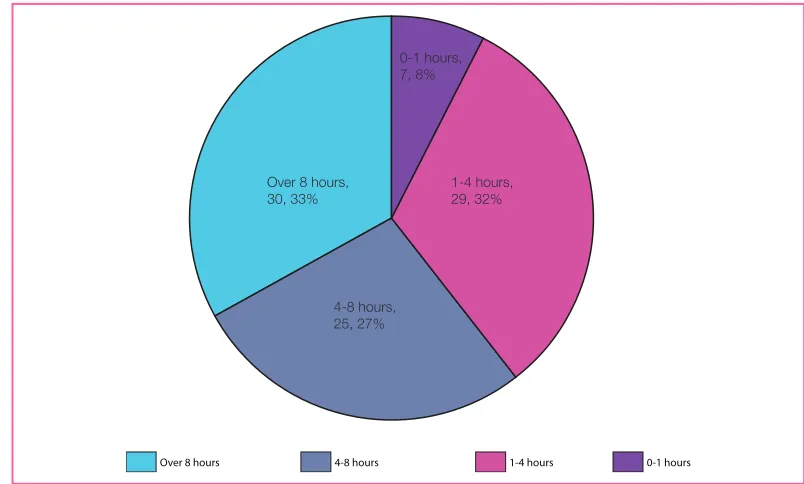
A third of the survey respondents who identified themselves as managers said they spent more than 8 hours per week supporting students outside classroom time. Taken alongside the chart showing teachers’ time spent on the same issue, this data suggests the significance of the scaffold of support needed for some students in further education. Many students bring with them very particular needs and support requirements. Sometimes these span across multiple areas. Simple institutional systems and structures are often not adequate in dealing with these. Often, instead, the requirement is that an individual member of staff guides the student through a prolonged process. In some cases, additional support needs continually surface during a student’s time in college. These have to be responded to.
This invisible, socially-situated and framing element of further education teachers’ work may also by necessity involve restorative work aimed at starting to repair the damage sustained by students to their learning identities in prior educational experiences. The research has uncovered the impact of experiences of social exclusion and labelling that students experienced at school and exposed how the educational system is not a meritocratic system; rather it is a place where intergenerational marginalization and exclusion is encountered. Labelling theory can be linked to teacher expectation and self-fulfilling prophesy (see Ball 1981). Activities by the teacher may lead to learners being labelled as ‘intelligent’, slow’ or ‘average’.
The study has revealed how transformative teaching and learning facilitates the subversion and rejection of negative labels by students and the re-working of learning identities to gain hope and pathways forward. Dialogic communication between teachers and learners was the key to actively involving students in their own education; this active participation included the co-creation of the curriculum whereby students’ needs, motivations and interests were the driving factors. Assessment was often measured by each students’ own goals and aspirations and the distance they had travelled in a self-defined learning journey. Offering an egalitarian model involved a consideration of the cultural, psychological and educational factors related to the student. This approach values their history, present and future narratives, rather than fitting all students into one prescriptive framework. It also facilitates the students’ own connection with historical, social, economic and political structures that privilege the dominant ideologies. As they gained confidence and were supported on their learning journey within a holistic learning environment, students spoke of how they developed real hope to strive for dreams they
0-1 hours 1-4 hours
4-8 hours Over 8 hours
Figure 8 Hours spent supporting students outside class per week (managers, n = 91)
Over 8 hours, 30, 33%
4-8 hours, 25, 27%
In order to build a picture of the different components of transformative teaching and learning, the survey used a series of questions from validated surveys that in our judgement best matched the key features of teachers’ work we had identified in the qualitative project data. We judged fostering a sense of belonging, knowing about students’ backgrounds, cultivating mutual respect in the classroom and listening to students’ problems to be important aspects of this.
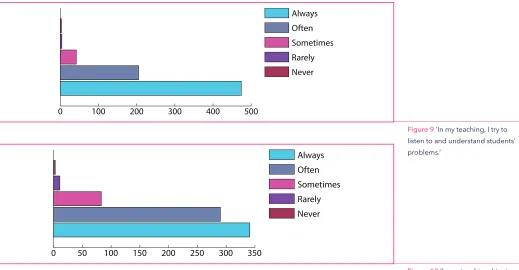
As we have already noted, further education teachers’ roles are broader than simply ‘delivering’ subject knowledge. Effective teaching and learning in colleges involves teachers fostering a sense of belonging in the classroom. The survey data provides insights into this element. The extent to which teachers tried to (1) listen and understand students’ problems, (2) know about students’ backgrounds, (3) feel connected to students and (4) provide emotional support for students when necessary, correlated with each other. These practices are all instances of fostering positive student-teacher relationships. On average, the teachers reported trying to incorporate these practices ‘often’ or ‘always’ (the mean score was 4.43, where 4 = often and 5 = always).
0 100 200 300 400 500
Always Often Sometimes Rarely Never
Figure 9 ‘In my teaching, I try to listen to and understand students’ problems.’
0 50 100 150 200 250 300 350
Always Often Sometimes Rarely Never
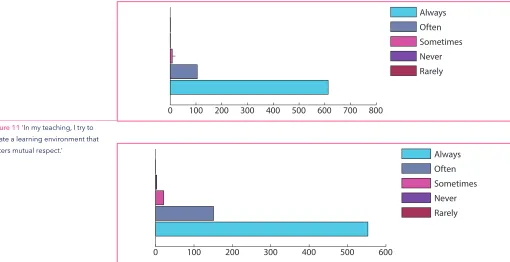
Responses to questions about the extent to which teachers tried to (1) create a learning environment that fosters mutual respect, (2) encourage students to feel a sense of belonging to the class, (3) ensure that students feel respected and valued, (4) give students space to voice their opinions and (5) encourage positive relationships between peers in the classroom, also correlated with each other. They can all be seen as aspects of fostering a sense of belonging to the class. On average, the teachers reported trying to incorporate these practices almost ‘always’ (the mean score was 4.75, where 4 = often and 5 = always). Findings are shown below for two example items (number of teachers shown after bars).
Interview data from many colleges indicated that teachers felt funding considerations often impacted negatively on their freedom to create the conditions in which transformative teaching and learning can take place. In addition, the survey sought to find out if a funding environment that has been significantly affected by budget cuts as part of government austerity measures has had any impact in this area. Although two thirds of teachers believed that course funding ‘always’ or ‘often’ impacted on their freedom to meet their learners’ needs and support students to achieve their aspirations, this had no effect on the extent to which they tried to foster positive student-teacher relationships or a sense of belonging in the classroom. While this suggests that restrictions caused by course funding did not influence teachers’ attempts to incorporate these positive practices into their teaching, once more, the data signals the importance of an invisible and unmeasured aspect of further education teachers’ work.
0 100 200 300 400 500 600 700 800
Always Often Sometimes Never Rarely
Figure 11 ‘In my teaching, I try to create a learning environment that fosters mutual respect.’
0 100 200 300 400 500 600
Always Often Sometimes Never Rarely
2. Routes into further education
There are many different routes into further education. This is another aspect that makes it special. Unlike school, entry points are not governed by age or catchment area and house prices. Rather they are rooted in the decisions of individuals. What this means is that further education can be an open door that provides opportunity for people with a range of different purposes. In that sense it is responsive to the agency and action of people from across the social spectrum. The two examples from our data below illustrate very different journeys, having different incidents that instigated a re-engagement with education as a means of bringing about change in each participant’s life.
Prior to her Access course, Abi felt she had lost her way and,
having just escaped from an abusive relationship, wanted to start a new life with her very young child. Taking charge of her