[Ozawa * et al., 5(4): April, 2018]
ISSN: 2349-5197
Impact Factor: 3.765
I
NTERNATIONAL
J
OURNAL OF
R
ESEARCH
S
CIENCE &
M
ANAGEMENT
A DEVELOPMENT OF PROTOTYPE OF COIL-EEFL LAMPS THAT HAVE
ASTRONOMICAL QUANTUM EFFICIENCY OF 1013 VISIBLE PHOTONS BY
ONE MOVING ELECTRON
Lyuji Ozawa*
*Consultant on Applied Science
DOI: 10.5281/zenodo.1220061
Keywords: quantum efficiency, FL lamps, power consumption, operation life, cultivation.
Abstract
We have developed a prototype of the coil-EEFL lamps after the critical review on the established FL lamps for last 90 years. The fundamentals of the established concepts of the FL lamps are on the hypotheses without the scientific proves. We have found the coexistence of disparate external AC driving circuit and internal DC driving circuit in the lighted FL lamps. The findings lead us to a development of the coil-EEFL lamps. The developed coil-EEFL lamps light up with the moving electrons in the internal DC driving circuit with the high quantum efficiency of ηq = 1013 visible photons by one moving electron per second. The electric power consumption of the external DC driving circuit is zero. The operation life is longer than 106 hours. By the application of the coil-EEFL lamps, the electric power consumption on the word will reduce around 31 %. Furthermore, the coil-EEFL lamps light up without the distribution lines from the electric power generators. The coil-EEFL lamps can use as the special light source for the cultivation in the greenhouse in the architecture of the solar cell panels with the combination of the electric battery. This may greatly help the agriculture in the desert areas and undeveloped lands on the world.
Introduction
The light sources are necessaries of our life activity. Historically, the candescent lamps utilize the lights from the fire-flame by the chemical reaction of the organic materials with oxygen in air. The heat of the fire-flame is generated by the change of the entropy. The candescence is the ancient Greek as the lights from the fire flame. After the finding of atoms and electrons on 1800s, the major light sources shift to the incandescent lamps that do not use the fire flames. Incandescent lamps generate the lights in the visible spectral wavelengths by the moving electrons in metal filaments, solid compounds, and gases. The electrons are quantum. Therefore the figure of the merit of the incandescent lamps is given by the quantum efficiency (ηq) that is given by the numbers of the emitted visible photons per one moving electron in the incandescent lamps. The illuminance (lm, m-2) is given by the product of the ηq multiplied with the numbers of the moving electrons in the incandescent lamps. It should be noted that the luminous efficiency (lm, W-1) has been used for the evaluation of the LED lamps but the luminous efficiency is for the study on the colorimetry. The luminous efficiency never uses for the evaluation of the incandescent lamps. The performance of the incandescent lamps is evaluated with either one of the illuminance (lm, m-2) or luminance (cd, m-2) and quantum efficiency (η
q). The values of the ηq are remarably changed with the kinds of the incandescent lamps.
Metal lamps
[Ozawa * et al., 5(4): April, 2018]
ISSN: 2349-5197
Impact Factor: 3.765
I
NTERNATIONAL
J
OURNAL OF
R
ESEARCH
S
CIENCE &
M
ANAGEMENT
The atoms in the LED and FL lamps totally differ from the metal lamp. The atoms in the LED and FL lamps do not form with the metallic bond. The atoms float in the vacuum. The solid and gas have the totally different vacuum conditions. The atoms of the solid LED lamps are arranged at lattice sites with the narrow separation distance at around 10-9 m that gives the vacuum space at 10-27 m3 between atoms at lattice sites. On the other hand, the Ar atoms in the FL lamp float in the vacuum with the large separation distance around 10-6 m that give the vacuum space at 10-18 m3. The LED lamps use the solids, and FL lamps use the atoms in gas phase. The both LED and FL lamps light up with the quite different mechanisms of the moving electrons. We will give a brief summary of the lighting mechanisms of the LED and FL lamps respectively for a determination of the ηq.
LED lamps
The LED lamps are produced with III-V compounds that are made by the covalent bounding. The covalent bounding does not have the vacancy in the bonding electron shell. The electrons in the covalent bounding cannot move in the bounding shell. Furthermore, the electrons in the covalent bounding cannot get out to the vacuum space between atoms at the lattice sites. The pure III-V compounds are the electric insulators. The pure III-V compounds do not have the valence band and conduction band. The moving electrons in the LED lamps are made by the n-type and p-type semiconductors. The n-type semiconductor is made by the addition of a small amount of the impurities that have extra bonding electrons in the covalent bonding shell. The extra-bounding electron of the impurity stays in the narrow vacuum space between atoms at the lattice sites. The electrons in the vacuum space between atoms can move in the vacuum space between atoms. The p-type semiconductor is made by the addition of the impurities that have lack of one electron in the bonding shell. The p-type semiconductor picks up moving electron from the narrow vacuum space between atoms at the lattice sites. Thus, the electrons in the semiconductors only move on in the narrow vacuum space between atoms arranged at lattice sites of the crystals. There is no conduction band and valence bands in the semiconductors, which have considered in the study on the LED lamps.
The generation mechanisms of the visible lights from the LED lamps are below: The moving electrons in the LED lamps inevitably have the R. Therefore, the LED lamps unavoidably heat up by the Joule Heat (I2R). The maximum numbers of the moving electrons of the LED lamps are restricted in the allowed temperature that does not diffuse out the impurities (e.g., luminescence centers) from the junction of the lighted LED lamps. The maximum temperature of the LED lamps is experimentally determined at around 70oC. The visible photons in the LED lamps are generated by the recombination of the pair of the injected electrons and holes at the luminescence (recombination) centers in the narrow junction of the n- and p- semiconductors. The attached electrodes of the LED lamps respectively inject the electrons or holes into the narrow vacuum space between atoms at the lattice sites. We can calculate the required numbers of the injected electrons from the metal electrodes into the practical LED lamp.
The LED lamp emits one visible photon with recombination of a pair of the electron and hole at the luminescence centers. We may determine the numbers of the emitted visible photons per second from the LED lamps in the Ulbricht Sphere. Then, we may determine the ηq of the LED lamp [1, 2, 3]. Since the moving electrons inevitably lose some amount of the kinetic energy by the Joule Heat (I2R) that is caused by the electric resistance, the practically obtained ηq ≈ 0.5. The amount of the moving electrons by the Joule Heat changes with the thickness of the semiconductor of the LED lamp. If the LED lamps are produced with the extremely thin III-V semiconductor, one may produced the ηq > 0.5, but it is < 1.0. The numbers of the emitted photons from the LED lamps are given by the products of the ηq and the numbers of the injected electrons. The brighter LED lamps are obtained with the large numbers of the injected electrons into the LED lamps. This gives the limitation of the maximum numbers of the emitted photons from the LED lamps.
You cannot increase the ηq higher than 1.0. We take ηq = 1.0 for the following calculations as the limitation of the LED operation. The numbers of the emitted photons from the LED lamps linearly increase with the numbers of the injected electrons. For the illumination purpose, the LED lamps should emit the 1025 visible photons (m2, s)-1, corresponding to the illuminance (300 lm, m2). With the η
[Ozawa * et al., 5(4): April, 2018]
ISSN: 2349-5197
Impact Factor: 3.765
I
NTERNATIONAL
J
OURNAL OF
R
ESEARCH
S
CIENCE &
M
ANAGEMENT
The 1 A of electric current is given by 1 Coulomb per second. The required electric current for the lighting LED lamp is 1.6 x 10⁶ ampere (m2, s)-1 (= 1025 x 1.6 x 10-19 Coulomb per second for 1 m2 room). The operation voltage of the LED lamps is around 2.9 V. The electric power consumption of the LED lamp for the illumination of 1 m2 room is given by 4.6 x 10⁶ watt (m2, s)-1 (= 1.6 x 106 A x 2.9 V) = ~ 5 x 10³ k-watt, excluding the loss by the Joule Heat. In the above calculations, we do not considered the narrow vacuum space between atoms at the lattice sites. It is not clear why the electrons can move on in the narrow vacuum space that fills up with the negative electric field from the orbital electrons of atoms in the III-V compounds. This is the remained problems for a future study.
From the above calculations, one may allow us to say that the LED lamps are the power hungry incandescent lamps with the ηq ≤ 1.0. The LED lamps do not have a potential for the contribution to the Green Energy Project of UN, even though the inventors and producers claim it.
FL lamps
On the other hand, the individual Ar atoms in the FL lamp float in the vacuum with the large separation distance at around 10-6 m. Consequently, the Ar atoms form the gas phase. Individual Ar atoms in the FL lamps isolate each other. The electrons in Ar gas move on in the vacuum between Ar atoms. Here arises a difficulty of the moving electrons in the vacuum space between Ar atoms. The vacuum space (= 10-18 m3) between floating Ar atoms in unlighted FL lamps fills up with the negative electric field from the orbital electrons in the floating Ar atoms. The presence of the negative electric field in the vacuum can be detected by the measurements of the optical absorption spectrum of the Ar gas by a spectrometer. You may detect the absorption lines of each Ar atom. The intrinsic level of the Ar atom splits to the sublevels by the Stark effect. The Stark Effect is caused by the electric field from the orbital electrons of the neighbor Ar atoms. The vacuum space between Ar atoms in unlighted FL lamp is the electric insulator. The electrodes at the both ends of the FL lamps never directly inject the electrons into the insulating vacuum in the unlighted FL lamps. For the evaluation of the ηq of the FL lamps, we must find out a way that neutralizes the negative electric field in the vacuum space between Ar atoms for the moving electrons. The lights from the FL lamps are generated by the moving electrons in the vacuum space between Ar atoms.
Revised lighting mechanisms of FL lamps
We have critically studied the established lighting mechanisms of the commercial 40W-HCFL lamps. We have found that the established technologies of the hotcathode (HC) FL lamps are made with the hypotheses, without the scientific proofs [4, 5, 6, 7, 8]. The typical hypothesis of the HCFL lamps is the thermoelectron emission from the heated BaO particles into the vacuum space between Ar atoms.
The drilled studies on the thermoelectron emission from the heated BaO particles had made with the development of the CRT and vacuum radio tubes. The heated Ba atoms on the top layer of the BaO particles on the metal cathode electrode steadily emit the thermoelectrons into the vacuum at the pressures less than 10-5 Pa (≈ 10-7 Torr). The thermoelectron emission from the heated Ba particles is seriously damaged in the vacuum pressures at 10-3 Pa (= 10-5 Torr). The heated Ba particles never emit the thermoelectrons to the vacuum at the pressures above 1 Pa (> 10-2 Torr) [1 .2, 3]. The commercial HCFL lamps contain the Ar gas pressure at 931 Pa (7 Torr). The use of the thermoelectron emission from the heated BaO particles in the HCFL lamps is the false story.
Coexistence of disparity of external AC driving circuit and internal DC electric circuit
[Ozawa * et al., 5(4): April, 2018]
ISSN: 2349-5197
Impact Factor: 3.765
I
NTERNATIONAL
J
OURNAL OF
R
ESEARCH
S
CIENCE &
M
ANAGEMENT
electric power, the electrodes of the external driving circuit never picks up the induced current, resulting in the zero electric power consumption, WDC = 0. The commercial HCFL lamps do not light up under the DC voltages.
AC electrode
C
Ar(A)
(B)
+
Ar
+-+
-AC electrode
cathode (-)
anode (+)
internal DC electric circuit
external AC electric circuit
DC electron current
only active with AC induced current
electric field
electric field
volume of glow (or corona)
e
-Ar
lighted Ar* in positive column
(no light generated)
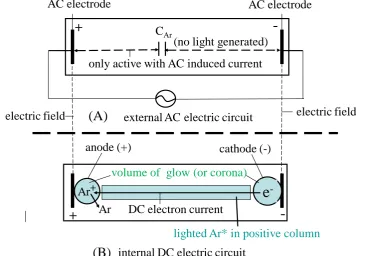
Figure 1 Schematic illustration of disparity of external driving circuit (A) and internal electric circuit (B). Both circuits are conjugated with electric field without electron flow
The results in Figure 1 (A) give us important information on the study of the FL lamps. If the FL lamps light up with the DC external driving circuit, the electric power consumption of the external driving circuit of the lighted FL lamps is zero. For aiming to the external DC operation of the FL lamps, we have studied the formation of the external and internal DC driving circuits in the lighted FL lamps. The basic experiments of the formation of the cathode and anode in the Ar gas space in the lighted FL lamps have studied with the needle electrodes [9]. The sharpness of the top point of the needle electrode was less than 10-6 m (1 μm). As the application of the DC voltage to the needle electrodes below 0.95 kV, there is nothing happened with the needle electrodes in the Ar gas space. By application at 1.0 kV to the needle electrodes, the total area of the needle electrodes at the both ends are suddenly covered with the volume of the glow light, rather than direct emission of the electrons into the Ar gas space. The formation of the volume of the glow light gives us a solution of the lighting mechanism of the FL lamps. The depth of the volume of the glow light on the needle electrodes is 3 x 10⁻³ m. If the sharp point is 10-5 m, the threshold voltage goes up to the high applied voltage, e. g., 2 kV depending on the sharpness. The sharp point of the needle electrodes less than 1 x 10⁻⁶ m is a necessary condition for the formation of the volume of the glow lights in the Ar gas. After the formation of the volume of the glow light, the entire area of the testing glass tube lights up with the sky-blue light, as illustrated in Figure 1 (B). The volumes of the glow lights on the needle electrodes actually form the cathode and anode of the internal DC electric circuit.
[Ozawa * et al., 5(4): April, 2018]
ISSN: 2349-5197
Impact Factor: 3.765
I
NTERNATIONAL
J
OURNAL OF
R
ESEARCH
S
CIENCE &
M
ANAGEMENT
Formation of cathode and anode of internal DC driving circuit in FL lamps
Fortunately, we have found the commercial cold-cathode FL (CCFL) lamps in the diameter of 1.0 x 10⁻² m. With an expectation, we have modified CCFL lamps. We turn on the lead wire on the outer glass wall of the CCFL lamps with few turns that are the coil external electrodes (coil-EE) on the outer glass wall. As the electric field from the coil-EEFL lamps reaches to the phosphor particles in the screen on the inner glass wall, the phosphor particles are polarized with the electric field from the coil-EEFL lamps. Then, we have found that the Ar gas on the well crystallized phosphor particles in the screen of the coil-EEFL lamps certainly forms the volume of the glow light by the application of the DC voltage at 1.0 kV. FL (1, 2, 3, 9). Then, the coil-EEFL lamps brilliantly light up with the application of the DC voltages above 1.0 kV. The coil-EEFL lamps surely emit the sky-blue light between the volumes of the glow lights as illustrated in Figure 1-(B). The thickness of the volume of the glow light on the phosphor screen is 3 x 10⁻³ m. The volume of the glow light on the phosphor screen does not change with the applied voltages of the external DC driving circuit up to 10 kV. We have developed the coil-EEFL lamps.
The volume of the glow light on the phosphor screen contains the Ar1+, free electrons, excited Ar atoms (Ar*). Ar1+ and free electrons are invisible by the naked eyes. The detection of them is sa very hard. Fortunately, Ar* emit the sky-blue lights. We can use the sky-blue light for the monitor of the presence of the volume of the glow light. Then we may analyze the details of the lighting mechanisms of the coil-EEFL lamps.
The lighting of the entire volume of the coil-EEFL lamps confines the positive column. The lighting mechanisms of the coil-EEFL lamp are below: The negative electric field in the volume of the glow light is electrically neutralized with the presence of Ar1+. When the FL lamp has the volumes of the glow light at the both ends, each volume of the glow light at the both ends of the FL lamps respectively forms the cathode and anode in the Ar gas space. The formed cathode and anode generate the DC electric field (FDC) over entire volume of the Ar gas space in the unlighted FL lamps. As the electrons in the volume of the glow light on the cathode are under FDC, the electrons in the volume of the glow light on the cathode are accelerated under the FDC. The accelerated electrons step out from the volume of the glow light on the cathode. The step-out electrons ionize Ar atoms (Ar1+) in the nearby volume of the glow light. The electrically insulating vacuum in the FL lamps instantly neutralizes with the moving electrons between cathode and anode with the running speed of the electrons at 108 m per second. By the neutralization of the vacuum space between Ar atoms, the active internal DC electric circuit is formed by the cathode and anode in the Ar gas space. The arrived electrons to the anode recombine with the Ar1+ for returning to the Ar atoms. There is no consumption of the Ar atoms in the operation of the coil-EEFL lamps, promising the operation life longer than 106 hours. The generate numbers of the Ar1+ are equal with the generated free electrons in the lighted coil-EEFL lamp. When the applied DC voltage to the EEs has turned off, all Ar1+ in the lighted FL lamp immediately recombine with all free electrons in the vacuum between the cathode and anode. The vacuum space in the unlighted coil-EEFL lamps is the electric insulator.
[Ozawa * et al., 5(4): April, 2018]
ISSN: 2349-5197
Impact Factor: 3.765
I
NTERNATIONAL
J
OURNAL OF
R
ESEARCH
S
CIENCE &
M
ANAGEMENT
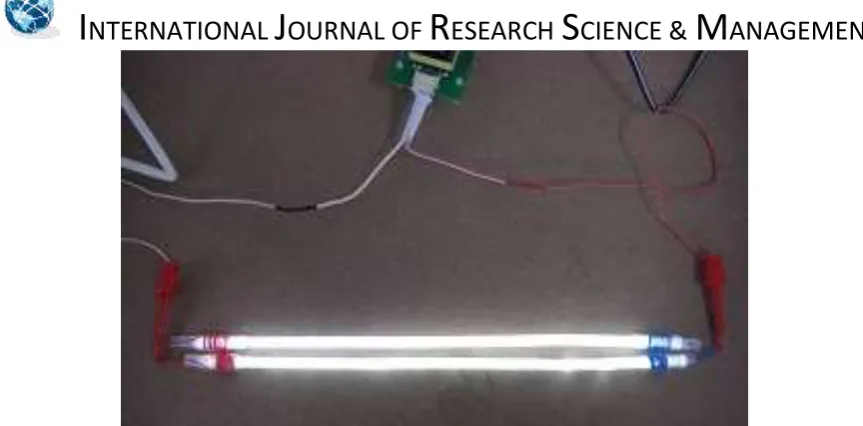
Figure 1 Photopicture of prototype of coil-EEFL lamps in parallel connection. Coil-EEFL lamps are converted from the commercial CCFL lamps.
Superconductive vacuum between cathode and anode of coil-EEFL lamps
We have studied the details of the characteristic properties of the internal DC electric circuit. The thickness of the volume of the glow light does not change with the applied DC voltages to the external DC driving circuit up to 10 kV. The external electrodes on the outer glass wall never inject the electrons in to the Ar gas space of the coil-EEFL lamp. With the separate experiments of the coil-EEFL lamp, we have found that the DC electric current in the internal DC driving circuit vertically increases with the applied voltages of the external DC driving circuit up to 10 kV that we have studied [1, 2, 10]. The vertical increase in the DC electric current with the different applied voltages provides us followings. The moving electrons in the wide vacuum space of 10-18 m3 between Ar atoms in the FL lamps do not have the electric resistance (R) [1, 2, 3, 10]. That gives V = RI = 0. This means that the electrons move on in the superconductive vacuum in the lighted coil-EEFL lamps without the Joule Heat. The vacuum space of the coil-EEFL lamps forms the superconductive vacuum at the temperature above the 30oC. Thus, we have found that the FL lamps are operated with the moving electrons in the superconductive vacuum. The operations of the coil-EEFL lamps have the extraordinary advantage with the superconductive vacuum above the room temperature. The high temperatures of the positive column are caused by the ionization of the Ar atoms that release the heat with the change in the entropy.
Then we have carefully studied the commercial hotcathode (HC) FL lamps. We have found that the commercial HCFL lamps use the volume of the heated corona light in the Ar gas at around heated bear spot of the W-filament coil with the BaO particles, instead of the volume of the glow light. The volume of the heated corona light in the HCFL lamps is the fourth generation (4G) electron source [11]. The lighting mechanisms by the 4G electron source are the same with the 3G electron source, except for the lighting volumes. The volume of the 4G electrodes extends to the inner glass wall of the HCFL lamps; e.g., 3.0 x 10⁻² m of the commercial 40W-HCFL lamp. The heating source for the 4G electron source is the heated spot in the W-filament coil. The demerit of the 4G electron source is the short operation life that is determined by the cut-off of the heated bear spot of the W-filament coils by the evaporation by the high temperatures. The cutoff of the W-W-filament coil gives rise to the operation life shorter than 104 hours, depending on the operation frequencies of the external AC driving circuit. As the operation frequency is 50 Hz, the average life of the HCFL lamps are less than 103 hours. The fundamentals of the lighting mechanisms of the HCFL lamps are the same with the coil-EEFL lamps.
Calculation of ηq of FL lamps
[Ozawa * et al., 5(4): April, 2018]
ISSN: 2349-5197
Impact Factor: 3.765
I
NTERNATIONAL
J
OURNAL OF
R
ESEARCH
S
CIENCE &
M
ANAGEMENT
electrons (e), and excited Ar atoms (Ar*) in the positive column in the lighted FL lamps, depending on the kinetic energy of the moving electrons. The operation of the lighted FL lamps heats up the Ar gas space in the positive column. The heat source in the lighted FL lamps attributes to ionization of the Ar atoms by the change in the entropy. The temperature of the positive column of the lighted FL lamps can be controlled with the Ar gas pressures; a high temperature with a high Ar gas pressures.
The generated Ar1+ and e by the ionization are invisible particles in the Ar gas space. Only Ar* emits the visible photons within 10-6 second after the formation of Ar*. The generated Ar1+ and e return to Ar atom with recombination in the lighted FL lamp. We may calculate the Ar1+ and excited Ar* in the lighted FL lamp as the statistical results in the unit time; e.g., one second [1, 2, 3]. The statistical consideration of the Ar1+ and Ar* is an essential condition for the study on the operation of the FL lamps. It should be noted that we cannot find the ηq (= numbers of visible photons per second) in the study of the lighted FL lamps for the last 90 years [4, 5, 6, 7, 8], even though the annual productions of the FL lamps are more than multi-multimillions.
Fortunately, we have found the superconductive vacuum between floating Ar atoms in the lighted FL lamps. We have calculated the numbers of the Ar atoms in the FL lamp at pressure of 930 Pa (7 Torr). The numbers of the Ar atoms in a given FL lamp is calculated from the Boyle-Charles law (PV = mRT) and Avogadro’s numbers. Where P is pressure at atmosphere, V is inner volume of the FL lamp, m is mole, R is gas constant (8.32 J/K. mol), and T is temperature by oK. The rounded Ar gas pressure (P) in the FL lamp is ≈ 0.01 atmospheres {= 7 Torr x (760 Torr)-1}. RT = 2.5 x 10³ Joule (= 8.32 J/K x 300 oK). P/(RT) = 4 x 10⁻⁶ {= (1 x 10-2) x (2.5 x 103)-1}. Mole of the Ar gas in the unit volume of the FL tube is given by {m = V x P(RT)-1} that is 2.8 x 10⁻⁹ mole (=4 x 10-6 x 7 x 10-4 m3). The numbers of the Ar gas atoms in the practical FL lamp are calculated by the Avogadro’s number (6 x 10²³ per mole). The numbers of Ar atoms in the practical FL lamp are calculated as 1.7 x 10¹⁵ Ar atoms (= 6 x 1023 x 2.8 x 10-9 mole). In the practice, the numbers of the Ar atoms are higher than 1.7 x 10¹⁵ Ar atoms because the Ar1+ and electrons recombine in the lighted FL lamps per second. We cannot calculate the practical numbers of the Ar atoms in the lighted FL lamps. The moving electrons in the lighted FL lamps have a constant voltage at 1.0 kV with the different application of the DC voltages (1, 2, 9). Then, we take the separation distance of the Ar atoms in the lighted FL lamps for the calculation of the statistics. The separation distance of the Ar atoms in the FL lamps is statistically calculated by the unit volume (m3). The numbers of the Ar atoms in 1 m3 are 2 x 10¹⁸ atoms {= 1.7 x 1015 x (7 x 10-4 m3)-1}.
The moving electrons in the vacuum between Ar atoms lose the kinetic energy by each collision with the Ar atoms. Each collision generates Ar1+ and free electron. We may statistically calculate the numbers of the generated Ar1+ before the attenuation of the kinetic energy higher than 15.7 eV. The generated numbers of Ar1+ and free electrons by one moving electron is 62 Ar1+ and 62 free electrons {= 1000V x (16 V)-1}. After the generation of the 62 Ar1+, the moving electron may excite an Ar atom (Ar*). The ratio of the Ar1+ to Ar* is given by 62 to 1. After the excitation of the Ar*, the moving electron has the kinetic energy smaller than 11.4 eV. The electrons less than 11.4 eV recombine with Ar1+ for the return to Ar atom. For the calculations of the formation of Ar1+ and Ar*, we take the statistical results per second, rather than the results by a specified electron. Since average separation distance between Ar atoms is 1 x 10⁻⁶ m, the average numbers of the collisions in unit volume (m3) are given by 1 x 10¹⁸ per m3 {= (1 x 10⁶ m)3. The generated average Ar1+ in the FL lamp is calculated as 1 x 10¹⁸ Ar1+ (m, s)-1 (1, 2, 9). The estimated numbers of the Ar* in the lighted FL lamps are ~1 x 10¹⁶ (m3, s)-1 {= 1 x 1018 x 62-1 (m3, s)-1. The each Ar* emits one visible photon in the sky-blue spectral wavelength.
[Ozawa * et al., 5(4): April, 2018]
ISSN: 2349-5197
Impact Factor: 3.765
I
NTERNATIONAL
J
OURNAL OF
R
ESEARCH
S
CIENCE &
M
ANAGEMENT
x 1016 x 10-3 (m3, s)-1}. The phosphor screen of the FL lamps transduces the invisible UV lights to the lights in the visible spectral region. The photons do not have electric charge. Therefore, the transduce of the photons is ηq ≈ 1.0. Then, we have the ηq = 1013 visible photons (m2, s)-1 from the phosphor screen of the lighted 40W-HCFL lamps [1, 2, 9,]. The maximum moving electrons in the FL lamps are 3 x 10⁻⁴ A that contains 2 x 10¹⁵ electrons per second. Consequently, the commercial 40W-HCFL lamps in the outer diameter of 3.2 x 10⁻² m (T-10) may emit 2 x 1025 visible photons (m2, s)-1 [= 1013 x 2 x 1015] which is equivalent with the illuminance (300 lm, m-2). Thus, we have proved the excellence of the lighted FL lamps. The commercial HCFL lamps surely have the high potentials of the contribution to the Green Energy Project with the high illuminance (lm, m3) by 1025 visible photons (m2, s)-1. But the commercial 40W-HCFL lamps are operated with the external AC driving circuit at the given voltage that consumes the AC active power consumption Wact ≈ 80 watt.
Significant reduction of electric power consumption on world by coil-EEFL lamps
The commercial HCFL lamps can convert to the coil-EEFL lamps. The coil-EEFL lamps are operated with the DC external driving circuit with the WDC = 0. As the external DC driving circuit is made with the piezoelectric transformer, the electric power consumption of the transformer for the DC voltages lower than 10 kV is also zero. According to the report of COP (Conference of Particle, 2013) of UN, the electric power consumption of the light sources on the world is 31 % of the totally generated electric powers on the world. Then, it can say that if one takes the coil-EEFL lamps as the illumination source, the total electric power consumption of the illumination source will instantly reduce 31 % of the total electric power generated on the world. The coil-EEFL lamps can be operated with the combination of the solar panels and the electric battery. In this case, the coil-EEFL lamps can be operated without the distribution network on the grand from the electric power generators. In this case, the electric power consumption will reduce more than 40 % from the present level. We have obtained the above results with the quantum (electrons) in the Ar gas space in the lighted coil-EEFL lamps.Light source for greenhouse in architecture of solar cells
The coil-EEFL lamps may also use as the special light source for the cultivation of the vegetables and fruits in the greenhouse in the architecture of the solar panels with the combination of the battery. The solar panels cover up a large area of the flat land. If the solar panels set on the roof of the architecture, the shadowed land under the solar panels may change to the greenhouse by the application of the special coil-EEFL lamps for all day long, without the electric power consumption of the generated electricity by the solar panels. This is because the electric power consumption of the coil-EEFL lamps is zero for 24 hours. With this reason, the output of the solar panels does not change with the lighting of the greenhouse.
The coil-EEFL lamps for the greenhouse should emit the more blue lights and deep red lights than the illumination of the rooms in houses. The coil-EEFL lamps can illuminate the greenhouse for 24 hours per day. This can only be made with the application of the coil-EEFL lamps with WDC = 0 for the long operation life more than 106 hours, corresponding to 100 years by lighting for 24 hours each day.
The application of the coil-EEFL lamps may greatly help the people on the world with (i) the agriculture in the desert areas of the undeveloped countries, (ii) the drying lands downstream of the water dams and (iii) possibly cold lands on the world. Thus, the application of the coil-EEFL lamps will greatly contribute to the Green Energy Project by UN and improving of the life style in the large areas on the world by the greenhouse business.
No poison of Hg droplets in FL lamps
However, here is a great afraid to use the FL lamps in the public media. This is because the Japanese Government has ordered the termination of the production of the FL lamps as the severe poison of Hg atoms for the human body, using Minamata disease. And then, the Japanese Government has taken the action to UN as the severe poison of Hg atoms to the human society.
[Ozawa * et al., 5(4): April, 2018]
ISSN: 2349-5197
Impact Factor: 3.765
I
NTERNATIONAL
J
OURNAL OF
R
ESEARCH
S
CIENCE &
M
ANAGEMENT
other hand, the CH3HgX has a light density that floats in sea water. The bacteria take the floating CH3HgX from the sea water. The small fishes take from the bacteria. When the mother has taken the small fishes with head and the viscera that are contaminated CH3HgX, the mother does not have a difficulty in her daily activity. When the mother is pregnant, only fetus in early stage less than 3 months selectively receives the contaminated organic CH3HgX from the mother. The brain of the fetus is selectively and seriously damaged by the organic CH3HgX for all his life. But other cells of the fetus are not damaged by the organic CH3HgX. The baby of the contaminated fetus grows up with the normal human body. The victim of the Minamata disease is the limited numbers in the small poor fishing villages in Japan, not Minamata City and the world. The similar chemical factories in USA and EU widely use the organic CH3HgX catalysis. They are well control the discharge of the organic CH3HgX from the factories. The Japanese Government did not control the discharge of the contaminated water by the CH3HgX. The Japanese Government must have the action of the withdrawal of their proposal from United Nation. It is said again the Hg droplets are not poison to human boy. The human society has used Hg doroplets for more than 4000 year without any troubles like as the Minamata disease. We can safely use the Hg droplets for the production of the excellent coil-EEFL lamps for the contribution to the Green Energy Project by UN.
Remained problems in production of FL lamps
Then we have analyzed the empirically developed HCFL lamps with the advance knowledge in the science. Here remains the difficulty of the production of the coil-EEFL lamps. The moving electrons in the vacuum in the FL lamps produced by the present production facilities and technologies are seriously influenced with the electric charges on the surface of the phosphor particles in the screens and with the residual gases in the produced FL lamps. The moving electrons are electrically repulsed from the electric charges of the surface of the contaminated phosphor particles in the screen, generating the deep gap between the positive column and phosphor screen [1, 2, 3]. The depth of the gap of the commercial HCFL lamps is higher than 3 x 10⁻³ m. The commercial phosphor particles on the world are deliberately contaminated with the surface treatment with the electric insulators. Furthermore, the phosphor particles do not produce with the control of the particle shapes. The particles of the commercial phosphor powders do not have the sharp edges and points. We cannot use the commercial phosphor powders for the production of the optimized coil-EEFL lamps. Followings are the problems by the users of the phosphor powders. The thickness of the phosphor screen should be less than 5 layers of the phosphor particles, hopefully 3 layers of the phosphor particles. The phosphor screens of many commercial HCFL lamps are made with the layers higher than 5 layers. They must determine the numbers of the phosphor particles in their phosphor screen of the scanning electron microscope.
[Ozawa * et al., 5(4): April, 2018]
ISSN: 2349-5197
Impact Factor: 3.765
I
NTERNATIONAL
J
OURNAL OF
R
ESEARCH
S
CIENCE &
M
ANAGEMENT
the start of your experiments. It said again that if you use the commercial phosphor powders and established production facilities of the FL lamps, you will face a very difficulty in the experiments of the advanced coil-EEFL lamps.
Conclusion
We have developed the EEFL lamps with the quantum (electrons) in the FL lamps. The developed coil-EEFL lamps have the superiority as the incandescent lamps over the LED incandescent lamps. The superiorities are (a) the zero electric power consumption, (b) astronomical high quantum efficiency at 1013 visible photons (m3, s)-1, (c) use of the small amount of the moving electrons in the superconductive vacuum in the lighted FL lamps and (d) operation life longer than 106 hours. If the developed coil-EEFL lamps light on 24 hours per day, the operation life of the coil-EEFL lamps will be over 100 years. However, here is the remaining problem for the production of the coil-EEFL lamps. It requires (a) the advanced phosphor powders, (b) advanced vacuum facilities, and (c) handling of the vacuum facilities, including the degassing furnaces. If someone will study on the adequate production facilities and handling them, he may produce the most advanced coil-EEFL lamps. His results surely reduce the reduction of the electric powers generated on the world. The coil-EEFL lamps may use the lighting source of the greenhouse in the architecture of the solar panels in the desert area and undeveloped countries. The developed coil-EEFL lamps surely contribute to the Green Energy Project by the United Nation.
References
[1] Lyuji Ozawa. [Contribution to Paris Agreement of United Nation by coil-EEFL lamps with zero electric power consumption], International Journal of Materials science and Application, 6(2), pp 65-76, 2017.
[2] Lyuji Ozawa. [Coil-EEFL tube as supreme incandescent light source with zero electric power consumption, astronomical quantum efficiency, and long life], Global Journal of Science Frontier Research; A Physics and Space Science, 15, pp16-50, 2015,
[3] Lyuji Ozawa, [An invention of coil-EEFL lamps operated with WDC = 0 for a great contribution to green energy project of UN], Open Access Journal of Physics, 11, pp 1-16, 2018
[4] J. F. Waymouth, Electron Discharge Lamp, MIT Press, 1971
[5] R. H. Flower and L. W. Nordheim, Proc. Roy. Soc. A, Vol. 119, p 173, 1928
[6] Handbook of Electric Discharge Lamps, Japanese Institute of Electric Engineering (1973)
[7] Handbook of Physics and Chemistry, CRC Press, Taylor & Francis Group, Boca Raton, London, New York, 2003
[8] Phosphor Handbook, Second Edition by William, Yen, ISBN, 084933647, CRC Press, Taylor & Francis Group, Boca Raton, London, New York, 2003
[9] Lyuji Ozawa, [Development of new electron sources for coil-EEFL tube], Science Research 3(4), pp 220-229, 2015
[10]Lyuji Ozawa, [A development of an ultimate coil-EEFL lamp with WDC ≈ 0 for Green Energy project by UN], International Journal of Physical Science Research, 1, pp 34-38, 2017
[11]Lyuji Ozawa and Yakui Tian, [A new 4G electron source for fluorescent lamp tubes], Journal China Illuminating Engineers, 7, pp 58-65, 2012
[12]Handbook of Physics and Chemistry, Iwanami Publish, Japan, 1987
[13]Lyuji Ozawa, [Special arrangement of phosphor particles in screen for optimization of illuminance (lm, m-2) of FL lamps], Science Research, 3(6), pp 261-272, 2015