COMPARATIVE ANALYSIS OF SANDCRETE HOLLOW BLOCKS
AND LATERITE INTERLOCKING BLOCKS AS WALLING
ELEMENTS
Akeem Ayinde Raheem1, Ayodeji Kayode Momoh2, Aliu Adebayo Soyingbe2
1Department of Civil Engineering, Ladoke Akintola University of Technology, Ogbomoso, Nigeria. 2Department of Building, University of Lagos, Lagos, Nigeria
*Corresponding E-mail : [email protected]
ABSTRACT
This study considered the production and testing of sandcrete hollow blocks and laterite interlocking blocks with a view to comparing their physical characteristics and production cost. Some units of sandcrete hollow blocks and laterite interlocking blocks were made using machine vibrated sandcrete block mould and hydraulic interlocking block making machine respectively. The blocks were tested to determine their density and compressive strength. The results obtained from the tests were compared with the specifications of Nigerian Building and Road Research Institute (2006), Nigerian Building Code (2006), and Nigerian Industrial Standards (2000). The results indicated that the compressive strength of 225mm and 150mm sandcrete hollow blocks varies from 1.59 N/mm2 to 4.25 N/mm2 and 1.48N/mm2 to
3.35N/mm2 respectively, as the curing age increases from 7 to 28 days. For laterite
interlocking blocks, the strength varies from 1.70N/mm2 at 7 days to 5.03N/mm2 at 28 days.
All the blocks produced satisfied the minimum requirements in terms of compressive strength, by all available codes. The cost per square metre of 225mm and 150mm sandcrete hollow blocks are ₦2,808:00 and ₦2,340:00 respectively, while that of laterite interlocking blocks is
₦2,121:20.It was concluded that laterite interlocking blocks have better strength and are cheaper than sandcrete hollow blocks.
Keywords: Sandcrete hollow blocks, Laterite interlocking blocks, Density, Compressive strength
1.0
INTRODUCTION
Walling materials constitute an essential element in housing delivery. It is estimated that it covers about 22% of the total cost of a building. The choice of walling material is a function of cost, availability of material, durability, aesthetics and climatic condition. Barry (1996)[1] defines a wall as a continuous, usually vertical structure of brick, stone, concrete, timber or metal, thin in proportion to its length and height, which encloses and protects a building or serves to divide buildings into compartments or rooms.
The word ‘sandcrete’ has no standard definition; what most people have done was to define it in a way to suit their own purpose. For the purpose of this study, sandcrete block is a walling unit produced from sand, cement and water. It is widely used in Nigeria as a walling unit. The quality of blocks is a function of the method employed in the production and the properties of the constituent materials. Sandcrete blocks are available for the construction of load bearing and non-load bearing structures [2].
Nowadays, improved technology induced people to use lateritic interlocking blocks as an alternative for sandcrete blocks in building houses because they do not require cement mortar in bonding the blocks during construction thereby further reducing the building cost [6]. The objective of this study is to compare sandcrete hollow blocks and laterite interlocking blocks in terms of their mechanical properties and cost, with a view to ascertaining which is more applicable in building affordable houses.
2.0
LITERATURE REVIEW
Several studies have been carried out on the use of sandcrete hollow blocks and laterite interlocking blocks as walling units [6-11]. Previous study by the Nigerian Building and Road Research Institute (NBRRI) involved the production of laterite bricks which was used for the construction of a bungalow (Madedor, 1992) [7]. From the study, NBRRI proposed the following minimum specification as requirements for laterite bricks: bulk density of 1810 kg/m3, water
absorption of 12.5%, compressive strength of 1.65 N/mm2 and durability of 6.9% with maximum
cement content fixed at 5%.
Raheem (2006) [6], considered an assessment of the quality of sandcrete blocks produced by LAUTECH Block Industry, an arm of the business ventures of Ladoke Akintola University of Technology, Ogbomoso, Nigeria. The results indicated that compressive strength of 450 x 225 x 225mm (9 inches) blocks increased from 0.54 N/mm2 at age 3 days to 1.68 N/mm2 at age 28 days,
while that of 450 x 225 x 150mm (6 inches) blocks increased from 0.53 N/mm2 at age 3 days to
1.59 N/mm2 at age 28 days. Also, about 60% of the compressive strength at 28 days was
developed at day 7 for both 9 and 6 inches blocks.
Raheem et al. (2010a) [10], carried out a comparative study of cement and lime stabilized lateritic interlocking blocks. It was concluded that cement stabilized interlocking blocks were more effective structurally and cheaper than those stabilized with lime. In another study, Raheem et al. (2012)[11], examined the production and testing of lateritic interlocking blocks with laterite samples obtained from Aroje (Ogbomoso North L.G), Olomi (Ogbomoso South L.G), Idioro (Surulere L.G) and Tewure (Orire L.G) of Oyo State, Nigeria. It was concluded that only laterite from Olomi and Idioro that met minimum 7 days requirements are suitable for producing interlocking blocks in the area.
This study carries out a comparative analysis of sandcrete hollow blocks and laterite interlocking blocks by evaluating their mechanical properties and production cost.
3.0 METHODOLOGY
3.1 MATERIALS
All materials used for production of sandcrete hollow blocks and laterite interlocking blocks were obtained locally. Sharp sand was used as fine aggregates and it was made free from deleterious substances by washing. Sieve analysis of the sand was done to determine its grading.
The laterite samples used were air – dried for seven days in a cool, dry place. Air drying was necessary to enhance grinding and sieving of the laterite. After drying, grinding was carried out using a punner and hammer to break the lumps present in the soil. Sieving was then done to remove over size materials from the laterite sample using a wire mesh screen with aperture of about 6mm in diameter as recommended by Oshodi (2004) [12]. Fine materials passing through the sieve were collected for use while those retained were poured away. The liquid limit, plastic limit and plasticity index of the laterite sample were determined in accordance with BS 1377 (1990)[13].
3.2 PRODUCTION OF SANDRETE HOLLOW BLOCKS
The sandcrete hollow blocks were produced using vibrating block moulding machine with double 150mm (6 inches) moulds and single 225mm (9 inches) mould. Cement and sand were measured in ratio 1:9 by volume batching with the aid of head pans. The materials were then thoroughly mixed together manually until a homogeneous mix with uniform colour was obtained. Water was then added in sufficient quantity to ensure workability of the mixture. The water was judged to be sufficient when a quantity of the mixture pressed between the palms caked without bringing out water [6]. The composite mixture was then introduced into the mould in the block moulding machine and the block vibrated for one minute to ensure adequate compaction as practiced by Raheem (2006) [6]. The green block on wooden pallet was removed from the block moulding machine and placed on the ground for curing. Water was sprinkled on the green blocks, at least twice a day for proper curing for twenty eight days.
3.3
PRODUCTION OF LATERITE INTERLOCKING BLOCKS
The interlocking blocks were produced using hydraulic interlocking block making machine with steel mould of size 230 x 230 x 115mm. The materials used for the production of lateritic interlocking blocks were measured by volume batching. For the 5% cement stabilization adopted, ninety five (95) parts of laterite with five (5) parts of cement i.e. ratio 19:1 (laterite : cement) was used. A four litre plastic container was used as the gauge box. The mixing was done on an impermeable surface made free from all harmful materials which could alter the properties of the mix, by sweeping and brushing or scraping. The measured laterite sample was spread using a shovel to a reasonably large surface area. Cement was then spread evenly on the laterite and the composite material thoroughly mixed with the shovel. The dry mixture was spread again to receive water which was added gradually while mixing, until the optimum moisture content of the mixture was attained. The optimum moisture content of the mixture was determined by progressively wetting the soil and taking handful of the soil, compressing it firmly in the fist, then allowing it to drop on a hard, flat surface from a height of about 1.10m. When the soil breaks into 4 or 5 parts, the water is considered right (National Building Code, 2006) [14].
The interior of the mould were lubricated so as to prevent the laterite interlocking block from sticking to the sides of the mould and also to give the block a smooth surface. The wet mixture was filled into the mould and then compacted with hydraulic press. After removing the blocks from the machine, they were first allowed to air dry under a shade made with polythene sheet for 24 hours. Thereafter, curing was continued by sprinkling water morning and evening and covering the blocks with polythene sheet for one week to prevent rapid drying out of the blocks which could lead to shrinkage cracking. The blocks were later stacked in rows and columns with maximum of five blocks in a column until, they were ready for compressive strength test.
3.4 TESTING OF THE BLOCKS
Compressive strength and density tests were performed on both sandcrete and interlocking blocks. Compressive strength test was carried out to determine the load bearing capacity of the blocks. The blocks that have attained the ripe ages for compressive strength test of 7, 14, 21 and 28 days were taken from the curing or stacking area to the laboratory, two hours before the test was conducted, to normalize the temperature and to make the block relatively dry or free from moisture. The weight of each block was taken before being placed on the compression testing machine in between metal plates. The block was then crushed and the corresponding failure load recorded. The crushing force was divided by the sectional area of the block to give the compressive strength. The strength value was the average of five specimens.
3.5 COSTING
The unit cost of the sandcrete hollow blocks and laterite interlocking blocks were calculated. Also, the cost per square metre for the sandcrete and interlocking blocks were determined as follows.
3.5.1
UNIT COST OF SANDCRETE HOLLOW BLOCKS
Mix Ratio = 1:9 (that is; one headpan of ordinary Portland cement to nine headpans of sharp sand). This translates to one bag of ordinary Portland cement to eighteen headpans of sand, since there are two headpans in a bag of cement.
The cost of one bag of ordinary Portland cement is ₦1800 as at the time of carrying out the research.
18 head pans of sharp sand @ N 150 = N 2,700
1 bag of cement @ N 1800 = N 1,800
Total = N 4,500
For 225mm block, N 4,500 produced 25 blocks.
Cost of materials for producing 1 unit of 225mm sandcrete block = N180
Assume 10% for labour = ₦18
Assume also 20% for plant and others = N36
Total cost incurred in producing one unit of 225mm sandcrete hollow block = N 234.00
For 150mm block, N 4,500 produced 30 blocks.
Cost of materials for producing 1 unit of 150mm sandcrete block = N150
Assume 10% for labour = ₦15
Assume also 20% for plant and others = N30
Total cost incurred in producing one unit of 150mm sandcrete hollow block = N 195.00
3.5.2
UNIT COST OF LATERITE INTERLOCKING BLOCKS
Mix Ratio = 1:19 (that is, one part of ordinary Portland cement: nineteen parts of laterite)
A 4 litre Plastic container was used as the gauge in measuring the composition of laterite interlocking block. There are four number of plastic container (each 4litre capacity) in one headpan. Since there are two headpans in one bag of cement, this means that eight number of plastic containers (each 4litre capacity) are contained in one bag of cement.
Cost of buying 1cement bag of laterite = N450
The cost of one bag of ordinary Portland cement is ₦1800 as at the time of carrying out the research.
Cost of one, 4litre plastic container of Laterite = 450 = N 56.25
8
Cost of one, 4litre plastic container of Cement = 1800 = N 225.00
19 parts of laterite @ N 56.25/ part = N 1,068.75
1 part of cement @ N 225/ part = N 225.00
Polythene sheet for curing = N 200.00
Cost of materials used = N 1493.75
N 1493.75 produced 40 blocks
Cost of producing one unit of laterite interlocking block = N 37.34
Assume 10% for labour = ₦ 3.73
Assume also 20% for plant and others = N 7.47
Total cost incurred in producing one unit of laterite interlocking block = N 48.54
3.5.3 COST PER SQUARE METRE OF SANDCRETE AND INTERLOCKING
BLOCKS
Elevation area of sandcrete block = 0.450m x0.225m = 0.1013m2
Number of sandcrete blocks in one square metre = 1.00 = 9.87
0.1013
= Approximately 10 Blocks
Cost of 225mm sandcrete hollow blocks per square metre = 10 x 234 = ₦2,340.00
Assume 10% for cost of mortar for laying the blocks = ₦234.00
Assume 10% for labour for laying the blocks = ₦234.00
TOTAL COST PER SQUARE METRE FOR 225MM SANDCRETE BLOCKS = ₦2,808.00
Cost of 150mm sandcrete hollow blocks per square metre = 10 x 195 = ₦1,950.00
Assume 10% for cost of mortar for laying the blocks = ₦195.00
Assume 10% for labour for laying the blocks = ₦195.00
TOTAL COST PER SQUARE METRE FOR 150MM SANDCRETE BLOCKS = ₦2,340.00
Elevation area of laterite interlocking block = 0.230m x 0.115m = 0.02645m2
Number of interlocking blocks in one square metre = 1.00 = 37.81
0.02645
= Approximately 38 Blocks
Cost of Laterite interlocking blocks per square metre = 38 x 48.54 = ₦1,844.52
No mortar required
Assume 15% for labour (more blocks involved) = ₦276.68
TOTAL COST PER SQUARE METRE FOR LATERITE INTERLOCKING BLOCKS = ₦2,121.20
4.0 RESULTS AND DISCUSSION
4.1 PHYSICAL PROPERTIES OF SAND
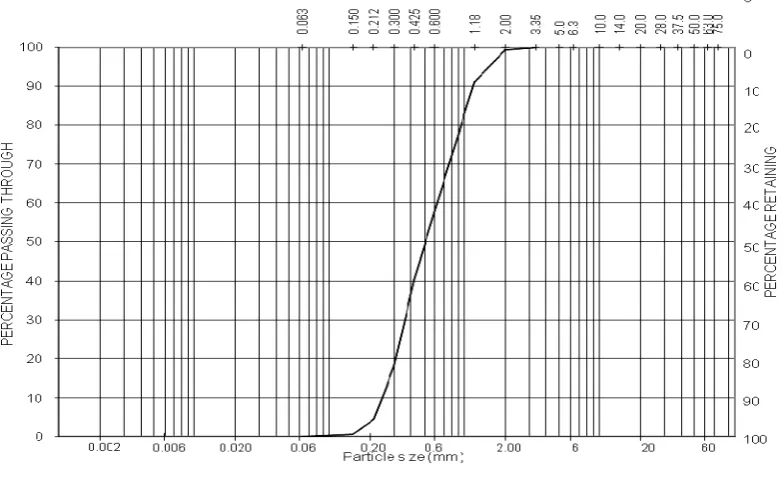
Figure 1: Grading curve for fine aggregates used
It could be observed from the grading curves that the coefficient of uniformity (Cu) and
coefficient of curvature (Cc) for the fine aggregates are 2.52 and 0.78 respectively. Thus, the sand
can be said to be well graded [15]. The specific gravity of the sand is 2.66.
4.2 PHYSICAL PROPERTIES OF LATERITE
The liquid limit (LL) of the laterite is 45.8% indicating that the soil sample is clayey. The plastic limit (PL) is 17.2% while the plasticity index (PI) is 28.6%. The LL, PL and PI fall within the limits obtained by Raheem et al. (2010b) [16] with value of LL from 42-50%, PL from 10-25%, and PI from 16-39%.
4.3 DENSITY
OF
BLOCKS
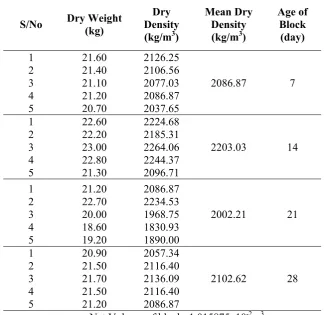
Tables 1 and 2 show the density of 225mm and 150mm sandcrete hollow blocks respectively. It can be observed from Table 1 that the density of 225mm blocks ranges from 2002.21kg/m3 to 2203.03kg/m3. These values are slightly higher than those of Raheem (2006) [6]
which range from 2073.5 kg/m3 to 2166.3 kg/m3. Similar trend was observed for 150mm blocks
as indicated in Table 2, with density ranging from 2146.46kg/m3 to 2209.60kg/m3 as against
2041.3 kg/m3 to 2160.9 kg/m3 in [6]. The higher values of densities recorded in this study may be
attributed to the mix ratio used. While the present study uses a mix ratio of 1:9 (cement:sand), Raheem (2006) [6] used a mix ratio of 1:12.
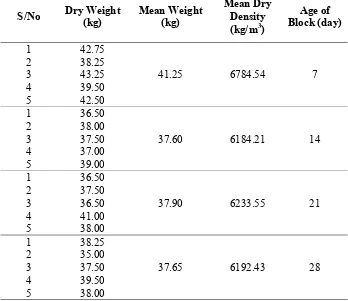
The results of the density of laterite interlocking blocks are presented in Table 3. The density ranges from 6184.21kg/m3 to 6784.54kg/m3. It could be observed from the table that the
Table 1: Density of 225mm Sandcrete Hollow Blocks
S/No Dry Weight (kg)
Dry Density (kg/m3)
Mean Dry Density (kg/m3)
Age of Block (day)
1 21.60 2126.25
2086.87 7
2 21.40 2106.56
3 21.10 2077.03
4 21.20 2086.87
5 20.70 2037.65
1 22.60 2224.68
2203.03 14
2 22.20 2185.31
3 23.00 2264.06
4 22.80 2244.37
5 21.30 2096.71
1 21.20 2086.87
2002.21 21
2 22.70 2234.53
3 20.00 1968.75
4 18.60 1830.93
5 19.20 1890.00
1 20.90 2057.34
2102.62 28
2 21.50 2116.40
3 21.70 2136.09
4 21.50 2116.40
5 21.20 2086.87
Net Volume of block=1.015875x10⁻²m3
4.4 COMPRESSIVE
STRENGTH
Figure 2 shows the results of compressive strength test for sandcrete hollow blocks and laterite interlocking blocks. The result indicated that the compressive strength of 225mm sandcrete hollow blocks varies from 1.59 N/mm2 at 7 days to 4.25 N/mm2 at 28 days. For 150mm blocks it varies from 1.48N/mm2 at 7 days to 3.35N/mm2 at 28 days. These results are higher than those obtained by Raheem (2006) [6] with values ranging from 1.01 N/mm2 to 1.68 N/mm2 and 0.53 N/mm2 to 1.59 N/mm2 for 225mm and 150mm sandcrete hollow blocks respectively, during the same period. The higher compressive strength recorded in this study are due to the stronger mix ratio of 1:9 (cement:sand) employed. While only 25 number, 225mm blocks are produced from one bag of cement in the present study, 33 were produced in [6]. Similarly, 30 number, 150mm blocks was produced from a bag of cement in this study as against 42 in [6]. Thus, the reduction in the number of blocks produced per bag of cement resulted in the improved
compressive strength. The minimum 28 days compressive strength of 3.40N/mm2 stipulated by
Nigerian Industrial Standard (NIS 87: 2004) [17], for 225mm sandcrete hollow blocks, was satisfied by the blocks produced in this study.
The result of compressive strength test for laterite interlocking blocks as shown in Figure 2 indicated that the compressive strength varies from 1.70N/mm2 at 7 days to 5.03N/mm2 at 28 days.
The results are higher than those obtained in similar studies by Raheem et al. (2010b) [16] and Raheem et al. (2012) [11], both of which involved manual production of laterite interlocking blocks as against the mechanical means employed in the present study. It can also be observed that at 28 days, the mean compressive strength of laterite interlocking blocks is more than the
minimum of 4N/mm2 stipulated by the Nigerian Building and Road Research Institute (NBRRI)
Table 2: Density of 150mm Sandcrete Hollow Blocks
S/No Dry Weight (kg) Dry Density (kg/m3)
Mean Dry Density (kg/m3)
Age of Block (day)
1 17.80 2247.47
2209.60 7 2 18.30 2310.61
3 17.50 2209.60 4 17.00 2146.46 5 16.90 2133.84 1 17.70 2234.85
2189.39 14 2 17.30 2184.34
3 17.60 2222.22 4 16.80 2121.21 5 17.30 2184.34 1 17.10 2159.09
2146.46 21 2 17.10 2159.09
3 17.00 2146.46 4 17.20 2171.72 5 16.60 2095.96 1 16.70 2108.59
2176.77 28 2 18.10 2285.35
3 17.40 2196.97 4 17.60 2222.22 5 16.40 2070.71
Net Volume of block=7.92x10⁻³m3
Table 3: Density of Laterite Interlocking Blocks
S/No Dry Weight (kg)
Mean Weight (kg)
Mean Dry Density (kg/m3)
Age of Block (day)
1 42.75
6784.54 7 2 38.25
3 43.25 41.25 4 39.50
5 42.50 1 36.50
6184.21 14 2 38.00
3 37.50 37.60 4 37.00
5 39.00 1 36.50
6233.55 21 2 37.50
3 36.50 37.90 4 41.00
5 38.00 1 38.25
6192.43 28 2 35.00
3 37.50 37.65 4 39.50
Volume of interlocking block=6.08 x10⁻³m3
Figure 2: Compressive Strength of Sandcrete and Laterite Interlocking Blocks
4.5 COSTING
The unit cost of 225mm and 150mm sandcrete hollow blocks are ₦234 and ₦195
respectively. This amount is higher than the prevailing price of blocks within the study area which was ₦180 and ₦120 for 225mm and 150mm blocks respectively. The reason for this is that, while only 25 number 225mm sandcrete blocks are produced from one bag of cement in this study, block industries within the study area produced an average of 40 from a bag of cement. Similar trend was observed for 150mm blocks with an average of 50 instead of the 30 blocks produced in this study. The reduction in quantity per bag of cement is responsible for the increase in cost. This is however compensated for by the improvement in quality as witnessed from the higher compressive strength recorded. The unit cost of laterite interlocking blocks is ₦48.54. This very low amount is due to the small quantity of cement (5%) used in producing the blocks since cement is the most costly of all material used. The cost per square metre of 225mm and 150mm sandcrete hollow blocks are ₦2,808:00 and ₦2,340:00 respectively, while that of laterite interlocking blocks is ₦2,121:20. Thus, laterite interlocking block is cheaper both in terms of unit cost and cost per square metre. The interlocking blocks are also aesthetically pleasing and may not require external rendering. It is therefore recommended for building affordable houses.
5.0 CONCLUSION
From the results of the various tests performed and the costing made, the following conclusions can be drawn:
(i) All the blocks produced satisfied the minimum requirements in terms of compressive strength, by all available codes.
(ii) Laterite interlocking blocks are denser and stronger than sandcrete hollow blocks. (iii) Laterite interlocking block is cheaper than sandcrete hollow block, both in terms of
ACKNOWLEDGEMENTS
The authors acknowledge the management and staff of Structures, Concrete and Soil Mechanics laboratories of Civil Engineering Department, University of Lagos, Nigeria; for the opportunity given to perform the various laboratory tests using their facilities.
REFERENCES
[1] Barry, R., (1996),”The Construction of Buildings”, 7th edition, Vol 1, England, Blackwell Science.
[2] Hodge, J.C. (1971), “Brick work”, 3rd edition, England, Edward Arnold.
[3] Mahalinga-Iyer, U. and Williams, D.J. (1997), “Properties and Performance of Lateritic Soil in Road Pavements”, Engineering Geology, Vol 46, pages 71 – 80.
[4] Oladeji O. S. and Raheem A. A. (2002), “Soil Tests for Road Construction”, Journal of Science, Engineering and Technology, (JSET), Vol 9 (2), pages 3971-3981.
[5]Raheem, A. A.; Osuolale, O. M.; Onifade, I. and Abubakar, Z. (2010a), “Characterization of Laterite in Ogbomoso, Oyo State, Nigeria”, Journal of Engineering Research, Vol 15 (2), pages 73 -79.
[6] Raheem, A. A. (2006), “Comparism of the Quality of Sandcrete Blocks Produced by LAUTECH Block Industry with others within Ogbomoso Township”, Science Focus, Vol 11 (1), pages 103-108.
[7] Madedor, A. O. (1992), “The impact of building materials research on low cost housing development in Nigeria”, Engineering Focus, Vol 4 (2) pages 37-41.
[8] Agbede, I. O. and Manasseh, J. (2008), “Use of Cement – Sand Admixture in Laterite Brick Production for Low Cost Housing”, Leonardo Electronic Journal of Practices and Technologies, Issue 12, pages 163 – 174.
[9] Folagbade, S. O. (1998), “Charateristics of Cement Stabilised Sandy – Lateritic Hollow Blocks”, Journal of Environmental Design and Management, Vol 1 (1&2), pages 67 – 74. [10] Raheem, A.A.; Bello, O.A. and Makinde, O.A. (2010a). “A Comparative Study of Cement and Lime Stabilized Lateritic Interlocking Blocks”. Pacific Journal of Science and Technology.
11(2):27-34.
[11] Raheem, A. A.; Falola, O. O. and Adeyeye, K. J. (2012), “Production and Testing of Lateritic Interlocking Blocks”, Journal of Construction in Developing Countries (JCDC), Vol.17 (1), In Press.
[12] Oshodi, O. R. (2004), “Techniques of producing and dry stacking interlocking blocks”, Paper presented at the Nigerian Building and Road Research Institute (N.B.R.R.I) Workshop on Local Building Materials, Ota, Ogun State, Nigeria.
[13] BS 1377 (1990), “Methods of Test for the Classification of Soil and for the Determination of Basic Physical Properties”, London, British Standard Institution.
[14] National Building Code (2006), “Building Regulations”, Ohio, LexisNexis Butterworths. [15] Smith, G. N. and Smith, Ian G. N. (1998), “Elements of Soil Mechanics”, 7th edition, London, Blackwell Science.
[16] Raheem, A. A.; Osuolale, O. M.; Onifade, I. and Abubakar, Z. (2010b), “Characterization of Laterite in Ogbomoso, Oyo State, Nigeria”, Journal of Engineering Research, Vol 15 (2), pages 73 -79.
[17] NIS 87 (2000), “Nigerian Industrial Standard: Standard for Sandcrete Blocks”, Lagos, Nigeria, Standards Organisation of Nigeria.