doi: 10.11648/j.ajmp.20180705.12
ISSN: 2326-8867 (Print); ISSN: 2326-8891 (Online)
Quantum Zeno Effect and Atomic Population Inversion
Jiu-Ming Li, Bo-Ying Zhang, Xue-Qun Yan
School of Science, Tianjin Polytechnic University, Tianjin, China
Email address:
To cite this article:
Jiu-Ming Li, Bo-Ying Zhang, Xue-Qun Yan. Quantum Zeno Effect and Atomic Population Inversion. American Journal of Modern Physics. Vol. 7, No. 5, 2018, pp. 180-184. doi: 10.11648/j.ajmp.20180705.12
Received: October 1, 2018; Accepted: October 25, 2018; Published: November 26, 2018
Abstract:
Quantum Zeno effect can be applied to quantum information processing,and can reveal the nature of quantum measurement. In addition, it has also many potential applications. This suggests that studying the quantum Zeno effect has great theoretical and experimental significance. In this work, the system of a two-level atom interacting with a single mode field is considered and the dynamics of the system subjected to successive projection measurements is studied, and the quantum Zeno effect is presented. Moreover, the influence of the quantum Zeno effect on atomic population inversion is discussed. Based on Schrödinger equation, the survival probability of the initial state of the two-level atom subjected to frequently repeated measurements can be obtained. The survival probability depends on the time interval between measurements. It is seen that the exponential decay of the system under slowly frequent measurements is presented instead of the naturally oscillatory process. For slowly repeated measurements the atomic population inversion and the survival probability of initial state decline rapidly at the early time and then both of them become unchanged. As the time intervals of the measurements are sufficiently short, the quantum Zeno effect occurs. These results have also shown how the measurement can inhibit the atomic population inversion.Keywords:
Quantum Zeno Effect, Population Inversion, JC Model1. Introduction
The development of quantum information and quantum computing over the last two decades has led to increasing attention to quantum Zeno effect (QZE) in the literature [1-4]. The QZE is firstly proposed by Misra and Sudarshan [5], and Itano, Heinzen, and Wineland have observed the effect through experiment in 1990 [6]. The QZE is a quantum effect that unstable quantum systems are induced to the reduction of the quantum decay rate even stop due to the frequent measurements at short time intervals [5-10]. An opposite effect known as quantum anti-Zeno effect (QAZE), i.e., the acceleration of the decay process caused by frequent measurement, has also been pointed out. In theory, after the frequent projection measurements for a two-level atoms, Francica et al. have demonstrated how both quantum and classical correlations are affected by the QZE and QAZE [1]. Moreover, Chaudhry and Gong have revealed the QZE and QAZE in the model of dephasing [2]. Interestingly, Porras has found that the QZE can make free-moving particles to stay in specific spatial areas [3]. In addition, David and Martín-Martínez et al. used the QZE to perform
non-projective measurements in finite frequency to obtain the quasi-Zeno effect [4]. In the meantime, the QZE has obtained wide attention in experiments. For example, Erez and Gordon et al. concluded that for frequent quantum measurements of a quantum system its entropy and temperature differ from the rate of change described in classical thermodynamic criteria [11]. Unlike previous most of the research is on the basis of the interaction with atoms, Peise and Lücke et al. used laser beams to realize no interaction measurements, resulting in the indirect QZE, thus inhibiting decay of ultracold atoms [12]. Because of these theories and experiments, the QZE has been widely used in various quantum protocols. Such as, the QZE can protect quantum entanglement [13], and Zheng and Xu et al. demonstrated by experiments this conclusion in the nuclear magnetic resonance system [14]. At the same time, the QZE has also been used in the preparation of controllable entanglement [15], all-optical exchange [16] and optical modulation [17].
different measurement time intervals on the time evolution of the transition and initial survival probability is studied in the system of atom-field interaction of JC model [23]. It is shown that when the measured time interval is short enough, the QZE will be generated, and the influence of QZE on the population inversion is investigated.
2. Model and Hamiltonian
Considering a two-level atom in the single mode field, the Hamiltonian of the total system in the rotating-wave approximation is (ħ=1)
0 1
= +
H H H (1)
where,
0 1
2 z
H = ωσ + Ωa a+ (2)
and
(
)
1
H =g σ−a++σ+a (3)
0
H represents the Hamiltonian of single-mode field and two-level atom, and H1 is the interaction between the field and the atom; †
a and a are the creation and annihilation operators of the field; ω and Ω are the transition frequency of the atom and the frequency of the field; g is the coupling strength between the atom and the field; σz, σ+ and σ−
are the Pauli operator, creation operator and annihilation operator of the atom, respectively.
In the interaction picture, the Hamiltonian can be written as
†
( i t i t)
V =gσ−a e− ∆ +σ+ae∆ (4)
where, ∆ = − Ωω . The interaction energy (4) only can cause transtions between the states a n, and b n, +1 ( a and
b are the excited state and the ground state). The state vector of the system is therefore represented as
, , 1
( ) a n( ) , b n ( ) , 1
n
t C t a n C + t b n
Ψ =
∑
+ + (5)The equations of motion for the probability amplitudes
, ( )
a n
C t andCb n, +1( )t are obtained by first substituting for ( )t
Ψ and V from (5) and (4) in Schrödinger equation
( i ( )t V ( )t
t
∂ Ψ = Ψ
∂ ) and then projecting the resulting
equtions onto a n, and b n, +1 , respectively. Then it is obtained
, 1 , 1
i t
a n b n
Cɺ = −ig n+ e∆C + (6)
, 1 1 ,
i t
b n a n
Cɺ + = −ig n+ e− ∆C (7)
A general solution for the probability amplitudes is
, ( ) , (0) cos( ) sin( )
2 2
n n
a n a n
n
i
C t C t t
Ω ∆ Ω = − − Ω / 2 , 1 2 1
(0) sin( )
2 i t n b n n ig n
C + + Ω t e∆
Ω (8)
, 1( ) , 1(0) cos( ) sin( )
2 2
n n
b n b n
n
i
C + t C + t t
Ω ∆ Ω = + − Ω / 2 , 2 1
(0) sin( )
2 i t n a n n ig n
C t e− ∆
Ω
+
Ω (9)
where, Ω = ∆ +2n 2 4g2(n+1) . All the physically relevant quantities relating to the quantized field and the atom can be obtained from these equations.
3. The Role of Quantum Measurement in
Atomic Population Inversion
Atomic population inversion means the difference of probability between the ground state and excited state of the atom. Considering the quantum-dynamical process in the absence of repeated measurements, the atomic population inversion can be written as
2 2
, ,
( ) ( a n( ) b n( ) ) n
W t =
∑
C t −C t (10)The probability of the system being in the initial state (0)
Ψ at later times is
2
( ) (0) ( )
S t = ψ ψ t (11)
Next it would be interesting to investigate the dynamics of the system subjected to successive measurements. It is assumed that the initial state of the system is Ψ(0) = a, 0 and the instantaneous ideal projection measurements are performed at regular time intervalsτ. When without repeated measurements are done, the probability of the system bing in the initial state at time t is
2 2
,0
( ) , 0 ( ) a ( )
S t = a ψ t = C t (12)
After N measurements have been performed at time t=Nτ, the survival probability of the initial state is
(N)( ) [ ( )]N cos2 N
In the short-time approxomation, when the interval time of the measurement is enough short, the equation (13) can be written as
(N)( ) exp[ ( ) ]
S t = −γ τ t (14)
where the effective decay rate γ τ( )=g2τ . After a series of measurements, the population inversion is
( )
( ) 2 exp[ ( ) ] 1
N
W t = −γ τ t − (15)
In the following figures analysis, the dimensionless time
gt and gτ will be chosen as time variables and time
intervals of measurement, respectively.
4. Numerical Analysis
Based on the above theoretical calculations, the measurement of influence population inversion will be analyzed. Moreover, it is easily seen how the QZE influences the population inversion and the survival rate of the initial state.
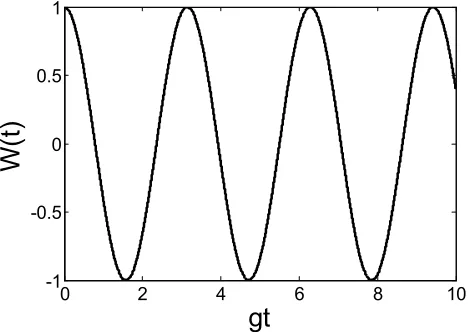
As a comparison, the evolution curve of atomic population inversion is shown in figure 1, while the system without repeated measurements are done. Here, only vacuum field is considered as the initial field state (n=0). It can be clearly seen from figure 1 that the atomic population inversion is always followed with Rabi oscillation, which has the characteristics of periodic recovery and collapse, and that is a well-known result.
Figure 1. The change of population inversion W(t) with time gt in the case of no reoeated measurements for the system. The field is initially in vacuum state and the atom in the excited state.
Figure 2 is the evolution curve of atomic population inversion when different values for the measured time intervals τ are taken in the case of measurements of the system. From the figure it can be found that when the time intervals between measurements are larger, such as gτ =1
(dash-dot line), the atomic population inversion is without showing oscilations and has a distinct decay, but the QZE is not found. Therefore, measurement can effectively inhibit population inversion. Compared with gτ =1 (dash-dot line),
the rate of decay of atomic population inversion slows down when measured time intervals become short, such as
0.1
gτ = (solid line), gτ =0.01(dotted line), and gτ =0.001
(dashed line). However, for gτ =0.1 (solid line) and
0.01
gτ = (dotted line), the QZE still do not occur. However, when the measured time intervals are short enough, the QZE is observed (shown in figure 2, dashed line).
Figure 2. The change of population inversion W(N)( )t with the time gt in the case of repeated measurements for the system and different time-intervals. The field is initially in vacuum state and the atom in the excited state. (gτ=1,
dash-dot line; gτ=0.1, solid line; gτ=0.01, dotted line; gτ=0.001,
dashed line).
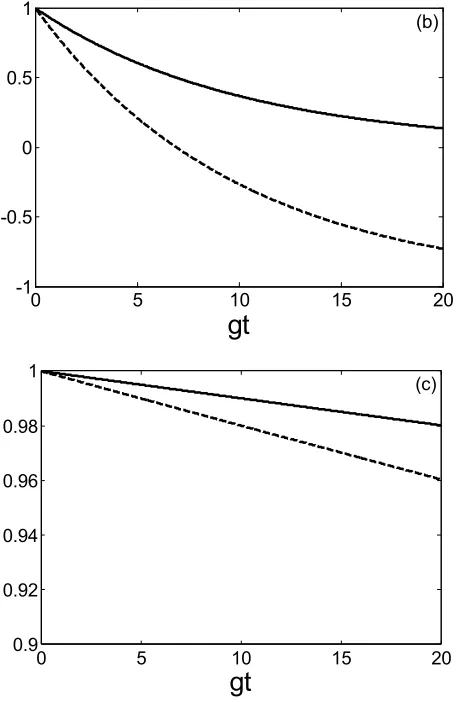
From the Figure 3(a), it can be seen that the atomic population inversion (dashed line) and survival probability (solid line) of initial state rapid decline for gτ =1 as
[0, 5]
gt∈ , then both of them are no longer changed as gt>5. Compared with figure 3(a), it can be seen from figures 3(b) and 3(c) that the curve of atomic population inversion and survival probability of initial state becomes more and more closed when the measured time intervals become short. Specially in figure 3(c), frequent measurement of the system results in the QZE. In addition, it can be concluded that the atomic decay rate and survival probability of initial state are close to unit as gτ decrease further.
0 2 4 6 8 10
-1 -0.5 0 0.5 1
gt
W
(t
)
0 5 10 15 20
-1 -0.5 0 0.5 1
gt
W
(n
)
(t
)
0 5 10 15 20
-1 -0.5 0 0.5 1
gt
Figure 3. The changes of population inversion W(N)( )t (dashed line) and survival probability S(N)( )t (solid line) with time gt in the case of measurements for the system and different time-intervals. The field is initially in vacuum state and the atom in the excited state. (a)gτ=1; (b)gτ=0 1. ; (c)
0.001
gτ= .
5. Conclusion
By using the JC model of interaction between atom and radiation fields, the influence of the QZE on atomic population inversion was investigated. It has been shown that when no measurements are done on the system, the atomic population inversion shows Rabi oscillations, which has the characteristics of periodic revival and collapse. For the case of frequence measurements, when the measured time intervals are larger, the atomic population inversion and survival probability of initial state decline rapidly at the early time and then both of them become unchanged. As the intervals become smaller, the curve of atomic population inversion and survival probability of initial state becomes more and more closed, and the decay of the atomic population inversion slows down. Especially, as the time intervals are sufficiently short (such as
0.001
gτ = ), the QZE occurs, and the atomic population inversion and survival probability of initial state is close to unit.
References
[1] F. Francica, F. Plastina, and S. Maniscalco, “Quantum Zeno and anti-Zeno on quantum and classical correlations” , Phys. Rev. A, 82, 052118(1-9), November 2010.
[2] A. Z. Chaudhry and J.-B. Gong, “ Zeno and anti-Zeno effects on dephasing”, Phys. Rev. A, 90, 012101(1-11), July 2014. [3] M. A. Porras, A. Luis, and I. Gonzalo, “Quantum Zeno effect for
a free-moving particle”, Phys. Rev. A, 90, 062131(1-6), December 2014.
[4] D. Layden, E. Martín-Martínez, and A. Kempf, “Perfect Zeno-like effect through imperfect measurements at a finite frequency”, Phys. Rev. A, 91, 022106(1-6), Febru ary 2015. [5] B. Misra and E. C. G. Sudarshan, “The Zeno’s paradox in
quantum theory”, J. Math. Phys. , 18, pp.756-763, February 1977.
[6] W. M. Itano, D. J. Heinzen, J. J. Bollinger, and D. J. Wineland, “Quantum Zeno effect”, Phys. Rev. A, 41, 2295-2300, March 1990.
[7] M. C. Fischer, B. Gutiérrez-Medina, and M. G. Raizen, “ Observation of the quantum Zeno and anti-Zeno effects in an unstable system”, Phys. Rev. Lett. , 87, 040402(1-4), July 2001. [8] A. Peres, A. Ron, “Incomplete collapse and partial quantum
Zeno effect”, Phys. Rev. A, 42, pp.5720-5722, November 1990. [9] H. Fearn, and W. E. Lamb, “Computational approaches to the
quantum Zeno effect: Position measurements”, Phys. Rev. A, 46, 1199-1205, August 1992.
[10] A. Lusi, “Zeno and anti-Zeno effects in two-level systems”, Phys. Rev. A, 67, 062113(1-4), June 2003.
[11] N. Erez, G. Gordon, M. Nest, and G. Kurizki, “Thermodynamical control by frequent quantum measurements”, Nature, 452, pp.724-727, April 2008.
[12] J. Peise, B. Lücke, L. Pezzé, F. Deuretzbacher, W. Ertmer, J. Arlt, A. Smerzi, L. Santos, and C. Klempt, “Interaction-free measurements by quantum Zeno stabilization of ultra-cold atoms”, Nature Commun. , 6, 6811(1-6), April 2015.
[13] S. Maniscalco, F. Francica, R. L. Zaffino, N. L. Gullo, and F. Plastina, “Protecting entanglement via the quantum Zeno effect”, Phys. Rev. Lett. , 100, 090503(1-4), March 2008.
[14] W. Q. Zheng, D. Z. Xu, X. H. Peng, X. Y. Zhou, J. F. Du, and C. P. Sun, “Experimental demonstration of the quantum Zeno effect in NMR with entanglement-based measurements”, Phys. Rev. A, 87, 032112(1-6), March 2013.
[15] W.-A. Li and L. F. Wei, “Controllable entanglement preparation atoms in spatially-separated cavities via quantum Zeno dynamics”, Opt. Express, 20, pp.13440-13450, May 2012. [16] K. T. McCusker, Y.-P. Huang, A. S. Kowligy, and P. Kumar,
“Experimental demonstration of interaction-free all-optical switching via the quantum Zeno effect”, Phys. Rev. Lett. , 110, 240403(1-5), June 2013.
[17] S. Krishnamurthy, Y. Wang, Y. Tu, S. Tseng, and M. S. Shahriar, “High efficiency optical modulation at a telecom wavelength using the quantum Zeno effect in a ladder transition in Rb atoms”, Opt. Express, 20, pp.13798-13809, June 2012.
0 5 10 15 20
-1 -0.5 0 0.5 1
gt
(b)
0 5 10 15 20
0.9 0.92 0.94 0.96 0.98 1
gt
[18] M. P. Telenkov, Y. A. Mityagin, A. A. Kutsevol, V. V. Agafonov, K. K. Nagaraja, “Intersubband population inversion in Landau level system in resonant tunneling quantum well structures with asymmetric double quantum well period”, JETP Lett., 100, pp.644-647, Januray 2015.
[19] F. Jia, S.-Y. Xie, Y.-P. Yang, “Interaction of an atom with a field with varying frequency without rotating-wave approximation”, Acta Phys. Sin. , 55, pp.5835 -5841, November 2006. [20] X. Liao, H.-L. Cong, D.-L. Jiang, X.-Z. Ren, “Influence of the
field with varying frequency modulation on atomic population inversion in non-rotating-wave approximation”, Acta Phys. Sin., 59, pp.5508-5513, August 2010.
[21] R. Manson, K. Roy-Choudhury, and S. Hughes, “Polaron master equation theory of pulse driven phonon-assisted population inversion and single photon emission from quantum dot excitons”, Phys. Rev. B, 93, 155423(1-13), April 2016. [22] M. Macovei, M. Mishra, and C. H. Keitel, “Population
inversion in two-level systems possessing permanent dipoles”, Phys. Rev. A, 92, 013846(1-6), July 2015.