23
The Role Of Dusung As Atraditional Arooresty
Pattern And Local Culture In Overcoming Food
Security And Security Problems In Small Islands
Thomas M. Silaya, Ludia Siahaya
Abstract: Food is a very basic need in human life and its demand continues to increase, especially on small islands in Maluku that span the influence of ecological conditions. To ensure the fulfillment of food needs, a new approach to managing food is needed through an agroforestry scheme. The purpose of this study is to examine the development of dusung management patterns as traditional agroforestry that can provide optimal benefits in the aspect of food production in order to overcome the problem of food security and security on small islands. In this study desc riptive research methods and survey research methods were used. While the approach used in this study is a quantitative and qualitative approach. Data and information collected, then analyzed using vegetation analysis, income level, contribution of dusung in the form of income of dusung farmers and frequency of collecting dusung results.The results showed that the structure and composition of the dusung vegetation at the study site co nsisted of tree, pole, weaning and seedling levels. There are 17 types of tree vegetation in the dusung (70.83%) and 15 species of plants / grassland that can be eaten or processed to become food and drink. This proves that tree-level vegetation in dusung is very potential in supporting food needs for the community. The contribution of dusung farming to the average family income per year was Rp.25,255,781.25 or 73.30%. The factors that influence the development of dusung management in overcoming the problem of food security and security are socio-cultural factors, the system of inheritance / ownership of dusung, cropping patterns and types of soil in the dusung and factors of changing people's lifestyle
Keywords: food, agroforestry, dusung, small islands
———————————————————
1.
INTRODUCTION
1.1 Background
Food is a very basic need in human life and its demand continues to increase along with the development of the population and improving the quality of life, besides the quality of food demanded also increases, so increasing production and quality of domestic food is very important. In 1987, the World Commission on Environment and Development (WCED) called attention to the major problems and challenges facing global agriculture, if current and future food needs were to be met, and the need for a new approach to agricultural development. Therefore, in recent years the world's attention on food security has been increasing. Food security consists of three main subsystems namely availability, distribution and consumption. If the three subsystems can be managed well in an area, then what is called the condition of food security is achieved and vice versa if it cannot be realized then there will be food insecurity. The condition of food security determines the nutritional status of individuals and families in society, which in turn affects the quality of human resources. (Kholiq, et al 2008)To ensure that the physical and economic consumption needs of the population are met, a new approach to food management in all components of society is needed. One of the new approaches to agricultural development, especially in the islands with small islands that are very stretched against environmental conditions such as Maluku, is an optimal land use system to ensure the sustainability of food production. This approach can be done through an agroforestry pattern that combines various agricultural products in the form of food crops, plantations, forestry and animal husbandry activities. The traditional agroforestry
pattern has long been known and practiced in Maluku in the form of dusung which is a tradition of Maluku people in land use. The use of forests and land in Maluku, especially on Ambon Island through agricultural activities is always associated with norms that regulate harmony and harmony with the natural environment through an agroforestry pattern known as the "Dusung".
1.2. Research Objectives and Benefits
The objectives of this study are:
1. Assessing the development of the management pattern of dusung in order to provide optimal benefits in aspects of food production in order to overcome the problem of food security and security on small islands
2. Knowing the structure and composition of various types of vegetation in dusung related to the management of dusung as a source of food.
3. Knowing the factors that influence the role of the dusung in overcoming the problem of food security and security on small islands.
II. RESEARCH METHODS
2.1. Research Location and Time
The study was conducted in two villages in the Ambon Island region, namely the Hatalai village at Leitimur Sub District and Tial village at Salahutu Sub Disrict. The implementation of this research lasted for six months.
2.2. Research Methods
In this study two research methods are used, namely descriptive research methods and survey research methods. The purpose of descriptive research is to make a picture of a situation systematically, factually and accurately about the factors, traits and relationships between phenomena that exist in the field (Nasir, 1998). While the approaches used in this study are quantitative (positivism) and qualitative (phenomenological) approaches.
______________________________
2.3. Data Collection
The determination of the research location in the Hatalai and Tial villages was carried out using a purposive sampling method, based on the potential and conditions of the dusung in the village, the location of the village, and historical background. Furthermore, from each village the number of respondents randomly drawn was 15-20% of the number of households in the dusung village. The primary data collection process is carried out by means of engaged observations and open and in-depth interviews. Observations involved are observations made by following the daily activities of the local community in the management of dusung. Data that has been collected, both based on fieldwork (field work), as well as from related agencies will be classified, described, analyzed and interpreted qualitatively and quantitatively.
2.4. Data Analysis
Data and information collected, then analyzed with qualitative and quantitative descriptive analysis. Data analyzed quantitatively are vegetation data to determine the structure and composition of vegetation, including the Important Value Index. While the data analyzed descriptively qualitatively include land use systems, and customary rules that are carried out in utilizing natural/forest resources and the environment.
III. RESULTS AND DISCUSSION
3.1. Structure and Composition of Dusung Vegetation as a Source of Food Material
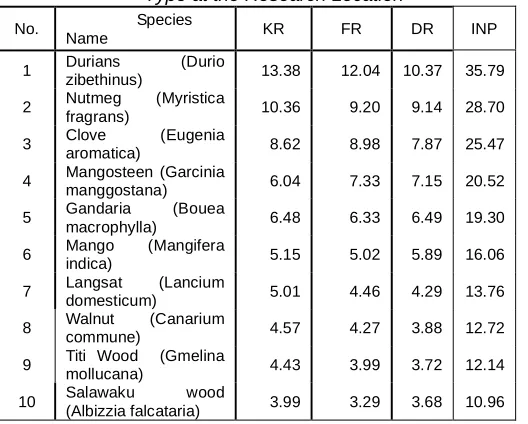
The area of the dusung at the research location in Hatalai and Tial villages is an ecosystem that is strongly influenced by the nature and characteristics of the local environment such as edafic, physiographic, climatic and biotic factors. The results showed that in the dusung at the study site there were 24 types of vegetation at the tree level, 22 types of pole levels, 17 types of weaning levels and 16 types of seedlings. The highest Importance Value Index (INP) of the 10 tree level vegetation types is shown in Table 1.
Table 1. Significant Value Index (INP) Tree-level Vegetation Type at the Research Location
Based on stratification of stands according to Soerianegara
(1979), the dusung area in the study site has a different structure of vegetation (stratum), where there are 5 strata with the division of stratum based on the height of the stand. Stratum A (30 m high), stratum B (20-30 m), stratum C (4-20 m), stratum D (1-4 m) and stratum E (<1 m). The types of vegetation in the strata A and B at the study site include: Durio zibethinus, Gmelina mollucana, Aleuritus mollucana, Canarium commune and Albizzia falcataria. The existence of stratum A and B vegetation shows that the dusung vegetation at the research location has been cultivated and has been developing for quite a long time. While the types of vegetation that are on the C strata include: nutmeg (Myristica fragrans), cloves (Eugenia aromatica), mangosteen (Garcinia manggostana), gandaria (Bouea macrophylla), mango (Mangifera indica) and langsat (Lancium domesticum). By referring to the difference in the level of this stratum, it can be said that the condition of the dusung vegetation owned by the community at the study site is almost the same as the condition of the primary forest vegetation. Where such conditions can guarantee various forest functions related to environmental sustainability (growing places) and soil fertility for plant growth and production. Based on INP data in Table 1, the types of vegetation in the dusung that have a higher level of mastery are durian (Durio zibethinus), nutmeg (Myristica fragrans), cloves (Eugenia aromatica), mangosteen (Garcinia manggostana), and gandaria (Bouea macrophylla).According to Odum (1971) in Soenaryo (2004), that the greater the INP of a species, the type of growth is very stable in the ecosystem because it is supported by factors of growth. Therefore the types with higher INP values tend to have the ability to grow and develop and produce far greater than other types. Of the 24 tree-level vegetation species contained in the dusung, 17 species (70.83%) can be eaten or processed to become food and drink. This proves that tree-level vegetation in dusung at the research location is very potential in supporting food needs for the community, especially for dusung owners.
No.
Vegetati on species
The Part
Utilized Utilization
1. Sagoo Starch processed into various types of food
2. Coconut Fruit
(Young/old) Drink and Food
3. Breadfrui
t Fruit Flesh Procced into food
4. Walnut Fruit Flesh Food direcly and processed into Food
5. Melinjo Leaf dan
Seed Food Processed
6. Gayang Fruti Flesh Food Processed
7. Petai Seed Food Processed
8. Durians Fruit flesh + Seed
Food direcly and processed into Food
9. Palm Sugar
Young fruit
and nira Drink processed and palm Sugar
10. Mangost
een Fruit Flesh Food and Processed into Drink
11. Gandaria Fruit Flesh Food and Processed into Drink
12. Langsat Fruir Flesh Food
13 Mango Fruit Flesh +
Seed Food and Processed into Drink
14 Lute Fruit Flesh Food No. Species
Name KR FR DR INP
1 Durians (Durio
zibethinus) 13.38 12.04 10.37 35.79
2 Nutmeg (Myristica
fragrans) 10.36 9.20 9.14 28.70
3 Clove (Eugenia
aromatica) 8.62 8.98 7.87 25.47
4 Mangosteen (Garcinia
manggostana) 6.04 7.33 7.15 20.52
5 Gandaria (Bouea
macrophylla) 6.48 6.33 6.49 19.30
6 Mango (Mangifera
indica) 5.15 5.02 5.89 16.06
7 Langsat (Lancium
domesticum) 5.01 4.46 4.29 13.76
8 Walnut (Canarium
commune) 4.57 4.27 3.88 12.72
9 Titi Wood (Gmelina
mollucana) 4.43 3.99 3.72 12.14
10 Salawaku wood
25 15 Candlenut Furit/seed flesh Processed into flavour
16 Cashew Seed flesh Food and Processed into Food
17 Namu-namu Fruit flesh Food
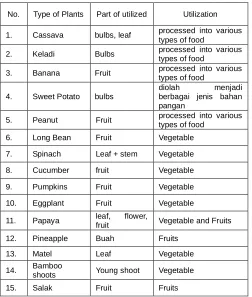
5.2. Types and Production of Food Crops in Dusung. Based on the type of land use in the research location, it can be seen that the traditional agroforestry (dusung) pattern exists because of the traditional practices of the community in producing food crops, plantation crops (seasonal) and plantation crops related to primary and secondary natural forests due to their use by trees and variety of plants. The types of food plants in the dusung at the research location can be seen in Table 3. The types of food plants in Table 3, are not completely in a certain dusung, usually only a few plants. Type of tubers (cassava, taro, sweet potato) and also banana types, because these types are a source of information for the community in the village.
Table 3. Types of Vegetation of undergrowth in Dusung that are utilized by the community as a source of food ingredients.
No. Type of Plants Part of utilized Utilization
1. Cassava bulbs, leaf processed into various types of food
2. Keladi Bulbs processed into various types of food
3. Banana Fruit processed into various types of food
4. Sweet Potato bulbs
diolah menjadi berbagai jenis bahan pangan
5. Peanut Fruit processed into various types of food
6. Long Bean Fruit Vegetable
7. Spinach Leaf + stem Vegetable
8. Cucumber fruit Vegetable
9. Pumpkins Fruit Vegetable
10. Eggplant Fruit Vegetable
11. Papaya leaf, flower,
fruit Vegetable and Fruits
12. Pineapple Buah Fruits
13. Matel Leaf Vegetable
14. Bamboo
shoots Young shoot Vegetable
15. Salak Fruit Fruits
The condition of food plants in dusung illustrates how potential the development of dusung as a traditional agroforestry pattern is to produce food for people who are on small islands in Maluku. Dusung as a traditional agroforestry pattern is a strategic choice of land management that not only considers economic, social but also environmental aspects. This makes the dusung system potentially more sustainable than a monoculture system. According to Silaya (2011) the traditional dusung agroforestry system has advantages both in terms of ecological, economic, environmental, social and cultural. Ecological superiority because dusung consists of multi types, multi-level canopy and vegetation continuity. Economic
advantage because the species planted are of commercial value and with diversity they have resistance to price fluctuations and market demand. Dusung has socio-cultural advantages because the technology is flexible, familiar, and efficient. Dusung is also a form of synergy between the forestry, agriculture, livestock and fisheries sectors. The synergy between sectors has the potential to become an alternative to realize national food security. Based on the description above, dusung as a traditional agroforestry pattern in Maluku has the potential to contribute to realizing national food security. All forms of agroforestry (agrisilviculture, silvopasture, sericulture, apiculture and silvofisheri) always produce or are related to food problems. This is confirmed by Von Meydell, (1986) that the goals and benefits of agroforestry in the tropics are (1) guaranteeing and improving food needs, (2) improving local energy supply, such as fuel wood, (3) increasing / improving raw material production forest and agricultural products, (4) improving the quality of rural life, and (5) maintaining and improving environmental services.
5.3. The contribution of dusung to community income Community income in an area depends on the livelihood of the community, generally people who live in rural areas have a homogeneous type of livelihood, depending on the natural resources available and utilized by the community in the area. The community at the research location planted estate crops as a very dominant crop in generating income. The plantation crops are nutmeg and clove, besides that the community also grows food crops such as bananas, cassava, and coconut. As for the fruits that contribute to the income, they are durian, mango and langsat types. The average family or respondent's annual income at the study site, comes from dusung farming income sources (food crops, plantations and fruits and vegetables) is the highest at Rp.25,255,781.25, or as much as 73.30 %. Then followed by income from side jobs (excluding dusung results) of Rp. 7,948,437.50 or 23.07% and the lowest is derived from revenues sourced from timber forest products with total revenues of Rp. 1,250,000 or 3.63%.Through the contribution of the results of this dusung, it can be seen that the community in the study location is highly dependent on the various types of plants in the dusung which are a hereditary family inheritance.
5.4. Factors Affecting the Role of Dusung in Overcoming Food Security and Security Issues
on Small Islands
a. Socio-cultural
In the life of the community in the research location there are a number of socio-cultural values or traditions that govern the relationship between the community and the natural environment. This socio-cultural value is a manifestation of the wisdom of the community in maintaining harmony and harmony with the natural environment, these values include sasi and Kewang institutions. Sasi is a rule or norm that prohibits communities from taking plant products or forest products within a certain period, where the rules or norms have been integrated in their lives, while Kewang is a traditional institution that functions to oversee the fishing grounds of a group of indigenous peoples including overseeing the implementation sasi.
Planting patterns in dusung are generally diverse or diversified, and this pattern is not only applied to fruit trees, but also to plantation crops such as cloves, nutmeg, coconut, and other species planted in different locations. Through this diversification pattern, it is possible for business failure on one type of plant that can be covered by other types of plant business. Related to this, aspects of suitability of soil types with plants are things that need attention. Soil plays an important role because it can affect plant growth, so that land suitability gets a very important priority, namely finding locations that have positive characteristics in relation to the success of production or use (Sitorus, 1985).
c. Dusung's Inheritance / Ownership System
Dusung in Maluku is generally a dusung that has been cultivated by previous generations and has been passed down from generation to generation. The social problem that occurs related to this inheritance is that each party feels more interest in the management of the dusung, so conflicts often occur in terms of division of dusung results. This conflict occurs because there are no standard rules or clear rules regarding the division of dusung results.
d. Changing Community Lifestyle
The existence of social interaction will lead to social processes in society, this will determine the direction, norms and values in organizations, social institutions and other social forms. (Soelaiman, 1998). The condition stated by Soelaiman also happened to the people of Maluku. Social changes that occur today are normal symptoms that are interconnected between one community to another. So it is very difficult for a community to close themselves from the spread of social change, meaning that there is no community in this world socially unchanged (Soeprapto, 2002). In connection with the management of dusung, the dusung owner community in Maluku has also experienced a social change (lifestyle) which is the impact of the process of modernization and development in all aspects. The change in question is a change from a simple lifestyle to a pattern of life that tends to be consumptive so that all efforts made are directed to obtain economic benefits in a relatively short time. This resulted in the community of dusung owners tending to utilize dusung products earlier than the actual harvest time. This method of harvesting causes a decrease in the quality of yields and dusung production in the next harvest season, and even a significant decline occurs.
IV.CONCLUSIONS AND RECOMMENDATIONS
4.1. Conclusion.
a. The structure and composition of the dusung vegetation at the study site consisted of tree, pole, weaning and seedling levels, while the stratification of stands consisted of stratum A (height> 30 m), stratum B (20-30 m), stratum C (4-20 m) , stratum D (1-4 m) and stratum E (<1 m). The types with the highest INP are durian (Durio zibethinus), nutmeg (Myristica fragrans), cloves (Eugenia aromatica), and mangosteen (Garcinia manggostana).
b. At the research location, there were 17 types of tree vegetation out of 24 types of tree-level vegetation in the dusung (70.83%) and 15 species of plants / understorey which could be eaten or processed to become food and
drink. This proves that tree-level vegetation in dusung is very potential in supporting food needs for the community. c. The contribution of dusung farming (food crops,
plantations and fruits and vegetables) to the average annual family income at the study site, amounted to Rp.25.255.781,25 or 73.30%.
d. Factors that influence the development of dusung management in overcoming the problem of food security and security are socio-cultural factors in the form of community wisdom such as sasi and Kewang, inheritance system / ownership of dusung, cropping patterns and types of soil in dusung and factors of changes in community lifestyle
Suggestion
a. The management of dusung on Ambon Island needs to be developed especially the combination of types of plants, spacing and application of agricultural technology to be more useful in overcoming food and environmental problems.
b. Synergy and support from all parties is needed in the effort to develop dusung as traditional agroforestry in order to optimize land use in supporting food security and security on small islands in Maluku.
REFERENCES
[1]. Kholiq, Hardiansyah, dan Djamaludin. 2008. Persepsi dan Partisipasi Masyarakat dalam Pengembangan Lumbung Pangan di Kabupaten Lampung barat. Jurnal Gizi dan Pangan, November 2008 3 (3) : 217 – 226
[2]. Nasir, M. 1998. Metode Penelitian. Graha Jakarta. [3]. Silaya. Th, 2011. Kajian Aspek Sosial Agroforestry
Tradisional “Dusung” pada Beberapa Desa di Pulau Ambon.
[4]. Sitorus, S. R. P, 1985. Evaluasi Sumber Daya Lahan. Tarsito, Bandung.
[5]. Soelaiman.M.M, 1998. Dinamika Masyarakat Transisi. Pustaka Pelajar Yogyakarta.
[6]. Soenaryo, 2004. Studi Tentang Struktur dan Komposisi Hutan Pantai di Pulau Nusalaut. Skripsi Fakultas Pertanian Kehutanan Unpatti, Ambon. [7]. Soeprapto, R. 2002. Interaksionisme Simbolik,
Perspektif Sosiologi Modern. Pustaka Pelajar, Averroes Press. Malang - Yogyakarta.
[8]. Surianegara,I. 1979. Ekologi Hutan Indonesia. Institut Pertanian Bogor.