Virtual Environments as a Medium of
Communication and Information Delivery on the
Internet
Rani Jaspai Parmar
ProQ uest Number: 10045672
All rights reserved
INFORMATION TO ALL U SE R S
The quality of this reproduction is d ep en d en t upon the quality of the copy subm itted.
In the unlikely even t that the author did not sen d a com plete manuscript
and there are m issing p a g e s, th e se will be noted. Also, if material had to be rem oved,
a note will indicate the deletion.
uest.
ProQ uest 10045672
Published by ProQ uest LLC(2016). Copyright of the Dissertation is held by the Author.
All rights reserved.
This work is protected against unauthorized copying under Title 17, United S ta tes C ode.
Microform Edition © ProQ uest LLC.
ProQ uest LLC
789 East E isenhow er Parkway
P.O. Box 1346
Abstract
Virtual environm ents are seen as the next com m unication metaphor, w hether on the
desktop or in a distributed fashion - it prom ises to expand our ability to interact,
com m unicate and deliver inform ation with the surrounding digital world.
The m ultidim ensional inform ation character o f the Internet fosters the use o f virtual
environm ents as a natural interface. The main aim o f this thesis is to exam ine w hether
virtual environm ents are effective as a m edium o f com m unication and inform ation
delivery on the Internet. Existing virtual environm ents on the Internet were review ed
and then a virtual environm ent m odel w as created for a financial institution for use on
the Internet. This m odel was analysed and exam ined together with a textual model
through a survey. The results have show n that virtual environm ents are effective as a
m edium o f com m unication and inform ation delivery on the Internet, not only in
w o u ld like to thank N ic k D alton for his e n c o u r a g e m e n t, and all the s t a f f at D igital
P or tfo lios and M P & A s s o c ia t e s for their support.
Contents
A bstract
Chapter 1
Introduction
The conceptual argum ent o f virtual reality
Interpretations o f virtual environm ents
Scope and lim itations
Chapter 2
Internet as a m edium o f com m unication and inform ation delivery
N eed for virtual environm ents on the Internet
Design as a governing factor
Present applications o f VE on the Internet
Discussion
Chapter 3
M ethodology
C onstruction o f a virtual environm ent model for Internet
Design Param eters
C hoosing VRM L to program VE for use on Internet
Chapter 4
Defining and designing the survey
Analysis o f the survey
Chapter 5
Conclusions
Further research
Bibliography
List o f Figures
A ppendix
-Source Code for HTML site
Chapter 1
Introduction
M an over the centuries has evolved ways o f com m unicating w ith each other across the
physical and geographical boundaries but nothing has created as m uch excitem ent as
virtual reality. The very notion o f com m unication and inform ation delivery by creating
“w orlds" sim ulating “real” w orlds has taken us by surprise. “ Virtual environm ents
displays potentially provide a new com m unication medium for hum an - m achine
interaction.” They m ay not only prove inexpensive and convenient but m ore efficient
than the form er traditional media. Infact the totally boundary-less additions o f “visual,
auditory and haptic interaction m odes” (17 Ellis) to virtual environm ents m eans a
totally new concept o f com m unication and inform ation delivery.
A sporadic grow th o f VE sites on the Internet has already been experienced. Human
intuition tells us that virtual environm ents (V E) is going to be not only an effective but
one o f the m ost popular means o f com m unication in the future. It is through Internet,
the m ost com m on platform , that VE is going to enter households and offices to enable
the m asses to com m unicate and interact with their offices, shopping centres and banks.
It is the purpose o f this thesis to exam ine w hether Virtual environm ents are an
effective m edium o f com m unication and inform ation delivery on the Internet.
In this introductory chapter term s o f virtual reality and cyberspace are going to be
introduced w hich will be follow ed by different interpretations o f Virtual reality. The
explanations o f various term s concludes with defining virtual environm ents,
com m unication and inform ation delivery in the context o f this study.
The second chapter review s Internet as a medium com m unication and inform ation
delivery, why virtual environm ents are needed on the Internet today and how Internet
is developing to incorporate the grow ing dem ands for bettering its existing textual
medium. Interface Design will also be looked at it has a significant role in governing
VE on the Internet
will be
exam ined as tools o f inform ation delivery and
com m unication.
To put the argum ent to test, in chapter three, a m ethodology will be draw n to construct
a virtual environm ent for a financial institution and then test its effectiveness on the
Internet not ju s t in isolation but also in com parison to an existing textual environm ent.
During the course o f this section a program m ing language will be chosen w hich will
fulfil all the design and technical requirem ents for creating virtual environm ent on the
Internet. This will be followed by discussing the lim itations o f the VE model.
In chapter four the VE m odel will be tested on the Internet together w ith a textual site
through a survey. The results o f various parts o f the survey w ill be analysed and
discussed to dem onstrate the effectiveness o f the VE m odel as a m edium o f
com m unication and inform ation delivery betw een the user and the organisation. This
will be follow ed by exam ining the lim itations o f the survey.
The conclusions in
chapter five are followed by suggestions for further research.
The conceptual argument of Virtual Reality
On a general level virtual reality or virtual environm ents are concerned with
simulation, w here a feeling is created through a set o f stimuli that “one is elsew here.”
“A distinguishing feature o f all virtual realities is that they are highly interactive,
responding to the user’s input in ways that are designed to give him or her a feeling o f
control over the environment. Users are provided with a point o f view, w hich enhances
feelings o f control and o f being in the environm ent ”( 189, Newby) On a philosophical
level virtual environm ents are symbolic o f real environm ents w hich leads us to the
aspect o f perception in this science. Heim quotes Em m anuel Kant to explain this
notion “The categories o f the understanding along with the form s o f intuition (space
and time) mould the chaotic givens o f perception, forging an intelligible,
com m unicable structure o f experience."(28, Heim)
A nother im portant aspect in the context o f this study is that o f interaction and
processors on desktop give the user no choice o f changing his or her point o f view in
the environm ent. In addition to this drawback, responses to input are not im m ediate,
and the only interaction the user has, is to give a com m and rather than a degree o f
control o f m anipulating the environment. The difference betw een textual and virtual
environm ents in not only that o f two dim ensional and "‘three-dim ensional, 360-degree,
colour landscape” (Heim) but that o f varying degrees o f interaction and m anipulation.
W hat does virtual reality mean? “Phrases are used synonym ously - cyberia, virtual
space, virtual environm ents, cyberspace, dataspace, the digital dom ain, the electronic
realm , the inform ation sphere” (123, W oolley) w hatever the term used, virtual
environm ents “give users the illusion o f displacem ent to another location” (17, Ellis)
thus com m unicating and delivering inform ation about another w orld w hich may or
may not exist in reality.
D iscussion on virtual reality cannot be com plete w ithout m entioning
the term
“cyberspace” . It was first coined by W illiam Gibson in his groundbreaking novel
N eurom ancer
- where he described it as a “consensual hallucination” (G ibson) - “the
point at w hich m edia (flow ) together and surround us. Its the ultim ate extension o f
exclusion o f daily life. With cyberspace as I describe it you can literally w rap yourself
in m edia and yet not have to see whats really going on around you” (G ibson as quoted
by W oolley; 122 W oolley) One o f the most im portant exam ples o f cyberspace is the
Internet w here millions o f digital docum ents reside virtually in electronic networks.
This m an-m ade digital space is proving to be one o f the m ost convenient m eans o f
Interpretations of Virtual Environments
M ichael Heim in the introductory chapters o f
M etaphysics o f virtual reality,
outlines
several interpretations som e o f w hich are as follows: Sim ulation, w hich concerns with
sharp im ages and com puter graphics attaining a 'high degree o f realism ” . Exam ples o f
sim ulations are landscapes produced on GE A erospace “visionics” (H eim ) equipment.
T hese are done through texture m apping in real-tim e o f photorealistic im ages which
can be navigated through. The m ost im portant application o f these are flight
simulators.
Im m ersion is an im portant interpretation o f VR, according to w hich VR means
“sensory im m ersion in a virtual environm ent. Primarily these system s are head
m ounted displays and gloves oriented; “first popularised by Jaron L anier’s VPL
(virtual program m ing language) Inc. The H M D cuts o ff visual and audio sensations
from the surrounding w orld and replaces them with com puter-generated sensations.
The body m oves through artificial space using feedback gloves, foot treadm ills,
bicycle grips, or jo y stick s.”(H eim ) Im m ersive technologies are m ost w idely used in
flight simulation.
Telepresence - is to be present som ew here rem otely or virtually. “ Virtual reality
shades into telepresence when you are present from a distant location - present in the
sense that you are aw are o f w hats going on, effective and accom plish tasks
by
observing, reaching grabbing and m oving objects with your own hands as though they
were close up.” (H eim ) A very recent exam ple o f telepresence was its use on Rover
Pathfinder on M ars through w hich scientists at NASA w ere virtually and rem otely
present on Mars.
Full-body im m ersion is step ahead o f im m ersion, w here human and com puter takes
place without covering the body.
The burden o f input rests with the com puter, and
the body’s free m ovem ents becom e text for com puter to read. Cam eras follow the
user's body, and com puters synthesize the user's m ovem ents with the artificial
N etw orked Com m unications - is one o f the m ost com m only used Virtual realities. The
interpretation arises from the ability o f com puters to be hooked on to networks, ‘'VR
seem s a natural candidate for a new com m unications medium. In this view, a virtual
world is as much a shared construct as a telephone is. Virtual w orlds, then can evoke
unprecedented ways o f sharing, w hat Lanier calls “post-sym bolic com m unication.”
(H eim )
Scope and lim itations
Interpretation o f VR in the context o f this study
is not going to be concerned with
head m ounted displays, datagloves, robots and other input and output devices, but will
concentrate on VR techniques o f three dim ensional interactive displays.
C om m unication
in the context o f this study will m ean sending and receiving
inform ation through e-mail, electronic form s and applications on the Internet and not
internet phone, or avatar-to-avatar chat.
Chapter 2
In the second chapter, Internet will be review ed as a medium o f com m unication and
inform ation delivery, why virtual environm ents are needed on the Internet today and
how Internet is developing to incorporate the grow ing dem ands for bettering its
existing textual medium. Interface Design will also be looked at as it has an im portant
role in governing the effectiveness o f any kind o f environm ent on the Internet. Present
applications o f VE on the Internet will be exam ined as tools o f inform ation delivery
and com m unication. As not m uch academ ic research has taken place in this field thus
traditional sources as well as Internet has been used as sources o f inform ation.
Internet as a medium o f C om m unication and inform ation delivery
runs parallel to
the traditional, often cum bersom e media. The users are not constrained to ju st text only
inform ation systems but have m ore choices for view ing and selecting inform ation. The
Internet’s system o f hypertext gives users a high degree o f selectivity, and hyperm edia
opens up many options o f new kinds o f input for users. Users can access inform ation,
text and graphics, using the Internet. H ow ever it lacks dynam ic and visual interaction
betw een the user and the application, thus there is room for im provem ent.
Need for virtual environm ents on the Internet
Virtual environm ents are seen as the next com m unication m etaphor, w hether on the
desktop or in a distributed fashion - it prom ises to expand our ability to interact,
com m unicate and deliver inform ation with the surrounding digital world.
The m ultidim ensional inform ation character o f the w orld wide web fosters the use o f
VE as a natural interface. “Existing HTM L based pages cannot adequately convey the
w eb’s topolgy - cyberspace that knows no boundaries” (16, Vacca) VE features have
the potential for enriching com m unication, inform ation and interaction on the Internet.
This has been realised by Internet corporate houses - “One o f the big things that is
environm ents are part o f that and we are doing all we can to move those standards
forw ards,” says the Internet product m anager at M icrosoft UK. (2, O nline -G uardian)
Design as a factor governing com m unications and inform ation delivery in virtual
environm ents
W ell executed virtual environm ents should provide “ a sense o f having had a life
experience'" (65 Helsel Roth) and to accom plish this, design is o f prim e im portance so
that the VE “are rich in concepts, (271-276 H enderson G alper Copes) that are realistic
in content and in their portrayal o f physical and social environm ents, (1115 H enderson
G alper) and that are interesting and entertaining to use.(H enderson)
Design o f VE governs the presentation and representation o f data and this issue is
often neglected as new concepts and technologies for com m unicating inform ation are
developed. Design orgainses the presentation o f textual, auditory and visual data
creating an environm ent through which com m unication can take place. This
com m unication could be for any purpose ranging from m edicine to architecture. One
o f the largest section o f VE sites on the Internet is in the entertainm ent and arts sector.
Education is another sector with a large potential “ w hether it is serving up explorable
anatom ies for schoolkids or establishing a virtual university w ith a global catchm ent
area.” (2, O nline-G uardian)
Present Applications of VE on the Internet
This section exam ines VE sites on the Internet which are m edium s o f inform ation
delivery and com m unication. The list is representative but not exhaustive o f all VE
sites on the Internet.
CAV Eview
CA VE view (Cave Automatic Virtual Environm ent view) is an interactive tool for
exploring virtual reality applications over the Internet via W eb browsers. With
CA V Eview , virtual reality applications are inserted into hypertext docum ents.
network. H owever, the transferred data is an application object file. The object file
fully describes the environm ent, allow ing the user to explore the scene for an unlim ited
am ount o f time.
A ccessing application program files lets the user have control over the story. This is in
sharp contrast to being able to upload and view anim ations in w hich the exploration o f
the scene is restricted to a fixed interval o f a pre-recorded sequence, the anim ator
w ould have to have m ore fram es, increasing the size o f the data file that must be
transferred. C A V E view adds stereo, realism , interactivity, sound to view ing 3D objects
in w eb brow sers w ithout the cost o f large anim ation files.
W eb brow ser give access to hypertext docum ents on the internet, m ost o f w hich
contain prim arily text and inline images. H ow ever som e docum ents contain high
resolution im ages, audio clips, anim ations and video sequences. The web brow sers
present these docum ents by invoking an external viewer, such as xv, ghost view, or
mpeg. W eb brow ser serve as an interface to view er by locating retrieving and storing
the data and calling the view er with the appropriate arguem ents. V iew ers have specific
control functionality that allow s the user to modify or change the view ing param eters
o f an im age, anim ation or sound. The user may be able to change colour size or crop
an im age, replay an anim ation at different speeds, or view the anim ation backward.
Recently the w eb brow ser added form s support, w hich allow s the users to input
param eters and to receive back inform ation reflecting those choices. “A user m ay
request an im age o f the US w eather system designed to his or her own specification.
C A V E view expands this kind o f user driven data and inform ation gathering system to
three dim ensional com puter graphics and virtual reality by presenting interactive
C A V E applications w ithin the web b ro w ser's HTM L docum ents." (100 Vacca)
T he CAVE
The CAVE (Cave A utom atic Virtual Environm ent) is a virtual reality environm ent
designed and im plem ented at the Electronic V isualisation Laboratory at the University
o f Illinois at Chicago. The CAVE is a surround screen, surround sound , projection
; M c ls c ü p e '^ ' [ F lc c l r o n i c V isu n liz A lto n C à h n i
m
' M ? '
i
htlp: //WWW. e vH. uic. e d u /E V L W e x . html
degrees cVLera
p a r t n e r a
âiid ü a liif r ’ d u ii. as p.riit.:>t ' 9 / , will bp presr-nrui
- (Electronl.
Pf ^ j
F ig 2 .l:T h e CAVE
cube, w here im ages are rear projected in stereo on two or three walls, and dow n
projected onto the floor. The view er explores a virtual w orld by m oving around inside
the cube and grabbing objects by the w and, the C A V E input device. In the CA VE high
resolution stereoscopic images are generated by a Silicon G raphics w orkstation or
m ultiple w orkstations and are rear projected onto several walls and there projected
onto the floor. Several people can be in a CA V E sim ultaneously, all w earing stereo
glasses. One person is tracked, and as he or she m oves in the CAVE, the correct
perspective and stereo projections o f the environm ent are updated to m atch the
person’s viewpoint. ‘T h e rest o f the participants are passive viewers, as though
w atching a 3D movie. ’ (99, V acca)
Surrogate T ravel
This area describes several ways to use a com puter generated environm ent (virtual
reality) with the w eb browsers. Tw o approaches are taken. The first is to allow the user
to interact with
a virtual environm ent displayed as part o f the w eb brow ser’s
docum ent, an inline image. The second is to create an independent process with which
a user can have high bandw idth interaction( real-tim e m anipulations w hich can drive
the web brow sers remotely).
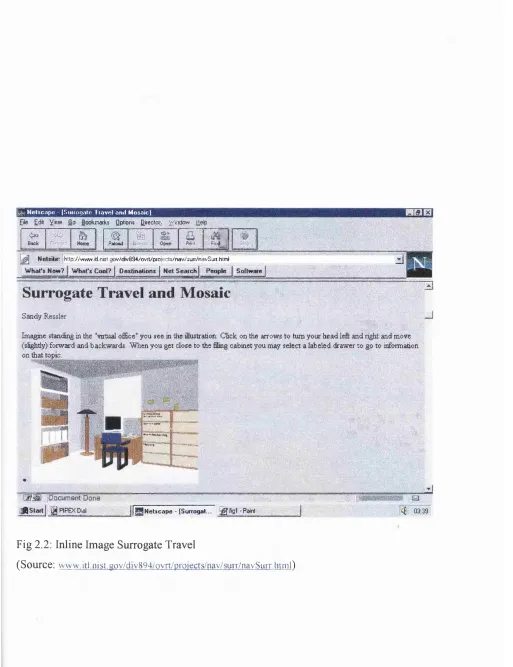
Inline G raphics Surrogate Travel
Using the inline graphics m ethod o f surrogate travel, the user is presented with a
graphic that visualises a first person point o f view (PO V ) in the m iddle o f a web
brow ser page. In addition to the graphic, the page contains buttons that allow the user
to control m ovem ent through the space in a virtual manner. W hen a button is selected,
the user moves through the space and the graphic is updated.
In the initial version o f this experim ent, each scene was hard coded into a separate
HTML page. Subsequently, a m ore extensive version (allow ing m ore com plete travel
through the room) was developed and called the virtual corridor. In this version the
user's m ovem ent com m ands interact with a CG l-bin com m and that com putes the
I N etscape (Siiimgato 1 ravel anil Mosaic]
E i l e £ d f t y i e w f i o v f i o o k m a r k s O p t i o n * O i t e c t o i v V y i n d o w H e l p
I
mP
l&Rr^
S ' ' h t l p 7 / w w w . i H , n i s t g o v / d i v 8 9 4 / 'o v r t / p t o ) e c l $ / n a v , '* u r T / n a v S u i r . h i r n l
%
Horn ;Ralo«d It PUMl
J£X
MS Ai
, _______■ *
'Ï C '
« f L
i::
Sandy 0
Imstgine standing in the "virtwal office" you se e m the fllustrataon. Click on the arrows to turn your headleft and and move (shghdy) forward and backwar<te, When you get close to the filing cabmet you may select a labeled drawer to go to information ' on that topi
J
^ "j
f i v
' *
' , ”
Cf
^
*
*5 VJ3
m .
i i S S t a r t J ^ R P E X D i a l J 1 9 9 N e t s c a p e - [ S u r r o g a t . . . j g f i g l - P a i n t
Why* »■? ...1...1J
Fig 2.2; Inline Image Surrogate Travel
y!- N etscape - [Navigating Thmugh Inlormatinn]
F*» £<* ï » w fio gookmatkg gpltpn* 3 ^ ^ H e^
1 & i # : . 8 ! 1 #
%
■ s m m :
Home m w w : Op«n Print find ;
1 , .
R O E3
http- //WWW. W.nist gov/dlv894/ovrt/pto|0cU/nav/nav. Wml
t
’.
!' t.
T " '
vlTus particular "virtual lab tour" ends with a view o f an Æ c c . The goal is to imk the various items m the office to Mosaic such -;fa that Items ; contain" links and represent a 3D hotiist. Idealty one would Idee to travel the Internet find items o f interest and bnng s the hnks back as visusd objects which one could place m the office v \ Î " ^ ^ I
ilSlat gMPEXÔW
XT»#*
sca p e - [NavigalL.. ig u n tite d Paintmm
f X
^
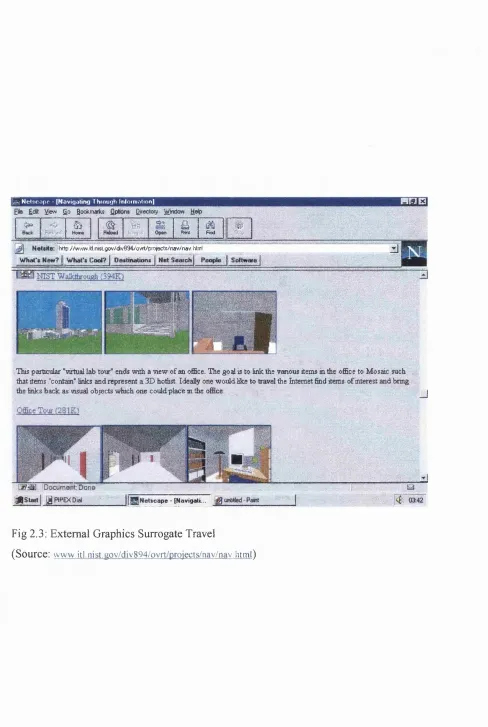
Fig 2.3: External Graphics Surrogate Travel
External G raphics Surrogate Travel
Using this technique o f surrogate, the user is presented with a com pletely separate
application. This application drives the W eb brow sers via rem ote control. The
principle advantage is that the user is able to m anipulate and com m unicate in a 3D
environm ent in real tim e, using all o f the resources and perform ance o f the graphics
w orkstation and independently o f the netw ork bandw idth. The disadvantage is the
loose coupling o f the separate application with the W eb brow ser and the need for a
separate user interface.
The existing test application is a m odification o f the Scene V iew er, the O pen Inventor
application provided by Silicon G raphics. The Scene V iew er program was m odified to
interpret object labels that are URLs. The URL is sent to a script that generates the
appropriate UNIX signal, causing the w eb brow ser to go to the URL in the label.
Im m ersive T echnologies
NCSA tries to provide a variety o f VR technology to give users the opportunity to
experim ent with various im m ersive m odalities. “NCSA is collaborating w ith the
Electronic V isualisation Lab (EV L) at the UIC to create a CA VE at N CSA to develop
both an em ulation interface and an Explorer m odule interface for the C A V E.”
( http://www.ncsa uiuc.eduW iz/VR/vr_hom epage.htm O
E m erging Technologies
Since VR Internet technology is very scarce and lab tim e is at a prem ium , NCSA
hopes that by allow ing m uch o f the developed to be taken off-line, the VR labs will
have a higher rate o f being used for experiencing and experim enting with virtual
environm ents on the Internet. " O f course, occasionally developm ent m ust talk place in
the lab. Testing the stereo algorithm s o f a program , for instance is best done by
w earing the equipm ent instead o f passing otT an interactive gam e screen as real V R.”
situations when a group o f people are w riting and testing code during the sam e time
fram e, as in a classroom or training environm ent.
The D iaspar V irtual Reality Network
Founded in 1991 by D avid M itchell the purpose o f the D iaspar virtual reality network
is to provide quality “ VR Edutainm ent (or educational entertainm ent on the Internet)” (
121 V acca) on the Internet. Education should be fun, and the best way to learn is by
sharing inform ation, products and services w ith others on the Internet.
D iaspar is an experim ental system focused on “learning by doing. This m eans that it is
not focused on projects w ith specific com pletion dates o f finite goals but rather on
evolving exploration and growth. Today the netw ork has the following:
•
V-nets - system s run by independent operators offering special services, products
and inform ation.
•
V ideo and graphics - online video im ages and graphics using Dmodem.
•
T eleoperations - the ability to rem otely control m odel vehicles.
•
Talk lines for live chat, conversation and com m unication.”
(Source: w w w .diaspar.com )
Virtual N etw orks
Virtual netw orks (V -N ets) are being added on D iaspar to m eet the interests o f
m em bers in various areas. Each V -Net has a system operator (sysop) that rents the
Vnet from the D iaspar for the purpose o f conducting business on the Vnet. V nets are
m uch like bulletin boards(bbs), except the sysop does not have to deal with ow ning
hardw are, softw are and m odem s to run the bbs. So a V net is a way for som eone who
wants to provide inform ation and products to D iaspar m em bers to have an online
office or store.
Diaspar currently has six Vnets open to all m em bers and additionally Vnets are added
D iaspar Lobby - system inform ation and conference areas on virtual reality and
events: file areas with D m odem s and POLY
LT M l - Lunar Teleoperations Model 1
Planetary Society - the O nline Planetary Society
SenseS - SenseS virtual reality product support
Verdi - Verdi interactive product support
Precision System s - online events and softw are products”
(124, V acca)
Text Based Virtual Environments as a communication medium
M UD
The list o f virtual realities on the Internet w ould be incom plete w ithout the m ention o f
M UDs and MOOs. T Erickson in his paper - From Interface to Interplace: addresses
the future potential o f use o f spatial interaction for hum an interaction or as a metaphor.
How com puters can interact in providing a m etaphor for hum an interaction in real
space taking exam ples from M UDs i.e. m ulti-user dungeons w hich are text based
virtual realities.(Erickson)
M UD stands for M ulti-user dungeon although som e other nam es include M ulti-user
Dim ension or m ulti-user dialogue w hich in my opinion is the m ost appropriate yet it is
much more than that i.e. it is a text based virtual reality or multi user interactive fiction
programmes.
But the most im portant attribute is the ability o f a M UD to support com m unication.
M ost interestingly, people converse, chance m eetings occur, room s are constructed,
objects are created things are discussed or said.
'Three m ajor factors distinguish a M UD from an A dventure style com puter game
though: A M UD is not goal-oriented, it has no beginning or end, no score and no
notion o f w inning or success. In short, even though users o f M UDs are com m only
called players, a M UD isn 't really a gam e at all.” (Rosenberg)
MUDs began as a text based com puter gam e in the 1970s w here one could hunt
M ellon U niversity constructed a M UD w ithout m onsters or w eapons but a place where
people could gather and talk and extend the M UDs structure by using a built in
program m ing language.
M UDs have been rediscovered recently and have attracted interest from m edia, science
and com m unications and hum an-com puter interaction. “A recent talked about exam ple
is M ediaM oo the M ud at MJT M edia Lab. There are around 200 to 250 M UDs active
on the Internet. There are at least 20,000 people using M UD s every w eek.” (Erickson)
M O O
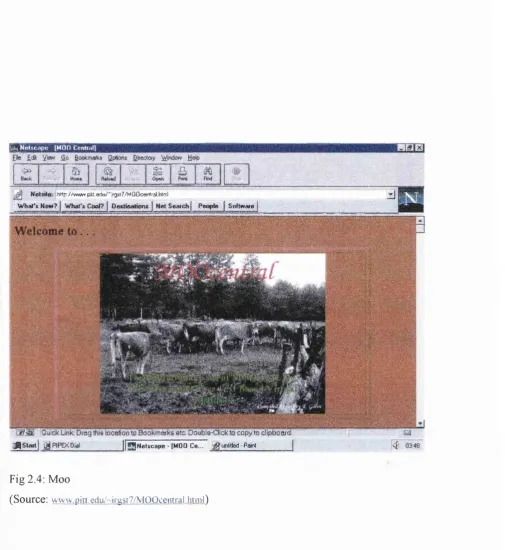
M oo (M UD object-oriented) is now being w idely used by the research com m unity to
support collaborative work, due to the ease o f m odifying the virtual reality
environm ent to support scholarship and sharing o f inform ation.
The M OO W ebsite server is distributed by X erox PA R C(Palo A lto Research Center)
through its study o f collaborative com puter systems. A lthough a large num ber o f
M OOs are still devoted solely to socializing, M OO system s have been established at
the M edia Lab, the U niversity o f V irginia (postm odern theorists), CalTech
(astronom ers) and the W eizm ann Institute o f Science in Israel (biologists).
H ypertext in the M OO
It w as apparent the M OO system , could be easily m odified to create a hypertext
fictional VR environm ent, since the M OO architecture o f room s connected by various
passages could correspond to the hypertext architecture o f nodes connected by links. It
seem ed that it w ould be especially interesting to transform “ Storyspace” (130 Vacca)
docum ents into a MOO. This w ould keep the structural and narrative elem ents o f the
docum ents yet provide for the possibility o f additional richness by the social
environm ent. 'W riters could m eet their readers in their in their text and engage in
im m ediate dialogues with them , or w riters could arrange to m eet and w ork on
___
0 i?i Wlp7 >www.pi« ad u /~ |fg st7/M 0 0 cen«;ral.htmi
i^ S tw tl ^ PIPE<W J î j g W e U c a p e - [MOO C o ... jg-untitled - P a N
Fig 2.4: Moo
Discussion
In the concluding part o f this section som e applications o f VE as a m edium o f
com m unication and inform ation delivery on the Internet w ere discussed to reveal that
as a field it needs further developm ent, merely having virtual environm ents on Internet
sites is not enough. They need to perform in term s o f effective delivery o f content and
inform ation and enabling com m unication that is not cum bersom e to use. The sites are
not only slow to dow nload but slow to run even on a fast network because o f the size
o f the files.
The present virtual w orlds need m ore input in term s o f design o f scenes to m ake them
m ore realistic. VE on the Internet at present is largely exploratory in nature and m ore a
vehicle for learning for new m edia than a carrier o f content. H ow ever V nets prom ise to
be popular m eans o f com m unication over the Internet in the near future judging by the
Chapter 3
The aim o f chapters 3 and 4 is to put the argum ent o f ‘Virtual Environm ents as a
medium for effective com m unication and inform ation delivery', to test by first
constructing a VE model for Internet, and then surveying its effectiveness in the light
o f a textual docum ent to dem onstrate the results.
Methodolgy
- To create a virtual environm ent for an organisation for use on the Internet:
To identify the design param eters for the VE m odel
-
To identify the program m ing language to construct a VE for use on the Internet
To point out the lim itations o f the VE site
-
To test the VE for its effectiveness for com m unication and inform ation delivery
betw een the user and the organisation
-
To d efine the experim ent - survey
To collect and collate the data
-
To analyse the data
To discuss the data
-
To identify the lim itations o f the survey
Construction of a Virtual Environment Model for Internet
The purpose o f this section is to construct a Virtual environm ent w hich can enable
com m unication and deliver inform ation betw een a user and an organisation on the
Internet.
The organisation chosen for this study is a financial institution simply
because the author is conversant with the subject and has experience in providing
Design Parameters
The virtual environm ent model consisted o f the following spaces:
m ain room, an
entrance and tw o secondary rooms.
The entrance view point was set to be at the entrance space ju st before the main room.
In the m ain room links appeared as posters on the walls. The “p o s te r’ links were
docum ents constructed using HTM L and served as inform ation sources o f various
services o f the financial institution. The linked infonnation sources w ere taken from an
already existing H TM L site designed by the author for M idland and G eneral, a
financial
institution
offering
various
kinds
o f
loans
and
services.
( w w w .digitalportfolios.com /purple2.htm l)
Purpose for choosing VRML to program VE for use on Internet
Guidelines o f VE model for use on the Internet
•
platform independence,
•
extensibility and
•
ability to w ork well over low -bandw idth connections (224, Vacca)
VRM L m et all the above requirem ents. As with HTM L, these are absolute
requirem ents for a network language standard. The developers o f VRM L decided that
VRM L w ould not be an extension o f HTM L, w hich is designed for text, not graphics.
Also VRM L requires even more finely tuned netw ork optim isations than HTML. It is
expected that typical VRM L scene will be com posed o f m any inline objects and served
up by m any m ore servers than a typical HTM L docum ent. M oreover, HTM L is an
accepted standard with existing im plem entations. To im pede the HTM L design
process with VRML issues and to constrain the VRM L design process w ith HTML
com patibility concerns w ould do both languages injustice. “As a network language,
VRML will succeed or fail independent o f H TM L." (224, Vacca)
Because o f the above technical advantages VRML 2.0 "is in the process o f being
that it will becom e universally accepted for creating VE on the Internet. Therefore
VRML was an obvious choice to create a VE on the Internet.
VRML is designed for use on low -end m achines over low bandw idth networks and
polygon count and file sizes are im portant considerations. Converting existing 3D
m odels into VRM L via file translators does not usually yield good results.
Tw o unique features o f VRM L that help m anage these concerns are the LOD (level o f
detail) node and inline node.
The LOD allow s the user to specify m ultiple
representations o f objects at varying com plexities. The version o f the object that is
displayed is chosen autom atically, based on the distance betw een the object and the
view er’s eyepoint. Effective use o f LOD node greatly im proves graphics perform ance
by helping to lim it the total num ber o f polygons displayed at any one time.
The inline node points to other VRM L files and can be used to break up large VRML
files into sm aller pieces. As a VRM L file is being read into the user’s machine, the
brow ser interprets the file and builds the appropriate geometry. W hen the brow ser
encounters an inline node in the VRM L file, it begins fetching this new piece. In the
m eantim e, the user can begin navigating through the scene even w hile it is being
constructed. This is especially useful if the user has a low bandw idth network
connection.
W hen inlines are w rapped inside LODs, a double advantage occurs. If the user
happens to navigate aw ay from the location o f an inlined part o f the scene and never
activates the LOD that contains this inline, the brow ser will not even attem pt to load
that part o f the scene across the network. This is especially efficient, since it reduces
VRML Browser Standards
Browsers should im plem ent every VRM L feature but not all the ones available today
do so. Following are som e o f the VRM L browsers:
•
Cosmo Player (PC Brow ser)
•
W ebspace from SGI and Tem plate G raphics (U nix and W in/NT brow ser based on
Open Inventor)
•
W ebfx from Paper Inc. (PC brow ser not based on O pen Inventor)
•
W orldview from Intervista (PC brow ser not based on Open Inventor)
Elements of the VE model
(Source code - A ppendix)
Polygons
Shapes in a VRML w orld are m ade o f polygons. The m ore com plex a shape, the m ore
polygons are required. A cube, for exam ple, is typically com prised o f ju st tw elve
polygons, since each side is m ade o f tw o triangles. In contrast a seem ingly simple
sphere requires m ore than 200 triangular polygons. As m ore objects are added to a
world, the polygon count for that w orld increases. Each tim e a user’s view point
changes in the VRM L w orld, the brow ser has to redraw the scene. The m ore polygons
the w orld contains the longer the redraws take. Therefore. Low polygon counts are one
way to increase the user’s navigation speed.
Textures
VRML allows the textures to be m apped onto shapes. Textures used in a VRM L w orld
may increase its size considerably. This will effect both dow nload and redraw times.
Therefore, if textures are used, small textures are desirable as one way to keep
dow nload tim es low and navigation speed high. Also, textures used in VRM L worlds
will require fewer client resources if they use few er colours.
Coloured textures w ere created in Photoshop using only two colours to keep file sizes
•
W alls Fig 3.3
•
C eilings Fig 3.2
•
Floors Fig 3.4
Instancing
O nce defined, objects may be reused in a VRM L world. This technique can help to
keep a w o rld 's file size small. O nce defined, an object can be used again, once or
many times. This technique is called instancing. Though there are som e lim itations to
instancing, its use can m ake your VRM L code easier to w rite and m aintain, and your
VRM L w orlds easier to dow nload.
Level o f Detail
In the real w orld as you get closer to an object, m ore details becom e visible. Level o f
detail(LO D ) m akes this possible in VRML worlds. The LOD node determ ines w hich
objects will be visible w ithin defined ranges o f coordinates w ithin the VRM L scene.
This perm its both special effects and realistic simulations.
Inlines
O ther w orld files may be “ pulled into” a w orld to help create a VRML scene. W hen
used this way, these files are called inlines. The W W W Inline node is used to refer to a
world file to included and, optionally to display a binding box to show the user w here
the object, or objects will be positioned before they are rendered. The inlines used in
the m odel w ere five H TM L files on the follow ing inform ation; U nsecured Loans,
Secured loans. Com pany profile, Interest rates, e-m ail webmaster.
Compression
The larger the VRML w orld file, the longer it takes to download. W orld files may be
com pressed, using utilities such as GZIP. If a VRM L brow ser recognizes the file type,
etscape
-Edit View Go Bookmarks Options Directory % n d o w Help
1
#
1
Ü i
t S
1
Jack1
r M Home : Reload ; Wage's : Open ; Print ; FindLocation: ! file:///C|AVBM_GGLD/NEWBAN.WRL
W s New? I Whal*s Cool? I Destinations
I
Net Search! People I Software
m m
m’Ji
! S
1
|Document: D one
Start
S Netscape - [file:///C |...
F jV 3 .2 -C tiU M 6
FÎ4 3 3 - W M l
*
TEXTURE
t e x t u r eTEXTURE
etscape - [fiie:///C W B M _G O L D /B A N K /N E W B A N .W R L]
Edit View Go Bookmarks Options Directory W indow Help
4 * ! ! & 1
i{^
:: ;Back 1 Home ^ Reload ! Open : *N n , 1 Find :
Location;lfile:///CWBM GOLDÆANK/NEWBAN.WRL
* ' ,iTfH " • - ..TW,"" '--r.-.
Aat's New? [ What's Cool? | Destinations ] Net Seafch j| People | S oftw afe|
IW
(&
BM
i N e t s c a p e
|S la ft 0 1 N e ts c a p e - [ M e : / / / C | .. Microsoft Photo Editor ]
ks Options Directory W indow Help
' 0 , .
Reload ;j
m
open
Print FindStop
3 s s r
GOLD/BANK/NEWBAN.WRL
Destinations
I
Net Search! People
J
Software
I
Account
r -■’
///Cl...
^ M i c r o s o f t Photo EditorPerformance
“Even the most enthusiastic user has limited patience for a slow Web page. This is a
key concern for VRML authors, since VRML is based on computation-intensive 3D
graphics and may incorporate other resource-intensive media. As with HTML
documents, download time is an important factor in VRML world creation. A VRML
world may require greater client system resources once downloaded. A fast browser
will offset this to some extent, but its important to construct VRML worlds efficiently.
Chapter 4
The aim o f this section is to conduct a survey to test the VE site constructed in the last
section, as a medium of communication and information delivery between the user
and the organisation. The results will then be analysed and discussed in the latter part
of this section.
Defining and designing the survey
Presently, on the Internet textual sites are predominantly the means of communication
and information delivery for organisations like banks. Therefore the survey was
designed so that the users not just judged the performance of the VE site in isolation
but also in comparison to a textual site.
Ten users (samples) were asked to view and navigate through the two sites: The VE
site for a financial institution constructed in the last section (Figs. 4.1 and 4.2) and a
textual site (Figs 4.3 and 4.4) already present on the Internet programmed in HTML by
the
author
for
Midland
and
General,
a
financial
organisation.
(www.digitalportfolios.com/purple2.html)
Both the sites contained the same information through hyperlinks therefore using the
same set o f icons. Description of Links used in both the environments:
•
Unsecured Loans
•
Secured loans
• Company profile
•
Interest rates
F ig 4 . 1 T H E MhiVl R.OOW OF THE VR.ML MO PEL,
elscape - [file:///C|/WBM_GOLD/BANK/NEWBAN WRL]
View Go Bookmarks Options Directory Window H«
> & ; ï H . :
m i
C$fO a ^ !sfik'l^ Fonv&rT Home i Reload In sjK .-,, Open i Pnmt Rnd i-'l
Location: | file:///C|/WBM_GOLD/0ANK/NEWBAN.WRL
hat's New? | What’s Cool? | Destinations j Net S e a r c h L People j Software
[N etscape - |tile:///C L .. ^ Microsoft Photo Editor • {tig9|
MAIN PA6E
OF
TEXTUAL
p
( 0
4 . 3
-
STRUCTURE OF T H E TEXTUAL SITE
0 Bookmarks Options Directory Window Help
pie Loans]
è
Home
WU '■
Reload ' Open i Print j Find
1
).7/www. digitalportfolios. com/purple2. html
What's Cool? I Destinations I Net Search I People ] Software
U n s e c u r e d
loans
Completive I Company I :
ë-mail
interest rates I
pr^iRiè
webmaster
AND&GENfRA)
of Finance Brokers L td and F .I S. A
25K (at 6 .4 l^ s e a 4 s e c s remaining)
(Dial
I etscape - [Purple L. ..
untitled - PaintF ( 6
l i - S -
A,»OVE U N K S VOERE
Q u e s t io n n a ir e
(Given: AU the subjects have the required p lug-in - C osm o player)
1 On a scale o f I to 4 w h e r e 1 is easy and 4 is difficult, please describe the task o f
finding and applying for “secured loa n s” in the t w o f o llo w in g sites:
Text based site
Virtual Environment site
2. On a scale o f 1 to 4 w h e r e 1 is easy and 4 is difficult, please describe the task o f
finding information on “ Interest rates” in the t w o fo llo w in g sites:
Text based site
Virtual Environment site
3 H o w many services d o y o u rem em ber w e r e available in the f o llo w in g sites:
Text based site
Virtual Environment site
4 G iven a c h o ic e w hich o n e w o u ld y o u prefer to use in a hurr\:
Text based site
Virtual Environment site
5. W hich site w o u ld y o u prefer as an alternative to g o i n g to a high street bank:
Text based site
Analysis of the survey
C hoice o f sam ples
Samples w ere chosen on the basis that they were used to using Internet and that they
already had the Cosm oplayer plug-in for view ing the VE site.
Part 1
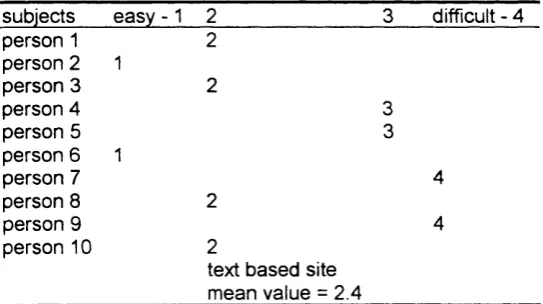
In the first part o f the questionnaire (Fig 4.6) ten subjects w ere
given the task o f
finding and applying for “secured loans” in the tw o sites. They w ere asked to describe
the task on a scale o f 1 to 4 w here 1 is easy and 4 is difficult.
The results were then tabulated and the m ean was calculated:
Easy -1
2
3
Difficult 4
person 1
1
person 2
2
person 3
2
person 4
3
person 5
2
person 6
1
person 7
2
person 8
3
person 9
4
person 10
1
virtual environment site
mean value =
2.1
Fig 4.7 Result o f VE site o f part 1 o f Q uestionnaire
subjects
easy -1
2
3
difficult - 4
person 1
1
person 2
2
person 3
2
person 4
3
person 5
4
person 6
2
person 7
1
person 8
4
person 9
1
person 10
text based site
mean value =
3
2.3
Fig 4.8 Result o f Text site o f part 1 o f Q uestionnaire
Part 2
In the second part o f the questionnaire (Fig 4.6) subjects were given the task o f finding
inform ation on “Interest rates" in the two sites. They w ere asked to describe the task
on a scale o f I to 4 w here I is easy and 4 is difficult.
The results w ere then tabulated and the m ean was calculated:
subjects
easy -1
2
3
difficult - 4
person 1
1
person 2
1
person 3
1
person 4
2
person 5
3
person 6
4
person 7
2
person 8
2
person 9
2
person 10
2
Virtual Environment site
mean value = 2
Fig 4.9: Result o f Virtual Environm ent site o f part 2 o f Q uestionnaire
1 2