The Effects Of Training In Timing
And Rhythm On Reading Achievement
Gordon E. Taub, University of Central Florida, USA Philip J. Lazarus, Florida International University, USA
ABSTRACT
This study investigated the relationship between improvement in students’ timing/rhythmicity and reading achievement. Two hundred eighty high school-age participants completed pre- and post-test measures from the Woodcock-Johnson Tests of Achievement-III (Woodcock, McGrew, & Mather, 2001). Students in the experimental group participated in a timing/rhythm intervention designed to reduce their latency response to a reoccurring metronome beat. Students in the control group participated in traditional classroom activities. The results from the study indicate that after treatment, the experimental group’s post-test Broad Reading and Reading Fluency scores were statistically significantly higher than the non-treatment control group’s post-test scores.
Keywords: Timing; Rhythm; Reading Achievement; Woodcock-Johnson
INTRODUCTION
any researchers believe that timing and rhythm play an important role in a variety of behaviors important to school success. These behaviors include motor planning, sequencing, and cognitive functions such as academic achievement, adaptive behavior, and attention (Barkley, 1997a, 1997b; Greenspan, 1992). Bloom (1993) found that sensitivity to timing necessarily involves sensitivity to affective and cognitive information important for school and social success. Other research identifies improvements in timing and rhythm as significantly related to students’ ability to monitor and control their behavior and outcome measures of motor skill (Gubay, 1979, 1985; Peterlin, 1991; Williams, Woollacott & Ivry, 1992) as well as students’ academic success (Taub, McGrew, & Keith, 2007; Wolff, 2002; Wolff, Michel, Ovrut, & Drake, 1990).
Research has identified significant relationships between timing and rhythm and student improvements in mathematics, reading, and measures of overall academic achievement (e.g., Ellis, 1992; Taub, McGrew & Keith, 2007; Weikart, Schweinhart & Larner, 1987). For example, Taub, McGrew, & Keith (2007) investigated the effect of a synchronized metronome tapping intervention designed to reduce participants’ latency response to a reoccurring metronome beat on elementary school-age students’ reading achievement scores. In this pre- and post-test study, both the experimental and non-treatment control group completed tests from the Comprehensive Test of Phonological Processing (Torgesen, Wagner, & Rashotte, 1999), Test of Word Reading Efficiency (Mather, Hamil, Allen, & Roberts, 2004), and Woodcock-Johnson Tests of Achievement III (WJ III ACH). The results from this non-academic intervention indicate that participants in the experimental group demonstrated statistically significantly higher scores on the reading achievement outcome measures than the non-treatment control group.
Research has also highlighted the role of timing/rhythmicity for students with dyslexia. Using an isochronic pacing metronome, Wolff (2002) compared the performance of students with dyslexia to those of matched typical readers. The findings indicated that students with dyslexia anticipated the signal of the metronome by intervals that were two or three times longer when compared to their typical same-age peers. Thus, individuals with dyslexia had millisecond times that were two to three times greater than their peers in anticipating (e.g., two to three times longer on either side of) the recurring metronome beat.
Fraisse (1982), Poeppel, Ruhnau, Schill, & Steinbuechel (1990), and Radiloka et al. (1997) reported that typical children tap their finger or repeat a single syllable at a specified rate, they also consistently anticipate a signal within 50 milliseconds (range 30-50 milliseconds) on either side of the signal. Based on these findings, Poeppel et al. (1990) hypothesized that 50 milliseconds might represent the basic time unit by which the synchronization among collectives of neurons regulates the timing of coordinated behavior.
This finding is noteworthy in that Wolff (2002) found that dyslexic students anticipated the signal in the range of 150 to 200 milliseconds. He hypothesized that the clocking mechanism mediates between the central nervous systems function and that coordinated behavior is dysfunctional within a restricted time window (Llinas, 1993). He further suggested that this delay, demonstrated by students with dyslexia, may result from an underlying deficit in temporal information processing.
Important in the public school setting are the encouraging results from initial studies investigating the relationship between improvements in timing and rhythm with academic achievement. Results from these studies identified significant relationships between timing/rhythmicity and improvements on important outcome measures of student success, including tests of reading and mathematics (e.g., Shaffer et al., 2000; Taub, McGrew, & Keith, 2007). The purpose of the present study is to investigate the effect of a synchronized metronome tapping intervention (SMT) designed to reduce participants’ latency response to a reoccurring metronome beat on high school students’ reading achievement.
METHOD
Design
This research used an experimental pre- and post-test design. Study participants were randomly assigned to either an experimental group or non-treatment control group.
Participants
All study participants were enrolled in a physical education/health education course; all pre- and post-tests were administered during this course. Initially, permission slips were received from parents of 318 students. Though their parents signed informed consent forms, some students declined to participate and two students had limited English proficiency; these 38 students were excluded from the study. A total of 280 students participated in the study. There were a total of 130 students in the control group and 150 students in the control group.
Instruments
The WJ III ACH consists of 22 tests organized into five areas; reading, mathematics, written language, knowledge and oral language. The instrument’s standardization sample is stratified using a design that controls for 10 specific community and subject variables: region, community size, sex, race, and others variables related to education and occupation of adults.
The WJ III ACH reading tests completed by all participants include:
Letter-Word Identification - This test requires identifying and pronouncing isolated letters and words. The median reliability for this test is .94
Reading Fluency (timed) - This test requires rapidly reading and comprehending simple sentences and indicating if the sentence is correct or incorrect; median reliability for this test is .90
The scores from Letter Word Identification, Reading Fluency, and Passage Comprehension tests combine into a Broad Reading cluster score, the reliability for this cluster score is .94.
Training Of Research Assistants
Research assistants were all graduate-level students who completed or were near completion of a course focusing on administering, interpreting, and scoring standardized norm reference tests, including the WJ III ACH. Graduate-level research assistants also received and additional five hours of specialized training in administration of the WJ III ACH tests used in this study.
The SMT Method
This study employed the Interactive Metronome (IM) method. During training participants wear a glove on one hand and are asked to clap as close to the point in time when a reoccurring metronome beat is heard through headphones. Participants face a computer screen which indicates in milliseconds how far prior to or after the beat he/she clapped his/her hand. There are several different tapping exercises participants complete. These tapping exercises include alternate toe tapping, alternate heel tapping, single toe and heel tapping, and hand clapping.
When clapping, participants clap his or her hands together, this hand clapping activates the trigger, which in turn sends a signal to the computer that analyzes how early or late the participant’s movement is relative to the metronome beat. The program computes a millisecond difference score between the metronome beat (zero milliseconds) minus the milliseconds either before or after the metronome beat. For example, a score of 80 milliseconds means the participant was 80 milliseconds away from the beat. Participants receive feedback indicating how far from or close to the beat they responded. This feedback is provided visually via time readout in milliseconds on the computer screen and auditorially via sounds heard through headphones.
To measure total performance, the absolute values of the millisecond scores are averaged to produce a mean millisecond deviation score for each exercise. These are then averaged to produce an overall millisecond deviation score. The lower the score, the more accurate the performance; the lower the score the closer the response is to the metronome beat.
Procedure
All participants completed the WJ III ACH reading tests together in groups. After the pre-tests were completed, participants were randomly assigned to either an experimental treatment group or non-treatment control group. Experimental participants completed the SMT intervention; non-treatment control group participants attended their regular physical education/health education course. After all participants in the experimental group completed the SMT intervention, control and experimental group participants completed post-test measures together. At no time were participants’ identities or group assignments known to graduate research assistants administering the post-test measures. It is important to note the experimental group participants did not receive any academic instruction- the intervention is strictly a non-academic SMT-based intervention.
SMT Intervention
Each participant underwent twelve 45 to 60 minute IM treatment sessions over about four weeks. Ninth grade students attended school only four days per week whereas 10th, 11th and 12th grade students attended school every day. Ninth grade students were on a rotating block schedule. Thus, there was variability in the number of weeks it took participants to complete the intervention.
RESULTS
This study investigated the relationship between improvement in students’ timing/ rhythmicity via a SMT-based intervention and reading achievement. At the end of the intervention, post-test scores of academic achievement were obtained for both the control and treatment groups together. The method of data collection and the assignment of participants in this study were consistent with a pre-test post-test control group design.
All data were analyzed using the Analysis of Covariance (ANCOVA) statistical procedure. Participants’ scores on the pre-test measures of academic achievement served as the covariate(s) in all analyses. For example, in an analysis of the post-test dependent variable Reading Fluency, participants’ pre-test Reading Fluency scores served as the controlling variable. Participants’ post-test Ref-W scores (a raw score conversion available on the WJ III ACH) served as the dependent variable in all analyses.
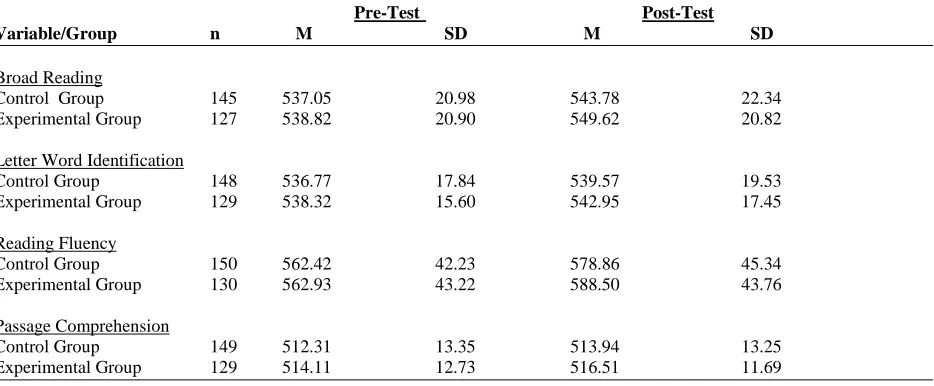
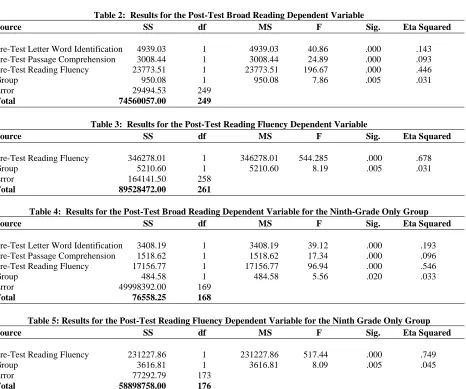
Descriptive statistics of participants’ pre- and post-test Ref-W scores are presented in Table 1. As expected, both the control and experimental group demonstrated gains on the post-test measures. A one-way ANCOVA was used to determine if there was a statistically significant between group differences in participants’ post-test scores. Table 2 presents the results of this one-way ANCOVA containing one between subjects variable (group), three covariate variables (pre-test scores on Letter-Word Identification, Passage Comprehension, and Reading Fluency), and one dependent variable, post-test Broad Reading cluster score. Three covariates were included in this analysis because they make up the Broad Reading composite score. The results from this analysis found a main effect for the experimental group on the post-test Broad Reading dependent variable. These data indicate that the experimental group’s post-test scores were statistically significantly higher than the control group’s post-test scores on the Broad Reading dependent variable, F (1, 244) = 7.86, p = .005. The treatment had a small effect on Broad Reading post-test scores (η2 = .031), and accounted for 3.1% of variance in this outcome measure. As presented in Table 3 an
analyses of the individual scores that contribute to the calculation of the Broad Reading cluster score reveals that the treatment group’s Reading Fluency post-test scores were also statistically significantly higher than the control group’s post-test Reading Fluency scores F (1, 258) = 8.19, p = .005. The observed raw score differences indicate the treatment group had a full grade-level increase on the post-test, when compared to the control group. As identified in Table 3, participants’ Reading Fluency pre-test scores were the only controlling variable in this analysis. In contrast to participants’ Broad Reading and Reading Fluency post-test scores, there was not a statistically significant difference between the two group’s post-test scores on either the Letter-Word Identification or Passage Comprehension subtests F (1, 258) = 2.874, p = .091 and F (1, 255) = .980, p = .32, respectively.
Table 1: Descriptive Statistics Of Participants’ Pre- And Post-Test Achievement Scores
Pre-Test Post-Test
Variable/Group n M SD M SD
Broad Reading
Control Group 145 537.05 20.98 543.78 22.34
Experimental Group 127 538.82 20.90 549.62 20.82
Letter Word Identification
Control Group 148 536.77 17.84 539.57 19.53
Experimental Group 129 538.32 15.60 542.95 17.45
Reading Fluency
Control Group 150 562.42 42.23 578.86 45.34
Experimental Group 130 562.93 43.22 588.50 43.76
Passage Comprehension
Control Group 149 512.31 13.35 513.94 13.25
Table 2: Results for the Post-Test Broad Reading Dependent Variable
Source SS df MS F Sig. Eta Squared
Pre-Test Letter Word Identification 4939.03 1 4939.03 40.86 .000 .143
Pre-Test Passage Comprehension 3008.44 1 3008.44 24.89 .000 .093
Pre-Test Reading Fluency 23773.51 1 23773.51 196.67 .000 .446
Group 950.08 1 950.08 7.86 .005 .031
Error 29494.53 249
Total 74560057.00 249
Table 3: Results for the Post-Test Reading Fluency Dependent Variable
Source SS df MS F Sig. Eta Squared
Pre-Test Reading Fluency 346278.01 1 346278.01 544.285 .000 .678
Group 5210.60 1 5210.60 8.19 .005 .031
Error 164141.50 258
Total 89528472.00 261
Table 4: Results for the Post-Test Broad Reading Dependent Variable for the Ninth-Grade Only Group
Source SS df MS F Sig. Eta Squared
Pre-Test Letter Word Identification 3408.19 1 3408.19 39.12 .000 .193
Pre-Test Passage Comprehension 1518.62 1 1518.62 17.34 .000 .096
Pre-Test Reading Fluency 17156.77 1 17156.77 96.94 .000 .546
Group 484.58 1 484.58 5.56 .020 .033
Error 49998392.00 169
Total 76558.25 168
Table 5: Results for the Post-Test Reading Fluency Dependent Variable for the Ninth Grade Only Group
Source SS df MS F Sig. Eta Squared
Pre-Test Reading Fluency 231227.86 1 231227.86 517.44 .000 .749
Group 3616.81 1 3616.81 8.09 .005 .045
Error 77292.79 173
Total 58898758.00 176
Although not all dependant variables were statistically significant, the observance of statistically significant increases in both Broad Reading and Reading Fluency were surprising. The reasons are first, the treatment lasted only 12 sessions, second, the intervention was not “academically oriented,” and third, developmental growth curves
derived from the tests used in this study (McGrew & Woodcock, 2001) indicate that very little academic growth takes place over short periods of time for a population averaging 15.5 years of age. This is in contrast to younger students or even primary school-age students who experience rapid academic growth over short periods of time.
In an effort to determine if ninth grade students performed differently on the post-test dependent variables (as opposed to grouping ninth, tenth, eleventh, and twelfth grade students together) additional analyses were conducted. In this set of analyses, data from the ninth-grade students (control and treatment groups) were analyzed separately. The mean age of the ninth-grade group was 14.88 years, with an age range of 13 to 17 years. There were a total of 191 ninth-grade students included in both the control and experimental groups. Table 4 contains the results from an ANCOVA that included post-test Broad Reading scores as the dependent variable and pre-test scores on Letter-Word Identification, Passage Comprehension, and Reading Fluency as covariates. A visual comparison between Table 2 (ninth, tenth, eleventh, and twelfth, grade students) and Table 4 (the ninth grade-only group) indicates that there was a slight increase in effect size for the ninth-grade only group, in addition to a decrease in the
indicates that there was an increase in the variance explained in the dependent variable by the SMT treatment. For ninth-grade students, the SMT accounted for 4.5% of the variance in Reading Fluency post-test scores, versus 3.1% for high school students in general. Although these results are impressive, the portion of variance accounted for by the ninth-grade only group is still below the 6 percent threshold needed for an effect size to be considered medium in magnitude (Cohen, 1977).
DISCUSSION
The results from this study are somewhat surprising for two reasons. First, participants in the experimental group did not receive academic training as part of the SMT intervention. This was not an “academically oriented” intervention. Without direct training one would not expect to observe increases in reading achievement. Second, the treatment lasted only twelve sessions over about four weeks; developmental growth curves based on the WJ III ACH (McGrew & Woodcock, 2001) indicate that students averaging 15.5 years of age experience very little academic growth over short periods of time.
Of the three measures comprising the Broad Reading cluster, scores on Reading Fluency were most affected by the treatment. Reading Fluency does not require new learning but may best be seen as the ability to rapidly read and comprehend sentences. It is hypothesized that the academic improvement observed in the present study are primarily related to more efficient cognitive processing. In other words, participants did not acquire more academic knowledge, however, experimental group participants appeared to process their acquired knowledge more efficiently (Taub, Mc.Grew, & Keith, 2007). For example, for a high school student to circle as quickly as possible Yes or No to sentences such as, “A fish lives on land” does not require new learning but instead requires efficient mental processing
There are two major theories regarding fluency’s contribution to a reader’s understanding of text. Both theories emphasize the component parts of fluency. One theory emphasizes the contribution of automaticity and the other stresses the role of prosody (Kuhn & Stahl, 2003). However, there appears to be some consensus regarding the primary components of fluency. These include: (a) accuracy in decoding, (b) automaticity in word recognition, and (c) the appropriate use of prosodic features such as stress, pitch and text phrasing.
In understanding the role of automaticity, efficient readers read both accurately and automatically. Given the fact that an individual only has limited attention available for any given task, attention expended in one activity is not available for another. In the case of reading, an individual must determine what words comprise the text while simultaneously constructing meaning. On the WJ III ACH Reading Fluency test the student must also evaluate the statement to determine if it is true or not. The more efficient the reader, the more accurately, automatically, and rapidly the student will perform the task.
Although the automaticity theory accounts for the accurate and effortless decoding that fluent readers demonstrate, it does not account for the role that prosody plays in reading. According to linguists, prosodic aspects of language include rhythm and expression (Kuhn & Stahl, 2003). Prosody comprises a series of features including timing or duration, pitch or intonation, stress or loudness, all of which contribute to reading text (Allington, 1983; Dowhower, 1991; Schreiber, 1987, 1991). Additionally, prosodic reading includes appropriately chunking groups of words into phrases or meaningful units in accordance with the syntactic structure of the text. Kuhn and Stahl (2003) believe that taken together these features are classified as suprasegmental because they extend over more than one speech sound and contribute to the construction of meaning from text. Prosody may also provide a link between fluency and comprehension. It is speculated (Chafe, 1988) that to read a sentence, one must assign syntactic roles to the words. Appropriate intonation, phrasing and stress are all indicators of fluent readers. Both timing and rhythm play an important role in the reading process.
LIMITATIONS
This study is limited by parents and student’s self-selection to participate in the study. This study is also limited by participant’s choice to attend a physical education/health education course. Additionally, the WJ III ACH was the only outcome measure of reading fluency and broad reading administered in the study. Despite these limitations, the present study has much strength including the random assignment of participants to either an experimental or control group and the use of a pre- and post-test design.
ACKNOWLEDGEMENT
This study was funded in part through a grant from the Interactive Metronome.
AUTHOR INFORMATION
Gordon E. Taub, University of Central Florida, USA. E-mail: [email protected] (Corresponding author)
Philip J. Lazarus, Florida International University, USA.
REFERENCES
1. Allington, R. L. (1983). Fluency: The neglected reading goal. The Reading Teacher, 37, 556-571.
2. Barkley, R. A. (1997a). Behavioral inhibition, sustained attention, and executive functions: Constructing a unifying theory of ADHD. Psychological Bulletin, 121, 65-94.
3. Barkley, R. (1997b). Attention-deficit/hyperactivity disorder, self-regulation, and time: Toward a more comprehensive theory. Journal of Developmental and Behavioral Pediatrics, 18, 271-279.
4. Bloom, I. (1993). The transition from infancy to language. New York: Cambridge University Press 5. Chafe, W. (1988). Punctuation and prosody of written language. Written Communication, 5, 396-426 6. Dowhower, S. L. (1991). Speaking of prosody: Fluency’s unintended bedfellow. Theory in Practice, 30,
158-164.
7. Ellis, M. C. (1992). Tempo perception and performance of elementary students, grades 3-6. Journal of Research in Music Education, 40, 329-341.
8. Fraisse, P. (1982). Rhythm and tempo. In D. Deutch (Ed.), The psychology of music (pp. 148-190). New York: Academic Press.
9. Greenspan, S.I. (1992). Infancy and early childhood: The practice of clinical assessment and intervention with emotional and developmental challenges. Madison, CT: International University Press.
10. Gubay, S. (1979). The clumsy child. In C. Rose (Ed.), Pediatric neurology (pp.145-160). Oxford, UK: Blackwell Scientific.
11. Gubay, S. (1985). Clumsiness. In P. Vinken, G. Bruyn, & H. Klawans (Eds.). Handbook of clinical neurology Vol. 2, (pp. 159-167), New York: Elsevier Science.
12. Interactive Metronone (1999). Interactive Metronome: Training Resource Binder.
www.interactivemetronome.com
13. Kuhn, M. R., & Stahl, S.A. (2003). Fluency: A review of developmental and remedial practices. Journal of Educational Psychology, 95, 3-21.
14. Llinas, R. (1993), Is dyslexia a dyschronia? Annals of the New York Academy of Sciences 682: 48-56 15. Mather, N., Hamil, D., Allen, E. A., & Roberts, R. (2004). Test of Silent Word Reading Fluency
(TOSWRF). Austin, TX: Pro-ed.
16. McGrew, K. S. & Woodcock, R. W. (2001). Technical Manual. Woodcock-Johnson III. Itasca, IL: Riverside Publishing.
17. Peterlin, C.L.M. (1991). Nurturing self-control through basic timing experiences. Unpublished master’s thesis. Rochester, MI: Oakland University, Department of Human Development and Child Studies. 18. Poeppel, E., Ruhnau, E., Schill, K. & Steinbuechel, N.V. (1990). A hypothesis concerning timing in the
brain. In H. Haken & M. Stadler (Eds.), Synergetics of cognition (pp. 144-149). Berlin: Springer. 19. Radiloka, K., Novak, A., Vokral, J. Radil, T., Virsu, V. & Reinikainen, K. (1997). Synchronization of
20. Schreiber, P. A. (1987). Prosody and structure in children’s syntactic processing. In R. Horowitz & S. J. Samuels (Eds.), Comprehending oral and written language (pp. 243-270). New York. Academic Press. 21. Schreiber, P. A. (1991). Understanding prosody’s role in reading acquisition. Theory into Practice, 30,
158-164.
22. Shaffer, R. J., Jacokes, L. E., Cassily, J. F., Greenspan, S. I., Tuchman, R. F., & Stemmer Jr. , P. J. (2000). Effect of Interactive Metronome training on children with ADHD. American Journal of Occupational Therapy, 55, 155-162.
23. Taub, G. E., Mc Grew, K. S., & Keith, T. Z. (2007). Improvements in interval time tracking and effects on reading achievement. Psychology in the Schools, 44, 849-863.
24. Torgesen, J. K, Wagner, R. K., & Rashotte, C. A. (1999b). Test of Word Reading Efficiency (TOWRE). Austin, TX: Pro-ed.
25. Weikart, P. S., Schweinhart, L. J., & Larner, M. (1987, Winter.) Movement curriculum improves children’s rhythmic competence. High/Scope Resources, 8-10.
26. Williams, H. G., Woollacott, M. H., & Ivry, R. (1992). Timing and motor control in clumsy children.
Journal of Motor Behavior,24, 165-172. Woodcock, R. W., McGrew, K. S., & Mather, N. (2001).
Woodcock Johnson Psychoeducational Battery-Third Edition. Chicago: Riverside.
27. Wolff, P. H. (2002). Timing precision and rhythm in developmental dyslexia. (2002). Reading and Writing: An Interdisciplinary Journal, 15, 179-206.