United Kingdom Vol. VI, Issue 5, May 2018
Licensed under Creative Common Page 615
http://ijecm.co.uk/
ISSN 2348 0386
ANALYSIS OF FACTORS AFFECTING THE DECISION OF
PURCHASING GLUTEN-FREE CAKES THROUGH SOCIAL MEDIA
Novita Mardhatillah
School of Business Bogor Agricultural University, Bogor, Indonesia [email protected]
Ujang Sumarwan
Department of Family and Consumer Sciences, Bogor Agricultural University, Bogor, Indonesia [email protected]
Irman Hermadi
Department of Computer Sciences, Bogor Agricultural University, Bogor, Indonesia [email protected]
Abstract
This study analyzes characteristics of consumers and factors influence of purchase decision
free-gluten cakes. This study use combination of purchasing decision model and social media
marketing. For the purpose, the causal research design is used. Convenience sampling method
is used to conduct an online survey. The samples on the survey are collected and filtered is 155
samples. This model contains 3 variable (social media marketing, attitude, and reference group)
to measure consumers to make the purchase decision. The data was subject to descriptive
analysis and PLS SEM method using SmartPLS version 2.7.3. The results showed that social
media marketing and purchasing decisions had an insignificant relationship of 0.277 (t-test <
1.96). Meanwhile, attitudes and purchasing decisions had a significant positive relationship of
3,543 (t-test > 1.96), and the reference group and purchasing decision had a significant positive
relationship of 8.943 (t-test > 1.96). This research provided some insights into the growing
business actors of gluten-free cakes. In online sales, sellers can use the strategy of
segmentation, targeting, and positioning in conducting online marketing strategies.
Keywords: Purchase Decision, Social Media Marketing, Free-Gluten Cake, Reference Group,
Licensed under Creative Common Page 616
INTRODUCTION
Innovations in the growing bakery field today are gluten-free cakes. This trend appears for those suffering from the celiac disease that is a disease in which the causative factor is the inability to digest food containing gluten (Heap and Van Heel, 2009). Gluten-free cakes are not only marketed among people who have celiac disease alone, but are widely consumed by the public because they have several benefits for the body. The number of cakes that use gluten-free materials has grown from 35% in 2008 to 38% in 2010 in the United States. People in the United States see that gluten-free cakes are common, seeing increasing numbers of items being advertised in some media. This positive trend can develop in some countries, especially in Indonesia as the emergence of local producers of gluten-free cakes.
Gluten can be found in wheat, jam, and rye (Renzetti et al, 2008). It is found in bread and pasta products. Grains that do not contain gluten can be contaminated by contact with grains containing gluten (Gélinas et al, 2008). This may occur during the processing of wheat, wheat milling and contact with production facilities. There are several gluten substitutes in gluten-free products. Rice flour, corn, and cassava are used to make the products. Cassava flour is a common ingredient in the world as a substitute for gluten flour. Based on Fatsecret data, the fat contained in cassava flour is smaller than that of gluten flour which is 1% and 5%, respectively. So this flour is suitable to take as the material of products that are safe against body weight.
Online media are complex media so that purchasing through these media has a unique pattern compared to the traditional one. There are three factors that can influence purchasing decisions, namely social media marketing, attitudes, and the reference group. The first factor is social media marketing that producers take as a strategy to attract consumers through contents they distribute. The second is attitudes toward information obtained about the product and the credibility of the sellers. The third one is the influence given by family members, friends, and the community as their references to buying the products.
The writing of this research was arranged based on three stages. The first one is reviewing related literature and related theories and presenting concepts and hypotheses. The second stage is putting forward the design and research results, including the process of data collection and validation of related hypotheses. Finally, the third one is discussing and analyzing the results of research and presenting the results in the form of conclusions.
PREVIOUS RESEARCH
Licensed under Creative Common Page 617
company's performance as well as about the experience of good or bad. Sinha and Swearingen (2001); Silverman et al (2001) states that consumers prefer recommendations from people they trust like friends and family members rather than strangers or recommendations that exist in social media.
Sarwoko and Churiyah (2007); Wahyuni (2008); Fredereca and Chairy (2010); Saputra and Samuel (2013), in order to deciding which products and brands to buy, consumers will choose the products and brands that are evaluated in the most profitable, so that there is a good attitude and positive on the various products offered by the company. Usvita (2013); Winarti (2015); Miauw (2016); attitude is an evaluation that reflects the likes or dislikes of the object, so that by knowing the results of the evaluation can be predicted how the potential will be the purchase. Indicators that influence the attitude variable in determining the purchase of the product is considered more healthy, quality, taste better, safe and efficacious (Sumarwan et al, 2013; Soediono, 2016). Attitude variables can have an impact on the frequency of repeat purchase (Cosmin, 2012).
The reference group has a positive and significant influence on the purchasing decision or on the decision to do something (Kim, 2013; Dian and Artanti, 2013; Prakoso and Iriani, 2015; Yuniarti, 2015; Oktavia, 2016). While in research conducted by Wang and Chang (2013); Selvakumar (2009); Sianturi et al (2012); Zahra et al (2016), The information and advice provided by the reference group in his research directly does not affect the consumer to decide to make a purchase, the consumer needs more than just information and reliable advice to make a purchase, this is because consumers pay attention to the attitude indicated others, and the change of interest purchases that consumers have because of an unanticipated factor. The gender of the consumer also influences the reference group variable in determining the purchasing decision. The male has more negative evaluations and tends not to choose, the product associated with the dissociative reference group (i.e. the female group) rather than the neutral product. This finding is moderated by whether the product is consumed in public or private and public consciousness (White and Dahl, 2006).
HYPOTHESES
For studying the factors influencing toward the purchase decision, following hypotheses were tested:
H1: Social media marketing has positive relationship towards purchase decision of free-gluten cakes.
H2: Attitude has positive relationship towards purchase decision of free-gluten cakes.
Licensed under Creative Common Page 618
RESEARCH METHOD
This research is a causal research (survey), namely research that aims to show or test that a variable becomes the cause or determine other variables (Aaker et al, 2004). Survey method is an analysis by taking samples from respondents as representative of the population and using questionnaires as a primary data gauge on each individual. This method is a cross-sectional survey. Respondents were chosen intentionally (purposive sampling), i.e. those who have already purchased healthy cakes at GulaGurih.
Data were collected by distributing questionnaires to respondents. Charging questionnaires conducted by respondents conducted online through the tool questionnaire is web survey provided by Google. Spread the questionnaire itself is done by the owner of GulaGurih account, which had previously been given socialization about the contents, how to fill and anyone who consumers who entered criteria become respondents by researchers. The distribution is done by the owner GulaGurih through WhatsApp message application, then the respondent is asked to fill out their own questionnaire given. In the spreading of this questionnaire, the required data must be filled in completely. The use of Likert scale in questionnaire according to Sumarwan (2015), which is scale 1 to strongly disagree, scale 2 to disagree, 3 for neutral scale, 4 to agree on the scale, and scale 5 to strongly agree.
This study used descriptive analysis and PLS-SEM assisted by SmartPLS 3.2.7 program. Structural Equation Modeling (SEM) is a method of predicting constructs in models with many factors and collinear relationships. The measurement of latent approaches to other factors that influence and can be measured is called the indicator variable. PLS-SEM is also used as a confirmation of the theory used to test proportions. PLS-SEM can also be used for modeling structure with reflective or formative indicators.
Licensed under Creative Common Page 619
Hypotheses Testing Approach
Testing Relationship between Social Media Marketing and Purchase Decision
Social media brings a new dimension for word-of-mouth marketing as an increased interest in certain environments which has influenced the way of communicating by individuals who love digital communication that ultimately helps for the emergence of social media as a platform for communication (Richardson et al, 2008). Social media is not to control what is said about the company, but about influencing conversations among social media users (Safko and Brake, 2009). Doing a good strategy and a bit of research on social media, companies will benefit from social media.
PD = β1* SMM + εsmm (Model 1)
PD is purchase decision and SMM is social media marketing. For estimating above models, there are several theories explaining about social media marketing. One of the theories is Sean Nelson's theories which are contains about 4C (Communication, Collaboration, Context, Connection) social media marketing. Then the four pillars of social media marketing strategy were developed by Safko and Brake (2009) which was used to explain the concepts behind social media marketing and how the concept can be used within organizations as their strategy.
Testing Relationship between Attitude and Purchase Decision
According to Sumarwan (2011), attitudes are the expression of consumer’s feeling about an object whether like or not. Attitudes can also describe consumer’s trust in the various attributes
and benefits of the object. Another definition states that attitudes are Person's enduring favorable or unfavorable evaluations, emotions, or action tendencies toward some object or idea (Kotler, 2005). A person's attitudes toward an object often arise in the context of the situation.
PD = β1* ATT + εatt (Model 2)
PD is purchase decision and ATT is consumer attitude. For estimating above models, there are factors influencing consumer’s attitudes toward the product. Hawkins et al (2007) explained that
Licensed under Creative Common Page 620
Testing Relationship between Reference Group and Purchase Decision
Sumarwan (2014) stated that the reference group is an individual or group of people who significantly influence one's behavior, whereas, in the marketing perspective, the reference group is a group that serves as a reference for a person in purchasing and consuming decisions. The reference group is divided into 2 types, namely the positive and negative reference groups. A positive reference group is a group in which individuals want to be involved. While the negative one is a group in which the individuals do not want to be involved (White and Dahl, 2006).
PD = β1* RG + εrg (Model 3)
PD is purchase decision and RG is reference group. In perspective of consumer behavior, the influence of reference groups can lead to purchasing decision. There are three types of reference group influences identified in research on consumers (Sumarwan, 2014). First, normative influence is the influence of reference group on a person through the social norms that must be obeyed and followed. The normative effect will be stronger on a person to follow the reference group if there is (1) strong pressure to comply with existing norms, (2) social acceptance as strong motivation and (3) purchased products and services will be seen as symbols and social norms. Second, the influence of value expression will influence a person through its function as a carrier of value expressions. Third, information influence will influence the choice of products or brands of a consumer, because the reference group is a highly-trusted advisor since it has better knowledge and information.
Source of Data
Survey is distributed by sending online survey link to 300 consumers via messaging app on smartphone. To reduce the possibility of data duplication, respondents were asked to fill in the name and birth date as a filter. After the completion of taking questionnaires, it was shown that the total respondents were 155.
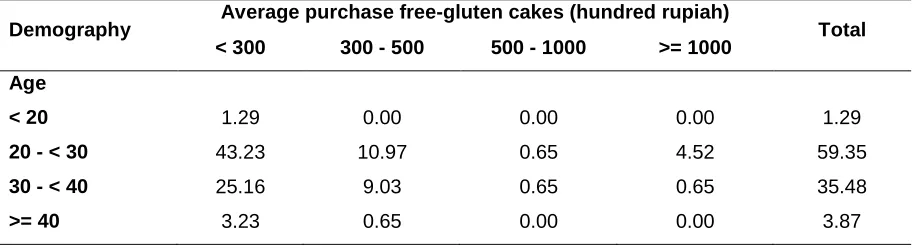
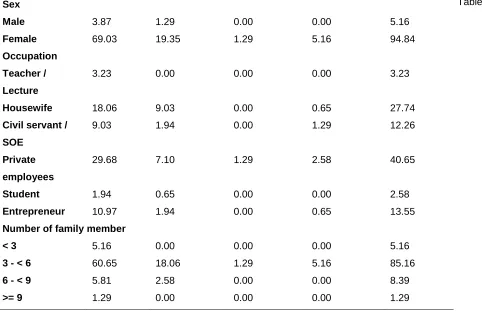
Table 1: Cross tabulation demographics and nominal purchase of gluten-free cakes
Demography Average purchase free-gluten cakes (hundred rupiah) Total
< 300 300 - 500 500 - 1000 >= 1000
Age
< 20 1.29 0.00 0.00 0.00 1.29
20 - < 30 43.23 10.97 0.65 4.52 59.35
30 - < 40 25.16 9.03 0.65 0.65 35.48
Licensed under Creative Common Page 621
Sex
Male 3.87 1.29 0.00 0.00 5.16
Female 69.03 19.35 1.29 5.16 94.84
Occupation
Teacher /
Lecture
3.23 0.00 0.00 0.00 3.23
Housewife 18.06 9.03 0.00 0.65 27.74
Civil servant /
SOE
9.03 1.94 0.00 1.29 12.26
Private
employees
29.68 7.10 1.29 2.58 40.65
Student 1.94 0.65 0.00 0.00 2.58
Entrepreneur 10.97 1.94 0.00 0.65 13.55
Number of family member
< 3 5.16 0.00 0.00 0.00 5.16
3 - < 6 60.65 18.06 1.29 5.16 85.16
6 - < 9 5.81 2.58 0.00 0.00 8.39
>= 9 1.29 0.00 0.00 0.00 1.29
According to demographic results on the samples, it can be seen that most consumers spent less than IDR 300,000 to purchase gluten-free cakes. The largest percentage of age category and nominal of purchase was happening in a group of 20-30 and of <IDR 300,000 that is 43.23%. The largest percentage of sex category and purchase nominal was happening on the female group and of <IDR 300,000 that is 69.03%. The largest percentage for occupation category and purchase nominal was happening on private employee group and of <IDR 300,000 that is 29.68%. The largest percentage for occupation category and purchase nominal was happening within private employee group and of <IDR 300,000 that is 29.68%. The largest percentage of the total number of family members and the nominal of purchase was on the group of 3 - 6 and of <IDR 300,000 that is 60.65%.
RESULTS
Reliability, convergence validity and discriminant validity on a multi-item scale were measured by following instructions of Fornell and Larcker (1981) and Gefen and Straub (2005). The accepted limit value for Cronbach's alpha value and discriminant validity is > 0.7. Convergent validity was assessed through the average variance extracted (AVE) value. The AVE value of
Licensed under Creative Common Page 622
the constructs is > 0.5, where the condition was accepted in the model test (Gefen and Straub, 2005).
Correlation between the focus constructs and the entire constructs was assessed by checking whether the squared root value for each construct’s AVE value is or not greater than
the correlation between the focus constructs and the entire constructs. The validity result showed that AVE squared root value was greater than correlation value between the constructs. These results met the requirements for discriminatory validity. Multicollinearity was also examined by assessing the index of variance inflation factor (VIF) (Gefen and Straub, 2005).
Results H1
Social media marketing values of cronbach's alpha 0.878 > 0.7, composite reliability values 0.896 > 0.7 and average variance extracted 0.554 > 0.5. All this value are meet acceptance criteria for reliability and validity testing.
Table 2: Reliability and validity Social Media Marketing
Constructs Cronbach’s
alpha
Composite
reliability
Average Variance
Extracted
Social Media
Marketing
0.878 0.896 0.554
Root mean square average variance extracted value of focused social media marketing is greater than the correlation between the social media marketing constructs and the entire constructs is 0.744 which meets acceptance criteria for discriminant validity. Value VIF of this construct is 1.737 < 3.3 which meets acceptance criteria for multicollinearity validity. The relationship between social media marketing and purchase decision have not significant value based on t-test value 0.27 < 1.96 according to acceptance criteria > 1.96.
Licensed under Creative Common Page 623 Table 3: Discriminant Validity and Collinearity Social Media Marketing
Discriminant validity VIF Causality
Relationship
Coefficient T-Test
SMM
1.737 Social media marketing →
Purchase decision 0.02 0.27
SMM 0.744
ATT 0.651
RG 0.085
PD 0.280
Results H2
Attitude values of cronbach's alpha 0.781 > 0.7, composite reliability values 0.850 > 0.7 and average variance extracted 0.552 > 0.5. All this value are meet acceptance criteria for reliability and validity testing.
Table 4: Reliability and validity Attitude
Constructs Cronbach’s alpha Composite
reliability
Average Variance
Extracted
Attitude 0.781 0.850 0.552
Root mean square average variance extracted value of focused attitude is greater than the correlation between the attitude constructs and the entire constructs is 0.743 which meets acceptance criteria for discriminant validity. Value VIF of this construct is 1.747 < 3.3 which meets acceptance criteria for multicollinearity validity. The relationship between attitude and purchase decision has significant value based on t-test value 3.55 < 1.96 according to acceptance criteria > 1.96.
Licensed under Creative Common Page 624 Table 5: Discriminant Validity and Collinearity Attitude
Discriminant validity VIF Causality Relationship Coefficient T-Test
ATT
1.747 Attitude → Purchase
decision 0.32 3.55
ATT 0.743
SMM 0.651
RG 0.113
PD 0.400
Results H3
Reference group values of cronbach's alpha 0.707 > 0.7, composite reliability values 0.828 > 0.7 and average variance extracted 0.532 > 0.5. All this value are meet acceptance criteria for reliability and validity testing.
Table 6: Reliability and validity Reference Group
Constructs Cronbach’s alpha Composite
reliability
Average Variance
Extracted
Reference Group 0.707 0.828 0.532
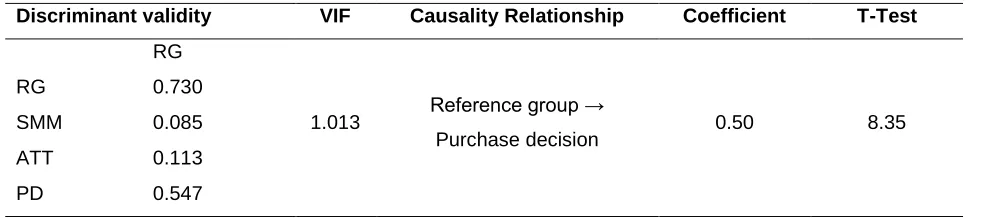
Root mean square average variance extracted value of focused attitude is greater than a correlation between the reference group constructs and the entire constructs is 0.730 which meets acceptance criteria for discriminant validity. Value VIF of this construct is 1.013 < 3.3 which meets acceptance criteria for multicollinearity validity. The relationship between the reference group and purchase decision have significant value based on t-test value 8.35 < 1.96 according to acceptance criteria > 1.96.
Licensed under Creative Common Page 625 Table 7: Discriminant Validity and Collinearity Reference Group
Discriminant validity VIF Causality Relationship Coefficient T-Test
RG
1.013 Reference group →
Purchase decision 0.50 8.35
RG 0.730
SMM 0.085
ATT 0.113
PD 0.547
SUMMARY AND CONCLUDING REMARKS
This study proposed a model of gluten-free cakes purchasing decision. Purchasing decision was reviewed by three factors, namely social media marketing, attitudes, and reference group. This model was tested employing 155 respondents who were consumers of one of the online manufacturers of gluten-free cakes, namely GulaGurih. The main findings summarized in the analysis of research results are as follows.
Firstly, social media marketing was not very effective to influence consumers to buy gluten-free cakes. Gluten-free products were a new kind of products in Indonesia so that consumers had not fully believed in the contents distributed by the manufacturers. Information integrity in terms of social media marketing was also important to build consumer interest in purchasing the product. Involvement between producers and consumers was not intertwined in social media, so producers did not get useful feedback to attract other consumers.
Secondly, attitudes had an impact on the purchase of gluten-free cakes because consumers enjoyed benefits from those products when receiving information from various sources about gluten-free products, ingredients used and benefits for the body. Exposure to such information was processed and assessed as a comparison of gluten-free products to other products. The exposure produces a response which was an interest to try the cakes and prove whether the information is true or not.
Thirdly, reference group had the greatest impact in influencing consumers to buy gluten-free cakes. References that resided in their social networks such as friends, relatives, and their families had a greater influence than the others/outsiders’ references. Consumers without any
Licensed under Creative Common Page 626
LIMITATIONS AND FUTURE RESEARCH
This study covered only 3 factors that influence the decision of purchasing gluten-free cakes, namely social media marketing, attitude, and the reference group. In addition to these 3 factors, there are many other factors that influence the purchase decision. Other factors include factors of perception, preference and product attributes. The addition of the product is not done due to limited time and cost.
REFERENCES
Aaker, J., Fournier, S., and Brasel, S. A. (2004). When Good Brands Do Bad. Journal of Consumer Research, 31, 1-16.
Brown, D. and Hayes, N. (2008). Influencer Marketing: Who Really Influences Your Constumers.New York: Butterworth-Heinemann Publishing.
Cosmin, D, A. (2012). Factors that Influence Consumer Purchasing Decision of Organic Food. Ph.D. Thesis, Alexandru Ioan Cuza University of Lasi.
Dian, N. F. and Artanti, Y. (2013). Pengaruh kelompok acuan dan atmosfir restoran terhadap keputusan pembelian konsumen Starbucks Coffee.Jurnal Ilmu Manajemen, 1(2), 414-427.
Fredereca, B. G. and Chairy. (2010). Pengaruh Psikologi Konsumen terhadap Keputusan Pembelian Kembali Smartphone Blackberry. Jurnal Manajemen Teori dan Terapan, 3(2), 128-143.
Fornell, C. and Larcker, D. F. (1981). Evaluating Structural Equation Model with Unobservable Variables and Measurement Error. Journal of Marketing Research, 18, 39-50.
Gélinas, P., McKinnon, C. M., Mena, M. C., and Méndez, E. (2008). Gluten contamination of cereal foods in Canada.International Journal of Food Science & Technology, 43, 1245-1252.
Gefen, D. and Straub, D. (2005). A Practical Guide to Factorial Validity Using PLS-Graph: Tutorial and Annotated Example.Communications of The Association for Information Systems, 16, 91-109.
Hawkins D. I. (2007). Consumer Behavior 10th Edition.New York: McGraw-Hill Publishing.
Heap, G. and Van Heel, D. (2009). Genetics and Pathogenesis of Coeliac Disease. Seminars in Immunology, 21, 346-354.
Kim, M. (2013). The impact of reference group influences in travel destination brand equity.Ph.D. Thesis, The Sun Yat-Sen University.
Kotler, P. (2005). Manajemen Pemasaran 12(1).Jakarta: Indeks Publishing.
Miauw, K. Y. H. (2016). Motivasi Konsumen dan Sikap Konsumen terhadap Keputusan Pembelian di Wild.Jurnal Manajemen dan Start-Up Bisnis, 1(5), 567-575.
Oktavia, L. F. (2016). Pengaruh Brand Image, Vanity Seeking, Materialism, dan Kelompok Acuan pada Minat Beli Ulang Jasa Klinik Kecantikan. M.Sc. Thesis, Sanata Dharma University.
Prakoso, H. W and Iriani, S. S. (2015). Pengaruh Kualitas dan Kelompok Acuan terhadap Keputusan Pembelian Sepeda Motor Suzuki Satria F150. Journal of Research in Economics and Management, 15(2), 262-279.
Renzetti, S., Dal Bello, F., and Arendt, E. (2008). Microstructure, Fundamental Rheology and Baking Characteristics of Batters and Breads from Different Gluten-Free Flours Treated with a Microbial Transglutaminase. Journal of Cereal Science, 48, 33-45.
Richardson, P., MacRae, A., Schwartz, K., Bankston, L., and Konsten, C. (2008). Student Outcomes in a Post-Professional Online Masters Degree Program.The American Journal of Occupational Therapy, 62, 600-610.
Safko, L. and Brake D. K. (2009). The Social Media Bible: Tactics, Tools, and Strategies for Business Success.New Jersey: John Wiley & Sons Publishing.
Licensed under Creative Common Page 627
Sarwoko, E. and Churiyah, M. (2007). Pengaruh Sikap Konsumen terhadap Keputusan Pembelian Minuman Merek Aqua Berkaitan dengan Penerapan Program CSR (Corporate Social Responsibility). Jurnal Ekonomi Modernisasi, 3(2), 147-164.
Selvakumar K. (2009). Willingness to Pay a Premium for Group Norms as a Measure of Reference Group Influence. Ph.D. Thesis, University of Guelph.
Sianturi, E., Erida, Nifita, A. T. (2012). Pengaruh kelompok acuan dan gaya hidup terhadap keputusan menggunakan blackberry.Jurnal Manajemen Fakultas Ekonomi Universitas Jambi, 1(2), 127-136.
Silverman, B. G., Bachann, M., Akharas, K. A. (2001). Implications of Buyer Decision Theory for Design of Ecommerce Websites. International Journal of Human-Computer Studies, 55,815-844.
Sinha, R. and Swearingen, K. (2001). Comparing Recommendations made by Online Systems and Friends. Proceedings of the DELOS-NSF Workshop on Personalization and Recommender Systems in Digital Libraries. Sumarwan, U. (2011). Perilaku Konsumen: Teori dan Penerapannya dalam Pemasaran Edisi ke-2.Bogor: Ghalia Indonesia.
Sumarwan, U., Noviandi, A., Kirbrandoko. (2013). Proses Keputusan Pembelian, Persepsi, dan Sikap Konsumen terhadap Beras Organik di Jabotabek. Pangan, 22(2), 333-344.
Sumarwan, U. (2014). Perilaku Konsumen Teori dan Penerapannya dalam Pemasaran.Bogor: Ghalia Indonesia. Sumarwan, U. (2015). Metode Riset Bisnis dan Konsumen.Bogor: IPB Press Publishing.
Soediono, W. (2016). Pengaruh Motivasi, Persepsi dan Sikap terhadap Keputusan Pembelian Kembali Smartphone. Jurnal Bisnis dan Akuntasi, 18(1), 109-112.
Usvita, M. (2013). Pengaruh Iklan dan Sikap Konsumen terhadap Keputusan Pembelian Cream Wajah Pond’s pada Mahasiswa Sekolah Tinggi Ilmu Ekonomi Yayasan Pendidikan Pasaman (Stie Yappas). E-Jurnal Apresiasi Ekonomi, 1(1), 53-63.
Wahyuni, D. U. (2008). Pengaruh Motivasi, Persepsi dan Sikap Konsumen terhadap Keputusan Pembelian Sepeda Motor Merek Honda di Kawasan Surabaya Barat. Jurnal Manajemen dan Kewirausahaan, 10(1), 30-37.
Wang, J. C., and Chang, C. H. (2013). How Online Social Ties and Product-Related Risks Influence Purchase Intentions: A Facebook Experiment. Electronic Commerce Research and Applications, 12(5), 337-346.
Weinberg, T. (2009). The New Community Rules: Marketing on the Social Web.California:O'Reilly Media Publishing. White, K. and Dahl, D. W. (2006). To be or not be? The Influence of Dissociative Reference Groups on Consumer Preferences. Journal of Consumer Psychology, 16(1), 404-414.
Winarti, C. E. (2015). Pengaruh Motivasi Konsumen, Persepsi Kualitas, Sikap Konsumen dan Harga terhadap Keputusan Pembelian Mobil Nissan Grand Livina di Dealer PT Nissan Motor Indonesia Jalan MT Haryono Kav.10 Jakarta Timur. Kelola, 2(3), 12-21.
Yuniarti Y. (2015). Pengaruh Kelompok Acuan dan Keluarga terhadap Keputusan Pembelian Batik Jambi di Kota Jambi. Jurnal Penelitian Universitas Jambi Seri Humaniora, 17(2), 09-18.