
Full potential calculations and atom in molecule analysis of the
bonding properties of perovskites Borides XRh
3B (X=Dy, Ho, Er)
B. Lasri1,2a, I. Merad Boudia1, and T. Ouahrani1,3
1Laboratoire de Physique Théorique, Université de Tlemcen B.P. 230, 13000 Tlemcen Algeria 2Université Dr Tahar Moulay de Saida, B.P. 138, Cité el Nasr, Saida (20000) Algeria.
3École Préparatoire en Sciences et Techniques, B.P. 230, 13000 Tlemcen Algeria
Abstract. ab initio calculations were performed for the cubic perovskites Borides
XRh3B, (X=Dy, Ho, Er). In this work, we have used the augmented plane-wave plus local
orbital method to compute the equilibrium structural parameters and electronic structure of densities of states, as well as for the first time, prediction of the thermo-elastic prop-erties of these crystals are presented. The chemical bonding of these compounds has been investigated by using of topological analyses grounded in the theory of atoms in molecules (AIM). All of the electron density critical points in the unit cell were system-atically calculated in order to calculate basins interaction of each atoms and give exact classification of the bonding character.
1 Introduction
Despite their name, rare earth elements are relatively plentiful in the Earth’s crust, the proper quantifi-cation of dynamical, thermal, transition pressures and Clapeyron slopes... is critical for the interpreta-tion of experimental data of these materials and for the construcinterpreta-tion of models of the Earth’s interior [1, 2]. The modelling of materials from first-principles has taken a prominent role in the understand-ing of the interior of planets and in particular of the Earth, followunderstand-ing the development of efficient ab-initiotechniques with the increase in computer power.
Borides and carbides forming in the antiperovskite or perovskite structures as rare earth (R) rhodium borides RRh3BX [3] are technologically very important materials due to their high stabil-ity and hardness that make them very advantageous for applications in high temperature environment, cutting tools, superconductivity [4] and hard coatings. From their electronic structure the role of the 4f state in their chemical property can be important, as mentioned by Kojimaet al.[5], the 4f states lie just above the Fermi level, there could be interesting changes in the properties under pressure. In such a case, leads to a change in a lattice parameter and in indirect way to the hardness of these crystals. Very recently, Djermouniet al.[6] have done a study on the magnetic stability of some car-bides, they analyze their hybdridation of local magnetic moment and that according to the influence of the 4f state. Despite the published reports on this family compounds the investigation of DyRh3B, ErRh3B and HoRh3B compounds is rarely invoked, apart the experimental measure from [7–9]. This
ae-mail: [email protected]
implies the important role of theoretical analysis of fundamental features of electronic structure, elec-tron density topology and bonding properties in these compounds under description, explanation and to some extent in prediction of thermal decomposition process pathway and its products.
A consistent, physically sound study of the chemical bonding in these compounds requires that extreme caution should be taken when using traditional orbital descriptions restated in the language of L/APW+lo. We have chosen, accordingly, the theory of atoms in molecules (AIM) of Bader [14] to overcome these difficulties and arbitrariness. It focuses on the electron density as the primary observable. This means that its conclusions are independent of the method chosen to obtain the density. It also allows us to directly calculate chemical bonding pictures coming from traditional wave function methods. On other hand, there is an additional point of interest, developments in the computation of first-principles phonon dispersion relations have led to an unprecedented accuracy in the prediction of thermodynamic properties within the harmonic approximation plus anharmonic corrections. For this propose we are aimed for the first time to investigate the thermal properties of the entitled compounds within the anharmonic Debey approximation as well as dynamical properties likes the equilibrium structures and the elastic constants.
The paper is organized as follows: we explain the computational method in Section 2. The results for the electronic structure dynamical and bonding properties are presented and discussed in Section 3. A brief conclusion is drawn in Section 4.
2 Theoretical method
To begin with the analysis of the electronic density and calculate the others dynamical properties, we need to know the equilibrium geometry of the compound.
To this end first principles calculations were carried by using of the new scriptrunwien [10] interfaced to thewien2kpackage [11]. Atoms were represented by the hybrid full-potential (linear) augmented plane-wave plus local orbitals (L/APW+lo) method [12]. In this method wave functions, charge density, and potential are expanded in spherical harmonics within non-overlapping muffin-tin spheres, and plane waves are used in the remaining interstitial region of the unit cell. In the code, the core and valence states are treated differently. Core states are treated within a multi-configuration relativistic Dirac-Fock approach, while valence states are treated in a scalar relativistic approach. The exchange and correlation effects are treated by the Perdew-Burke-Ernzerhof generalized gradient approximation GGA [13].
3 Results and discussions
Great care has been taken to select the appropriate set of deformations involving changes in the cell lengths and angles to calculate the elastic properties of the studied compounds. This procedure imple-mented inrunwienscript, is based on performing a minimum number of finite Lagrangian deforma-tions on the crystal unit cell. For cubic crystals, the mechanical stability requires the elastic constants satisfying the well-known Born stability criteria:
C11>|C12|
C11+2×C12>0 (1)
C44>0
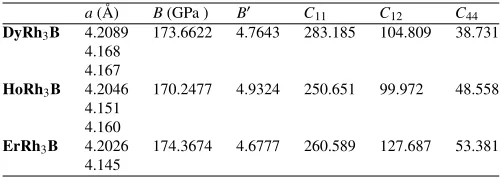
Table 1.Equilibrium properties of calculated compounds: lattice constant,a; bulk modulusB; first derivative of
the bulk modulus with respect to the pressure,B′and elastic constantsCi j(GPa ). Our FPLAPW results using
the PBE-GGA functional are compared to the experimental data.
a(Å) B(GPa ) B′ C11 C12 C44
DyRh3B 4.2089 173.6622 4.7643 283.185 104.809 38.731
4.168 4.167
HoRh3B 4.2046 170.2477 4.9324 250.651 99.972 48.558
4.151 4.160
ErRh3B 4.2026 174.3674 4.6777 260.589 127.687 53.381
4.145
for the elastic constants of these compounds are available. Therefore, we consider the present results as a prediction study.
A problem arises when single crystal samples cannot be obtained, for then it is not possible to measure the individual elastic constantsCi j. Instead, the isotropic bulk modulusBand shear mod-ulusG are determined. These quantities cannot in general be calculated directly from theCi j, but we can use our values to place bounds on the isotropic moduli. Reuss found lower bounds for all lattices, while Voigt discovered upper bounds [15]. For the specific case of cubic lattices, Hashin and Shtrikman [16] found stricter bounds. The isotropic bulk modulus for cubic system is given exactly by:
BV,R = 1/3(C11+2C12) (2)
GV = 1/5(C11−C12+3C44) (3)
GR = [5C44(C11−C12)]/[4C44+3(C11−C12)] (4)
The shear modulusGis given by
G=(GV +GR)/2 (5)
Which are frequently measured for polycrystalline materials when investigating their hardness, the Young’s modulusEand the Poisson’s ratioσ:
E = 9BG/(3B+G) (6)
σ = (3B−E)/6B (7)
The value of the Poisson ratio for covalent materials is small (σ≈0.1), whereas for ionic materials a typical value ofσis 0.25 [17]. In our case the value ofσvary from 0.351 (DyRh3B), 0.329 (HoRh3B), to 0.348 (ErRh3B), i.e. according to this index, a higher ionic contribution in intra-atomic bonding for these compounds should be assumed. However, this tool still does not give good results in all cases, for instance in our previous work [26], this index has been predicted that our compounds have strong ionic behaviour, but after its more reliable analysis by means of the QTAIM theory, we have found that the character must place our crystals rather on the covalent to ionic edge, closer to the covalent than to the ionic corner. Our results reveal that the three studied compounds have Young modulus for Dy, Ho and Er crystals, equal to 54.49, 57.94 and 58.27 (GPa) respectively, it means that the rigidity rises with the increase of the atomic number.
Table 2.Selection of thermal properties at 300 K: thermal expansion coefficient (α, 10−5K−1); vibrational
contribution to the volume and pressure constant heat capacities (CvandCpin J/mol K); isothermal and
adiabatic bulk moduli (BandBS, in GPa); Debye temperature (ΘD, K); and Grüneisen parameter (γ).
Crystal α Cv Cp B BS ΘD γ
DyRh3B 4.82 118.66 123.47 151.45 157.58 300.98 2.801
HoRh3B 4.44 119.87 152.87 113.47 125.01 268.41 5.570
ErRh3B 4.67 118.57 123.11 152.88 158.73 303.25 2.730
[23]. This latter is well detailed in much work [24], so we will just have to give the most important properties at ambient temperature. A set of properties that are specially related to the volume and de-pendent to Debye temperatureΘ, as the heat capacities, thermal expansion coefficient, isothermal and adiabatic bulk moduli, Grüneisen parameter and obviously the Debye temperature. all these quantities are gathered in Table 2.
3.1 Density of states and population analysis
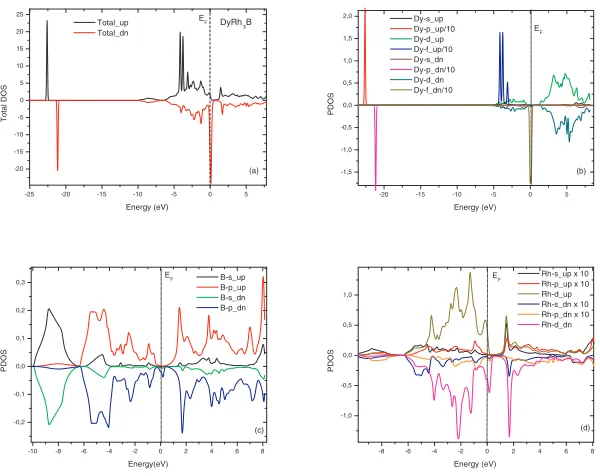
In this part, the electronic structure and population analysis features are discussed. When we observe carefully the topology of curves and especially related to the f states, the magnetic character seems clear, however, after analysis we made sure that they are ferromagnetic and not anti-ferromagnetic materials, after reversing of the spin the shape of the densities remain the same. However, this work does not address the magnetic properties, so we pay more attention to the electronic structure. In order to have more understanding and give weight interpretation of this structure, we start by analysing the Mulliken charge population, this procedure is very simple as it is implemented in thecastepcode, it has not the same reliability as the sophisticated method proposed by Bader, however, we can see through the Table 3: the vast majority of the electrons comes from the characterdstates of rhodium atom and from thef states of rare earth elements. We have analyzed the contribution of the anion and cation’s states to each set of bands by decomposing the total density of states (Total Dos) (see Fig. 1a) intos-,p-,d-, andf-orbital contributions. The result is the site-projected partial density of states shown in Figure 1b,c,d. As a consequence of similarity between the calculated spectrum of the three compounds, we show only the plot of the spin-polarized electronic structures of the DyRh3B crystal, it will be done as a demonstrator.
We may see that there is a number set of pronounced peak formed essentially between -10 and 10 eV. The bands originate predominantly from the B and Rh ofs,pord states, are similar in the two state of the spin. Nevertheless, a sharp peak originated from the Dy-f state are located at -4 eV in the spin up order and centred at the energy Fermi in the spin down order. Dy-pcharacter are shifted in the different order of the spin by about 1.5 eV. As conclusion the electronic structure is found to be metallic with the near-Fermi-level DOS determined by the Dy 4f, Rh 4d, and B 2pstates.
3.2 Electronic density topology
-25 -20 -15 -10 -5 0 5 -20 -15 -10 -5 0 5 10 15 20 25 (a) EF DyRh3B
Total DOS
Energy (eV) Total_up Total_dn
-20 -15 -10 -5 0 5
-1,5 -1,0 -0,5 0,0 0,5 1,0 1,5 2,0 (b) EF PDOS Energy (eV) Dy-s_up Dy-p_up/10 Dy-d_up Dy-f_up/10 Dy-s_dn Dy-p_dn/10 Dy-d_dn Dy-f_dn/10
-10 -8 -6 -4 -2 0 2 4 6 8 -0,2 -0,1 0,0 0,1 0,2 0,3 (c) EF PDOS Energy(eV) B-s_up B-p_up B-s_dn B-p_dn
-8 -6 -4 -2 0 2 4 6 8
-1,0 -0,5 0,0 0,5 1,0 (d) EF PDOS Energy (eV)
Rh-s_up x 10 Rh-p_up x 10 Rh-d_up Rh-s_dn x 10 Rh-p_dn x 10 Rh-d_dn
Figure 1.Spin polarized calculation of the total and partial densities of states of the DyRh3B crystal
Table 3.Atomic Populations (Mulliken)
Species Ion s p d f Total Charge (e)
DyRh3B
B 1 1.76 1.45 0.00 0.00 3.20 -0.20 Rh 1 0.80 0.24 8.40 0.00 9.44 -0.44 Rh 2 0.80 0.24 8.40 0.00 9.44 -0.44 Rh 3 0.80 0.24 8.40 0.00 9.44 -0.44 Dy 1 2.58 4.01 2.10 9.77 18.47 1.53
HoRh3B
B 1 1.31 2.25 0.00 0.00 3.57 -0.57 Rh 1 0.94 0.26 8.25 0.00 9.45 -0.45 Rh 2 0.94 0.26 8.25 0.00 9.45 -0.45 Rh 3 0.94 0.26 8.25 0.00 9.45 -0.45 Ho 1 2.81 4.19 1.49 10.59 19.07 1.93
ErRh3B
Figure 2.Electron density of DyRh3B in the [111] plane. This plane contains all the CPs of the structure: the
three nuclei, the B–Rh and Dy–Rh bond Cp’s, a single ring Cp’s, and two different cage Cp’s.
(see Figure 2). This task, computationally cheap, corresponds to the determination of the primary bundles or the atomic basins and the integration of quantum mechanical properties within them. That means to find a solutions to the equation∇⃗ρ·⃗n=0. This method, previously described in ref [26, 27], is based on the recursive division of the irreducible wedge of the Wigner-Seitz polyhedron of the Bravais lattice and the minimization of|∇⃗ρ|within the edges, surfaces, and interiors of the resulting tetrahedra. Using the critical points distribution shown in the plot of the {111} plane of the charge density in figure 2, and according to the structure satisfying Euler’s relationship (faces−edges + vertices=2), we can construct in this manner a polyhedra which contains all atomic attraction basins (see Figure 3). From these quantities and using the relation given the ionicity index defined as an average for all the basins of the ratio between the local topological charge and the nominal oxidation state,c= N1 ∑NΩ=1OSQ((ΩΩ)), and the flatness topological indices f a=ρmin
c /ρmaxb given the percentage of the metallic character, all these index are gathered in Table 4.
On 120 halide perovskites, Luañaet al.[28] have found that the electronic density can be classified into one of seven different topological schemes (i.e. seven different arrangements of critical points). Our investigated compounds according to figure 3 correspond to the dominantR9 family [28]. where the Boride basin is topologically equivalent to a cube. The result from calculating the two indices of the metallic behaviour f aand 1−cgiving the degree of covalencity predicted that our materials are dominated by nearby 65 % by covalent character with a mixture of 17 % of metallic one.
Table 4.Atomic properties of XRh3B (X=Dy, Ho, Er) In column order, it shows the multiplicity in the
conventional unit cell, the integrated chargeQ, the degree of ionicitycand the flatness topological indices f a.
Atom Wyck. Q c f a
DyRh3B 33.85% 17.46%
Dy 1a +1.3676 B 1b −0.1309 Rh 3c −1.2367
HoRh3B 34.19% 17.25%
Ho 1a +1.3809 B 1b −0.1316 Rh 3c −1.2492
ErRh3B 34.41% 17.23%
Er 1a +1.3879 B 1b −0.1299 Rh 3c −1.2579
Figure 3.Top: atomic basins for Dy , Rh and B in the DyRh3B Perovskite, Bottom: Crystallographic (balls and sticks) of DyRh3B crystals. Yellow balls represents the dysprosium ions, Light blue balls rhodium ions and green balls Bore ions. Small red balls are placed at the Wycko’s 3c are the (3,-1) bond Cp’s and (3,3) cage Cp’s are represented by the small blue balls
4 Conclusion
In summary, ourab initiosimulation provides valuables information regarding dynamical, electronic and bonding properties of the borides rare earth perovskites with formula XRh3B, where X=Dy, Ho as well as Er.
In the same time evaluation for the first time of elastic and thermal quantities have been provided. The stability of these compounds are found from this dynamical properties. We have presented also an analysis of the most common behaviour of the electronic structure of the densities of states, as a consequence of the behaviour discussed above, thef state is located very close to the Fermi level, this makes our ferromagnetic materials very matchmaker for an application in the field of superconductiv-ity.
References
[1] Wentzcovitch, R. M., Wu, Z. and Carrier, P. (2010), vol. 71 of Reviews in Mineralogy & Geo-chemistry, pp. 99–128, Mineralogical Soc. Amer., Chantilly, VA, USA.
[2] Wentzcovitch, R. M., Yu, Y. G. and Wu, Z. (2010), vol. 71 of Reviews in Mineralogy & Geo-chemistry, pp. 59-98, Mineralogical Soc. Amer., Chantilly, VA, USA.
[3] H. Holleck, J. Less-Common Met.52, 167 (1977)
[4] M. Oku, T. Shishido, T. Shinohara, T. Fukuda, Q. Sun, Y. Kawazoe, K. Wagatsuma Journal of Alloys and Compounds339, 317–326 (2002)
[5] H. Kojima, R. Sahara, T. Shishido, A. Nomura K. Kudou, S. Okada, V. Kumar, K. Nakajima and Y. Kawazoe Appl. Phys. Lett.91, 081901 (2007)
[6] M. Djermouni, S. Kacimi, and A. Zaoui, Phys. Status Solidi b,2488 (2011)
[7] M. Takeda, J. Wang, M. Takahashi, T. Shishido, A. Yoshikawa , A. Nakamura Journal of Alloys and Compounds408–412, 371-374 (2006)
[8] H. Takei, T.Shishido, Journal of the Less-Common Metals97, 223-229 (1984) [9] R. Vijayaraghavan, Journal of Magnetism and Magnetic Materials47, 561-566 (1985) [10] A. Otero-de-la Roza, V. Luaña, Comput. Phys. Commun.108, 800-812 (2009).
[11] Blaha P, Schwarz K, Madsen G K H, Kvasnicka D and Luitz J 2001 WIEN2K, An Augmented Plane Wave+Local Orbitals Program for Calculating Crystal Properties, Karlheinz Schwarz, Techn. Universitat, Wien, Austria (ISBN 3-9501031-1-2)
[12] E. Sjöstedt, L. Nordstrom, and D. J. Singh, Solid State Commun.114, 15 (2000). [13] J. P. Perdew, K. Burke, M. Ernzerhof, Phys. Rev. Lett.77, 3865-3868 (1996)
[14] Bader, R. F. W. Atoms in Moleculess, A Quantum Theory, Oxford University Press: Oxford, (1990).
[15] M.J. Mehl, B.M. Barry, D.A. Papaconstantopoulos, in: J.H. Westbrook, R.L. Fleischeir (Eds.), Intermetallic Compounds: Principle and Practice, Volume I: PrinciplesWiley, London, pp. 195-210 (Chapter 9) (1995).
[16] Z. Hashin, S. Shtrikman, J. Mech. Phys. Solids10, 335 (1962).
[17] J. Haines, J. M. Leger ,G. Bocquillon, Annu. Rev. Mater. Res.31. 1 (2001) [18] S. C. Abrahams, F. S. L. Hsu, J. Chem. Phys.63, 1162 (1975).
[19] B. N. Oshcherin, Phys. Stat. Solidi (a)35, K35 (1976). [20] H. Siethoff, K. Ahlborn, J. Appl. Phys.79, 2968 (1996). [21] C. Rincon, Phys. Stat. Solidi (a)134, 383 (1992).
[22] V. Kumar, A.K. Shrivastava, Rajib Banerji, D. Dhirhe, Solid State Communications149,1008– 1011 (2009).
[23] M. A. Blanco, E. Francisco, V. Luaña, Comput. Phys. Commun.158, 57 (2004).
[24] T. Ouahrani, A. Otero-de-la-Roza, R. Khenata, Lua´na, B. Amrani, Computational Materials Science47, 655-659 (2010)
[25] A. Otero-de-la-Roza, M. A. Blanco, A. Martín Pendás and V. Luaña, Comput. Phys. Commun. 180, 157 (2009).
[26] T. Ouahrani, A. Otero-de-la-Roza, A.H. Reshak, R. Khenata, H.I. Faraoun, B. Amrani, M. Me-brouki and V. Luaña, Physica B405, 3658–3664 (2010)
![Figure 2. Electron density of DyRh3B in the [111] plane. This plane contains all the CPs of the structure: thethree nuclei, the B–Rh and Dy–Rh bond Cp’s, a single ring Cp’s, and two different cage Cp’s.](https://thumb-us.123doks.com/thumbv2/123dok_us/8991037.1437156/6.482.132.324.62.214/figure-electron-density-contains-structure-thethree-single-dierent.webp)

