Hiradas G Lihare et al, IJSRR 2019, 8(2), 1216-1230
Research article Available online www.ijsrr.org
ISSN: 2279–0543
International Journal of Scientific Research and Reviews
Analysis and Recommendations of Total Dissolved Solid of
Chandrapur Area
1*
Hiradas G Lilhare and
2Dr. Arif khan
1, 2
Department of Civil Engineering, Nuva College of Engineering and Techology Katol Kalmeshwar road Nagpur, India
ABSTRACT
The Chandrapur cities rapidly developing due to industrialization over the last two decades. It is considered as the fourth most polluted city in India. In view of the present study, understanding about the pollution status of water quality, especially in the vicinity of Chandrapur district, industrial area and mining projects. Environmental studies carried out on land and surface water to detect physical chemical parameters like TDS and dirt.At some stations the concentration of parameters beyond the boundaries can be reduced and in this area can be an invaluable source for domestic purposes. Current project status relate the water quality accounts of different sites located in Chandrapur and their capacity. Generally water is a good solvent and easy to blame. Pure water, tasteless, colourless, and odourless. Any solution of mineral, salts, metals, cations or anions dissolve in water. Total dissolved inorganic salts (main calcium, magnesium, potassium, sodium, bicarbonates, chloride and sulphates) and some small amount of organic matter that are dissolved in water. We generally have something to contribute to the definition of salinity ions TDS as a discussion on TDS only for freshwater systems. Study of quality of water for streams, rivers and lakes is the most important application of TDS, although TDS is the primary pollutant, but it does not indicate the presence of a broad array of chemical contaminated substances as an indicator of the aesthetics characteristics of drinking water.
KYEWORDS-
TDS (Total Dissolve Solids), Turbidity, Dissolved solids, Suspended solids, Hydroponic, Gravimetry, conductivity Keyword, Surface water, Ground water,, Physico-Chemical Parameters, APHA.*Corresponding author:
Hiradas G Lilhare
P.G Student
Department of Civil Engineering,
Hiradas G Lihare et al, IJSRR 2019, 8(2), 1216-1230
INTRODUCTION
Water is one of the important resources. In economic terms, a resource has utility, that is, it can satisfy a need, and at the same time is not available without efforts. To meet this need during any process of development, the quality and accessibility of water tends to diminish, rendering it comparatively scarce. Of all liquids known to man, none can take the place of water in the great variety of life processes. All living organisms have their specific environment with which they continuously interact and remain adapted. The environment embraces all abioticand biotic conditions influencing the organisms. Water is an essential part of all living systems and is the medium from which life evolved and exists.Water is very useful of human life. Life is impossible without water plays a key role in acontrol of climatic conditions. Everything originated in the water and everything is sustainedby water. Water is the versatile inorganic liquid on this planet occurring as universal solventand indispensable component of nature, holding both biotic and abiotic entities, in a complexdynamic and delicate ecological balance by virtue of its unique capacity of existing in solid,liquid and gaseous state.
Water used in additional todrinking and personal hygiene water is needed for agriculture, industrial and manufacturingprocess hydroelectric power generation and production of electricity recreation and wild lifeetc. all peripheral and totally life cycle are ceased without water plays a key hole in a controlof climatic condition.Unfortunately pollution of the environment is one of the most horrible ecological crises towhich we are subjected today. No conservative components such as dissolved gases (e.g., O2, CO2, H2S, N2), nutrients(phosphates and nitrates), silica, trace metals, colloids and particulate matters are generallythe limiting factors in growth of organisms.. Growth of industries is a vital link factor forimproving the quality of human life. However, there has been a growing concern in last fewyears over the environmental degradation due to ecologically unplanned industrialization andurbanization. Wastes with toxic chemicals, released constantly into water bodies’ fromindustries are polluting surface and ground water source. Pollution is thus the price paidtowards development through scientific achievements to improve human life style. In simplewords pollution is an anthropogenic contribution to nature through evolved technologies forthe human welfare.
There are three source of fresh water. i. The rain fall
ii. River streams iii. Ground water
Hiradas G Lihare et al, IJSRR 2019, 8(2), 1216-1230
good health in human body. Safe and good water onlyone of source in ground water. But ground water is very dissolve solvent and elements heavytrace and any way parameters in present and very impure water drinking is dangerous tohuman health and cause disease such as various cancers, paralysis, neurological, disorder,nerve damage, thyroid problems, liver damage, kidney problems, cardio-vascular disorderfinger nail loss, diarrhoea, hair loss, mottle teeth, lung irritation and so many diseases are human body. With the development of global economies, many environmental problemshave arisen. Particularly sewage discharge is the most important source for organicpollution.Drinking water pollution is caused bysource and its route of flow. Thus, the ground and river water pollution may lead to drinkingwater pollution. Water pollution can be point source or non -point source, i.e. it can be caused near the source of pollution or pollutants are far away fromthe water bodies. Besides human activities, Nature also contributes to water pollution. Theconcentration of pollutants generally decreases as water moves to longer distances/depths andas the time passes. Not all pollutants are immediately harmful, but they may cause ill effectswith time. However, pollutants like cadmium, copper or ammoniacompounds can be harmful in high concentration. Some other pollutants (nuclear wastes)have long term effects though no short term effects are noticed. However, the sensitivity topollutants in drinking water is more connected to physiology of human/animal body than concentration of pollutant within safe range.
Hiradas G Lihare et al, IJSRR 2019, 8(2), 1216-1230
referred “Sulphated”. The term “saline” is applicable to waters containing sodium chloride present in more than usual quantities. When nitrates are present in unusual amounts, the water is said to be “nitrated”. If iron is present in amounts discernible by taste, then the water is termed as “ferruginous”. In the present day, Public Health Engineering Department (PHED) is taking care to make water safe for consumption by doing chlorination and filtration. The water treatment facility is not available at rural levels. Further, the availability in sufficient quantities of treated water in the urban areas is limited and compelling the people to the use other water sources such as bore wells, step wells, conventional cylindrical wells etc. to meet their potable water requirement. This necessitates the examination of the waters of these sources for their quality determination in respect of chlorides, harmful gases, hardness, nitrates, total dissolved solids, iron, fluorides andbacterial counts etc.
I.
OBJECTIVES
OF
PROJECT
The objective of the proposed study is as follows:-
1. To assess its quality to provide a pure and wholesome water to the public for drinking and other domestic purposes.
2. To find out whether a water is suitable for the specific industrial purpose, and if not so, to choose the most effective treatment.
3. To determine whether any pollution has occurred in a water source and to trace the origin and extent of pollution and to suggest a possible remedy.
4. To determine the efficiency towards natural purification when sewage and industrial wastes are discharged into water sources.
5. To check the efficiency, uniformity and consistency of treatment and purification Processes. 6. To find out whether infection by microbial organisms has occurred and if so, to find out the
particular organism and to suggest preventive measures and effective disinfect ion procedures.
7. To categorize the different types of water with a view to putting it in proper classifications 8. The objective of the scientific investigations is to determine the hydrochemistry of the ground
water and to classify the water in order to evaluate the water suitability for drinking and domestic uses and its suitability for drinking purpose.
9. 09. To study about the problems related with drinking water quality of Chandrapur Tahsil of Chandrapur District (M.S).
10.To study about the causes of water pollution of Chandrapur Tahsil of Chandrapur District (M.S).
Hiradas G Lihare et al, IJSRR 2019, 8(2), 1216-1230
Taluka) by organizing lectures and programs as well as by print media or electronic media’s publishing.
12.To find out the authentic preventions about polluted drinking water of Tahsil. 13.to study and survey the prescribed area and to select the study sites.
14.To check the contamination of minerals in Wadha River and surrounding villages.
15.Physicochemical description of water bodies in WardhaRiver and surrounding village wells from different locations with respect to hydrology.
II.
LITERATURE
REVIEW
1. Bhalme S.P and DrNagarnaik P.B (2012), Stated that the study is based on the analysis of drinking water parameters in an educational institute situated in Hingna MIDC area Nagpur. By which concluded that due to increase in industrialization, water quality of drinking water get decreases, and hence there is a need of proper analysis of water and prior treatment.
2. DevendraDohare and Vyoma Gupta (2014), Stated as a human body contains about 60% of the water and water is being used in most of human activities in different ways. Therefore it is observed that early human civilization had spread along the river banks. The degradation of water quality in water body creates adverse condition so that water cannot be used various purposes including bathing, recreation and as a source of raw water supply. According to central pollution control board (2008), out of total water supplied to the town and cities in India 90 % is polluted, and out of which only 1.6 % gets treated. Therefore water quality management is fundamental for the human welfare. Safe water supply is required in adequate quantity at convenient points and at reasonable cost to the consumer. Therefore performance of water treatment plants needed to be evaluated and monitored by analysis of various physico-chemical and bacteriological parameters.
Hiradas G Lihare et al, IJSRR 2019, 8(2), 1216-1230
4. Dhawale P.G and Ghyare B.P (2015), Stated that water resources are of critical importance to both natural ecosystem and human development. It is essential for agriculture, industry and human existence. The healthy aquatic ecosystem is dependent on the physic-chemical and biological characteristics. Good quality of water resources depends on a large number of physic-chemical parameters and biological characteristics. To assess that monitoring of these parameters is essential to identifying magnitude and source of any pollution load. These characteristics can identify certain condition for the ecology of living organisms and suggest appropriate conservation and management strategies.
5. Dhirendra Mohan Joshi, Alok Kumar, and Namita Agrawal (2009), Stated as a systematic study has been carried out to assess the water quality index of River Ganga in Haridwar District. 90 water samples from five sampling stations were collected and analyses for physico-chemical parameters ( Temp, Velocity, PH, Dissolved oxygen, free CO2, C.O.D, B.O.D, Carbonate, bicarbonate, total alkalinity, hardness, turbidity, calcium, magnesium, sodium, potassium, nitrate, phosphate, chloride, sulphate, and electrical conductivity, total dissolved solid, and total suspended solids.). The study area experiences a seasonal climate and broadly divided into three seasons as winter (November to February), summer (March to June), and rainy (July to October). 6. DivyaRaghuvanshi, Harendra Singh, et al (2014), stated that water samples were collected from
RasoolabadGhat to ChatnaagGhat from five sampling sites in the year 2012-2013. Ten water quality parameters for all sites were estimated by adopting the standard methods and procedures. Comparison of estimated values with WHO and USPHS standards revealed that water of study area is polluted which may be harmful for aquatic bio-system and human beings. So water quality management is urgently required to achieve the water quality standards determined by WHO.
7. Jadhao R.G (2014), The industrial waste from Maharashtra Industrial Development Corporation area of the yavatmal city is towards the village Bhoyar located towards west about two km away. A small nalla located about 100 Meter distance from the village Bhoyar, where effluent that is industrial sewage is discharged and resulting to precipitate the chemical in the nalla water. The village Bhoyar located in hard rock area and main aim of study is whether the water gets percolated or not into the groundwater. Then how does it affect the quality of the nallawater?. This is totally based on result of chemical analysis of water samples both surface and groundwater.
Hiradas G Lihare et al, IJSRR 2019, 8(2), 1216-1230
information system (GIS) technique. GIS, a tool which is used for storing, analyzing and displaying spatial data is also used for investigating ground water quality information. For this study, water samples were collected from 8 bore wells open wells representing the entire watershed area. The water samples were analyzed for physico-chemical parameters and compared with the standards. The results obtained in this study and the spatial database established in GIS will be helpful for monitoring and managing ground water pollution in the study area.
IV. CAUSES OF TOTAL DISSOLVED SOLIDS
The TDS concentration is a secondary drinking water standard and therefore is regulated it is more of an aesthetic rather than health hazards.
Total TDS causes following effects
The concentration of the dissolved ions may causes the water to be corrosive, salty or brackish taste, results in scale formation, and interfere and decreases efficiency of hot water heaters.4
TDS can result in water having a bitter or salty taste result in incrustations, films, or precipitates on fixtures; corrosion of fixtures, and reduced efficiency.9
The suitability of ground water for drinking purpose is determined keeping in view the effects of various chemical constituents in water on the biological system of human being. Though many ions are very essential for the growth of human, but when present in excess, have an adverse effect on human body
TDS is a general indicator of overall water quality. It is a measure of inorganic and organic materials dissolved in water. Increased TDS may impart a bad odour or taste to drinking water, as well as cause scaling of pipes and corrosion. High TDS level indicates water hardness in respective sampling station.
It reduces the potable for drinking purposes in the region
V. GROUND WATER RELATED ISSUES AND PROBLEMS
The main parts of the district are mainly around Rajura, Gondpipri Chandrapur, Bhadravati, Warora and Chimur Brahmapuri and Sindewahi, therefore, the parts of the water included mainly in the parts of the southern, north-west and north eastern districts, mainly the quality of ground water2.
Hiradas G Lihare et al, IJSRR 2019, 8(2), 1216-1230
Essentiality although many essential elements can contribute to TDS, there is no measurement technique, which is a necessary difference from the toxic elements themselves. Since TDS, about metabolism dissolved in just one water sample, it is impossible to represent an undifferentiated collection of TDS's "metabolism" to talk about. The total dissolved solids (TDS) poisoning is interesting, the study of early epidemiology suggests that "high middle" TDS concentrations prevent people against preserved cancers and heart disease. Incorporating other cardiovascular risk factors such as N, accounts for conflicting results in old literature in the total TDS of the first studies. Influence on saline water can affect the health of animals in various potential mechanisms. An extreme example of this effect is the result of water intoxication. The presence of excessive solvent in drinking water is called this burden and consume resources that otherwise would be used to fight development, milk production, or disease.
VI.RESEARCH METHODOLOGY (WORK PLAN
)
For the above research topic the research methodology consist of two phases as below
1. Questionnaire Survey Method
:-
Both (A) Objective method & (B) Descriptive method will be applied .Preliminary survey for population, source of water, type of water treatment schemes and capacity of water supply / water treatment plant at Chandrapur Taluka were done by questionnaire survey. Data will be collected from both primary as well as secondary sources. Primary data will be collected from the very professionals working in the related field & government bodies etc. Tools used for collecting primary data will be formal, non-formal, observation, interview & questionnaire etc. Secondary data will be collected from internal sources directly via formal / non-formal observation and external sources like libraries, government data and internet etc.
2. Field Studies:
- In the field studies water treatment plant / water supply system & water tank, different open wells, different hand wells, different bore (tube) wells and Lake of Chandrapur Taluka will be visited. Detailed information on raw water quality, treated water quality, organizational structure for operational and maintenance (O & M) of water treatment plant / water supply, size of water treatment plant / water supply system and types of treatment unit, operational status / problems related with drinking water quality and information on mode of disposal of filter backwash water & clarifier sludge, were also taken into account while making selection of water treatment plant / water supply system for visits.Hiradas G Lihare et al, IJSRR 2019, 8(2), 1216-1230
(tube) wells as well as sample from lake will be collected. Total samples will be 70 (Seventy) and these 30 samples will be collected from various purifier that’s why the grand total quantity of samples will be 100.
The first chapter will begin with an introduction which will include the meaning, definition, source of fresh water, types of impurities present in water, factors affecting ground water pollution and details of parameters, importance and future scope of research work and objectives of research work.
The second chapter will be include the review of literature, conceptualization and study background.
The third chapter will deal with sampling and experiments.
The forth chapter will covered by results given by experimental data, discussion, summary, conclusion and suggestion for future improvement and at the ending there will be bibliography / references.
3. Sampling of Water
7The sampling points will be chose to cover the entire radius of 25 km of Chandrapur district after preliminary survey of the area, in order to get exact evaluation of water quality assessment in and around Chandrapur district. The project is based on testing the quality of water. Different-different sample will be collect from Different-different areas of chandrapur region. Sample of water will collect for the testing of different sources that is well water, tap water, river water, bore well water and hand pump.
4. Determining the Water quality
8In this we will analyzed the TDS of water to determine the quality of water. According to the IS 10500 will relate the quality of water and its suitability for drinking1. Central Ground Water Board
(CGWB) is monitoring the ground water quality of the district since the last four decades through its established monitoring wells8. The objectives behind the monitoring are to develop an overall picture
of the ground water quality of the district.10 A TDS test measures the amount, but does not identify
the individual compounds or their sources.
5 Method applied to determine the TDS
Hiradas G Lihare et al, IJSRR 2019, 8(2), 1216-1230
5.1 Gravimetric methods
9Gravimetric methods are the more accurate methods and they involve evaporating the liquid solvent at 180° C and talking the mass of residues left9. The increase in weight of the dish represents
the TDS and it is reported in mg/l. This is the best methods generally, but it is time consuming. If inorganic salts are there as the great majority of TDS, gravimetric methods are more appropriate.
5.2. Conductivity method
9The measure of the ability of an electrolyte solution to conduct electricity is called its conductivity. Conductivity is also referred to as specific conductance. The SI unit of conductivity is Siemens per meter (S/m).
Concentration of dissolved ionized solids in the water is directly related to the electrical conductivity of water. Ions in the dissolved solids in water generate the stability for that water to conduct electrical current, which is measured by a TDS meter or conventional conductivity meter. Conductivity generally provides an approximate value for the TDS concentration, usually to within 10% accuracy
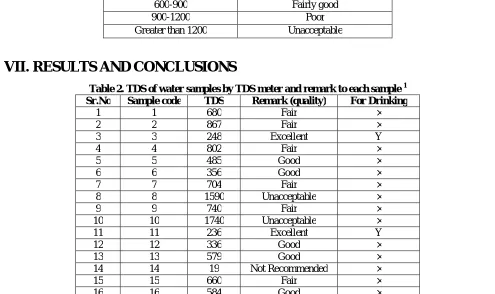
According to IS 10500 TDS and Quality of water relates as follow1:
Table.1 Water Standard As per IS 105001
Level of TDS in mg/lit Rating
Less than 300 Excellent
300-600 Good
600-900 Fairly good
900-1200 Poor
Greater than 1200 Unacceptable
VII. RESULTS AND CONCLUSIONS
Table 2. TDS of water samples by TDS meter and remark to each sample 1
Sr.No Sample code TDS Remark (quality) For Drinking
1 1 680 Fair ×
2 2 867 Fair ×
3 3 248 Excellent Y
4 4 802 Fair ×
5 5 485 Good ×
6 6 356 Good ×
7 7 704 Fair ×
8 8 1590 Unacceptable ×
9 9 740 Fair ×
10 10 1740 Unacceptable ×
11 11 236 Excellent Y
12 12 336 Good ×
13 13 579 Good ×
14 14 19 Not Recommended ×
15 15 660 Fair ×
Hiradas G Lihare et al, IJSRR 2019, 8(2), 1216-1230
17 17 1060 Poor ×
18 18 666 Fair ×
19 19 554 Good ×
20 20 494 Good ×
21 21 258 Excellent Y
22 22 335 Good ×
23 23 599 Good ×
24 24 532 Good ×
25 25 97 Excellent Y
26 A 649 Fair ×
27 B 358 Good ×
28 C 282 Excellent Y
29 D 279 Excellent Y
30 E 173 Excellent Y
31 F 241 Excellent Y
32 G 398 Good ×
33 H 426 Good ×
34 I 283 Excellent Y
35 J 439 Good ×
36 K 394 Good ×
37 L 38 Not Recommended ×
38 M 332 Good ×
39 N 193 Excellent Y
40 O 282 Excellent Y
41 P 405 Good ×
42 Q 96 Excellent Y
43 R 331 Good ×
44 S 155 Excellent Y
45 T 466 Good ×
46 U 130 Excellent Y
47 V 213 Excellent Y
48 W 74 Excellent Y
49 X 350 Good ×
50 Y 101 Excellent Y
51 Z 70 Excellent Y
52 R-1 98 Excellent Y
53 R-2 326 Good ×
54 R-3 96 Excellent Y
55 R-4 95 Excellent Y
56 R-5 812 Fair ×
57 R-6 360 Good ×
58 R-7 99 Excellent Y
59 R-8 632 Fair ×
60 R-9 100 Excellent Y
61 R-10 682 Fair ×
62 R-11 94 Excellent Y
63 R-12 225 Excellent Y
64 R-13 241 Excellent Y
65 R-14 1370 Unacceptable ×
66 R-15 106 Excellent Y
67 R-16 253 Excellent Y
68 R-17 147 Excellent Y
69 R-18 808 Good ×
70 R-19 118 Excellent Y
71 R-20 26 Unacceptable ×
72 R-21 62 Excellent Y
Hiradas G Lihare et al, IJSRR 2019, 8(2), 1216-1230
74 R-23 33 Unacceptable ×
75 R-24 40 Unacceptable Y
76 R-25 89 Excellent Y
77 R-26 125 Excellent Y
78 R-27 22 Unacceptable ×
79 R-28 102 Excellent Y
80 R-29 122 Excellent Y
81 R-30 16 Unaccepted ×
82 R-31 94 Excellent Y
83 R-32 104 Excellent Y
84 R-33 12 Unaccepted ×
85 R-34 15 Unaccepted ×
86 R-35 42 Unaccepted Y
87 R-36 08 Unaccepted ×
88 R-37 66 Excellent Y
89 R-38 72 Excellent Y
90 R-39 12 Unaccepted ×
91 R-40 52 Excellent Y
92 R-41 16 Unaccepted ×
93 R-42 74 Excellent Y
94 R-43 58 Excellent Y
95 R-44 28 Unaccepted ×
96 R-45 142 Excellent Y
97 R-46 132 Excellent Y
98 R-47 38 Unaccepted Y
99 R-48 52 Excellent Y
100 R-49 32 Unaccepted ×
This study emphasizes the quality of regular groundwater, emphasizing the pollution activity from time to time to reduce the intensity of pollution activity taking proper management measures in time. The amount of water in the vicinity of industrial area reached the effect of health due to the already dangerous stage as a report. Major industries should supply the sample points nearby for people surrounded by industries, supplying drinking water or for rehabilitation of people from that point, because they are polluting the water.
Hiradas G Lihare et al, IJSRR 2019, 8(2), 1216-1230
as possible, the risk of heavy metals and health risks may be prevalent in the field of study. Apart from this, water can be brought to a better condition for public utility by limiting settlement of sewage, organic waste, bath and laundry. Otherwise, the erosion of such important water resources will continue in the near future and the water crisis in the area will worsen. Therefore, significant water for future generations of adoption of appropriate remedial measures.
Trusted figures are not available on the impact of TDS in the possible health drinking water. The results of early epidemiological studies suggest that there may also be a beneficial effect of TDS in drinking water, although adverse effects have been reported in two limited investigations. Although acceptance may vary according to the conditions, the water containing TDS concentrations below 500 mg / liters is generally acceptable for consumers. However, due to high level presence of TDS in water, which can be as objectionable to the taste and due to excessive scaling of water pipes, heater, boilers, and home appliances. Water with very low concentrations of TDS cannot be acceptable to consumers due to its flat, faded flavor; It is also often corrosive to water supply systems. In areas where TDS material of water supply is very high, individual components should be identified and contacted local public health officials. Guidelines on a health basis are proposed for TDS. However, the guidelines for drinking water are available for some of its constituents including boron, fluoride, nitrate and high levels of sodium or potassium are recommended to treat high TDS levels.
VIII. RECOMMENDATIONS
After analyzing the result we have concluded some Recommendation as follow
1. Ground water (Bore well) of the Ghugus have the TDS ranges from 680 mg/lit to 1000 mg/lit and according ti IS 10500 this water is not good for the drinking and at the same place water provided by the municipality have TDS of 248 mg/lit which is good for drinking so we concluded that they should use only tap water for drinking1.
2. 2. Ground water (Bore well) of the Pandharkawda have the TDS range very high that is 1540 mg/lit this water is unacceptable according to IS 10500. The villagers must use RO filter or other substitute for overcoming the ill effects from this water1.
3. Nagala village have the TDS of ground water as 1740 mg/lit which is greater than 300 mg/lit so this water cannot be used directly before treatment for the drinking purpose but these villagers uses this for drinking purpose which is hazardous.
Hiradas G Lihare et al, IJSRR 2019, 8(2), 1216-1230
5. Ground water of the Mahakurla have the TDS value of 704 mg/lit this water is not good for the drinking purpose as per the IS10500 Code1.
6. Ground water of the Padoli have the TDS of 579 mg/lit which is less compared to the other places but this water is also unsuitable for the drinking according to IS10500 so this water should give proper treatment before used for drinking1.
7. 7. Water used in the other public places like Restaurant, Hospital, Library, Temple Hotels for drinking have the TDS below 50 mg/lit even some place of RO water it was found to be 6 ppm which is also hazardous than More TDS water because the necessary minerals require by body cannot fulfill by this water. Most of the minerals like Calcium, Magnesium, Phosporus, Iron, and other Necessary minerals provided by water. But low TDS water cannot feed required minerals and body suffer from various types of disease and weakness1,7.
8. Most of place it was found that the use RO to treat water of TDS of good range which is very good water. They Reduce the TDS of water below 50ppm and use which may be also leads to health issue. Hence providing proper information about TDS parameter its role on human health and other problems related to its.
9. Many parts of Chandrapur area there are various industries of different types like Mines, CSTPS, Paper milt, Cements factories, Alloy plants, Chemical Factories. Most of theme situated at bank of Wardha and IraiRiver. Drinking Water in provided by Municipal Corporation is taken from Irai River. Hazardous substances from these industries contributed to TDS. Most of the Villages are situated near bank of river from where they used these water for drinking purpose. Hence before using water there must be need to check TDS.
Hiradas G Lihare et al, IJSRR 2019, 8(2), 1216-1230
IX. REFERENCES
1. BUREAU OF INDIAN STANDARDS Drinking water specification (First Revision), IS 10500, 1991
2. Duraiswami, R.A. Groundwater conditions in the groundwater provinces of eastern Maharashtra: emerging challenges. Gondwana Mag. Spec. 2007; 11: 69-76.
3. Duraiswami, R.A. Changing geohydrological scenario in the hard rock terrain of Maharashtra: issues, concerns and way forward. Mem. Geol. Soc. India, 2008;69:86-121.
4. Handa, B.K. Natural waters, their geochemistry, pollution and treatment with a chapter on the use of saline water. Govt. of India, Min. Agri. Tech., 1975b; 2: 246.
5. Department, Government of Maharashtra, 1-16.
6. Paranjpe, S.C. \Climatic classification of Maharashtra State based on methods proposed by Thronwaite. In: Groundwater Surveys and Development Agency Seminar volume "Integrated approach for strengthening and protecting drinking water sources", IUCCA, Pune, 1999; 489-498.
7. IS 10500:2012Code for drinking water Standard.
8. IS 1622 and IS 3025 (Part 1) SAMPLING Representative samples of water.
9. Boob T.N, Evaluation of groundwater quality for its drinking suitability-A case study for Pusad town (India), Int jour of curr eng and tech, 2014; 4(3): 1