© 2015 IJSRST | Volume 1 | Issue 4 | Print ISSN: 2395-6011 | Online ISSN: 2395-602X Themed Section : Science and Technology
Effect of Weaning Age on growth Performance and Feed
Conversion Efficiency of Large White Yorkshire (LWY) Piglets
under Intensive System of Management in Mizoram
G. Kalita
1, R. Buragohain
2, P. Saikia
1, K. Sarma
3and S. Rahman
3#1Department of Livestock Production Management, College of Veterinary Sciences & Animal Husbandry, Central Agricultural
University, Aizawl, Mizoram, India
2Corresponding author, Department of Animal Nutrition, College of Veterinary Sciences & Animal Husbandry, Central
Agricultural University, Aizawl, Mizoram, India
3College of Veterinary Sciences & Animal Husbandry, Central Agricultural University, Aizawl, Mizoram – 796014, India 3#Department of Animal Husbandry Extension, College of Veterinary Sciences & Animal Husbandry, Central Agricultural
University, Aizawl, Mizoram, India
ABSTRACT
The study was for assessment of weaning age on growth performance and feed conversion efficiency of LWY piglets under intensive system of management in Mizoram. The study was conducted on piglets from twelve LWY sows. The sows were selected based on parity, sire mated, litter size and weight, and divided into three homogenized
groups with 4 sows in each group (T1, T2 and T3). Piglets of T1 group were weaned at 28 days, of T2 at 35 days and
of T3 at 42 days of age. The weaned piglets were reared up to 77 th
days of age. The animals were reared under intensive system of management following standard feeding and managemental norms. The average body weight of
piglets weaned at 28th and 35th day of age were found to be significantly (P<0.05) higher than the body weights of
piglets weaned at 42nd day of age. The body weight gain of the early weaned piglets was observed to be higher than
the late weaned piglets. The average total body weight gain at 77th day of age was found to be 19.11, 17.72 and 16.60 kg, respectively for piglets weaned at 28th, 35th and 42nd day age. Feed conversion efficiency at 77th day of age was recorded as 2.32±0.16, 2.44±0.19 and 2.48±0.07 indicated that early weaned piglets performed well under the
same feeding and managemental situation. From the findings of the study, it was concluded that weaning at 28th day
of age may be recommended for LWY piglets under intensive management in Mizoram.
Keywords: Weaning age, LWY piglets, growth, feed conversion efficiency, Mizoram.
I.
INTRODUCTION
Pig husbandry ensures livelihood to millions of rural people in India. In recent years, adoption of improved managemental practices has increased the efficiency of pig production throughout the world. Amongst the various improved managemental tools, weaning at an early age is one common practice which helps to improve pig production efficiency.
Weaning at an early age minimizes body weight losses of the sows during lactation, and ensures early
rebreeding of the sows increasing the numbers of piglets produced per sow per year [1,2]. Early weaning also reduces expenditure on labour and housing [3]. Weaning of piglets between 10 to 35 days of age is an adopted practice in many developed countries. However, in India, weaning is usually done at 56 days of age.
Large White Yorkshire (LWY) piglets managed under intensive system in Mizoram.
II.
METHODS AND MATERIAL
Ethical approval: Necessary approval has been taken from the Institutional Animal Ethic Committee for conducting the study.
Location of the Study
The study was conducted at the Piggery Unit of the Instructional Livestock Farm Complex (ILFC), College of Veterinary Sciences and Animal Husbandry, Central Agricultural University, Selesih, Aizawl, Mizoram during 2013-2014.
Experimental design
Piglets from 12 LWY sows were utilized for the study. Based on parity, litter size and weight, and sire mated,
twelve (12) LWY sows of 2nd and 3rd parity with litters
were selected and divided into three homogenized groups of 4 sows in each group (T1, T2 and T3). Piglets
of T1 group were weaned at 28 days, of T2 at 35 days
and of T3 at 42 days of age. The weaned piglets were
reared to 77th days of age.
Management and feeding
The piglets of treatment groups were reared in the creep area of the furrowing pen before weaning. Adequate care was taken to minimize thermal discomfort to young piglets. Strict hygiene was maintained during creep rearing period. Routine management practices like naval cord cutting, teeth clipping, iron injection, etc. were done following standard protocols. After weaning, piglets were shifted to weaner pen fitted with heating device.
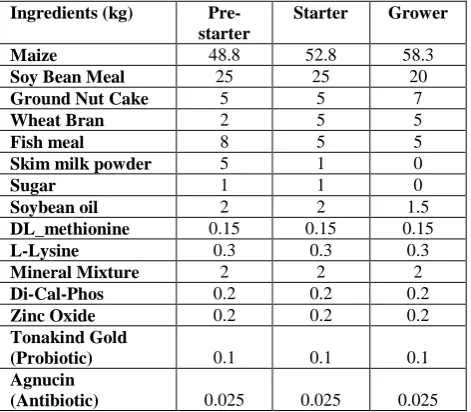
Balanced rations [4] were prepared incorporating conventional feed ingredients. Piglets irrespective of groups were provided pre-starter ad libitum during 3rd week of age, starter feed during 4th to 6th week and grower feed from 7th to 11th week of age. Pre-starter and starter ration were fortified with milk powder, sugar, probiotic, zinc oxide, antibiotic, lysine, and methionine. Data collection
Feed consumption of experimental piglets was recorded individually on daily basis. Body weight records of
piglets were made at weekly interval from birth to 11 weeks (77 days) of age. Total expenditure on management and feeding per kg live weight was calculated.
Statistical Analysis
The data generated were statistically analyzed as per Snedecor & Cochran [5].
III.
RESULT AND DISCUSSION
Ingredient and nutritional composition of the experimental rations
The rations fed to the piglets, based on age irrespective of treatment groups, are presented in table 1. The nutritional compositions of the rations are presented in table 2. Based on the retail market prices of the feed ingredients, the expenditure on per kg pre-starter, starter and grower ration were calculated as Rs. 52.80, 43.26 and 39.60, respectively.
Feed consumption
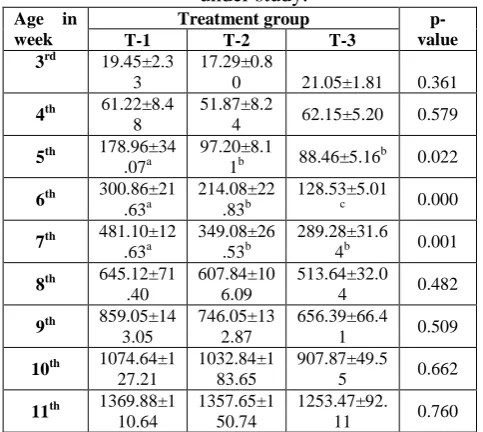
The average Daily Feed Intake (ADFI) is presented in
Table 3.The ADFI were found to be low during 3rd and
4th weeks of age in all the groups. Post-weaning feed
intakes were gradually increased in all groups up to11th
weeks of age. Less feed intake during the early age might be for availability of milk consumption. Post weaning ADFI was higher in late weaned piglets as compared early weaned piglets, but was non-significant (P<0.05) among the groups.
Table 1 : Ingredient composition of the rations fed to the piglets before and after weaning
Ingredients (kg) Pre-starter
Starter Grower
Maize 48.8 52.8 58.3
Soy Bean Meal 25 25 20
Ground Nut Cake 5 5 7
Wheat Bran 2 5 5
Fish meal 8 5 5
Skim milk powder 5 1 0
Sugar 1 1 0
Soybean oil 2 2 1.5
DL_methionine 0.15 0.15 0.15
L-Lysine 0.3 0.3 0.3
Mineral Mixture 2 2 2
Di-Cal-Phos 0.2 0.2 0.2
Zinc Oxide 0.2 0.2 0.2
Tonakind Gold
(Probiotic) 0.1 0.1 0.1
Agnucin
Salt 0.3 0.3 0.3
Total (kg) 100 100 100
Cost** (Rs./kg) 52.80 43.26 39.60
** Based on market price of ingredients at Aizawl City, Mizoram, India during 2013-2014
Table 2 : Nutritional composition## (on DM basis) of the rations fed to the piglets before and after weaning
Nutrient
Pre-starter
Starter Grower
Dry Matter (%) 87.61 87.31 87.05 Energy(DE)(Kcal/kg) 3306 3308 3287 Crude Protein (%) 21.94 20.03 19.02 Crude Fibre (%) 3.85 4.21 4.21
Lysine (%) 1.51 1.31 1.19
Methionine (%) 0.57 0.50 0.48 Methionine + Cystine
(%) 0.90 0.83 0.80
Calcium (%) 0.96 0.84 0.81
Phosphorus (%) 0.74 0.69 0.69 Ether Extract (%) 5.68 5.71 5.17 ## Calculated value.
The higher post weaning feed consumption as compared to low pre-weaning feed intake in all the groups signified that there might be inhibitory effect of
lactation on creep feed consumption of piglets. Kuller et
al. [6] demonstrated that both pre and post weaning feed
intake were higher for the intermittent sucker than the continuous sucker during lactation. Sulabo et al. [7] on the other hand suggested that limited nutrient supply did not drive piglets to consume more creep feed. Lower feed intake might have contributed to low growth rates for lately weaned piglets as compared to early weaned piglets. The present findings are in agreement with the findings of Fraser et al. [8] and Kuller et al. [6].
Table 3 : Average daily feed intake (g) of the piglets under study.
Age in week
Treatment group p-
value
T-1 T-2 T-3
3rd 19.45±2.3 3
17.29±0.8
0 21.05±1.81 0.361
4th 61.22±8.4
8
51.87±8.2
4 62.15±5.20 0.579
5th 178.96±34
.07a
97.20±8.1
1b 88.46±5.16
b
0.022
6th 300.86±21 .63a
214.08±22 .83b
128.53±5.01
c 0.000
7th 481.10±12
.63a
349.08±26 .53b
289.28±31.6
4b 0.001
8th 645.12±71
.40
607.84±10 6.09
513.64±32.0
4 0.482
9th 859.05±14
3.05
746.05±13 2.87
656.39±66.4
1 0.509
10th 1074.64±1
27.21
1032.84±1 83.65
907.87±49.5
5 0.662
11th 1369.88±1 10.64
1357.65±1 50.74
1253.47±92.
11 0.760 Means within each row bearing at least one common superscript do not differ significantly (P < 0.05)
Growth Performance of Piglets
The average weekly body weights of the piglets before and after weaning are presented in table 4. No significant (P<0.05) differences were observed in body weights of piglets under different weaning regime up to 6 weeks of age. However, it was observed that body weights of piglets weaned early were higher than the late weaned piglets and at 11th week of age, average body weight of piglets weaned at 28th and 35th day of age were found to be significantly (P<0.05) higher than the body weights of piglets weaned at 42nd day of age.
Table 4 : Average weekly body weights (kg) of the piglets under study.
Age in week
Treatment group p-
value
T-1 T-2 T-3
At Birth 1.42±0.05 (34) 1.39±0.04 (36) 1.36±0.04 (33) 0.650
1st 2.49±0.09 (34) 2.28±0.20 (35) 2.45±0.08 (33) 0.130
2nd 3.74±0.15 (33) 3.64±0.13 (33) 3.70±0.11 (33) 0.158
3rd 4.88±0.16 (32) 4.67±0.15 (31) 4.70±0.17 (33) 0.656
4th 5.67±0.19 (32) 5.55±0.14 (31) 5.63±0.20 (33) 0.895
5th 6.21±0.19
(32) 6.65±0.17 (31) 6.63±0.24 (33) 0.242
6th 7.52±0.23
(32) 7.31±0.19 (31) 7.38±0.27 (32) 0.813
7th 9.32±0.32
a (32) 8.33±0.24b (31) 8.53±0.30 ab (31) 0.043
8th 11.52±0.3
7a (32)
10.45±0.35b (31) 9.92±0.39 b (31) 0.010
9th 13.87±0.4
9a (32)
12.94±0.47a
b (31)
12.07±0.4 4b (31)
0.027
10th 17.05±0.6
3a (32)
15.86±0.56a
b
(31)
14.88±0.6 0b(31)
0.039
11th 20.53±0.6 8a (32)
19.11±0.70a
b
(31)
17.96±0.7 5b (31)
0.041
Means within each row bearing at least one common superscript do not differ significantly (P < 0.05).
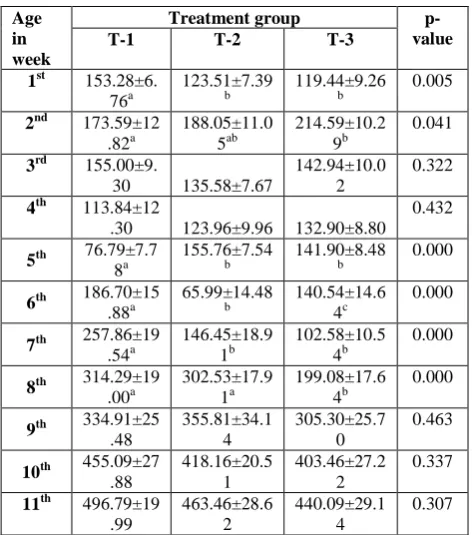
Table 5. Average daily gain in body weights (g) of the piglets under study
Age in week
Treatment group p-
value
T-1 T-2 T-3
1st 153.28±6. 76a
123.51±7.39
b 119.44±9.26b 0.005
2nd 173.59±12 .82a
188.05±11.0 5ab
214.59±10.2 9b
0.041
3rd 155.00±9.
30 135.58±7.67
142.94±10.0 2
0.322
4th 113.84±12
.30 123.96±9.96 132.90±8.80 0.432
5th 76.79±7.7
8a
155.76±7.54
b 141.90±8.48b 0.000
6th 186.70±15
.88a
65.99±14.48
b 140.54±14.6
4c
0.000
7th 257.86±19
.54a
146.45±18.9 1b
102.58±10.5 4b
0.000
8th 314.29±19
.00a
302.53±17.9 1a
199.08±17.6 4b
0.000
9th 334.91±25
.48
355.81±34.1 4
305.30±25.7 0
0.463
10th 455.09±27
.88
418.16±20.5 1
403.46±27.2 2
0.337
11th 496.79±19 .99
463.46±28.6 2
440.09±29.1 4
0.307
Means within each row bearing at least one common superscript do not differ significantly (P < 0.05)
In all the groups, ADG was observed to increase from 1st
to 2nd week and thereafter decreased during 3rd and 4th week of age. ADGs were found to increase in 5th week
in 35 & 42 days weaning group. During 1st week of post
weaning, ADGs in all the groups were reduced. This might be for post weaning growth depression which persisted for one or two weeks after weaning. Similar
trends were also reported by Bhatia et al. [3], Mahan [9],
Abraham [10],and Phukan [11].
Reduced ADGs during 3rd and 4th week of age might be
due to lower milk availability and/or less consumption of pre-starter ration by the piglets. Milk production of sows usually decline after 3rd week of lactation which increases the gap between supply and demand of
nutrients for nursing piglets [2]. Digestibility of
uncooked feeds was reported to be low in young piglets [12]. The pre-starter rations provided during the experiment were uncooked ones which might contribute to poor intakes and hence decreased growth of young piglets during their early life as also the piglets needs to be adopted to the ration.
Feed conversion efficiency (FCE)
The overall FCE was found to be better in early weaned pigs than the late weaned counterpart (table 6). However, there was no statistical (P<0.05) differences among the weaning groups under the study. Better growth rate of
early weaned piglets might result better FCE than the lately weaned piglets. The present findings are in confirmation with the results of Rava [13], Abraham
[10], Collins et al. [14], Phukon [11], and
Suryanarayana and Suresh [15].
Table 6 : Average feed conversion efficiency of piglets under study
Age in week
Treatment group p- value
T-1 T-2 T-3
5th 2.45 ± 0.19 - - -
6th 1.66 ±
0.26a 3.26± 0.39b - 0.007
7th 1.88±0.16 2.32±0.21 2.83±0.
52 0.199
8th 2.07±0.19 2.05±0.12 2.54±0.
22 0.158
9th 2.65±0.48 2.08±0.20 2.18±0.
15 0.418
10th 2.33±0.25 2.50±0.29 2.28±0.
13 0.794
11th 3.01±0.19 2.96±0.26 2.89±0.
13 0.916
Overall 2.32±0.16 2.44±0.19 2.48±0.
07 0.753 Means within each row bearing at least one common superscript do not differ significantly (P < 0.05)
IV.
CONCLUSION
From the findings of the present study, it was concluded that weaning age of 28th day may be recommended for LWY without any adverse effects on growth performance and feed conversion efficiency when reared under intensive system of management in Mizoram.
V.
ACKNOWLEDGEMENT
Authors are thankful to the Dean, College of Veterinary Sciences & A.H., Central Agricultural University, Selesih, Aizawl, Mizoram, India for providing financial support and necessary facilities to carry out the study successfully.
VI.
REFERENCES
[1] Chatterjee J.K, Majumder S.C, Roy S.K, Maitra D.S (1987): “Effect of early weaning on the performance of pure and crossbred piglets”, Indian J. of Animal Sciences, Vol.57, No.7, Pp 770-772.
[3] Bhatia S.S, Chhabra A.K, Agarwal D.K (1985): “Effect of age at weaning on sow productivity”, Indian J. Anim. Res, Vol.19, No.1, Pp 48-50.
[4] NRC (1998): “Nutrient requirement of pigs,” 9th Edition, National Research Council, USA.
[5] Snedecor G.W, Cochran W.G (1994): “Statistical methods,” 8th edn. Iowa State University Press, USA. [6] Kuller W.I, Soede N.M, Van Beers-Schreurs H.M.G,
Langendijk P (2007): “Effects of intermittent suckling and creep feed intake on pig performance from birth to slaughter,” J Anim Sci, Vol.85, Pp 1295-1301.
[7] Sulabo R.C, Jacela J.Y, Tokach M.D, Dritz S.S, Goodband R.D, De Rouchey J.M, Nelssen J.L (2010): “Effects of lactation feed intake and creep feeding on sow and piglet performance,” J Anim Sci, Vol. 88, Pp 3145-3153.
[8] Fraser D, Feddes J.J.R, Pajor E.A (1994): “The relationship between creep feeding behaviour of piglets and adaptation to weaning: Effect of diet quality,” Can. J. Anim. Sci, Vol. 74, Pp 1-6.
[9] Mahan D.C (1993): “Effect of weight, split-weaning, and nursery feeding programs on performance responses of pigs to 105 kilograms body weight and subsequent effects on sow,” J Anim Sci., Vol. 71, Pp 1991-1995.
[10] Abraham J. (2001): “Effect of different weaning management systems on the performance of Landrace x Desi pigs,” M.V.Sc. Thesis, IVRI, Izatnagar, Bareilly, Uttar Pradesh.
[11] Phukon J.C (2011): “Influence of early weaning on productive performance in Large White Yorkshire pigs,” M.V.Sc. thesis, submitted to Tamil Nadu University of Veterinary and Animal Sciences (TANUVAS), Tamil Nadu.
[12] Mavromichalis I (2006): “Applied nutrition for young pigs,” CABI, Wallingford, Oxfordshire OX10 8DE, United Kingdom.
[13] Rava S (1991): “Effect of skim milk feeding and early weaning on the growth performance of Hampshire pig,” M.V.Sc. thesis, College of Veterinary Science, Assam Agricultural University, Khanapara, Guwahati-22, Assam.
[14] Collin C.L, Leury B.J, Dunshea F.R (2010): “Early weaning has minimal effects on lifetime growth performance and body composition of pigs,” Anim. Prod., Vol. 50, Pp 79-87.