Parental Knowledge of Child Development and the Assignment of Tractor
Work to Children
William Pickett, PhD*; Barbara Marlenga, PhD‡; and Richard L. Berg, MS§
ABSTRACT. Objectives. Many childhood farm tractor injuries occur during the performance of work that was assigned by parents, and some tractor work is beyond the developmental capabilities of children. This has been highlighted recently by a policy statement authored by the American Academy of Pediatrics. The objective of this study was 1) to assess child development knowledge of farm parents who received a new resource, the North American Guidelines for Children’s Agricultural Tasks (NAGCAT), and 2) to determine whether this knowledge was associated with use of NAGCAT in the assignment of tractor jobs and with compliance with 2 aspects of the NAGCAT tractor guideline.
Methods. Secondary analysis of data collected during a randomized controlled trial that involved 450 farms in the United States and Canada was conducted. Variables assessed included 1) parental knowledge of child devel-opment across several age groups and 3 domains of child development (physical, cognitive, and psychosocial), 2) documentation of the most common tractor jobs assigned to each child, and 3) a report of whether NAGCAT was used in assigning these tractor jobs.
Results. High parental knowledge of child develop-ment was associated with enhanced use of NAGCAT and fewer violations when assigning tractor work to children. However, even in the presence of high knowledge, some farm parents still assigned to their children work that was in violation of NAGCAT.
Conclusions. Educational interventions by them-selves are not sufficient to remove many farm children from known occupational hazards. These findings are discussed in light of the recent policy statement on agri-cultural injuries from the American Academy of Pediatrics.Pediatrics2003;112:e11–e16. URL: http://www. pediatrics.org/cgi/content/full/112/1/e11; child develop-ment, child, agriculture, wounds and injuries, rural popu-lation, knowledge, attitudes, practice, parenting, safety.
ABBREVIATIONS. AAP, American Academy of Pediatrics; NAGCAT, North American Guidelines for Children’s Agricul-tural Tasks; PTO, power take-off; ROPS, rollover protection struc-ture.
C
hildhood farm injuries are an important injury control problem and remain a priority for pre-vention. The recent policy statement by the American Academy of Pediatrics (AAP), Prevention of Agricultural Injuries Among Children and Ado-lescents, summarizes the scope of the pediatric farm injury problem, identifies the need for continuing and improved injury control strategies on farms, and provides recommendations for pediatricians. The recommendations for pediatricians address the need for patient and community education as well as pub-lic advocacy related to agricultural injury prevention in childhood and adolescence.1 Specific injury pre-vention strategies that are proposed include the need for physicians to educate parents about normal growth and development of children and to encour-age them to consider this information when making decisions about a child’s readiness for work. The statement also describes legislative alternatives sur-rounding the operation of farm tractors.1Although developed for pediatricians, issues cov-ered by the AAP policy statement are important for farm parents. When assigning farm work to children, parents are responsible for making informed choices about many hazards to which their children are ex-posed. To make sensible decisions, parents may rely solely on their intuition,2,3 they may look to their own childhood experiences or standards of practice in their local community,2,3 or they may base deci-sions on something more formal. Optimally, the last would include knowledge obtained from empirical research evidence or the recommendations of those with child development expertise.
When the physical environment is inherently dan-gerous, an error in adult judgment can lead to seri-ous injuries to children; thus, these decisions become more consequential. Children on farms experience especially high rates of death,4,5 morbidity,6,7 and disability8as a result of injury. Many pediatric farm injuries occur because children are exposed to occu-pational hazards such as tractors, unguarded ma-chinery, large animals, drowning and suffocation hazards, and unguarded heights. However, some of these injuries are also attributable to farm parents assigning work that is beyond the developmental capabilities of the child.9
Because the farm is both an occupational work site and a home environment, the decisions that parents need to make regarding the safety of their children are more complex. Parents may struggle with judg-ments about whether the work environment is
pre-From the *Department of Emergency Medicine and Department of Com-munity Health and Epidemiology, Queen’s University, Kingston, Ontario, Canada; ‡National Children’s Center for Rural and Agricultural Health and Safety and the §Department of Biostatistics, Marshfield Clinic Research Foundation, Marshfield, Wisconsin.
Received for publication Jun 28, 2002; accepted Mar 13, 2003. Drs Pickett and Marlenga contributed equally to this work.
Reprint requests to (B.M.) National Children’s Center for Rural and Agri-cultural Health and Safety, 1000 North Oak Ave, Marshfield, WI 54449. E-mail: [email protected]
senting undue risk to the child or whether the work assignments are appropriate and safe. The difficul-ties inherent in making such decisions may be re-flected in assignment of work that is clearly beyond the developmental abilities of the child.
Even when parents have a good understanding about what children are capable of doing at different developmental stages, this may not always be re-flected in actual behavior. For example, children may be exposed to adult work activities for them to de-velop skills, a reasonable work ethic, or the judgment necessary to manage complicated situations.3These work assignments may be made deliberately for the long-term benefit of the child but may not be devel-opmentally appropriate for the child.3,10
Although there are many possible reasons why farm parents allow themselves to make inappropri-ate work assignments to children, there is little pub-lished evidence about how farm parents’ knowledge of child development principles influences their de-cision making. In a previous series of analyses that focused on the nature of farm work assignments11 and tractor work assignments12 to children, we ob-served that children on farms begin to work and are often assigned adult work responsibilities at an early age. The present analysis examined whether these work assignments could, in part, be attributed to a lack of parental knowledge about child develop-ment. If so, then this would inform the content and delivery of health and safety interventions aimed at farm parents.
The purpose of this study was to assess the level of relevant child development knowledge that farm parents possessed and evaluate whether this knowl-edge related to work assignments. Specifically, we determined whether knowledge was associated with 1) their use of a new parent resource (the North American Guidelines for Children’s Agricultural Tasks [NAGCAT])9 when assigning farm work to their children and 2) their appropriate assignment of tractor work to their children based on the NAGCAT recommendations. Findings are discussed in light of the recommendations contained in the AAP policy statement.
The NAGCAT are a set of consensus guidelines developed to assist farm parents in assigning appro-priate and safe work to their children aged 7 to 16 years. Child development principles provided the scientific basis for this assessment tool, which cov-ered 62 common agricultural jobs. Each job is de-picted in a poster that includes a job illustration and lists of adult responsibilities, hazards, safety remind-ers, recommended levels of supervision, and a de-velopmental checklist. The posters are grouped into booklets based on job type and include the categories of animal care, general activities, haying operations, implement operations, manual labor, specialty pro-duction, and tractor fundamentals (go to www. nagcat.org).
The NAGCAT tractor fundamentals booklet con-tains a tractor matrix that summarizes the minimum ages for children to be involved in farm tractor work. The tractor matrix is the only place within the NAG-CAT parent resource where ages are directly linked
to a farm job. All other NAGCAT guidelines contain a checklist to be used by parents to make develop-mentally appropriate work assignments. Age recom-mendations for tractor work were based on typical developmental abilities of children at different ages (based on expert opinion and normative data) while considering the complexity and relative level of haz-ard of the tractor jobs. Thus, by limiting our study only to tractor jobs, we were able to use the reported age of the child as a proxy for child development. Tractor work assignments were also selected for fo-cused study because tractors are a leading cause of fatal traumatic injuries in the pediatric farm popula-tion.5
METHODS Overview
The study involved a cross-sectional analysis of data collected by telephone survey. Participants were volunteer farm parents who agreed to participate in a randomized controlled trial, de-scribed elsewhere.13In short, the randomized trial itself was
de-signed to test the efficacy of an enhanced dissemination strategy to increase the likelihood of adoption of NAGCAT. This trial showed that the provision of information contained in a safety video, child development fact sheets, and supportive telephone calls improved rates of adoption of NAGCAT but did not lead to improved parental knowledge about child development.13As part of that
trial, each parent completed interviews about themselves and their farm operation and job assignments to children who worked on the farm. Interviews with parents took place on recruitment and during follow-up interviews. The current analysis was based on follow-up at 15 months with 450 (90%) of the 498 farm parents originally recruited for study. The ethics committees of the Marsh-field Clinic Research, University of California-Davis, and Queen’s University at Kingston, Canada, each approved the original study protocol.
Farm Sample
The sample of farms and associated parents was selected from the United States Department of Agriculture’s master sampling frame for the 1998 national childhood agricultural injury survey and in Canada from the Canadian Farm Register and the Agricul-tural Publishing Company farm database. The available sample of farms was large and covered a range of North American regions (western United States; midwestern United States; and Ontario, Canada) and types of production agriculture. Eligibility criteria were as follows: 1) the farm had at least 1 child aged 7 to 16 years (age range covered by NAGCAT) working on the farm, 2) a parent who makes decisions about work assignments for children was willing to participate, 3) this person was conversant in English, and 4) he or she provided informed consent according to institu-tional requirements. In addition, parents had to participate in the 15-month follow-up interview to be included in analyses pre-sented here.
The full trial protocol is described elsewhere.13As part of the
trial, all farm parents received copies of guideline booklets from the NAGCAT Parent Resource. Each individual work guideline contained a child development checklist specific to that job. Fur-thermore, if they had been randomized to receive the enhanced dissemination strategy, then they received additional training ma-terials about child development, including a video about age-appropriate farm tasks from the National Safety Council and fact sheets developed from principles and prose contained in the NAGCAT parent resource.
Assessment of Parental Knowledge
Parental knowledge about child development principles was assessed via 13 questions from the follow-up interview. These questions addressed a range of developmental attributes used in the construction of the NAGCAT parent resource.9The attributes
concepts and associated prose contained in NAGCAT. When the NAGCAT parent resource was being developed, it was pilot-tested iteratively with review teams that consisted of farm parents, the agricultural media, agricultural health and safety profession-als, and researchers. The specific questions used in the scale were also pilot-tested iteratively with samples of farm parents in both countries, and, where necessary, wording was clarified to improve understanding. Cronbach’s␣was used to assess the internal con-sistency reliability of the scale. Questions contained in the scale were asked on multiple occasions during the trial to monitor change, if any, in levels of parental knowledge. In the present analysis, parents were rated according to their level of knowledge at the 15-month follow-up interview.
Tractor Work Assessment
Parents were asked to identify every child aged 7 to 16 years who worked on the farm. For each, they were asked to name the 2 tractor jobs that the child did most often during the previous July and August and whether the NAGCAT parent resource was re-ferred to in the assignment of these jobs. When tractor jobs were named, the parent was also asked whether a power take-off (PTO) device was used, the age and horsepower of the tractor involved, and whether the tractor was equipped with a rollover protection structure (ROPS). All tractor jobs were then classified according to the following binary (yes or no) self-reported outcomes:
1. Was the NAGCAT parent resource used during the assignment of the tractor jobs?
2. Was the tractor the child operated equipped with ROPS? 3. Was any tractor job assignment in violation of at least one of the
following NAGCAT age restrictions: tractor work assigned to a child younger than 12 years and/or assignment to a large tractor (⬎70 hp) when a child was 12 to 13 years of age and/or assignment to PTO-related tractor work before the age of 14?
Parents were instructed to consider that “use of NAGCAT” meant that they had read NAGCAT and 1) changed the job, 2) changed the working environment, or 3) simply confirmed that the work was appropriate.
Assessment of Additional Variables
Additional variables assessed during the interview and consid-ered in the analysis included study group, study region, and parental demographics (age, gender, highest level of education).
Analysis
Descriptive analyses were used to characterize the child devel-opment knowledge levels of farm parents by randomized group, region, gender, age group, and education. The knowledge score
calculated for each parent was assigned to his or her children. A logistic regression model was used to examine the potential asso-ciation between use of NAGCAT (first binary outcome) and levels of parental knowledge in the assignment of tractor work to chil-dren. Additional logistic models examined potential associations of the assignment of work on tractors without ROPS (second binary outcome) and violations to the age restrictions advocated by NAGCAT (third binary outcome) with parental knowledge. The last analysis was restricted to children younger than 14 years, as these are the ages for which clear age restrictions apply. All of the logistic models used generalized estimating equations to allow for correlation among children from the same farm and these were adjusted for region as per the stratified study design.14
Parental age, gender, and the study intervention were evalu-ated as potential confounders but were found to have little impact on the model results (generally⬍1% change in the knowledge score estimate) and were not included in the final models. Parental education was recorded in the study but was not included as a covariate in the statistical models; formal education is seen as one factor that leads to knowledge, and including such a factor in a model with the knowledge score would likely reduce the precision of the analysis.15
Statistical tests for association were based on the full knowl-edge score, but for presentation purposes, the lowest scores (8 or less) were pooled to avoid small response frequencies. Estimates of prevalence rates, odds ratios, and associated 95% confidence intervals were computed from the logistic models. The analyses were conducted in SAS.16
RESULTS
Parental Knowledge of Child Development
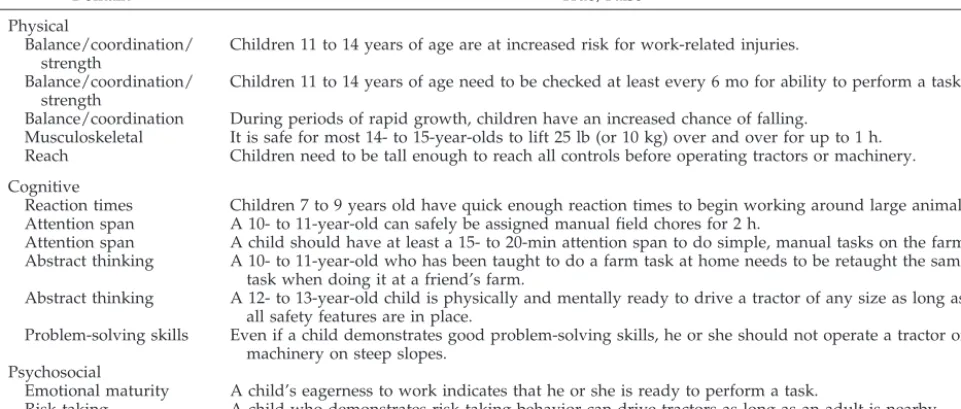
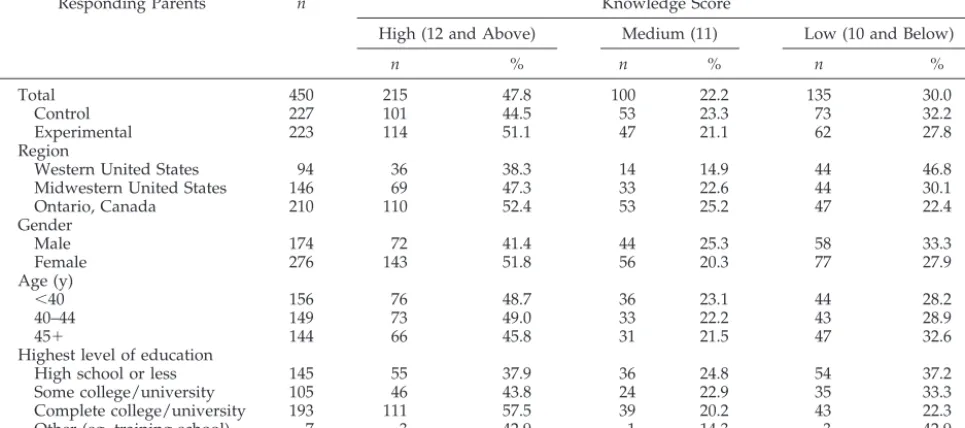
Levels of parental knowledge were summarized according to the score developed from questions contained in Table 1. Raw scores ranged from 5 (38% correct) to 13 (100%) with a median score of 11 (85%). Scores of 12 or more were observed in 215 (47.8%) farm parents, scores of 11 were observed in 100 (22.2%) farm parents, and lower knowledge scores (5–10) were observed in 135 (30.0%) farm parents. Scores were observed to be higher among younger and better-educated parents and for female parents (Table 2). These knowledge scores did not vary sub-stantially between experimental and control groups.
TABLE 1. Child Development Questions Forming the Basis for the Parental Knowledge Score
Domain True/False
Physical
Balance/coordination/ strength
Children 11 to 14 years of age are at increased risk for work-related injuries.
Balance/coordination/ strength
Children 11 to 14 years of age need to be checked at least every 6 mo for ability to perform a task.
Balance/coordination During periods of rapid growth, children have an increased chance of falling.
Musculoskeletal It is safe for most 14- to 15-year-olds to lift 25 lb (or 10 kg) over and over for up to 1 h. Reach Children need to be tall enough to reach all controls before operating tractors or machinery.
Cognitive
Reaction times Children 7 to 9 years old have quick enough reaction times to begin working around large animals. Attention span A 10- to 11-year-old can safely be assigned manual field chores for 2 h.
Attention span A child should have at least a 15- to 20-min attention span to do simple, manual tasks on the farm. Abstract thinking A 10- to 11-year-old who has been taught to do a farm task at home needs to be retaught the same
task when doing it at a friend’s farm.
Abstract thinking A 12- to 13-year-old child is physically and mentally ready to drive a tractor of any size as long as all safety features are in place.
Problem-solving skills Even if a child demonstrates good problem-solving skills, he or she should not operate a tractor or machinery on steep slopes.
Psychosocial
Emotional maturity A child’s eagerness to work indicates that he or she is ready to perform a task.
Parental Knowledge and Use of NAGCAT
Table 3 summarizes the relationship between the parental knowledge score and use of NAGCAT in the assignment of tractor work to children. There was a strong relationship between lower parental knowledge and lower use of NAGCAT. Parents with the lowest level of knowledge most often failed to use NAGCAT, with a relative odds of nonuse that was 8.0-fold higher (95% confidence interval: 3.6 – 17.7) than parents in the highest knowledge group.
Although the specifics of how NAGCAT were used were not recorded for individual jobs, the most common changes made as a result of study partici-pation by parents that reported NAGCAT use on tractor jobs were 1) preventing the child from doing a job (67.7% of these farms), 2) providing more su-pervision (65.5%), and 3) setting a limit on the amount of time worked (49.6%).
Parental Knowledge and Violations of NAGCAT Clear violations of NAGCAT for farm tractor jobs were associated with lower levels of parental knowl-edge of child development. The prevalence of ROPS
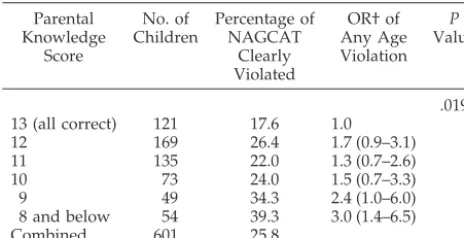
violations (Table 4) decreased from 36.8% among parents with the lowest knowledge scores to 19.5% among parents with the highest scores, although this trend was not statistically significant (P ⫽ .076). Knowledge scores were significantly associated with age violations (Table 5). Age violations were higher among parents with the lowest knowledge scores (odds ratio: 3.0; 95% confidence interval: 1.4 – 6.5 for parents who scored 8 and below). Although the high-est rate of violations was among parents with low levels of child development knowledge, ROPS and age violations were present even among the most knowledgeable parent group.
DISCUSSION
A major finding of the present analysis was that, on testing, farm parents had a relatively high level of knowledge about child development. Lower levels of parental knowledge were associated with decreased use of NAGCAT in the assignment of farm work to children. Furthermore, higher rates of violation to the NAGCAT tractor guidelines were observed
TABLE 2. Description of Parental Knowledge by Parental and Farm Characteristics
Responding Parents n Knowledge Score
High (12 and Above) Medium (11) Low (10 and Below)
n % n % n %
Total 450 215 47.8 100 22.2 135 30.0
Control 227 101 44.5 53 23.3 73 32.2
Experimental 223 114 51.1 47 21.1 62 27.8
Region
Western United States 94 36 38.3 14 14.9 44 46.8
Midwestern United States 146 69 47.3 33 22.6 44 30.1
Ontario, Canada 210 110 52.4 53 25.2 47 22.4
Gender
Male 174 72 41.4 44 25.3 58 33.3
Female 276 143 51.8 56 20.3 77 27.9
Age (y)
⬍40 156 76 48.7 36 23.1 44 28.2
40–44 149 73 49.0 33 22.2 43 28.9
45⫹ 144 66 45.8 31 21.5 47 32.6
Highest level of education
High school or less 145 55 37.9 36 24.8 54 37.2
Some college/university 105 46 43.8 24 22.9 35 33.3
Complete college/university 193 111 57.5 39 20.2 43 22.3
Other (eg, training school) 7 3 42.9 1 14.3 3 42.9
TABLE 3. Association Between Parental Knowledge and Use of NAGCAT in the Assignment of Tractor Jobs to Children Ages 7 to 16*
Parental Knowledge
Score
No. of Children
Percentage of NAGCAT Not Used
OR† of Nonuse of NAGCAT
PValue
⬍.001
13 (all correct) 221 7.5 1.0
12 310 13.6 1.9 (1.0–3.9)
11 252 9.3 1.3 (0.6–2.7)
10 155 17.7 2.7 (1.2–6.0)
9 91 28.9 5.0 (2.3–11.1)
8 and below 87 39.3 8.0 (3.6–17.7)
Combined 1116 16.2
* Estimates from logistic regression using generalized estimating equations with adjustment for region (95% confidence interval). † Odds ratio of negative outcome relative to highest knowledge category (95% confidence interval).
TABLE 4. Association Between Parental Knowledge and ROPS Violations of NAGCAT for Farm Tractor Jobs Among Working Children Ages 7 to 16*
Parental Knowledge
Score
No. of Children
Percentage of NAGCAT
Clearly Violated
OR† of ROPS Violation
P
Value
.076
13 (all correct) 221 19.5 1.0
12 310 21.5 1.1 (0.6–2.0)
11 252 21.9 1.2 (0.7–2.0)
10 155 17.2 0.9 (0.4–1.8)
9 91 23.7 1.3 (0.6–2.7)
8 and below 87 36.8 2.4 (1.2–4.7)
Combined 1116 22.4
among parents who scored lower on the knowledge test.
The strong associations between parental knowl-edge and childhood farm work assignments were not unexpected. What was revealing was the extent to which the influence of this knowledge seemed to be mitigated by other factors. Even among parents who scored highest on knowledge of child develop-ment, some parents still assigned dangerous tractor work to their children. This was demonstrated in a motivated group of farm parents who had volun-teered for our randomized trial. The “real world” assignments of dangerous tractor work to farm chil-dren may be somewhat higher, and this in turn would contribute to the high rates of childhood farm trauma observed in North America.
Agrarian societies historically have placed a high value on independence, self-sufficiency, and a strong work ethic, and farm children are often taught these values from an early age.17,18 Children may be ex-posed to challenges for them to develop the skills necessary to make independent decisions and to al-low them to assume adult work responsibilities. On farms, work assignments that are developmentally inappropriate for children seem to be common. In addition, childhood work assignments are further influenced by economic considerations.19 Even par-ents who are well informed about child development issues sometimes subject their children to risks to make productivity gains.19 When the risks imposed by farm hazards are weighed against the farm’s eco-nomic well-being or a child’s potential future in ag-riculture, the hazards may be overlooked.19,20 The constant need to keep the farm enterprise on solid financial ground is a recurrent theme in the agricul-tural health literature. Although not assessed directly by the present study, on the basis of this cited evi-dence, we expect that agrarian values and produc-tivity considerations both played roles in the ob-served tractor work assignments to children.
Established approaches to the prevention of work-place injuries include education to raise awareness about known hazards, modifications to the work environment to protect the worker from undue risks, and enforcement of established occupational health
and safety regulations. Children on North American farms are generally not subject to these regula-tions21,22or analogous child labor laws23because the agricultural industry has historically opposed legis-lated safety standards. The need for safe working conditions for farm children has been well recog-nized for decades,24 but there is still a reliance on voluntary occupational safety standards within this industrial sector, and educational solutions to health and safety problems are preferred over regulations. Our analyses suggest that high parental knowledge acquired through education seems to have some in-fluence on the appropriateness of tractor work as-signments. However, knowledge by itself is not suf-ficient to remove all children from obvious and known hazards, as even parents with perfect knowl-edge scores showed clear violations in nearly 20% of tractor jobs (Table 4).
The approach to the current study was analytical in nature, and common forms of bias that typically threaten the internal validity of such analyses should be considered. The analysis was based on a volun-tary sample of farm parents who had participated in a randomized controlled trial. Selection bias is pos-sible in this situation, and the strengths of associa-tions between parental knowledge and pediatric work practices may be different (inflated or dimin-ished) relative to general farm population norms. Similarly, some misclassification of the study out-comes (self-reported use/violations of the NAGCAT tractor guidelines) is likely, and if the degree of misclassification varied with parental knowledge, then this could also lead to bias in estimates of asso-ciation. Hence, caution is warranted in the interpre-tation of the exact magnitude of the estimated rates. The lag period between the times of parental knowledge assessment and tractor job assignments also warrants discussion, as the 15-month follow-up knowledge score may not have reflected levels of parental knowledge at the times of job assignments. However, on average, this lag period was relatively short (median: 60 days; range: 29 –102). In addition, the knowledge score had been assessed in the months leading up to the work assignments. After a median of 7 months between assessments, the mean knowledge score had increased by only 0.36 (median change: 0) on the 13-point scale, and the 2 knowledge score assessments were strongly correlated (intra-class correlation coefficient: 0.54;P ⬍ .001). We ex-pect that the lag period therefore would have a min-imal impact, if any, on the observed associations.
The reliability of the new instrument used to eval-uate parental knowledge also requires comment. Al-though based on 13 questions that cover 3 standard domains of child development, the internal consis-tency reliability of this instrument was found to be moderate (Cronbach’s␣: 0.53), and additional refine-ment would be desirable.
A major strength of the analysis was that it was based on a robust and diverse sample of farm par-ents. A high level of follow-up was achieved among the study recruits, and efforts were made to collect information in a standardized and structured man-ner according to modern survey principles.
TABLE 5. Association Between Parental Knowledge and Age Violations of NAGCAT for Farm Tractor Jobs Among Working Children Ages 7 to 13*
Parental Knowledge
Score
No. of Children
Percentage of NAGCAT
Clearly Violated
OR† of Any Age Violation
P
Value
.019
13 (all correct) 121 17.6 1.0
12 169 26.4 1.7 (0.9–3.1)
11 135 22.0 1.3 (0.7–2.6)
10 73 24.0 1.5 (0.7–3.3)
9 49 34.3 2.4 (1.0–6.0)
8 and below 54 39.3 3.0 (1.4–6.5)
Combined 601 25.8
AAP Policy Statement
The results of this study have a number of impli-cations for pediatricians in light of the recent policy statement by the AAP.1First, the AAP recommends that ROPS and seatbelts be present on tractors that are operated by children. This is a sensible recom-mendation, and pediatricians can be strong advo-cates for children in this regard. However, there is a definite need to evaluate the efficacy of physician advice in terms of whether it influences farm safety behaviors. Our results suggest that knowledge pro-duced by specific educational efforts may not be enough to change farm parents’ practices.
Second, the AAP recommends educating parents about normal growth and development and about NAGCAT, in particular. This, too, is a sensible rec-ommendation. However, our findings indicate that many farm parents, although informed about the child development principles, still assigned work to children that was developmentally inappropriate. Educational efforts may have some impact on farm safety practices, but knowledge imparted by safety resources such as NAGCAT, by themselves, are in-sufficient to remove many farm children from known occupational hazards.
Third, the AAP recommends that pediatricians en-sure that the community is educated about agricul-tural health and safety issues as they affect children. Again, this recommendation is sensible, as increased knowledge is necessary to affect behavior change; however, it may not be sufficient to change the prac-tices of some farm parents.
Finally, the AAP recommends promotion of vol-untary or legislated safety standards. Our data sug-gest that even with an educated population of farm parents who have voluntary standards in hand (NAGCAT), many children still will be assigned de-velopmentally inappropriate work. Perhaps the time indeed has come to examine and put to the test the legislated alternatives for tractor operation sug-gested by the AAP. The latter include safety stan-dards that would 1) restrict individuals younger than 18 from operating any tractor that was not equipped with a ROPS and seatbelt, 2) restrict individuals younger than 16 from operating any farm vehicles, and 3) require children aged 16 and older to have a valid driver’s license before they could operate a tractor on a public roadway.1Our findings suggest that the voluntary approach to safety standards cur-rently in use is insufficient to remove many farm children from known tractor hazards.
ACKNOWLEDGMENTS
This study was sponsored by the Centers for Disease Control and Prevention/National Institute for Occupational Safety and Health (R01 CCR515576-01) and the Ontario Ministry of Health and Long-Term Care via a Career Scientist award to Dr Pickett.
We thank the primary advisors of the NAGCAT. Dr William Steinke was initially a co-investigator on this project but withdrew
for personal reasons. We thank Cathy Ortscheid for intellectual contributions; Drs Anne Gadomski and Richard Clark for review-ing our manuscript; Jim Linneman for assistance with the study databases; Kathi Hartle, Juanita Herr, Debbie Hilgemann, Deb Kempf, Amy Ruchti (Marshfield), and Deborah Emerton (Ontario) for data collection efforts; Susan Streight for help with the litera-ture review; and Tracy Jakobi for administrative support.
REFERENCES
1. American Academy of Pediatrics, Committee on Injury and Poison Prevention and Committee on Community Health Services. Prevention of agricultural injuries among children and adolescents.Pediatrics.2001; 108:1016 –1019
2. White LK, Brinkerhoff DB. Children’s work in the family: its signifi-cance and meaning.J Marriage Fam.1981;789 –798
3. Lee BC, Jenkins LS, Westaby JD. Factors influencing exposure of chil-dren to major hazards on family farms.J Rural Health. 1997;13:206 –215 4. Rivara FP. Fatal and non-fatal farm injuries to children and adolescents
in the United States, 1990 –3.Inj Prev. 1997;3:190 –194
5. Pickett W, Hartling L, Brison RJ, Guernsey JR. Fatal work-related farm injuries in Canada, 1991–1995. Canadian Agricultural Injury Surveil-lance Program.Can Med Assoc J. 1999;160:1843–1848
6. Pickett W, Hartling L, Dimich-Ward H, et al. Surveillance of hospital-ized farm injuries in Canada.Inj Prev. 2001;7:123–128
7. Centers for Disease Control and Prevention. Youth agricultural work-related injuries treated in emergency departments—United States, Oc-tober 1995-September 1997. MMWR Morb Mortal Wkly Rep.1998;47: 733–737
8. Reed DB, Claunch DT. Nonfatal farm injury incidence and disability to children: a systematic review.Am J Prev Med. 2000;18:70 –79 9. Lee B, Marlenga B, eds.Professional Resource Manual: North American
Guidelines for Children’s Agricultural Tasks. Marshfield, WI: Marshfield Clinic; 1999
10. Clark RW.Development Characteristics of Children: A Framework for Age Appropriate Tasks.Bloomington, IL: National Institute for Farm Safety Summer Conference Presentation Summary; 1994
11. Marlenga B, Pickett W, Berg RL. Agricultural work activities reported for children and youth on 498 North American farms.J Agric Saf Health. 2001;7:241–252
12. Marlenga B, Pickett W, Berg RL. Assignment of work involving farm tractors to children on North American farms.Am J Ind Med. 2001;40: 15–22
13. Marlenga B, Pickett W, Berg RL. Evaluation of methods for the dissem-ination of the North American Guidelines for Children’s Agricultural Tasks. A randomized controlled trial.Prev Med. 2002;35:150 –159 14. Liang K-Y, Zeger SL. Longitudinal data analysis using generalized
linear models.Biometrika. 1986;73:13–22
15. Greene T, Ernhart CB. Adjustment for cofactors in pediatric research.J Dev Behav Pediatr. 1991;12:378 –385
16. SAS Institute Inc.SAS/STAT Software: Changes and Enhancements Through Release 6.12.Cary, NC: SAS Institute Inc; 1997
17. Flinn WL, Johnson DE. Agrarianism among Wisconsin farmers.Rural Sociol. 1974;39:185–201
18. Buttel FH, Flinn WL. Sources and consequences of agrarian values in American society.Rural Sociol. 1975;40:134 –149
19. Kidd P, Townley K, Cole H, McKnight R, Piercy L. The process of chore teaching: implications for farm youth injury.Fam Community Health. 1997;19:78 – 89
20. Elkind PD. Correspondence between knowledge, attitudes, and behav-ior in farm health and safety practices.J Saf Res. 1993;24:171–179 21. United States Department of Labor.All About OSHA.Washington, DC:
US Government Printing Office; 1991
22. Government of Ontario.A Guide to the Occupational Health and Safety Act.
Toronto, Ontario, Canada: Queen’s Printer for Ontario; 2000 23. US Department of Labor.Child Requirements in Agriculture Under the Fair
Labor Standards Act (Child Labor Bulletin No. 102). Washington, DC: US Government Printing Office; 1990
DOI: 10.1542/peds.112.1.e11
2003;112;e11
Pediatrics
William Pickett, Barbara Marlenga and Richard L. Berg
to Children
Parental Knowledge of Child Development and the Assignment of Tractor Work
Services
Updated Information &
http://pediatrics.aappublications.org/content/112/1/e11
including high resolution figures, can be found at:
References
http://pediatrics.aappublications.org/content/112/1/e11#BIBL
This article cites 17 articles, 5 of which you can access for free at:
Subspecialty Collections
_management_sub
http://www.aappublications.org/cgi/collection/administration:practice Administration/Practice Management
following collection(s):
This article, along with others on similar topics, appears in the
Permissions & Licensing
http://www.aappublications.org/site/misc/Permissions.xhtml
in its entirety can be found online at:
Information about reproducing this article in parts (figures, tables) or
Reprints
http://www.aappublications.org/site/misc/reprints.xhtml
DOI: 10.1542/peds.112.1.e11
2003;112;e11
Pediatrics
William Pickett, Barbara Marlenga and Richard L. Berg
to Children
Parental Knowledge of Child Development and the Assignment of Tractor Work
http://pediatrics.aappublications.org/content/112/1/e11
located on the World Wide Web at:
The online version of this article, along with updated information and services, is
by the American Academy of Pediatrics. All rights reserved. Print ISSN: 1073-0397.