ARTICLE
Impact of Interview Mode on Accuracy of Child and
Parent Report of Adherence With Asthma-Controller
Medication
Bruce G. Bender, PhDa, Susan J. Bartlett, PhDb, Cynthia S. Rand, PhDb, Charles Turner, PhDc, Frederick S. Wamboldt, MDd, Lening Zhang, PhDe
Departments ofaPediatrics,dMedicine, andeAcademic Affairs, National Jewish Medical and Research Center, Denver, Colorado;bDepartment of Medicine, Johns Hopkins
University, Baltimore, Maryland;cDepartment of Sociology, City University of New York, Queens College and the Graduate Center, Flushing, New York
The authors have indicated they have no financial relationships relevant to this article to disclose.
ABSTRACT
OBJECTIVES.Parents and children often overreport adherence to treatment regimens,
which in turn complicates interpretation and application of clinical trial findings. The objective of this investigation was to test the effect of reporting mode on accuracy of inhaled corticosteroid-adherence reporting in children with asthma and their parents under conditions similar to those of an asthma clinical trial.
PATIENTS AND METHODS.Participants included 104 children who were being treated with
an inhaled corticosteroid delivered by a metered-dose inhaler for asthma diagnosed by their health care provider. Each parent and child dyad was randomly assigned to 1 of 3 self-report adherence-assessment modes: (1) audio computer-assisted self-inter-viewing; (2) face-to-face interview with study staff; or (3) self-administered paper-and-pencil questionnaire. At the 4 monthly visits, the parent and child were inter-viewed separately and asked questions about adherence on the previous day and in the past week. Electronic devices were attached to the each participant’s metered-dose inhaler to provide an objective record of actual daily medication activations.
RESULTS.Both children and parents greatly overreported their inhaled corticosteroid
adherence when queried about either time frame (1 day or 1 week) in any of the 3 interview modes. One of 3 responses reported full adherence when no medication had been taken. Inconsistent with the study hypothesis, discrepancy between self-report and objectively measured adherence was greatest in the computer-interview condi-tion. In the optimal circumstance where children were interviewed by study staff about their adherence within the previous 24 hours, reported adherence was within the⫾25% accuracy range for only half of the participants. Larger discrepancy scores were observed for both parents and children when reporting by computer or ques-tionnaire.
CONCLUSIONS.Under the best of conditions in this study, accuracy of self-report was
insufficient to provide a stand-alone measure of adherence. Verification of treatment adherence by objective measures remains necessary.
www.pediatrics.org/cgi/doi/10.1542/ peds.2006-3457
doi:10.1542/peds.2006-3457
Key Words
asthma, corticosteroids, patient nonadherence, interview mode
Abbreviations
ICS—inhaled corticosteroid ACASI—audio computer-assisted self-interviewing
MDI—metered-dose inhaler
Accepted for publication Feb 16, 2007
Address correspondence to Bruce G. Bender, PhD, Pediatric Behavioral Health, National Jewish Medical and Research Center, 1400 Jackson St, Denver, CO 80206. E-mail: [email protected]
S
ELF-REPORT IS THEmost commonly used method for assessing parent and child health-related behaviors in clinical and research settings. Researchers and health care providers routinely rely on parent and patient re-ports of health-related behaviors, including health-pro-moting (eg, exercise, diet, and medication adherence) and health-jeopardizing (eg, smoking and illicit drug use) behaviors. Pediatric clinical trials rely on self-report, often including parent- and patient-provided informa-tion about symptoms, behaviors, quality of life, and treatment adherence. The accuracy of conclusions based on these data is dependent on the validity of the self-reported information.The accuracy of self-reports of health-related behav-ior, in particular, medication treatment adherence, has been examined across a wide range of diseases and med-ical regimens and has been found to be highly variable and, in many instances, markedly inaccurate.1Children with asthma frequently take no more than half of their prescribed controller medication, whereas they report much higher levels of adherence. For example, elec-tronic monitoring documented that children with asthma used only 50% of prescribed inhaled corticoste-roid (ICS) over 6 months, whereas the patients and their mothers reported⬎80% adherence.2
Accuracy of parent and child self-reported adherence may be influenced by a number of variables, including content, memory ability, social desirability, characteris-tics of the respondent, and assessment mode. Content that is potentially embarrassing to parents, such as fail-ure to vaccinate their child,3may lead to underreporting. Younger children have less developed cognitive skills and, therefore, may do less well than older children on tasks that demand memory ability.4 Parents who are strongly influenced by the social desirability effect, re-flecting the desire to present a positive impression to the health care provider or researcher, will tend to under-report undesirable behaviors, such as excessive eating,5 or overreport desirable behaviors, such as exercise.6 In-formation accuracy also depends on the respondent. Parents and children may produce differing accounts of the child’s medication adherence,2 and children may underreport behaviors such as alcohol use if a parent is present.7Finally, variation in assessment mode, includ-ing questionnaire, direct interview, or computer re-sponding, can influence reporting bias.8
Pediatric researchers seeking to maximize self-report accuracy to obtain valid information should consider the variables that influence accuracy. For example, patient recall accuracy improves when possibility of embarrass-ment is reduced and recall is limited to events that occurred in the last 24 hours.9,10Multiple 24-hour inter-views can be combined to produce a comprehensive estimate of treatment adherence.10–12Mode of reporting is another determinant of accuracy but seems to interact with other variables, most particularly content and risk
of embarrassment. Face-to-face inquiry about stigma-tized behaviors may lead to less forthcoming responses. For example, compared with face-to-face inquiry, inter-views using audio computer-assisted self-interviewing (ACASI) in assessing parent reports of infant feeding practices found that ACASI seemed to decrease socially desirable responses and improve information quality.13 However, in these studies, whereas relative rates of re-ported events were compared between inquiry condi-tions, no objective behavior measure was included to determine actual accuracy of each self-report condition. The admission of treatment nonadherence is a source of potential embarrassment and, therefore, may account for the tendency of parents and children to largely over-report their use of medications. However, it is not known whether nonadherence is stigmatized to a degree so that increased anonymity improves reporting accu-racy. The purpose of this investigation was to test the effect of reporting mode on accuracy of ICS adherence reporting in children with asthma under conditions sim-ilar to an asthma clinical trial. We hypothesized that adherence report accuracy would be highest where par-ent and child interviews were conducted by a computer with no other person present and lowest when con-ducted in a face-to-face interview with study personnel. Study design included random assignment of partici-pants to 3 assessment modes reflecting differing levels of potential exposure to interpersonal embarrassment. Multiple respondents (children and parents) and ques-tions were included to contrast additional variables that might impact recall accuracy. Objective measurement of adherence was included to allow for the determination of relative discrepancy among the 3 self-report condi-tions.
METHODS
Participants were recruited through advertising and re-ferrals from multiple practices and clinics in the Denver, Colorado, area and met the following inclusion criteria: (1) aged 8 to 18 years; (2) current diagnosis of asthma by a health care provider; (3) currently under a health care provider’s care for asthma; (4) currently prescribed ICS delivered by metered-dose inhaler (MDI); (5) otherwise in good general health; and (6) no known significant learning or psychological problems.
month, 2 months, 3 months, and 4 months. The 4-month study period with monthly visits was included to provide a sufficient length of time to document the comparative validity of the adherence measures. At each 45-minute clinic visit, the participant’s MDI was equipped with a newly initialized MDILog (WestMed, Englewood, CO) or Doser (Meditrack, Hudson, MA), which are electronic devices that attach to the side of a plastic MDI or the top of the canister and record daily activations of the MDI on a microchip. To track device failures and prevent data contamination, all of the de-vices were tested immediately before they were given to participants and again after they were returned at monthly visits.
Parents were physically separated from the child for the period when they were reporting adherence. The ACASI technology was developed by researchers at Re-search Triangle Institute (ReRe-search Triangle Park, NC) and City University of New York to administer complex questionnaires in personal interview surveys.14 Inter-view procedures were piloted on the first 20 children meeting study inclusion criteria to determine that the children understood the questions and were able to re-spond using the ACASI system. Adherence questions were adapted from the Adherence in Clinical Trials Questionnaire15and focused on puffs of ICS taken on the previous day and in the past week. Adherence questions were identical across the 3 interview modes. At the baseline visit, questions were reviewed to assure that they were clearly understood by both parent and child. Procedures were explained for those in the ACASI dition, in which the participant wore headphones con-nected to the computer, heard each recorded question, responded by pushing a numbered button on the com-puter keyboard, and could elect to hear the question repeated.
Consistent with most clinical guidelines for the man-agement of asthma, participants received asthma educa-tion and educaeduca-tional materials at study visits and were encouraged to adhere to their prescribed treatment pro-tocol. All of the children received the same educational content in the 5 asthma education modules, which were culturally sensitive, required low literacy, and included (1) establishing a partnership to manage asthma, (2) asthma basics, (3) asthma medicines, inhaler/spacer skills, and using a peak flow meter, (4) action plan to manage asthma, and (5) triggers of asthma. This study was approved by the institutional review boards at Na-tional Jewish Medical and Research Center, Research Triangle Institute, and the City University of New York.
Data Analysis
Objective and self-reported adherence were determined separately for each of the 2 respondents (child and par-ent) and for each of the time periods (yesterday and last 7 days). Percentage of adherence was determined by
dividing the number of puffs taken (reported or re-corded) by the number prescribed. Self-report discrep-ancy was the primary outcome variable and was ob-tained by subtracting each participant’s self-report percentage of adherence from their objective measure percentage of adherence. Thus, positive discrepancy scores represent underreporting, whereas negative dis-crepancy scores represent overreporting of adherence. A 0 discrepancy indicates exact agreement between objec-tive and self-report measures of adherence. A ⫾25% accuracy range was chosen for this analysis because, first, a precedent has been established of using a 25% drop in adherence as the cutoff between adequate and inadequate adherence16–18 and, second, because that range is below the average discrepancy scores reported previously for parents and children self-reporting adher-ence.2
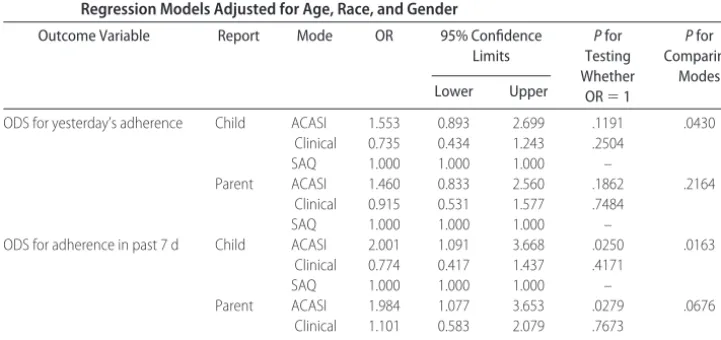
All of the statistical analyses were conducted with SAS 9.1 (SAS Institute Inc, Cary, NC). Percentage of adherence of both the self-report and objective measures was truncated to 100% if it was ⬎100% to prevent artificially elevating mean adherence. The nonparamet-ric Kruskal-Wallis test was used to compare discrepancy scores. A generalized linear regression model (SAS Proc Genmod, SAS Institute Inc) was used to compare ordinal discrepancy scores among reporting modes with and without covariates (age, race, and gender). The ordinal discrepancy scores were assumed to have multinomial distributions with a cumulative logit link. The footnotes in Table 2 provide the categorization of ordinal discrep-ancy scores. For all of the analyses, 2-tailed tests were used, and Pvalues ofⱕ.05 were determined to be sta-tistically significant.
RESULTS
Subjects
Participants included 104 children and 104 parents. The parent group included 94 mothers, 8 fathers, and 2 guardians. Mean child age was 11.75 years (SD: 2.73; range: 8 –18 years old). Boys comprised 53.9% of par-ticipants. Race of participants included 37.5% white, 26.0% black, 21.2% Hispanic, and 15.3% other (includ-ing Native American, Asian, and multiracial). The max-imum attained education level of 75% of the parents included college attendance.
Adherence Discrepancy Scores According to Mode and Respondent
and interquartile ranges (range between the 25th and 75th quartiles; Table 1). For child self-reports, the dis-crepancy scores were significantly different among the 3 interview modes on both the yesterday and last-7-days questions, with greatest discrepancy in the ACASI mode. For parent self-reports, the discrepancy scores were sig-nificantly different among the 3 interview modes on the last-7-days question, where ACASI mode produced the lowest median and the largest discrepancies. Mode dif-ferences were not found for the yesterday question, although the data trend followed a pattern similar to the last-7-days question where ACASI mode had the least number of accurate scores and the most⫺100% scores, suggesting that parents were least accurate in the ACASI mode (Table 1).
Self-report discrepancy frequencies were compared for both the yesterday and past-week questions (Figs 1 and 2). More than half of children and parents over-reported adherence by ⱖ25% and, in the ACASI mode, more than one third reported 100% adherence when no ICS had been used. Underreporting of ad-herence occurred very infrequently. Child
self-re-ported adherence was in the⫾25% accuracy range for 50% and 48.7% of those children in the clinical in-terview condition for the yesterday and last-7-days questions, respectively. In contrast, child reports had 39.2% and 32.8% of responses in the⫾25% accuracy range for the ACASI condition for the yesterday and last-7-days questions, respectively. Results were sim-ilar for parents, where 47.8% and 41.4% were in the
⫾25% accuracy range when interviewed with the 2 kinds of questions in contrast to 29.4% when re-sponding to both questions via computer. Increasing the accuracy range to⫾35% or decreasing it to⫾15% predictably resulted in greater or fewer numbers of accurate reports, respectively. Nonetheless, where group differences emerged, the ACASI group pro-duced the least proportion of accurate responses (data not shown).
Effect of Subject Characteristics on Discrepancy Scores
To determine whether mode differences were influ-enced by age, gender, or race, a generalized linear regression model on the discrepancy scores was used.
TABLE 1 Self-Report Discrepancy Scores Self-Report
Discrepancy Scores
ACASI Clinical
Interview
Self-Administrated Questionnaire
P, Kruskal-Wallis Test
Child
Yesterday ⫺50.0 (100.0) ⫺12.5 (50.0) ⫺29.1 (100.0) .0145 Past 7 d ⫺42.9 (68.9) ⫺14.3 (42.9) ⫺17.3 (57.1) .0002 Parent
Yesterday ⫺50.0 (100.0) ⫺25.0 (100.0) ⫺50.0 (100.0) .1433 Past 7 d ⫺46.4 (53.1) ⫺28.6 (51.8) ⫺30.3 (64.3) .0040
Data are presented as median (interquartile range); interquartile range is the range between the 25th and 75th quartile of the variable.
TABLE 2 Comparison of Ordinal Discrepancy Scores Among Interview Modes Using Generalized Linear Regression Models Adjusted for Age, Race, and Gender
Outcome Variable Report Mode OR 95% Confidence
Limits
Pfor Testing Whether
OR⫽1
Pfor Comparing
Modes
Lower Upper
ODS for yesterday’s adherence Child ACASI 1.553 0.893 2.699 .1191 .0430 Clinical 0.735 0.434 1.243 .2504
SAQ 1.000 1.000 1.000 –
Parent ACASI 1.460 0.833 2.560 .1862 .2164 Clinical 0.915 0.531 1.577 .7484
SAQ 1.000 1.000 1.000 –
ODS for adherence in past 7 d Child ACASI 2.001 1.091 3.668 .0250 .0163 Clinical 0.774 0.417 1.437 .4171
SAQ 1.000 1.000 1.000 –
Parent ACASI 1.984 1.077 3.653 .0279 .0676 Clinical 1.101 0.583 2.079 .7673
SAQ 1.000 1.000 1.000 –
Because the discrepancy scores were not normally distributed and tended to cluster, the scores were con-verted to an ordinal variable. The fact that each sub-ject had ⱕ4 measurements was accounted for in the model. As in the nonparametric comparison of medi-ans, this model revealed self-report discrepancies that
were greatest in the ACASI condition for both ques-tions (yesterday and past 7 days) when the child was queried and a trend (P ⫽ .068) indicating a similar pattern when parents were queried about adherence over the past 7 days. These results were not affected when age, gender, and race were added as covariates
FIGURE 1
Self-report discrepancy frequencies for yesterday questions: ACASI (left), clinical (middle), and questionnaire (right).
FIGURE 2
into the model (Table 2). Device (Doser versus MDILog) was also entered as a covariate but, because it was nonsignificant, was not included in the final model.
DISCUSSION
Both children and parents greatly overreported their ICS adherence. Approximately 1 of 3 responses reported full adherence when no medication had been taken (ACASI mode, yesterday’s adherence). Under the best of condi-tions in this study, accuracy of self-report was insuffi-cient to provide a stand-alone measure of adherence. In the optimal circumstance where children were inter-viewed by study staff about their adherence within the previous 24 hours, reported adherence was within the accurate range for only half of the observations. Of the remaining participants, 46% exaggerated their adher-ence by ⬎25%. The mode of self-reporting influenced parent and child accuracy but not in the direction hy-pothesized. Contrary to our prediction, computerized adherence self-reporting was less accurate than face-to-face interview or questionnaire; both children and par-ents in the ACASI condition produced the largest aver-age overreporting of adherence. The reason for increased discrepancy in the ACASI condition is not evident. The ACASI procedure was more technically demanding than the other conditions and required use of the computer keyboard. The possibility that the cognitive demands of the ACASI condition may have resulted in more errors, however, is inconsistent with the finding that age did not alter the mode effect and that there was little un-derreporting, both of which should have occurred if the ACASI condition was a cause of confusion. It seems that either the ACASI condition did not decrease the embar-rassment of admitting nonadherence or that embarrass-ment is not a primary reason for exaggerating adher-ence. In most of our analyses, face-to-face interviews with parents and children yielded the least discrepancy between self-report and objective adherence measure. This result supports the conclusion that embarrassment was not a determining factor influencing mode differ-ences and stands in contrast to adult studies demonstrat-ing that ACASI reportdemonstrat-ing of risky sexual behavior or illicit drug use increased over face-to-face19 or tele-phone20interviews. The reduced sense of shame, which may have accounted for increased reporting of those stigmatized behaviors, seems not to be a determining factor in the case of medication adherence reporting in parents and children.
Inadequate accounting of adherence may compro-mise clinical trials and the treatment guidelines that they inform. Data from clinical trials provide the evidence base for pediatric treatment guidelines. When informa-tion about dose-response sensitivity does not take into account variability in adherence of trial participants, the possibility of recommending unnecessarily high drug
dose increases.21 Diary-card reporting of medication in clinical trials, long the standard for establishing adher-ence sufficient to support a trial’s validity, has been shown repeatedly to overestimate adherence. For exam-ple, diaries resulted in overreporting of adherence by 67% in a trial of treatment for chronic obstructive pul-monary disease22 and by 60% and 68% in studies of children2and adults23with asthma. Evidence from this study, in combination with previous research, indicates that no self-report methodology has yet been demon-strated to match objective adherence measures, yet self-report measures of adherence continue to be used in pediatric clinical trials more frequently than electronic adherence measures.
Patient or parent misrepresentation of medication ad-herence in the pediatrician’s office may also result in unnecessary escalation of treatment while failing to re-mediate an important factor underlying poor illness con-trol, medication nonadherence. Although this study was not designed to evaluate adherence reporting in pediat-ric offices, it nonetheless suggests that accuracy of self-report in clinical settings is of concern and warrants further investigation, particularly in light of findings that patients frequently provide inaccurate information on medication adherence to their physicians.24–25
Limitations to this study should be considered. The relative accuracy of 24-hour and 7-day adherence que-ries may not be best established through simultaneous questioning. The ⫾25% accuracy range chosen for this analysis may not represent an acceptable margin of ac-curacy for all physicians and researchers. The 5-module patient education program may have increased adher-ence of participants, although it is likely that such effects would have been distributed equally across conditions. Measurement of patient or parent embarrassment, not included in this study, should be incorporated in future investigations of self-report accuracy. The interview methodology used in this study did not include the use of telephone-based adherence inquiry, which may pro-vide a greater degree of anonymity and, therefore, greater encouragement of disclosure than seen in the 3 conditions included here. Pediatricians who invest time and effort communicating effectively with families may obtain more accurate adherence information than seen in this investigation.26 Objective adherence measures, although more accurate than self-report, may still intro-duce measurement error, which must be managed by judicious data inspection and management, including truncation of daily adherence scores.27–29
CONCLUSIONS
pharmacy refills remain superior to patient reports for measuring adherence.
ACKNOWLEDGMENTS
This work was supported by General Clinical Research Centers grant M01-RR00051 and National Heart, Lung, and Blood Institute grant 5R01HL64199.
REFERENCES
1. Bender B, Boulet L, Chaustre I, Rand C, AW. Asthma. In:
Adherence to Long-Term Therapies: Evidence for Action. Geneva, Switzerland: World Health Organization; 2003
2. Bender B, Annett R, Ikle D, DuHamel T, Rand C, Strunk R. Relationship between disease and psychological adaptation in children in the Childhood Asthma Management Program and their families.Arch Pediatr Adolesc Med.2000;154:706 –713 3. Willis G, Brittingham A, Lee L, Tourangeau R, Ching P.
Re-sponse Errors in Surveys of Children’s Immunizations.Hyattsville, MD: US Department of Health and Human Services; 1999. DHHS Pub No. (PHS) 99-1083
4. Friedman W, Lyon T. Development of temporal-reconstructive abilities.Child Dev.2005;76:1202–1216
5. Scagliusi F, Polacow V, Artioli G, Benatti F, Lancha A. Selective underreporting of energy intake in women: magnitude, deter-minants, and effect of training. J Am Diet Assoc. 2003;103: 1306 –1313
6. Adams S, Matthews C, Ebbeling C, et al. The effect of social desirability and social approval on self-reports of physical ac-tivity.Am J Epidemiol.2005;161:389 –398
7. Aquilino W, Wright D, Supple A. Response effects due to bystander presence in CASI and paper-and-pencil surveys of drug use and alcohol use.Subst Use Misuse.2000;35:845– 867 8. Slotnick S, Dodson C. Support for a continuous (single-process)
model of recognition memory and source memory.Mem Cognit.
2005;33:151–170
9. Baxter S, Smith A, Litaker M, Shaffer N, Baglio M, Frye F. Recency affects reporting accuracy of children’s dietary recalls.
Ann Epidemiol.2004;14:385–390
10. Zabinski M, Daly T, Norman G, et al. Psychosocial correlates of fruit, vegetable, and dietary fat intake among adolescent boys and girls.J Am Diet Assoc.2006;106:814 – 821
11. Council NR.Nutrient Adequacy: Assessment Using Food Consump-tion Surveys. Washington, DC: National Academy Press; 1986 12. Johnson S, Freund A, Silverstein J, Hansen C, Malone J.
Ad-herence-health status relationships in childhood diabetes.
Health Psychol.1990;9:606 – 631
13. Waruru AK, Nduati R, Tylleska¨r T Audio computer-assistant self-interviewing (ACASI) may avert socially desirable re-sponses about infant feeding in the context of HIV.BMC Med Inform Decis Mak.2005;5:24
14. Turner C, Forsyth J, O’Reilly P, Cooley T. Automated Self-Interviewing and the Survey Measurement of Sensitive Behaviors. New York, NY: Computer-Assisted Survey Information Collection; 2005
15. Rand C, Nides M, Cowles M, Wise R, Connett J. Long-term metered-dose inhaler adherence in a clinical trial. The Lung Health Study Research Group.Am J Respir Crit Care Med.1995; 152:580 –588
16. Apter A, Reisine S, Affleck G, Barrows E, ZuWallack R. Adher-ence with twice-daily dosing of inhaled steroids.Am J Respir Crit Care Med.1998;157:1810 –1817
17. Rand C, Wise R. Measuring adherence to asthma medication regimens.Am J Respir Crit Care Med.1994;149:S69 –S76; discus-sion S77–S78
18. Diette GB, Wu AW, Skinner EA, et al. Treatment patterns among adult patients with asthma.Arch Intern Med.1999;159: 2697–2704
19. Perlis T, Des Jarlais D, Friedman S, Arasteh K, Turner C. Audio-computerized self-interviewing versus face-to-face in-terviewing for research data collection at drug abuse treatment programs.Addiction.2004;99:885– 896
20. Turner C, Villarroel M, Rogers S, et al. Reducing bias in tele-phone survey estimates of the prevalence of drug addiction.
Addiction.2005;100:1432–1444
21. Vrijens B, Gross R, Urquhart J. The odds that clinically unrec-ognized poor or partial adherence confuses population pharmacokinetic/pharmacodynamic analyses.Basic Clin Phar-macol Toxicol.2005;96:225–227
22. Tashkin D, Rand C, Nicles M. A nebulizer chronolog to monitor compliance with inhaler use.Am J Med.1991;91:335–365 23. Krishnan J, Riekert K, McCoy J, et al. Corticosteriod use after
hospital discharge among high-risk adults with asthma.Am J Respir and Crit Care Med.2004;170:128 –1285
24. DiMatteo M, Robinson J, Heritage J, Tabbarah M, Fox S. Cor-respondence among patients’ self-reports, chart words, and audio-videotapes of medical visits.Health Commun. 2003;15: 393– 413
25. Norell S. Accuracy of patient interview and estimates of clinical staff in determining medication compliance.Soc Sci Med.1981; 15:57– 61
26. Winnick S, Lucas D, Hartman A, Toll D. How do you improve compliance? Pediatrics. 2005;115(6). Available at: www.pediatrics.org/cgi/content/full/115/6/e718
27. O’Conner S, Bender B, Gavin-Devitt L, et al. Measuring ad-herence with the doser CT in children with asthma.J Asthma.
2004;41:663– 670
28. Wamboldt F, Bender B, O’Connor S, et al. Reliability of the model MC-311 MDE chronolog.J Allergy Clin Immunol.1999; 104:53–57
DOI: 10.1542/peds.2006-3457 originally published online August 13, 2007;
2007;120;e471
Pediatrics
Wamboldt and Lening Zhang
Bruce G. Bender, Susan J. Bartlett, Cynthia S. Rand, Charles Turner, Frederick S.
With Asthma-Controller Medication
Impact of Interview Mode on Accuracy of Child and Parent Report of Adherence
Services
Updated Information &
http://pediatrics.aappublications.org/content/120/3/e471 including high resolution figures, can be found at:
References
http://pediatrics.aappublications.org/content/120/3/e471#BIBL This article cites 24 articles, 0 of which you can access for free at:
Subspecialty Collections
http://www.aappublications.org/cgi/collection/asthma_sub Asthma
ub
http://www.aappublications.org/cgi/collection/allergy:immunology_s Allergy/Immunology
following collection(s):
This article, along with others on similar topics, appears in the
Permissions & Licensing
http://www.aappublications.org/site/misc/Permissions.xhtml in its entirety can be found online at:
Information about reproducing this article in parts (figures, tables) or
Reprints
DOI: 10.1542/peds.2006-3457 originally published online August 13, 2007;
2007;120;e471
Pediatrics
Wamboldt and Lening Zhang
Bruce G. Bender, Susan J. Bartlett, Cynthia S. Rand, Charles Turner, Frederick S.
With Asthma-Controller Medication
Impact of Interview Mode on Accuracy of Child and Parent Report of Adherence
http://pediatrics.aappublications.org/content/120/3/e471
located on the World Wide Web at:
The online version of this article, along with updated information and services, is
by the American Academy of Pediatrics. All rights reserved. Print ISSN: 1073-0397.